Super Mario Odyssey (2017)

It was a big claim when Nintendo placed Super Mario Odyssey on the same plane as Super Mario 64 and Super Mario Sunshine. Super Mario 64 arguably being the most influential game of all time, and Super Mario Sunshine is no pushover either. Sure, the Super Mario Galaxy games are phenomenal, but we haven’t had a Mario game in the style of Super Mario 64 or Super Mario Sunshine in 16 years, so a ton of hype was built around the release of Odyssey. Upon release, Odyssey has received a massive amount of praise, but surprisingly a fair amount of criticism as well. So, did Super Mario Odyssey live up to its hype for me? Yes. Easily.

1

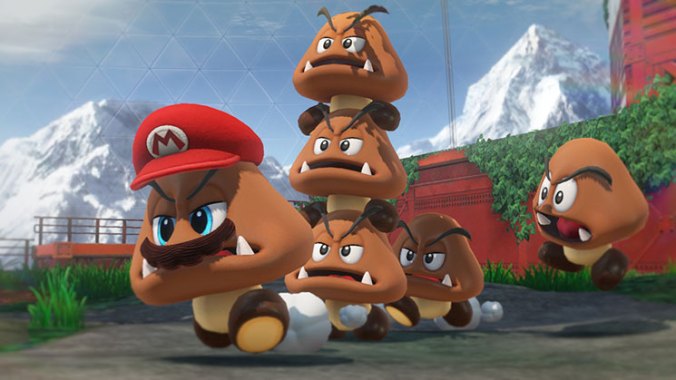
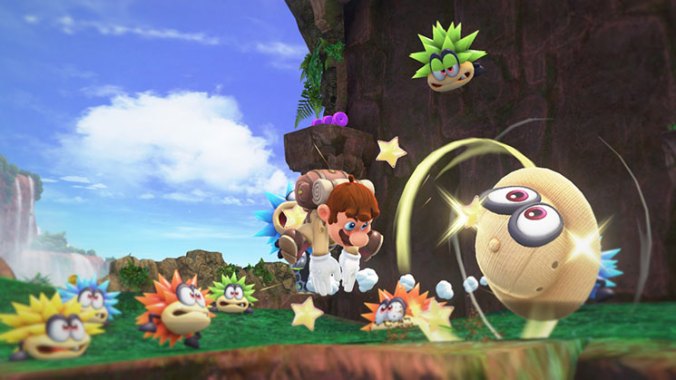
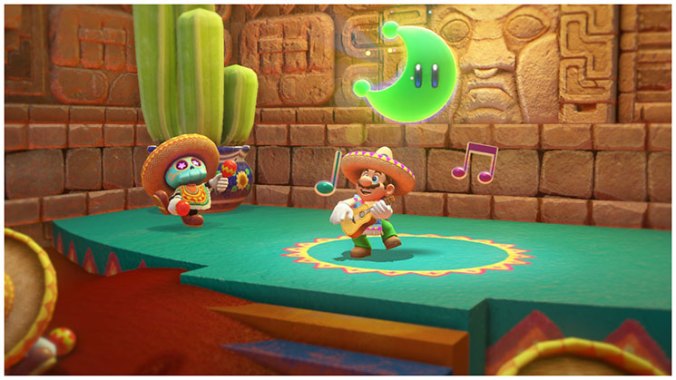
The Super Mario series is probably my favorite series of all time, especially the 3D entries. Naturally, Super Mario Odyssey was my most anticipated game of the year for me, even more so than Legend of Zelda: Breath of the Wild. Thankfully, I was not disappointed by Super Mario Odyssey. The Super Mario series is defined by the tightness of the controls and just how satisfying it is to move around as Mario. Super Mario Odyssey sports the greatest controls of any of the 3D entries. In addition to the classic moveset of jump, backflip, walljump, triple jump, and dive Mario has a few more tricks up his sleeve due to the addition of Cappy. Cappy, a sentient hat, is Mario’s new friend and provides a large variety of new moves to traverse the world. On top of the variety of new tricks that Cappy allows, the big addition is that Cappy can possess enemies. This lets the player use the movesets of enemies to progress through levels. It is enormously fun to chain these possessed enemies together with Mario’s standard moveset to allow for some crazy combinations to achieve a ton of distance. It is an absolute joy to just jump around the levels as Mario is known for.

2

Super Mario Odyssey is centered around the open-world exploration of 17 different kingdoms. Each of these kingdoms starts off with a scripted sequence that throws back to Super Mario 64 and Super Mario Sunshine. The camera zooms in on your objective, and off you go. After you complete these scripted story missions, the entire kingdom opens up for you to discover. First and foremost, Super Mario Odyssey is a collectathon. There are almost 900 objectives, known as moons, spread across the 17 kingdoms. The biggest task in collecting them is just finding them, so if you are looking for a pure platforming experience you are not going to find it here. This is just a pure treasure hunt, finding something new every few minutes, supplemented by just how fun it is to control Mario.

3

While many have praised Super Mario Odyssey, there has been a lot of negativity surrounding it as well. There are two key criticisms: it is too easy, and it is repetitive. I can understand where these criticisms come from, but I do not think they are valid considering what this game sets out to achieve. First of all, this is a Mario game, it is meant to be accessible for casual players, children, anybody can play Mario. So, it being “too easy” feels like a misdirected jab. Would I have liked challenging levels that fully use the expansive moveset that is offered? Yes. But again, this is not meant to be a challenging game. Most of the challenge is hunting down the numerous moons that a crammed into every nook and cranny of the levels. The second criticism is that while there is a ton of moons to collect, most of them are repetitive tasks or are deemed as “garbage” moons where no effort is required. This holds some weight, as many of the moon tasks are reused frequently, but I would argue that you are not meant to collect every moon. You only need 120 to beat the game, and since you open up the final kingdom at 500 moons, it seems that there are 400 extra moons tagged on. Some would argue that these are tacked on content meant to pad the game’s length, but I think otherwise. All these extra moons make it so that every player can achieve the 500-moon benchmark without straining themselves searching for every last moon. All those extra moons are just there as a buffer so everyone can find moons at an extraordinary rate, and as some extra content if you really enjoyed the game and want to hunt down some extra moons.

4

Super Mario Odyssey may not be the most innovative game of the year, but is some of the most pure, unadulterated fun that I’ve had in a while. Sure, it’s not the hardest game, and it is a collectathon at heart. But somehow, Super Mario Odyssey elicits a feeling of childhood joy that is rarely found in modern day games. It’s a colorful potpourri of platforming, and just pure fun. For these reasons I give Super Mario Odyssey 10/10. I may just be nostalgic, but I genuinely believe Super Mario Odyssey can make anyone feel like a kid again.

Spec Ops: The Line (2011)

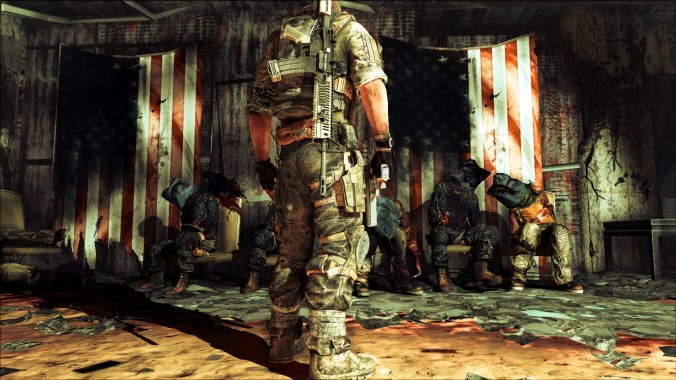
Can mediocre gameplay be forgiven if the narrative, story, and setting are all superb? This is a question that I’ve thought about a lot in the past, and it definitely applies to Spec Ops: The Line. While it is incontestable that the plot in Spec Ops: The Line is top-notch and may have sparked an enlightenment era for narrative driven games, I felt that the game was severely bogged down by the gameplay. This is unfortunate, as I do love it when a developer can effectively use video games as a medium to effectively tell a story. Spec Ops: The Line nails its setting, plot, and effectively uses narrative elements to make for some unforgettable moments, but even though I loved those features it is impossible to ignore the sluggish gameplay.

2

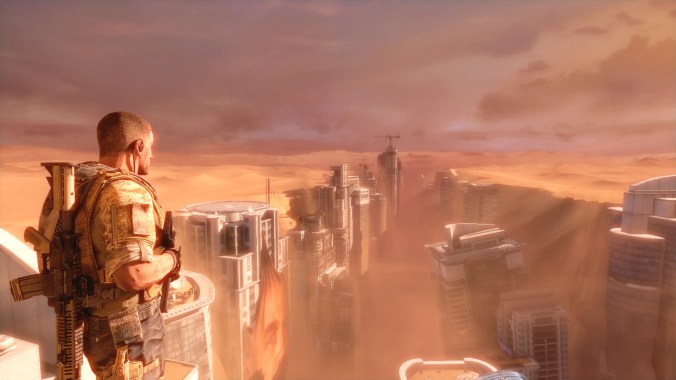
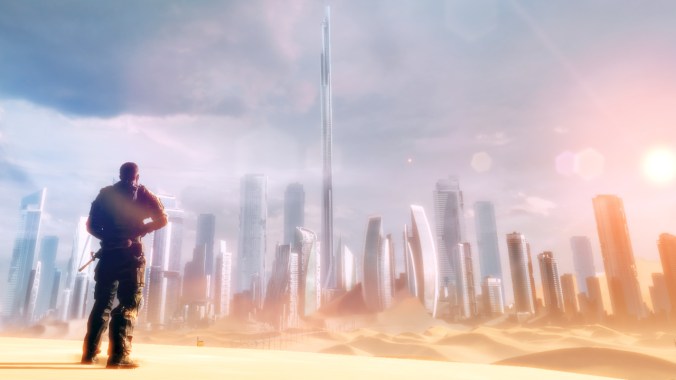
The setting and atmosphere established by Spec Ops: The Line is incredible. The player and his squad must descend into the depths of the buried city of Dubai. Constant sandstorms have covered the once prosperous city in a mountain of sand, leaving only small portions of the city exposed to sunlight, the rest is embedded in a sandy tomb. The player starts at what is essentially the top of the city, and slowly descends deeper into the depths of the derelict Dubai. As you make your way down through skyscrapers and across rooftop, it atmosphere changes drastically. The once sunny city dims as you dive deeper, bodies of the dead pile up, and chaos erupts at all corners. This effect of verticality is incredibly similar to the feelings invoked by games such as Dark Souls and Hollow Knight. You descend further and further down, the game gets darker and more foreboding. You reach a point in which you feel like you cannot possibly dig any deeper, but you just keep going. The use of verticality, ascending and descending, is a tactic that can be incredibly effective at invoking emotions into a player. Going up always feels rewarding, like you are climbing a ladder to victory. But going down, that is a prospect that is meant to instill terror into the player. The atmosphere achieved by Spec Ops: The Linethrough its use of vertical levels is meant to instill stress, panic, and unease in the player as you cascade further and further into hell. The setting of Spec Ops: The Line is phenomenal, and it truly makes for an unforgettable journey.

3

While the atmosphere established in Spec Ops: The Line is incredible, the game is mostly known for its story. The main character sets out with his 2 squad mates to investigate a distress signal sent from Dubai. The game’s story matches its setting sense of verticality, the main character is at his highest point when they game starts, at the top of Dubai. As you descend, the protagonist witnesses atrocities and horrible scenes of death and destruction. The main character’s mental state deteriorates and the entire squad begins to squabble with each other as time progresses. Spec Ops: The Line borders on being a psychological thriller as you unravel the happenings in Dubai, and you trust the main characters perspective less and less as time progresses. All of this time you are lead to a spectacular and mind-warping ending that just made me ask “What just happened?” What is really interesting to me is how effectively the developers used video games as a medium to tell a story. Many games tell a good story, but they leave you with the feeling that the story would have been better told in a movie. In Spec Ops: The Line however, it places you in the role of the protagonist, you are not just a bystander to the events that unfold. I felt sick to my stomach in many of the gruesome climactic scenes. There are a few different ways of effectively using video games as a story telling medium, and Spec Ops: The Line utilizes the personal nature of video games to tell an unforgettable story.

4

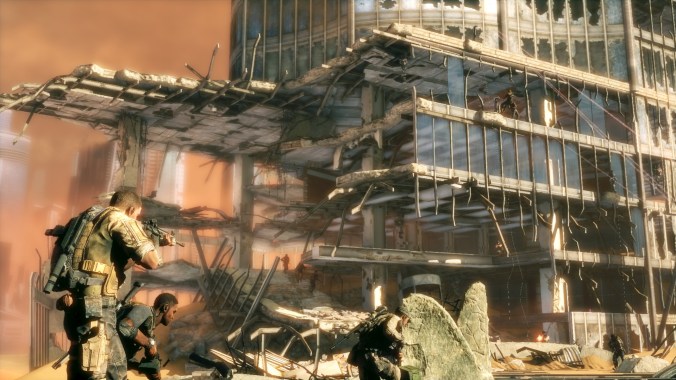
Unfortunately for Spec Ops: The Line, a key component for any game is its gameplay. Story, setting, and atmosphere all are incredibly important, but at the end of the day you still have to actually play the game to experience those attributes. It is a shame that the gameplay of Spec Ops: The Line is so disappointing, because otherwise I would consider it to be a must-play title. It brands itself as a tactical third-person-shooter, as you must tactically command your squad as you shoot your way through Dubai. This starts off okay as your squad mates are relatively useful early on, but as the game progresses a critical flaw is unearthed. As you progress, enemies get stronger, get better weapons, and number of enemies increase, but your squad mates are the same strength that they were at the very start of the game. So as the game gets harder, your teammates become increasingly useless, and by the end of the game they mainly serve as a distraction for enemies to shoot at. On top of that, the controls are just plain clunky. I’ve never been a huge fan of cover-based shooters. It always feels awkward to press a button and get “stuck” to cover, then press another button to “detach” from that piece of cover. It just feels sticky and restrictive; getting behind cover, peeking and shooting, and then detaching from the cover feels unnatural. I much prefer the fluid and open movement of games like Wolfenstein, DOOM, Call of Duty, or Battlefield. I started to get seriously frustrated once enemies began regularly tossing grenades at me because I would get stuck on the cover and couldn’t detach and get to safety quick enough. I can only describe the controls of Spec Ops: The Line as sticky, and it takes too much effort to get the character do to what you want.

1

The issues with the gameplay don’t end with the useless teammates and clunky cover-based mechanics. Spec Ops: The Line falls into the same traps that many other modern shooters, in which they blend into each other and feel stale. So many shooters fall into a pattern where the player gets behind cover, kills some enemies from relative safety, and then moves to the next piece of cover, and you repeat ad infinitum. There is a not a whole lot of excitement in this format, and I often feel like I’m playing whack-a-mole as enemies pop up from their cover and I pick them off one by one. Towards the end of the game bullet-sponges make their appearance and you have to pump loads of bullets into these enemies before they go down. This is doubly frustrating because not only is it boring to deal with enemies, but bullets are relatively scarce in this game, so unloading all of your resources to kill one enemy is a pain. Moreover, Spec Ops: The Line suffers from an overabundance over enemies in the latter parts of the game. Maybe the developers intended for your squad mates to dispose of a significant portion of these enemies, but as I mentioned before, your squad mates are functionally useless late in the game. What ends up happening is that you just have to sit behind cover and slowly pick off what feels like hundreds of enemies per encounter; it’s tedious, draining, and grows tiresome quite rapidly.

5

As an entire package, I think Spec Ops: The Line is decent. The story and environment is phenomenal, but this is a video game and the importance of gameplay cannot be understated. While the story had me hooked, actually playing the game was a frustrating slog towards the end. I’m not sure if I can recommend Spec Ops: The Line even though I thoroughly enjoyed its atmosphere and plot. All I can say is if you believe that “gameplay is king”, stay away from Spec Ops: The Line, otherwise definitely give it a shot.

Dark Souls (2011)

In a time in which numerous video games hold the players hand and are generally easy, one game challenged the idea that difficult games were too frustrating and that mainstream games should stray away from challenging the player. That game was Dark Souls. This action-RPG was an industry-changing title, other developers realized that there was a market for games that did not coddle the player. The difficulty is far from the only factor that makes Dark Souls what it is, although its reputation of being hard is what everyone knows about Dark Souls, even if they have never played it. Dark Souls is also a bastion of success in level design, atmosphere, and world building, and I have yet to come across a game as impressive as Dark Souls in those departments. I consider Dark Souls to be one of the greatest and most important games of all time, rivaling titles like The Legend of Zelda: Ocarina of Time, Metal Gear Solid, and Super Mario 64. It has had a profound effect on the industry and will shape video games for years to come. That being said, I consider Dark Souls to be a flawed masterpiece. It is no secret that the second half of the game was rushed to reach a deadline. It also dangerously teeters on the line of “difficult but fair” and “frustrating”. While I consider the game to be “difficult but fair” a majority of the time, there are still a few moments that cross the line and enter “frustrating” territory. Despite these shortcomings, Dark Souls has quickly become one of my favorite games and its importance cannot be denied.

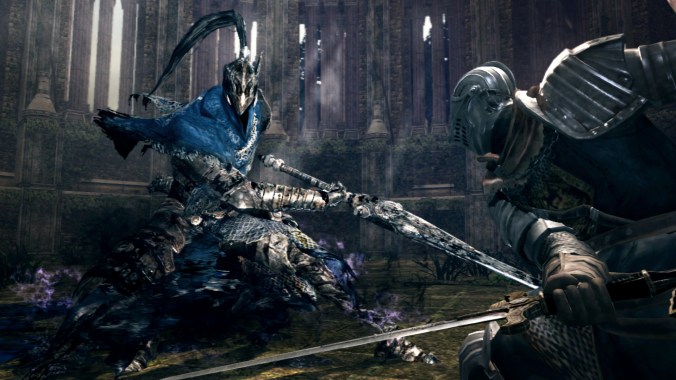
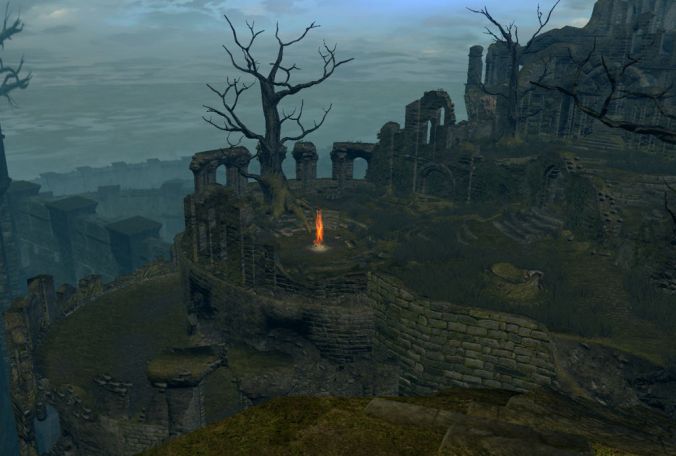
What makes the difficulty of Dark Souls so compelling? Part of its success is that Dark Souls is tough, but it rarely ever feels cheap or gives you an unwarranted death. Every time you die, it’s your fault. Every time I died, I learned something valuable and I could avoid dying the same way in the future. It is evident that nothing is too difficult to execute because on my second play-through I died extremely infrequently due to my prior knowledge on how to defeat all the enemies. There is a certain beauty to the challenge of Dark Souls.  Many challenges seem insurmountable at first, but you keep trying and trying until eventually you figure it out. When you do finally overcome a tough area or boss, there is an overwhelming feeling of elation and pride at what you have just accomplished. There is something to be said in that Dark Souls mimics life in this regard. Dark Souls is not difficult for the sake of being difficult, rather it uses difficulty as a tool to make the player feel different emotions. The sense of accomplishment when you defeat a boss, the anxiety of not knowing what is on the other side of a fog door, the fear and tension of fighting a tough enemy, or the immense relief when you discover a new bonfire; these emotions are possible only because of the challenge provided by Dark Souls. Furthermore, I really appreciate when games are actually challenging, it is far more engaging and addicting.  That feeling of wanting to conquer a genuine challenge makes me want to keep playing, and when I did finally defeat whatever was in my way I really felt like I had made significant progress.
1

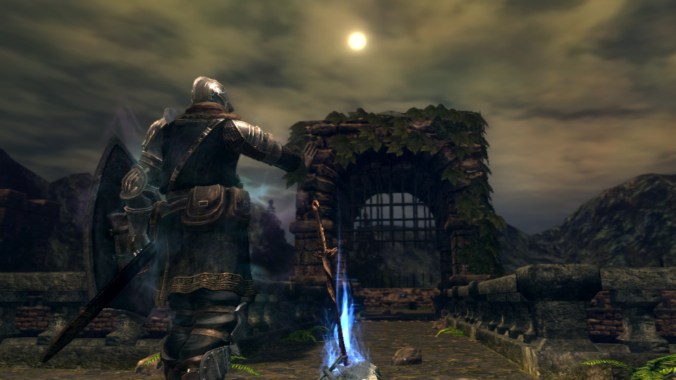
While the difficulty is probably the most well-known feature of Dark Souls, there are many other categories which make Dark Souls master class. The most impressive feature to me was the brilliant level design. Each area in Dark Souls often loops in on itself and reveals a shortcut from the nearest checkpoint. This is genius for a couple of reasons. First, it lets areas evolve in a sense, and as you progress through the game an area is going to have more paths and shortcuts available to access. Since many paths are closed to the player initially, it allows the player to become familiarized with the level’s layout before further complicating it. This sort of circular level design also surprises the player, and makes you stop and think how you ended up back where you started. From a player progression standpoint, the looping level design is massively important. As you return to areas you have been previously, you can test how strong you have become. As gear, level, and player skill increase you feel much more powerful visiting areas that you were in just a short time ago. Lastly, this type of design also reduces tedium by a massive amount. The player will only have to get through a particular chunk once and can skip that chunk once a shortcut has been opened. So, there is very little tedium when running from a checkpoint to where you died.
2

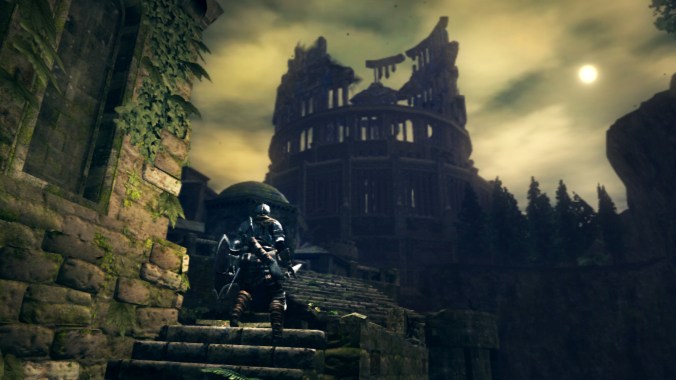
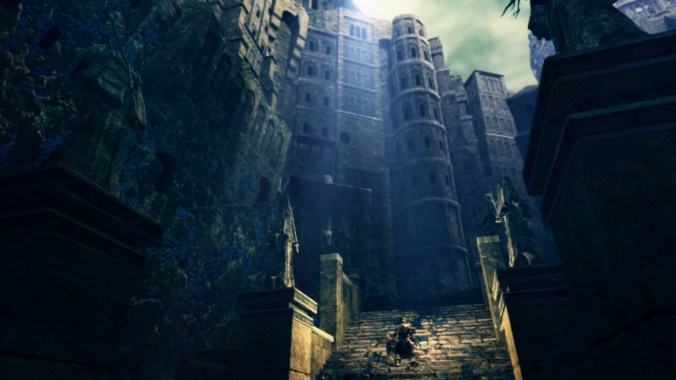
The atmosphere, setting, and world of Dark Souls is also hauntingly beautiful. Every area is completely unique and memorable. Often, I just stopped adventuring and had to take in my surroundings. The world of Dark Souls mirrors the level design in the sense that it utilizes vertical layers to have areas loop in on themselves to create a compact and believable world. There are many instances of Déjà vu as you open a door or descend an elevator as you realize that you have been here before. Atmospherically, Dark Souls is in a tier of its own. The world is littered with viewing points from high places where you can gaze upon the areas that you have just conquered, or even look ahead to see your next trial. I often felt insignificant when gazing upon the wondrous land or Lordran, and fighting enemies that were magnitudes larger than me reinforced that feeling. Despite this, as I traversed the world and surmounted these creatures, I felt powerful. The world of Dark Souls is vast but compact, it is interconnected, and it is breathtaking.
3

Another aspect of world-building is the lore and the story. While the story of Dark Souls is fairly simple, it becomes incredible as you learn the backstory to the world. I don’t want to delve too deep into the lore, as I feel like people should attempt to discover it on their own. There is a real feeling of living in a dying world, and you are putting this worlds creators and gods to rest in order to preserve life for a little while longer. Fighting many of the bosses of Dark Souls becomes far more emotional once you learn their backstory, and often times it is profoundly sad as you put these old gods to rest. Speaking to all of the characters in the game gives you a sense that they are on their own journeys through this world, and don’t solely exist for the benefit of the player. The other interesting thing about the lore is that it is never explicitly laid out for the player. You must discover it for yourself through contextual clues, item descriptions, and character dialogue. This gave me the feeling of piecing together a puzzle, and even if some of the pieces were missing, I could still make out the overall picture. I really felt like an adventurer in a fantasy setting, discovering the world for myself.
4

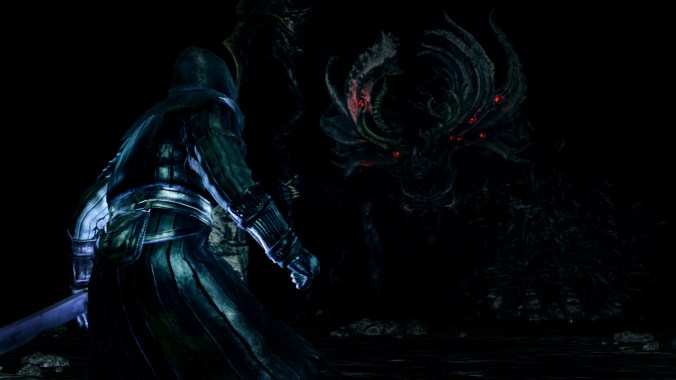
One of the most important features of an action-RPG is obviously the combat. At first glance, the combat of Dark Souls seems pretty rudimentary and slow, but looking deeper into the game one can see that this is not the case. Every action that the player takes has a significant wind-up at the beginning and some down-time at the end, this is to encourage the player to only make an action when it is safe to do so, otherwise you will get hit. Enemies hit hard in Dark Souls, even the weaker enemies in most areas can kill the player in a few hits, so you better be sure that you have a big enough window to attack, or you will pay heavily for it. The combat is actually surprisingly deep in a sense, as the player learns the ins and outs of all the combat systems. Learning how to use stamina, poise, staggering, shields, rolling, light attacks, heavy attacks, shield breaks, back stabs, parries, and efficient use of the estus flask are all essential as you get further into the game. The combat is heavily focused around risk and reward, for example: you can shield an incoming attack to guarantee your safety, but you’ll lose stamina, or you can parry the attack and riposte for massive damage, but if you mess it up you will get hit hard. That is just one example, and the player is encouraged to test out all of the combat options available to them. The other interesting thing is that all the enemies abide by the same rules that the player follows. Enemies also have stamina, poise, wind-up animations, and down-time after their attacks, and they also die from a few swings of your weapons. You can always expect the enemies to behave in a similar way to the player, which is immensely important. If enemies did not have to follow these rules, they would feel cheap and unfair. There is a feeling of weight and permanence in the combat of Dark Souls, every decision must be carefully calculated because the stakes of getting hit are so high.
6

Do you remember being a kid and huddling around the playground with you friends and telling each other about all the cool secrets you found in a game? Most of what was said in these discussions ended up being wrong, but it was still neat to imagine all of the hidden features in a game. Dark Souls does a great job of recreating this feeling. Players can leave messages for each other, telling of illusory walls or how a great item is waiting for you if you jump off this cliff! This harkens back to the playground discussions, as these messages are mostly jokes. But occasionally you will find a tip about a hidden item, or a how a trap is waiting for you up ahead. These messages can also be likened to adventurers swapping tips and stories around a bonfire. There are also bloodstains scattered across the world and you can view exactly how other players died in that spot, which can be pretty humorous. Not only can you communicate with other players, but you can also summon players to play alongside you and engage in jolly cooperation. Be careful though, some of the crueler players can invade your world and fight you one on one. I don’t consider the multiplayer aspect of Dark Souls to be one of the main features of the game, but I definitely did get a few chuckles out of the goofy messages and bloodstains.

It is clear that I adore Dark Souls, so why did I call it a “flawed masterpiece”, what is wrong with the game? One of the issues is that there are definitely some moments that are more frustrating than they are difficult. Luckily, these moments are not too common, but they still sour the experience a little. This was a risk the developers took when creating a challenging game, every encounter must be extensively tested to make sure that it is tough, but not so hard that it makes you want to smash your controller. While it is a shame that some of these types of moments made it into the full game, I think it is remarkable that these frustrating moments are so few and far between and it shows how much care what put into this game. Also, the game can often be a little too cryptic for its own good. While the DLC areas and bosses are some of the best in the game, accessing the DLC is so confusing that I doubt most people figured it out without looking it up. Unfortunately, these are not the sole issues of Dark Souls, the most important issue is that the game is just not finished. In order to meet a deadline, the final areas in the game were rushed and are nowhere near the quality previously demonstrated. The level design falls apart as it no longer loops in on itself, and the same can be said for the world design. There are a few separate paths that lead to dead ends, there are no grand revelations of “I know exactly where I am”. Furthermore, many of the enemies, bosses, and the areas themselves are clearly rushed. I think the other big issues with the final 4 areas in the game is that the developers attempted to let the player tackle them in any order they wanted.
5

While some fans claim that one of the biggest strengths of Dark Souls it its open format, I have to disagree. Sure, you can go to a variety of different areas at the start of the game, but you are clearly pushed into one path. To me, that is the beauty of the pseudo-open world of Dark Souls. The developers trust that the player is intelligent enough to avoid tougher areas early on and instead come back when they are better prepared. At the end of the game, there are 4 paths all laid out for the player to go in any order they want. The issue with this is that as the player progresses through these paths, they will become more powerful, so it is immensely difficult to balance these 4 paths. They all must be about roughly equal in difficulty so that the player can choose to go to whichever one they want first. What ends up happening is that the first area you go to is going to be the hardest, and then each area you visit gets progressively easier as you level up and get better equipment. I think the developers realized this issue, and since difficulty is such an important factor in the game they attempted to combat the problem that subsequent areas get easier and easier. In order to fix this, the developers made each area difficult by adding a gimmick. These gimmicks remain relevant regardless of the players level. The pitch blackness of the Tomb of the Giants, the lava of Lost Izalith, the invisible platforms of the Crystal Caves, and the ghost enemies in New Londo are all gimmicks. They are cheap tricks meant to make the game more difficult and I feel like they damage what could otherwise be decent areas. These gimmicks could actually be pretty interesting twists to these levels if they were implemented better, but as they stand now they are just annoying to deal with. Despite this, I still think that most of these areas are decent, they just don’t adhere to the brilliance that was the first half of Dark Souls.

Even though it is undeniable that Dark Souls is flawed, it is still an immensely important game. It has redefined level design, world building, and atmosphere in games. I have struggled for a while to write this piece. It is not easy for me to put into words my opinion about Dark Souls, and as such I believe that it is a game that everyone needs to at least try. Do not be intimidated by others boasting about how hard the game is, as I think it is entirely accessible to anybody decently experienced at video games. Dark Souls is a truly wonderous and unforgettable experience, and while it may not be everyone’s cup of tea, I highly recommend that everyone should at least give it a chance.
Civilization VI (2016)

It is no surprise that a Civilization game is underwhelming at launch. Civilization IV and Civilization V for example were extremely bare-bones at the time of their release, but they were significantly expanded on with patches, downloadable content (DLC), and expansion packs. In Civilization VI, all of those bonus features that were added onto its predecessors were present at launch. Unfortunately, most of these features are so fundamentally broken that I would much rather them be absent from the game. I figured I would give the developers some time to fix the major issues or at least acknowledge that these issues exist. It has been nearly a year now, and Firaxis has not done anything besides patching some glitches and adding new, paid DLC civilizations to play as. At this point, I am worried that the developers have no idea what is wrong with their game, let alone how to fix it. For me, there are 3 clear game-breaking issues that must be addressed. These 3 issues are the artificial intelligence (AI), user interface (UI), and the various tedium that plague Civilization VI.

Full disclosure, I feel like I have to mention that I am veteran of the Civilization series. I started with Civilization III when I was young, played a good amount of Civilization IV, and I have near 1000 hours of Civilization V and play on the highest difficulty setting. Many of my criticisms of Civilization VI may not be apparent to newer players, but I assure you if you play enough Civilization VI you will understand what I am talking about. That being said, I realize that I may be harsh on this game because of my experience, so a more casual player may not care about a lot of what I am going to mention.

1

By far the most apparent issue with Civilization VI is its artificial intelligence (AI). The Civilization series is definitely not known for its brilliant AI, but there has always been a basic level of competency that could make the AI competitive. Not only is that competency is absent from Civilization VI, but the AI is completely unpredictable and illogical. It is clear that the developers knew that the AI was awful, as they gave the AI massive bonuses on the highest difficulties that are unprecedented in the series. For example, only on the highest difficulty of previous Civilization games the AI receives a bonus settler. But in Civilization VI, the AI starts receiving that bonus settler on the third highest difficulty, and now it receives 2 settlers on the highest difficulty. The AI is also extremely aggressive in Civilization VI, as the only way they can hope to defeat the player is by sabotaging the player so much that they cannot catch up to the AI’s massive early game advantages. I say sabotage because the AI is also completely incapable of actually wiping out the player or at effectively sieging your cities.

2

One of my favorite things about playing Civilization V was studying the AI’s behavior and learning how each leader acted. I could then use this knowledge in future matches to predict what a certain leader was going to do and guess how the game was going to play out. This was essentially eliminated from Civilization VI because the AI is so unpredictable and varies heavily from game to game. The only consistent thing about the AI’s behavior is that their default state seems to be hatred. They hate the player and they hate each other, often leading to lackluster diplomacy as no matter what you do everybody is just going to denounce each other.

Another factor of the Civilization series that I also really enjoyed was the sort of role-playing aspect and watching as empires expanded and clashed over territory. Every time I generated a new game I felt as if I was witnessing an alternative history, and it is a factor that I considered insanely addictive.  Unfortunately, since the AI are so wholly incompetent this role-playing aspect is also destroyed. By the modern era half the world is unsettled because the AI unwilling to expand past a few cities. There are tiny, disjointed empires instead of sprawling empires where the civilizations border each other and make for a believable world. Also, since the AI is so horrible at waging offensive wars, they will almost never conquer their neighbors or take a capital city. In Civilization V, you could expect at least 1 or 2 of the AI to be wiped out by their neighbors, making for an evolving and interesting game world. But in Civilization VI, the AI are incapable of conquering each other, they may take a single city or destroy a city-state, but they almost never take capitals. This makes for a rather boring and uninteresting world to observe. The AI in Civilization VI is what I would consider a game-breaking issue, and I doubt that I will return to this game unless the AI is amended.

3

Other than the AI, there are a few other major flaws that Civilization VI has that also hamper the game’s entertainment value. The next thing I want to touch on is its confusing and overcomplicated user interface (UI). In a strategy game like Civilization VI all of the vital information should be readily available to the player and there should be no clutter of superfluous information. In Civilization VI it is the other way around. The game has no problem clogging up your screen with random stuff like “England has built a granary in London!” Who cares? But you have to dig deep in order to understand key game mechanics like amenities. On top of that, most of the menus and just general layout of information is rather clunky and cumbersome to navigate. Also, the mini-map is a complete disaster. It now shows water tiles as owned land by other civilizations, the colors of the fog of war and undiscovered territory are the same, and it just feels very boxy and unpolished. They have done a little bit to improve the UI since launch, but it is still abysmal. If you want an example of a good UI in a strategy game, Fire Emblem: Fates is phenomenal in that department. There is a ton of information on the screen, it is laid out in a sensible manner, and if you want any more information on anything, you just tap on it.

I’ve heard people say that Civilization VI is a good base for a game to build upon in future expansion packs, even if it needs significant work before it can compare to its predecessors. I don’t fully agree with that sentiment, as the AI and UI are possible to fix and would significantly improve the game, but many of the core game mechanics are fundamentally broken and need a massive overhaul. This is why I am not optimistic for Civilization VI, sure the developers could fix the AI and UI, but I doubt they will scrap so many of these new features that they added into the game. Many of these new features are meant to give the game strategic depth and add more choices into the game, but they end up just becoming tedious, frustrating, and tiresome. These mechanics are: Religion, agendas, housing, the civic tree, eurekas and inspirations, governments, the new movement system, city management, diplomacy, builders, espionage, barbarians, and spies. I am not going to delve deep into why I think these mechanics are busted, as I want to keep this review at least a somewhat reasonable length. I may later do a full analysis of Civilization VI where I go deeper into these mechanics, what is wrong with them, and how to fix them. All of these issues highlight the biggest flaw of the Civilization series as a whole, which is that the game becomes boring and tedious once you have essentially won.

4

There comes a point in every Civilization match when you realize that you are so far ahead that there is no feasible way for the opponents to make a comeback and defeat you. Some people quit when they reach this point, but many like to play the game out to its conclusion. You kind of turn on auto-pilot and hit the “next turn” button until you reach victory. Civilization VI exasperates this issue because you can no longer turn on auto-pilot, you still have to micromanage all of these features that I highlighted earlier. All of these features are unnecessarily tedious, and it feels like the developers just added more decisions and micromanagement just for the sake of having more decisions. All this does is reduce the weight from any decisions, and makes playing the game a chore because I now have to make a dozen meaningless decisions every turn. The importance of these decisions is drastically reduced because of the sheer number of them. Why should I care what government policy I choose when I can change it in 3 turns anyway? The lack of meaningful decisions and plethora of worthless decisions makes for a game that feels like a chore.

5

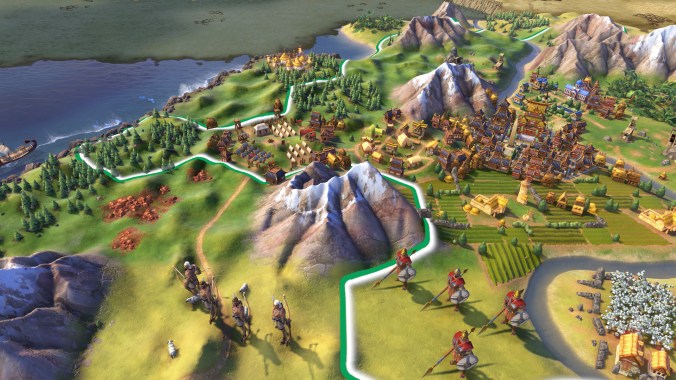
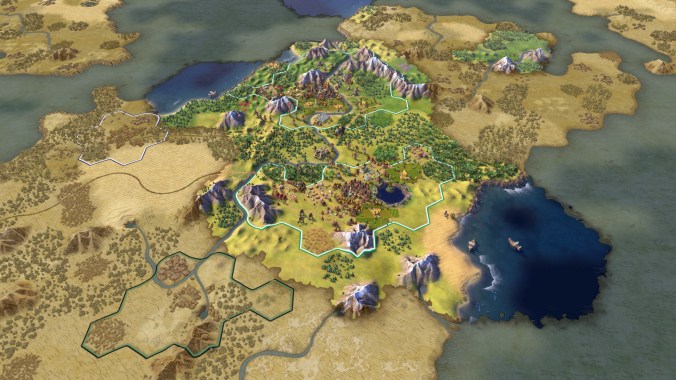
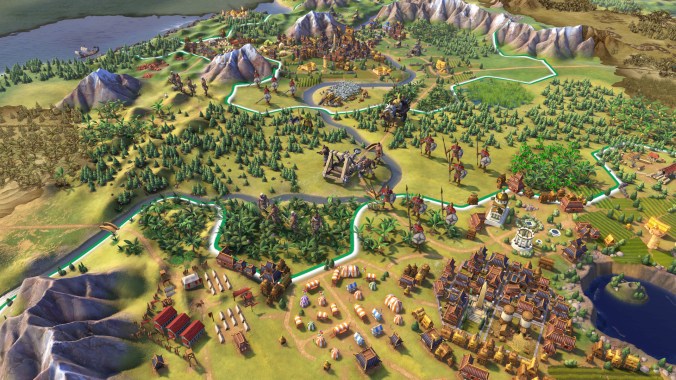
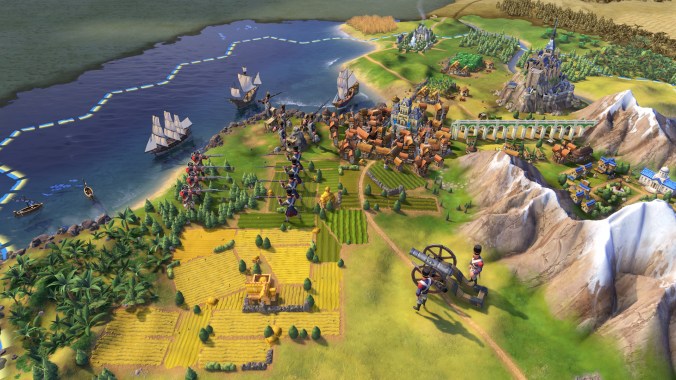
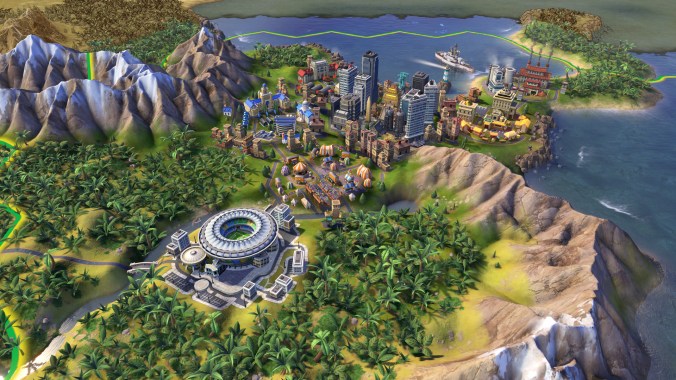
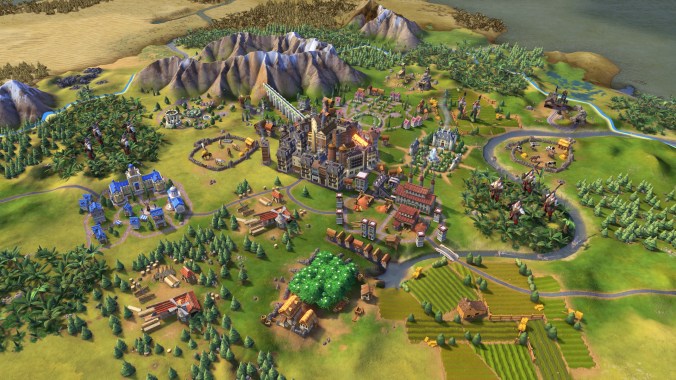
There are a few worthwhile things in Civilization VI. The most obvious is the district system. Instead of everything in a city being built in that 1-tile area, now you have to establish districts on other tiles. For example: you need a campus district to build libraries, universities, and other science related buildings. From a world-building perspective it makes for a much more believable empire than in past iterations. It also has some interesting strategic properties as districts receive bonuses depending on where you place them, so you can plan out cities and what their districts will be for maximum efficiency. Another positive factor of Civilization VI is just the visuals. I think the art-style borders on being a little too cartoony at times, but sometimes you have to just sit back and admire the landscapes populated by your cities, districts, and wonders.

6

It’s a shame really. It seems like Firaxis genuinely attempted to make this a complete game upon launch. But in their attempts to fill up the game with content, they neglected to check if all of that content was actually any good. As it stands you are much better off buying Civilization V and all its expansions and DLC, which as an entire package often goes on sale for less than $15. It is just a way more polished and complete game, and for a quarter of the price of Civilization VI. I am not sure if Civilization VI will ever be a good game, but the future looks grim for this title. For these reasons I give Civilization VI a 3/10. Maybe it will be good after some expansion packs, but right now the game is just a mess. If you ever feel an itch to play a grand strategy game, just play Civilization V instead.

Captain Toad’s Treasure Tracker (2014)

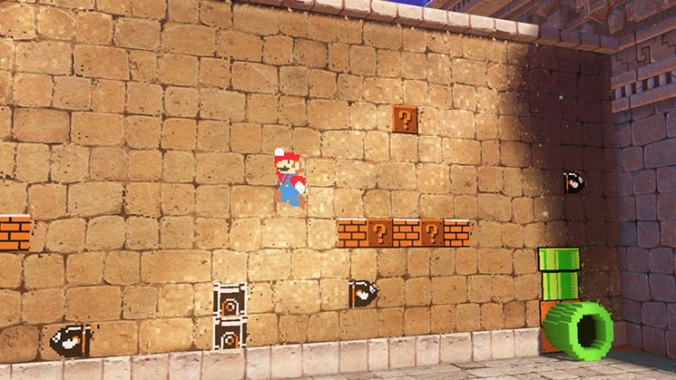
One of my favorite features from Super Mario 3D World was the inclusion of Captain Toad and his mini-games. Clearly, many others also adored those mini-games as Nintendo developed a full game using the base concept from Super Mario 3D World. Captain Toad’s Treasure Tracker is a puzzle-platformer adventure game. The main objective is to progress through small stages and collect stars and gems along the way.

1

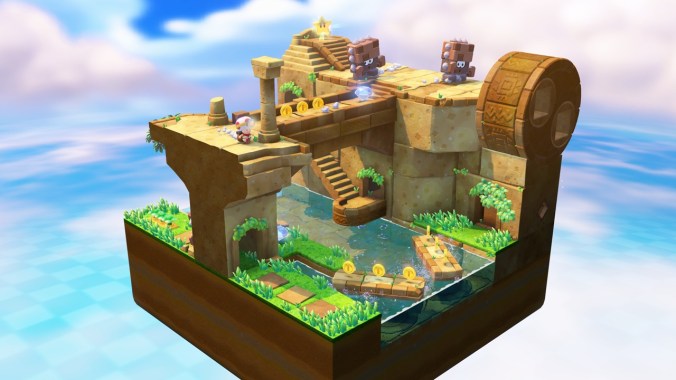
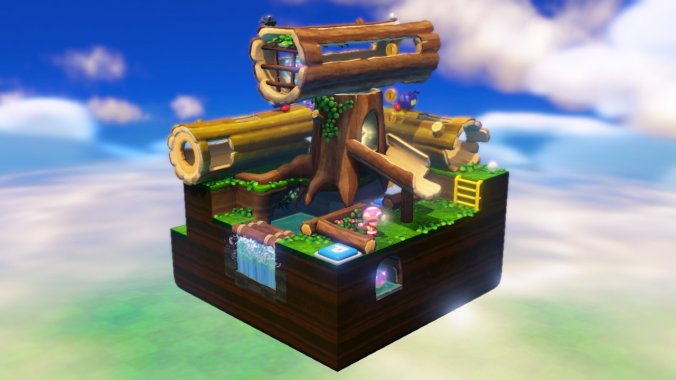
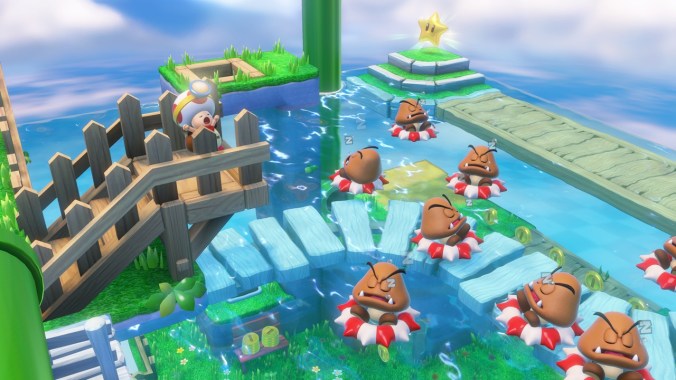
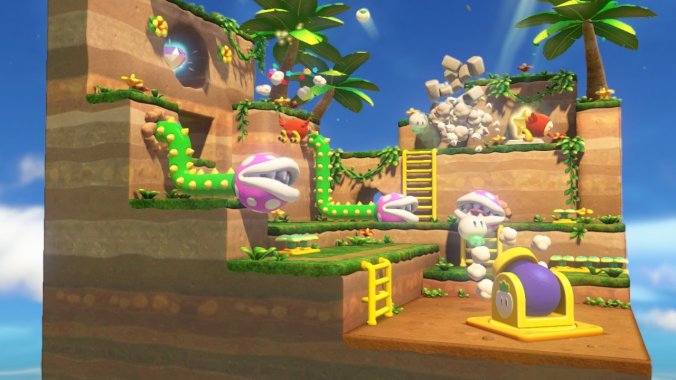
Captain Toad’s Treasure Tracker is a great game to just chill out for some relaxing fun. This is largely due to its simple level design. Levels are small arenas that the player can rotate to get a better view from all sorts of different angles. Captain Toad cannot jump or attack, so most levels consist of navigating these small maze-like courses, avoiding enemies and dangerous obstacles, and finding your way to the star, which acts as a goal in every level. Along the way, the player must also collect the 3 gems that are hidden in every level, as some stages later in the game require a certain number of these gems to unlock. These gems are often hidden in plain sight, or at least are fairly easy to guess where they might be hidden. Stages are very compact and quick to navigate through, so even if you are having trouble finding a hidden item it takes no more than a minute or two to play through the entire stage again to get another look. For the most part, the gems are out in the open and you just have to figure out how to get to them. Usually it involves a bit of puzzling or thinking of a not-so-obvious way of navigating these tiny courses. This is in stark contrast to a game like Yoshi’s Woolly World, where the collectibles were obtuse to find and required scouring every inch of a level to unearth them. In Captain Toad’s Treasure Tracker, there is no obnoxious combing of entire levels to find secrets, they are in plain sight and you just have to figure out how to get to them, which is how collectibles should be handled.

5

While I find the level design itself to be both simple and gratifying, I think the visuals of each level are also top-notch. The idea of making most levels a small cube that just floats in the sky is actually pretty cool. Every stage is kind of like a 3D diorama that you can rotate in your hands. This is a unique way of exploring all sorts of different environments, which is a key element of any adventure game, but it takes out all the long treks and expanses of nothingness between each important zone. It also allows the developers to space out any theme they want, rather than playing them in big chunks. In traditional adventure games, if you enter a snowy area for example, you know that you are going to be exploring that snow-covered area and that area alone for the next few hours, and after a while seeing the same environment over and over can just get dull. I enjoy the fact that the themes can be spread out across the game instead of having to play them all at once. You can always expect some fun places to explore in a Nintendo game, and Captain Toad’s Treasure Tracker is no exception. There are plenty of visually appealing environments and atmospheric areas to discover.
3

While I did enjoy Captain Toad’s Treasure Tracker, I feel like there was a lot of missed potential here. Nintendo does not have a puzzle game franchise, and I feel like there was perfect opportunity to make Captain Toad’s Treasure Tracker into a puzzle game series. Instead, we got a platforming-adventure-puzzle hybrid, which is fine, but the puzzle elements are fairly lacking. Most puzzles in this game are just involve hitting a switch which changes the stage and opens up a new path to the goal. There are no truly head scratching moments or things that make you really think about how to proceed. There are a couple of optional challenges that the game provides that are interesting, like limiting how many times you can hit a switch during a particular stage. These are fairly uncommon though and are entirely optional. Some levels show a good deal of potential and made me think that I was going to keep track of all the different forms the stage takes from hitting a button, and then hit the buttons in the correct order to progress forward. In reality, you just kind of progress forward and hit the buttons along the way, there is not much thinking involved. I was never really thoroughly impressed by any of the levels, and as a whole the game lacks a “wow” factor.

2

Not every game has to be an industry-changing, genre-defining game. Captain Toad’s Treasure Tracker is just fine for what it is: a short, clever, charming, and relaxing adventure. If you are looking for a cute adventure game with a few platforming and puzzle elements, then this game is perfect for you. This is not an ambitious title that will shape the industry for years to come, but it does not pretend to be. It’s just a simple little adventure game that you can meander your way through. For these reasons I give Captain Toad’s Treasure Tracker a 7/10. I enjoyed the calming pace and nature of this game, but there is definitely some untapped potential here.

Stardew Valley (2016)

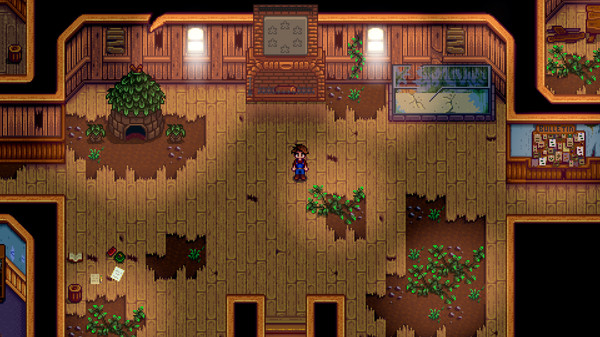
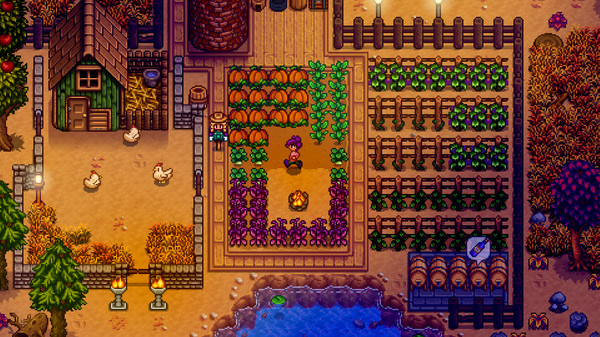
There is nothing more relaxing than chilling out and maintaining your farm in the calming Stardew Valley. This Harvest Moon inspired game is the brainchild of a single developer, ConcernedApe. Can this farming simulator overcome the pitfalls of the other games in its genre? In some ways yes, but I feel like the same problems that plague this genre also drag down Stardew Valley. Regardless of this, Stardew Valley is the perfect comfy game to just sit down and relax and play for a while.

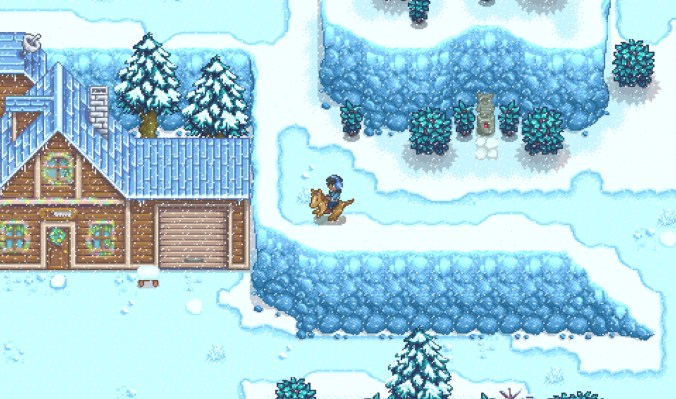
From start to finish, Stardew Valley is undeniably charming. The great pixel art and sprite work, bright visuals, and upbeat music keep this game cheerful. The main character inherits a farm from their grandfather, and uses it as an escape from a soulless corporate world. It is your job to restore this run-down farm and maintain it for years to come. There is so much that needs to be done, and that is what makes Stardew Valley so addictive at the start.

1

Through the clever use of quests, Stardew Valley subtly directs the player into the many different tasks that must be completed. Open-ended games like this can often lack a feeling of direction and the player can either become overwhelmed or they feel like there is no point to doing anything. This is not the case in Stardew Valley, helping out the villagers of Pelican Town is certainly rewarding and gratifying. But the real goal I found myself working towards was restoring the community center. Early in the game, you learn of the dilapidated community center, and you discover the secret that magical creatures known as Junimos are living there. They will help you restore the community center if you bring them all sorts of different materials.

All of the different crops, ores, fish, foraged goods, and other special materials that you collect will  be needed to fully restore the community center. There are dozens of bundles that require specific materials to complete, and you get a small reward for each bundle, as well as a big reward for completing all of the bundles in one of the rooms. These big rewards were very satisfying as they often opened up new areas and I could not wait to see what the next big reward would be. The use of the community center as a central goal was very clever, as it does not force the player into doing anything, but it serves as a sort of guideline as to what can be done. Whenever I felt like I had run out of things to do in this game, I took a look at what was needed in the community center and realized there was plenty that I had not explored or played around with. This sort of direction is desperately needed in an open-ended game like this. Unfortunately, once I had finished the community center, I felt like this game just lost its purpose.

2

Games like this can often get repetitive, and Stardew Valley certainly does not avoid this later on in the game. Once you get your farm up and running, you have to spend good portion of your limited daily time and energy to just water the crops, take care of the animals, make artisan goods, and whatever else needed to be done that day. Eventually you just get into a cycle that you cannot break, and it started to get repetitive and draining for me. I know many people may find it relaxing to do the same tasks over and over, but once I got into this late game cycle I found it to be very boring. I had bought everything and was gaining money hand over fist, so I did not even feel like there was a point to this tedium. This combined with the lack of direction that the game had once I completed the community center made for a very monotonous late game.

3

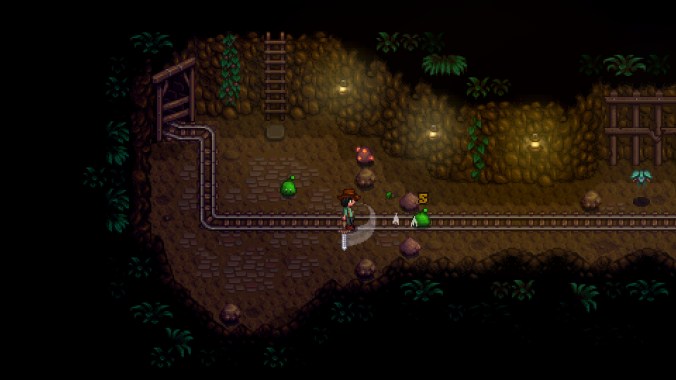
There were a few other issues I had with Stardew Valley. One of them being that while I mainly looked to this game as a source of relaxation, I felt like some of the main tasks in this game could get pretty frustrating. In particular, the fishing mini-game was aggravating and so much of time spent fishing just sitting around waiting for a fish to bite. Also, combat in this game is reminiscent of NES-era games like the original Legend of Zelda. This is not a good thing. While combat is a minor part of Stardew Valley, I feel like it often gets in the way while am trying to mine for resources. My last issue with Stardew Valley is that while it does a great job with its delayed gratification, I feel like it sometimes it goes overboard with using time from keeping the player from progressing. Certain tasks can only be completed in specific seasons, so if you want to do that thing, you are going to have to wait a while. As I was almost done with the community center, there were long stretches of days I just had to wait around before I could do anything of significance to further myself to completing my goal.

5

As I said, Stardew Valley is usually pretty great when it comes to delaying gratification, but keeping you hooked while you wait. Most things in Stardew Valley take a while before you can start reaping their benefits. Planting crops, upgrading tools, adding new buildings, renovating your house, raising animals, making artisan goods, all of these things require a few days before they become profitable. But as you are waiting for that big payoff, there is still plenty to be done. Fishing, mining, foraging, or just cleaning up your farm were enough to suffice and keep me entertained while I waited.

4

As a whole, I did thoroughly enjoy Stardew Valley. For the first 3 seasons, I was addicted and could not stop playing it. For the next couple of seasons, I still enjoyed it, but I could feel the tedium and repetitive nature of the game arise. In the final seasons that I played, I just kept going so I could have that one final payoff of finishing the community center. I just wish there was some more engaging tasks to be done while waiting for those final items to be attainable. Maybe Stardew Valley is not my type of game, as this is not a genre that I play very often, but the repetitiveness definitely wore me out after some time. That being said, even though this is not a genre that I typically play, I still really loved the first few seasons of this game. I would highly recommend it to anybody who likes these types of games. Overall, I have to give Stardew Valley an 8/10. It does run into the same issues as its predecessors, but is fantastic otherwise. If you are looking for a relaxing game to play, look no further than Stardew Valley.

Hotline Miami (2012)

While playing through the calm and slow-going Stardew Valley, I felt like I needed to quench my thirst for action. And there is no better way to fulfill that desire than Hotline Miami. What makes Hotline Miami stand out from many other indie action titles is how intensely satisfying it is in every regard. Every factor of this top-down shooter feels tailored to making beating the hell out of enemies feel just right.

1

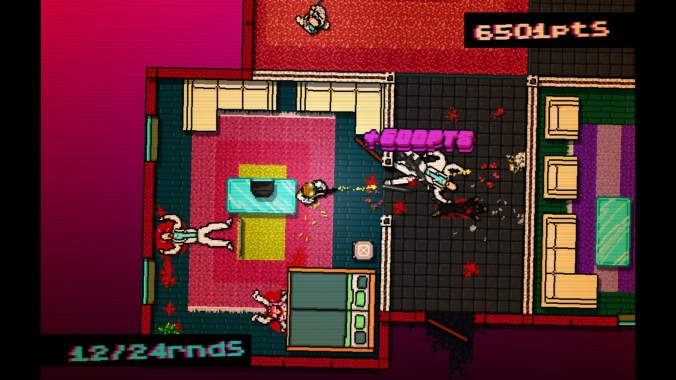
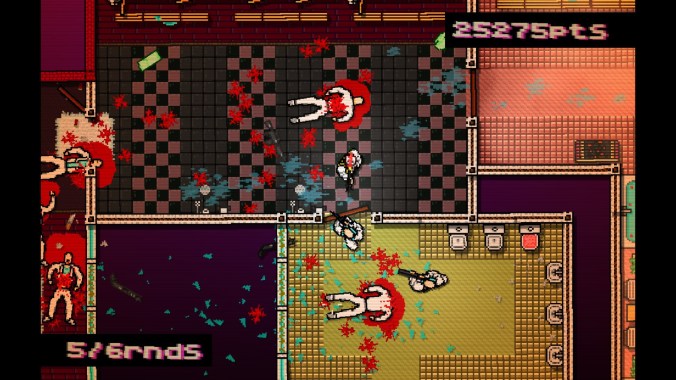
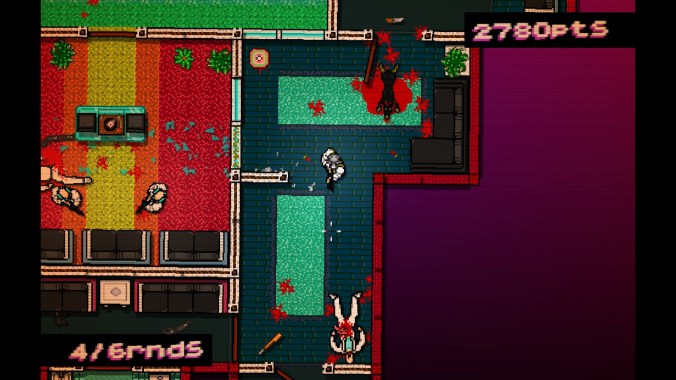
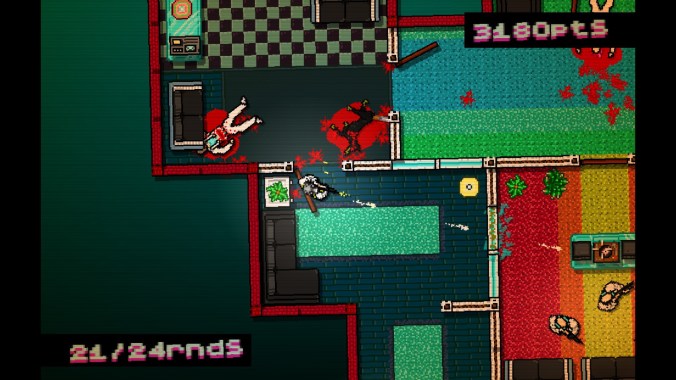
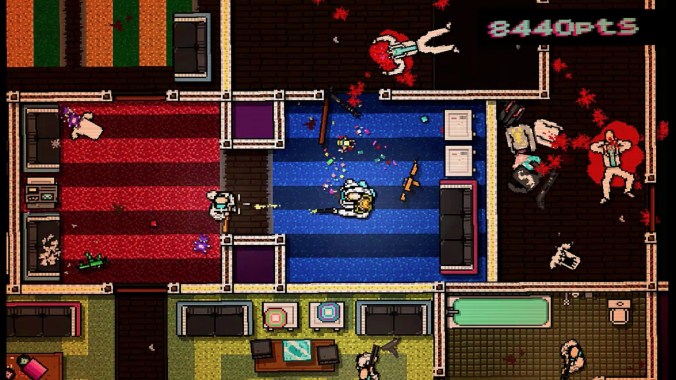
In an age where violence in video games in being condemned by the media, Hotline Miami revels in its violent nature. It is not afraid to go all out, and that is partly makes the game so gratifying, as sometimes you just need to play something intense. Another one of the factors that makes Hotline Miami so satisfying is how brutally brisk and quick it is. One shot is one kill. Many other action games suffer from bullet sponges and enemies that take entirely too long to take down. In this game, however, if you hit an enemy with a weapon, they are immediately dead. Of course, this works in the reverse as well. All it takes is one hit to take down the player. The unforgiving nature of this system is what keeps the game so fast-paced. Just a careless step by the player leads to death. Being able to blast through enemies with just a single hit from a bat or one bullet makes every action much more meaningful and satisfying. There is a real sense of “oomph” when you bash someone with the bat or blow them across the screen with the shotgun.

2

A game with such a small margin of error requires great level design in order to keep it from being aggravating. When a single stray bullet can lead to your demise, the levels need to be specifically designed to avoid cheap and unsatisfying deaths. That being said, you are going to die in Hotline Miami, a lot. Luckily, just a quick button press and you are back at the start of the floor, there is not even a break in the music. Since a game like this is reliant on its level design, it is a good thing that Hotline Miami is phenomenal in that regard. Small sectioned-off rooms make sure you do not have to tackle too many enemies at once. Every floor is designed in such a way that it is advantageous to go fast, and slowing down could be a death sentence. It is critical for you to get the first shot off in every encounter, which is a result of the “one shot, one kill” style gameplay. Every obstacle and enemy is clearly displayed to the player. Enemies are not hidden off-screen or sniping you from across the map. There is maybe two points in the game that I was shot by an off-screen enemy, which was definitely frustrating, but those moments are few and far between.
3

Every level in Hotline Miami feels like an intense and violent puzzle. Which mask and ability would work best, which rooms should I hit first, should I attempt to be stealthy or go in guns blazing; these are all questions I asked myself at the start of every level. Of course, any strategy that you might have quickly gets overridden by your desire to just run in and kill some Russian mobsters, and the game rewards you with bonus points for doing so. Enemies mostly have set patterns, but often deviate just a little bit so repeating the same exact actions over and over may yield different results. Most of the time in Hotline Miami, you just have to rely and your killer instincts in the heat of the moment.

4

Now that it is established that Hotline Miami is fantastically brutal, fast, and bloody from a gameplay perspective, we need to talk about its other aspects. The psychedelic and neon-soaked visuals of Hotline Miami perfectly depict the drug fueled city of Miami in 1989. You are dropped into the bizarre life of Jacket, who constantly has surreal visions and begins to receive phone calls that instruct him to perform massacres on the local Russian mafia. As the game progresses, reality and Jacket’s identity become warped and distorted. In some in-game sequences it becomes difficult to tell what is real and what is Jacket’s mind imagining violent scenes and imagery. Jacket’s identity is also perverted as time passes, he always wears a mask during the killings, but certain dreamlike sequences reveal that he is conflicted and confused. The player shares these emotions with Jacket, as unraveling the mystery of Hotline Miami is quite the task. Many questions are asked, and it starts to make sense as you reach the end of the game. Unfortunately, I felt like the ending was a little bit lackluster, but ultimately for a game that I was just playing for some violent fun I was pretty impressed by the narrative elements.

7


You cannot talk about Hotline Miami without mentioning its soundtrack. Thumping synth filled songs, like M.O.O.N. – Paris, are blasting when you slaughter floors upon floors of Russians. Deep and distorted guitars, from Coconuts – Silver Lights, play in the surreal sections of the game. And no song is better matches Jacket waking up from a drug induced slumber like Sun Araw – Deep Cover. Hotline Miami is full of great tracks for all different situations, and some of the songs are downright addictive.

5

One last thing I want to touch on is the ability of the developers to show restraint. Many of great games are brought down by the fact that they just drag on too long and become repetitive, to the point of being exhausted with the game. This is certainly not the case in Hotline Miami. The game is relatively quick, it only took me about 5 hours to complete it. I rarely revisit a game immediately after I beat it, but with this one I went right back in and replayed some of my favorite levels. The gameplay of Hotline Miami is definitely addicting and fun, but I feel like if it went on too long and overstayed its welcome, it could have quickly gotten grating. Luckily, Hotline Miami knows its limits and does not overdo it.

6

As a whole, Hotline Miami knows what it is and plays to its strengths. Quick, violent action with distorted storytelling and arcade-esque visuals. Hotline Miami has mastered the art of making everything intensely satisfying. This game is certainly not for everyone, and if you are not interested in violent games or games that require quick reaction time I would stay away from this title. But if you are looking for a blood-soaked, fast-paced action game, look no further than Hotline Miami.

Mass Effect (2007)

While some believe Mass Effect to be outdated and clunky, it is the necessary starting point for a legendary series. While the original Mass Effect definitely has not aged well, I believe it would be an injustice to the series and yourself to skip over it to play the more refined sequels. Mass Effect is a space action-RPG (role-playing game), and while the “action” and gameplay is dated, the RPG aspects are still top-notch and make Mass Effect a game worth playing. Deep lore, emotional decisions, strong story-telling, and an intriguing plot are the factors that make Mass Effect successful.

One of the major elements of Mass Effect is the depth of its lore and its expansive universe. Codex and journal entries are available to the player if they ever want to learn more about the missions they are doing or the lore behind the universe. Various entries on the different alien species, including their physiology, galactic presence, and their history. Everything in this game has an explanation and background info if you are interested to learn more about something in particular. Knowing the backgrounds and the relationships between all the alien species definitely adds depth and a factor of validity to this game.

The characters and the story are the defining factors of Mass Effect for me. You play as Commander Shepard and are in charge of the space vessel Normandy and her crew. Most of the time you will be interacting with your “squad” as they are the ones that you can bring along with you to combat. It is definitely a rewarding and almost cozy feeling as you build up your squad and add new members to it at the beginning of the game. Throughout the course of the game you talk with them, get their input on certain situations, build friendship, help them complete certain personal quests, or even romance them. What sets Mass Effect apart from other shooters is the reliance on this squad both on and off of the battlefield. Other games suffer from the protagonist doing everything while other characters just sit around, but in Mass Effect your squad is a massive part of the game. It adds a sense of legitimacy and realness to the game. This is why certain decisions and choices that must be made are so emotional. You build up this squad, fight with them, train them, and interact with them, so when a squad mate gets killed off in the story, it is a devastating blow.

The story of Mass Effect is full of mystery, intrigue, and emotion. The basic premise is that you must figure out what happened to an advanced alien species that died off 50,000 years ago, and you must prevent the same fate from happening to humans and their allies. The game feeds you piecemeal clues as you progress through the story. Seemingly unconnected events and plot-lines all come together by the end to form a cohesive and alluring plot. The story was paced well, there is never any downtime and I was always wanting to see what happened next. There are plenty of individual decisions and choices that you must make in this game. Some choices are minor, while others play a huge role in whats to come. You get to decide the fate of many lives and species. My only issue with this was that it was a little too rewarding to be the “nice guy”. There is rarely any downside going with the games heroic “paragon” options. I wish there was more incentive to be neutral or even go with the “renegade” option. There were a few points in the game that did this right, but for the most part the paragon route is the most rewarding option by a long shot.

While the RPG aspects of Mass Effect are clearly masterclass, the gameplay is definitely clunky and unsatisfying. Enemies often times have tons of health and shields, and some take minutes to take down a single basic enemy. This is compounded by the fact that the guns that you are using do a pittance of damage and overheat frequently, so you are forced to stop shooting for long stretches of time. There is no jumping or hurdling objects, so you have to slowly navigate even the smallest of obstacles. Constantly re-equipping your squad of 7 members with 4 types of weapons, upgrades for those weapons, and armor just gets tedious. Your squad mate’s special abilities often feel underwhelming as there is no big audio or visual cue when they are being used. For some reason, you can only sprint in combat, but not out of combat, which is when you really want to be sprinting so you can get around faster. There is an excessive amount of loading screens and elevators, which just waste a ton of time. Travelling from planet to planet is also tedious. Realistically, getting around anywhere in this game is just slow and draining. Driving the Mako vehicle is easily one of the worst driving experiences in any game that I have played. It goes extremely slow, defies physics, is tough to handle, and it does not even shoot where you aim it. This is made even more frustrating by the fact that you often have to scale cliffs with this abomination of a vehicles. Some of the biggest gameplay problems stem from the sidequests. They often drop you off in barren worlds, leaving you to drive the Mako across a vast nothingness for a few minutes. Then when you finally reach the building where the quest is located, you realize that it is the same exact layout as every other sidequest in the game, so you essentially repeat the same firefight that you have done many times before.

While the gameplay of Mass Effect could be categorized as clunky, repetitive, and tedious, it is still a worthwhile game. Not only to set up the legendary sequels, but also because the characters and story can keep you playing despite the tedium. The biggest improvement that should be made from Mass Effect for its follow-up titles is that it definitely needs to be streamlined in places. Trim off the banal tasks and clean up the controls and overall movement to make the game less monotonous and burdensome at times. All in all, it is worth sticking through the mediocre gameplay just for the RPG elements. And if you avoid doing sidequests you will skip over a lot of problematic sections altogether. Mass Effect might not be perfect, but it is still worth a play through. I am very excited to see what Mass Effect 2 and Mass Effect 3 have in store for me, and if they could solve the issues of Mass Effect.

Alan Wake (2010)

Alan Wake is a story-driven action game developed by Remedy Games. It is a psychological thriller and many have likened it to “Twin Peaks meets Stephen King”. It is clearly inspired by Stephen King and plays out similarly to his works, it even mentions him a few times. I generally like psychological thrillers, and Alan Wake has received generally favorable reviews, so I was excited to play this title. Unfortunately, I was sorely disappointed as I felt Alan Wake achieved nothing higher than mediocrity. The only thing that I really liked about this game was its atmosphere, everything else was just average at best. Both the story and the gameplay felt like they had potential to be interesting and unique, but both went nowhere interesting.

In a story-driven game the story better be memorable. Sadly, for Alan Wake that is not the case. At times, I was certainly drawn in and intrigued by the story, but those moments are fleeting in Alan Wake. The story revolves around a writer who is struggling to write his next story. The novel that the main character does write ends up coming true, and now you are living in it. You constantly are dropped into dreamlike sequences where you fight a dark presence that infects and controls people. At the start of the game, you are meant to be confused and disoriented by the surreal experiences that make up the majority of the game. This is similar to some other psychological thrillers like Memento, The Game, and Shutter Island in the sense that you are meant to be confused. Unlike those movies however, Alan Wake never has a big payoff or moment that makes you say “I get it now.” As I was playing I understood where the story was going pretty quickly as the clues and hints that the game gives you lack any subtlety. While a perceptive viewer could piece together the plots of the movies I mentioned through subtle clues, in Alan Wake the solution is completely obvious and in your face. The dialogue and characters are solid for the most part, but the facial animations and lip-syncing are a little off putting. While the characters are certainly interesting they cannot carry the story. The story interesting enough to grab my attention for a little while, but it just lacked a big payoff to really bring it all together. Any surprise that the game did have in store for the player was completely ruined by the goofy collectible system.

In Alan Wake the main collectibles are manuscript pages. These give further detail to the story and help the player understand what is happening in the story. They are generally pretty easy to find as they are lit up and lay out in the open. Many of the manuscript pages that you find end up detailing events that are yet to come. There is no feeling of suspense when you are told exactly what is going to happen before it happens. Any element of shock that this game could have had is completely stripped away by the manuscript pages.

Despite the issues with the story, it was engrossing enough to keep me interested for a little while. The biggest issue with Alan Wake was the gameplay. The gameplay is a mix of third-person shooter, action-adventure, and thriller. In Alan Wake before you shoot enemies, you must first shine a light on them until they become weakened. This was great idea thematically, but it needed some changes for me to like it from a gameplay perspective. The flashlight that you use to weaken enemies runs out of juice so fast, you can weaken maybe one enemy with a fully charged battery. So, you either have to put in a new battery, which you have to collect like ammo, or you can just wait for the flashlight to slowly regain its energy. You mostly want to save the batteries for intense fights where you need quick bursts of energy, so most of the time you are left waiting for the flashlight to recharge, which is unbearably slow. In most of the fights I found myself kiting big groups of enemies around and waiting for my flashlight to recharge. A lot of the time I just ran past enemies and to the next safe zone to conserve ammo and time. The other big issue was just how repetitive the gameplay became. After the first hour or two of playing the game I was just tired of how similarly every single encounter played out. There was one sequence of gameplay that I actually really enjoyed that I felt really upped the intensity, speed, and pressure. In this particular sequence, you are fighting on a stage that produces its own light, so you do not have to worry about slowly weakening the enemies with the flashlight, it is just pure, intense, gameplay for a few minutes.

My biggest personal gripe with the gameplay was just how clunky it was. Alan is a little tough to control, but more frustrating than that was that he was incredibly slow. You can sprint for maybe three seconds at a decent pace before you run out of stamina, and once that happens Alan is the slowest character in the history of video games. This is extremely distracting and off-putting, as I am trying to run from evil beings that are trying to kill me, or a possessed train that is going to crush me, Alan cannot muster enough energy to move faster than an anemic tortoise. Another irritating feature was the cinematic zooms during combat. As an enemy sneaks up on you, sometimes the game will zoom in on them and go into slow motion. This not only ruined any surprise or thrills that the game could have had, but it was also extremely disorientating. As the game snaps back to your perspective after one of these sequences it takes a second to readjust to your surroundings. On top of that, the game is still going on in the background as these cinematics play. You can still control your character, even though you cannot see him, and enemies can still approach and attack you. There was one particular instance that the game zoomed in on an enemy 10 meters from me as I was running from two other enemies. As the game went back to my perspective the enemies that I was closer to had closed the gap and begun attacking me before I could even do anything about it. These slow-mo sequences were frustrating, disorientating, action-breaking, and unnecessary.

With everything that let me down in Alan Wake, the one redeeming feature was its impeccable atmosphere. Set in rural Washington state, Alan Wake is a mix of serene forests, lakes, and mountains. At night, these typically calming and relaxing features turn into nightmarish environments for the player to traverse. Nowhere is safe in the dark, enemies can creep up on the player at any time and this instills a sense of fear and dread at all times. Alan Wake is not a horror game, it is not particularly scary or disturbing, but it is great at unnerving the player with the motif of light and dark. The darkness surrounds the player and gives you the feeling that nowhere is safe and that something is watching you. Seeing a beacon of light in the distance is a very reassuring feeling. Areas like the gas station or radio station in and of themselves are not particularly comforting, but the feeling of safety imbued by their light makes them such a huge relief once you reach them.

All in all, Alan Wake was disappointing for me. A story that starts off as compelling and intriguing, but goes nowhere. A collectible system that ruins any suspense. Unique gameplay that grows repetitive after an hour. Everything feels like it is almost good, but just falls a little short. The only stand out feature from this game was its atmosphere. The theme of dark and light conveys feelings of danger and safety so incredibly well. Overall the entire experience was just mediocre in almost all aspects. I would not say Alan Wake was bad, but it was not particularly good either. Alan Wake is just decent.

Hollow Knight (2017)

This year has been great for video game lovers. There have been many large releases that saw massive success and critical acclaim. Only 5 months in and we already have: Resident Evil 7, Yakuza 0, Horizon Zero Dawn, Nioh, Legend of Zelda: Breath of the Wild, NieR: Automata, Prey, and Persona 5. Alongside all these huge titles it may seem strange, but the biggest surprise of this year was the indie game Hollow Knight. This is the first game by the Australian independent studio Team Cherry, but it feels like these guys have been making games for years. Hollow Knight is a metroidvania style game that takes place in the ruined bug kingdom of Hallownest.

hollow 1

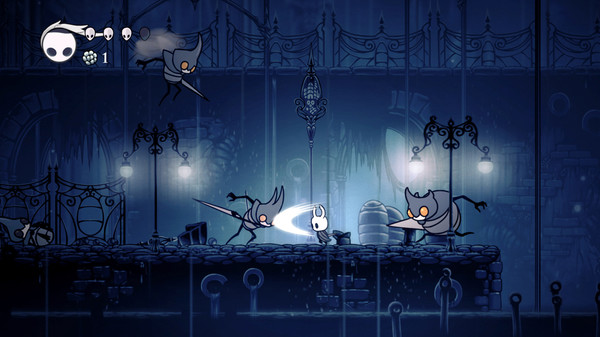
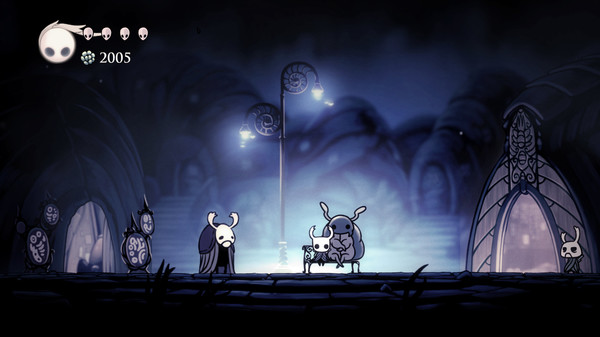
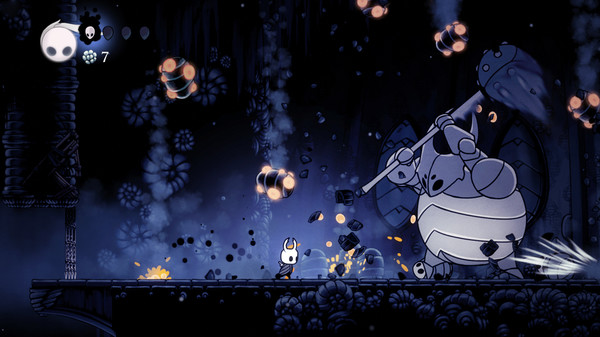
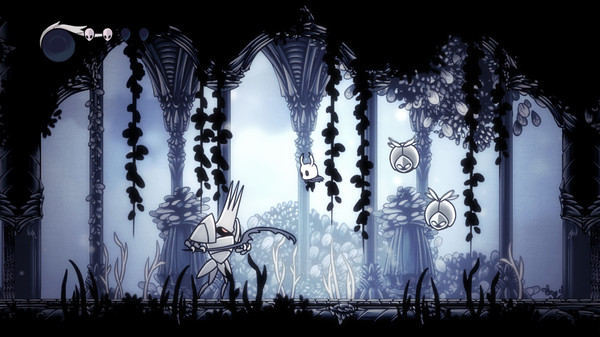
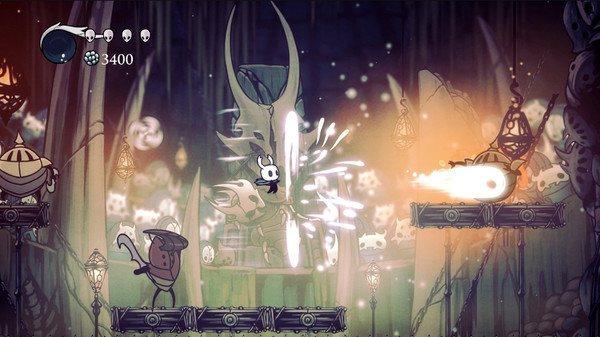
The setting and atmosphere of Hollow Knight is the dark and dingy underground kingdom of Hallownest. The game is very cryptic and it is pretty much left up to the player to interpret the plot through subtle clues scattered through the environment. There are plenty of different environments for the player to discover and explore, each with a completely unique setting. These gloomy areas are accompanied by a matching moody soundtrack. While the game definitely has a drab vibe to it, there are plenty of charming moments. For example, there are these cute little Grubs scattered throughout the world that have been trapped in jars. As you find them and set them free you can visit them back in their home and the Grubfather will give you a present for each one that you have rescued. Accompany moments like that with the beautifully hand-drawn art style of Hollow Knight and you have a game that is simultaneously dreary and endearing.

hollow 3

Do not let the cutesy bits of Hollow Knight fool you, this game can be brutally difficult at times. It starts off slow, as most metroidvanias do, but quickly ramps up as you acquire new abilities. There are many difficult boss fights and platforming sections that took me numerous tries to master. Despite this, I never felt like the game was unfair, it achieved a perfect balance of difficulty. It was challenging enough to be entertaining and engaging, but it was never frustrating. While another recent metroidvania in Ori and the Blind Forrest focused mostly on platforming, Hollow Knight is much more combat focused with platforming sections scattered throughout. There are dozens of unique boss fights to perfect and complete. When you are fighting bosses, you are exploring the masterfully crafted world of Hollow Knight.

hollow 2

As a metroidvania, Hollow Knight has a big, interconnected, sprawling world. As you acquire new abilities and items you can access new places that were previously unavailable to you. This world was particularly well thought out. It is incredibly easy to get from area to area, as they are connected in such a way that makes them simple to navigate. There is so much to be found in the world of Hollow Knight. Grubs, health upgrades, magic upgrades, new abilities, upgrades to abilities, and new items are all around the player. There is so much to discover and be found that I was constantly enthralled with the exploration aspect of this game. One pretty unique thing about Hollow Knight is that it really never tells you where to go. It is up to the player to explore and stumble upon the correct path. Many of the paths that you will take will lead to boss fights, new abilities, and secrets, but a lot of these things are completely optional to complete the game. I really loved the fact that the game does not tell you where to go. There is less pressure to move forward, and it opens up a much bigger window for exploration. This game lets you play and discover at your own pace. Instead of saying “Well let me go here and move forward in the game”, I was saying “Let me explore and I will see what I stumble unto”. The latter is much more compelling, especially in an exploration based genre like metroidvanias.

hollow 4

One of the most common complaints that I have heard about Hollow Knight was its map system. When you discover a new area, you have to first find the cartographer to sell you the base map. From there you have to explore on your own to record the full map. Some people do not like this because they claim it makes navigating new areas a chore and a hassle. I do not agree with the sentiment in the slightest. I quite enjoyed that feeling of mapping out areas for myself. When you can see the whole map from the start, a lot of the excitement of finding different paths is lost. The only criticisms for Hollow Knight that I have is that I would have liked to see the base town of Dirtmouth to be built up throughout the course of the game. Maybe some new vendors to sell the player some items that would help locate secrets at the end of the game. In games like this, I can reach about 90% full completion pretty easily, but finding those last few secrets and items can be like searching for a needle in a haystack. So, towards the end of the game I would have liked to see some way to find those secrets that I missed. Other than that, the only real issue with Hollow Knight is that is really nothing “new”. It does not introduce any spectacularly new mechanics or revolutionize the genre. That being said, it does a fantastic job of taking all the greatest aspects from other games and combining them into the best metroidvania that I have ever played. While I value innovation pretty highly, I also greatly value the ability for a developer to perfect a genre and Hollow Knight does exactly that.

hollow 6

I rarely talk about prices of video games, but I think something has to be said in the case of Hollow Knight. This game is only $15 for a ton of entertainment, just to complete the game it will take about 20 hours. To get the true ending or 100% the game it takes more in the realm of 30-40 hours. Compare this to other fantastic indie games like Owlboy, Ori and the Blind Forrest, and Shovel Knight. Those games are about $20-$25 and will last the player maybe 10-15 hours. Not only is Hollow Knight a phenomenal game, but it gives you a pretty big bang for your buck.

hollow 5

All in all, Hollow Knight is one of the best games that came out this year, and that says a lot. I cannot sing enough praises for this game. If you like metroidvanias, 2D platformers, or 2D action games, definitely check this one out. It is expertly crafted and is quite possibly the best metroidvania ever made. For these reasons, I give Hollow Knight a 10/10. It may not introduce anything entirely new, but it does a damn good job of perfecting the formula.