I don’t think there’s been a bigger shake-up to the Mario Kart formula than the changes in Mario Kart World. For decades, every Mario Kart game has followed the same basic formula: grands prix consisting of 4 tracks, each track being 3 laps. There were some exceptions of course, some tracks were long routes that didn’t loop. Mario Kart World takes this concept even further; the whole game takes place in an open world with the tracks being scattered about. Driving from one course to another is part of the races, which is undoubtedly a controversial change. But I appreciate the commitment that Mario Kart World has to its central idea of a connected racing world.
As soon as I opened the game I hopped right into the open world. I enjoyed being able to drive around each track and the surrounding areas, taking in the details and scenic environments. There are characters hanging around, cars driving the roads, and other racers zipping around the tracks. Hunting down collectibles like the Peach Coins and Mystery Panels can be a fun little hunt, but I found myself absolutely absorbed in the P-Switch challenges. Across the world there are hundreds of these micro-challenges, and they are decently varied. They could be small races, timed coin collections, or brief challenges that utilize the new mechanics such as rail grinding. There was even one where my cart transformed into an 18-wheeler and then a helicopter to reach the goal in time.
I think if I was a kid, I would happily spend dozens of hours aimlessly driving around the map of Mario Kart World. Even as an adult there’s something about the design that makes it hard to step away from just driving around and seeing what you can do. The world is so amazingly realized and each major area has much more going on than just the racing tracks. I wish there was a proper adventure mode like most racing games with an open world. A campaign with races and challenges that escalate in difficulty as you progress. Honestly, I would have even been happy with just the ability to play the Grands Prix, Knockout Tours, and Time Trials while in the open world. I would have loved being able to be fully immersed in the world, playing the cups as I found them rather than through a menu.
A huge contributing factor to making the world so engaging to just drive around is all the new mechanics. While you can play Mario Kart World like any other Mario Kart game, you can also choose to try to master things like charging jumps, riding on walls, grinding on rails, and using directional tricks to change your trajectory mid-air. There are tons of opportunities to learn how to string these mechanics together to take unexpected paths and shortcuts. And in the open world, the game can almost be treated like a platformer where you jump, bounce, wall-ride and rail-grind to reach secrets. All these new tricks can also be utilized in the traditional races, but aren’t strictly necessary to win offline. Mastering a new shortcut can be super satisfying, and there are plenty that are totally reasonable, even for casual players.
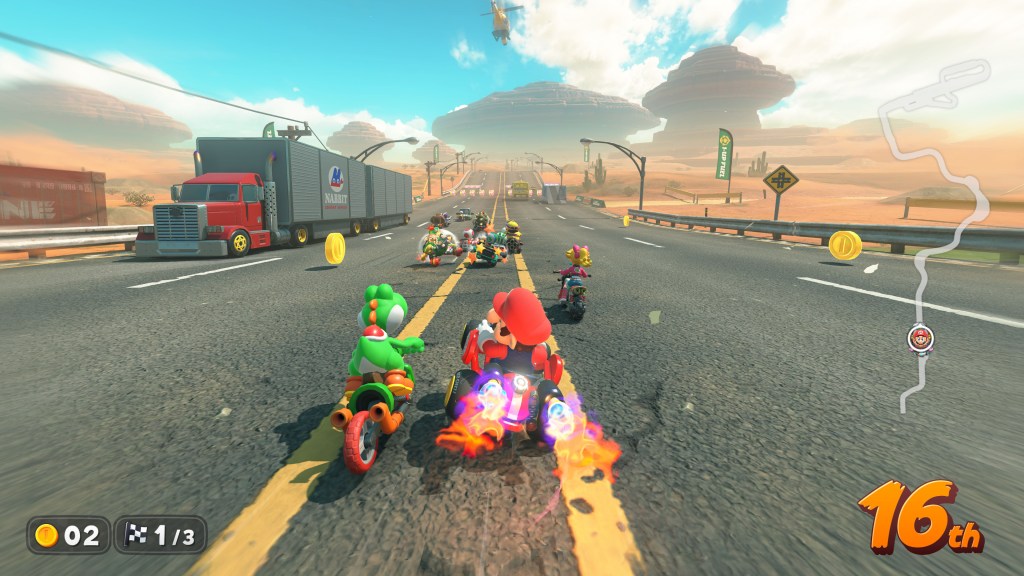
One of the biggest shocks to me while playing Mario Kart World was during my first Grand Prix. When I realized that most races in the cup would only consist of mostly traveling between the courses and only one lap around the actual track, I was pretty disheartened. The tracks are the interesting parts of the race, both visually and mechanically. Most of the connecting bits are wide open highways lacking any sharp corners or interesting obstacles. As I kept playing the concept grew on me in the context that the races take place organically in the world. I just think the execution needed some tweaking.
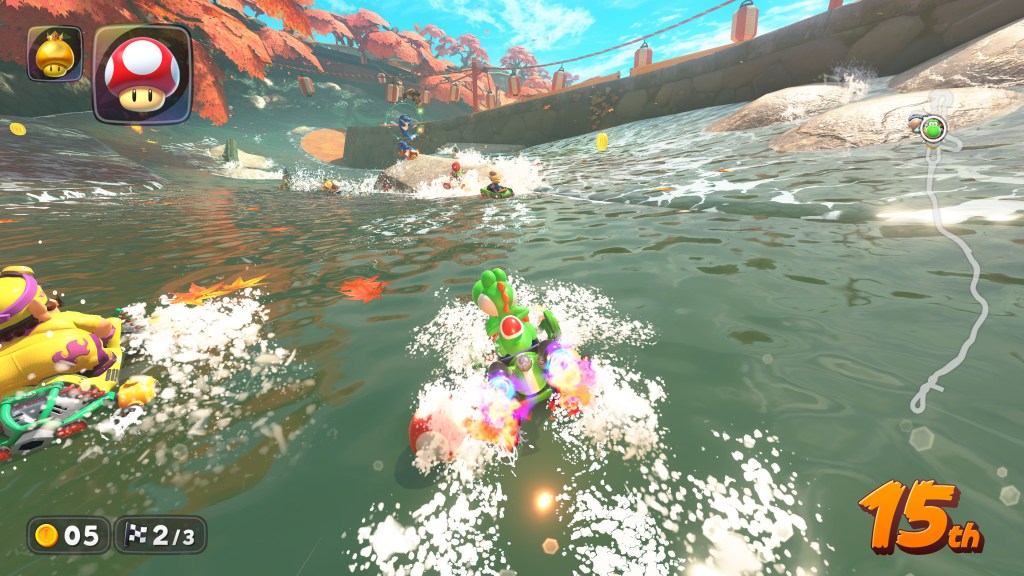
I think the most obvious and easiest solution would have been to do at least two laps once you arrived at the actual courses. The races would end up being a bit longer as a result, but a single lap on most tracks is only about 45 seconds long. I think the more elegant solution would have been to really flesh out the areas surrounding the tracks so that the connections would be more interesting. Instead of just having a highway surrounded by snowbanks, I wish we drove up winding mountain roads. Instead of surfing on the top of a wide-open ocean, I wish we raced around coral reefs and underwater caves. I’d love to see more set pieces and spectacle paired with more interesting roads to race on. I suspect that the connecting tracks are generally straighter because a lot of ground needs to be covered to cross the world to the next track. But this could’ve alleviated by either condensing the world a bit, or by having the connecting highways increase your speed like certain sections in Rainbow Road or Bowser’s Castle.
One of the big new additions is the Knockout Tour game mode. Knockout Tour makes the best use of the open world of Mario Kart World as each race consists of one long continuous track through the world, broken up into six segments. At the end of each segment, the four last-placed racers get eliminated. I love the concept, having one long course that progresses through a bunch of different environments really captures the spirit of a cross-country race. And because the race begins with 24 players all fighting to stay out of last place, Knockout Tour plays into the chaotic carnage of Mario Kart. The wide highways are perfect for accommodating a pack of 20+ players all bombarding each other with items. And the roads are full of traffic and obstacles, sometimes hurling their own items to further add to the pandemonium.
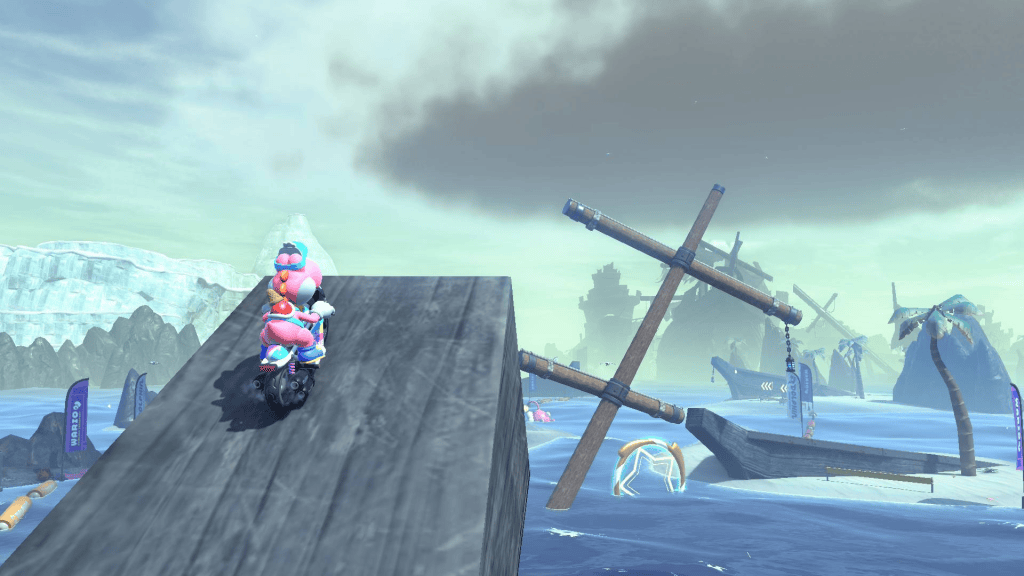
The one downside of Knockout Tour is that it isn’t nearly as enjoyable to play offline against CPUs. The mode’s strength is playing with a group of friends or similarly skilled players, leaning into the mayhem of Mario Kart. Everyone is grouped together, fighting for survival. Against CPUs however, it is far too easy to get an early lead and then just cruise to victory. Because the races are fairly long and are on rather direct and wide highways, it can be boring to cruise along in first place for minutes at a time. This isn’t a problem in the traditional Grand Prix because the races are short, you don’t have time to build a substantial lead and even if you do the race will end soon. Moreover, the tracks in Grand Prix are more interesting to drive, even if you are in first place by yourself it can be fun to zip around corners. Knockout Tour’s tracks are built for pandemonium, so if you find yourself to be significantly more skilled than your opposition it can be a boring drive to the finish line.
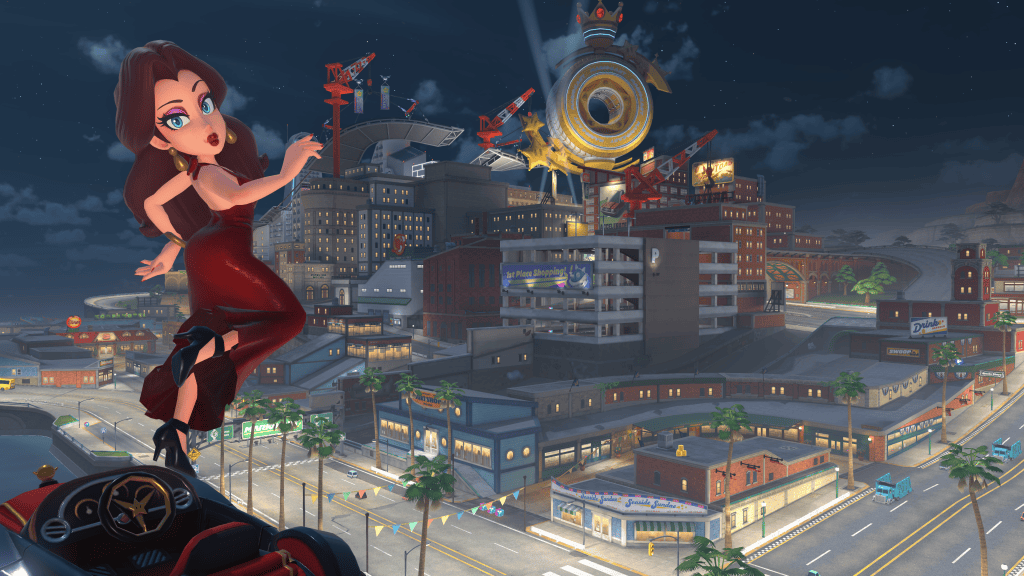
There’s no question that Mario Kart World has a masterful presentation. The visuals are absolutely stunning; they keep the cartoony style of Mario but have such incredibly high fidelity and detail that it’s hard not to be impressed. The tracks are a mix of new and remixed classics to fuel your nostalgia. But the real star is the soundtrack. Nearly 350 songs total with many of them being brand new live arrangements of classic Mario songs. Genres ranging from jazz, to classical, to bossa nova, to rock and more. The songs lead into each other and effortlessly transform as you drive across the world. I could spend hours driving around the world just admiring the scenery and listening to the gorgeous arrangements.
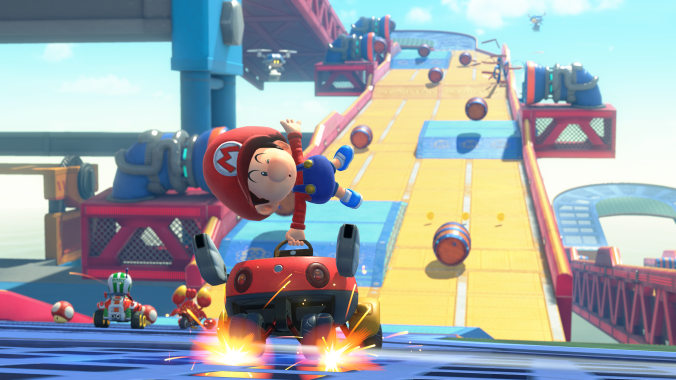
Overall, I’m glad that Mario Kart World took the series in a completely new direction. While I would’ve loved to see the open world utilized more with a fully-fledged campaign, I think it was a worthwhile addition. The world is a giant playground filled with scenic vistas and fun mini-challenges. The Grand Prix mode suffers a bit from the over-reliance on connecting highways over traditional tracks. But the new Knockout Tour mode is an excellent utilization of the open world for cross-country races. And all the new mechanics such as rail-grinding and wall-riding are simultaneously accessible and take enormous skill to master. It is for these reasons that I give Mario Kart World an 8.5/10. I think Mario Kart 8 Deluxe perfected the traditional Mario Kart formula, which is why I appreciate that Mario Kart World made huge changes to stand out from its predecessors.