UFO 50 (2024)

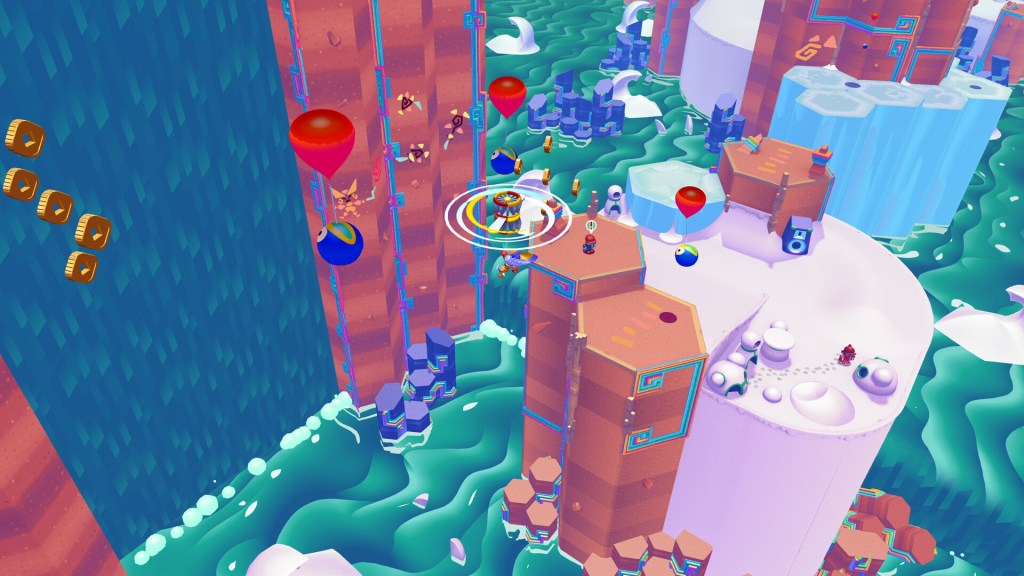
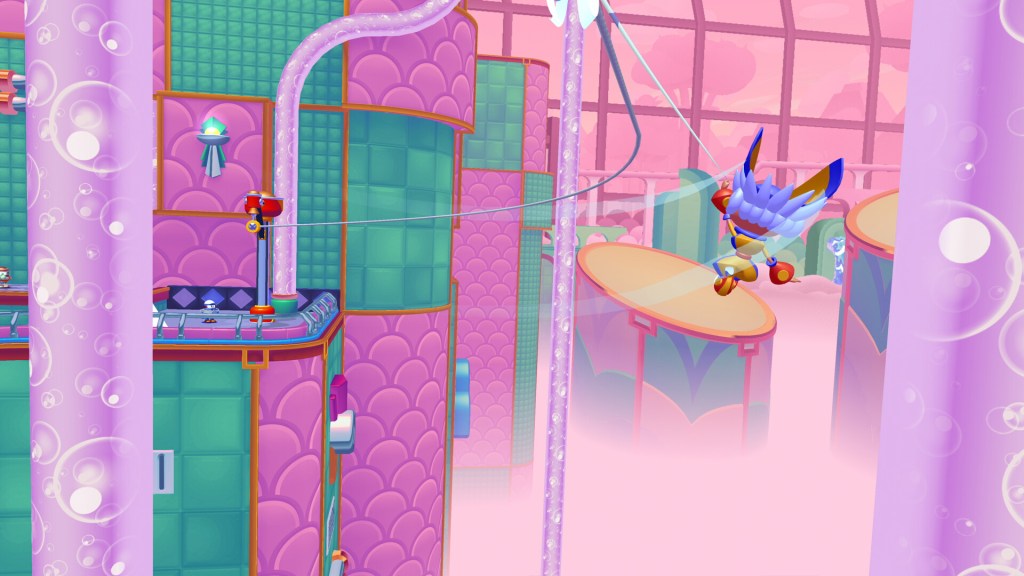
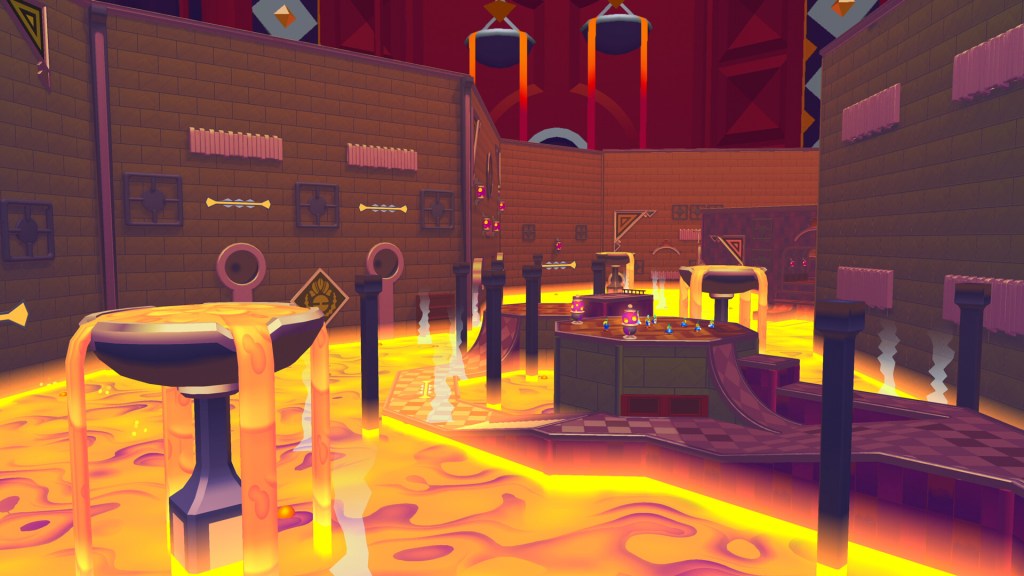
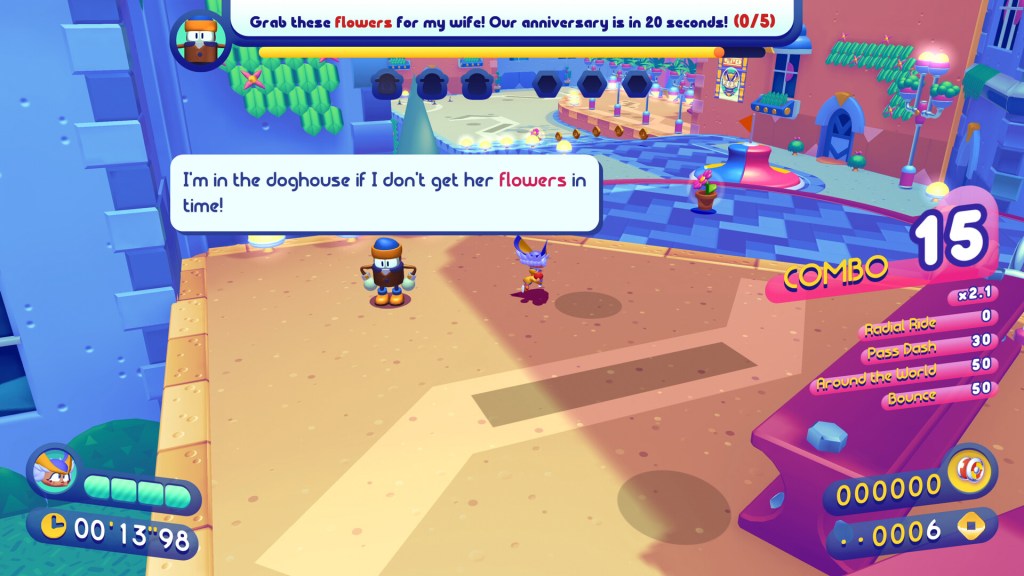
You stumble across a dusty cardboard box in an abandoned storage unit, inside is a retro video game console along with 50 games from a company you’ve never heard of. That’s UFO 50. A collection of 50 retro games from an alternate universe, each showing the progression of the fictional developers UFO Soft. The games range from platformers, to sports games, to fighting games, to shmups (shoot-‘em-ups), to puzzle games, to strategy games, each with a unique twist or gimmick. The real developers of the UFO 50, Mossmouth, claim that these are retro games with modern design sensibilities, which I think is a perfectly apt description.

Retro games are notoriously difficult and are oftentimes clunky to play. UFO 50 does a fantastic job at maintaining a reasonable level of difficulty without making these games frustrating to play. Many of the games in the collection have slow movement, punishing mechanics, or initially uncomfortable control schemes. But it doesn’t take long for each title to click, and once you figure out how to play the smart design begins to unveil itself. 

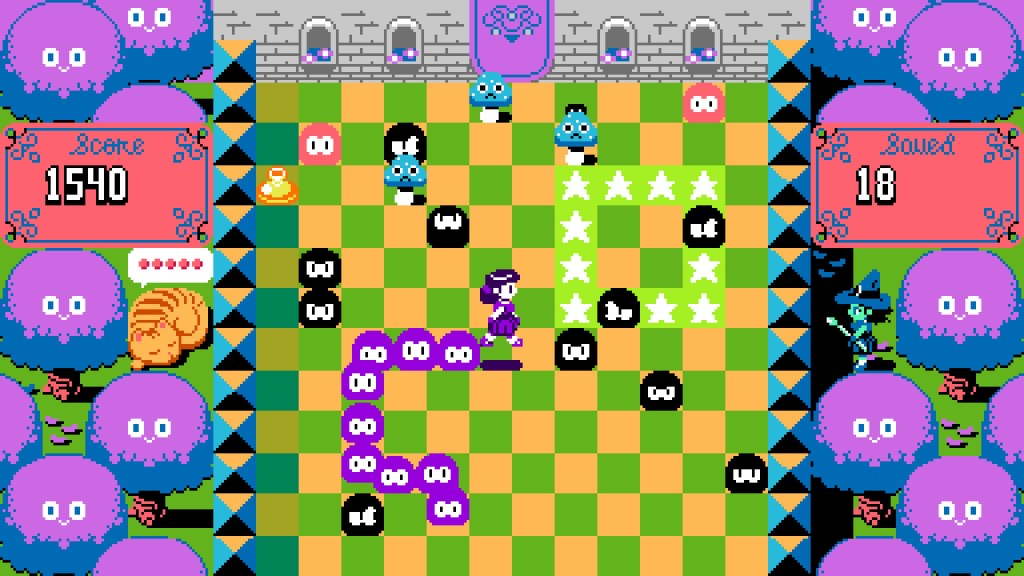
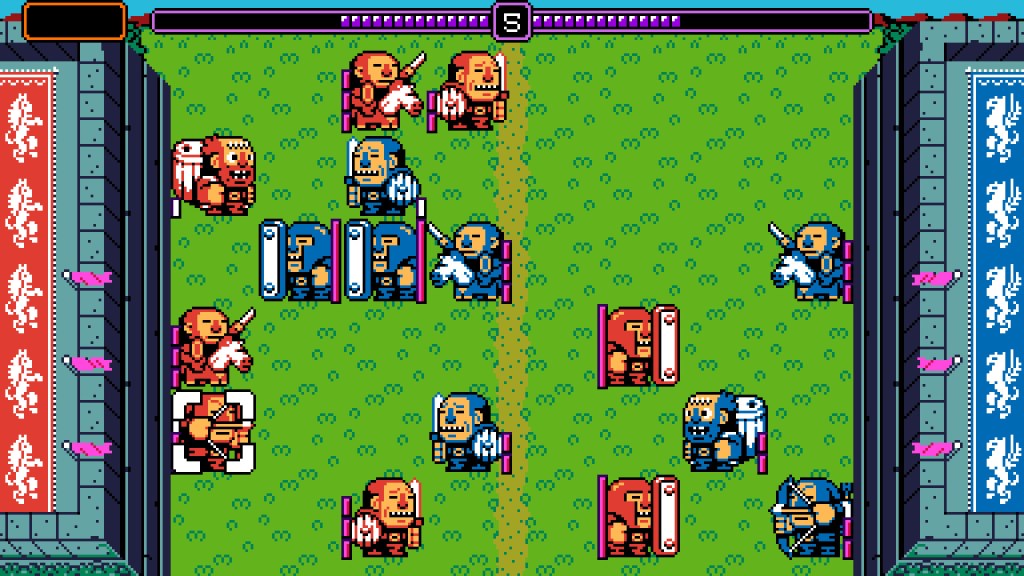
Each game in the collection has something that makes it stand out. There’re no straight up clones of actual retro games, although some of the games do feel at least inspired by classic titles. Take one of the earlier games in the collection for example, Magic Garden. It takes elements from Snake and Pacman as you lead friendly slimes to safety and use power-ups to clear out evil slimes. But Magic Garden is its own game, shepherding slimes to the scoring zone and collecting power-ups has intricacies as you are encouraged to take risks and let a ton of slimes occupy the board before chaining together multiple power-ups for an exponential score increase. There’s an edge of risk and reward if you want to maximize your points.

There’s an absurd level of variety available in UFO 50. I’m extremely confident that there is a game in the collection for everybody. And for $25, you really can’t go wrong. And don’t think that these are just short little arcade games either. There are fully fledged RPGs and metroidvanias that take hours to complete. Many of these titles could easily be standalones. Mini & Max for example is a genius little metroidvania in which you try to escape a supply closet by shrinking down and exploring the shelves and talking to the micro-civilizations that are invisible to the naked eye. Grimstone is a turn-based RPG that is over a dozen hours from start to finish. You could play UFO 50 for 100 hours and barely scratch the surface. If you truly want to 100% complete the collection, you are looking at 300ish hours. Personally, I have not clocked even remotely close to that number but this is a game that I am planning to play and revisit for a long, long time.

A smart decision was made to give every game some reasonable milestones to achieve. Every game has a simple challenge to earn a “gift” which goes into the little house on the console which is cute. You earn a gold trophy for beating each game. And you can earn the “cherry” by completing whatever additional challenge there is after completing the game, usually this is getting a high score or something along those lines. I think these tiers of achievements makes every game more approachable and presents attainable goals as you slowly get better at each game.

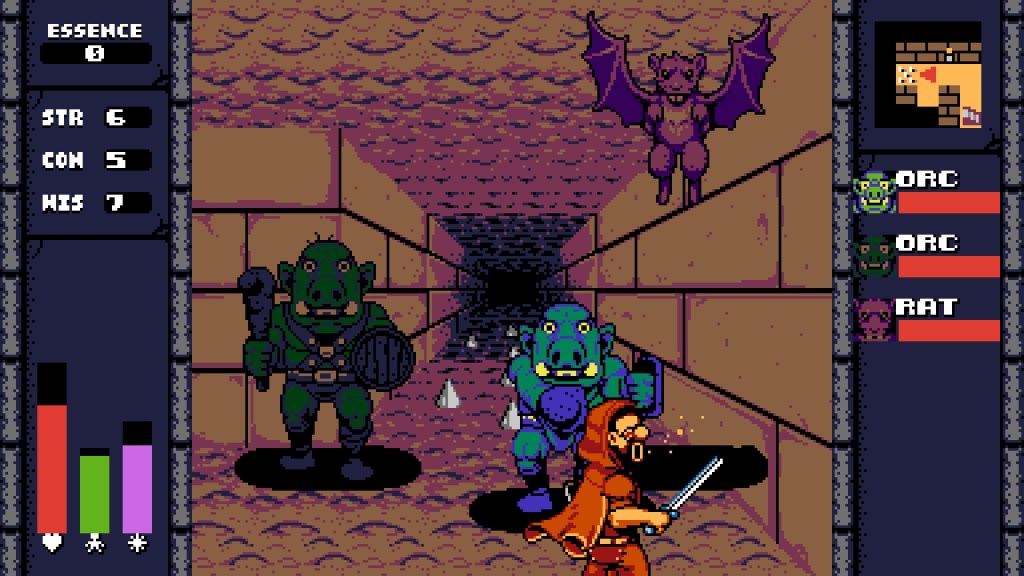
I loved the dedication to the fictional company of UFO Soft. Each game has a short blurb about its development and it’s fun to recognize the fictional names of the developers in the credits of each game. There’s a handful of sequels across the collection, and I enjoyed the references to the company’s other games as I played. It was interesting to watch UFO Soft evolve in design and technology. It was a brave decision by Mossmouth to have the first game in the collection be Barbuta, an esoteric metroidvania with no music, no color, painfully slow movement, unfair traps, and no quality-of-life features. But it was the perfect origin to the UFO Soft mythos. A game developed by a sole employee with extreme technical limitations and no game design experience. Following the evolution of UFO Soft is a journey of its own, and there’s a layer of secrets to be discovered for dedicated players.

The presentation of the collection is fantastic the whole way through. Mossmouth had to make sure every game fit its respective era and chronological place in the collection. All the games look good for being retro games and have distinctive designs and characters. But what I really want to highlight is the music. Oh my god. There are so, so many excellent tracks in this game. In the alternate universe where UFO Soft is real, I could easily see these tunes being as memorable as classics like the Super Mario Bros theme is to us.

I think that the size and breadth of the collection is the greatest strength and weakness of UFO 50. While it is exciting to boot up the game and choose from 50 games, not having to commit to any given game, I also found myself treating each one as disposable. Since the games are difficult and often have unconventional control schemes, I found it very easy to not give each game a fair chance. Dusting off a cartridge and playing for 5 minutes before exiting and trying something else was a common occurrence initially. After noticing this pattern, I forced myself to try to give every game more attention. I’m still working through the majority of the collection, but I am glad that I slowed down to really appreciate each game. The downside is that some of the games never do click, even after putting time into them. Planet Zoldath and Combatants are examples of games that I think are just not very good. 

Since I think that it can be a bit intimidating to know where to start with such a massive collection, I wanted to share some of my favorite games that I’ve played so far. While part of the beauty of UFO 50 is that everyone has different favorites, I did want to highlight these five games. Hopefully these suggestions can give you some options to try if you have trouble choosing where to begin.

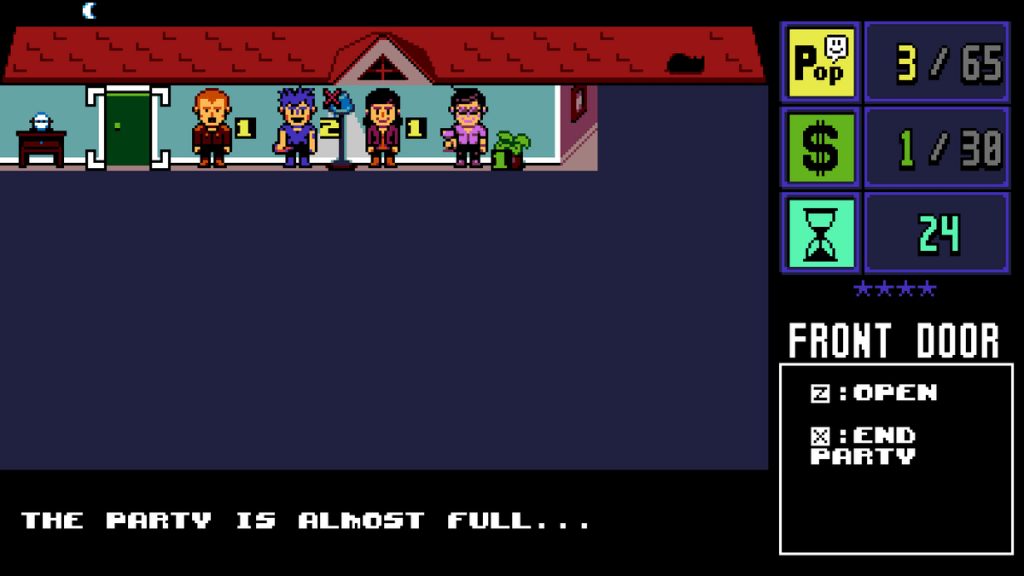
Party House is the first game in the collection that really clicked with me. It’s a deck builder where you are trying to throw the ultimate party. By spending popularity to add new guests to your rolodex you try to accumulate more popularity and cash every night. After 25 nights you have to have 4 “starred” guests attend your party to win. There’s a good amount of decision making involved, but what makes Party House interesting is its “push your luck” mechanics. Troublemaker guests typically earn more popularity and money, but more than two of them at once will cause the cops to show up. And there’s also the decision of when to stop spending popularity on normal guests and when to start acquiring the “starred” ones. There’s a lot of delicate choices to balance, and Party House is a ton of fun.

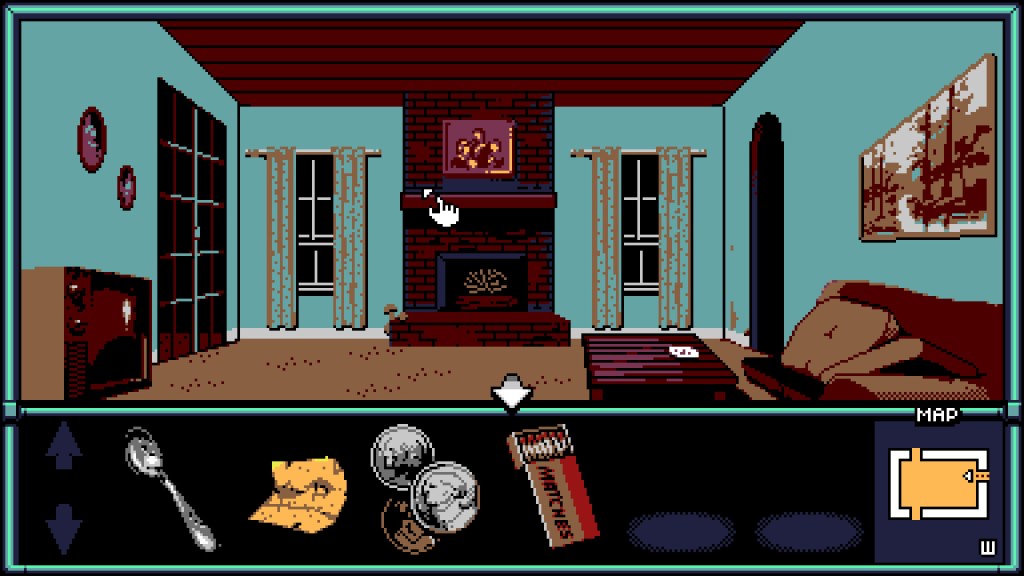
Night Manor is a point-and-click horror game that takes place in a disarrayed mansion filled with trash and fungus. You have to figure out a way to escape while avoiding the zombie-like man infected with fungus who is hunting you. If you run into him, your cursor jitters to simulate the terror your character feels, making it harder to click on doors to escape as he chases you through the manor. Old point-and-click games often have moments of ridiculous leaps in logic, but Night Manor avoids this with its puzzles. I found that everything made sense and I couldn’t put the game down until I played through the whole thing over the course of a few hours. There’s also a story to uncover through notes of what happened at the manor which was fun to discover.

Seaside Drive is a stylish shmup, but you can only move left and right as you drive your car down the road. As you dodge projectiles and enemies you have to move back and forth quite a bit to keep up your meter. You build up charge by skidding to the left, and expend charge by shooting and driving right. The higher the meter, the more damage your shoots do. I love this game because it seems crazy difficult at first, but I quickly learned how to maneuver and overcome the challenge. It’s so satisfying to clear the stages that were giving you a hard time without getting hit at all. Seaside Drive also has incredible aesthetics and one of my favorite songs in the whole collection. It’s a slick, stylish, and fun to play shmup with perfectly tuned difficulty.

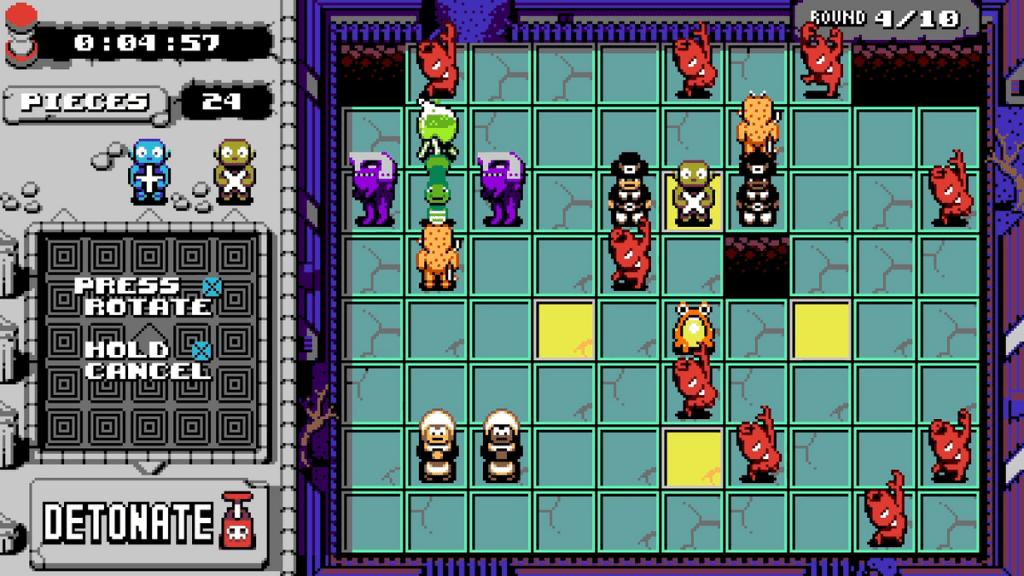
Devilition is my favorite puzzle game of the collection that I’ve played so far. A grid is filled with villagers and demons and you have to place pieces that kill the demons. The twist is that your pieces have to act like a chain reaction, each one can only be set off if hit by another. You have to keep track of what pieces you’ve placed and how to connect the chain. There’s 10 rounds and any pieces that you don’t use carry over to the next round, encouraging you to be efficient in your placement. I enjoyed watching the Rube Goldberg machine go off and clear the demons off the board as I prayed that I didn’t mess up and miss a crucial link in the chain. 
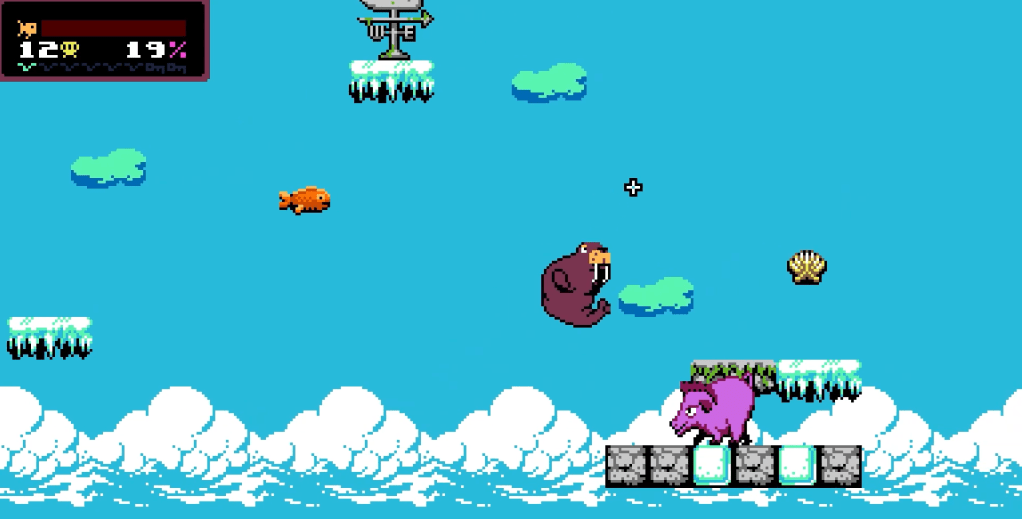
Waldorf’s Journey is a platformer that takes place entirely within the dream of a walrus. It’s reminiscent of a golf game as you charge up and launch Waldorf the walrus across gaps and try to precisely maneuver him to land on tiny patches of ice. You really have to master the momentum as you use your flight meter to propel Waldorf forward. It’s tempting to fly as far as you can on every jump, but it becomes incredibly difficult to slow down enough to safely land. There’s a few different power-ups and items to help you along as you inch towards revelation at the end of the dream. I also love the visuals, music, and minimalist story in this game as well. 

I think UFO 50 is a game that I am going to be playing for the rest of my life. Or at least for a very long time. The breadth and depth of this collection is unmatched. After dozens of hours played, I’ve barely scratched the surface of what UFO 50 has to offer. The fictional history of UFO Soft ties the whole thing together beautifully. It is for these reasons that I give UFO 50 a 9.5/10. UFO 50 is a paradise for fans of retro games with its dedication to melding retro gaming experimentation with modern design considerations.

Balatro (2024)

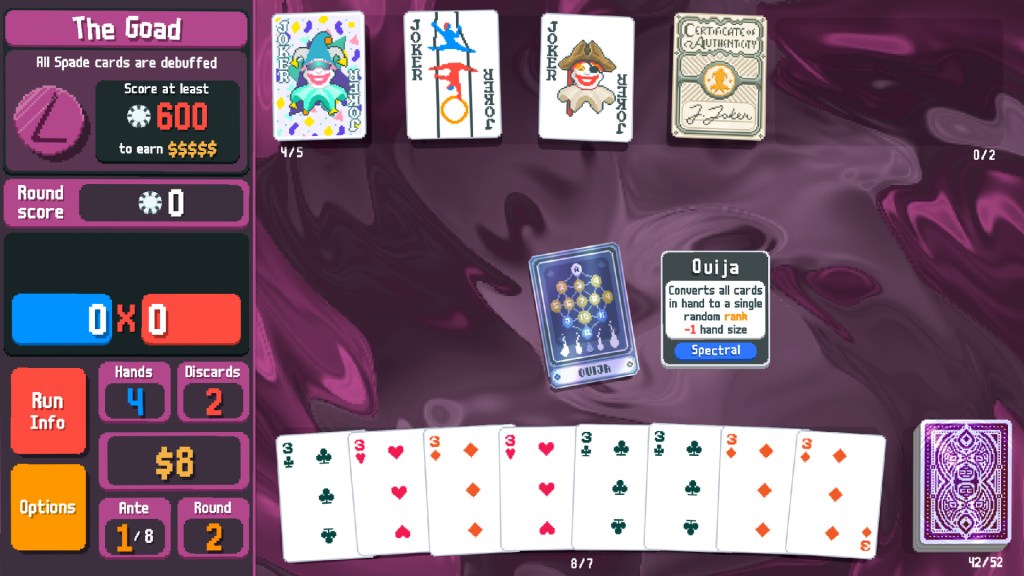
Balatro is the video game equivalent of crack. Every aspect of this game makes it hard to put down. It’s easy to spin it up for “one quick round” and look at the clock to realize that hours have passed. Balatro is a roguelite deck-builder that is about playing poker hands to score points, as well as using a variety of modifiers to multiply those points. There’s a wonderful level of random chance that influences every run that influences the player to experiment with all sorts of different builds. Even after spending dozens of hours playing poker hands, I still feel the draw of Balatro to see what kind of strategy I can cook up.

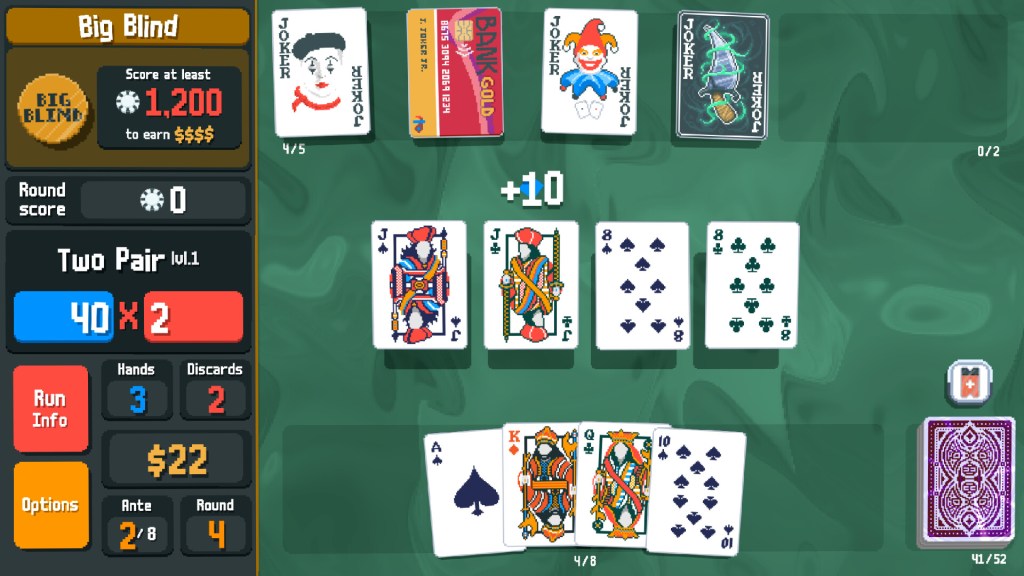
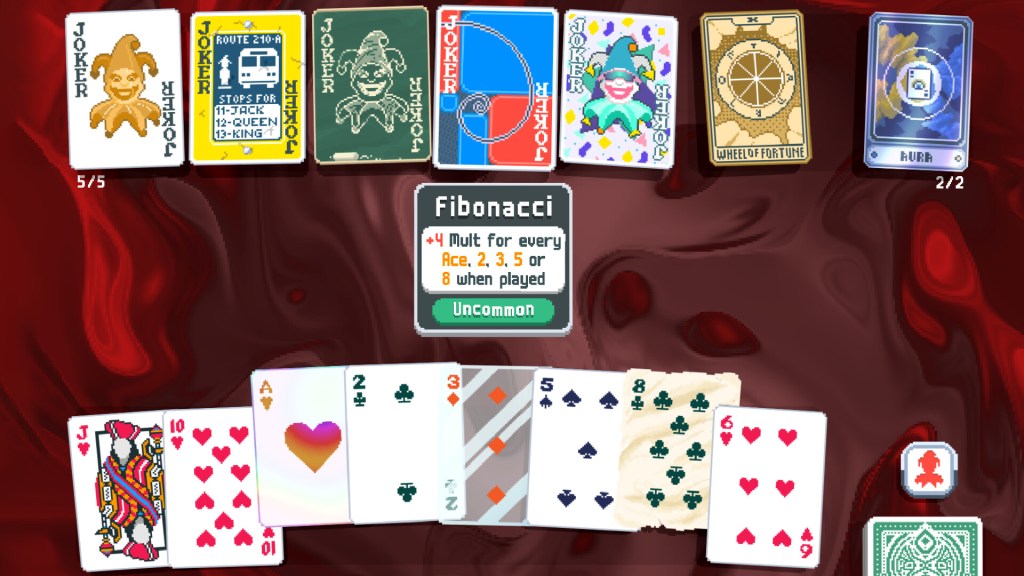
The structure of the game is that you play poker hands to try to accumulate points and surpass a threshold to complete a round. Typically, you get 4 hands to play per round and 3 discards to try to put together higher scoring hands. After each round, you visit the shop to spend money earned on modifying cards to increase your points. The cornerstone of these modifications are the joker cards. You can hold 5 joker cards that vary wildly in the bonuses that they provide. From simple bonuses like multiplying your hand’s score or giving you extra discards, to more specific bonuses like increasing the base chips and multiplication of Aces or Fibonacci numbers. 

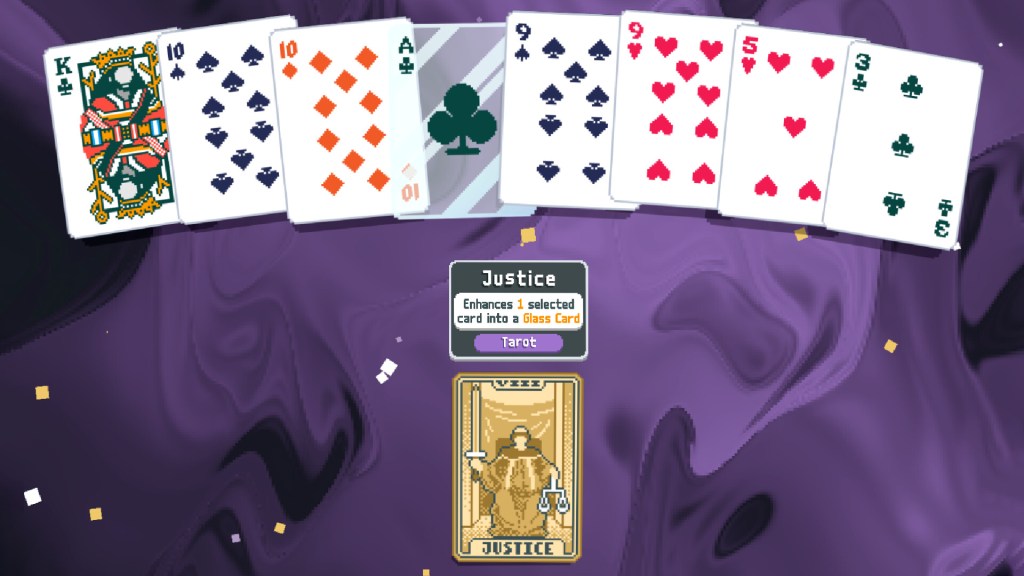
There are so many jokers to stumble on and it is incredibly engaging to try to find the synergies between them. My highest scoring run consisted of a multiplicative joker that increased its multiplier every time a card was added to the deck along with another joker that added a card at the start of every round. This was further enhanced by two of my other jokers that copied the effects of other jokers, leading to a rapidly climbing multiplier. Aside from jokers, there are also planet cards that permanently increase the base point value of certain poker hands. There’re tarot cards that provide a variety of effects from buffing individual cards to giving you more money.

All these options provide a fantastic system for decision making. Every time you visit the shop after a round you have to weigh what bonuses you want and whether or not you want to gamble on booster packs and hope there is something good inside. You want to have a healthy amount of money to earn interest and allow for big purchases later. There’re so many factors at play that you have to consider. Sometimes you have to make short-term purchases just to get you through the next few rounds while hoping you stumble upon better options. The randomness isn’t frustrating, it’s what makes the game so compelling. Every time you get a run going, it feels powerful. Being forced to experiment with whatever the game throws at you leads to incredible moments.

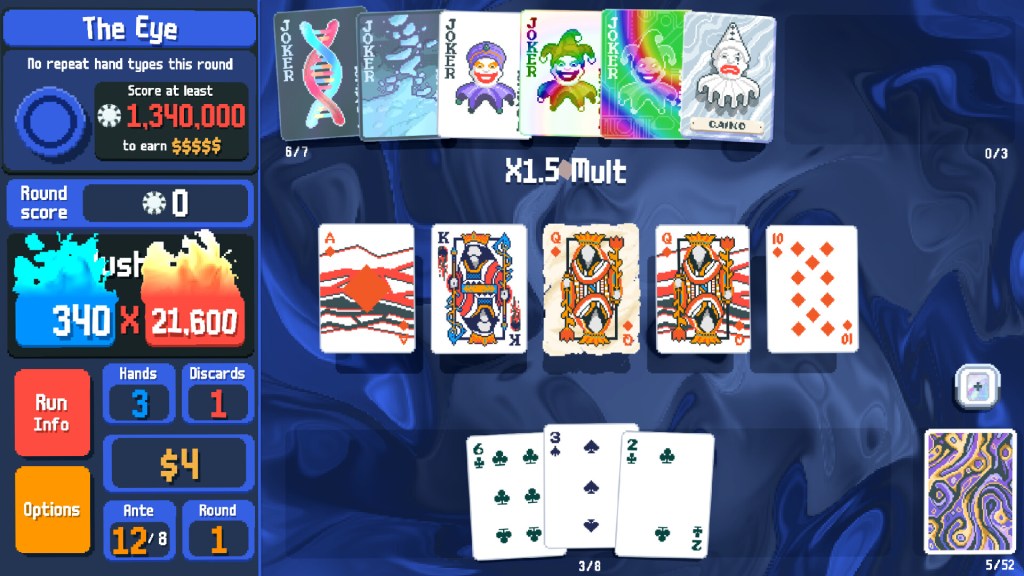
Each run is structured into 8 “antes”, each ante having 3 rounds of increasing point requirements, the last of which being a “boss” with special effects. After completing the 8th ante, there’s an option to continue with your deck in endless mode. Initially, I found myself always going into endless mode to see how far I could take my deck. I discovered that the score requirements quickly begin to scale exponentially, leading to most of my runs sputtering out around ante 11 or 12, no matter how good they were. At first, I was frustrated by this, but I soon realized it is a blessing that the endless mode scales exponentially. At some point, your build is essentially complete so you are just going through the motions every round. Most of the fun decision making happens much earlier in the run, so dragging out the endless mode wouldn’t be enjoyable. And having a concrete goal of completing the 8th ante means you can take short-term risks and attempt non-optimal builds as you don’t need to scale exponentially to win.

The one problem that I have with the gameplay of Balatro is that the early rounds are fairly boring and repetitive. You need to save up money before you can buy anything, so you are often stuck playing high-value hands like flushes and straights to clear the first few rounds. You are at the mercy of the shop to have some decent jokers to get you through ante 2. You don’t have the money to reroll or gamble on booster packs unless you are truly desperate. It’s hard to alleviate this issue without the developer placing a finger on the scale and tipping the odds in the player’s favor early on. My suggestion would be to have the cost of rerolls scale by ante. That way players can actually afford to reroll the shop a few times early on to fish for usable jokers while simultaneously increasing the difficulty in later antes.

The issue with the early game is only made worse as you turn up the difficulty. There are eight difficulties and over a dozen decks to choose from. I mostly enjoy how the difficulties were designed as they rarely equate to “score more points”. Many of the difficulties add modifications to jokers that make them unsellable, or cost money every turn, or expire after 5 rounds. This adds an additional layer of decision making on which jokers you want to purchase. The problem is that on the highest difficulties you really need everything to go right early on to have a successful run. I don’t think it’s the end of the world because it is still a ton of fun to try to scrape by with suboptimal choices, but I do wish there was something to make the first couple antes more engaging.

Part of what makes Balatro so addicting is its presentation. The game looks great, even on mobile platforms. I love looking at the distinctive design of all the jokers. But the animations and sound effects are really what makes Balatro tick. Watching the game emphasize every card and joker as the score climbs up is addicting. Your deck becomes a Rube Goldberg machine of multiplying bonuses that is fun just to watch unfold. The game cleverly doesn’t tell the player the final point value of the hand they are about to play, leaving the player to watch and wait with bated breath as the score rapidly grows. I particularly love that when a single hand surpasses the total point value necessary for a given round, the score display lights on fire. It’s a really satisfying touch.

It’s hard to explain why Balatro is so addicting, but beware how difficult it is to break free from the grasp of Balatro. The pure variety and allure of creating an overpowered deck fires all the right synapses in my brain. The dopamine of watching the score skyrocket is addicting. There’s so many different decks, difficulties, and challenges that force you to play with all the different options available. It is for these reasons that I give Balatro a 9/10. I would say it’s the perfect game to play a quick run when you have time to spare, but it’s so fun that I’d have a hard time putting it down after a single run. 

Max Payne (2001)

Older games are often rough around the edges, and I was concerned when I needed to download a 3rd-party mod to even run Max Payne. But the little bit of research that I had to do to get the game running was well worth it, because Max Payne is an absolute classic. It’s an old-school FPS that makes you feel like an action movie hero, while simultaneously gripping you in its noir narrative and setting. For its time, it was a technically impressive game that made clever decisions to hide its shortcomings. Despite a few hiccups with the difficulty design, Max Payne is an excellent game, even to this day.

After his wife and infant child were killed by drug addicts in a burglary a couple years ago, Max becomes an undercover DEA agent. He gets a lead on the source of the drug known as Valkyr, a mysterious substance that makes people enter a zombie-like state. Max hunts for the truth during a historic blizzard in New York City. It escalates from mob drug war to full-blown conspiracy as Max spirals in his quest for vengeance.  
As the plot unfolded, layer by layer, I was also impressed by the thematic consistency. The weight of the guilt that Max carries because of the murder of his family turns him into a relentless hunter. He is haunted by hallucinatory dreams where he is the one pulling the trigger during the tragedy. As the blizzard progressively worsens, so does Max’s mental condition and grip with reality. The narrative benefits from its noir styling. Max narrates the events with melodramatic descriptions and the presentation embodies the dreamlike yet brutal characteristics of classic noir films. 

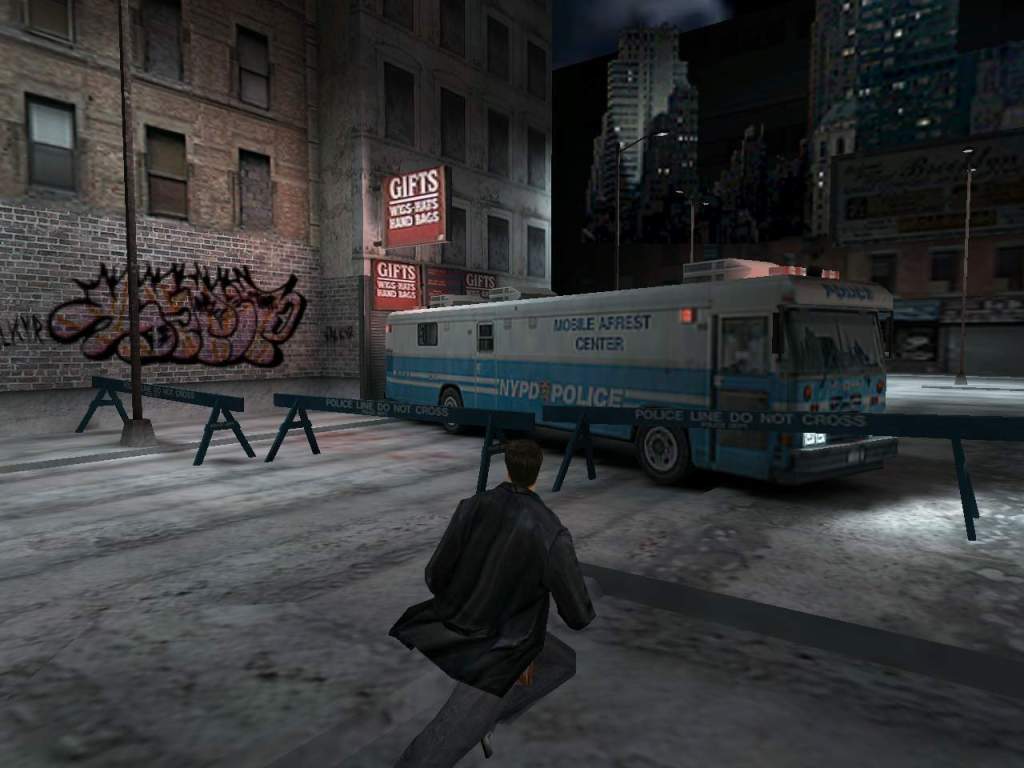
Despite its age, Max Payne visuals hold up remarkably well. 3D graphics were still in their infancy, so the developers decided to forgo cutscenes for comic panels. This was a clever choice because these stylized comics have aged so much better than cutscenes from that era. It also plays wonderfully into the noir theming and surreal elements of the plot. The setting is also quite memorable. New York City in a blizzard is one of my favorite environments to explore. The snow-covered rooftops, empty streets, icy docks, and rundown apartments are wonderfully atmospheric and filled with little details. I quite liked how many of the locations had radios or televisions that gave news updates on the “historic storm”. These little flourishes gave the world more credibility.
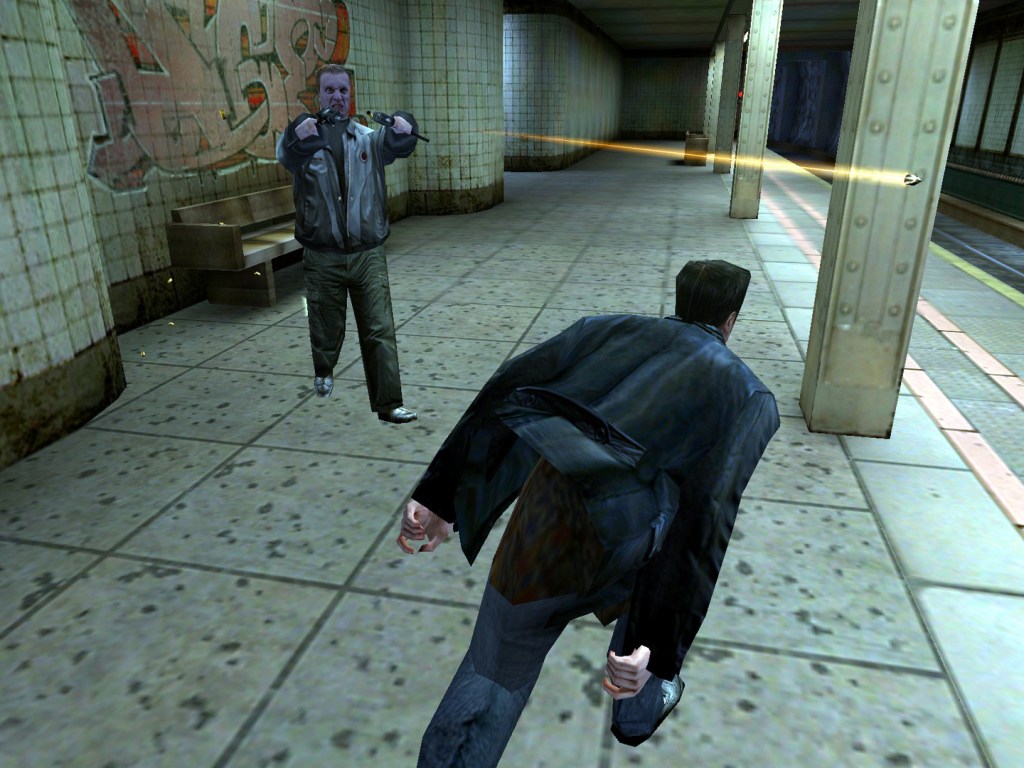
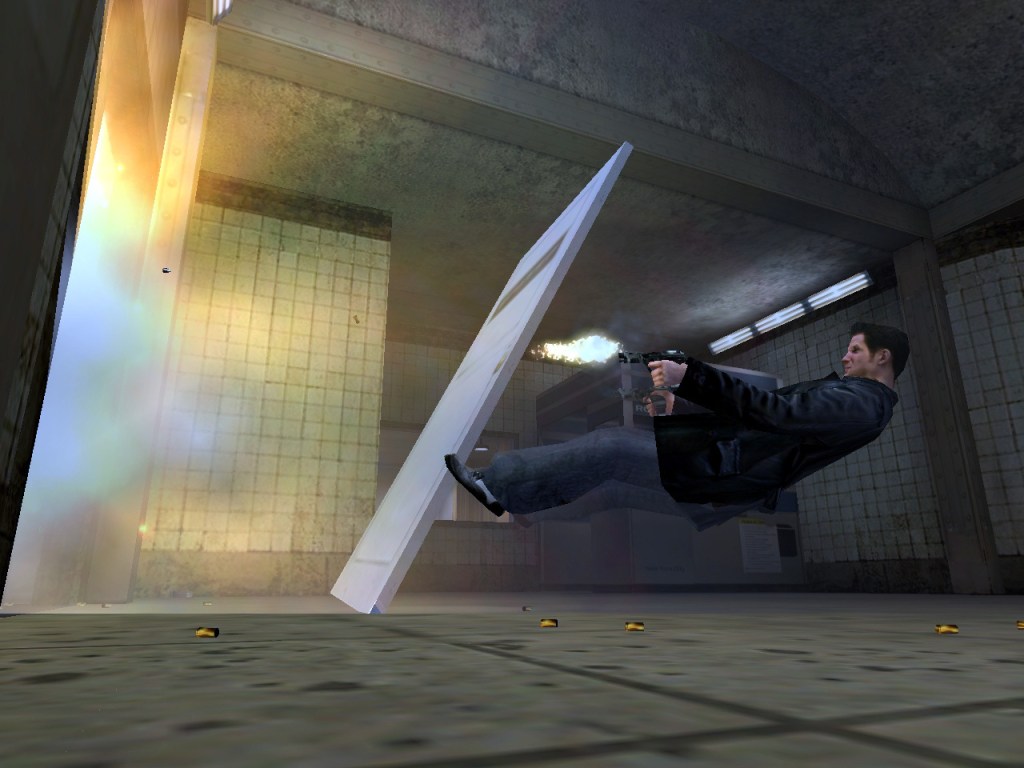
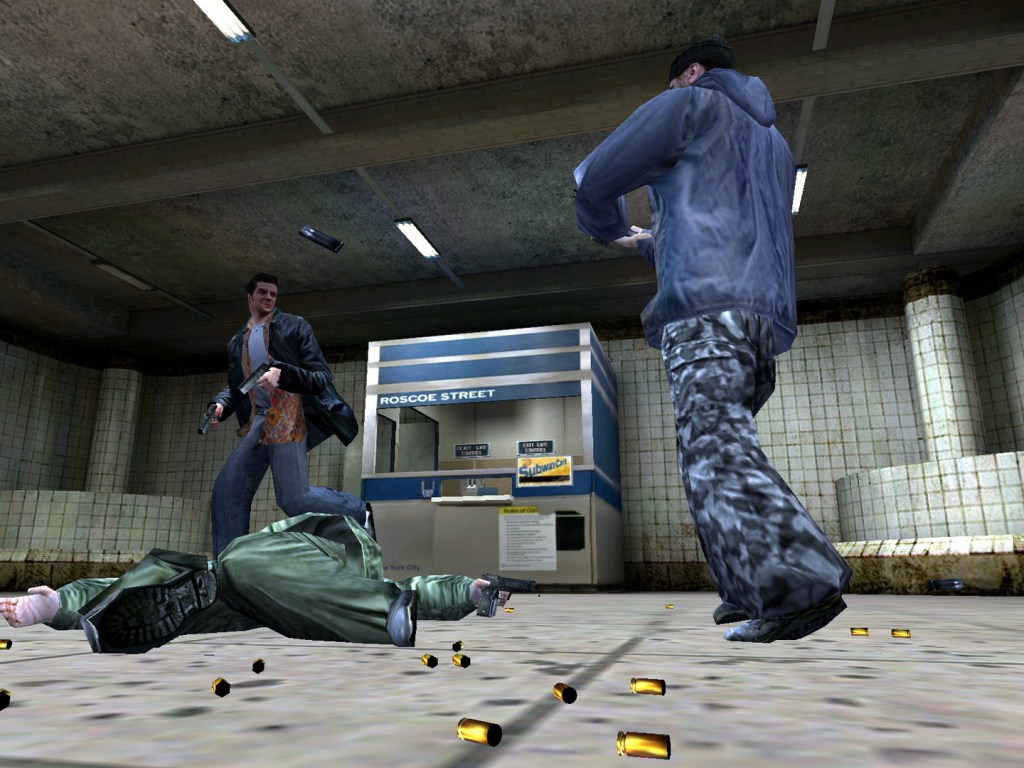
The presentation and story aren’t the only elements that are impressive despite their age, the gameplay also holds up well. It’s a classic FPS, shooting waves of goons as you move from room to room. But what makes it special is the inclusion of bullet time. At the press of a button, you can slow down time to dodge bullets and return fire. You also can quickly roll or dive in all different directions. Combining the dodge with bullet time can make for some cinematic moments as you burst through doors, diving in slow-motion and raining bullets on mobsters. It also adds a layer of fun complexity to otherwise simple gunplay. Bullets have actual velocity rather than instantly doing damage when the trigger is pulled. Staying in motion, utilizing bullet time, and leading your shoots is crucial to success. I found this fast-paced action to be very fun.

My only complaint about the gameplay is the adaptive difficulty implementation. I don’t hate the idea of tuning the difficulty based on how the player is doing, but in Max Payne it can drastically affect the experience. The game adjusts enemy damage, enemy health, player health, and other factors to extreme degrees based on how frequently the player dies. I found if I was doing too well basic enemies would suddenly become superhuman threats. The game flow is dramatically altered when multiple shotgun blasts from point blank can’t fell a single foe, but a single shot from their rifle kills you instantly. Luckily, you can save and reload as frequently as you want, so after a few deaths and reloads the enemies become manageable again. But still, it’s jarring to experience such sharp spikes in difficulty.

I was pleasantly surprised by my time with Max Payne. Every element was well done. The exciting story, the meaningful and thoughtful themes, the memorably moody setting, and the thrilling gameplay were all impressive. Despite the questionable inclusion of adaptive difficulty, I genuinely had a ton of fun with Max Payne. Which is not something I can say for many other games from its era.

Astro Bot (2024)

Astro Bot is a game for people who love gaming. Not only is it a technical marvel, but it lives by the ethos that games should be fun. While I personally love experimental and mature games that toy with inspiring other emotions such as rage or sadness, the unbridled joy that Astro Bot brought me reminded me of playing games as a kid. It’s reminiscent of all-time greats such as Super Mario Galaxy. It’s a modern day classic that I’m already eager to revisit in a few years’ time.

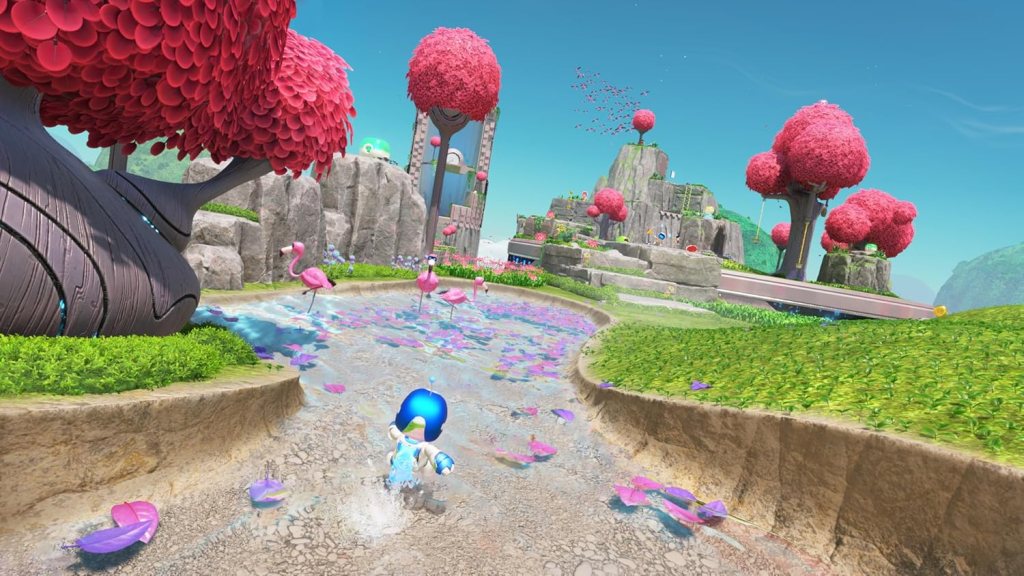
Astro Bot starts with your Playstation-shaped spaceship being destroyed by an alien and having all your robotic allies scattered across the universe. You crash land on a barren planet and have to visit different galaxies and planets to rescue the little bots and repair your spaceship. Each level plays out as a fairly linear course-clear style stage with hidden collectibles scattered about. Astro Bot clearly takes inspiration from Super Mario Galaxy with its approach to level design and reliance on interesting power-ups.

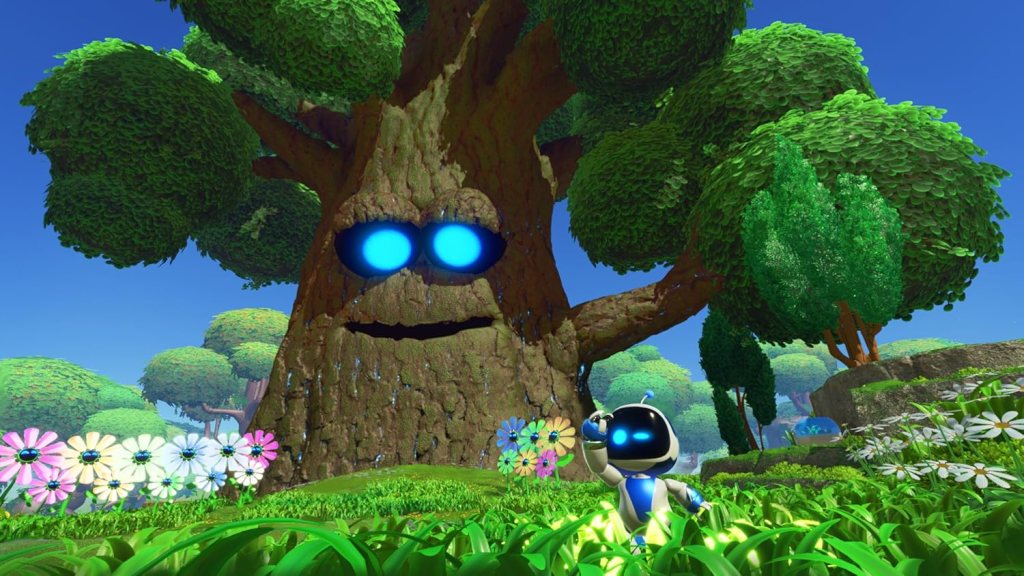
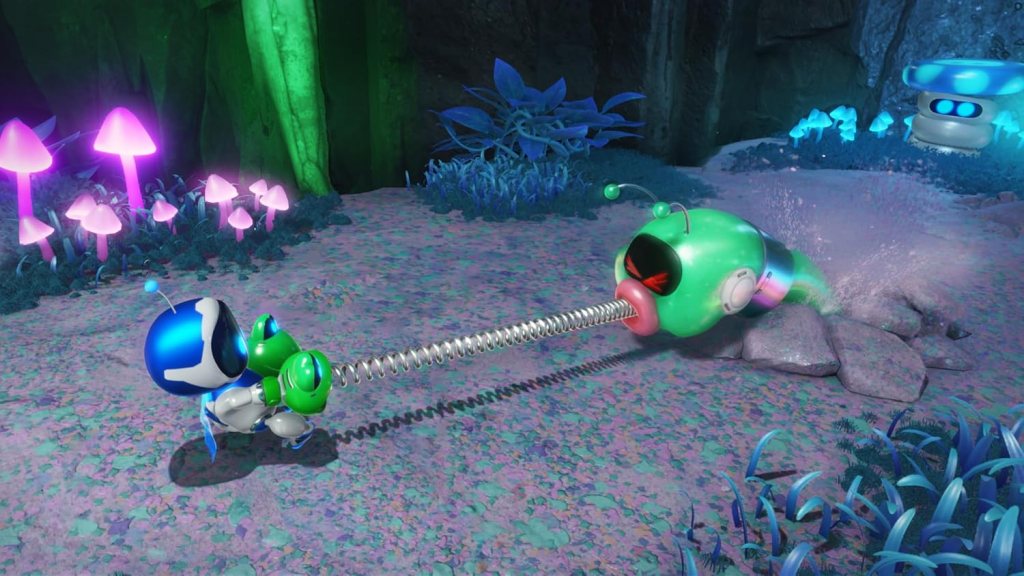
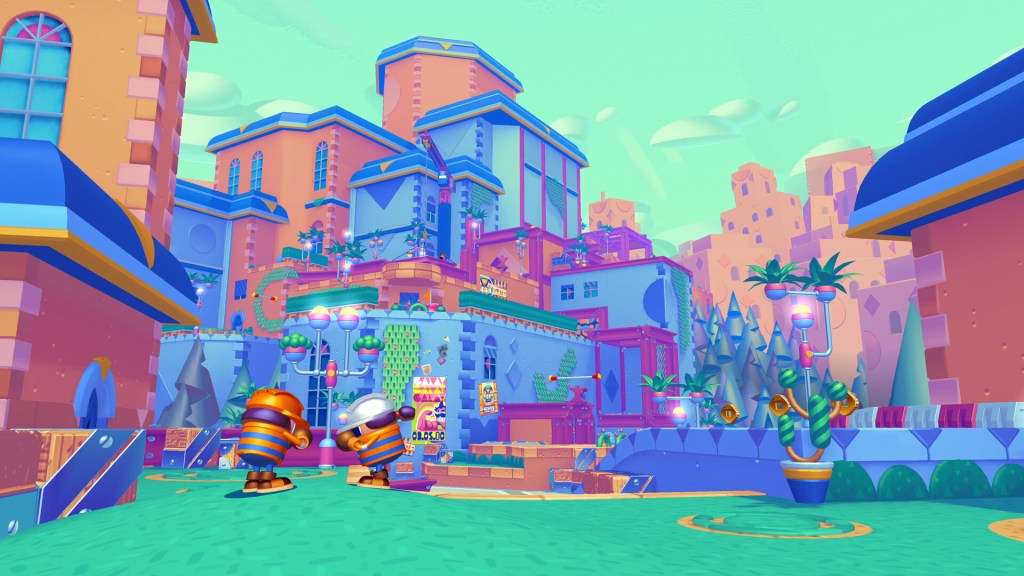
Most levels are a straightforward 3D platforming affair, but there is almost always a power-up or gimmick to keep things fresh. My favorites include the mouse backpack that lets you shrink and explore the nooks and crannies of the level, goggles that let you briefly slow time to avoid speedy obstacles, and a chicken jetpack that blasts you skyward at dizzying speeds. There’s a ridiculous amount of creativity on display in the levels. Each one is like a giant set piece with fantastic theming and spectacle. Whether it’s freeing chained-up starfish, jumping into the mouth of a giant singing tree, or hunting for treasure in sandy villages and stumbling on a Djinn in a lamp, Astro Bot is absolutely brimming with memorable ideas and I don’t want to spoil too many surprises.

Not only are the levels filled with spectacle, but there is also an unparalleled attention to detail. The developers had a penchant for showing off the physics on tiny objects. Levels are filled with things like acorns, confetti, gems, bolts, and other objects that move seamlessly as you wade through them or forcefully launch them. The game also frequently has destructible environments and set pieces that show off the sophisticated physics. The sound effects as you move about on different surfaces is sublime. Astro Bot makes fantastic use of the PS5 controller’s haptic and audio feedback to really immerse the player. The rain effect in particular is very slick. 

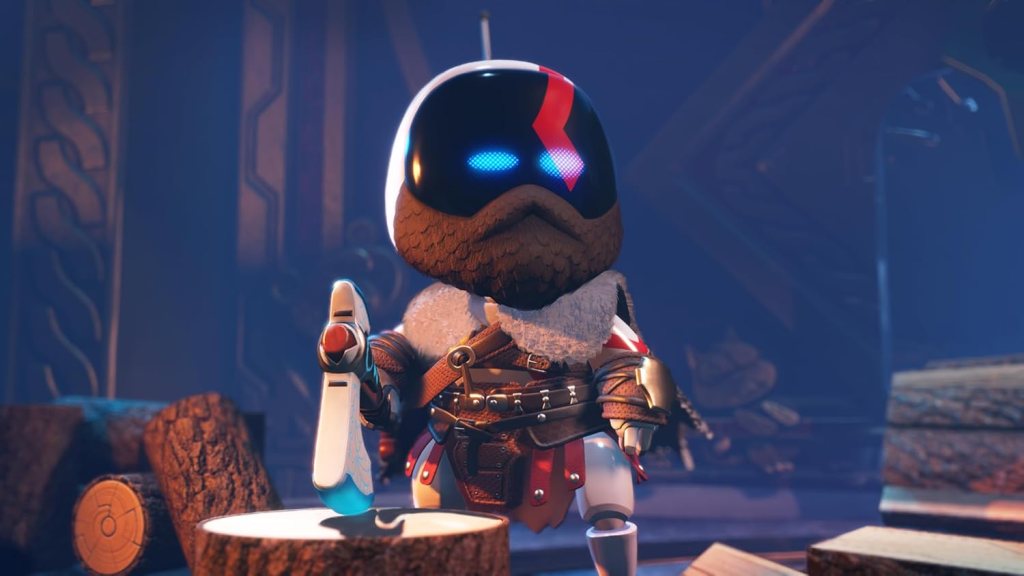
I love collectathons and games with a good hub world, and Astro Bot combines those aspects brilliantly. As you play levels you will be rescuing little robots who will come back to the initially barren crash site. Many of these bots are cameos from classic Playstation games, but they don’t feel like cheap references. Many of the references are fairly obscure and even I had trouble recognizing some of them. But aside from the referential costumes every character has their own comedic blurb that makes it seem like the developers of Astro Bot actually played these games and aren’t using them as cheap references. Furthermore, you can spend coins you collect to acquire accessories for the bots. For example, you can get a cardboard box for the Solid Snake bot to hide underneath. I quite enjoyed walking around the hub world and taking in the characters and scenes from Playstation’s past. It feels like a love letter to gaming.

The one fault I have with Astro Bot is perhaps not a fair one. Because comparing any game to Super Mario is putting it up against the best of the best. But Astro Bot is clearly Playstation’s version of Super Mario, so the comparison is necessary. The main character, Astro, doesn’t have nearly the same movement complexity that Mario has. Astro can run, jump, punch, spin, and briefly hover using lasers. But it doesn’t feel like there is anything to master. I remember playing Super Mario Sunshine a bunch as a kid and trying to master my control on momentum to backflip, wall jump, and hover up to ledges that seemed out of reach. Mario’s moveset is far more complex and the reliance on momentum allows for more mastery for advanced players.

While the movement is simpler, I do think the game benefits from Astro’s fragility. Getting hit once will reset you back to the latest checkpoint. The level design and simple movement lend themselves to a fairly laid-back experience, but you still have to be careful. The game is fairly easy, but it has an edge because a single mistake means death. There are some challenge levels and gauntlets that are decently difficult. Overall, I think the difficulty was tuned quite well for being a family-friendly platformer. 

While playing Astro Bot I really didn’t want the experience to end. It’s an absolute joyous adventure that celebrates gaming and the philosophy that games should be fun first and foremost. While Sony has recently focused on more mature storytelling games, I hope Astro Bot signals that there is still a space for polished platformers and collectathons. The variety of levels, attention to detail, spectacular power-ups, and love for older titles makes this a game nobody should miss out on playing. It is for these reasons that I give Astro Bot a 9.5/10. There’s no doubt in my mind that Astro Bot is a modern classic. 

Animal Well (2024)

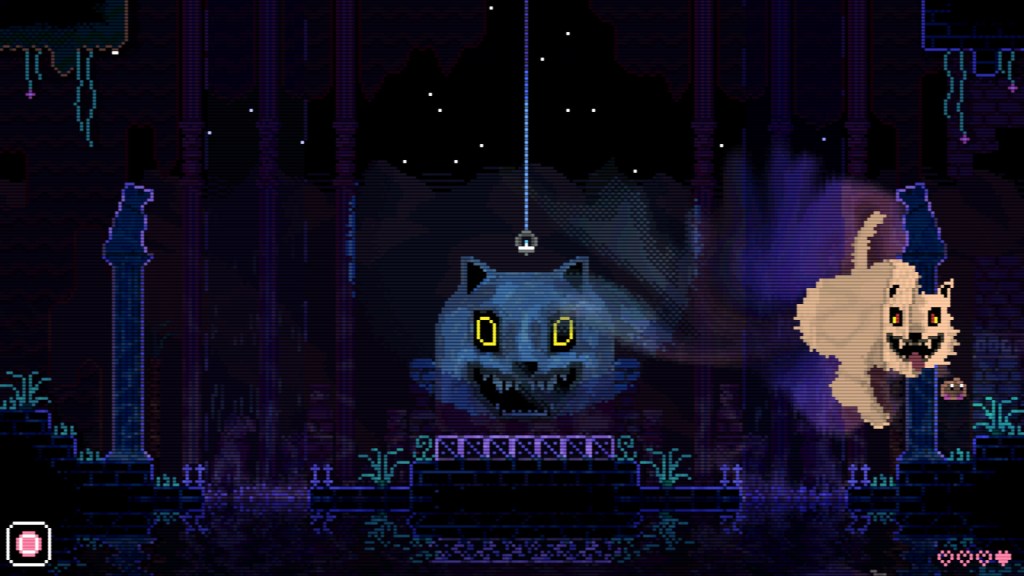
Animal Well is a special game. It’s a game that begs the player to get lost in its atmosphere and labyrinthian level design. It’s a game that has no tutorials or guiding text, the player has to experiment with ideas and explore the world to figure out what to do. It’s a game that transported me into its ethereal world filled with mystery, spooky vibes, and of course, animals. It’s a game that I think everybody is capable of completing, yet it has much deeper secrets that require a dedicated community to uncover. It’s a game that I think you should play.

Metroidvanias are exceedingly common in the indie gaming landscape, but Animal Well stands apart from its peers. There is no combat and it doesn’t really focus on platforming either. Instead, Animal Well is about navigation and thinking. You have to figure out where you can go and how to get there using the tools at your disposal. After a short introductory area, you emerge into a great cavern with four pedestals and matching statues. There are four primary directions to choose from and a handful of other branching paths. It’s up to the player’s curiosity to lead them in a direction.

You may stumble across roadblocks and have to poke around in different directions to see what is accessible. But that is part of the magic of Animal Well. It is a real labyrinth that requires the player to be inquisitive about the world. I often went in a direction and had to turn around and find a different way to go, but I never felt discouraged or stuck. The cogs in my brain were always turning and thinking of where to go next and how to progress. The game’s dream-like atmosphere and gorgeously stylized visuals ensured that I wanted to stay in its world as long as possible.

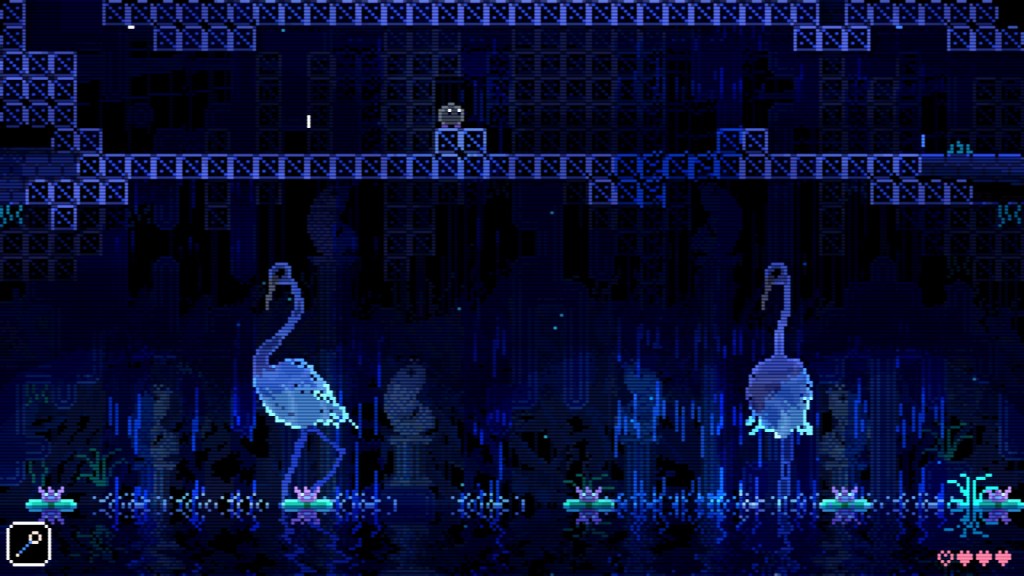
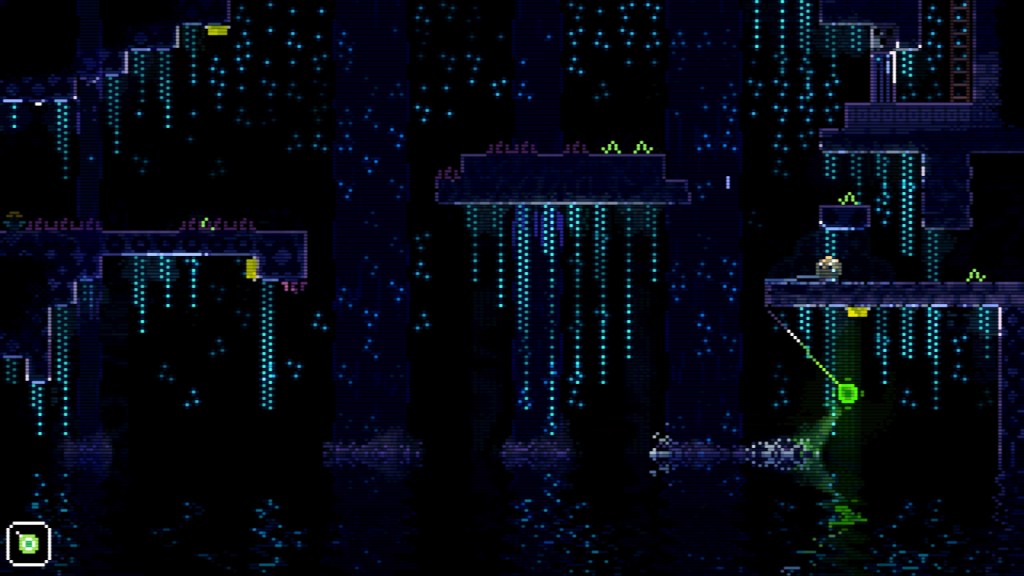
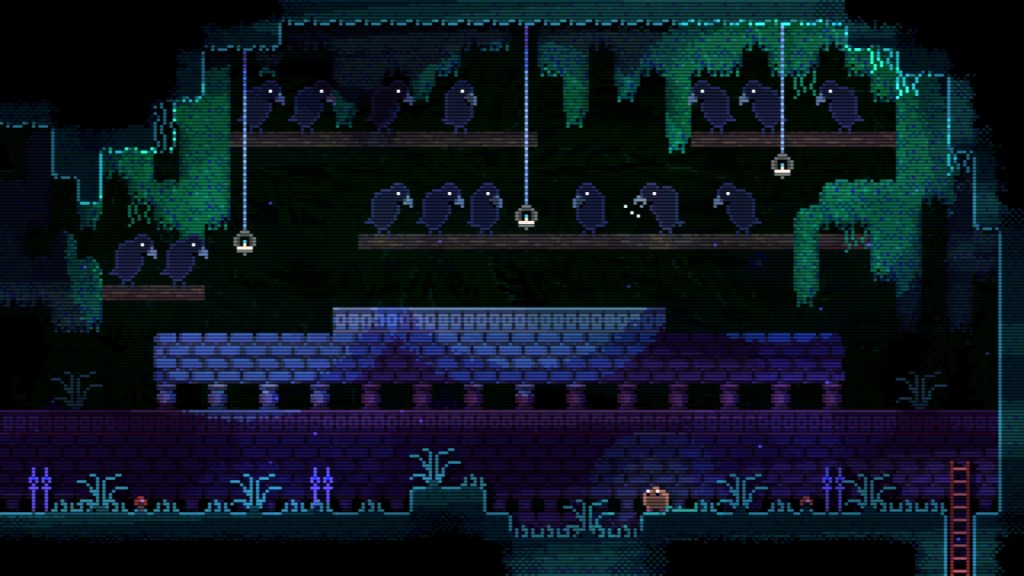
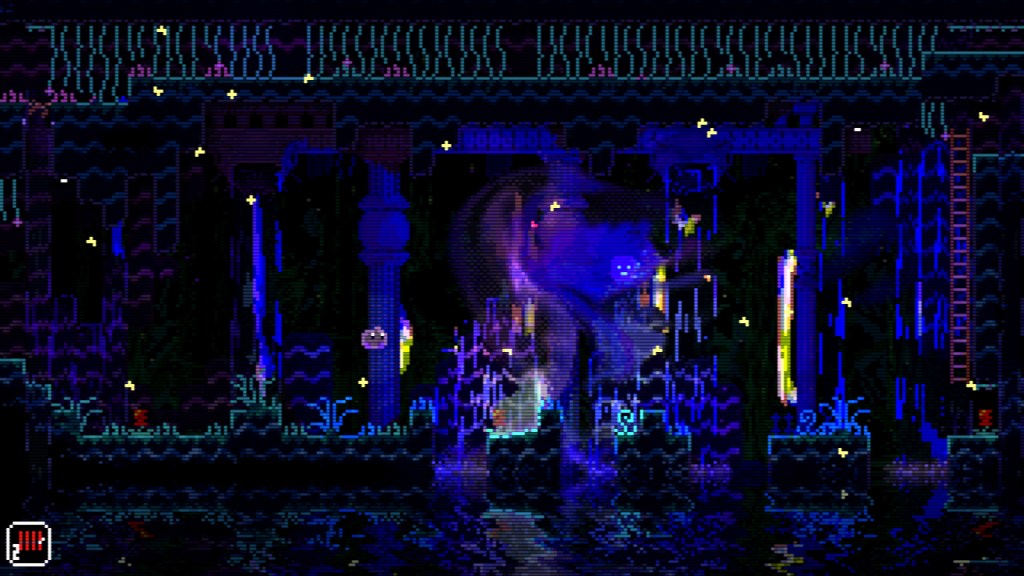
I’ve never seen a game that looks quite like Animal Well. Its cutesy pixel art paired with simulated lighting and fluid effects is truly remarkable. The world is dark, mysterious, and ominous at times. There are even moments of outright terror. But the faint light from lanterns and fireflies provides a comforting glow. Firecrackers provide flickering illumination as well as a hazy smoke effect to distort the environment. The ambient darkness and the understated soundtrack go a long way to make Animal Well immersive. This is further assisted by its cast of creatures.

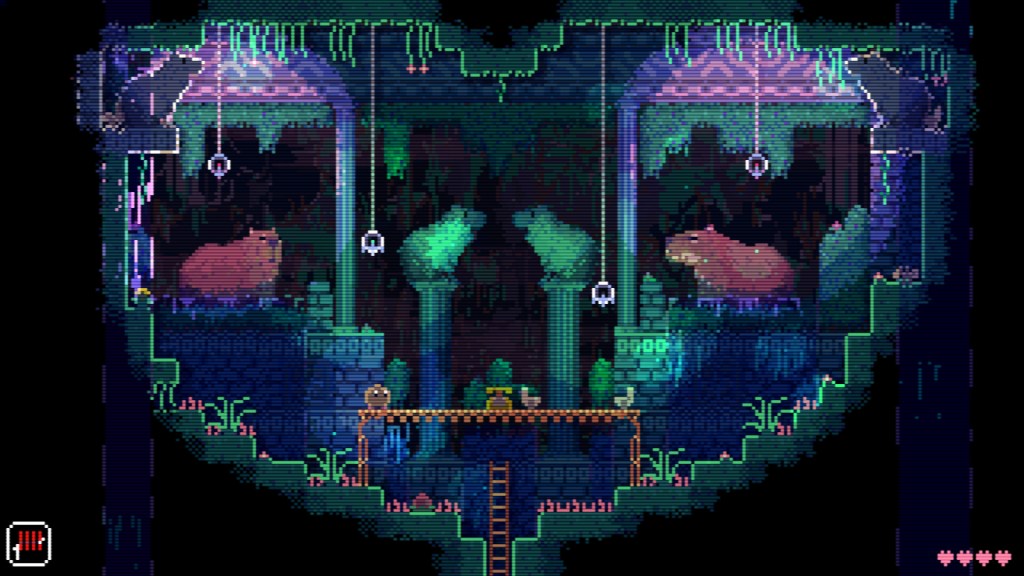
One of my favorite aspects of Animal Well is of course the animals. The world is populated by cute, charming, and sometimes ferocious creatures. From little chinchillas that you can ride atop, to dogs that chase you down, to a whale that shoots jets of water at you, the animals aren’t just set dressing. They feel like real residents of this world with their own personalities and behavior. Figuring out how to avoid or use the animals to solve puzzles is not only satisfying, but intuitive.

The commitment to crafting an ethereal world filled with animals is further reflected in the playful toolset of Animal Well. You never acquire the classic double jump or explosive item to blast open walls, instead the things that you find are more interesting. The player will most likely come across the Bubble Wand and Frisbee as their first couple of items. Figuring out how these seemingly mundane and silly tools can be useful is very enjoyable. Experimenting with how to use these gadgets to traverse the world, solve puzzles, and interact with animals is wonderful.

The only potential hiccup in the main part of the game is the existence of a handful of awkward jumps. I don’t feel like Animal Well really is a platformer. Of course there is platforming in the game, but it rarely asks the player to make a series of difficult jumps. Which makes it odd when there is a particularly awkward jump seemingly out of nowhere. This is made more frustrating because oftentimes when you miss a jump you fall to a previous screen or even get reset at a checkpoint. I think having real stakes when exploring is great, but I can see how some players may get frustrated if they miss a particularly tricky jump a few times in a row and lose their progress.

Animal Well is known for being a “layered” game. From the moment you start to the first time you see the credits roll is the main part of the game and is known as “Layer 1”. There are 3 deeper layers, each with increasing obscurity and there are secrets that still haven’t been found months after release. I strongly disagree with a common sentiment that “the real game doesn’t start until after the credits”. To me, Layer 1 is the most enjoyable due to the exponential growth of complexity and obscurity that the deeper layers require.

I was able to complete Layer 2 and made some progress in Layer 3 before I called it quits. Layer 2 is a fairly straightforward completionist egg hunt. You have to dig through the nooks and crannies of the world to find 64 hidden eggs. I think this is mostly fine, but hunting down those last few eggs can be a little painful as you have no idea where they could be. I spent hours running around the map in circles looking for those last few secrets. Layer 3 is where things quickly get insane. There are 16 bunnies hidden across the map and simply finding them requires a ton of dedication and observational skills. To actually solve the puzzles and acquire the bunnies often requires extreme out-of-the-box thinking. I don’t think that these puzzles are unfair or unsolvable, but I’d be shocked if anybody got all 16 bunnies without outside help. I didn’t even touch Layer 4 and I assume it is only for the most dedicated of puzzlers.

I admire how layers upon layers of secrets are built on top of one another. I love the feeling when you discover something that was expertly hidden right in front of your eyes. While I gave up early on in Layer 3, I appreciate that there are deeper and more obscure puzzles for players who want them. I think the downside of this is that the game will almost always end on a limp note for many players. At some point you are going to reach your limit of obscurity and throw in the towel. It doesn’t feel great to have a great experience end because you had to quit. There’s not really a way to avoid this in a “layered” game like Animal Well. It’s a necessary tradeoff to allow for the iceberg of secrets that the game hides.

Animal Well really is a game that you just have to experience. It’s hard to describe how gripping its dreamlike world is. Exploring the depths of the well and uncovering its secrets is something that I had a hard time stepping away from. Even though I wasn’t able to peel back all the layers, the first layer by itself is spectacular. It is for these reasons that I give Animal Well a 9/10. It’s an experience with unparalleled atmosphere, thoughtful puzzles, and has a mix of memorable moments that are charming and terrifying. 

Penny’s Big Breakaway (2024)

Penny’s Big Breakaway is a game that gets better and better as you play it. As a lover of 3D platformers, I was excited for Evening Star’s debut game. These guys gave us Sonic Mania, the best Sonic game in decades. Once I started playing it though, I thought Penny’s Big Breakaway was just alright. I had trouble with the innovative control scheme and never quite found a satisfying flow to the platforming. But as I progressed through the game, I slowly got more and more familiar with the movement. And that’s where the game shines. Once it clicks, Penny’s Big Breakaway is immensely fun as you dash, swing, and zip through levels. Maintaining momentum and combos is not easy, but the satisfaction of going fast makes it a reward worth earning.

Penny’s Big Breakaway takes place in a brightly colorful world of performers and penguins. Penny is a performer who has to go on lam because her sentient yo-yo ripped off the king’s pants during a performance. The story itself isn’t all that exciting or worth talking about, but that’s ok because it definitely isn’t front and center. What makes Penny’s Big Breakaway interesting is the platforming.

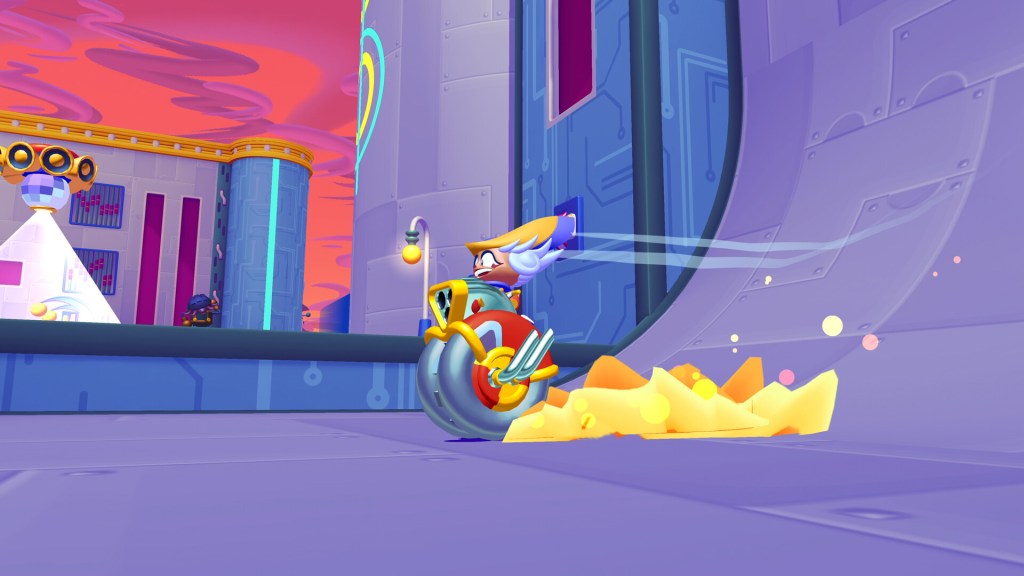
Penny herself is a rather slow and clunky character, but that’s made up for the array of abilities that her yoyo provides. In the air you can sling the yo-yo in any direction using the control stick, and from there you can either dash to the yo-yo or swing from it. These both have their own uses to build speed, height, and distance. Moreover, you also have a small double jump. On the ground you can roll on the yo-yo or spin it around you. The roll is key to maintaining momentum while the spin attack is mostly used for maintaining combos.

With all these possibilities it can be tricky to get a grasp on how to string these moves together. Especially because Penny’s Big Breakaway has a unique control scheme that can take some getting used to. Like I mentioned, Penny is slow and rather boring to just walk around and jump like a normal platformer. The key to having fun is utilizing slopes and stringing her moves together to create a fast-flowing performance. For instance, dashing into a roll on a hill is an easy way to build up a ton of momentum. You can then swing out of the roll to fling yourself across big gaps. An additional consideration is that timing these movements is critical. If you attempt to roll from too high up you won’t keep most of your momentum. And of course, you will fling off tangent to your swing arc whenever you release a swing.

There’s lots of nuances in the movement in Penny’s Big Breakaway. Aside from all the basic moves that I listed above you have to contend with enemies, poles to swing on, power ups, bouncy pads, dramatic slopes, and other complications. Learning how to go fast is what makes Penny’s Big Breakaway fun. And it’s also why I think the game has a steep learning curve. I didn’t really start having a lot of fun until about halfway through because I wasn’t good at chaining together my movements and timing things so I could reach top speeds.

Aside from going fast, another omnipresent objective is to maintain a combo. By masterfully manipulating your entire moveset you will rack up a combo that steadily increases your point total. At first, I thought this is what the focus of Penny’s Big Breakaway was as it is in your face. And don’t get me wrong, maintaining a combo can be fun, as long as you are doing it with speed. If you are new at the game, floundering around to make sure you never drop the combo can be more discouraging than it is fun. And there’s plenty of places where you can just combo back and forth for minutes at a time to rack up a big score. Honestly, I suggest just ignoring the combo system altogether until you start mastering the movement. 

I wish Penny’s Big Breakaway would have emphasized the need for speed a little more. It’s the most entertaining aspect of the game, but the game does very little to encourage going fast. Your score at the end of the level is independent of the time it took to complete it. If you want a high score, you could just combo back and forth as I previously mentioned. Getting a point multiplier based on your speed of completing the level might have encouraged speed. There is a time trial mode, but there are no developer-set baselines. I think this was a big misstep. After completing the game, I was looking to replay some of the levels to get a fast time, but without a benchmark to measure myself against I had no idea if I was doing well or not. Playing against your own times can be fun once you master the game, but I would have liked a point of reference to try to beat.

One of the biggest appeals of Penny’s Big Breakaway is its speedrun-friendly level design. Levels are cleverly laid out with some diverging paths that encourage experimentation. Moreover, there aren’t invisible walls or other tricks to keep the player from finding huge shortcuts. If you do master the movement, you can skip huge chunks of the levels if you find the right gaps and walls to scale. Even if you aren’t a speedrunner, the levels are well-designed that flow nicely and still encourage smaller shortcuts. Sadly, the boss fights are fairly underwhelming compared to the standard levels. My other major gripe with the levels is the optional objectives.

I usually enjoy finding hidden secrets or doing challenges in platformers. But Penny’s Big Breakaway is all about going fast. Having to slow down and look around for potential secrets is annoying. Each level has 3 hidden items and 3 short quests. The quests also are frustrating because they start as soon as you walk in the vicinity of the NPC, and are often timed challenges. Meaning you quickly have to read what your goal is and look around to find where you are supposed to go all while the clock is ticking. If you fail, you have to reset from the checkpoint. I realize the side objectives aren’t necessary to beat the game, but are required if you want to unlock the bonus levels. And the bonus levels are some of my favorites in the game.

Unfortunately, we can’t talk about Penny’s Big Breakaway without mentioning its performance issues. I had many instances of clipping into terrain and walls. During a boss fight I just fell through the floor and died. Certain sloped surfaces also have Penny sliding on them very strangely. These collision bugs aren’t the end of the world, but they are common enough that they can’t be ignored. Luckily, the developers seem to be aware of these bugs and are actively working on patching the collision issues.

As for presentation, I found Penny’s Big Breakaway to be almost too colorful. I understand that the game is trying to harken back to the days of Sega consoles and the dominance of Sonic. But I found the art style of Penny’s Big Breakaway to be garish. Fortunately, the soundtrack is stellar. It’s a nice mix of jazz, funk, and electronic beats that do fondly call back to retro games.

Penny’s Big Breakaway is the epitome of “high skill floor, high skill ceiling”. It’s a game that, if you put the time into mastering it, is an immensely fun fast-paced platformer. Conversely, it can be tricky to find the fun in Penny’s Big Breakaway if you aren’t proficient at building speed. The movement can be slow, clunky, and unintuitive until you learn the timings and sequences needed to gain momentum. It is for these reasons that I give Penny’s Big Breakaway an 8/10. It’s a game that experienced platformers and speedrunners will love to master, but newer players may find it slow and frustrating.

The Talos Principle (2014)

Many games try and fail to meaningfully incorporate philosophical concepts. The Talos Principle is a puzzle game that is genuinely impressive in how it asks classical philosophy questions in a context in which they make sense. Philosophy always runs the risk of sounding pretentious, but The Talos Principle balances it masterfully. Puzzle games in general rarely have a story worth talking about, so I was pleasantly surprised with the unique approach that The Talos Principle took. It’s not the hardest puzzle game around, but I enjoyed how puzzles slowly ramped up in complexity while remaining approachable.

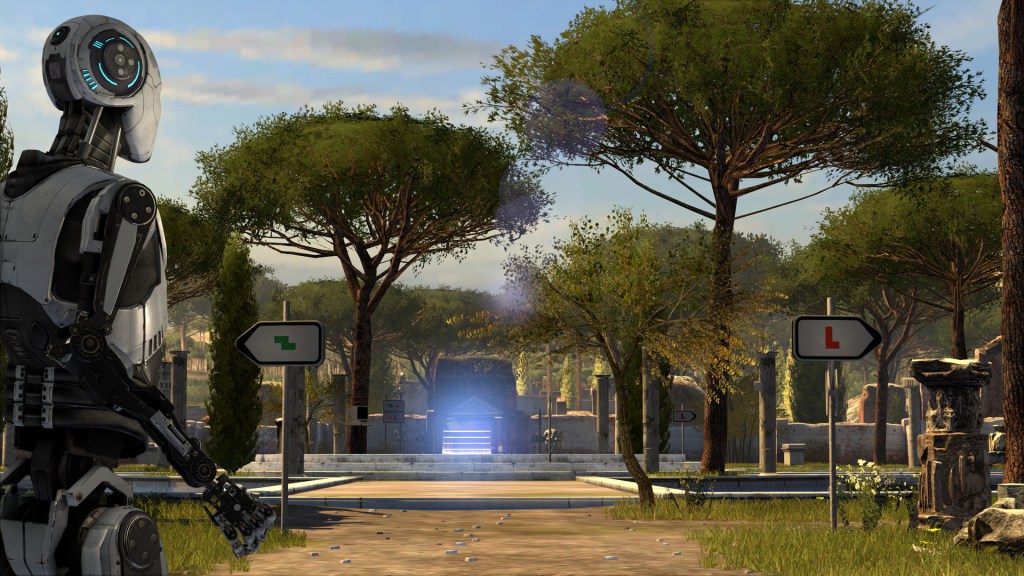
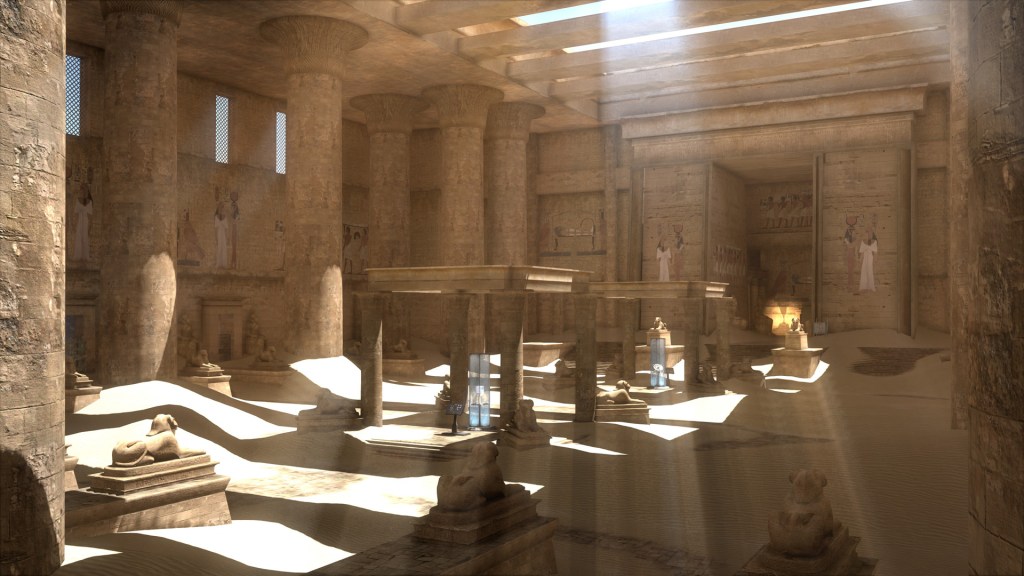
The Talos Principle begins when you come to life in what seems like Greek ruins. An omnipresent voice warmly regards you as his child, as he is Elohim. He is God. You have to solve his puzzles and stay on the path to achieve eternal life. But he warns you against ascending the tower that looms over the temples of this land. Aside from the occasional praises from Elohim, the only other signs of life are in the computer terminals as well as messages scrawled on the wall from those who came before you.

The computer terminals have a variety of texts. Some are excerpts from classic philosophy documents, some are random blog posts, and some are emails sent to and from a scientific institute. It quickly becomes clear that something catastrophic has happened to humanity, and you are in some sort of simulation that had been created by the aforementioned science team. An AI converses with you from the terminal, asking you questions about sentience, consciousness, humanity, free will, and other introspective musings.

I don’t think The Talos Principle tackles any new philosophical concepts, but it’s how the game presents these ideas which makes it intriguing. When you are confronted with the implication that you are a program in a simulation, it makes you think hard about what constitutes a human. You argue with the AI assistant at the computer terminals, debating the purpose of all of this and if you are truly human or not. Can a program ever achieve free will, or does it merely do as it’s told? Philosophy often borders on being pretentious, but The Talos Principle never felt like it was trying to show off how smart it was. It merely places you in the appropriate context to be confronted with these classic questions.

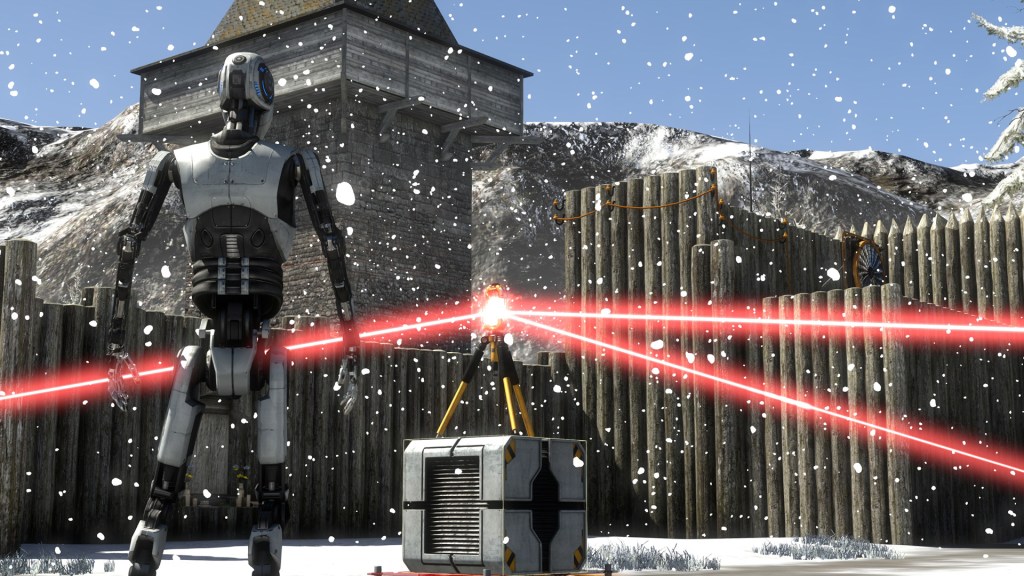
Aside from its philosophical elements, The Talos Principle is first and foremost a puzzle game. Each puzzle is almost like a maze filled with tools and obstacles. There are force fields, turrets, and moving minefields that prevent you from reaching your goal. You are given an arsenal of tools such as jammers, cubes, and laser reflectors to assist you open up pathways. The puzzle design frequently relies heavily on spatial reasoning and order of operations. As you get further and further into the game, the number of tools and obstacles grows such that you have to perform dozens of steps to complete a single puzzle.

A technique that I noticed while playing was that no matter how elaborate a puzzle got, the first step was always obvious. The game rarely gives you more than one object to interact with right away, so you know what to do first. This is clever because it makes the puzzles far less intimidating when you are making progress. Even if all you did was connect two dots, that’s still a step towards the solution. I never truly felt like I was stuck and I never got frustrated because The Talos Principle makes sure its puzzles are segmented into smaller, easier puzzles. And putting the pieces all together at the end is immensely satisfying.

Another interesting aspect of the game’s puzzle design is how deceptive it often is. You learn tricks and gain habits as you play, only for the game to turn those against you. You may see a force field that seems like you need to use a laser to open it, but there’s no feasible way to get a laser in that spot. Or you may think that you need two laser reflectors to get around a couple corners, but really there’s a specific angle that you need to place the reflector at. As I previously mentioned, none of the puzzles felt overwhelmingly difficult, but they do make you feel smart when you catch on to their tricks.

While I did enjoy the standard puzzles in The Talos Principle, there were two other types of puzzles that I loathed. The first type being sigil puzzles. As you solve a regular puzzle, you are rewarded with a sigil, which is a block shaped sort of like a Tetris piece. When you collect enough sigils, you can use them to open doors. You have to fit the pieces together into a perfect rectangle. It’s simple enough, and most of the time isn’t too difficult. But towards the end of the game there are some sigil puzzles leading to secret areas that require you to fit a dozen or so pieces together. I never found a reliable way to solve these puzzles, and mostly relied on just guessing or using intuition. Sure, you learn which pieces fit nicely together as you play, but it’s annoyingly time consuming to just slap pieces together and pray that it works out.

The second variety of groan-inducing puzzles are the secret stars. There are 30 secret stars hidden throughout the game, and collecting enough of them grants you access to bonus areas. Truthfully, I quite enjoy the puzzle portion of collecting most of these. They usually require some outside-the-box thinking, like stacking boxes to go outside the boundaries of a puzzle or using a laser from one puzzle to open a gate in another one. The issue with the secret stars is finding them. They are often hidden in completely obscure locations with little to no hints of their whereabouts. I want to solve puzzles, not run around in circles looking for a corner that might have a secret in it.

Fortunately, both the secret stars and sigil puzzles are only minor aspects of the game. Sigil puzzles are usually fairly simple and the stars can be ignored altogether. The bulk of The Talos Principle is in its standard puzzles and in its philosophical ponderings, both of which are excellent. It’s rare to come across a game that doesn’t make philosophy feel forced and pretentious, but The Talos Principle excels at asking questions in an organic manner. The puzzles never wowed me with grand revelations, but I found them to be addictive in their simplicity. As a lover of puzzle games, I can’t believe that I put off playing The Talos Principle for so long. If you enjoy puzzle games, you owe it to yourself to play The Talos Principle.

Borderlands 2 (2012)

Admittedly, I don’t have a fresh mindset going into Borderlands 2. I wish I did, but I’ve played this game numerous times since its release. It is hard for me to give my straightforward impressions since I am already so familiar with everything in Borderlands 2. This should be a testament to how much I enjoyed the game. I rarely replay games, but I’ve played Borderlands 2 about five times. Even after a couple of single-player campaigns as well as a few co-op playthroughs I still never grew tired of Borderlands 2. With Borderlands 3 finally being released, I think it is time for me to finally let one of my most played games rest.

1

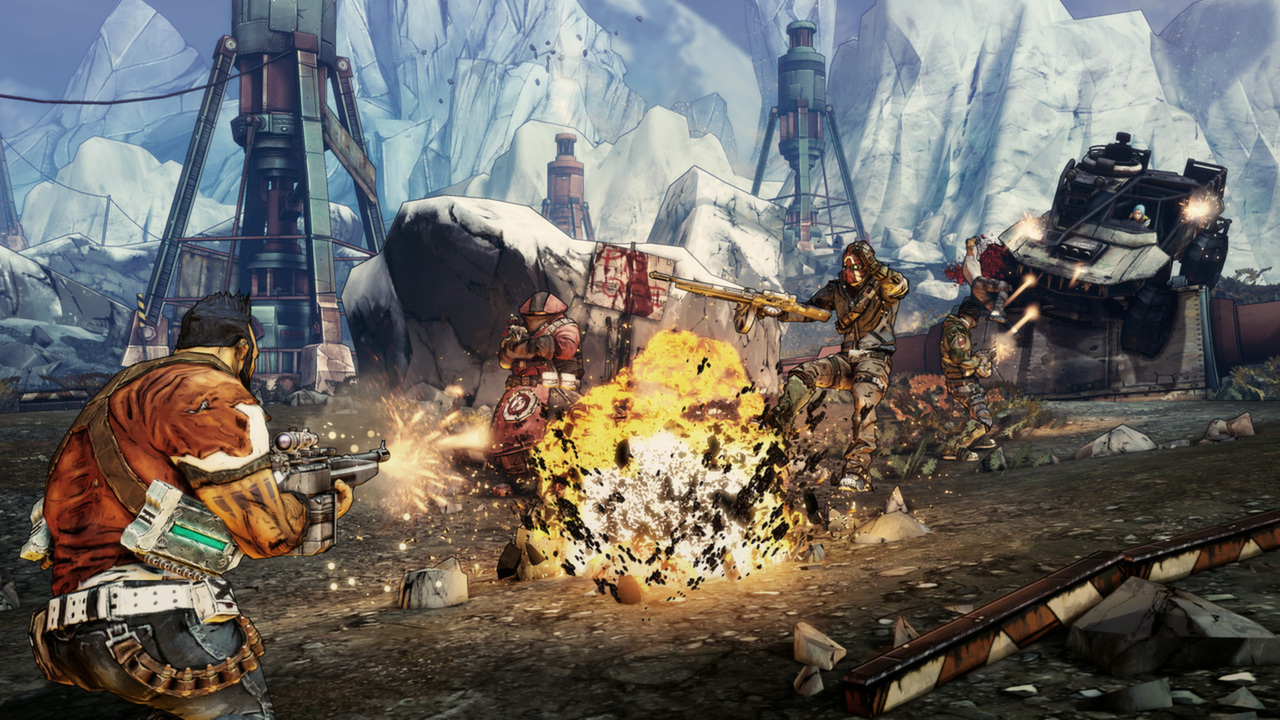
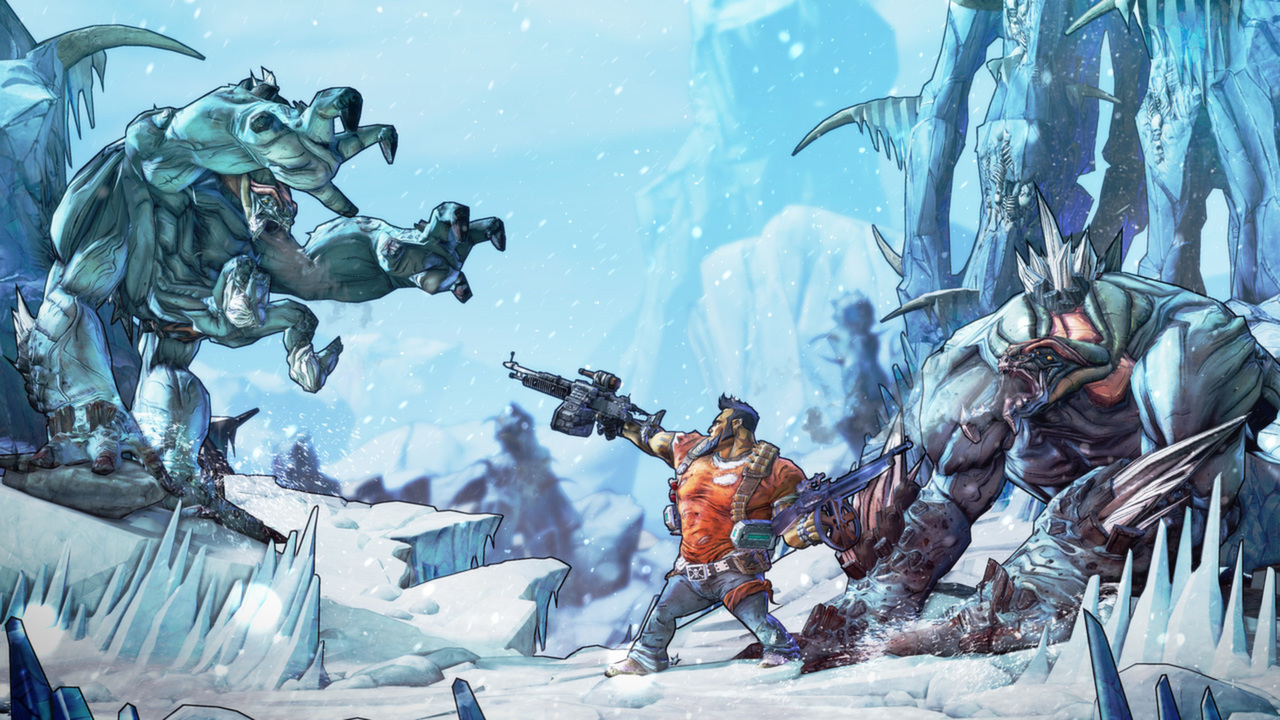
Playing the first Borderlands has made me appreciate the sequel with at least a little of a fresh perspective. The original game invented the looter-shooter genre, but Borderlands 2 perfected it. The general formula is the same as the original game: you play as an intergalactic treasure hunter, blasting your way through desolate wastelands to reach a mystical vault. There are 4 different vault hunters to choose from, each with their own abilities and skills to upgrade as they level up. Of course, to reach the vault the player must shoot their way through hordes of bandits, alien creatures, and deadly machines.

2

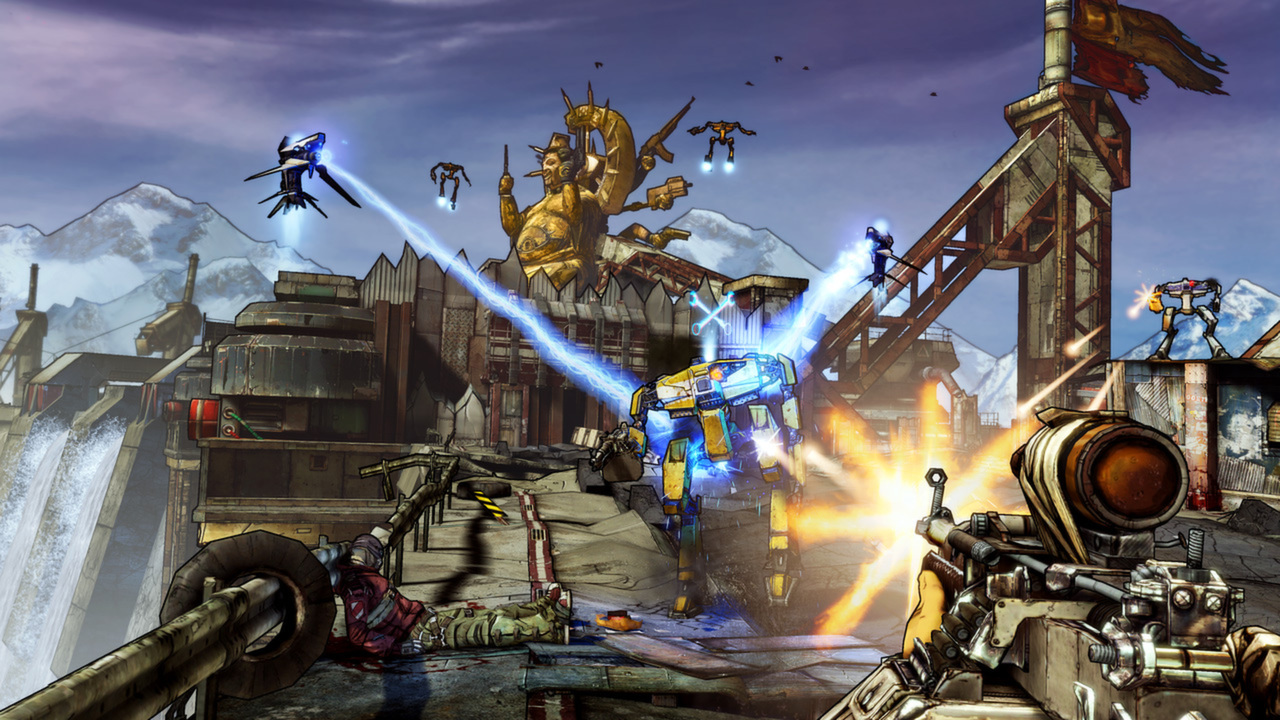
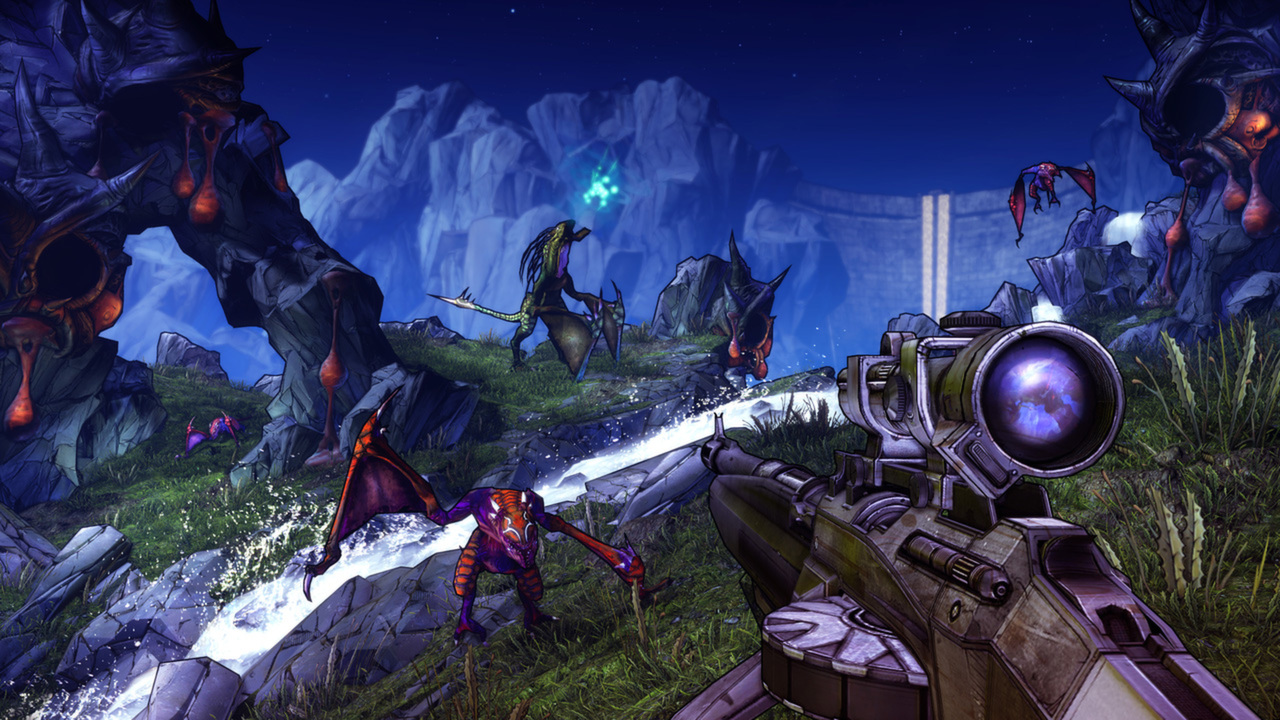
Unsurprisingly, Borderlands 2 is tangibly more modern than its predecessor. Visually, Borderlands 2 holds up superbly. The classic comic book style is striking and remarkably distinguishable. When you see a screenshot of Borderlands, you know its Borderlands. While I felt like the environments of the original game were an amalgamation of shades of brown, the world of Borderlands 2 pops with vibrant colors and varied areas. Most importantly, Borderlands 2 just feels better to play than its predecessor. Movement is less sluggish, the weapons are more responsive, and there are far less technical issues. It cannot be understated how important it is for an FPS to have guns that simply feel powerful. The sounds, animations, enemy reactions, and immediate feedback all contribute to having weaponry feel impactful. Additionally, my Borderlands playthrough was plagued by technical issues like bugs and crashes. Thankfully, Borderlands 2 performs consistently and cleanly compared to its ancestor.

3

Looter shooters live or die on their loot system. When loot is weak or infrequent, the player can feel like no progression is being made. Conversely, overly powerful or abundant loot can lessen the impact of those moments where you get something really special. Borderlands 2 strikes a nice balance which the original game did not. The original game’s loot was heavily randomized: fodder enemies could drop top-tier loot, but most of the time you just got garbage. While Borderlands 2 cut down on the player’s odds of getting great loot from random enemies, instead the game doles out more consistent loot at obvious intervals. Doing side quests and defeating bosses is the single most reliable method of getting new and exciting guns. I much prefer this system over farming numerous weak enemies for a tiny chance at a new piece of equipment.

4

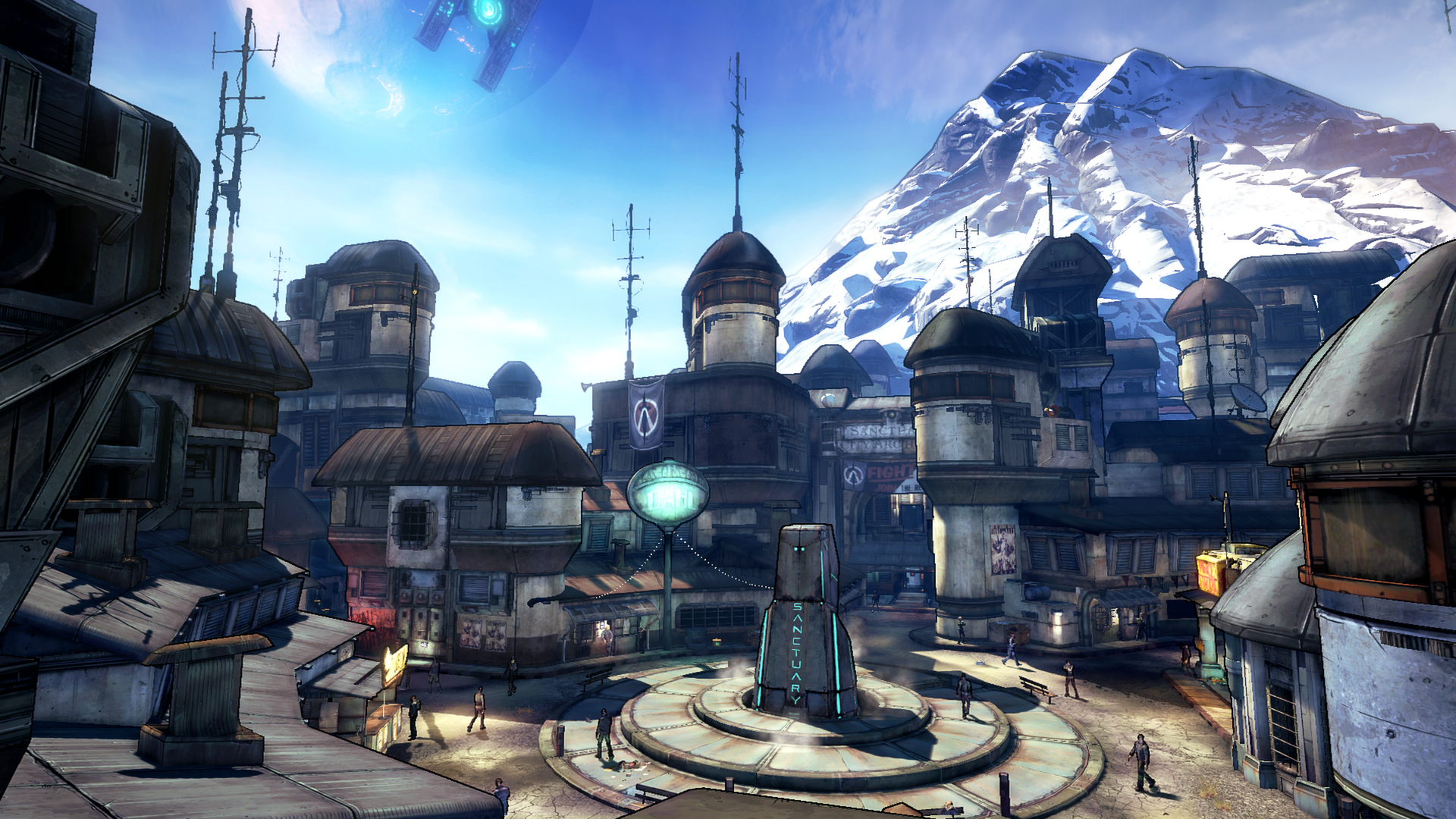
Borderlands 2 is legendary partly due its characters and story. As you traverse the planet of Pandora you encounter various factions vying for control. At the head of the conflict is Handsome Jack, a cruel and vindictive business man. His ultimate goal is to open the vault and harness the power that is held within. As the vault hunter, the player is obviously at odds with Handsome Jack. As you ally with the locals at the town of Sanctuary, Handsome Jack is prepared to do anything to take you and your associates down. It cannot be understated how iconic of a villain Handsome Jack is. His genuine belief that he is the “good guy” makes him a compelling nemesis, willing to do anything to succeed.  There are many returning characters from the first game, including the playable vault hunters from that expedition. I absolutely loved seeing how the protagonists from the first game played a key role in the narrative of Borderlands 2.

5

While known for its bombastic sense of humor, Borderlands 2 is hit or miss in the writing department. Every character is an over the top caricature, equipped with heaps of jokes. Unfortunately, many of the jokes fall completely flat. Now, this is partially due to when the game was released. In 2011, the internet was full of outrageous “random” humor which Borderlands 2 heavily leans into. It may be unfair to judge the ridiculousness of Borderlands 2, as it was a product of its time. Still, it feels like the writer’s were trying to hard to pack in a million gags, and I wish it had been dialed back a bit. Despite it being a defining feature of the game, much of its humor has not aged particularly well.

6

Ultimately, I think Borderlands 2 was a revolutionary game which blew open an entire genre. Looter shooters have become increasingly popular over the years, but Borderlands 2 holds supreme. The bombastic action, variety of characters, plethora of guns, graphic art style, and wacky dialogue certainly makes this game unique. I’ve played this game numerous times since its release, and it will always remain as a classic in my heart.


Gravity Rush 2 (2017)

With its evolution from PS Vita to PS4, I had high hopes for the Gravity Rush series. Unfortunately, Gravity Rush 2 missed the mark of my expectations and left me disappointed. The original Gravity Rush had vibrant characters, an exciting world, and unique gameplay, but it was hindered by its lack of scope and general repetition. Gravity Rush 2 inherited all of the great things from the original game, but the menial gameplay was also brought along. It’s a shame because Gravity Rush has tremendous potential as a series, but it is squandered by painfully boring missions.

1

It is undeniable that the characters of Gravity Rush 2 are incredibly likable. Kat remains as a bubbly and exuberant as ever, but Gravity Rush 2 introduces some equally lovable heroes. Also, a stronger focus on returning characters such as Raven and Sid is a welcome addition. Undoubtedly, the largest improvement was to the world itself. The original Gravity Rush took place within the confines of the flying city of Hekseville. Gravity Rush 2 progresses through multiple settlements and cities, taking a deeper look at life in this fantasy world. Moreover, the vibrant artstyle brings plenty of life and character to the setting of Gravity Rush 2.

2

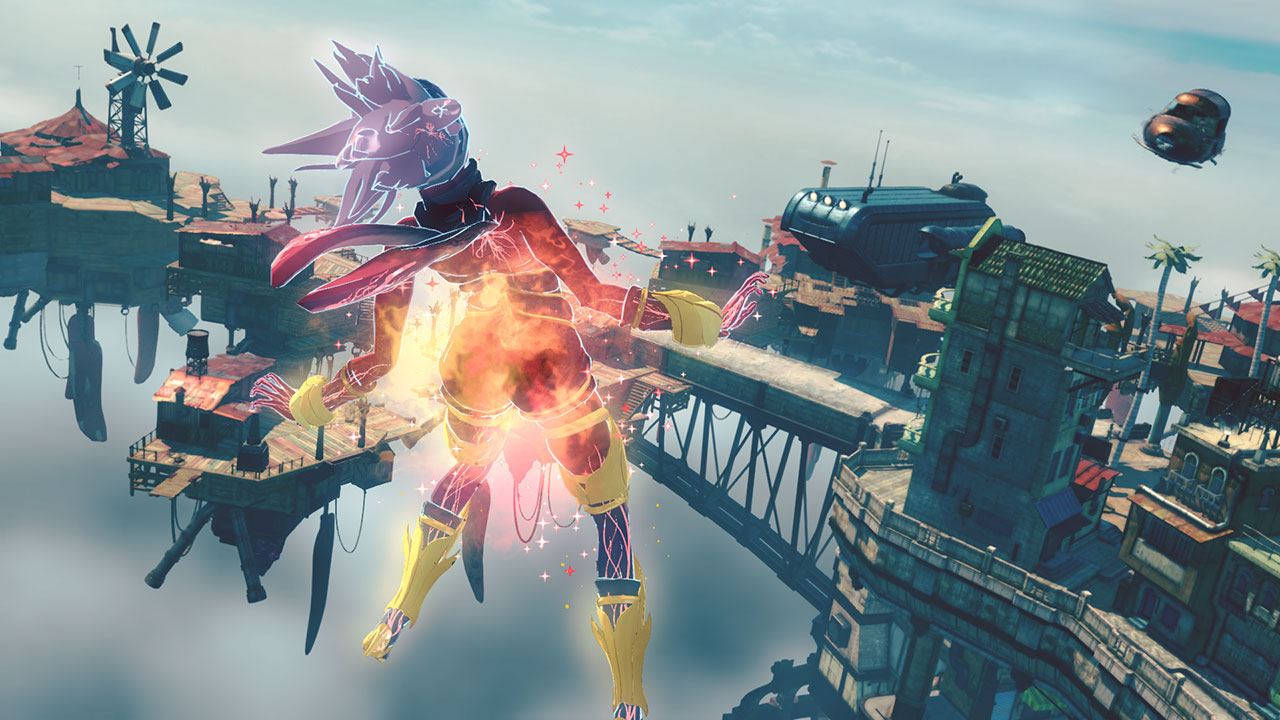
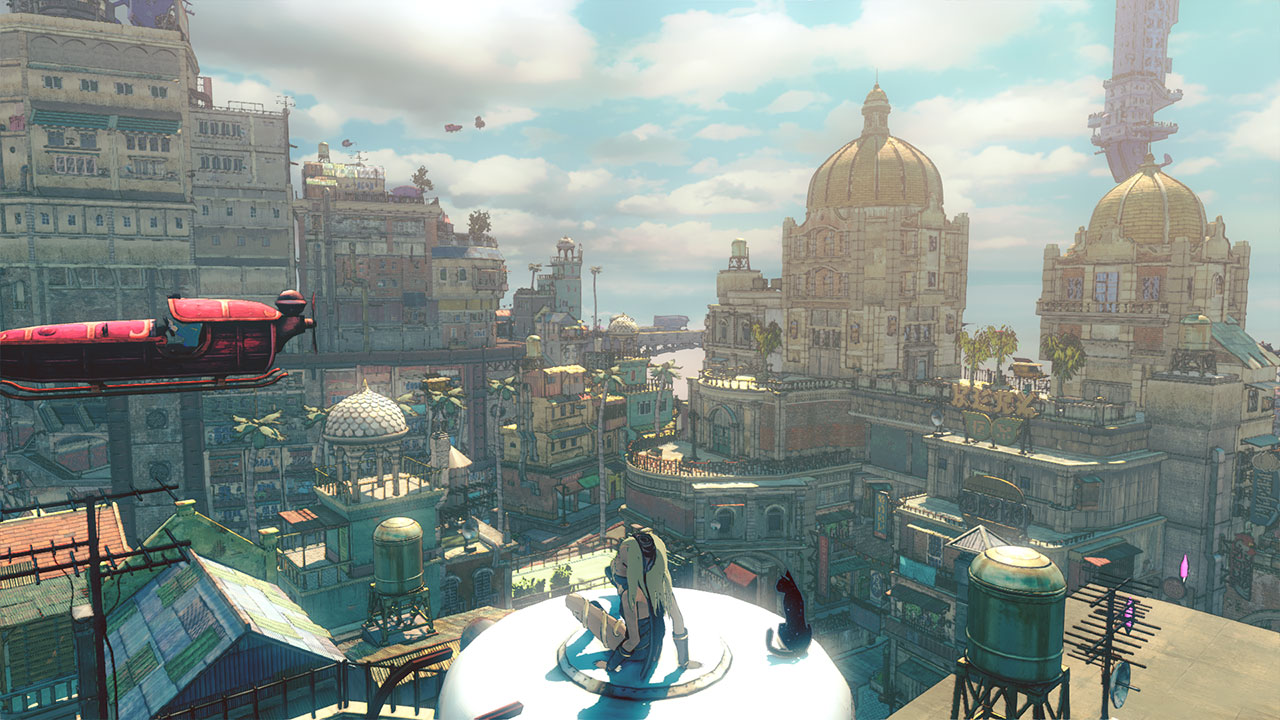
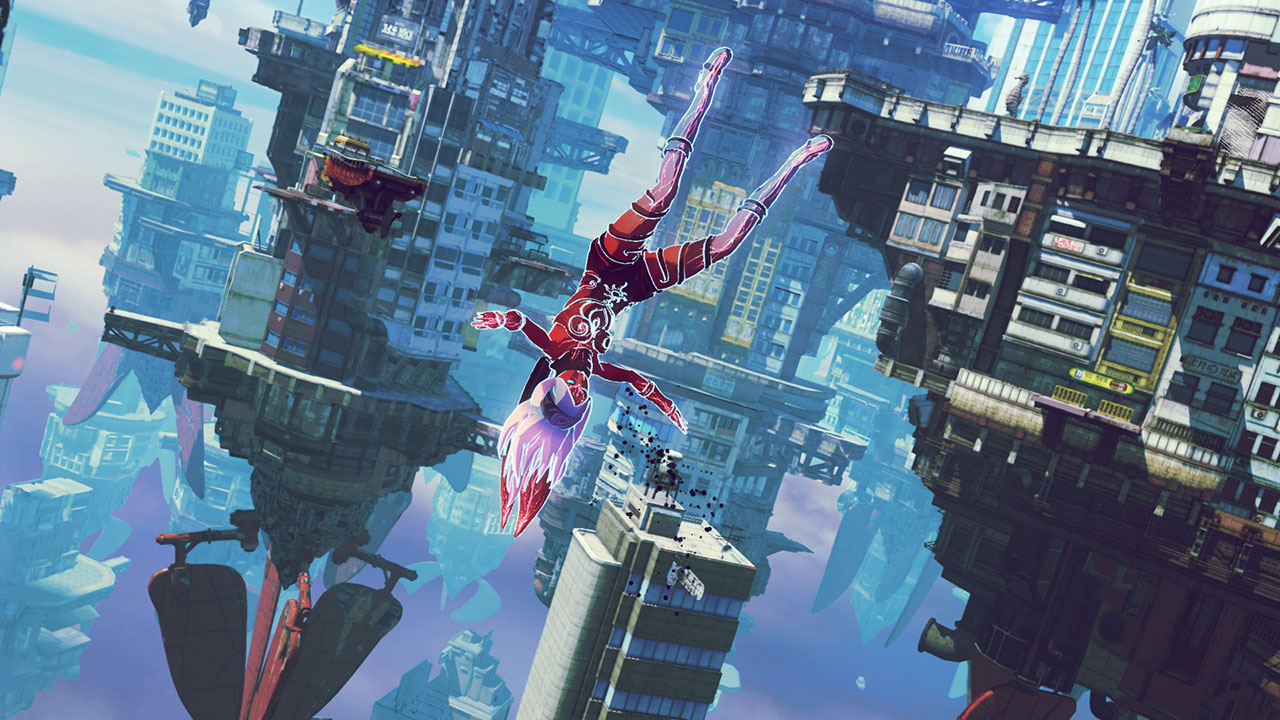
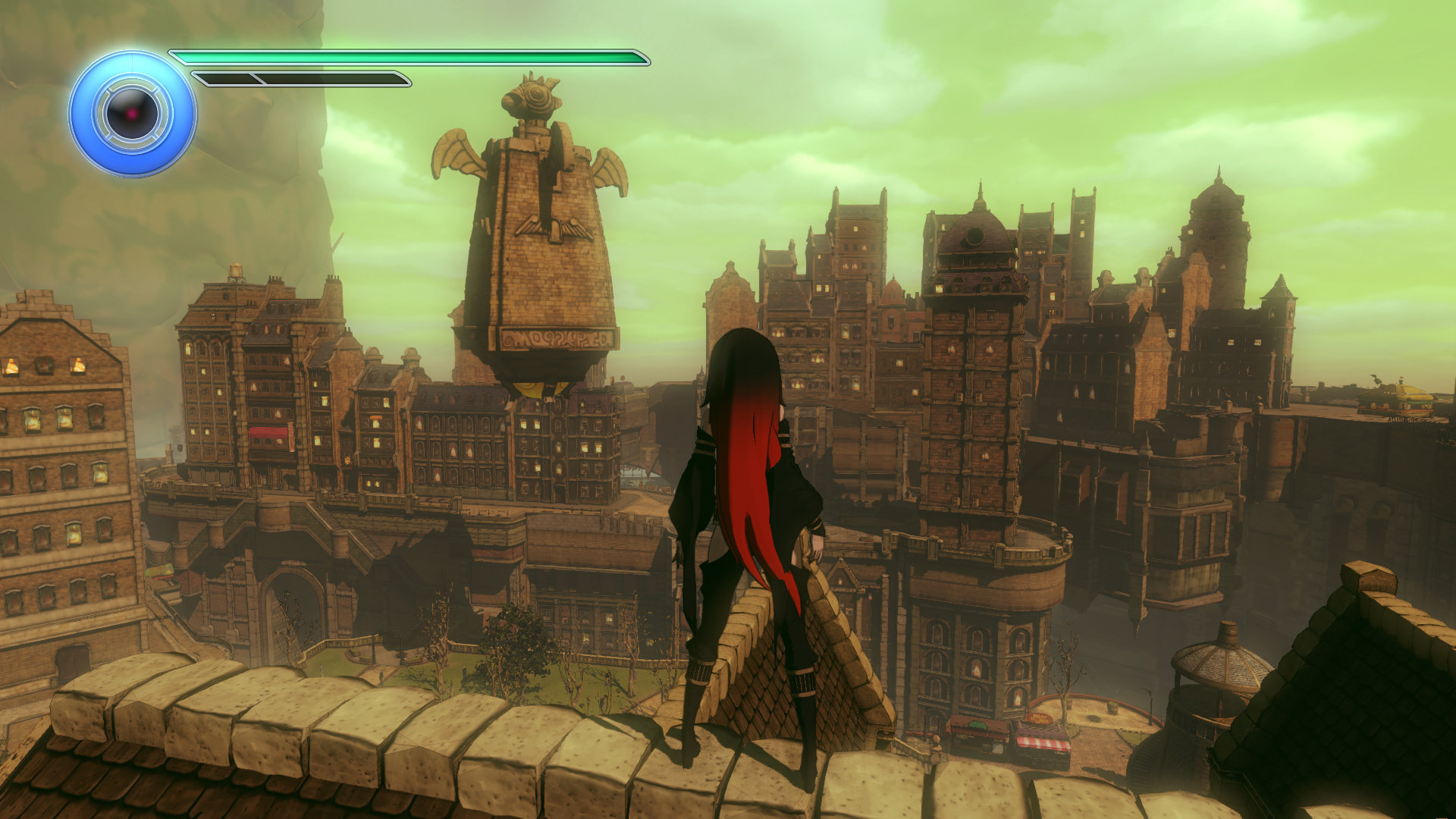
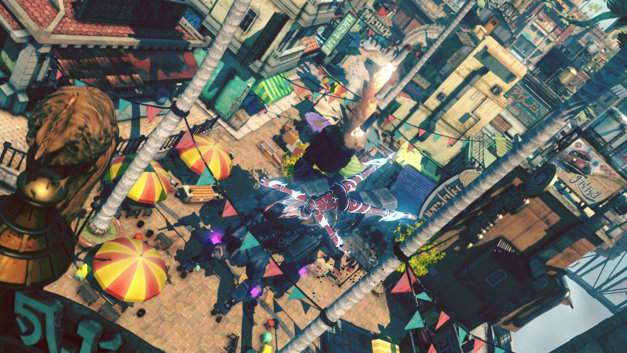
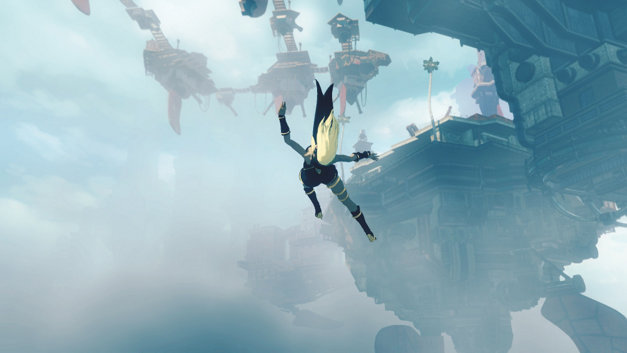
Initially, the player starts in Banga, a mining settlement which is no more than a loose collection of shanties and huts. The people of Banga fly through the skies, stopping at pits of ore that they collect that is used to power the flying machines. The nomadic miners sell the ore to the flourishing city of Jirga Para Lhao. This metropolis is a collection of floating islands, separated into economic sections. The verticality and scope of Jirga Para Lhao is truly astonishing, and it serves a phenomenal example of a memorable game world. At the very bottom of the city is a rundown slum, overcast by clouds and the islands above it. The central level is a bright and lively marketplace, while the top level consists of mansions and private islands.

5

Unsurprisingly, the theme for much of Gravity Rush 2 is class inequality. While Kat tries to recount her past, her helpful personality leads to her uncovering exploitation and abuse of power. Kat motivates the downtrodden people of Banga and Jirga Para Lhao to rebel against their corrupt government. It’s not a revolutionary plot-line, but it was heartwarming. After that story-line, Gravity Rush 2 enters complete insanity mode. Once the truth of Kat’s past begins to unfold, the interconnected nature of all the plot-lines becomes clear. It’s hard to accurately describe the ending of Gravity Rush 2 without spoiling too much. It suffices to say that time-distortion and higher-power beings play an integral role in the final chapter. Throughout the series I was worried that all of the seemingly disjointed threads would never be connected, but I was thoroughly satisfied by the over-the-top conclusion.

4

While the presentation of Gravity Rush 2 is stunning, I was incredibly disappointed by just how banal the gameplay actually was. Most missions fell into a few different archetypes, the vast majority of which were just flat out uninteresting. The most common thing the player is tasked with is flying to various waypoints. While this makes use of the fairly fun flying system, most of the time you are just repeatedly flying in a straight line from island to island. Many of the missions consist of flying around searching for a needle in a haystack. The game will give you a general location of your objective, but you have to painstakingly comb the area for what you are searching for. The absolute worst is when you have to talk to every nondescript NPC you can find and hope that is the right person. These sections are nothing but a frustrating waste of time. To make matters worse, many side-missions strip away your gravity powers entirely. This is odd considering that the premise of the game is to shift gravity.

8

For some bizarre reason, Gravity Rush 2 implemented a significant number of stealth missions. The core prospect of the game is being free to manipulate gravity and zip around the city, so being forced to slowly walk around in a stealth mission is an obnoxious interruption. The mission structure of the game sucks out any modicum of fun that could’ve been drawn from the game’s unique concept. The optional side-missions could’ve been a great asset to the game, as they let the player interact more with the beautiful world and characters. It’s a shame that they are so mundane and offer pitiful rewards. Gestures and objects to be used in the game’s photography-mode is not a suitable reward for a 45-minute long side-mission. While I gave up on doing many of the side-missions, the main-missions of the game are not any better.

9

I heavily criticized the original Gravity Rush for its combat system. Luckily, Gravity Rush 2 has made significant improvements to the diversity of the player’s tool set. I no longer had to spam the gravity kick repeatedly, as the standard kick and gravity throw have been upgraded to actually serve a purpose. The standard kick, while still weak, is used to charge up the player’s special gauge which is used to unleash more powerful attacks. The gravity throw was substantially improved as it’s radius for grabbing nearby objects was greatly increased. Also, it can be used to grab some of the game’s weaker enemies. I will always get a kick out of flinging some poor guy at his friends like some sort of human bowling ball.

7

The other way that the game improves upon some of the combat repetition is by adding some additional styles. The new Lunar style decreases the effects of gravity and makes Kat much lighter. This is critical for fighting airborne enemies who can otherwise be a nuisance. Conversely is the Jupiter style, which greatly increase gravity and makes Kat much slower and clunkier. She deals much more damage, but is far more unwieldy. I didn’t make much use of these additional styles because they both made Kat much harder to precisely control, but they both have merit in specific situations.

3

Even with the addition of the new styles and improved combat, I still felt like the combat of Gravity Rush 2 was lacking in a few regards. Most fights still just consisted of spamming either the gravity kick or gravity throw. Also, I felt like I was fighting the camera just as much as I was fighting the enemies. If you miss your gravity kick by a little bit, be prepared to massively disoriented. Additionally, a few areas existed in such tight confines that it was incredibly difficult to make accurate use of any gravity shifting powers. As a result, the combat was mediocre and not nearly enough to carry the rest of the game’s shortcomings.

6

I really wanted to like Gravity Rush 2. I was enthralled by its world and excited by its premise. The original game showed plenty of promise but needed to reduce repetition, but it seems the sequel has just doubled down on these flaws. I rarely found myself having fun with the game, and every mission felt like a chore. I don’t know how you take the concept of being a gravity shifting superhero and turn it into a game where you mostly do menial chores like handing out flyers and bringing people from one place to another like some sort of glorified taxi service. Still, the game’s presentation is absolutely stunning. It is for these reasons I give Gravity Rush 2 a 5.5/10. I was incredibly disappointed that the missions were so fumbled so badly that it dragged down the more promising aspects of the game.

Sundered (2017)

As someone who loves metroidvanias, action games, and Lovecraftian atmospheres, Sundered seemed like a perfect fit. This is the second game developed by Thunder Lotus Games, who have become renowned for their beautifully hand-drawn characters. At times, Sundered felt exceptionally exhilarating to play, but in other instances the game was pure frustration. This dichotomy stems from the game’s core ideas and the inherent randomness of the experience.

5

In Sundered you play as Eshe, an adventurer who fell into an eldritch portal which transported her to an ancient underground city. Eshe encounters a shapeshifting sinister being, which guides the player on their journey and serves as their weapon. You travel throughout the devastated city, encountering monsters and bosses along the way. Eshe collects new weaponry and upgrades to aid her on her journey back to the surface. Simply put, the game is a metroidvania, but with a unique twist. The levels are partially randomly generated, which is a bold decision in a genre that heavily relies on its level design. Additionally, apart from new weaponry and items, you also collect currency and runes to upgrade Eshe’s abilities.

8

As you explore the world, you will uncover runes that can be equipped. These runes are intriguing because they have positive and negative attributes. For example: you deal 30% more damage, but you have 20% less health. You must pick and choose which runes you would like to use, being aware of what synergies make sense. Players must decide what negative effects they are willing to cope with. I quite like the choices and I enjoyed testing out different combinations of runes. In addition to runes, you will collect currency to spend on your skill tree. This giant tree also implements some interesting decision making. Small nodes contain flat bonuses to your damage, health, armor, and shield. Scattered along the tree are larger nodes with more powerful bonuses such as an additional 15% damage or more critical strike chance. You must prioritize which bonuses you want to go for, as it quickly becomes expensive to work your way through the tree. I actually really liked this implementation of progression as building a character to my liking is engrossing.

9

Each area in Sundered has a basic outline, represented by big blocks on the map. Within these large chunks, there are smaller blocks which are randomized. Every time you generate an area, these smaller blocks get jumbled around and create a different path through the big blocks. In essence, the basic structure of the area will always remain the same, but the exact path is going to constantly change. I actually feel like this works decently. Metroidvanias are all about exploration, and with the levels constantly changing, the player will always need to explore. With the unchanging large block locations there are cleverly placed shortcuts to open to ease navigation. As you progress through a level, you can open doors that link back to locations earlier in the level. This way, next time you go through the level you can skip many of the procedurally generated bits. This randomization also makes sense in the context of Sundered. It’s appropriate that the twisting, living tunnels of a demonic city are constantly shifting.

7

The downside to the random level generation is much of the game ends up being entirely forgettable. The tunnels and rooms utilize the same assets, so there lacks a unique element to make areas stand out. Every trip through an area feels like déjà vu, you encounter the same rooms, just in a different order. Overall, a procedurally generated metroidvania works in the context of Sundered, but it ends up being repetitive after a while. Interestingly, randomization doesn’t end with the level design; enemies also spawn in randomly. Occasionally enemies will spawn in small groups, but the bulk of the combat occurs when hordes spawn. Hordes occur randomly and are signaled by the signature bang of a gong.

3

The pure chaos which a horde brings is almost indescribable, hundreds of enemies run at the player from all directions. Many of these enemies can also shoot projectiles, fly, or teleport. Absolute mayhem. At times, hordes can be actually incredibly fun. If you are well equipped and in a prime fighting location, shredding through dozens of enemies with a few satisfying swings of the blade is viscerally gratifying. It’s challenging, intense, fast-paced, and pure fun. Unfortunately, this is not always the case. If you aren’t strong enough, hordes will absolutely wreck you. No amount of skill can overcome the muddle of hordes, you are guaranteed to be hit, you just need sufficient stats to win. Moreover, if the horde spawns in an inopportune location, such as one with many hazards or pits, the fight can become immensely overwhelming.

2

Furthermore, with so many enemies, visual effects, animations, and projectiles, it is incredibly easy to lose track of where Eshe is. Especially since you get bumped around when taking damage. The absolute worst part about hordes is how randomly they occur. Sometimes I could play for 10-15 minutes with no combat at all, and other times there were so many hordes I literally could not progress forward. I would defeat a horde, move forward for 15 seconds, then the gong would sound and have to do it all over again. Fighting multiple hordes in a row can easily drain your health potions and get you killed. It can be frustrating that your progress is essentially tied to how many hordes spawn in any given timeframe. I wish hordes occurred in specific rooms instead of entirely randomly. That way the developer can control the environment, the type of enemies, and how many hordes a player has to deal with before unlocking a shortcut or new item.

4

The enemies and bosses of Sundered are incredibly creative and interesting to look at. The bosses in particular are humongous, awe-inspiring beasts. The boss fights are mostly very fun, you have to hit weak points to do damage. Dodging the telegraphed attacks of the bosses works better than fighting hundreds of enemies at a time during hordes. Towards the end of a fight, the boss will begin spamming all of their attacks. It becomes a frantic rush to finish off whatever little bit of health they have left before you get overwhelmed. My only big issue with the boss fights is that they are so big that the screen has to zoom out, making it hard to make out where your character is located. Eshe and the weak spots are tiny in comparison to the gargantuan beings, making it unbelievably difficult to execute precise movements.

1

Combat itself is fairly simple. Aside from basic directional attacks, there are also finishers. Hitting attacks builds the finisher meter, and getting hit drains the meter. Once full, the player can unleash a finisher attack which has high range and damage. These are quite useful for dealing with groups of enemies, the additional range is incredibly helpful. There is also a dodge roll that lets the player dodge through enemies. Additionally, hitting enemies in the air resets your jump. As long as you keep whacking at enemies, you can stay in the air. Overall, the combat is simple and intuitive. Unfortunately, when fighting hordes, you often just have to mash buttons and pray that your character is strong enough.

6

Sundered is hit or miss. Every game design decision seems like a neat idea, but they have significant downsides. Randomly generated levels prompt exploration, but end up being repetitive. Hordes can be chaotic fun, but can get overwhelming. Bosses are awe-inspiring, but they are so big that I find it hard to tell what is going on. Combat is simple and character building is interesting, but it often becomes stat-check button-mash fests. It is for these reasons I give Sundered a 6/10. Sundered has many unique aspects, but some of these facets can grow irritating and spoil the experience.