Moonlighter (2018)

Currently, there are a slew of indie games available and many independent developers struggle to stand out. In the case of Moonlighter, the uniqueness stems from the games concept. Developer Digital Sun has created a dungeon crawler with an emphasis on shopkeeping. You play as Will, a merchant who has a propensity to delve into local dungeons and fight monsters to gather resources to sell on the marketplace. Is the concept alone enough to make Moonlighter stand above the rest, or does it fail to shine in a saturated marketplace?
1

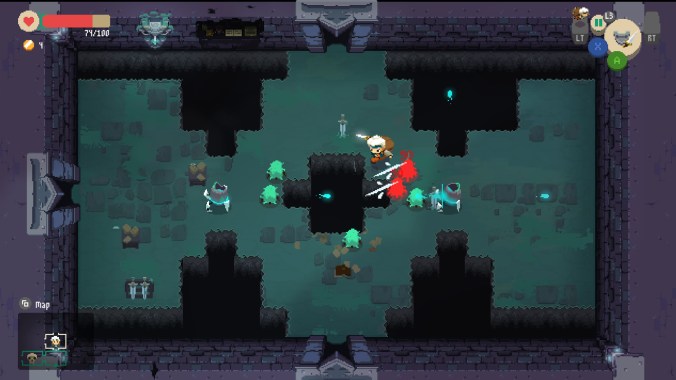
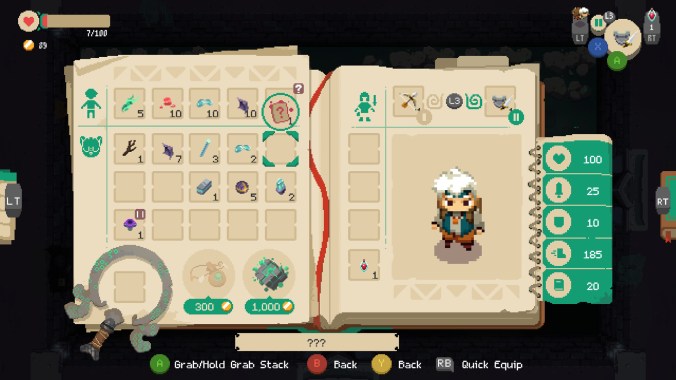
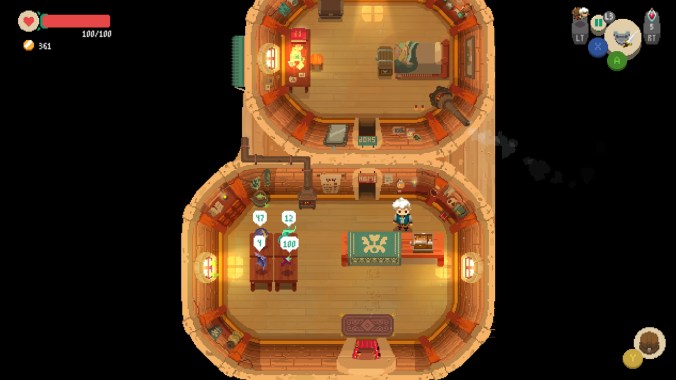
I quite like the concept of Moonlighter as it puts an interesting twist on the standard formula of dungeon crawling. In most top-down adventure games you explore dungeons to gain experience, new equipment, and the progress further into the game. In Moonlighter, you tackle dungeons to collect items dropped by slain monsters. After filling up your inventory, you return back to your shop and spend 5-10 minutes selling the goods to accumulate wealth. You can use the gold acquired to renovate your shop, upgrade the town, and buy new equipment. As you get better equipment, you can delve deeper into the dungeons to fight harder monsters and eventually take on the boss of each dungeon. This is an extremely addictive feedback loop of dungeon crawling, selling the loot, upgrading your gear, and then going back to dungeon crawling. Each one of these cycles only takes about 20-30 minutes, so it is easy to hooked and play hours at a time.
2

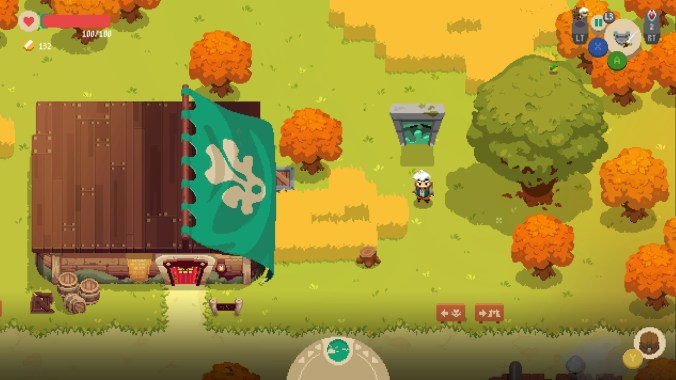
After playing through some difficult games recently like the Devil May Cry series and Shenzhen I/O, Moonlighter was a much-needed wholesome experience. The gameplay is not overly tough, and the shopkeeping aspect of the game is a nice cooldown period between dungeon runs. Just relaxing in your store and watching townsfolk come in and buy goods is just a chill experience. This combined with the extremely well-done pixel art and calming music makes for a charming game. Moonlighter is an easy game to get into, and I found it to be a nice and relaxing game.
3

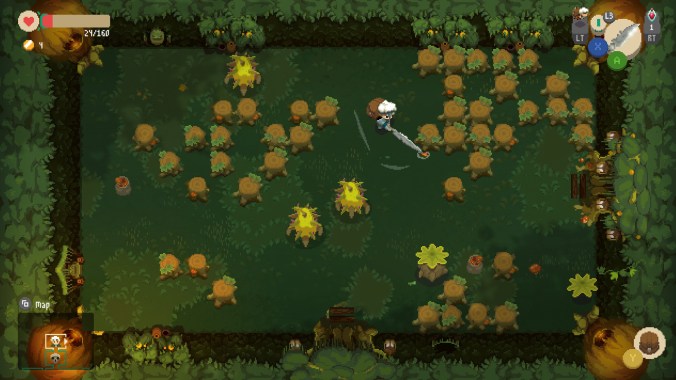
I wish that Moonlighter was a bit more innovative or at least went a little more in depth with the mechanics it had. As it stands, the game only really has 2 aspects: dungeon crawling and shopkeeping. I wish these were a little more fleshed out, as they are both fairly rudimentary. Dungeons are randomly generated, so each run will be different from the last. There are 4 different dungeon themes that get progressively more difficult: Golem, Forest, Desert, and Tech. Each dungeon has 3 floors and a boss at the end. The further you get in each run the better loot will become available. The problem is that all 4 of these dungeons are extremely similar. Just a reskinned background and tougher enemies. Once you complete the first dungeon, you have mostly seen everything Moonlighter has to offer. I wish each dungeon has its own unique twist to differentiate them from one another.
4

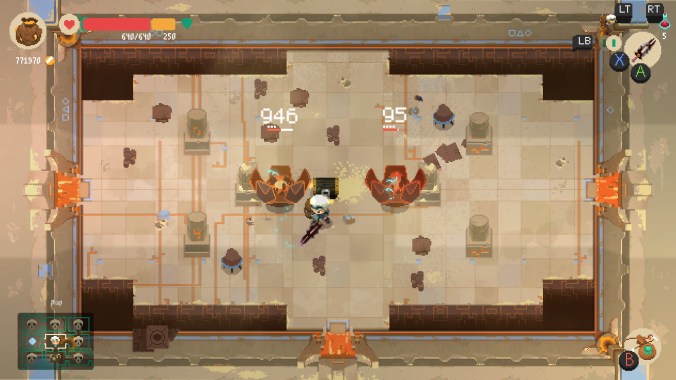
Other then the similarity between dungeons, Moonlighter also struggles in gameplay depth. Combat as a whole is extremely basic, sure there are 5 different types of weapons, but actually battling enemies is not complicated. Each weapon has a basic attack and a special function such as a shield, or spear charge, or charged punch. For the most part, I never used the special ability of any weapon and just spamming the basic attack was enough to defeat any enemy. I didn’t expect much innovation in combat, but I did expect more from the other half of the game. The shopkeeping is pretty barebones, and there is very little interaction with the town. Selling items mostly consists of just setting prices and chasing away the occasional thief. There is a little supply and demand that affect prices, but again the interaction is minimal. The biggest disappointment is that there is little to no gameplay revolving around the town. I really wish you could interact with the townspeople, explore the surrounding area, or do really anything. The town’s entire purpose is for the player to sell their loot and gear up for future expeditions. I did not expect anything incredibly innovative, but I wish Moonlighter just had more.
5

Other than its lack of innovation, Moonlighter has a few other minor issues. First and foremost, a few technical issues occurred during my playthrough. The game crashed twice and once I got stuck in a wall. These hiccups never destroyed significant progress, but its still a technical flaw. Hit registration feels a little off at times, sometimes my weapon would phase right through an enemy and other times a hit would register twice, dealing extra damage. Other than that, I feel there were some wonky balance issues as the game got closer to the end. I began making ludicrous amounts of money and I had no issues buying whatever I wanted from a single loot run. I only had to go into the games 4th dungeon three times total, when in the previous dungeons I had to do them seven to eight times to get fully upgraded. Maybe I just got better at optimization, but I think the gold amounts were just out of balance. Lastly, the sales box and banker upgrades are both entirely worthless and I have no idea why they were even included.
6

I think Moonlighter does do enough to make itself a worthwhile experience. Its not going to blow anyone’s mind, and it isn’t an innovative game. Still, the addicting progression loop and calming design made it an enjoyable game. I quite liked Moonlighter, I just wish there was a little more. Better combat, dungeon variety, or a more interactive town would have gone a long way to make Moonlighter more complete. It is for these reasons I give Moonlighter a 7/10. It’s not a revolutionary game, but its fun all the same.

Stardew Valley (2016)

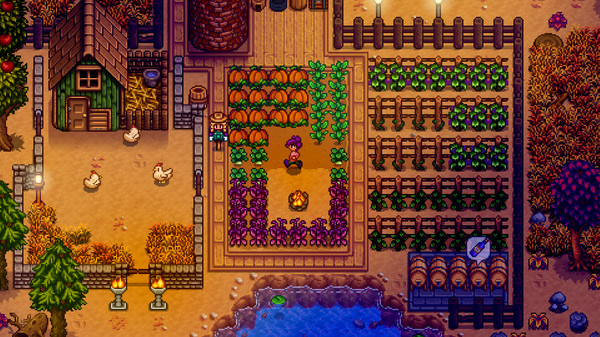
There is nothing more relaxing than chilling out and maintaining your farm in the calming Stardew Valley. This Harvest Moon inspired game is the brainchild of a single developer, ConcernedApe. Can this farming simulator overcome the pitfalls of the other games in its genre? In some ways yes, but I feel like the same problems that plague this genre also drag down Stardew Valley. Regardless of this, Stardew Valley is the perfect comfy game to just sit down and relax and play for a while.

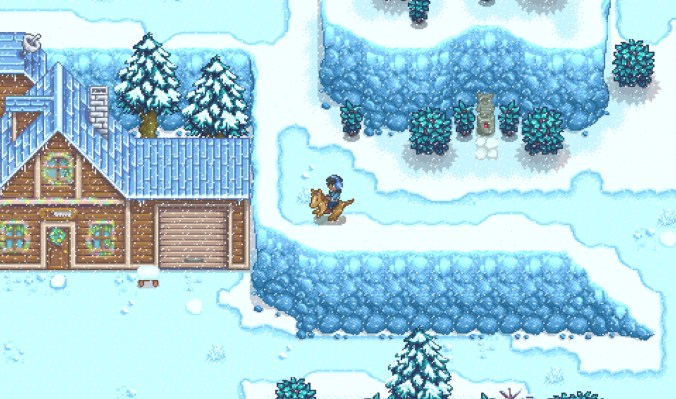
From start to finish, Stardew Valley is undeniably charming. The great pixel art and sprite work, bright visuals, and upbeat music keep this game cheerful. The main character inherits a farm from their grandfather, and uses it as an escape from a soulless corporate world. It is your job to restore this run-down farm and maintain it for years to come. There is so much that needs to be done, and that is what makes Stardew Valley so addictive at the start.

1

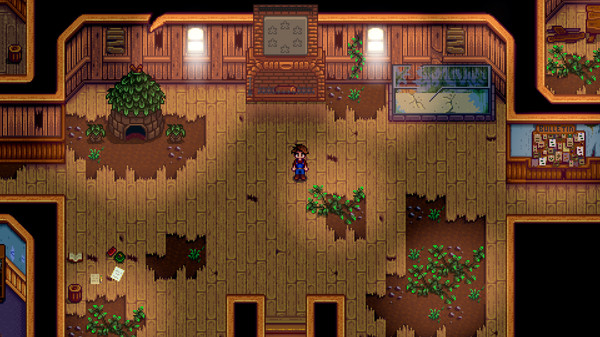
Through the clever use of quests, Stardew Valley subtly directs the player into the many different tasks that must be completed. Open-ended games like this can often lack a feeling of direction and the player can either become overwhelmed or they feel like there is no point to doing anything. This is not the case in Stardew Valley, helping out the villagers of Pelican Town is certainly rewarding and gratifying. But the real goal I found myself working towards was restoring the community center. Early in the game, you learn of the dilapidated community center, and you discover the secret that magical creatures known as Junimos are living there. They will help you restore the community center if you bring them all sorts of different materials.

All of the different crops, ores, fish, foraged goods, and other special materials that you collect will  be needed to fully restore the community center. There are dozens of bundles that require specific materials to complete, and you get a small reward for each bundle, as well as a big reward for completing all of the bundles in one of the rooms. These big rewards were very satisfying as they often opened up new areas and I could not wait to see what the next big reward would be. The use of the community center as a central goal was very clever, as it does not force the player into doing anything, but it serves as a sort of guideline as to what can be done. Whenever I felt like I had run out of things to do in this game, I took a look at what was needed in the community center and realized there was plenty that I had not explored or played around with. This sort of direction is desperately needed in an open-ended game like this. Unfortunately, once I had finished the community center, I felt like this game just lost its purpose.

2

Games like this can often get repetitive, and Stardew Valley certainly does not avoid this later on in the game. Once you get your farm up and running, you have to spend good portion of your limited daily time and energy to just water the crops, take care of the animals, make artisan goods, and whatever else needed to be done that day. Eventually you just get into a cycle that you cannot break, and it started to get repetitive and draining for me. I know many people may find it relaxing to do the same tasks over and over, but once I got into this late game cycle I found it to be very boring. I had bought everything and was gaining money hand over fist, so I did not even feel like there was a point to this tedium. This combined with the lack of direction that the game had once I completed the community center made for a very monotonous late game.

3

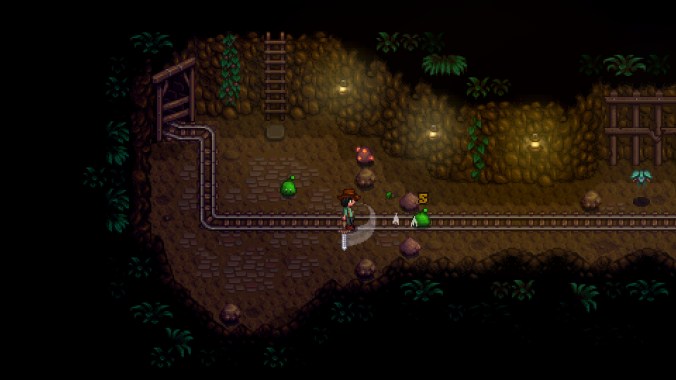
There were a few other issues I had with Stardew Valley. One of them being that while I mainly looked to this game as a source of relaxation, I felt like some of the main tasks in this game could get pretty frustrating. In particular, the fishing mini-game was aggravating and so much of time spent fishing just sitting around waiting for a fish to bite. Also, combat in this game is reminiscent of NES-era games like the original Legend of Zelda. This is not a good thing. While combat is a minor part of Stardew Valley, I feel like it often gets in the way while am trying to mine for resources. My last issue with Stardew Valley is that while it does a great job with its delayed gratification, I feel like it sometimes it goes overboard with using time from keeping the player from progressing. Certain tasks can only be completed in specific seasons, so if you want to do that thing, you are going to have to wait a while. As I was almost done with the community center, there were long stretches of days I just had to wait around before I could do anything of significance to further myself to completing my goal.

5

As I said, Stardew Valley is usually pretty great when it comes to delaying gratification, but keeping you hooked while you wait. Most things in Stardew Valley take a while before you can start reaping their benefits. Planting crops, upgrading tools, adding new buildings, renovating your house, raising animals, making artisan goods, all of these things require a few days before they become profitable. But as you are waiting for that big payoff, there is still plenty to be done. Fishing, mining, foraging, or just cleaning up your farm were enough to suffice and keep me entertained while I waited.

4

As a whole, I did thoroughly enjoy Stardew Valley. For the first 3 seasons, I was addicted and could not stop playing it. For the next couple of seasons, I still enjoyed it, but I could feel the tedium and repetitive nature of the game arise. In the final seasons that I played, I just kept going so I could have that one final payoff of finishing the community center. I just wish there was some more engaging tasks to be done while waiting for those final items to be attainable. Maybe Stardew Valley is not my type of game, as this is not a genre that I play very often, but the repetitiveness definitely wore me out after some time. That being said, even though this is not a genre that I typically play, I still really loved the first few seasons of this game. I would highly recommend it to anybody who likes these types of games. Overall, I have to give Stardew Valley an 8/10. It does run into the same issues as its predecessors, but is fantastic otherwise. If you are looking for a relaxing game to play, look no further than Stardew Valley.