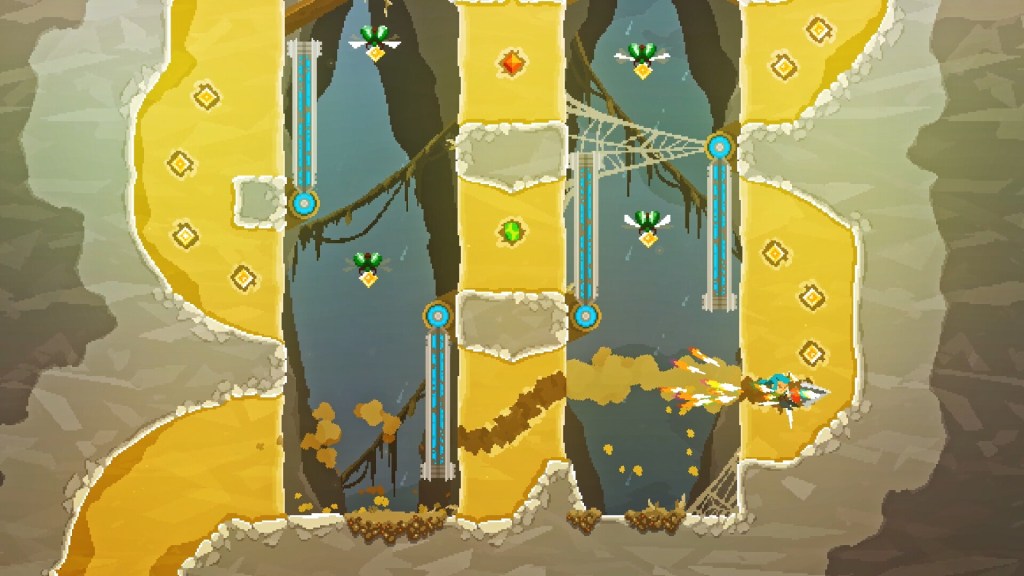
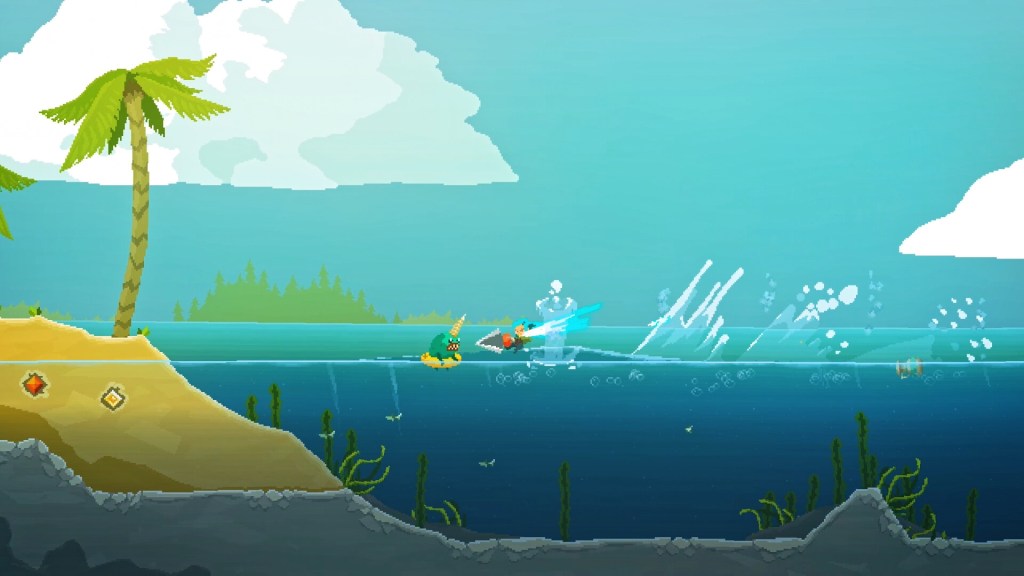
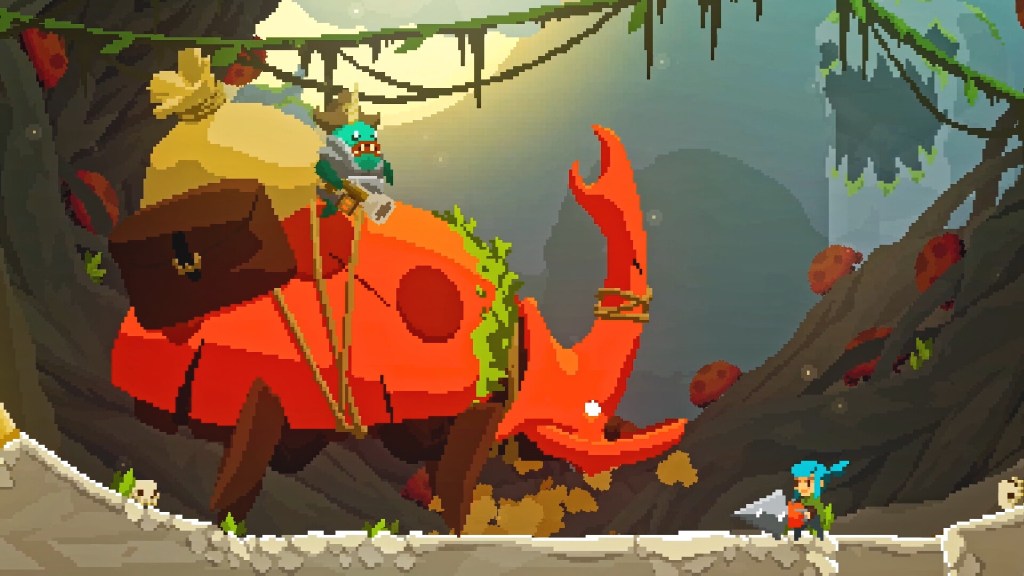
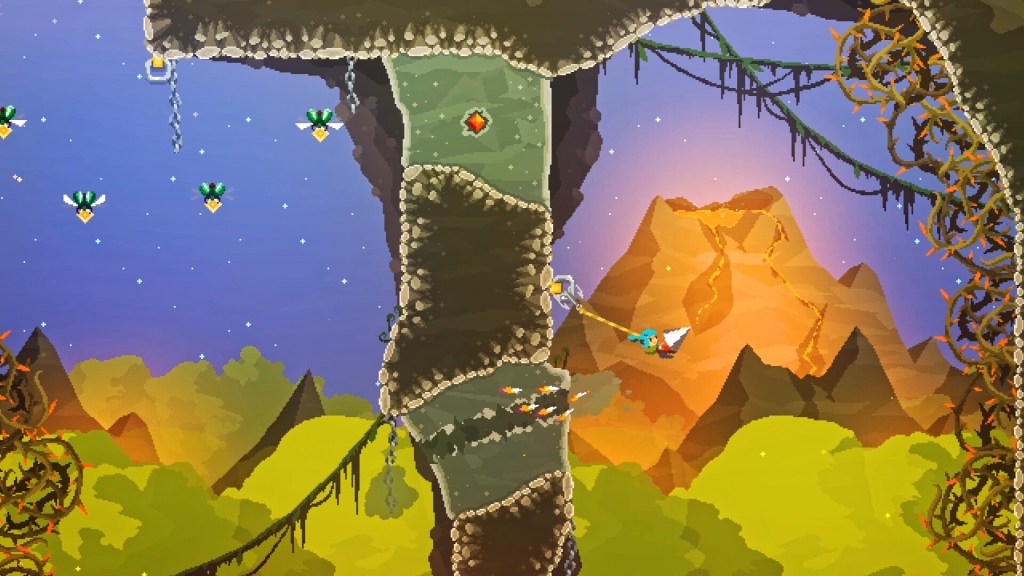
Pepper Grinder is a wonderfully retro game. Its detailed pixel art, gorgeous environmental backdrops, charming cast of characters, and focus on fun gameplay concepts made me feel like I was playing a classic SNES platformer. Pepper Grinder may be short, and it may not do anything revolutionary, but it is remarkably polished and is purely distilled fun. There’s no fat on this game, every level has its own ideas and mechanics that put a twist on the drilling and digging platforming.
The key mechanic in Pepper Grinder is the drill. You tunnel through sand, earth, and snow, avoiding obstacles along the way. As you pop out of the ground you can boost yourself and launch yourself from platform to platform. It’s a remarkably smooth mechanic that the entire foundation of the game is built upon. Digging through the ground is intuitive to control, fast-paced, and allows for some creative level design. And Pepper Grinder delivers that in spades.
While it may be a short game, Pepper Grinder makes up for that with the sheer variety in its levels. Every level is distinct in some way. There are grapple points to swing between patches of earth, falling chunks of snow to flow through, cannons that blast you across the sky, gatling guns to mow down enemies, and a variety of locations to explore. One minute you’ll be gunning down goons in a volcano and the next you will be diving in shark-infested waters and splitting boats in half.
What makes Pepper Grinder feel like a retro game is its charm. There’s no dialogue or much of a narrative at all. The main character, Pepper, washes up on shore and has her treasure stolen. The rest of the adventure is just using her newfound drill to hunt down her missing treasure. But what makes the game so endearing is the visual story that is told. Traveling through the lands and encountering a handful of friendly faces like a farmer mole and a friendly giant is reminiscent of SNES era games such as Super Mario World and Super Mario World 2: Yoshi’s Island. And this retro influence is also obviously present in the art style of Pepper Grinder.
The game is full of lovingly crafted pixel art and animations. The levels, environments, and characters all come to life in its high-fidelity pixel art style. Even with the bright colors and fast-paced platforming, I felt that visual clarity was extremely good. I never lost track of where I was or where I was supposed to be going. The presentation is further bolstered by a great soundtrack of mixed genres: jazz, rock, drum and bass, and even drum and bass.
There’s no arguing that Pepper Grinder is a short game. There’s only two dozen or so levels and each can be completed in 5-10 minutes. But I don’t think being short is necessarily negative. The developer obviously did not want to pad that game out with repetitive levels or filler content, which can be seen from how every level has its own gimmick or trick. Additionally, there are 5 hidden coins in every level to be found if you are interested in collectible hunting. And I found quite a bit of fun in the time trial mode, trying to get the gold medal on every level. It never felt overly challenging, but I loved finding shortcuts or optimizations to spare a few seconds.
The only major flaw with Pepper Grinder is the boss fights. There are only four of them, but none of them are particularly fun. They are neat concepts, but are unfortunately in cramped arenas that feel awkward to maneuver in. The last boss in particular is a huge difficulty spike, I could see tons of players giving up before seeing the credits because of how frustrating that fight can be. And to make matters worse, if you are doing the time trial mode you will have to deal with 30-second unskippable cutscenes on every single attempt of every boss. Truly maddening.
Pepper Grinder definitely isn’t a revolutionary game. It doesn’t dwell on any of its ideas or mechanics. If you are looking for a platformer that slowly evolves as the player gets better, Pepper Grinder may not be for you. It’s a game that delivers on a fun and fluid base movement system while throwing a bunch of different ideas at the player. Sure, many of those ideas could be explored further and expanded upon, but I appreciate the brevity of the game. And if you are looking to master the game’s mechanics, time trial mode can provide a decent but reasonable challenge.
I love when a game focuses on just being fun. And that’s what Pepper Grinder is. It may be on the shorter side, but that’s only because there is not any fat on this game whatsoever. Every level is its own idea. And the basic drilling movement is just pure fun. Although it doesn’t do anything revolutionary it manages to feel nostalgic and reminiscent of classic Nintendo platformers. It is for these reasons that I give Pepper Grinder a 7.5/10. Definitely give this game a shot if you want a quick burst of platforming fun.
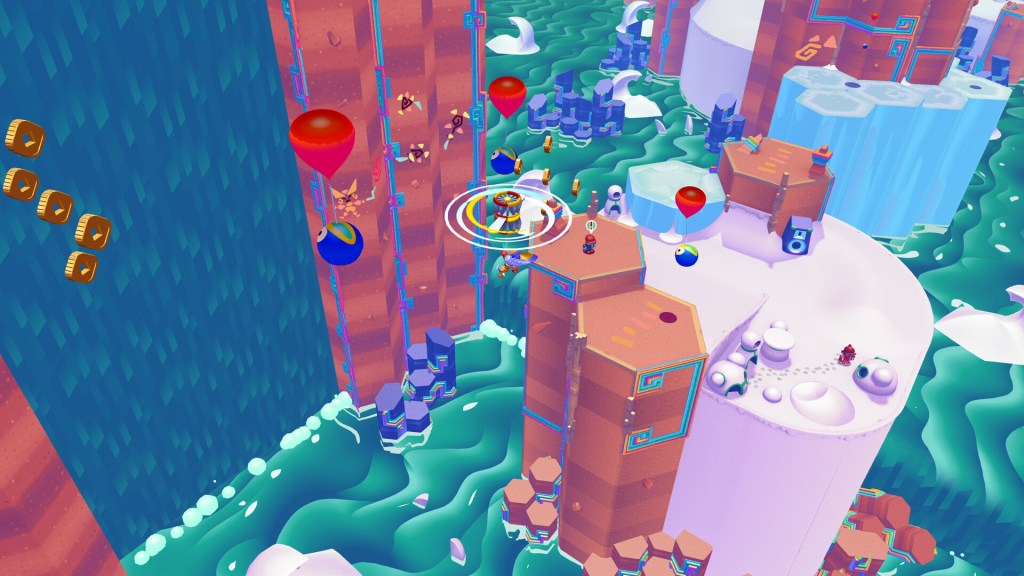
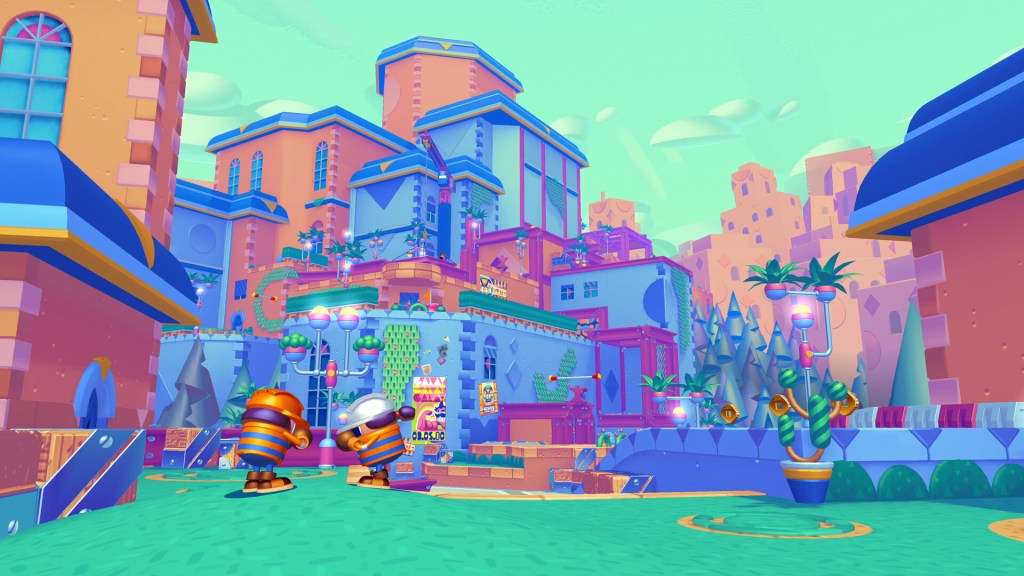
Penny’s Big Breakaway is a game that gets better and better as you play it. As a lover of 3D platformers, I was excited for Evening Star’s debut game. These guys gave us Sonic Mania, the best Sonic game in decades. Once I started playing it though, I thought Penny’s Big Breakaway was just alright. I had trouble with the innovative control scheme and never quite found a satisfying flow to the platforming. But as I progressed through the game, I slowly got more and more familiar with the movement. And that’s where the game shines. Once it clicks, Penny’s Big Breakaway is immensely fun as you dash, swing, and zip through levels. Maintaining momentum and combos is not easy, but the satisfaction of going fast makes it a reward worth earning.
Penny’s Big Breakaway takes place in a brightly colorful world of performers and penguins. Penny is a performer who has to go on lam because her sentient yo-yo ripped off the king’s pants during a performance. The story itself isn’t all that exciting or worth talking about, but that’s ok because it definitely isn’t front and center. What makes Penny’s Big Breakaway interesting is the platforming.
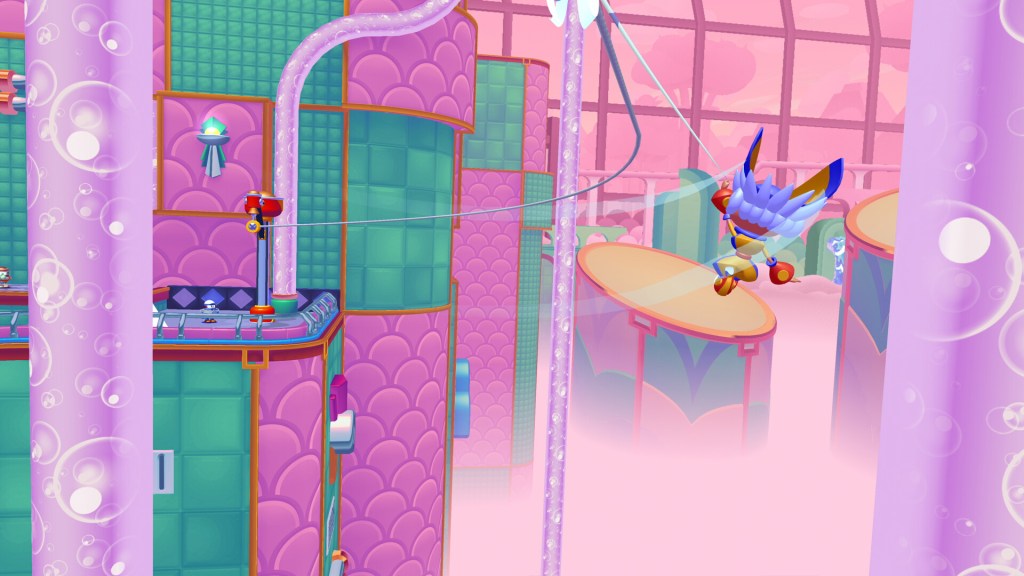
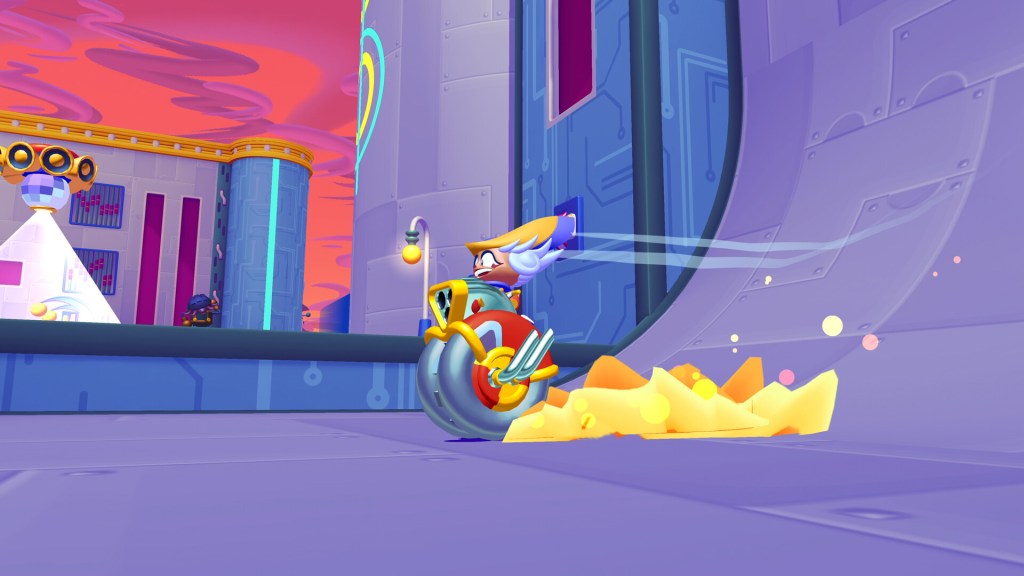
Penny herself is a rather slow and clunky character, but that’s made up for the array of abilities that her yoyo provides. In the air you can sling the yo-yo in any direction using the control stick, and from there you can either dash to the yo-yo or swing from it. These both have their own uses to build speed, height, and distance. Moreover, you also have a small double jump. On the ground you can roll on the yo-yo or spin it around you. The roll is key to maintaining momentum while the spin attack is mostly used for maintaining combos.
With all these possibilities it can be tricky to get a grasp on how to string these moves together. Especially because Penny’s Big Breakaway has a unique control scheme that can take some getting used to. Like I mentioned, Penny is slow and rather boring to just walk around and jump like a normal platformer. The key to having fun is utilizing slopes and stringing her moves together to create a fast-flowing performance. For instance, dashing into a roll on a hill is an easy way to build up a ton of momentum. You can then swing out of the roll to fling yourself across big gaps. An additional consideration is that timing these movements is critical. If you attempt to roll from too high up you won’t keep most of your momentum. And of course, you will fling off tangent to your swing arc whenever you release a swing.
There’s lots of nuances in the movement in Penny’s Big Breakaway. Aside from all the basic moves that I listed above you have to contend with enemies, poles to swing on, power ups, bouncy pads, dramatic slopes, and other complications. Learning how to go fast is what makes Penny’s Big Breakaway fun. And it’s also why I think the game has a steep learning curve. I didn’t really start having a lot of fun until about halfway through because I wasn’t good at chaining together my movements and timing things so I could reach top speeds.
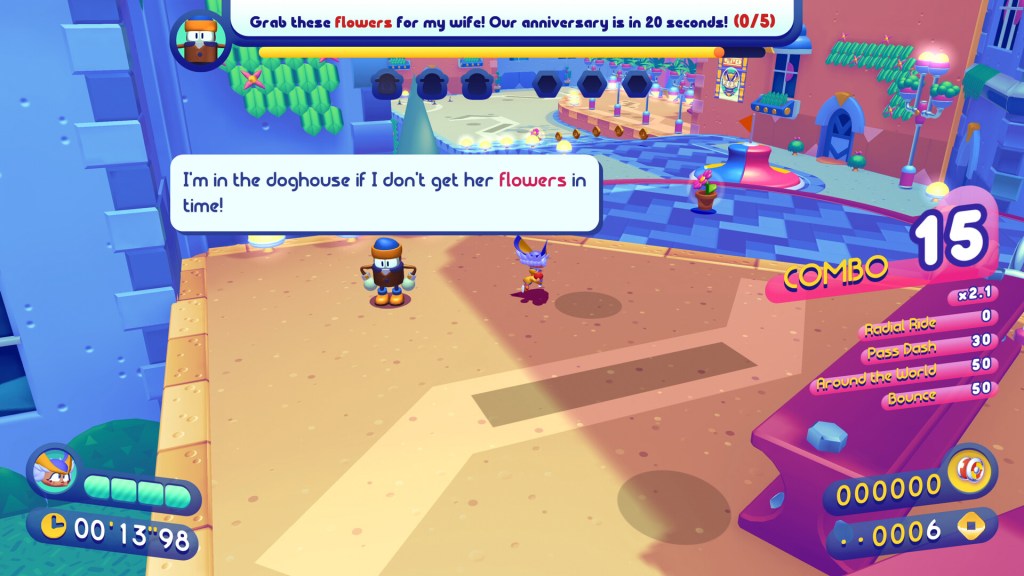
Aside from going fast, another omnipresent objective is to maintain a combo. By masterfully manipulating your entire moveset you will rack up a combo that steadily increases your point total. At first, I thought this is what the focus of Penny’s Big Breakaway was as it is in your face. And don’t get me wrong, maintaining a combo can be fun, as long as you are doing it with speed. If you are new at the game, floundering around to make sure you never drop the combo can be more discouraging than it is fun. And there’s plenty of places where you can just combo back and forth for minutes at a time to rack up a big score. Honestly, I suggest just ignoring the combo system altogether until you start mastering the movement.
I wish Penny’s Big Breakaway would have emphasized the need for speed a little more. It’s the most entertaining aspect of the game, but the game does very little to encourage going fast. Your score at the end of the level is independent of the time it took to complete it. If you want a high score, you could just combo back and forth as I previously mentioned. Getting a point multiplier based on your speed of completing the level might have encouraged speed. There is a time trial mode, but there are no developer-set baselines. I think this was a big misstep. After completing the game, I was looking to replay some of the levels to get a fast time, but without a benchmark to measure myself against I had no idea if I was doing well or not. Playing against your own times can be fun once you master the game, but I would have liked a point of reference to try to beat.
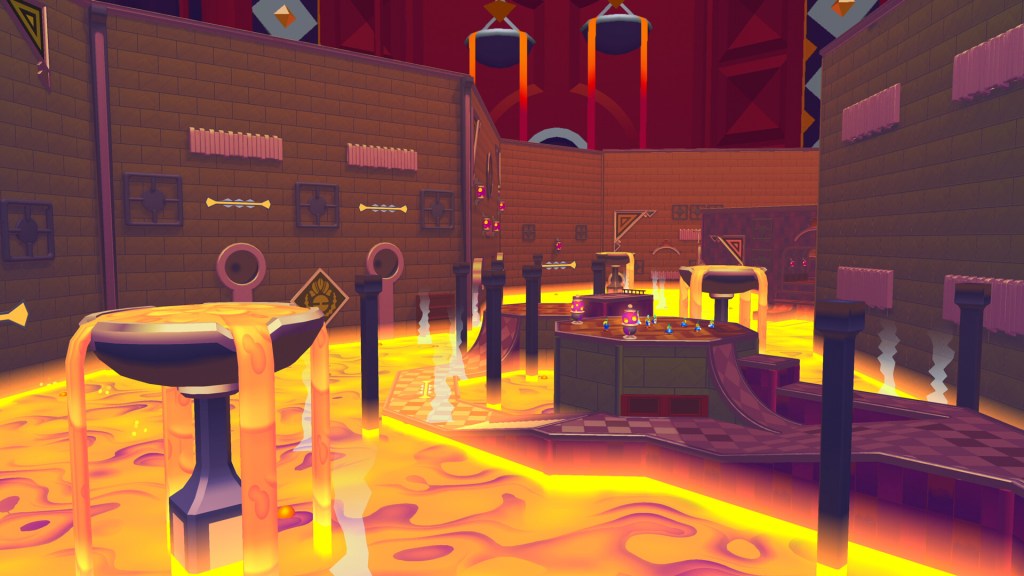
One of the biggest appeals of Penny’s Big Breakaway is its speedrun-friendly level design. Levels are cleverly laid out with some diverging paths that encourage experimentation. Moreover, there aren’t invisible walls or other tricks to keep the player from finding huge shortcuts. If you do master the movement, you can skip huge chunks of the levels if you find the right gaps and walls to scale. Even if you aren’t a speedrunner, the levels are well-designed that flow nicely and still encourage smaller shortcuts. Sadly, the boss fights are fairly underwhelming compared to the standard levels. My other major gripe with the levels is the optional objectives.
I usually enjoy finding hidden secrets or doing challenges in platformers. But Penny’s Big Breakaway is all about going fast. Having to slow down and look around for potential secrets is annoying. Each level has 3 hidden items and 3 short quests. The quests also are frustrating because they start as soon as you walk in the vicinity of the NPC, and are often timed challenges. Meaning you quickly have to read what your goal is and look around to find where you are supposed to go all while the clock is ticking. If you fail, you have to reset from the checkpoint. I realize the side objectives aren’t necessary to beat the game, but are required if you want to unlock the bonus levels. And the bonus levels are some of my favorites in the game.
Unfortunately, we can’t talk about Penny’s Big Breakaway without mentioning its performance issues. I had many instances of clipping into terrain and walls. During a boss fight I just fell through the floor and died. Certain sloped surfaces also have Penny sliding on them very strangely. These collision bugs aren’t the end of the world, but they are common enough that they can’t be ignored. Luckily, the developers seem to be aware of these bugs and are actively working on patching the collision issues.
As for presentation, I found Penny’s Big Breakaway to be almost too colorful. I understand that the game is trying to harken back to the days of Sega consoles and the dominance of Sonic. But I found the art style of Penny’s Big Breakaway to be garish. Fortunately, the soundtrack is stellar. It’s a nice mix of jazz, funk, and electronic beats that do fondly call back to retro games.
Penny’s Big Breakaway is the epitome of “high skill floor, high skill ceiling”. It’s a game that, if you put the time into mastering it, is an immensely fun fast-paced platformer. Conversely, it can be tricky to find the fun in Penny’s Big Breakaway if you aren’t proficient at building speed. The movement can be slow, clunky, and unintuitive until you learn the timings and sequences needed to gain momentum. It is for these reasons that I give Penny’s Big Breakaway an 8/10. It’s a game that experienced platformers and speedrunners will love to master, but newer players may find it slow and frustrating.
I love when a game expands on a commonly seen mechanic that we take for granted. The prime example of this is how Death Standing turned both traversal and inventory management into its core gameplay hook. Running up cliffs and carrying hundreds of pounds of equipment is something that gamers have grown accustomed to, and Death Stranding made it so walking down a slight hill was a treacherous activity. Jusant does something similar, but for climbing. The entirety of the game is about the ascent up an impossibly high tower of rock. There’s no combat, no puzzles, fairly little exploration, and a story that is only told through the environment and the occasional note. Despite this, the meditative beauty of Jusant was enough to keep me going until the end.
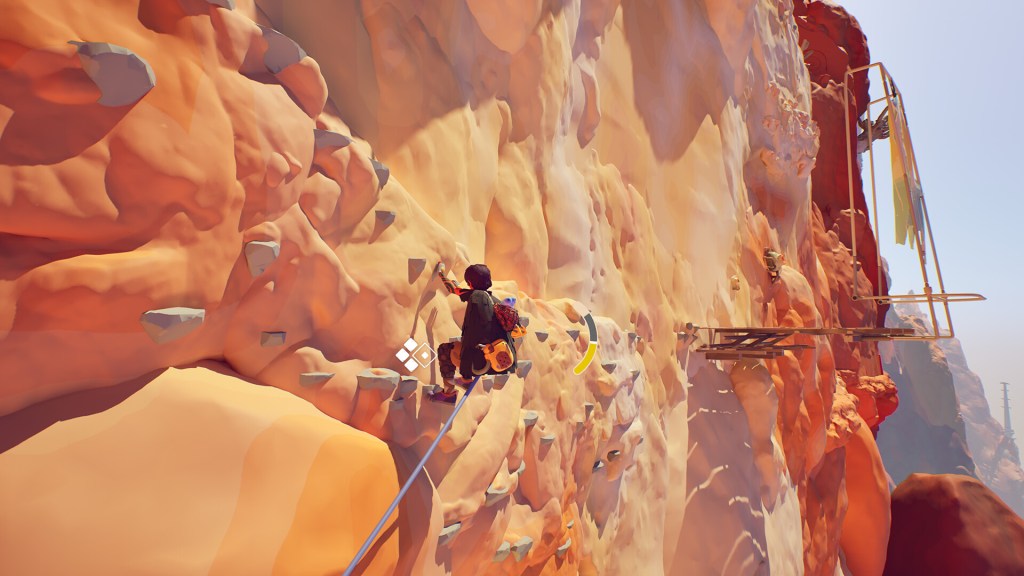
Climbing has become a multi-purpose mechanic in a multitude of modern games. From basic traversal, to providing down time, to showing off the environment, to hiding loading screens, climbing has many uses and as such is absurdly common. Unfortunately, climbing is usually boring due to the simplicity of its implementation. Jusant makes strides to make climbing more interactive and thoughtful. You control both of the protagonist’s arms, grabbing onto handholds with each hand individually. This leads to a satisfying rhythm of alternating between the left and right triggers to ascend the terrain.
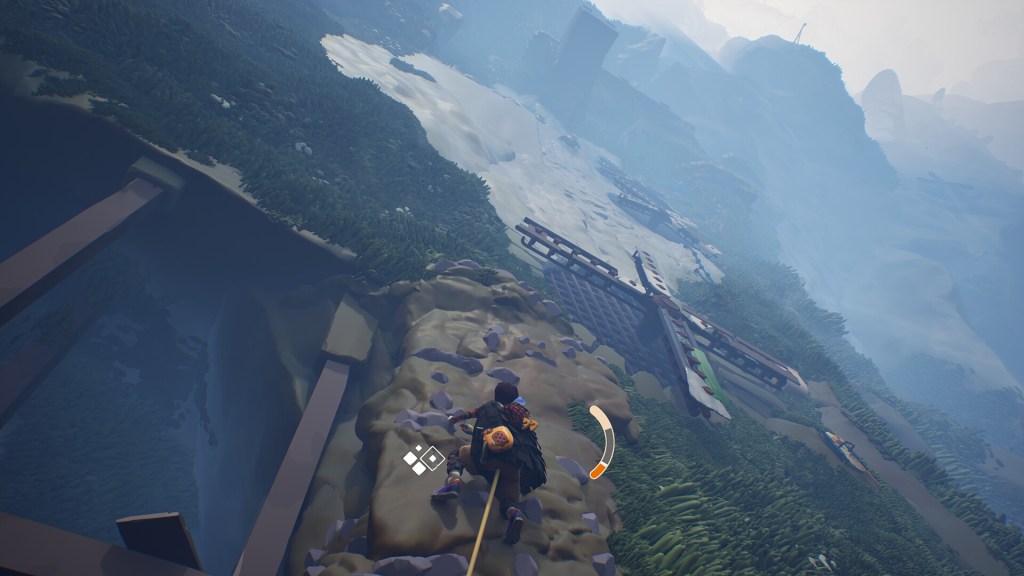
This simple change makes climbing far more engaging and immersive, but it’s not the only trick that Jusant has up its sleeve. You have access to a series of pitons and rope that always act as a safety system. You can never fall to your death; you only tumble a few dozen feet to where you last hooked into the wall. Pitons double as a self-managed checkpoint system and a way to place an anchor for some rope swinging. While Jusant isn’t terribly difficult, it is still nerve-wracking to swing and jump over a seemingly endless chasm.
Despite its efforts to make climbing fun, the biggest fault of Jusant is that it doesn’t do enough. There’s just not much thinking involved. You follow a straightforward path of handholds and ledges, just alternating between hands. The stamina system is barely worth mentioning as I never was in danger of running out of stamina. If you are running low, you just press a button and rest for a second to regain a large portion of the meter. I would have loved for the climbs to have a variety of routes to survey and choose from. Having to assess your options and think about how to reach your goal could’ve gone a long way to make the climbs more interesting. You could make more use of your tools, and there would be an actual threat of running out of stamina if you planned a poor route.
Even though I wish Jusant did more to make climbing more engaging, I still adored the surroundings of my ascent. The rocky tower is barren at its base, surrounded by miles and miles of desert. As you scale the tower you will find yourself in abandoned communities that have been carved into the sides of the mountain. Tiny collections of stone huts tell the story of tight knit communities that were deserted due to some ecological disaster. As you climb higher, you gain more hints about what happened to these people.
While Jusant has no dialogue, I found it told a poignant tale regardless. There’s a sense of mystery as to why the unnamed protagonist is determined to reach the summit with his frog-like companion. You find notes scattered throughout the journey which give a glimpse into the life of the people who inhabited the tower. Many players probably will skip these notes altogether, but I enjoyed piecing together how civilization crumbled. Seeing how the environment evolves as you scale gives you clues as to how this society functioned and then collapsed as the water dried up. Even without dialogue, the final scenes of Jusant manage to be emotionally impactful.
After the grueling nightmare of Alan Wake II, I needed a nice relaxing breather. And Jusant is perfect for that. The simple additions to traditional climbing mechanics make a normally boring concept more engaging. But I would have loved to see some more puzzle elements incorporated to encourage the player to carefully plan their routes. Nevertheless, I enjoyed the relaxing ascent and discovering more about this barren world. It is for these reasons that I give Jusant a 7/10. Transforming climbing into the main hook of a game and having it be fun is a tall order, and one that Jusant delivers on that.
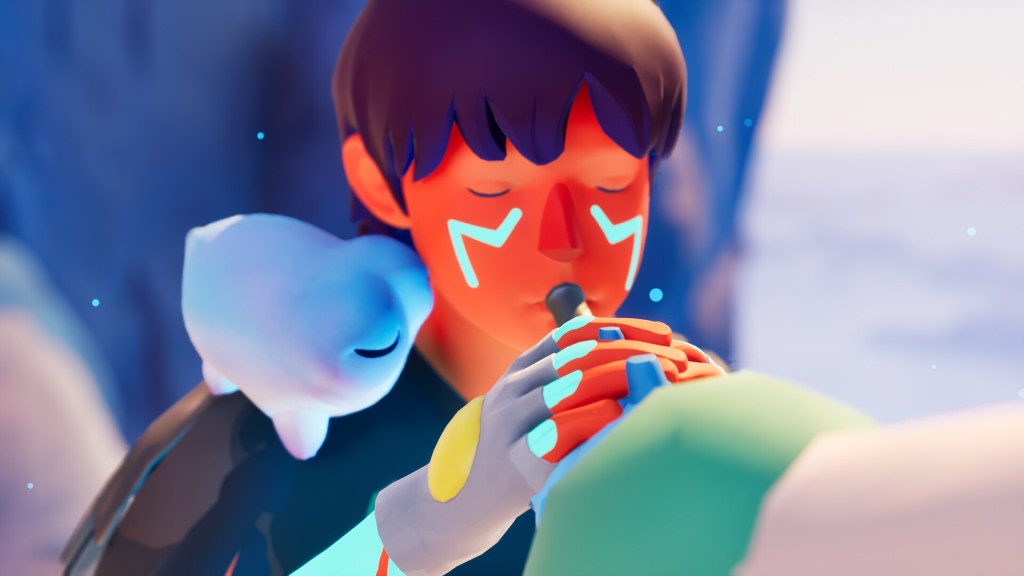
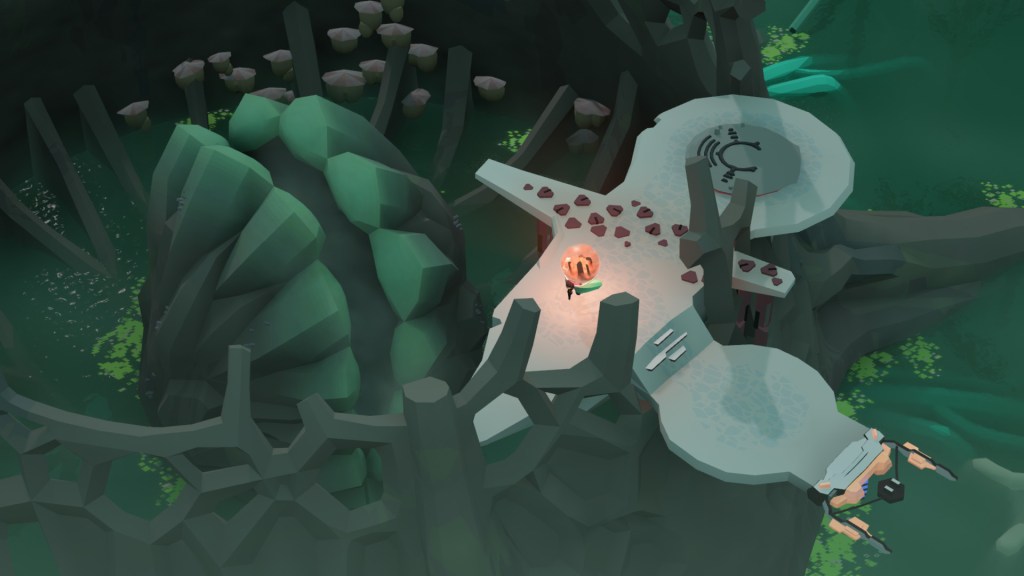
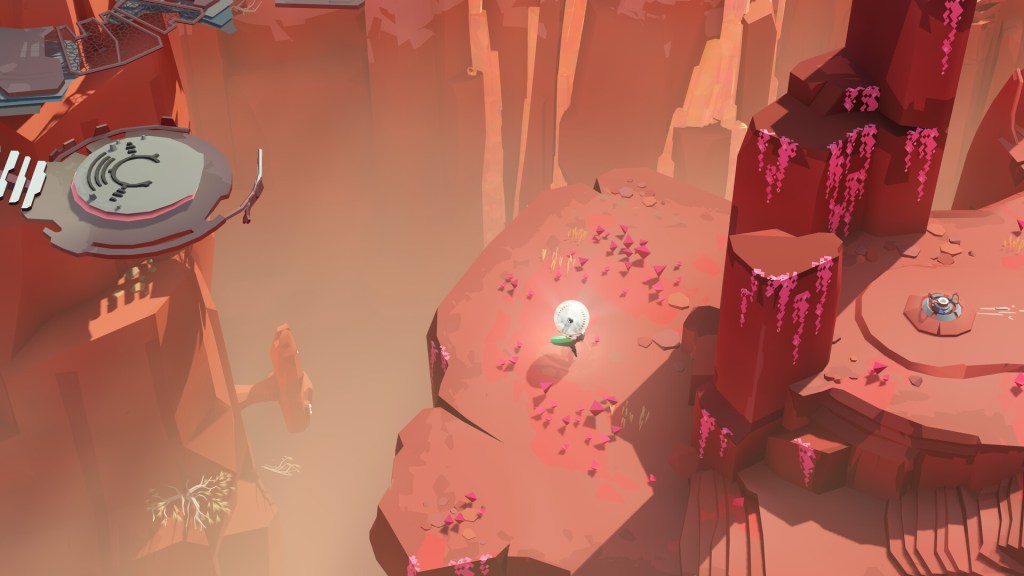
Cocoon is unlike any other puzzle game that I’ve played. It revolves around the brilliant idea of portable worlds that you can jump in and out of. Worlds reside within other worlds, and you can carry them around as if they were just trinkets. It’s a Russian doll of realities that you traverse through. But it manages to reign in the difficulty and makes its puzzles approachable. There’s a sense of Zen as you solve mind-bending puzzles and take in the magnificently alien world of Cocoon.
The main idea of Cocoon is that the player can dive in and out of these world-like orbs. You carry them around, using them to power machinery and progress forward. You solve a puzzle in one orb which lets you do something in a different orb which lets you exit the orb that contains them both. Each orb additionally has some power to use in puzzles as you carry it. Puzzles often have you jump in and out of worlds, carrying the orbs around and utilizing their properties to bypass obstacles. The world within a world within a world within a world nature of the orbs can be rearranged and reformed to fit your needs. It may sound confusing but Cocoon is intelligently designed to minimize frustration and confusion.
An interesting technique of puzzle design that Cocoon utilized was explicitly cutting off the player from backtracking once they encountered a new puzzle, so long as they had the required materials to progress. This minimizes the common confusion of spending a while staring at a puzzle and thinking you are missing something to proceed. Stopping you from going backwards is the game’s method of telling the player that the puzzle is solvable. It greatly reduces the frustration of backtracking or spending time messing with previous elements that have no bearing on the current puzzle.
I found that the puzzles of Cocoon were never too challenging. This is in part because the game stops you from getting too far off track, but it’s mostly because the puzzle design is fairly simple. Despite the mind-bending world-hopping mechanic of Cocoon, the game rarely requires an intricate series of steps to progress. Often, a puzzle will introduce a new idea that highlights the game’s underlying mechanics. It begs the player to tinker around and experiment with how nesting worlds like a Russian doll could be used to solve its puzzles. There’s a lot of potential for some truly difficult puzzles, but Cocoon holds back on purpose.
If you love games that fully explore their main mechanics, Cocoon may not be what you are looking for. Instead, Cocoon focuses on letting the player progress and discover its world and mysteries without being hindered too much. There is still a sense of accomplishment and Cocoon does make you feel intelligent due to the innate complexity of its core mechanic. I love immensely difficult puzzle games like Baba is You and Stephen’s Sausage Roll. They squeeze every drop of creativity out of their central mechanics, asking the player to use everything they’ve learned in an intricate series of steps. Cocoon isn’t that. And that’s ok. Personally, I would’ve loved to see a few trickier puzzles along the way, but Cocoon has other things going for it.
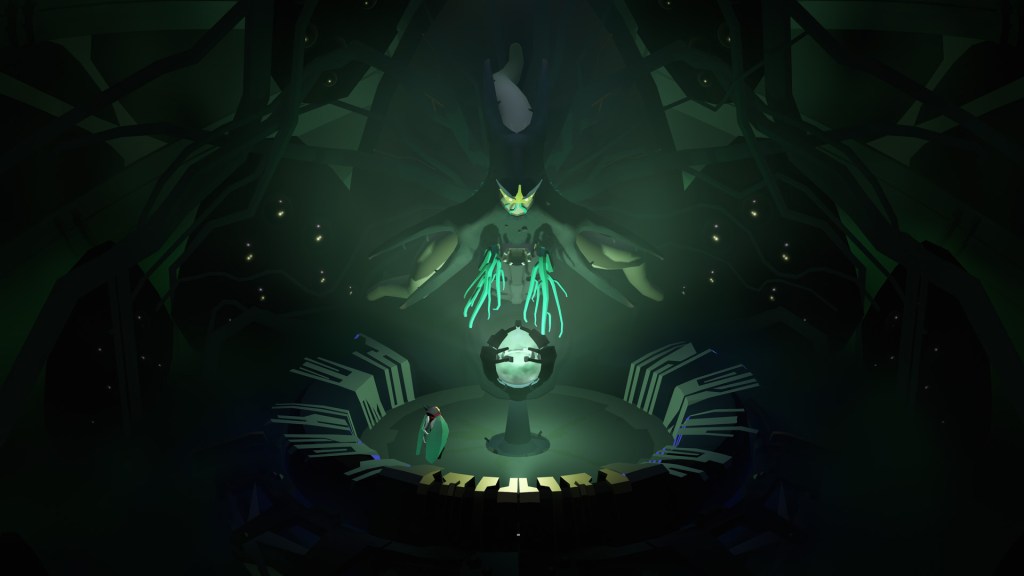
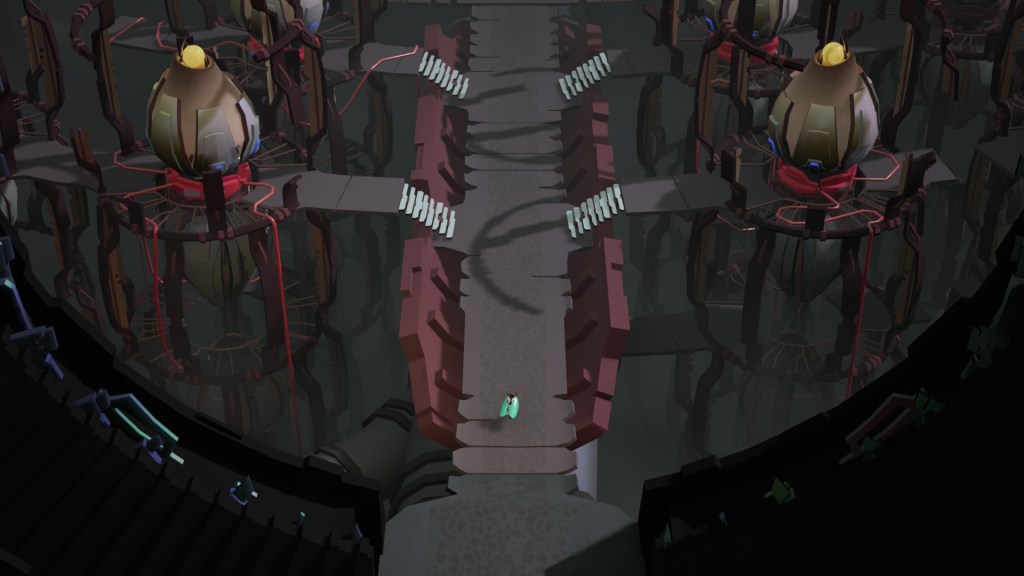
I loved the art and environmental design of Cocoon. You traverse a handful of different alien worlds, each being beautiful in its own right. There are alien contraptions and creatures that litter these worlds. I loved progressing through these worlds and marveling at their environments. Everything feels appropriately alien. The sound design uses echoing chirps and metallic groans that sound otherworldly. There is no written story in Cocoon, but there is some environmental storytelling to discover as you adventure through the orbs. I found the ending to be quite satisfying and it puts the entire journey into a new context.
Cocoon may not be the longest or the hardest puzzle game, but it is one of the more memorable puzzle games that I have played. The truly alien setting paired with its world-hopping mechanics is immensely enjoyable. Its lower difficulty and stakes make for a fairly relaxing experience. That being said, I would have loved to see its mechanics potentially explored further in some challenging post-game content. It is for these reasons that I give Cocoon a 9/10. Cocoon is a phenomenal experience, even if it lacks some truly difficult puzzles.
On the surface, Dredge does not appear to be anything special. Mostly, it’s a simple fishing game with some resource management and exploration. But Dredge is more than the sum of its parts. Its systems work together to create an addictive loop that it’s easy to sink hours into. But where Dredge really shines is in its quaint, yet unsettling atmosphere.
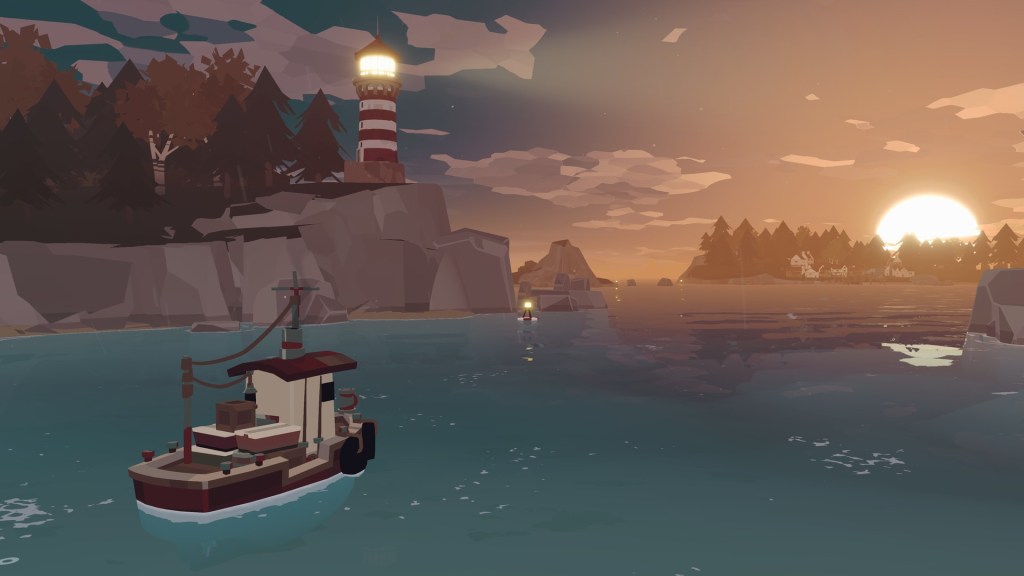
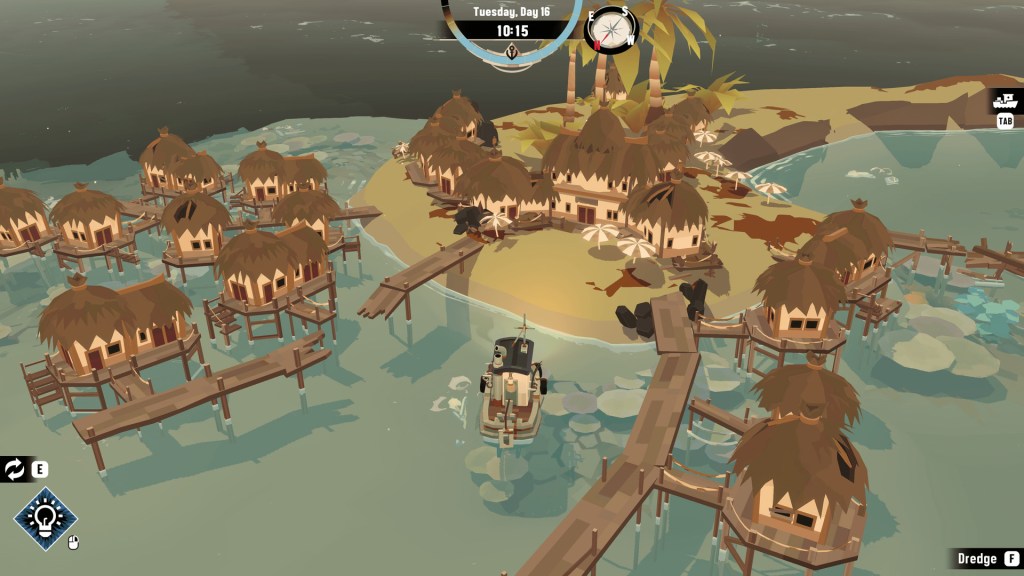
You play as a fisherman who has crashed along the shore of the small town of Greater Marrow. The mayor provides you with a boat, as long as you promise to sell your fish to the town to repay your debt. There’s something quite unsettling about the town, as inhabitants whisper about the previous mayor and fisherman who disappeared. Nevertheless, the town is a safe haven for your travels across the ocean. The lighthouse is an ever-present beacon, guiding the player back to the safety of the harbor no matter where you roam.
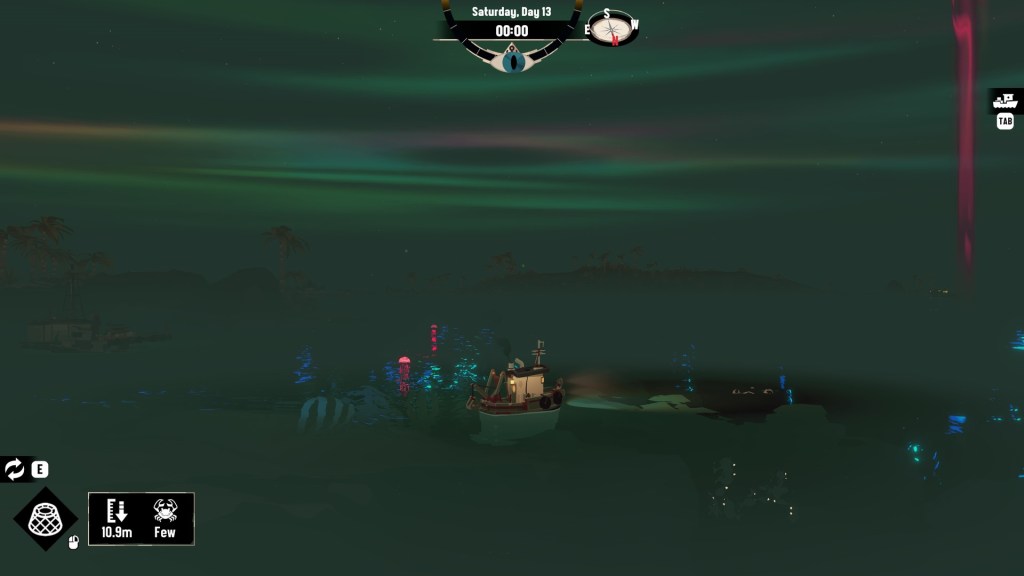
Traveling the seas is fairly relaxing most of the time, but if you aren’t watching the clock, you could find yourself in the pitch-black night. As you spend time away from the safety of a dock at night the panic meter quickly fills. Ghostly apparitions and eldritch abominations stalk your small ship, causing you to frantically navigate to a port. Yet in this panic it is easy to become hopelessly lost and crash upon the rocks. There’s an effect that I quite like when the panic meter fills in which terrain is often invisible until you get very close to it. This is excellent as it punishes the player for panicking and not cautiously steering, and it is thematically appropriate as a terrified captain is prone to making errors and splintering their vessel on the rocks.
The juxtaposition of safe ports and disquieting darkness is something that I adore. There’s something charming about how a little bit of light and comfort can become such a powerful motivator when surrounded by uncertainty. Dredge is dotted by little towns and floating platforms that serve as shelter. The imposing aesthetic also fuels the contrast between the night and day of Dredge.
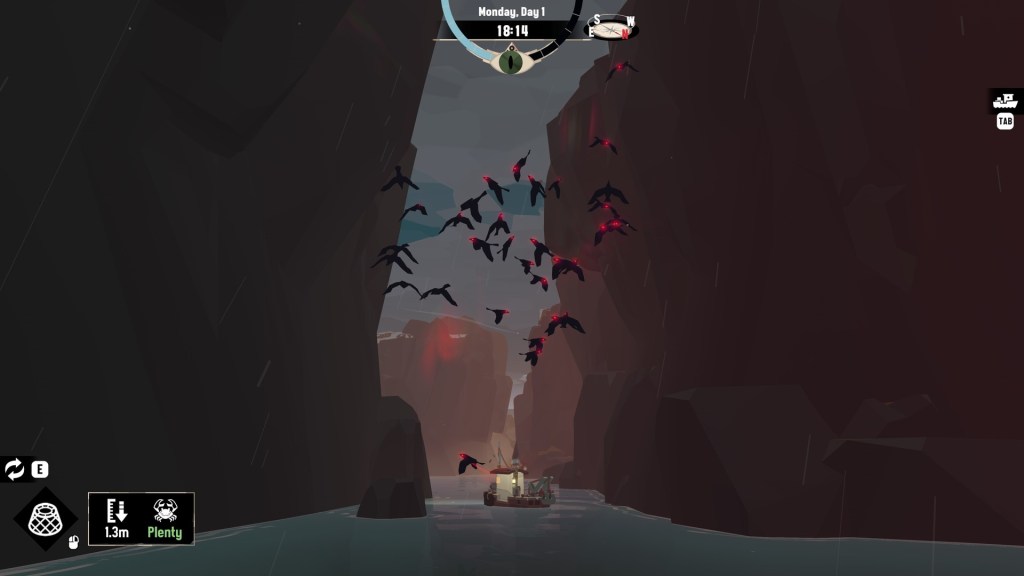
The art of Dredge is highly stylized, relying on low-poly silhouettes and shadows. This low-poly approach is utilized wonderfully to create cozy towns and calming waters. Yet, in an almost impressionist fashion, Dredge plays with light and shadows to create more ominous scenes and characters. The standard fish that you become familiar with often can be seen as “aberrations”, deformed and disturbing versions of themselves that suggest that there is something wrong with these waters.
While it’s obvious that Dredge nails the atmosphere and vibes of a spooky fishing game, I think its rudimentary gameplay systems also complement each other quite well to make for a game that’s hard to put down. There are four main components to gameplay: fishing, inventory management, upgrading, and exploration. All of these are relatively simple in isolation, but the quick cycling between them kept gameplay fresh.
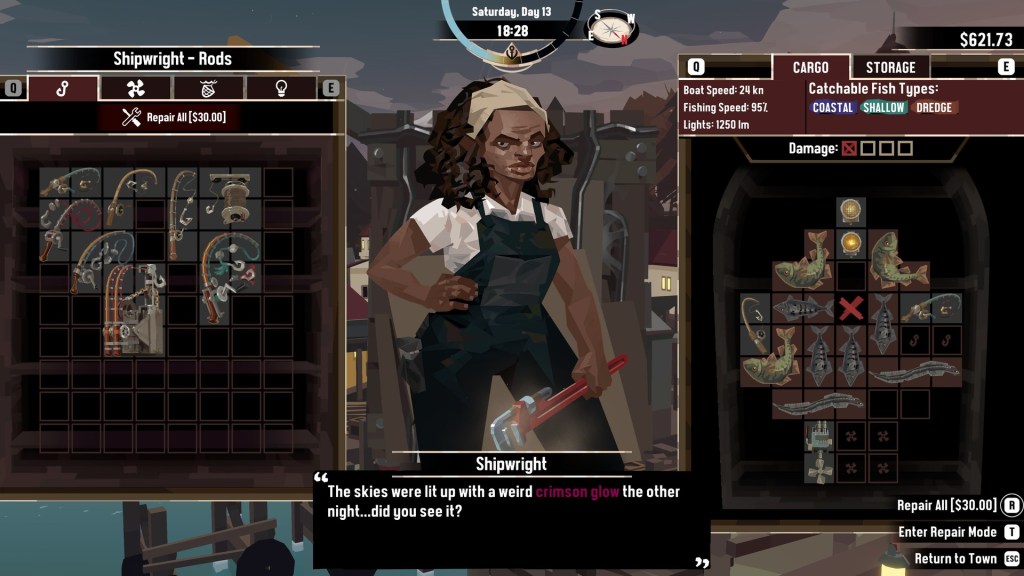
For a fishing game, the actual act of fishing is simple. It’s a minigame in which you time a button press to reel in the fish faster. There are some variations in what the timing wheel looks like and how it functions, but the basic idea is always the same. The only other mastery involved with fishing is identifying the silhouettes of the species of fish to know which one you’re reeling in. Inventory management is similarly straightforward. You have limited capacity on your boat and need to decide what equipment to bring. Moreover, you have to arrange any of your catches or plunder to maximize the relatively limited capacity of your cargo hold. It’s not necessarily difficult, but the awkward geometry of the fish and cargo hold does engage your brain to fit the pieces together. The other component to inventory management is just deciding what is even worth a spot in your hold, as it fills up quickly.
Through maximizing your inventory space and fishing efforts, there are numerous avenues to improve your boat. You can use your yields to upgrade your rods, engines, trawl nets, crab pots, lights, and cargo space. There are so many ways to improve that it always feels like you’re on the cusp of the next one. The upgrades feed into the other avenues of gameplay as it allows you to catch different varieties of fish, have a larger inventory, and explore new areas. While none of the gameplay aspects are complex or deep, they embrace the spirit of brevity to ensure that Dredge never gets stale. They feed into each other for a rapid feedback cycle that it’s easy to get sucked into.
My one desire for Dredge would be to lean more on the night-time terrors. The game rarely encourages the player to make the intimidating trek out into the treacherous night sea. The atmosphere at night is thick and eerie, but aside from a couple of night-only fish there’s rarely a reason to take the risk. Moreover, I wish that being out at night was slightly more threatening. While it’s initially anxiety-inducing, I quickly realized that it was only a little more treacherous than standard sailing. The Lovecraftian atmosphere and spooky vibes are only captivating if the world is actually dangerous. Once the illusion is broken, the game isn’t nearly as suspenseful.
In a year full of smash-hit indie games, I’m glad I chose to play Dredge this spooky season. Its ambience is impeccable. The warm and cozy feeling of taking port under the safety of the lighthouse after frantically evading terrifying monstrosities is magical. While the gameplay doesn’t do anything spectacular or novel, it all fits together quite nicely and knows not to overstay its welcome. It is for these reasons that I give Dredge an 8/10. Dredge has mastered the art of being relaxing while being disquieting, and I love that.
It’s not often that I play a game which causes me to reflect on how I perceive life. In a world where handheld dopamine hits are almost always available, it can be difficult to just appreciate the tranquility that comes from a simple walk in the park. It’s apt that a simple game like A Short Hike has reframed the meditative nature of moment-to-moment life for me. For what may appear to be an unremarkable game, there are some lessons to be gleaned about taking the time to appreciate what’s around you. At the very least, A Short Hike is a fantastic cozy adventure guaranteed to boost your mood.
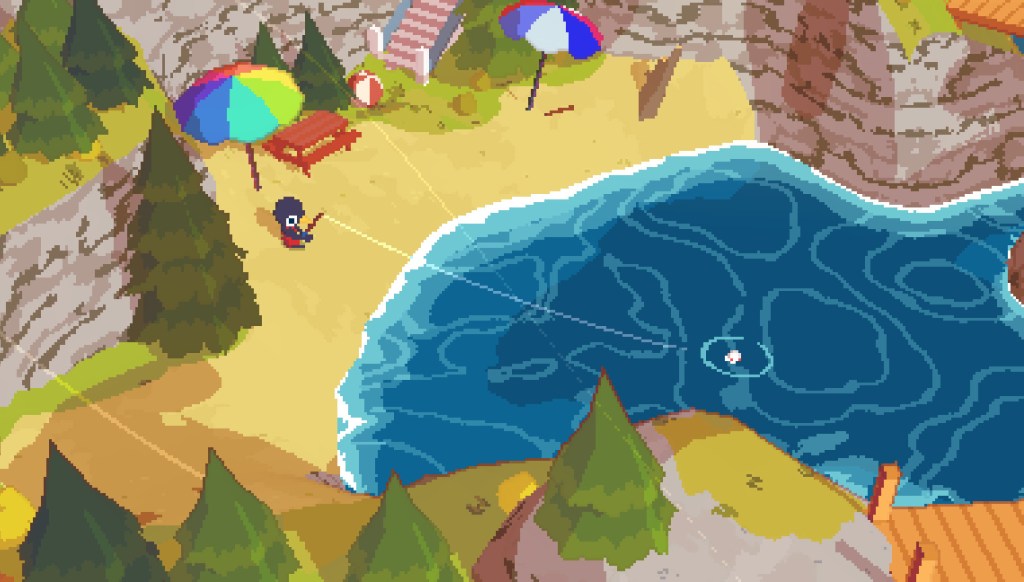
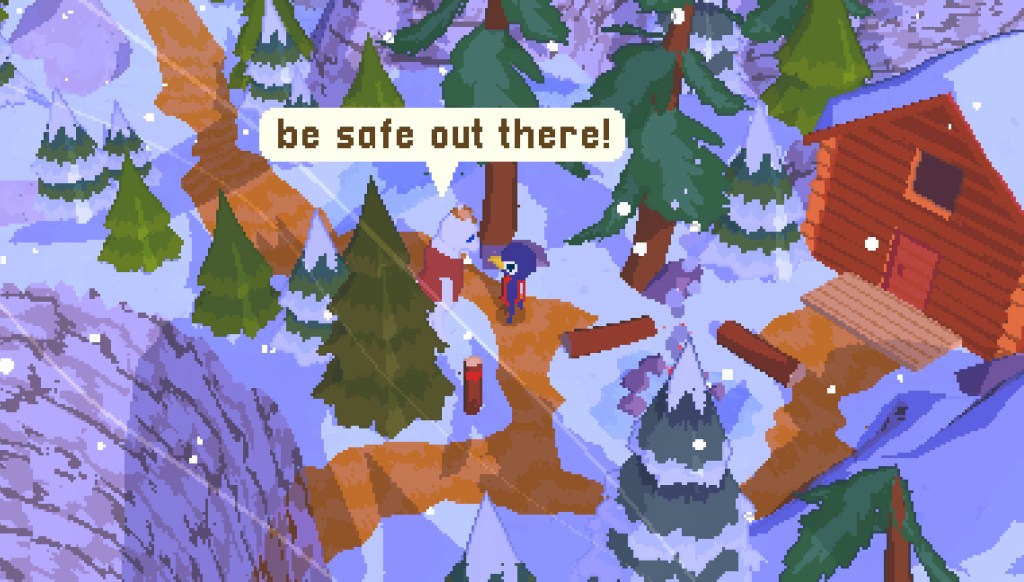
Like the title suggests, the goal of A Short Hike is to reach the peak of a mountain by hiking through some trails. The route is straightforward, and the objective is obvious. But it’s difficult not to stray off the path to explore and indulge in the homey island and converse with its wholesome inhabitants. You play as Claire, a young bird on a nature vacation. Gameplay consists of walking, jumping, climbing, and gliding to reach Claire’s destination of Hawk Peak.
The trek to the summit is meant to be taken at your own pace. A Short Hike is certainly not a difficult game. Aside from some light platforming, gameplay almost entirely insists of exploration. I found myself consistently deviating from the path to experience each area of the island. There are secrets, mini-games, beautiful views, and charming characters to converse with. I quite enjoyed the laidback nature of the game. My favorite aspect is that the exploration is almost entirely driven by the player’s own motivation.
While there are Golden Feathers to be found which act as additional stamina, I was far more interested in spending time in this adorable little world than rushing to the peak. If you really wanted to you could easily dash up the mountain, collecting only the requisite Golden Feathers and ignoring all the other extraneous activities. But I would find it sacrilegious to bypass all the alluring goings-on of Hawk Peak Provincial Park. I loved assisting the characters, playing the made-up game of Beachstickball, going on treasure hunts, or just gliding and taking in the sights. And it all culminates in a heartwarming conclusion.
While A Short Hike is by no means a revolutionary game with an abundance of new and groundbreaking ideas, I love it nonetheless. Other cozy and wholesome games such as Animal Crossing: New Horizons and Spiritfarer are often driven by extrinsic motivation such as unlocks and rewards for completing tasks. A Short Hike relies almost entirely on intrinsic motivation, the satisfaction from doing something just for the sake of doing it. There’s an important lesson here that is paralleled in real life. Not everything needs to be tied to rewards or immediate gratification. It’s often imperative to slow down and enjoy the scenery, literal or metaphorical.
When I downloaded A Short Hike, I expected a quick jaunt up a mountain. What I didn’t anticipate was the profound reminder to appreciate life’s simple pleasures. I was prompted to slow down and just enjoy things for the sake of it. While A Short Hike is assuredly not innovative, I cannot recommend it enough. It’s a refreshing, cozy, and heartwarming adventure that everybody should experience.
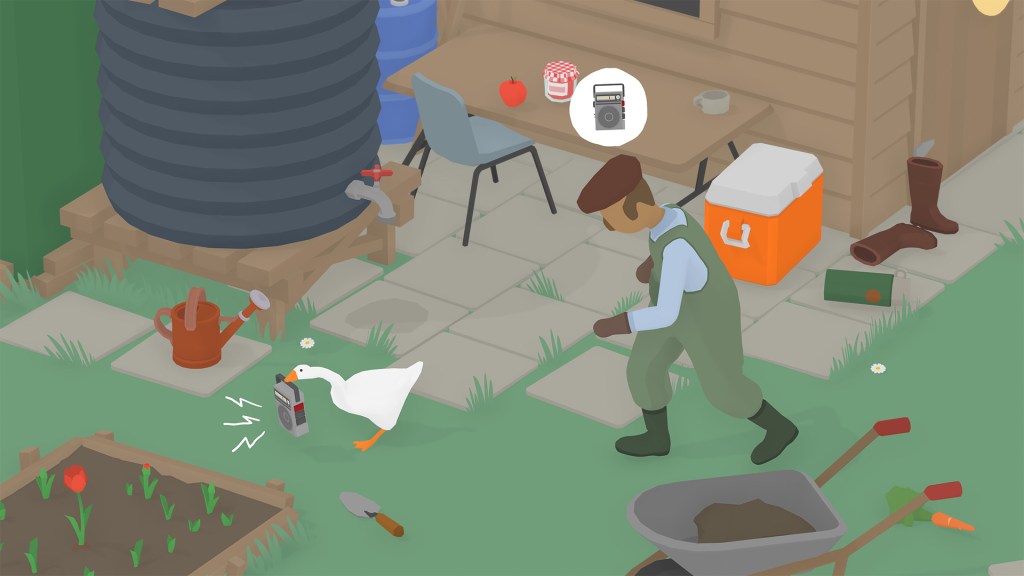
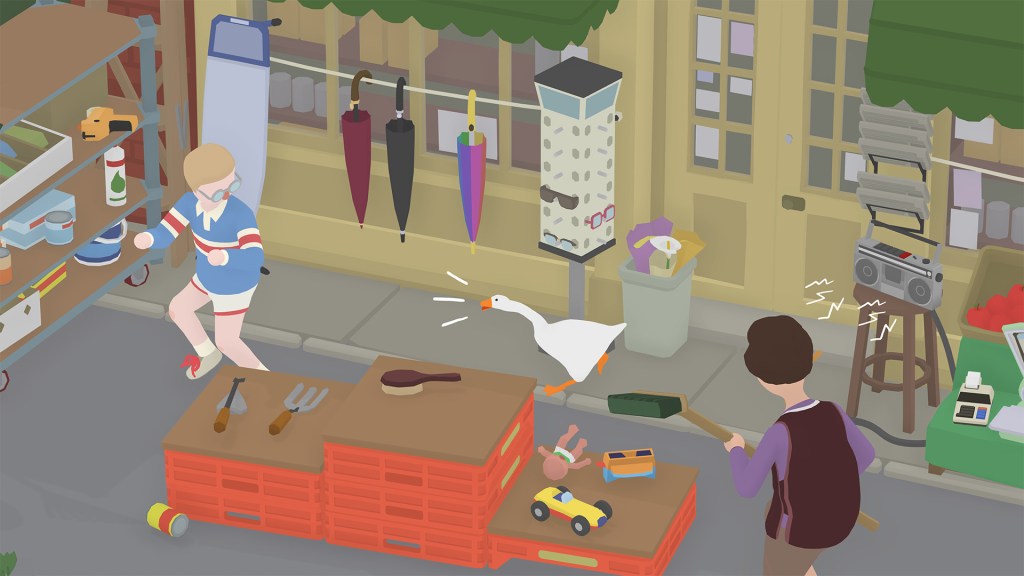
As I’ve grown older, I’ve come to appreciate the condensed, more focused experiences of shorter games. Time is at a premium, and I’d rather a game contain only the very best ideas and executions of its premise rather than be bloated and go on for way too long. Untitled Goose Game is one of the best examples of “short but sweet” in the gaming industry. You play as a horrible goose whose only goal is to annoy and antagonize the residents of a quaint town.
Untitled Goose Game is a rare kind of game. It’s a pure experience, built with a singular purpose of having the player be a goose. There is no bloat. You start the game and are told how to move, grab things, honk, and flap your wings. There’s not a lengthy tutorial explaining how to interact with the NPCs or steal items. There are no dialog sequences or a written story; the story is instead told through the environmental storytelling. I really appreciate it when a game trims the fat and trusts the player to figure things out. It leaves the joy of discovery and problem solving in the player’s hands rather than it being spoon-fed to them.
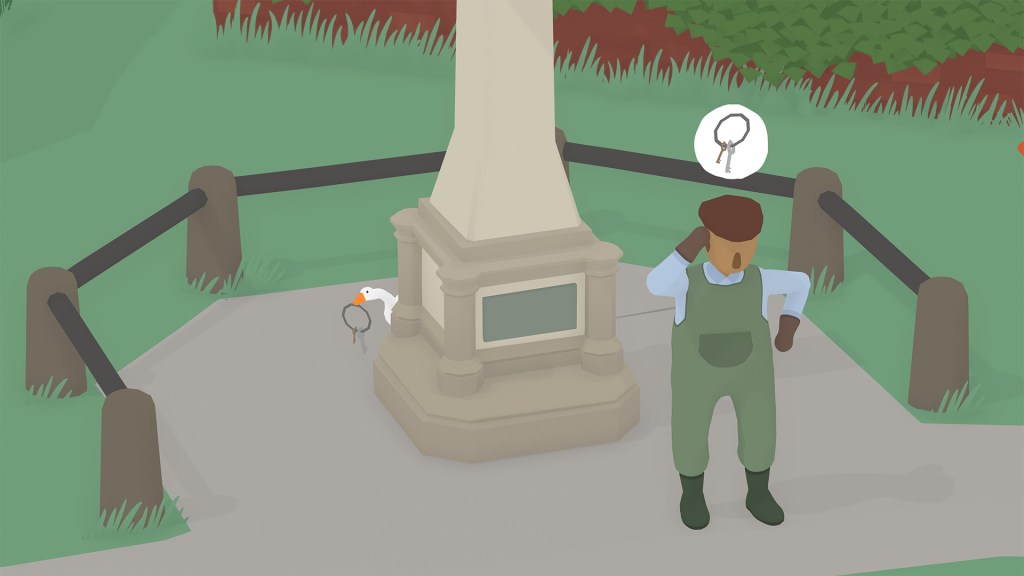
The game consists of a few different areas in the village to play around in. Each area has a list of mayhem inducing tasks, but leaves the player to figure out how they want to accomplish those tasks. From stealing vegetables to have a picnic, to chasing a terrified boy until he hides in a phone booth, to pulling the stool out from an old man trying to sit down, the goose is an arbiter of chaos. At its heart, Untitled Goose Game is a mix of puzzle game and stealth game. It’s up to the player to figure out how to finish their list of disorderly deeds, but usually you have to be somewhat stealthy to prevent the pesky humans from undoing your hard work.
Part of the fun that comes with being a goose is just messing about and being an absolute pain in the ass. While the list of tasks is solid guidance on what to do to progress the game, there is a ton of other fun interactions to engage with. I loved just exploring the tiny town and finding what items I could mess with. It almost feels like a modern Hitman game in the sense that the developers thought of so many different interactions and possibilities in the context of being a goose.
There’s no debating that Untitled Goose Game is short. The main game can be completed in a couple of hours, and while there is some bonus content in the post-game, the meat of Untitled Goose Game can be experience in an afternoon. A common sentiment among gamers is that “hours per dollar” is a valuable metric in judging a game’s worth. This is a garbage way of determining if a game is good. It’s how we end up with 100+ hour games that are filled with repetitive and unnecessary bloat. I’d rather have a short, focused experience than one that drags on for way too long and outlives its entertainment. My most common complaint with many games is that they are too long and up being tedious as you drag towards the finish line. Untitled Goose Game is an absolute delight that is the perfect length for its premise.
Overall, Untitled Goose Game is the perfect game to sit on the couch with your friends or family and just be goofy for a few hours. There’s something genuine and pure about the Untitled Goose Game, it’s just fun. It may not blow anyone’s mind, and it certainly isn’t going to revolutionize the industry, but there’s nothing wrong with just having some plain old fun. It is for these reasons that I give Untitled Goose Game an 8/10. Be a goose, cause some chaos, honk at bystanders, steal what is rightfully yours, and chase children to your hearts content.
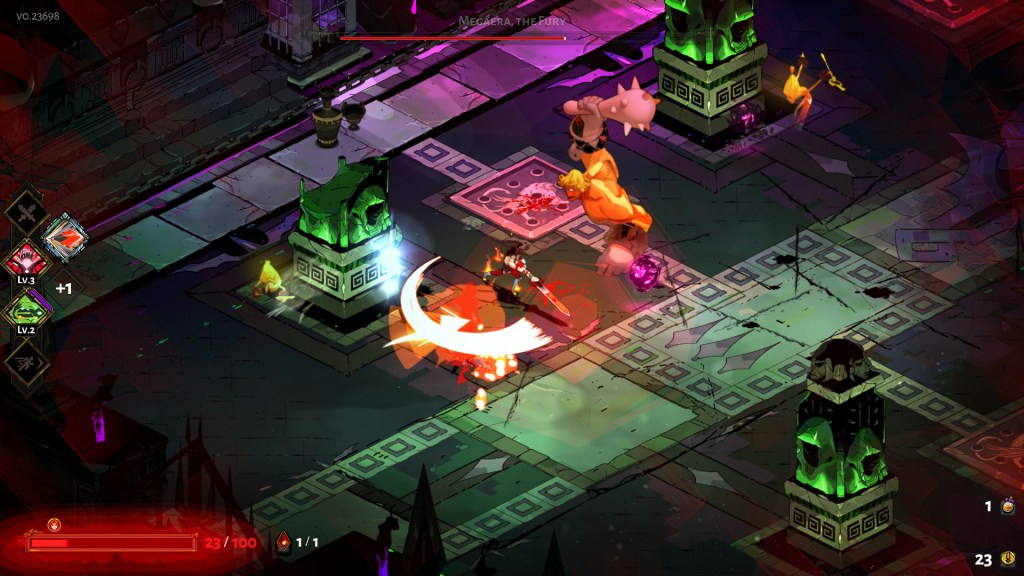
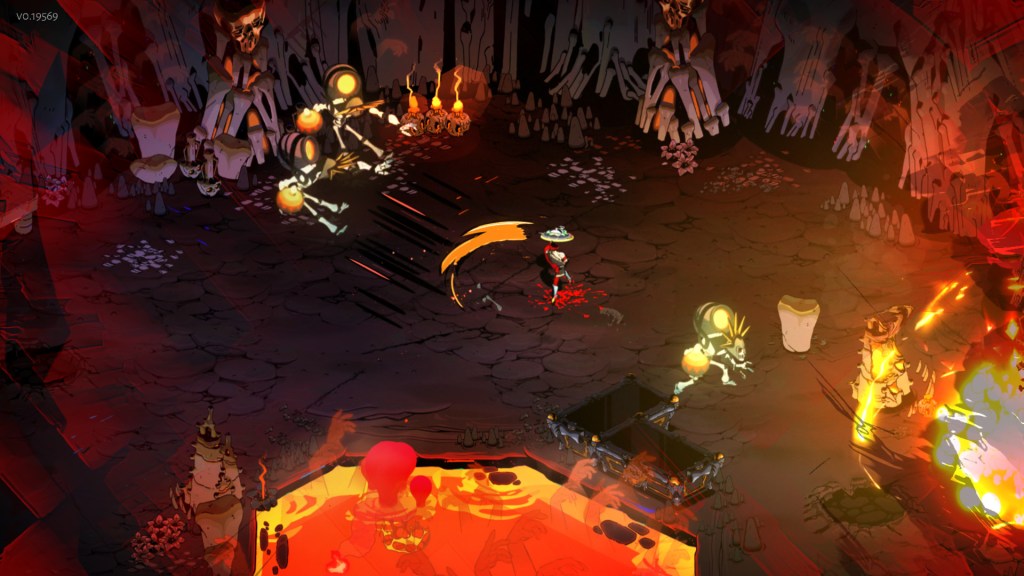
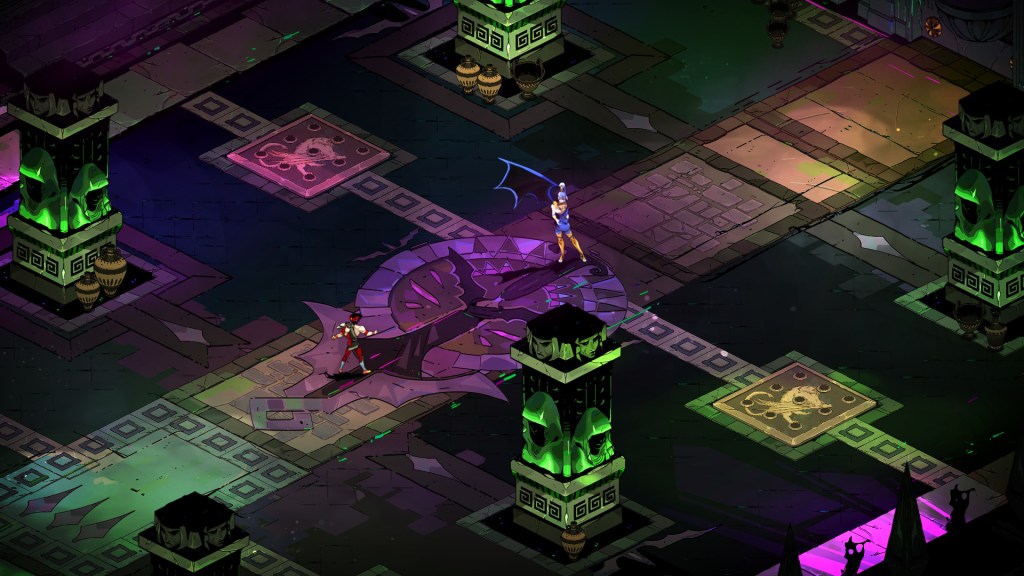
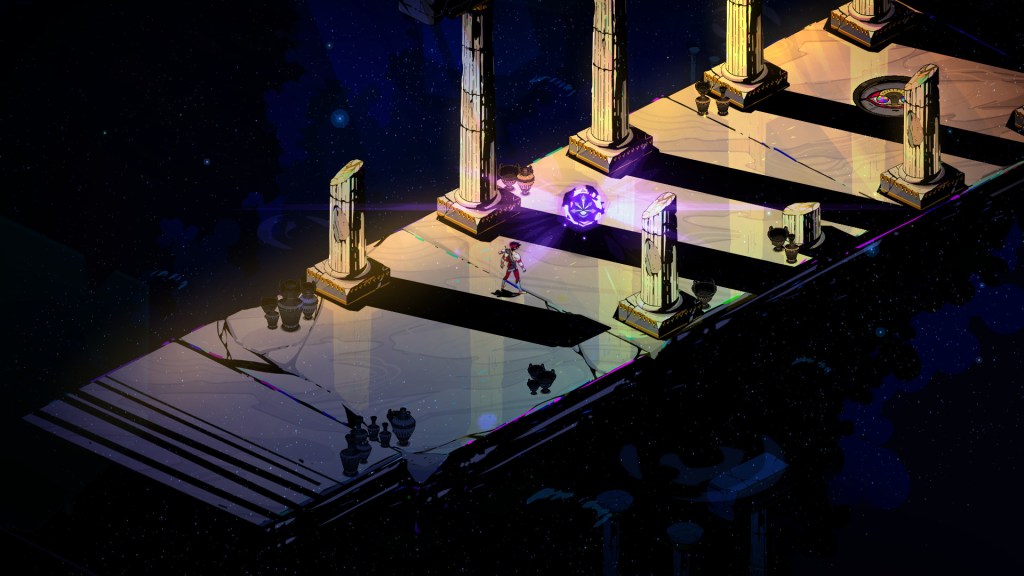
I always try to be wary about external hype when going into a new game. It can alter your expectations, making you overly critical. Alternatively, hype potentially blinds you from issues if you buy into the narrative too hard. That being said, it was extremely difficult to avoid the talk around Hades. Being the indie darling of 2020, winning a plethora of awards, including multiple Game of the Year awards and even a Hugo Award, made it hard to ignore Hades. I had high expectations going into Hades, and while I believe it is an excellent game, I don’t quite get a lot of the unanimous and unquestioned praise that it has received.
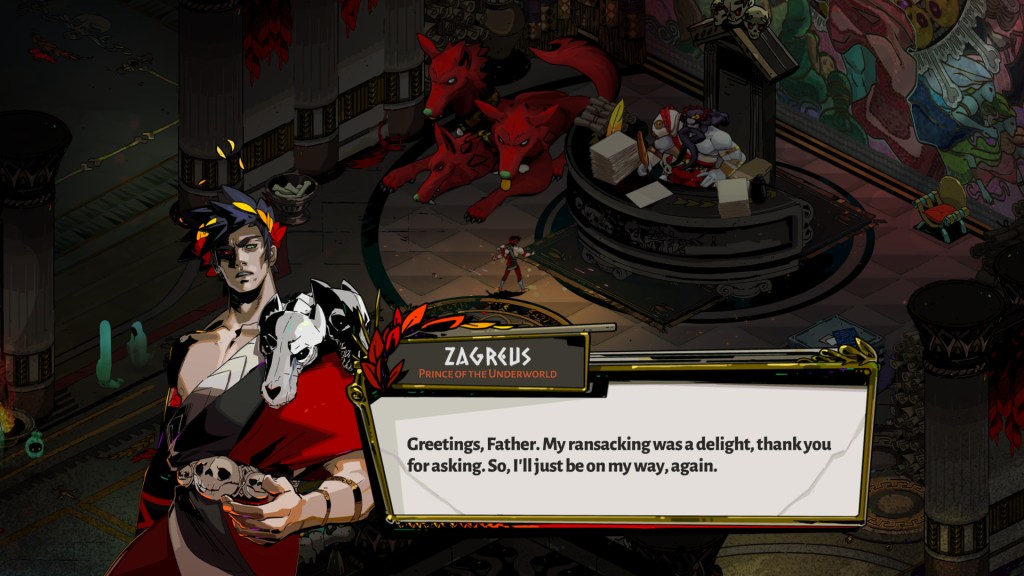
As a roguelite, Hades is all about battling your way through the layers of the underworld to escape to the surface. You play as Zagreus, the son of Hades, who has recently discovered the true identity of his birth mother and that she lives outside of underworld. Every time you die, you are sent right back to the beginning. Don’t fret though, Hades is all about progression, whether or not you succeed in any individual escape attempt.
A large factor in the appeal of Hades is that it is always moving forward. Even when you fail, it’s not painful. Not only do you bring back valuable materials to power up for future runs, but you also get the pleasure of conversing with the gods who reside in the hub. They always have new dialogue, often revealing new story tidbits. They have complex relationships with Zagreus and the other gods, which you get to hear in bite-sized chunks after every run.
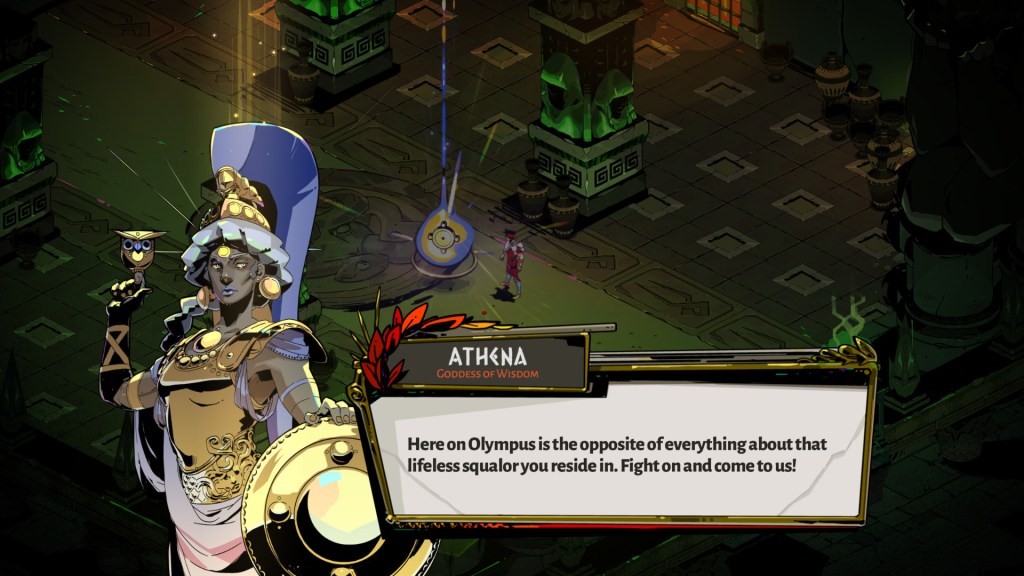
During your escape, you are also offered assistance by the gods of Mt Olympus. As you play the game you will talk to them, furthering your relationships and learning more about them. The quality and sheer quantity of writing here is absurd. In dozens of hours playing the game, I don’t think there was a single repeated line. And the writers did a phenomenal job giving each of the gods a distinct personality. All of the dialogue felt believable, not like the cheesy or over-dramatic dialogue that is more common in video games.
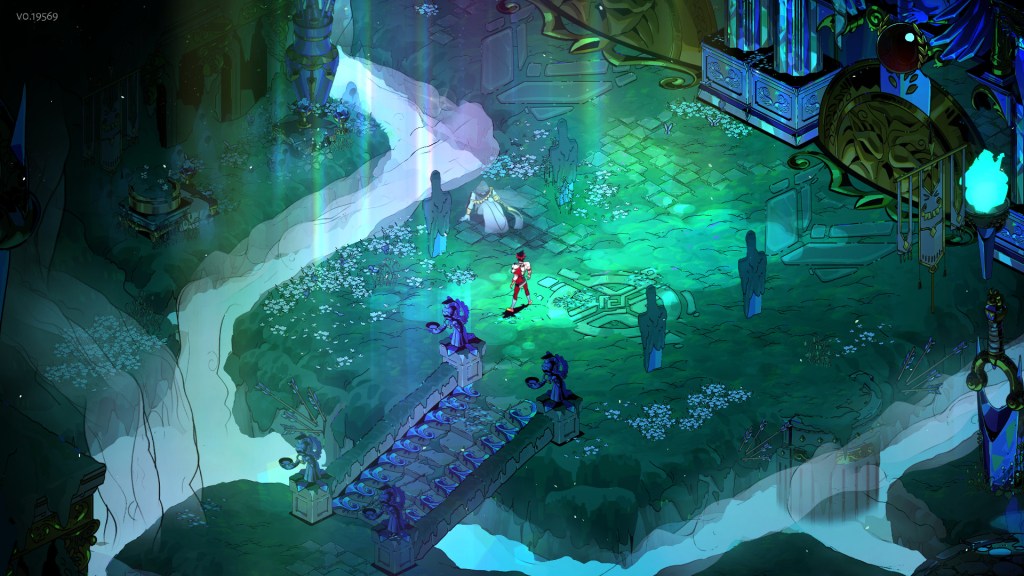
The writing was only further brought to life by the artistry of the game. The voice actors gave tremendous presence and fitting personality to the characters. Hermes is a fast talker, Athena is stoic, Zeus is confident but quick to anger, Demeter is cold, and so on. Every line is excellently delivered. Furthermore, the art style that Supergiant Games is known for is absolutely phenomenal. It brings the mythical gods to life. The aesthetic is downright gorgeous, both in combat and when conversing with the gods.
Your first attempt to escape the underworld will be nigh impossible. With little knowledge of the enemies and obstacles in your way, and a complete lack of any permanent power-ups, you stand nearly no chance. But it won’t be too long before you are on the doorstep of Greece, Hades does a phenomenal job marrying your skill progression with your character progression to create an engaging gameplay loop. As you clear rooms and make it deeper in each run, you earn different currencies to purchase permanent upgrades.
While each upgrade may seem individually weak, they quickly add up to drastically increase your power. The further you make it in each run, the more currency you earn. This creates an engaging loop in which every run you get better at playing the game while also increasing Zagreus’ strength, guaranteeing that you will steadily make more and more progress. If you are skilled at the game you will power up faster, while if you are doing poorly, you may not earn a ton of currency at first. This is genius as it allows the player’s skill to progress in parallel with their upgrades.
I had a blast with Hades while building up to successfully complete my first run. I felt myself getting closer and closer with each attempt. Gaining power and hearing more of the story as I talked to the gods. But after reaching the end for the first time, I felt that the successive runs quickly grew repetitive. There is plenty of variety to be found in Hades, choosing a weapon, the aspect of the weapon, and the randomized boons between runs does greatly increase variety. But still that variety felt stunted in comparison to other games in its genre. Furthermore, the goals after escaping the underworld felt more centered on grinding instead of an ultimate achievement.
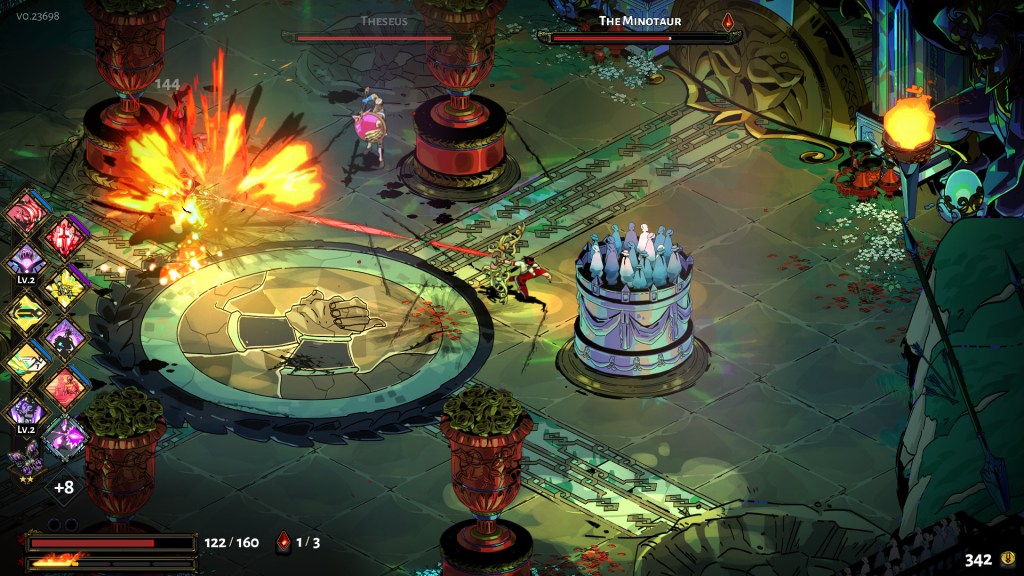
I understand that the roguelite genre is all about replayablity. Repetition is baked into the genre, and it is totally understandable that Hades follows suit. But Hades lacks variety between runs to keep things interesting. You always fight through the same four areas with the same four bosses. Thematically it makes sense, but it can get stale without interesting boon combinations. On each run you acquire boons from the gods that act as power-ups for that run. Zeus boons electric enemies, Poseidon knocks enemies around with waves, Artemis gives critical strike, Dionysus poisons enemies with wine, so on and so forth. But ultimately many of the boons just feel like different flavors of the same thing: more damage.
You can get some really interesting combinations of boons that synergize well together, but it felt like most of the time boons are just colorful ways to up your damage. The real variety between runs feels like it comes in the weapon selection. There are six weapons to start the run with, each with multiple unlockable aspects that modify how the weapon behaves. Additionally, on each run you can find two hammers which further transform the weapon. For example, you can find a rapid-fire modifier for the bow, or make the spear bounce between enemies when you throw it. Its these huge modifications in playstyle that opens up interesting variety between runs. But the boons and level designs often do very little to make each run feel distinct.
My other major issue with the grind of Hades is that the ultimate goal is focused on grinding rather than accomplishing something. To truly “beat” the game and see the end credits you need to achieve ten successful escape attempts. To further relationships in the epilogue, you need many more. I prefer a format like Enter the Gungeon in which there are concrete goals like beating a final boss or unlocking a new character. Hades just feels like you are supposed to play it a lot. It gets frustrating when I’ve beaten the game 7 times in a row on progressively higher difficulties but need to do it 3 more times just to see the end credits.
While I do think Hades can be repetitive, I do appreciate its in-depth difficulty system. After your first successful clear, you can choose to increase the “heat” of any subsequent runs. There are dozens of different options to toggle, many of which can drastically change a run. You can add timers to force yourself to move quickly, add more powerful enemies, make traps more dangerous, give bosses more potent move sets, so on and so forth. Every time you play on a new heat level with a given weapon, you will be able to attain rare resources, which encourages the player to keep upping the challenge.
The aspect that I think defines Hades as a roguelite is how it handles the randomization aspect. Games like The Binding of Isaac and Enter the Gungeon can be extremely volatile. In one run you may get extremely powerful combinations of weapons and buffs, and in the next you get absolute garbage that makes it nigh impossible to succeed. Randomization is the lifeblood of roguelites and roguelikes, as few people would want to play the same game over and over with little variety. But conversely, if the game is too random, it can be immensely frustrating to be stuck in a run where you have gotten nothing of value. Hades handles this in an interesting way by allowing to player to choose what bonuses they will be acquiring.
You are almost always given an option between multiple rooms, with the reward of the room being visible before you even enter. That way you can decide which god’s boons will fit your build and choose accordingly. You won’t get stuck getting a mishmash of useless bonuses. Moreover, when choosing a boon from a god you will get a choice between three different boons. There is still some randomization on which gods will be available and which boons they will offer, but the combination of choosing which reward you want and getting a choice of three boon different options minimizes the odds that you get undesirable bonuses.
I am torn on how randomization is handled in Hades. Minimizing the frustration of getting unlucky runs is fantastic, but perhaps Hades leans too far in letting the player choose their benefits. The game can never really have any incredibly powerful unrestricted boons, as the player would choose it every single time. As a result, it’s exceedingly rare to get truly crazy combinations of bonuses that feel game-breakingly powerful. Much of the appeal from playing roguelites comes from wanting to see what overpowered build you can cook up next. In Hades I always felt like I had a powerful build, but nothing overpowered.
An underrated aspect of Hades is how much information it provides on what different things actually do. It clearly and concisely describes which attacks are being enhanced, and exactly what the bonus is. This sounds obvious, but I constantly had to play Enter the Gungeon with a wiki tab open because the game simply does not tell you what the different weapons or their synergies are. I greatly appreciate how Hades gives the player all the information they need to make informed decisions.
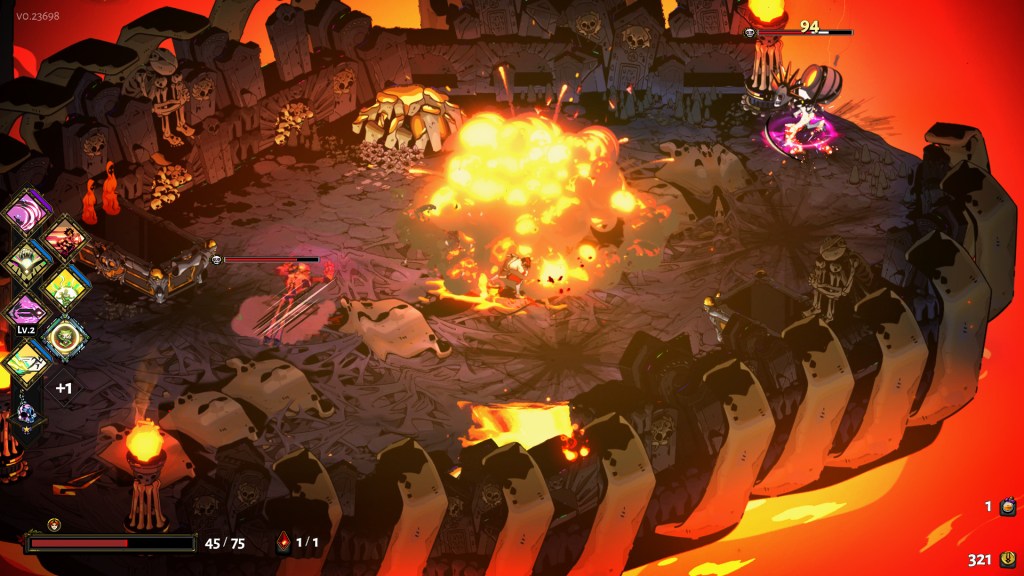
The gameplay as a whole is extremely fun as a simple beat-‘em-up. Hades feels like a modern arcade game, smashing through waves of weak enemies with a limited moveset. There aren’t any crazy combos, and the many of the enemy types are glorified punching bags. It’s fun to unleash hell on mobs, and Hades has great visual and audio feedback. The bosses are where I felt the meat of the challenge was, as you had to be fairly familiar with their movesets in order to avoid damage.
The combat is nothing revolutionary, but it is addictive. I did feel like at times it could be a bit button-mashy. Because of how snappy your controls are, it can be a pretty effective strategy to dash around a bunch and mash the attack button. Enemies that don’t have armor and are not bosses can easily be stun-locked if you just keep hitting them, making spamming attacks very potent. My only other issue is with the visual clarity, as the battlefield can quickly become cluttered with hyper-stylized visual effects. It can often be tricky to read what enemies are doing when there are a dozen different flashy visual effects firing off as you attack. But I ultimately don’t think it’s a huge issue considering that Hades is not a game that demands perfection or precise timing.
Overall, I believe Hades is a different breed of roguelite. With a heavy focus on meta-progression and character development, there is always something to work towards. It abandons some of the genre’s traditional frustrations like the influence of luck and lack of information. Hades was a ton of fun to play until I had a few clears under my belt, which is when I began to miss the truly random builds and combinations that I could acquire in other roguelites. It is for these reasons I give Hades an 8.5/10. It is a spectacularly well-crafted game, but it doesn’t boast the infinite replayabilty of the other games in its genre.
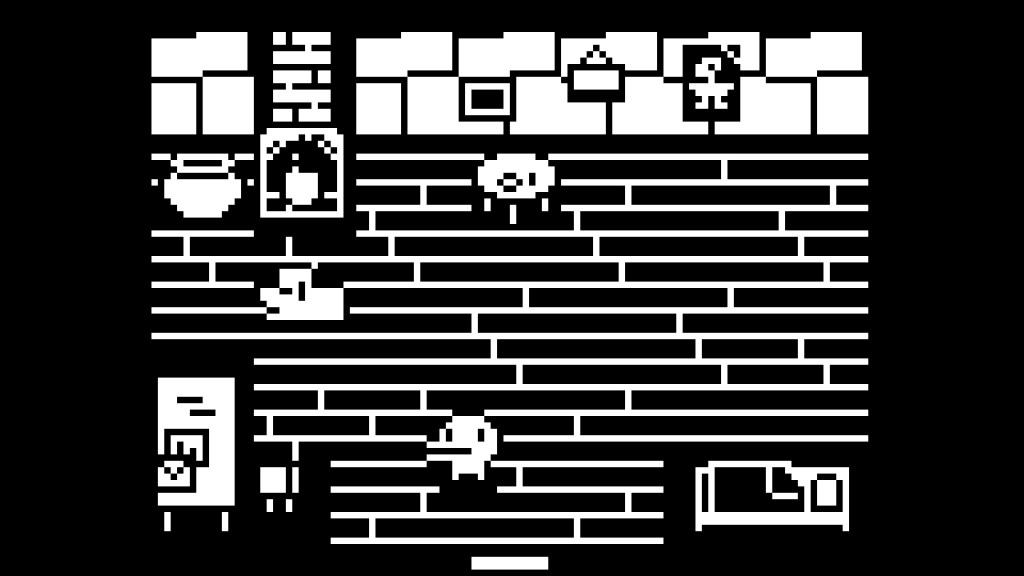
An often-repeated idea in many gaming spaces is a game is only as valuable as how many hours of entertainment it provides. Games that provide dozens or hundreds of hours of content are hyped up, while games that are shorter or have a defined end are seen as a waste of money. I vehemently disagree with this mindset. Extremely long or open-ended games are usually bloated with tons of filler or subpar content. I much prefer shorter games that have a well-defined structure that isn’t beaten to death over the course of 100 hours. An extreme example of bite-sized experience is the indie game Minit.
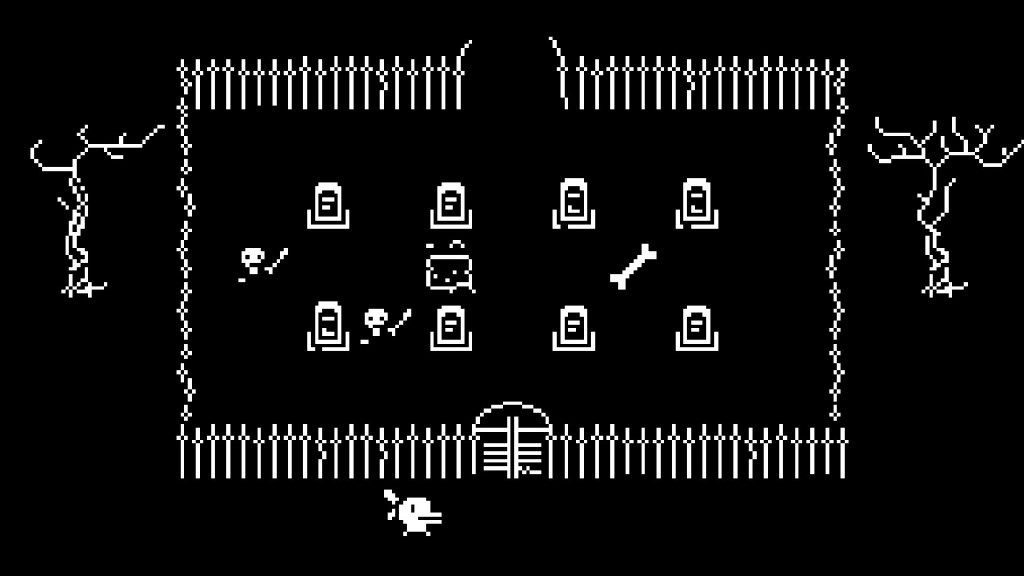
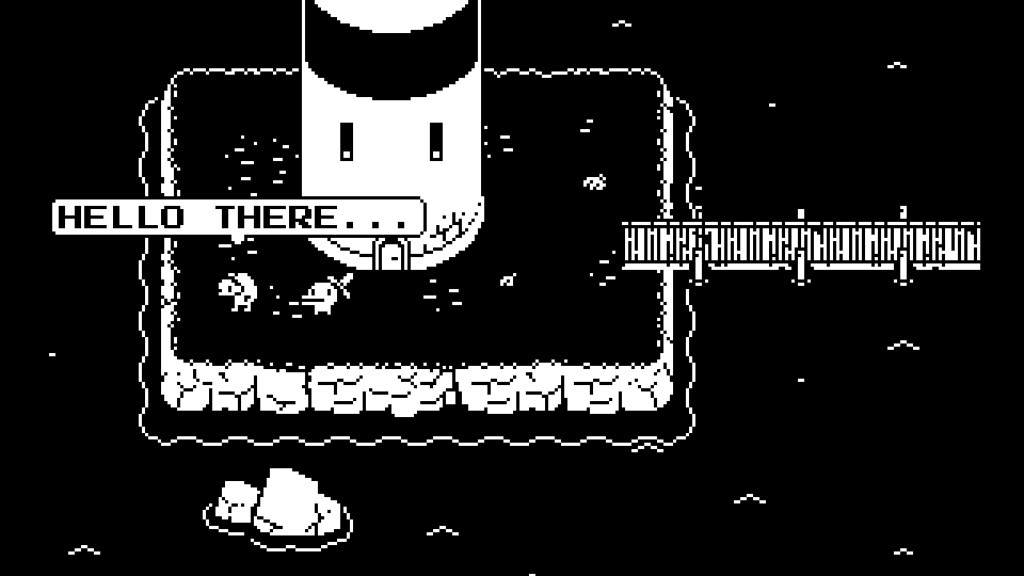
Minit is a top-down adventure game that is clearly inspired by the original The Legend of Zelda games. Like the adventure games of old, you run around the world with sword in hand, solving puzzles and conquering foes. The twist of Minit is that every 60 seconds you die and are reborn at your home base. Every minute is a frantic rush to progress forward in some way, whether it be exploring a foreign area, solving a puzzle, or unlocking a new item.
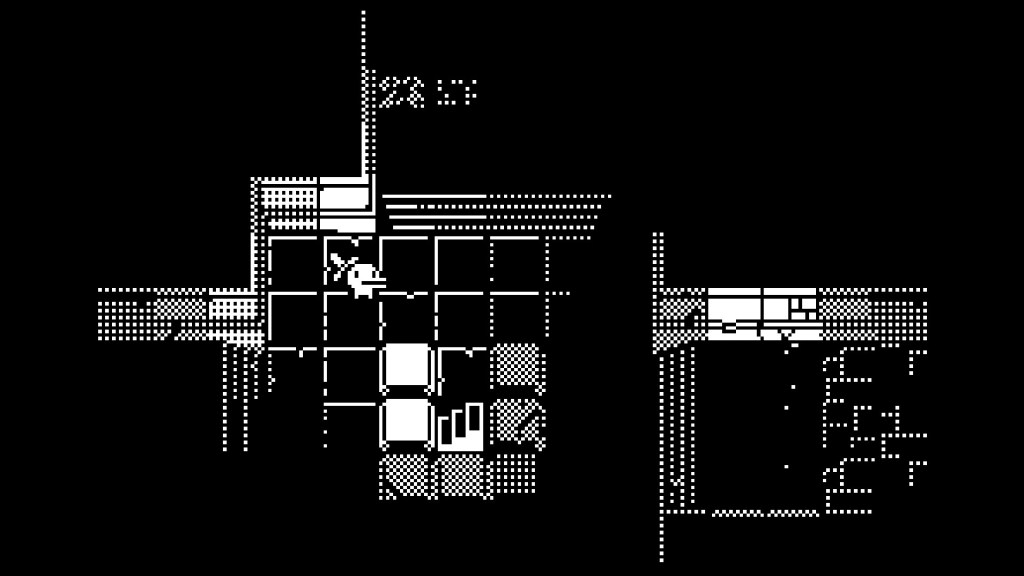
Dying and respawning every minute causes the player to think about what they want to achieve in such a short time frame. Minit is incredibly tightly designed, I was shocked quickly I could traverse the world. I initially assumed that I would frequently run out of time having achieved nothing in a minute, but the map is so compact and dense that it was always simple to discover something of interest. The interconnected nature of the world allowed for quick navigation. Unlocking new items would allow access to previously inaccessible areas, and exploring these areas often revealed shortcuts to other parts of the map.
One of my main gripes with Minit was that it infrequently actually made use of its timer mechanic outside of just resetting the cycle. I do enjoy the concept of only having a minute in each cycle, as it forced such tight game design and pushes the player to carefully route their path through the world. However, most of the puzzles, exploration, and combat never utilize this mechanic at all.
There are a few clever uses such as interacting with a man who speaks very slowly, so if you want to hear what he says you must reach him early in the cycle. But for the most part the only impact that the minute long cycle has on the game is emoti the player to move quickly and with purpose. Interestingly, you could remove the minute long cycle and the game would still function perfectly well. I do think that it is still a worthwhile addition in how it motivates the player to maneuver through the game.
A common sentiment in many gaming spaces is the idea that games as a product should provide you with a sufficient amount of content to justify their price. I don’t wholeheartedly agree with this line of thinking as it is how we end up with 100-hour slog fests with repeated and tedious content. I much prefer if games deliver a focused experience, only including the very best that the designers had to offer. That being said, Minit is short. Incredibly short. Minit took me a little over an hour to complete. Even if I went hunting for all the hidden collectibles, I doubt it would’ve taken me more that 2 hours to 100% complete the game.
To be honest, I was refreshed with how short Minit was. It definitely did not overstay it’s welcome, which is one of the most pervasive issues that I have with games. But I think Minit is too extreme on the other end of the spectrum. There were definitely more ideas that could have been explored. Especially considering that the game barely scratched the surface when it came to time or cycle-based mechanics.
Overall, Minit is a short but sweet adventure harkening back to the games of yesteryear. I quite enjoyed the use of the minute long cycles and how they influenced the world design, but it felt underused when it came to game mechanics. If anything, Minit is a fun little adventure if you don’t feel like committing to a grandiose globetrotting RPG that spans dozens of hours. But if you are looking for a more comprehensive experience, you may have better luck elsewhere.
It is a rare occasion in which I get to play a truly innovative game. Games that push the boundaries of a unique concept can be difficult to come by. That is why I was excited to try the acclaimed puzzle game Baba is You. This indie game presents an elegant idea: rules are meant to be broken. This is a game about rules, and how you can manipulate them to reach your goal.
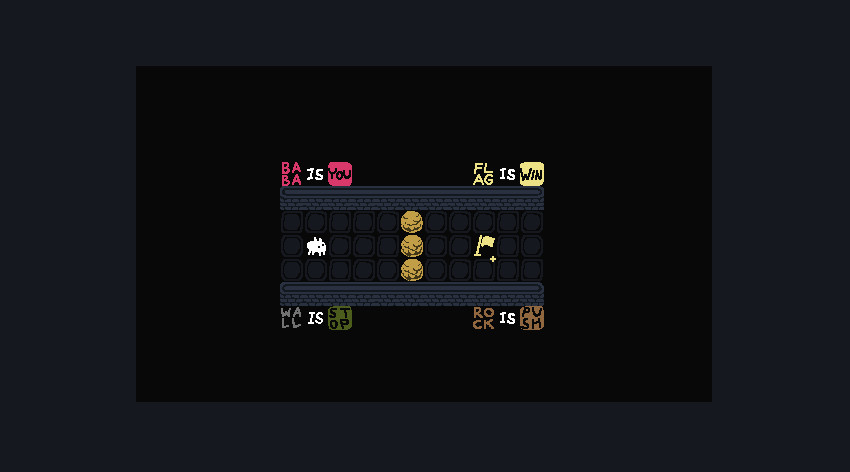
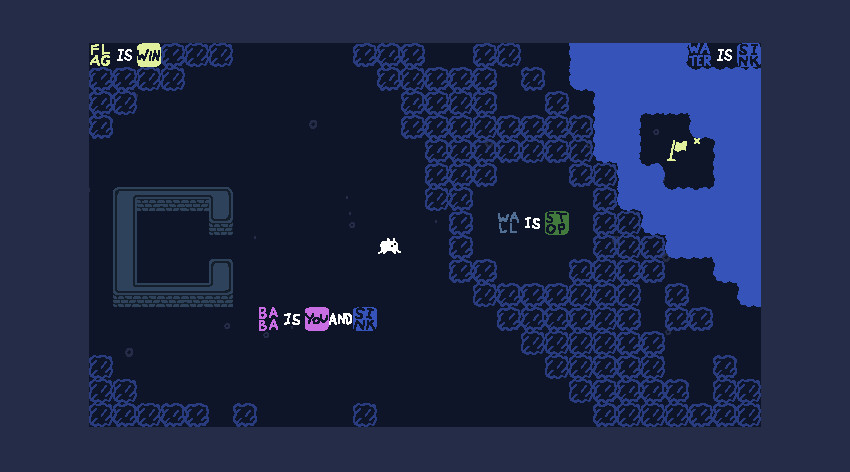
Like many puzzle games, the premise of Baba is You is to get to the goal. The genius of the game is that the rules are ever changing. Each level is a square grid, and each rule is simply laid out for the player. It starts innocuous enough; the first level begins with rules such as “flag is win”, “Baba is you”, and “wall is stop”. You are a little white creature called Baba, you must make your win to the flag to win, and any wall in your way will stop you. What makes this game special is that the player can manipulate the rules as each word is movable. For example, you can push the word “wall” to break up the sentence “wall is stop”. Now that rule no longer exists, and you can freely walk through walls. Moreover, you can use whatever words are given to you to form new rules. In the previous example, you could use the given words to make “wall is win” to change the win condition of the level.
The idea behind Baba is You is absolutely phenomenal. In every game that I have played, rules are concrete. Through tutorials, text, or simple trial and error the player must deduce the mechanics of the game and how everything interacts. In Baba is You, every level has its own ruleset laid out in plain sight. It’s up to the player to manipulate those rules to their advantage. Breaking up sentences to invalidate troublesome barriers, or forming new rules that could prove useful. As the game progresses, new words begin appearing that could drastically change how levels need to be approached. Part of the beauty of the game is that despite the ever-changing rules, the win condition always remains the same: whatever object is “you” needs to be touching whatever is “win”. This inevitable end-state of any puzzle is a helpful starting point to begin thinking about how you can achieve victory.
The most critical aspect to any puzzle game is its level design. Challenges must be creative and fully utilize the games mechanics, while at the same time having relatively simple solutions that are not obtuse. If you’ve played many puzzle games, I’m sure that you’ve run into a roadblock and after finally stumbling into the solution you say “how the hell was I supposed to figure that out”. Designers must avoid this feeling while simultaneously crafting puzzles that force you to think. Baba is You has fantastic level design. Most solutions are simple to execute and don’t require some obscure mechanic. The designs are ingenious in that most levels require some trick or tactic that any other level hadn’t utilized yet, but remain simple and seem obvious once you discover the solution.
Moreover, Baba is You utilizes its unique premise to challenge preconceived notions. Most gamers are going to have internal habits that are going to be broken. You are going to make false assumptions about how to beat a level, and the developer was fully aware of that. Many of the levels have this uncanny quality to exploit the player’s desire to immediately attempt an obvious solution. It baits you into using an object the same way that you’ve used it so many times before, but that assumption will only lead you away from the goal. Many times, you feel so close to solving a puzzle, but in reality, you are so far off from the correct solution.
Additionally, for a game that is all about breaking rules Baba is You is remarkably good at stopping unintentional or “cheese” solutions from working. Again, it felt like the developer thought of every way a person could attempt to solve a level and prevented everything but the intended solution from working. The final note on level design that I want to touch on is the ability for each level to foster an “aha!” moment. It’s a great feeling when you figure out some trick that you hadn’t thought of before that makes the puzzle a breeze. Baba is You excels at creating those sensations when a level finally clicks.
One of the most important aspects to Baba is You is how relatively easy it is to get into. Some of my favorite puzzle games are notoriously unapproachable. Stephen’s Sausage Roll and SHENZHEN I/O are both confusing and cumbersome for new players, and as a result many people don’t give the games a fair chance. Baba is You is comparably simple to pick up and play. The game starts with extremely easy levels for the player to grasp the basics. Moreover, while there are over 200 individual levels, you only need to complete a few dozen to beat the game. You can pick and choose which levels you want to do, so if you get stuck on one particularly troublesome puzzle, you can skip it entirely and try something else.
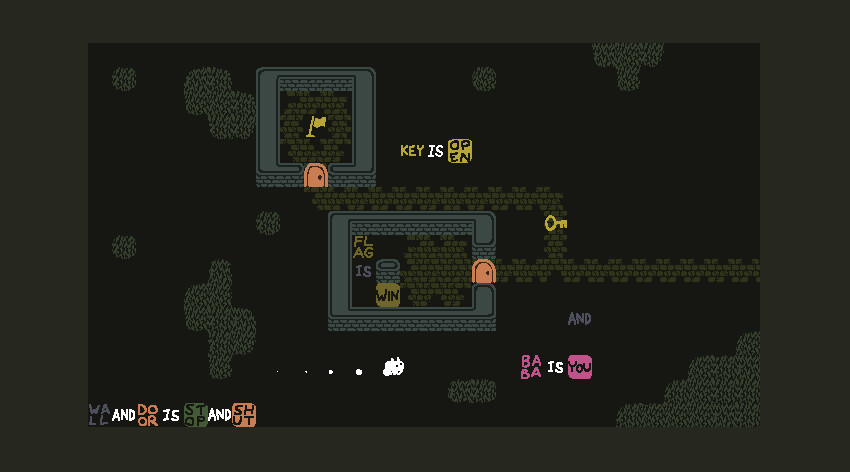
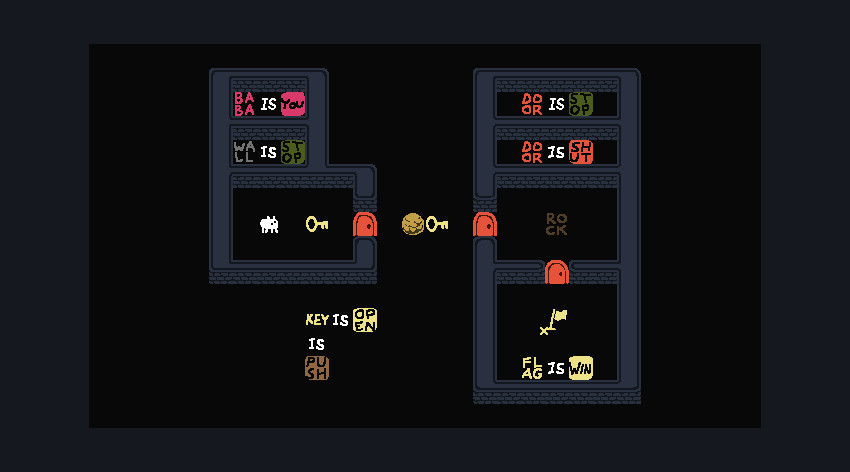
Despite Baba is You being easy to pick up, it can be an extremely challenging game. While the beginning sections of the game are there to ease new players in, there is plenty of optional content that will test even the most veteran puzzler. The final few sections of the game in particular are insane. These parts are entirely optional, but they utilize a rapidly expanding ruleset and rely on meta solutions. How you complete one puzzle may affect another puzzle, and how to get to the next puzzle is dependent on how you completed a previous puzzle. I don’t want explain too much, as it may ruin the surprise for people who do want to experience these sections. It suffices to say that Baba is You truly maximizes the potential of its concept and it boasts plenty of difficult content.
My single point of contention with Baba is You comes from the moments where a level truly stumps the player. Baba is You relies on players to experiment with the rules on their own, nothing is explained outright. It is up to the player to figure out how each rule and object interacts. For the most part, this is a good thing. It respects the player’s intelligence and rewards creative use of rule manipulation. It also fosters those “aha” moments I spoke of before. The problem arises in that it can be a common occurrence where a puzzle completely stumps the player.
The issue is that nearly every single level in the game relies on some trick to complete it. Once you figure out the trick, the level seems elegant and simple. But if you haven’t figured it out then the puzzle is quite literally impossible. In other puzzle games, there is usually a series of moves or steps to get to the goal; you can make intermittent progress towards the finish as you figure out each individual step. Baba is You on the other hand relies on grand revelations and “aha” moments, so it may so happen that you stare at a puzzle for an hour and have made no progress. While these moments are frustrating, I do have to commend the game for providing a way to avoid this. As previously mentioned, you don’t have to complete every puzzle to beat the game. If one is stumping you, you can avoid it entirely. While I did end up 100% completing every puzzle in the game, any moment of frustration was self-inflicted because the game provides the option to circumvent any particularly tricky levels.
Something about Baba is You clicked for me in a way no other puzzle game has. It has a truly remarkable premise and incredibly designed logic-based puzzles. In a way, it reminds me of the enjoyable side of programming. Logically stringing together rules and statements to solve some problem is inherently satisfying to me. It is for these reasons that I give Baba is You a 10/10. I highly recommend this game for anybody who enjoys puzzles as it may be the best puzzle game ever made.






 stephensopinions