Firewatch (2016)

Firewatch is an indie title developed by Campo Santo. It is set in the Wyoming wilderness and the main character, Henry, becomes a fire lookout. The game revolves around its beautiful scenery and compelling narrative instead of gameplay and action. I was nervous about how good the game could be when the only real gameplay is just walking around in the wilderness, but I believe it worked out alright. I am going to try to avoid spoilers in this review, as the story is all that this game has and it would be a shame if I were to ruin it for somebody.

The game is about the main character, Henry, and how he isolated himself after his wife develops dementia. He becomes a fire lookout in the middle of a national park, and his only form of human contact is talking with his supervisor, Delilah, over the radio. As the player walks around the park doing mundane tasks you are constantly in conversation with Delilah. The dialogue is witty, humorous, sometimes somber, and most importantly it all feels real. Many games struggle in this regard, conversations often feel robotic, but not in Firewatch. The conversations that the player has could actually happen in real life, and this aspect is further strengthened by the excellent voice acting. As time passes in the game Henry and Delilah stumble upon a mystery and they take it upon themselves to unravel it. Overall this was very compelling and kept me hooked the entire time. The mix of exploring the wilderness, conversing with Delilah, and pondering the mystery kept my brain busy.

Though the narrative and story-telling is where Firewatch shone through, there were also a fair amount of issues with the game. The controls were a bit clunky and tough to get used to, and the game was inconsistent when it comes to what you can traverse and what you cannot. Sometimes you can climb up giant rock faces, other times you cannot even step over a pebble, this occasionally got frustrating as I explored the park. While these issues were minor, there were much bigger problems. Although I really liked the narrative, I wish it was tacked onto more actual gameplay. Firewatch plays itself: you cannot do anything wrong, all you do is walk around, and none of your choices matter. I just want a little more sustenance, because it felt like I was watching a TV show or movie instead of being an active player in the game. My other big issue with the game was the ending. I was extremely disappointed in the way the game ended. I know the old cliché “It is about the journey, not the destination”, but in this case I felt the destination completely invalidated the journey. It felt like the entirety of the game was building up many different plot lines, but most of them just went nowhere. The ending just left a bitter taste in my mouth, after completing the game I was left thinking “That’s it?”

If you are intrigued by the aspect of just enjoying the scenery and narrative of a game, then Firewatch is a great game for you. Unfortunately, if you want anything more than just walking around you are going to be disappointed. Also, if you are planning on playing this game, just prepare your self to be let down by the ending. All in all, I did enjoy Firewatch despite its shortcomings and I thought it was a neat little game. I am going to give Firewatch a 6/10. Its narrative and story-telling are top-notch and other developers should attempt to model it. I just wish there was a little more to this game.

Dishonored 2 (2016)

For me, Dishonored 2 was highly anticipated title as I loved the original Dishonored that came out back in 2012. I personally feel that Dishonored 2 does a fantastic job at continuing what made that original so great. Dishonored was all about having different ways of tackling every mission and scenario, and Dishonored 2 runs with that idea. It expands the player’s tool set and options to the point where every single person that plays this game is going to have a different experience. There were a few issues with the game, but a lot of the problems are pretty minor when compared to what makes the game so fun.

In Dishonored 2, you have the option to choose between two different characters to play as. Each character as a unique set of supernatural abilities that you can play with and upgrade by collecting Runes. The player also has access to a very wide variety of tools and weapons at their disposal such as sleep darts, stun mines, a pistol, explosives, and so on. These tools are also upgrade-able through black market shops hidden across the world. On top of all of that, you have the option of being stealthy or chaotic in your methods. You can go into any scenario guns blazing as long as you are prepared for a fight, but you can also sneak past any unsuspecting foes and complete the mission in a more stealthy manner. Also, you have the option of using non-lethal methods to dispose of enemies, or you can kill enemies if you so choose. The combination of all these different aspects makes the game feel like a sandbox. Every scenario you walk into, there are dozens of different ways to tackle it. I personally played using non-lethal tactics and all the while never once being even detected by an enemy. I viewed every room as almost like a puzzle of how to use my limited resources to never be seen and to never kill anybody. Of course, this variety in options is only possible if the level design matches in the amount of paths you can take. There would be no use for all these fun new toys without a playground to use them in, luckily Dishonored 2 delivers just that.

Every level in Dishonored 2 is giant. There are numerous routes and paths that is available to the player to get to any desired point. In every room there are cleverly placed objects to hide behind. There are numerous walkways and surfaces to get on top of or even under to perhaps tackle a challenge from a different angle. Catwalks and back-alleys are scattered through every mission if the player wants to take a more stealthy and less direct approach. Due to these level design choices and the amount of tools and options at the players disposal, Dishonored 2 has a ton of variety and replay-ability. On top of just cleverly designed levels, every mission was extremely unique in both concept and execution. From run down research institutes, to lively palaces, to witches hideouts, Dishonored 2 has it all. My two personal favorite levels were both brilliant in design and execution. The Clockwork Mansion is a mansion filled with gears and mechanisms that at the flip of the switch can turn any room into something completely different. Hitting the switches throughout the mansion was very fun as I watched the level transform. It is also possible to get inside the inner workings of the house and sneak through it in that manner. My favorite level however was Stilton’s Manor, as it very cleverly implemented time travel to change the level from an overgrown mess to a well-guarded and pristine estate. Switching back and forth between these two versions of the manor was necessary to progress through the level. These ever changing and evolving level designs were among my personal favorites, but all the other missions were extremely fun as well.

Despite everything that Dishonored 2 does right, it does have its set of flaws. Most importantly, for many PC users the game does not run properly. Hopefully the developers can get this issue sorted out as soon as possible, but two months after the release I am still hearing of issues concerning the poor performance on PC. Luckily I did not have any performance related problems, but there were also a few other issues that I had with the game. The overall story was just mediocre. It plays out similarly to the original Dishonored: the queen is overthrown and you must retake the throne by eliminating the usurper’s associates in one way or another. The usurper and her associates are the main enemies and villains of the story but you rarely ever see them or hear of them outside of their particular missions. I never really cared about any of the characters as you so rarely interact with any of them. Overall the whole story just felt loosely stringed together and it seemed like it was just the vehicle to connect all the unique and interesting level designs together. The cool thing about the story is that there is a large set of different endings depending on who you leave alive and who you kill and how much overall chaos you have caused. My only other complaint with the game is at times there was a bit of backtracking. There were many levels that required you to walk all the way back to the starting point just to complete the level. It just feels like every level should have an exit point near the end, instead of having to walk all the way back to the start after completing the main objective.

All in all, Dishonored 2 was pretty great game. Just the sheer amount of options and tools available to the player is a breath of fresh air when so many games play so linearly. The amount of creativity and thought that went into every mission is remarkable. Many of the levels were extremely memorable and jaw-dropping. Unfortunately the PC performance issue exist so just be weary if you are thinking of purchasing this game on PC right now. Other than that there were only some minor issues with the game overall. Due to all of these aspects I give Dishonored 2 a 8.5/10. Just think of Dishonored 2 as a giant playground, and you can do whatever you want, that is what makes it so fun.

Doom (2016)

In an age where video games have a heavy focus on the narrative aspect, Doom hearkens back to the days where it was all about the action. It was a refreshing experience to load up the game and immediately jump into the action. I thought killing hell-spawn would grow old after a couple of hours, but the constant additions of new enemies, weapons, and upgrades kept the game feeling fresh throughout. These factors combined with the overall polish made Doom extremely entertaining. While I really enjoyed Doom, I do not think it is for everybody.

Doom was extremely well made, but there was nothing really groundbreaking or super innovative about. To me it was just a modernized version of the classic Doom from 1993. That is fine if you are satisfied with just moving from room to room killing hordes of enemies, but many players want a little more from games these days. I could see how people may feel that it is repetitive or a worn out concept. Doom is all about one thing, but it does that one thing very well.

There is a level of polish on Doom that indicates that it was heavily tested before it was released. I played on the hard (ultra-violence) difficulty and nothing about the game seemed unfair or unjust. The arenas were intelligently designed to flow and never feel stagnant. Items and power-ups were placed strategically throughout the rooms, and all the different enemies were manageable once I got the hang of it. With the amount of different enemies in the game I expected at least one of them to be frustrating, but they all had clearly defined strengths and weaknesses. What really makes Doom great is the speed at which it is played. The game forces you to move around the arenas that you fight in, which is definitely refreshing after playing military shooters in which you just sit behind one piece of cover for an entire battle. In Doom, if you stand still for more than a couple of seconds you will be overrun. As long as you keep on the move you will be able to dodge most of the damage coming from the demons, and you can constantly refresh your ammo, armor, and health with items scattered across the maps. Also the glory kill system was great at incentivizing fast paced gameplay: executing low-health enemies at melee range would have them drop health and ammo. I needed to constantly utilize this mechanic to keep my health and ammo topped off. You need to keep on the move to have a hope of surviving. The constant action kept the game very intense and energetic. This was complimented by the soundtrack and how it matched the mood and intensity of the game.

While in between action packed arenas Doom did have some other things to offer that did not involve slaying hell-spawn. There were plenty of hidden nooks and hallways to find secrets. Finding these secrets was actually rewarding, as they allowed me to upgrade my weapons and suit to be better prepared for future encounters. There were even some mini-games that would allow me to equip special power-ups. The weapon upgrade system was pretty great as well. Every weapon had two unique upgrade paths, for example the shotgun could be upgraded to have a grenade launcher or have a tighter spread of bullets. You could further power up these upgrades and you could switch between them at any time to fit a particular situation. To earn tokens to upgrade these weapon systems there were certain tasks to complete in every level, like glory killing five enemies or killing two enemies with one bullet. You also earn upgrade points just by killing enemies, so there was always a sense of progression as I quickly powered up my character and his arsenal of weapons.

All in all, I really enjoyed Doom for what it was. I loved the constant action and just bad-ass feeling of the game. I also enjoyed taking a breather in between arenas to explore and find secrets and upgrades. Doom is really good at what it does, which is being high energy arena shooter focused on taking on hordes of hell-spawn.  Do not expect anything groundbreaking or anything that is not blasting through swarms of demons. For these reasons I give Doom a 8.5/10. It is a really great action game, but that is all that it is.


Pokémon Sun and Moon (2016)

Pokémon Sun and Moon are the most recent addition to the famous franchise. Sun and Moon take the player to the tropical islands of Alola which was a refreshing experience. As a whole, these games make some big changes to the series that I believe were desperately needed. The past couple of years the series has been getting stale; Pokémon has recently celebrated its 20-year anniversary and in twenty years the games have remained the same. Of course there has been some nice changes over the years, but the basic formula has been the same. Sun and Moon do a great job of breaking the stagnation and in my opinion they are the best Pokémon games in awhile.

The innovation is apparent from the start of the game as the region of Alola is a chain of tropical islands, which is radically different than any of the other six regions. Instead of Pokémon gyms and collecting badges, the player must complete various trials. These trials can be anything from searching for hidden items, playing spot the difference, or listening for a specific sound. The only similarity in these trials are the Totem Pokémon which are exceptionally powerful Pokémon that the player must battle. There is also a Kahuna on every island, a trainer chosen by the guardian deities of the islands, that the player interacts with and eventually has to battle. Another big innovation was the addition of regional variants of different Pokémon. These are variations of classic Pokémon with changed types, abilities, and appearance. I believe this was a very clever idea as it allowed Game Freak to make some tweaks to some older Pokémon to make them stronger and more appealing to use. It also added some great variety and it was interesting to see how different Pokémon adapted to Alola. Outside of regional variants, most of the new Pokémon introduced were also well designed and had some new abilities to play around with. The change of format in the games was a huge step forward and it allowed for a lot more creativity and variety.

When it comes to variety, I believe that the Pokémon series is held back by its desire to keep using the same couple of Pokémon in every scenario and game. This is by far my biggest gripe with the series and this game as a whole. It is incredibly frustrating that there are over 800 Pokémon in total and yet every game is plagued by the same couple of species. Every ocean is overflowing with Magikarp, and every cave is filled with mostly Zubat. This has being going on for years and I would really appreciate seeing some other Pokémon. I am fine with the occasional appearance of Pokémon from Generation I, but as a long time player of the series it gets extremely tiring and boring to see the same couple of Pokémon all the time. I would just like to see more Pokémon from Generations II-VII. There are also a couple of minor issues that I had with this game. The first being that frame rate does tend to drop when in chaotic battles. There is also the issue of strange move-set and evolution complications that were probably unintended by the developers. For example Kadabra does not learn a damaging move until level 28. Or the fact that many species of Pokémon do not have the ability to evolve until right before the end of the game. There were also a couple of big level spikes at the end of the game, going straight from a level 45 Totem Pokémon to a trainer with five level 50 Pokémon is kind of strange. The tutorial was also a bit lengthy and could have been slimmed down a bit. Lastly, leveling up Pokémon in the post-game is a painful process. Overall I feel most of these issues were pretty small but they do add up and hurt the quality of the game a little bit.

I cannot talk about Sun and Moon without mentioning the story quality. The past couple of generations Pokémon has had a larger focus on the story than it has in the past. I was not a huge fan of this approach in Generations V and VI as I just did not care much about the stories being presented. In Sun and Moon I believe this narrative-heavy approach was executed much better than it was in the past. This is mostly due to the constant interaction with the games characters and their lively dialogue. Characters such as Kukui, Hau, and Lillie are actually memorable and likable. Even the supporting and side characters were great; the hilarity of Team Skull and their ridiculous antics were certainly a welcome addition to the game. While I did enjoy more interaction with the characters, it did have a drawback. I felt a little overwhelmed and occasionally frustrated with how often my adventure was put to a halt to read some dialogue. There just was not enough time in between these story interactions and it made the game just feel slow.

There were a number of small changes in Sun and Moon that improved the experience. The new Pokédex made it easy to use the map and see where to catch different Pokémon. The battle interface was also greatly improved as it allowed the player to see more detail for each move. Poké Pelago was nice addition that made it easier to grow berries, collect items, and hatch eggs. It also lets the player interact with Pokémon that they have caught but are not currently using. The game also had a fairly good difficulty level; I turned the Exp. Share off and the game provided a couple of decently challenging battles. The PC storage system was also streamlined and made a lot simpler to navigate. One of my favorite changes was the disposal of Hidden Machines and their obnoxious existence. Overall these small changes really improved the game and I hope they keep these features in future generations.

Pokémon Sun and Moon brought some desperately needed innovation to the otherwise stagnant series and it was really a refreshing experience. There were some issues like lack of generational variety, the overall slow pace, as well as a couple of minor issues, but it is much more important to me that the series finally took a step out of its comfort zone and attempted to create a new experience. I am going to give Pokémon Sun and Moon a 8.5/10 as it breathed new life into the series. The region of Alola was unique and enjoyable and it felt like a breath of fresh air after years of stale and repetitive games. Sun and Moon for me are the best Pokémon games in years.

Owlboy (2016)

I have to admit that I am a sucker for indie games, metroidvanias, and pixel art. Clearly Owlboy was made for me, as it has all of these elements and more. This game was a highly anticipated indie title as it has been development for nine years and I was curious to see how it would turn out. I was more than pleasantly surprised, from the first moments I was gripped by the polished and charming visuals, as well as the heart-wrenching tale of Otus. The unique combat and movement systems were a boon and kept me engaged throughout the course of the game.

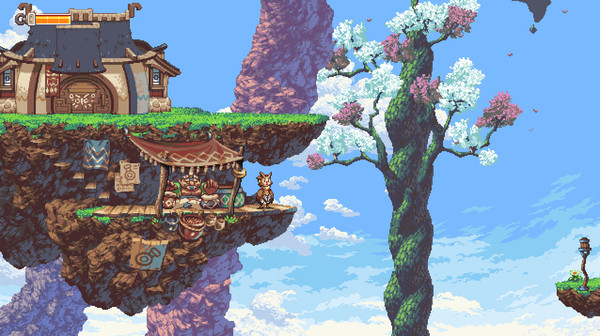
owlboy1

Owlboy had a very interesting take on combat. Otus, the main character, is an owl and as such he cannot fight enemies by himself, but he can fly. He enlists the help of his best friend Geddy, a human mechanic and soldier to help him fight enemies. It felt extremely smooth and natural to carry Geddy around and both aim and dodge enemies at the same time. Otus also recruits a few other unlikely friends to join his ragtag band of heroes; all of these characters have unique combat mechanisms and utility to allow Otus to access different parts of the world. At first I was worried that carrying around these different characters would become tedious, but it was extremely easy to get a grasp on how the combat worked. Controlling Otus was a blast and his variety of movement options led to some entertaining fights as I dipped and dodged hordes of enemies.

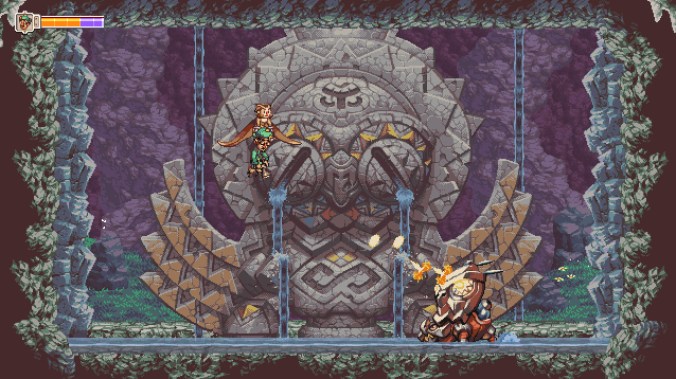
owlboy2

The dungeons in this game were fun and they all had unique concepts and ideas that made them enjoyable. I do think that they did seem to run on a bit too long and got a little repetitive at times, but for the most part they were very well designed, especially the boss battles. I absolutely loved all of the boss battles in this game; they were all fast-paced, challenging, unique, and intense.  Having the ability to fly seems like it would make any platforming non-existent, but that is not true. The game is cleverly designed to have challenging platforming sections despite being able to fly. There are also some stealth sections to add some flavor and variety to the game.

The gameplay was fantastic, but that was not the only thing that kept me interested in Owlboy. The hi-bit style of pixel art was masterfully done and it led to some beautiful visuals. There seems to be a trend in indie games to have great soundtracks, and Owlboy is no exception.  Calming and relaxing songs to match the aesthetic of Otus’ home of Vellie, and intense songs to match the high octane boss battles.  I was also very surprised by the quality of the story. Very few games manage to leave me wondering and interested even after the game has ended, but Owlboy did precisely that. Throughout the entire game there is an air of mystery, but not until the end of the game did I realize the scope of these small hints and mysteries. The game’s story is not that interesting in the beginning, but it is setting up and alluding to the wonder-inducing ending.

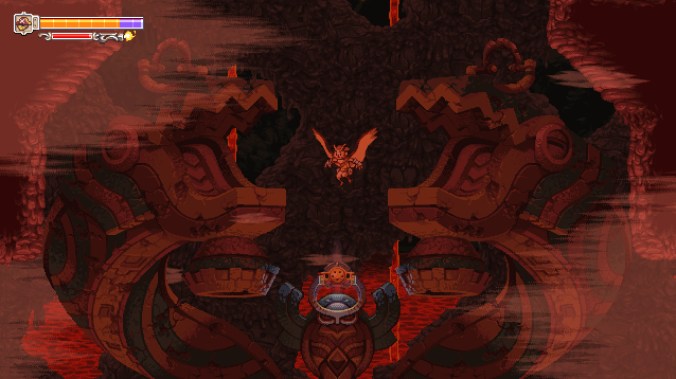
owlboy3

The world of Owlboy is also very well crafted. It does not take long to travel from one point to another and every section of the world has a distinct feel to it.  I only wish that there was a map of the overworld to see how the world really comes together. I did not have a big problem with this because I have been navigating metroidvanias for years, but some players might be thrown off by the lack of a map. In a game that constantly revisits areas and branches out in many different directions I could see how it may be confusing to some people. There was also a couple of interesting side-quests to play and enjoy, the Boguin Cannon in particular was very fun. The characters in Owlboy were also interesting and were memorable. Even characters that I did not like at first grew on me. The game has a consistent motif of friendship that drives the story and adds to the lovableness of certain characters. The game also was plenty silly and funny, there were many moments that had me smiling. The silliness, backstory, and characters of Owlboy and its world is certainly interesting and worth the time.

Owlboy also has plenty of collectibles, in the form of coins. I genuinely enjoyed collecting the coins scattered across the world and reaping the rewards in the form of trinkets. Trinkets could be health increases, goofy hats, or upgrades for your partners. The upgrades were definitely powerful enough to warrant spending time collecting coins to unlock these power-ups. My only complaint is that some of the coins were hidden in really strange spots. Invisible passageways in walls meant that if you want to collect every coin you are going to need to run into every wall, ceiling, and floor in the game to see if there are any hidden hallways. Granted, most of the coins were pretty easy to find and you can get most of the rewards in the game just casually collecting the coins. There were also three Golden Disks which unlock a very interesting secret at the end of the game. I will not spoil anything, but it is 100% worth it to look out for those Golden Disks.

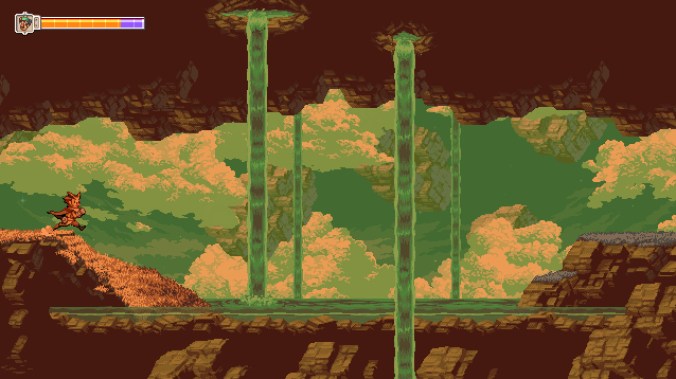
owlboy4

Owlboy has so many elements that I love, and it was one of my favorite games that I have played this year. If you enjoy indie titles, hi-bit pixel art, metroidvanias, lovable characters, and mysterious stories I definitely recommend this game. I am going to give Owlboy a 9/10, it was excellent and I loved every moment of it. Do not hesitate to pick up this title as it is an absolute joy to play and experience.

Wolfenstein: The New Order (2014)

Wolfenstein: The New Order is a continuation of the classic shooter franchise. I have not personally played any of the other Wolfenstein games but I was able to easily jump in as the game was somewhat of a reboot for the franchise and built a new story. The game was solid and had plenty of qualities that I really enjoyed but there were also a lot of flaws in this game. I have played a lot of first person shooters (FPS) and this game attempts to differentiate itself but falls just a little short of creating an entirely new experience. The basic premise of the Wolfenstein games is that the main character, William Blazkowicz, is an American soldier fighting the Nazis. This installment of the franchise takes an interesting twist where the Allied powers lose the war and Nazis now control the world. The story was, in my opinion, the strongest portion of this game.

I was very surprised at the strength of the story in this game. The first thing that surprised me was how quickly and without hesitation the characters are killed off. It always seemed ridiculous to me that in other FPS games how infrequently characters actually died, but this game is not afraid to do so. The story starts off very depressing and makes the player make a difficult choice and at the same time builds up the villain, General Deathshead, to be one of the most evil and sadistic character  in any game. I usually do not feel such hatred for a character, but the game really did a fantastic job at actually making me want to kill the villain. Despite starting strong, I feel like the game is unevenly paced in which most of the story is packed in the beginning and the end of the game. The theme of the game was pretty unique, as it was futuristic and had plenty of advanced technologies but it did manage to keep the gritty feel of World War II. I do not want to spoil anything, but the ending of the game was a bit open ended and I feel like it tries to set up a sequel. On one hand this is a good thing as it leaves you wondering, but on the other hand some people could see it as a cop-out. Most of the major characters are fleshed out well, and the game does give you some small character biographies if you want some more information on any character. Also, there are two alternate timelines in the game that make very minor changes in the story and gameplay. I like this feature as it allows people to replay the game but have a slightly difference experience, but everyone who plays the game is going to have a very similar experience regardless of which timeline they choose. Overall I felt like the first couple missions and the last couple missions had phenomenal story telling but I just wish that the middle bits were also as strong.

The gameplay I also felt mirrored the story in which it started strong but faltered around the middle chapters. While the first thirty minutes of the game are slow and serve as a tutorial, once I began the first mission I was sucked in. The game gives the player four different ways of tackling it and has different perk trees to reflect these choices. While perk and ability trees are not a unique concept, what was interesting about this game was that the perks were not earned through experience or just giving you a skill point to distribute into whatever perk you want, but instead they were achievement based. For example if you stealth kill five commanders you get a perk that reveals the location of all the commanders on the map. I really liked this system as it gave me alternate objectives and tasks during missions as I attempted to complete the main goal. There are four different perk trees, Stealth, Tactical, Assault, and Demolition. Stealth was based on sneaking up behind enemies and taking them out silently. Tactical was about smartly engaging the enemy from a distance and from behind cover. Assault was just DOOM style running and gunning. Lastly, Demolition was all about using explosives to clear spaces. This mix of gameplay options led to some epic moments, for example when I snuck up behind a commander and stealth killed him, then took over the mounted mission gun and mowed down the rest of the enemies from behind before they could react. Unfortunately I felt like there were too many missions that limited all the options that there were supposed to be. Some of map designs felt really lazy and linear, making a lot of missions play out like every generic FPS where I entered a room, posted up behind some cover, kill all the enemies, rinse and repeat until the mission is over. Another issue was the lack of ammunition, there was a plethora of different guns and tools at my disposal but the only guns with reliable amounts of ammunition to find were the Assault Rifle and the Laserkraftwerk. Despite the fact that some missions were limited in the options to tackle it, there were also a lot of really well designed levels that had many different pathways that allowed me to use a mix of the perk trees. Chapters 1, 2, 3, 8, and 13 are in my opinion what the rest of the game should have been when it comes to level design. All five of those missions were very entertaining and allowed me to use a mix of all the different tactics.

Apart from the five fantastic chapters, the rest of the levels were either just too linear or just blatant filler. Chapters 5, 7, and 9 were the most obvious examples of this and they should have just been cutscenes instead of full chapters. All three chapters play out in a very similar fashion and really serve no purpose at all, there are no enemies to fight, no stealth, no puzzles, just walking around to pick up some random item. Some of the other chapters also had some filler sections but these three missions did nothing but lengthen the game. This is really unfortunate because Wolfenstein: The New Order only has sixteen chapters so at least 18% of the game is just filler.

While the level design of the game left something to be desired, the difficulty scaling of the game felt just right to me. I played on the second hardest difficulty “I am death incarnate!” and while the game started off pretty easy it did quickly ramp up and provide some challenge. At no point did I feel like the difficulty was unfair or the game was asking an unreasonable task, but at the same time I knew that if I screwed up I would be punished for it. Unfortunately, a lot of the difficulty in the later stages of the game comes from the overwhelming amounts of “bullet sponges”. These are enemies that have a lot of health and required me to shoot at them for a minute of two to kill a single enemy. I feel like bullet sponges can be implemented properly, but they were not in this case. Since enemies have no health bars I could not even tell if I was damaging the enemies, and since I was shooting at some enemies for a couple of minutes I questioned if some enemies were even killable with bullets or if I needed to find another way to defeat them. Fighting these bullet sponges was occasionally entertaining as I needed to dip and dive out of cover to try to out maneuver them, but they are used way too frequently and there needed to be some sort of indicator that they were actually taking damage. Also, a lot of the enemies just felt inconsistent to me. Some enemies could not spot me when I was standing right in front of them, but I remember in one mission where I was hidden in a vent and a guard twenty feet away spotted me while facing the other direction. Despite the amount of bullet sponges and inconsistent enemies, I really enjoyed the two late game boss fights. Both fights had a cat and mouse feel to them and they did not drag out to long like a lot of video game bosses do. All in all, the difficulty was solid and while it was challenging, it never felt unfair.

The last thing about Wolfenstein: The New Order that I want to talk about is the collectible system. I am somebody who loves getting all of the collectibles in a game, and this game had plenty of them, but I did not get even close to getting all of them. The game has the weird system in which it reveals some of the hidden items locations on the map, but not all of them. So if I wanted to find all of the items I would have to comb the entire map and break open every box and look in every cabinet for items that were frankly tough to spot. I do not mind if the collectibles are hidden and do not show up on the map, but they should at least be easy to spot if that is the case. Despite this issue I really did appreciate how many things there were to collect if the player chooses to do so.

I did not expect much when I first started this game, but it certainly did surprise me with the first couple of chapters in terms of the strength of the gameplay and the impact of the story. If these aspects were carried out through the rest of the game it would have been a phenomenal game, but it does fall flat in the middle, has too much filler, and it has some smaller gameplay issues. For these reasons I give Wolfenstein: The New Order a 6/10. It was extremely fun, engaging, and emotional for a couple of chapters; I just wish that the entire game was like that.