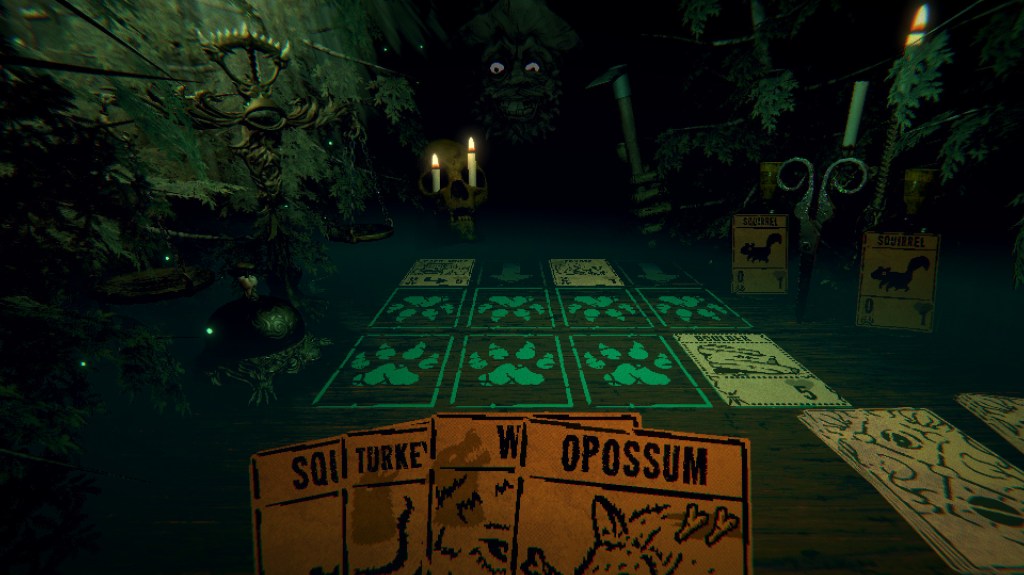
You are trapped in a dark cabin in the woods, playing a game of cards that determines your fate. Inscryption blends a multitude of genres to deliver a game that you never know where it will lead next. Tension permeates the experience as you attempt to unravel the dark secrets hidden within. Inscryption is a truly unique experiment, and it all revolves around a simple card game.
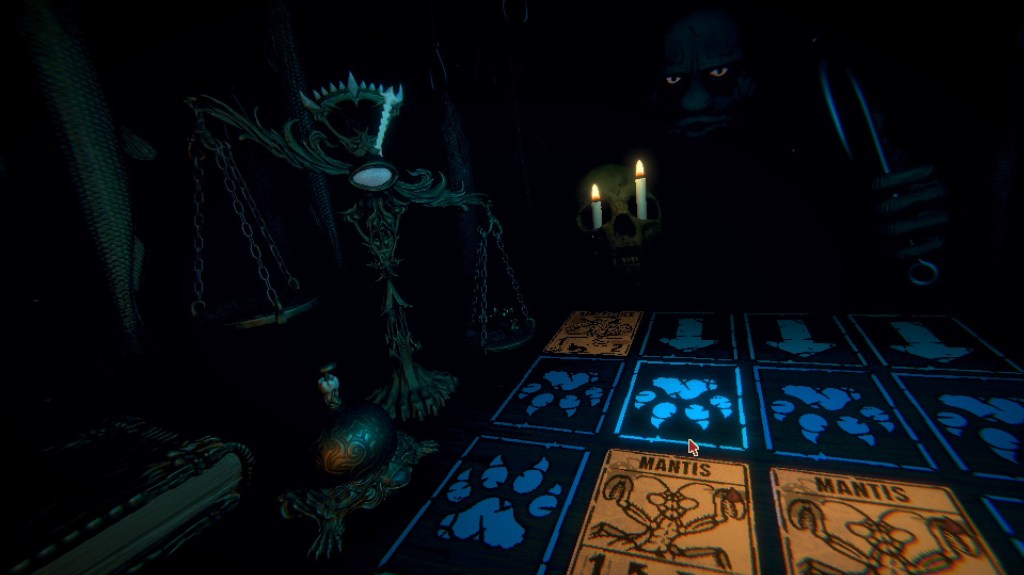
In every act of the Inscryption, you will be playing some variation of the titular card game. The card game itself starts remarkably simple. Whoever deals five damage more than their opponent first, wins the game. Cards have the basic stats like attack and defense, as well as special abilities. It’s all straightforward and easily understood by anyone vaguely familiar with trading-card-games. While I appreciate that the game starts simple and gradually gets more complex, I also think that it is almost too easy to find the winning strategies that almost guarantee success.
You sit across from a mysterious and deranged figure, who sets up tabletop adventure in which you traverse encounter to encounter playing cards. As you defeat his scenarios, you are also given the opportunity to improve your deck. Gaining new cards, adding stats to existing cards, combining cards of the same type, or sacrificing a card to give its ability to another card are some options that you may encounter.
Once I understood the basics of the game, I found it a bit repetitive. It’s pretty easy to leverage events to power-up a single card or two that let you win each round almost immediately. The central card game is just too simple. I never felt like I was building a coherent deck that relied on a synergistic strategy. Instead, I almost always found myself making use of totems to boost the ubiquitous Squirrel card, as it was needed as the foundation to summoning any other creature. After that, I just needed to stall until I drew one of my boosted cards to wreak havoc.
The game was designed this way on purpose, you unlock powerful boosts, items, and cards after playing a few rounds. It becomes difficult to lose without a blundering horribly. The game was intentionally made easy so the player can progress the story. But when the central mechanic is playing cards, and I master the card game after only completing 25% of the game, the following 75% can get a bit dull. The game does mix up the decks periodically throughout the course of the experience, which is a welcome change to keep things fresh.
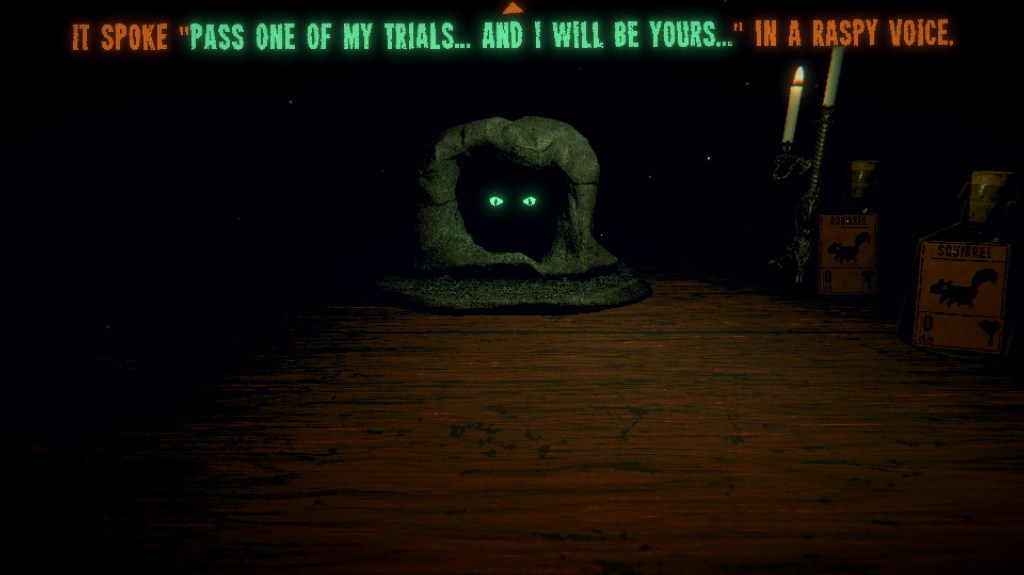
While I found the card game itself to be a little too simple, there is more to Inscryption than playing cards. You can explore the claustrophobic and dingy cabin, interacting with objects in hope that they will help you escape. This was the strongest aspect of Inscryption. The atmosphere and anxiety of playing cards when you are trapped. Every draw, every move, every decision brings you closer to being a victim. Your only hope is to use the cabin’s secrets to your advantage.
The card game pairs well with the atmosphere. It’s designed to be tense, to be played on a knife’s edge. The metallic tinker on the scale as you take damage is chilling feedback that you are a single mistake away from having your candle blown out. The nature of sacrificing cards to summon more powerful ones means you are always careful about what cards you are playing, as momentum plays a pivotal role in keeping your side of the board healthy. In the most desperate of situations you can utilize items, many of which have horrifying implications. Even though I knew it was just a game, I always felt a sense of revulsion whenever I used a pair of pliers to rip out a tooth to add a point of damage to the scale.
Inscryption is cloaked in layers upon layers of metafictional storytelling and genre switching. The nature of the game slowly reveals itself as the player progresses. In an effort to remain spoiler free, I will not delve deep into this aspect of Inscryption. I enjoyed going down the rabbit hole of Inscryption and revealing the deep dark conspiracies within.
Uniqueness is becoming more and more of a virtue as I play games. The ability for a game to be different. To be weird. To experiment. Inscryption is that kind of game. It may not have the best deck-building or card game mechanics, but the context around that simple card game is what breathes life into Inscryption. It is for these reasons I give Inscryption an 8.5/10. If you are even vaguely interested in Inscryption, don’t read or watch any more about it and play it for yourself.
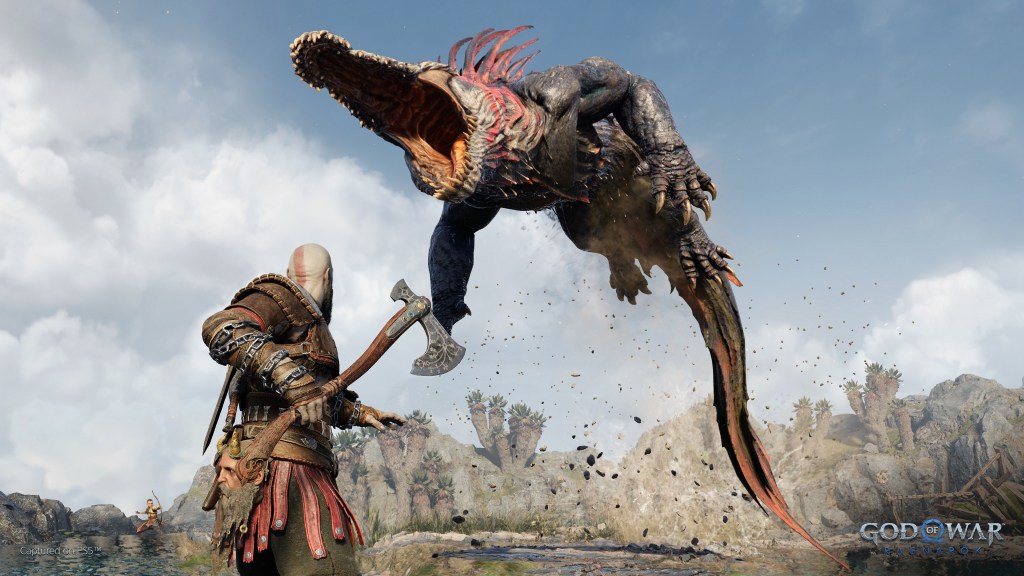
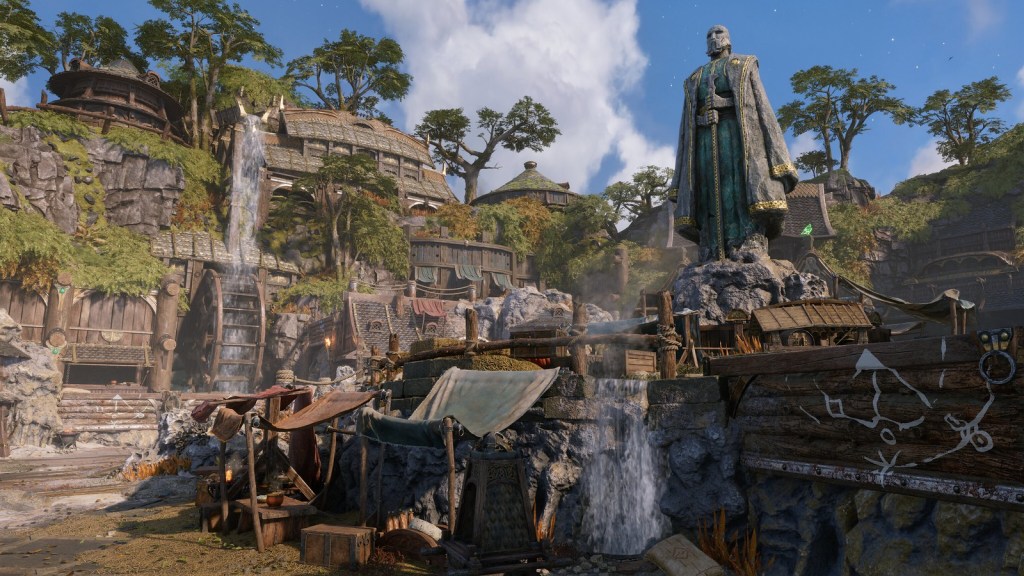
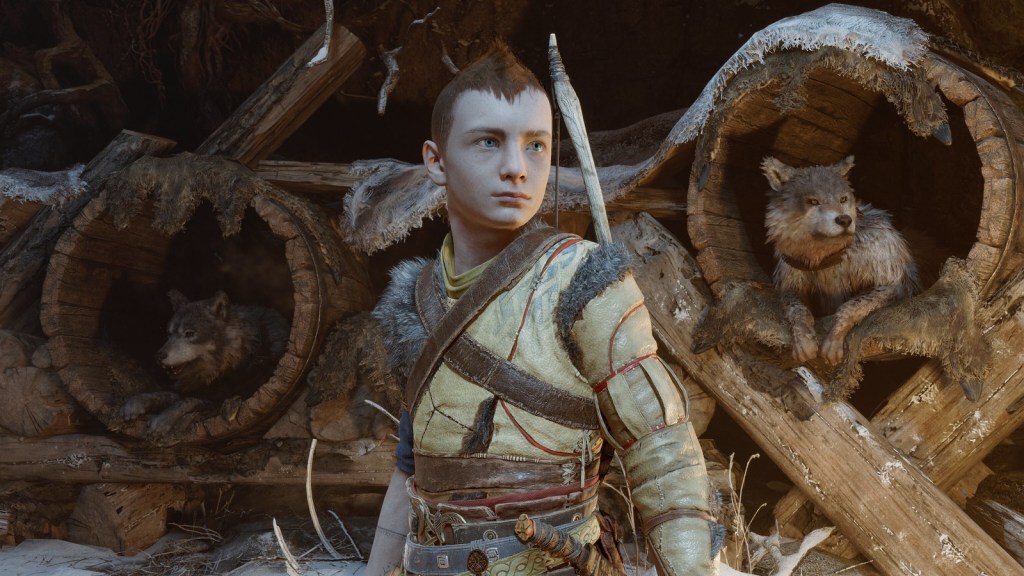
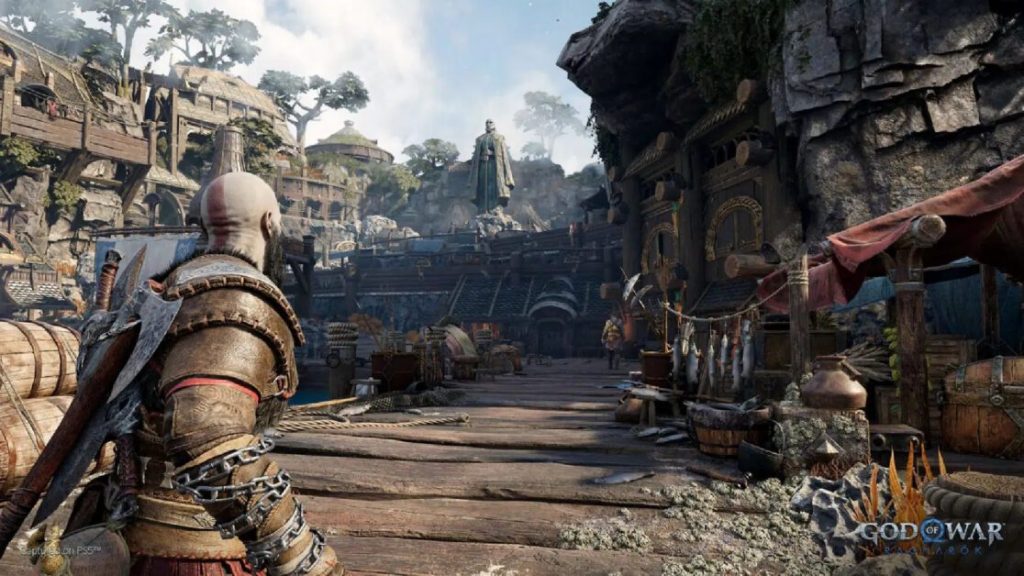
Despite its faults, I gave the revival of God of War a glowing review. It was an excellent game in many regards and had masterful presentation. Four years later, I don’t feel nearly as positive about its sequel, God of War Ragnarök. While it’s not uncommon for a sequel to regress or diverge from the original, that’s not the case here. Instead, God of War Ragnarök is a victim of being overly safe and designed-by-committee, with little to give it an identity of its own. Sure, it’s a competent video game and it’s undoubtably well-made, but its lack of originality makes it unremarkable. Moreover, God of War Ragnarök is bloated and desperately needed more revisions and editing to make it a leaner and more cohesive experience.
Before I dive into the individual systems, I want to make clear that many of these exact same flaws also existed in God of War. While it feels unfair to judge the sequel harsher for the same faults, it’s important to recognize that games don’t exist in a vacuum. Context is important. Being a sequel, God of War Ragnarök should have its own identity but instead it just feels like more of the same. In the four years between the releases, I don’t feel like any significant improvements were made. The combat and RPG mechanics are slightly better than its predecessor, but the story and writing definitely took a dip in quality. The pacing in particular feels bizarre.
God of War Ragnarök starts off strong, throwing the player into a thrill ride of exciting story sequences culminating with a spectacular boss battle. After that, the game’s pacing takes a nose-dive. While the first game in this saga had some slow pacing at times, it was far more character driven than plot driven. The singular goal of reaching the top of the mountain always loomed, and everything in between served as a way for characters to grow and develop their bonds. God of War Ragnarök instead tries to cram many plot threads and events into a single game.
The main plot of God of War Ragnarök focuses on its namesake, Ragnarök. The characters of the game desperately attempt to avoid the fated event and its consequences. It introduces tons of new characters, motivations, relationships, and moving pieces. I think this Norse chapter of God of War would have benefited from being a trilogy instead of a duology. While I understand that the developers did not want to stretch this story over a decade of real time, I think the pacing of God of War Ragnarök would have benefitted heavily from this. The first game in the Norse saga was a slow burn, a character driven adventure, so most of the actual plot of the story had to be stuffed into God of War Ragnarök.
While I believe that God of War Ragnarök would have benefitted from having a sequel to scope its story, it admittedly has other bizarre pacing issues. While the game starts strong, it slows down tremendously for dozens of hours then races through the climax. It spends too long on these “slow-burn” character building moments that no time is left for the actual plot. I was let down by the abrupt ending, which was the result of dozens of hours of build-up culminating in a rather lackluster couple of boss fights.
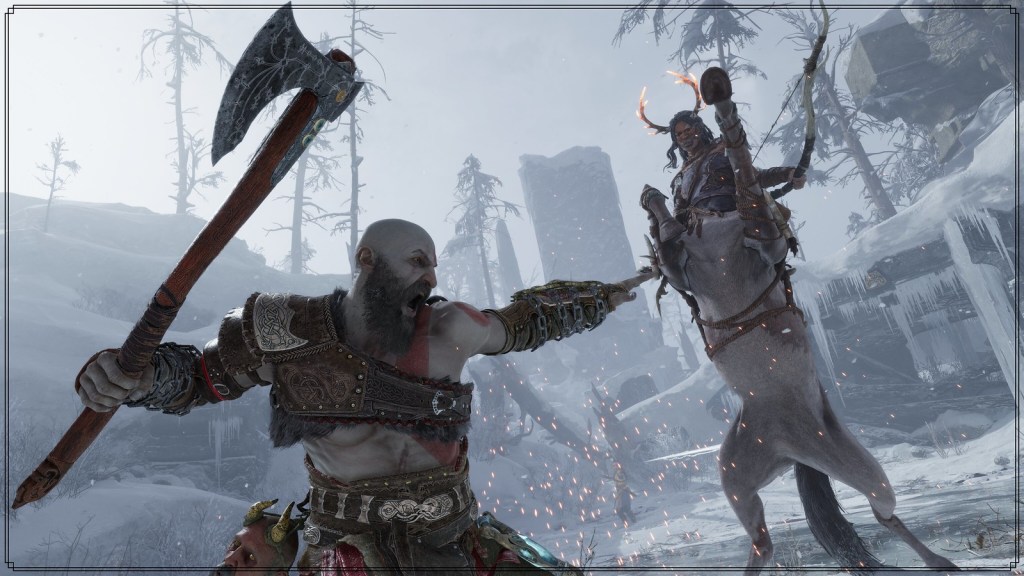
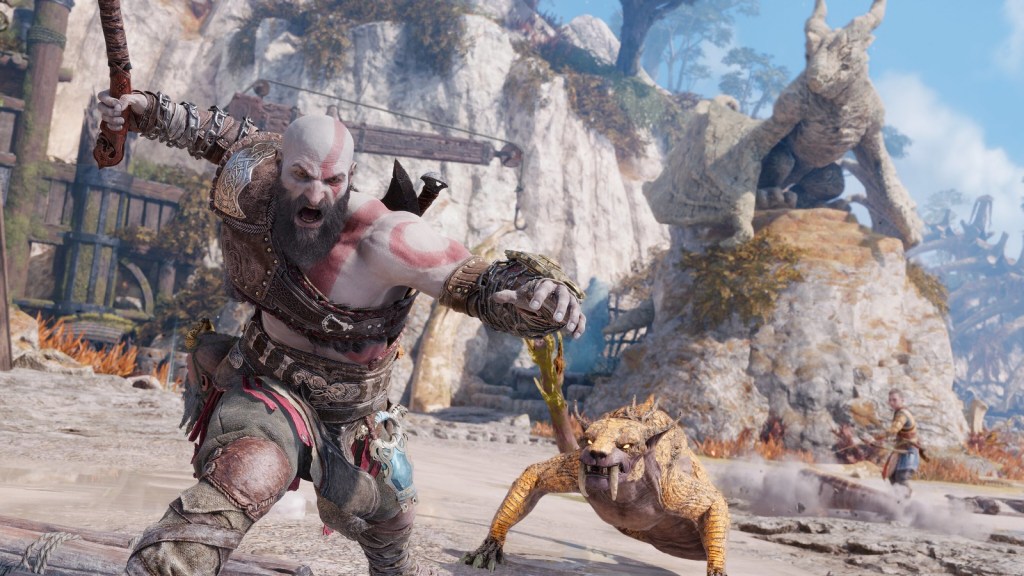
Where God of War Ragnarök does make strides is its combat. While it does not reach the complexity of other character action series like Devil May Cry, Bayonetta, or even its predecessors in the God of War series, it does manage to be fun. There’s a beauty in simplicity, and God of War Ragnarök manages to keep things straightforward and approachable while also providing some advanced techniques for more experienced players. While the first game in the Norse saga was debatably too simple, God of War Ragnarök introduces some key changes and combat options. First in foremost, the player starts the game with multiple weapons unlocked, allowing for some more experimentation right at the beginning. Unlocking new techniques using experience makes a return, and you can disable certain techniques if they disrupt your flow.
Being able to stack elemental damage to inflict status effects is emphasized, encouraging the player to swap between their weapons for big damage. Runic attacks make a return but have much higher cooldowns, meaning that they are no longer a spammable win condition but instead supplement your moveset. The most important change wasn’t to the combat itself, but in the boss variety. God of War Ragnarök has tons of bosses. Fighting unique mythological beings is much more engaging than fighting the same troll mini-boss over and over again.
Unfortunately, there are a few returning problems in the combat. First and foremost being the camera. It follows the player too closely in an over-the-shoulder 3rd-person view. You can’t see anything behind you, and you have to rely on directional indicators for incoming attacks. These indicators are unreliable and it’s impossible to tell what kind of attack is incoming. Is it a projectile? Or an area-of-effect blast? Or an unblockable attack? Or a standard strike? All these things require different reactions but you never know which it is or how long it will take to reach you. Once you see one of these indicators you pretty much have to stop your combo and maneuver and dodge away from where you are standing. It interrupts the flow of combat pretty badly.
My other big issue is one that plays a larger role on the higher difficulties. Enemy hyper-armor. The ability for certain enemies to shrug off your attacks and continue as if you were a fly buzzing around them. Enemies that are a higher level than you are have the nasty tendency of being doused in hyper-armor, making it impossible to pull off combos on them. You have to rely on an overly safe style of play to defeat these foes. Moreover, it creates an inconsistent experience because a level 3 draugr will easily be combo’d by the player, but a level 5 draugr does not even react to your hits. This isn’t a huge issue on normal difficulty as you will most often be at similar levels to the enemies, but it quickly gets out of hand when attempting the higher levels of difficulty.
The concept of levels itself is strange in the context of God of War, and I maintain that the Norse saga would have been much better off leaving out the majority of its RPG elements. I think that God of War Ragnarök does better than its predecessor because it has streamlined the enchantments and accessories a tad bit. Furthermore, stats and set bonuses actually feel like they have an impact in combat. However, I still find all of this to be unnecessary in a game like God of War Ragnarök. Shoehorning in RPG elements doesn’t feel like it adds anything except for time wasted staring at your inventory menu. Quests are intrinsically rewarding if they have a fun boss or interesting story line, I don’t need a cooldown-boosting pair of pants to make it worth my while to explore.
One of the biggest sources of the game’s bloat is the traversal. Getting from Point A to Point B in God of War Ragnarök is painstakingly slow. Like its predecessor, God of War Ragnarök makes frequent use of walky-talky sections and wall-climbing to pad out the space in between combat encounters and major story moments. I don’t mind having characters talk to each-other during their adventures, but when time spent in combat is dwarfed by time spent mindlessly climbing walls, it’s gone too far.
I understand that some of these sections are meant to hide loading screens, but this was a poor choice. Consider that the amount of climbing and walking can never be shortened, but load times can be massively reduced by newer hardware. This is blatantly apparent as God of War Ragnarök can be run on both the PS4 and PS5, and the PS5 players have to suffer due to the PS4’s technical constraints. If it takes the PS4 one minute to load a new environment, they had to make the climbing section at least that long to compensate. The PS5 can load in half the time, but it doesn’t matter as the game was designed around the slower load times of the weaker hardware.
While I praised the first game in this saga for its use of the single-take cinematic shot, I think the novelty of this has worn off. The immersion that this effect brings is simply not worth the trade-offs. I think that you could argue that most of my complaints with the game could be attributed to the dedication of maintaining this single shot. The camera being too claustrophobic in combat may be because zooming out would break the consistent over-the-shoulder camera angle. Poor pacing could be a result of not being able to utilize traditional cutscenes to cut out lengthy filler and skip to the point. Traversal is frustrating because you have to go slowly in order to avoid loading screens as that would break the immersion.
Furthermore, the number of resources spent in development to maintain this effect and work around its pitfalls could have been spent elsewhere. More time could have been spent refining core systems rather than being so adamantly tied to a gimmick. In retrospect, I don’t think the cinematic benefit of this single-take camera shot was worth it in God of War either. However, at least that game can take credit for originality. God of War Ragnarök doesn’t have the benefit of being the first game to implement this effect. It’s something that we’ve seen before. It’s no longer new or unique. The effect is frequently broken anyway as the player will constantly being opening their menu at their quest log, gear, and map.
More than anything, God of War Ragnarök needed an editor. Simply put, it’s bloated. The unnecessary RPG mechanics, the time-wasting climbing, the poorly-paced story sequences that went on for far too long, the single-shot cinematic effect, the dozens of collectibles that litter the map; there’s just so much extraneous fluff. Realizing what components exist to serve the core domain and what features detract from the experience is a vital skill that’s necessary when creating any form of media. Addition by subtraction is a well-known concept. All these features could have been iterated on, refined, or outright removed for the betterment of the final product.
Despite all of this, God of War Ragnarök is still a good video game. But not a great one. It is still technologically impressive. It has gorgeous environments and stellar animations. The combat is weighty, flashy, varied, but deceptively simple. The setting and premise are intriguing. The writing, despite taking a step back from its predecessor, is still leagues better than most other games. The plot was captivating even if it was poorly paced and had a rushed final act. But I wish these positives were further elevated, rather than having to sift through hours of monotonous tedium to get to the soul of the game.
God of War Ragnarök is a victim of high aspirations and poor planning. There’s too many systems and ideas at work here, bloating the final experience. Cramming two games of plot into a single game resulted in poor pacing. The insistence on being cinematic hampered many gameplay elements. Solid combat isn’t enough to carry the game when the player has to climb dozens of literal walls to get to it. It is for these reasons I give God of War Ragnarök a 6/10. I wish there was further refinement and editing to remove superfluous aspects, as being a more focused title would have benefitted God of War Ragnarök greatly.
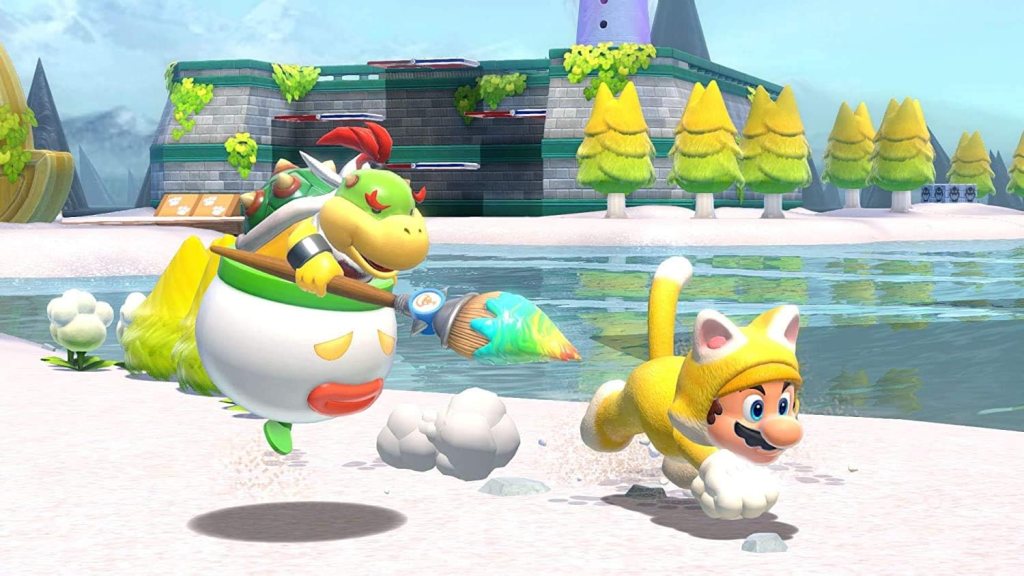
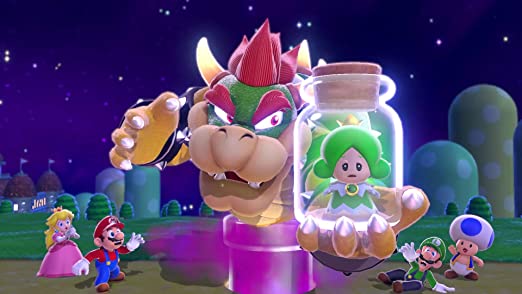
After playing Super Mario 3D World, my primary complaint was how disjointed the experience felt. Other 3D Super Mario games felt like a coherent adventure, while Super Mario 3D World feels a series of fun but unrelated obstacle courses. Bowser’s Fury is a game that was packaged alongside the Switch port of Super Mario 3D World, but that’s not the only game that it takes inspiration from. Bowser’s Fury is a glorious marriage between the platforming excellence of Super Mario 3D World and the open-ended collectathon adventure of Super Mario Odyssey. It’s a relatively short game, but Bowser’s Fury is a massive success.
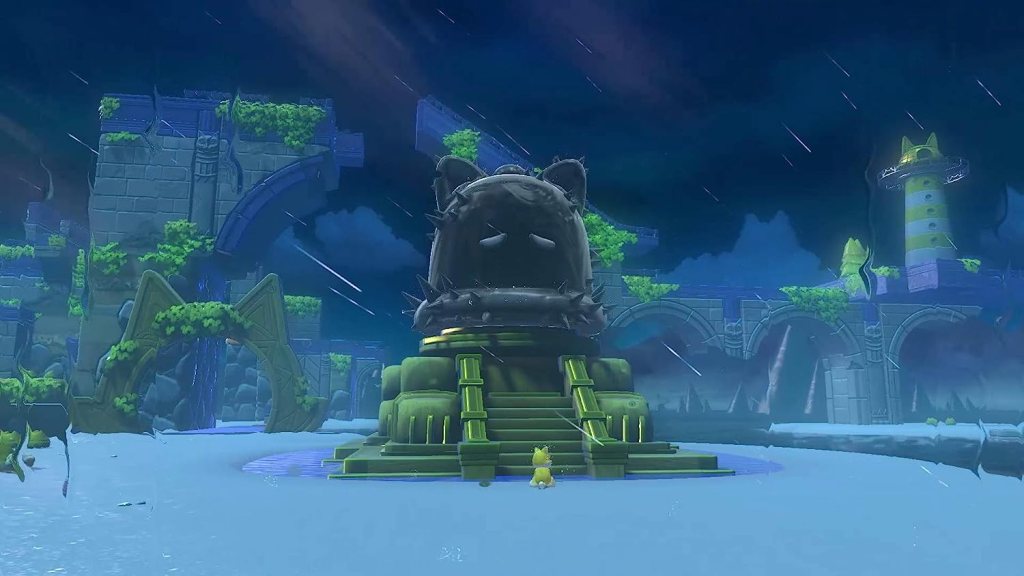
Bowser’s Fury is set in one giant area, an ocean dotted with islands and partially covered in black ink. Bowser has gone berserk and you have to collect Cat Shines to revert him to his usual self. Each island is like one of the levels from Super Mario 3D World, a short challenge that usually is focused on a unique gimmick. Additionally, the islands have five Cat Shines each, meaning the player gets to revisit each island multiple times. The islands morph with each subsequent level, retaining their core theme and gimmick but changing up the layout to accommodate for different objectives.
The ability and necessity to revisit areas is a massive improvement over Super Mario 3D World. Instead of every level being a one-and-done affair that is easily forgotten, the designers are able to evolve on the ideas and gimmicks that make each level unique. You get to fully explore these dense areas and really familiarize yourself with them. They feel like real locations rather than artificial obstacle courses.
Another aspect that contributes to the adventure of Bowser’s Fury is the world. As previously mentioned, the whole game takes place in a single area. While not all the islands are immediately accessible, you will quickly uncover them. Getting between the main islands is a breeze, as Plessie makes a return from Super Mario 3D World. Plessie acts as a mode of transportation across the giant body of water, and she is a ton of fun to ride. She’s fast, handles well, and is always available no matter where you are. She will pop up out of the water seamlessly, without any need for the player to summon her or go to limited predetermined locations where she resides.
Like many other 3D Super Mario games, many of the Cat Shines reside not only in the main levels, but in side challenges and secrets hidden around the map. These are usually quick trials like racing Plessie through an obstacle course or catching a rabbit running around on the lake. These little side missions also contribute to the feeling of cohesion, as you can find these little distractions while exploring the greater world.
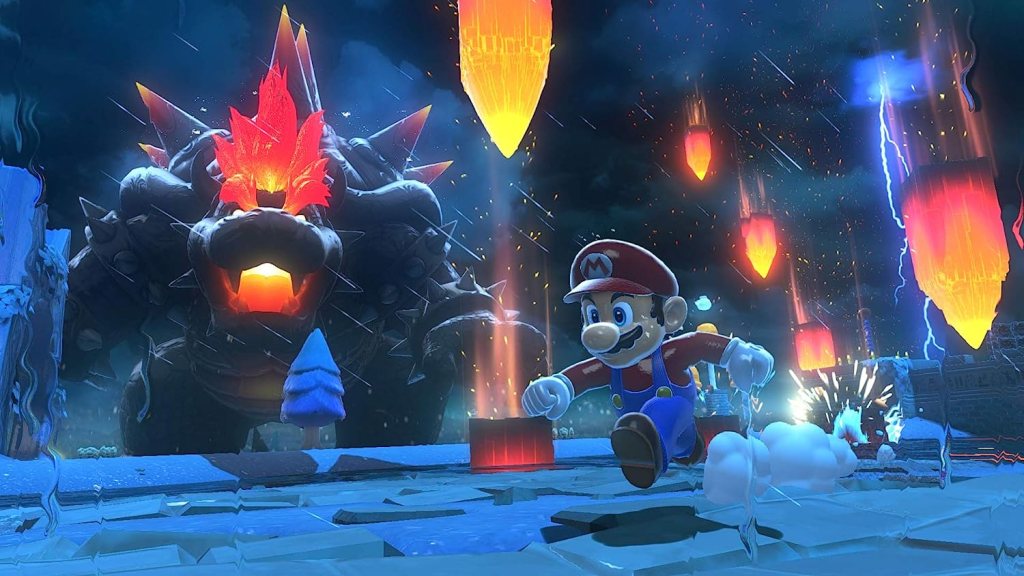
A central aspect of Bowser’s Fury is when Bowser gets furious. He is a behemoth in this game, always residing in the center of the map, occasionally awakening to cause terror. When Bowser emerges from his slumber, the sky goes dark in a torrential downpour and fire balls rain down as the colossal Bowser towers above you and spits his fiery breath at Mario. It really is a phenomenal sight to see, and it makes the game much more frantic while Bowser is awake.
While you could just hide from Bowser until he goes away, but I found it much more fun to engage with the more difficult platforming challenges that Bowser creates. Dodging the raining fireballs and fire breath make things more challenging, but Bowser also causes giant obelisks to be lodged in the ground. These can act as additional platforms and shields from his attacks. It can be fun to dodge all the chaotic madness using these temporary platforms, and after collecting a single Cat Shine Bowser will temporarily halt his rampage and go back to sleep.
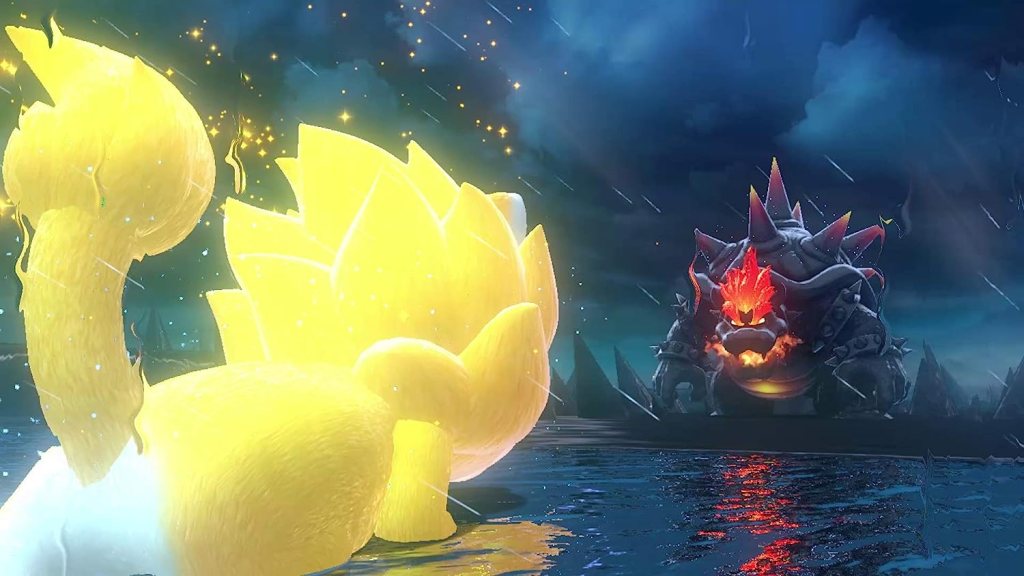
The other method of dealing with Bowser is to fight him directly. Across the world there are a few Giga Bells, power-ups that transform Mario into a giant to contend with his equally goliath foe. Battling with Bowser is enjoyable, and it slowly ramps up in complexity as the game progresses. These Kaiju battles visually fantastic, even if they are similar to Bowser battles from past games.
While I generally enjoyed Bowsers constant looming presence throughout the game, it also has a fair share of issues. The first being that Bowser can get irritating when he starts to appear more frequently at the end of the game. While I enjoy the additional challenge of dodging his attacks, sometimes it can get annoying when he seems to appear during every single level. On the flip side, many Cat Shines require Bowser’s presence to acquire. This is also frustrating as it led me to abandoning levels halfway through to scramble to get to where I needed to be for these time-limited Cat Shines. And at the end of the game, I had to literally just sit still and wait for Bowser to show up for the last five or so Cat Shines. Lastly, whenever Bowser appears there is noticeable performance drop.
I enjoy the inclusion of Bowser and his rampages; they definitely make for some fun platforming and cohesive theming across the game. I’m not sure how I would feel about it if Bowser’s Fury was a much longer game. It only took me a few hours to beat with couple more hours to 100% complete it, and a popular opinion that I have been seeing is that many people want the next Super Mario game to be an extended version of Bowser’s Fury. While I can agree that this is a great foundation to build off, I think the format would outlast it’s welcome if it was any longer than the short romp that was presented in Bowser’s Fury.
A totally open world Super Mario game with no world or level selection would be fantastic, but even in Bowser’s Fury I felt there was a lot of filler or repeated Cat Shines. For being such a short game, I was disappointed with how many of the objectives were identical to one another. There were so many Rabbit chases, Bowser blocks, Lucky Island Cat Shines, Plessie speed challenges, and so forth. There wasn’t a great balance between the number of core platforming levels and these side missions. I love exploring and completing optional tasks, but I think Bowser’s Fury just has too many of them in relation to how short the game is.
Bowser’s Fury is an immensely successful experiment. It meshes classic Super Mario platforming and the giant, open-ended exploration from Super Mario Odyssey. The singular area scattered with short levels is a fantastic formula. Bowser himself was a fun gimmick for a majority of the game, and I would love to see an expanded upon game with big areas and gimmicks similar to Bowser’s reign of terror. It is for these reasons that I give Bowser’s Fury a 9.5/10. While it had a few flaws, I think Bowser’s Fury is the sensational appetizer for what’s to come next.
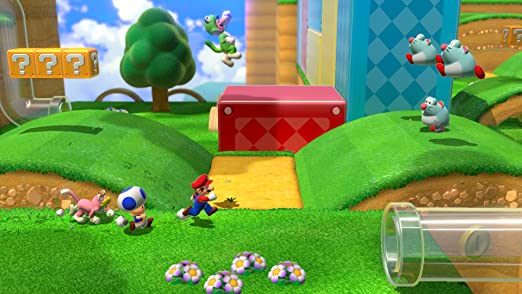
In a series that is home to some of the greatest and more influential games of all time, Super Mario 3D World seems a little underwhelming at first glance. It’s less adventurous than Super Mario 64, less experimental than Super Mario Sunshine, and less grandiose than Super Mario Galaxy. What Super Mario 3D World does have going for it is its simplicity. In fact, it is the most direct translation of the 2D Super Mario titles into the 3D space. From start to finish, Super Mario 3D World is a smorgasbord of fun ideas and classic platforming.
There’s no denying that Super Mario 3D World is closer to the original 2D Super Mario games than its 3D counterparts. Every level is a one-and-done obstacle course that ends with a goalpost. This is in stark contrast to other 3D Super Mario games which almost always reuse the same areas for multiple levels. And many times, those levels aren’t straightforward obstacle courses, but require exploration and puzzle solving. But in Super Mario 3D World, pure platforming is the main focus of the game.
While there are a few collectibles in every level, three Green Stars and a stamp, the levels are short and linear. This is not a bad thing by any means, and it allows the team of developers to design a much more curated experience. There are nearly 120 levels in Super Mario 3D World, and almost every single one introduces a new idea or concept. While many of these ideas are borrowed from previous titles, there are a few stand out new inclusions. The Cat Suit is an important new power-up that is showcased. Captain Toad makes his first appearance in the short puzzle-platformer diorama levels. And the Double Cherry makes for some engaging challenges as you control multiple clones at once.
The most surprising aspect of Super Mario 3D World is just how good all the levels are. In a game brimming with ideas and content it’s crazy that not a single one is a clunker. The level of polish here is unfathomable. The gimmicks don’t necessarily feel gimmicky because they don’t change the way Mario is controlled. The game never strays away from the pure platforming bread-and-butter than it is so committed to. It’s an insanely well-curated collection of all the best concepts from the Super Mario series.
Part of the reason why levels could be so refined is partly due to Mario’s reduced movement options. The side-flip and long-jump were drastically reduced in effectiveness, while the triple-jump was removed altogether. These constraints allowed the designers to make levels with a much clearer intended path. You cannot use advanced movement techniques to skip obstacles, and levels are much more linear. While I do think that I enjoy how polished the levels feel as a result of these movement limitations, it ultimately comes down to preference if you enjoy this style compared to all the other 3D Super Mario games.
Levels in Super Mario 64, Super Mario Sunshine, and Super Mario Odyssey are free-roaming affairs. Many times, you don’t even know what your goal is. Exploring the environments was open-ended, and led to freestyling as to how you would approach the level. This is also reflected in how the camera works in these games, as you can rotate the camera to get a better look around. This is opposed to Super Mario 3D World which has locked camera angles so that there is never a doubt that the player has a good view of the action, but also is restrictive and prevents exploration.
While I did love playing Super Mario 3D World, it lacked the sense of adventure that makes the Super Mario series my favorite. I prefer the wide-open stages that you revisit many times and become intimately familiar with as opposed to the linear and restrictive levels that are present here. Moreover, Super Mario 3D World lacks cohesion and visual theming. While Super Mario Galaxy had mostly linear levels, it had the consistent context of exploring tiny planets. Levels made sense in that context, and they had visuals to support that theme. Super Mario 3D World just feels like a collection of artificial levels.
Most of the stages are floating islands of toy-like cubes. They don’t feel like real locales, and they lack the planetoid context of Super Mario Galaxy. I think having backgrounds and visual flair that made the levels feel more authentic would have gone a long way to making Super Mario 3D World a more immersive adventure. Moreover, while there is a world map to traverse, there is no cohesion within the worlds. The desert world doesn’t have mostly desert levels, the ice world doesn’t have more snowy levels than average, the worlds don’t group levels in a meaningful manner.
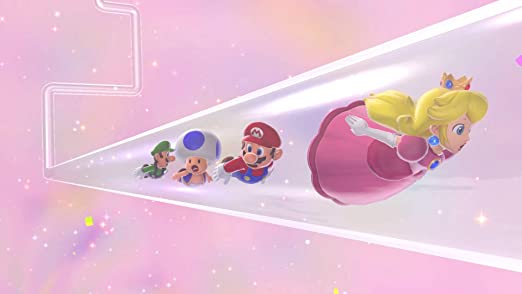
The most unique aspect of Super Mario 3D World is the inclusion of multiplayer. The fixed camera, simplified levels, and more basic controls all make a multiplayer experience possible. While it’s been a while since I played it with others, it can be a blast to partake in the sheer chaos of Super Mario 3D World multiplayer. I found that the game is much harder when trying to coordinate with your friends. And it can get competitive as you try to earn more points than your fellow players.
One thing that I felt I should mention is that in the recent Switch port of the game the movement speed has been noticeably increased for some reason. I don’t know why this decision was made, or if it was even intentional at all. But either way, you move much quicker than the original version of the game and this sometimes trivializes some speed-based obstacles. Additionally, you no longer have to collect Green Stars all in a single attempt but they are saved once you clear a level. While both of these changes make the game easier, I don’t think they are game-breaking.
Super Mario 3D World is the most consistent of the 3D Super Mario games. It’s a collection of some of the best ideas that the series has, and it’s executed superbly. The pure platforming may appeal to fans of the series who miss the old, 2D Super Mario days. Personally, I missed the sense of adventure and exploration that the other games in the series offered. While I had a lot of fun with Super Mario 3D World, it’s definitely my least favorite of the series. Of course, few games could ever compare to the excellence that is the Super Mario catalogue.
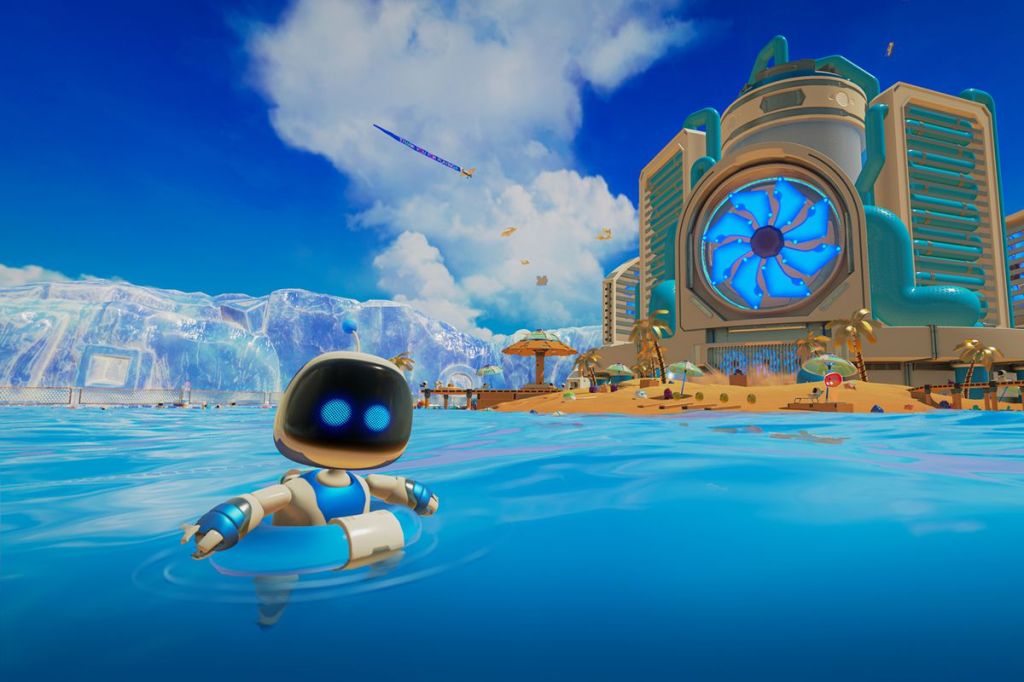
One of the biggest surprises when I started up my Playstation 5 for the first time was Astro’s Playroom. Not that the game existed, but simply how much effort and soul went into making it. I expected a short tech demo, showcasing the haptic feedback of the controller. Astro’s Playroom is much more than that, and despite it being a short game, it’s one that nobody who owns a PS5 should miss.
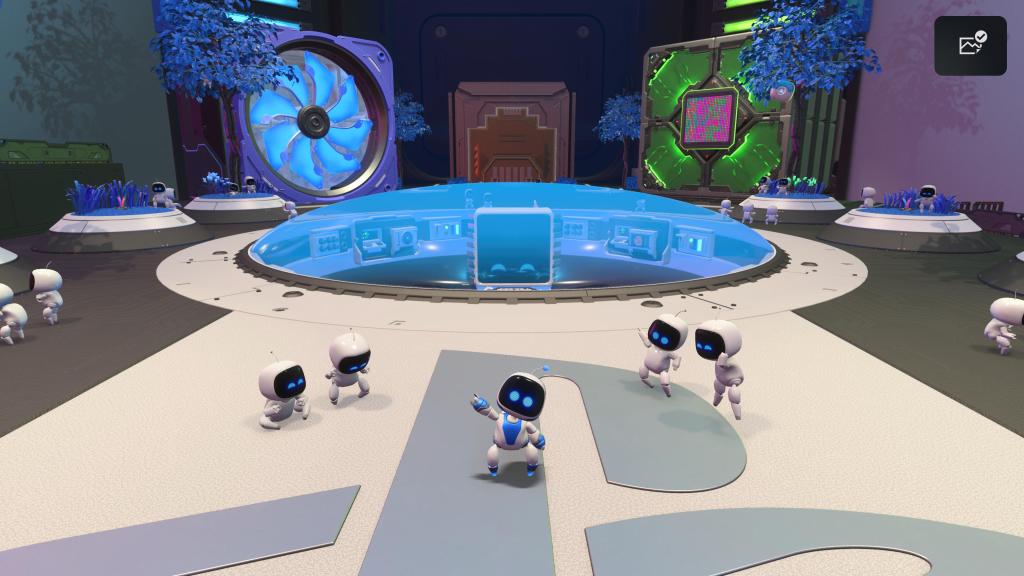
Astro’s Playroom is a celebration of everything Playstation. It’s a platformer with a few short levels, but each of these levels is packed with references and homages to Playstation’s past. There are a ton of cute little robots acting out scenes from classic and obscure games alike. There are tons of collectibles that showcase old Playstations and their respective peripherals. Finding puzzle pieces unlocks murals that celebrate Playstation throughout the years.
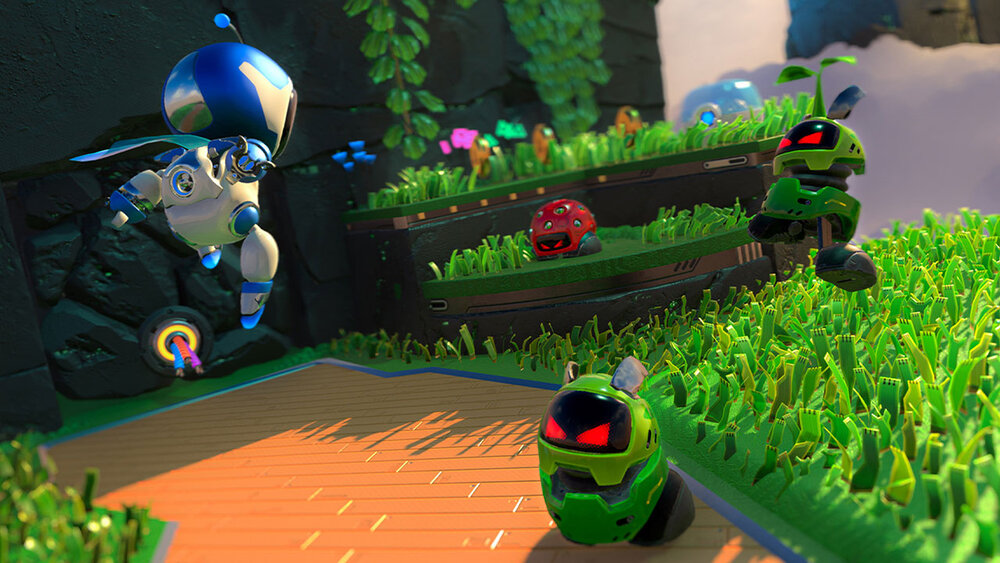
The levels themselves are creative, varied, and enjoyable to traverse. There are four main areas along with a small hub world and a final boss battle. Each of the main areas has four levels, and those levels alternate between traditional platformer and more gimmicky concepts. The levels are extremely short, but I found them to be great nonetheless. They are visually engaging and packed to the brim with secrets, collectibles, and fun scenes. The gimmick-based levels utilize the motion controls of the new controller in creative methods, and they work well.
I was impressed with how well Astro’s Playroom showcased the new features of the PS5’s controller. Even after playing a few more PS5 titles, few utilize the stellar haptic feedback like Astro’s Playroom. The dynamic rumbling can really add some phenomenal textural feedback to the player. I distinctly remember a certain part of the game when I was holding on to a moving platform because the rumble had a very distinctive clicking sensation. If it had just been a standard rumbling, it would not have stuck out in my mind at all.
Astro’s Playroom is a short game. It only took me a few hours to complete it and find all the collectibles. This is not a bad thing. It’s a short but sweet experience. I’d love to see a more expansive version of Astro’s Playroom, but there would need to be an overhaul of the movement mechanics. Movement is super simple, you can walk, jump, and briefly hover. This is fine for a quick and free title that comes included with the PS5. But to compete with other major 3D platformers, Astro would need more complex movement to keep traversal interesting.
Take for example the 3D entries of Super Mario. They are simple, approachable, and easy to grasp. However, there are plenty of extra mechanics like triple jumps, side flips, long jumps, slides, and momentum. Traversing the environments in Super Mario games is like exploring a playground. As you master the movement, you can find shortcuts and more easily navigate obstacles. Astro’s Playroom feels like it’s on rails in comparison. It’s not egregious since the game is so compact and there are plenty of gimmicky interludes to mix up the movement. If there were to be a longer sequel to Astro’s Playroom, I’d love to see some more intricate movement.
Overall, I was pleasantly surprised by Astro’s Playroom. It’s an approachable, charming, and enjoyable bite-sized game. Not every game needs to be an expansive behemoth, and I love when games have a more focused approach. While it doesn’t have complex movement, Astro’s Playroom is a joy to explore. It is for these reasons I give Astro’s Playroom an 7.5/10. It’s not a game that is going to revolutionize platformers, but Astro’s Playroom is an excellent romp through imaginative environments.
I can appreciate when a studio tries to do something different. There are tons of well-made games out that are completely risk-averse, they just combine proven ideas and concepts in a slightly different way. As a studio, Remedy has always impressed me with how they were willing to develop games around wacky concepts. While Alan Wake had grating combat, the setting and atmosphere were unmatched. Control is Remedy’s latest creation, and it fully dives into the untapped genre of New Weird. Sadly, Control was as disappointing as it was exciting.
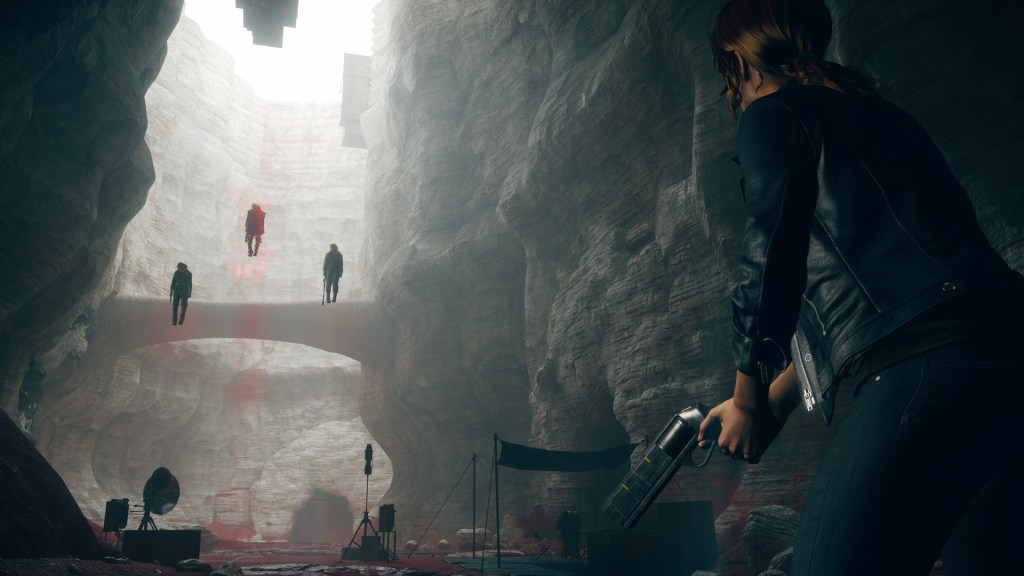
It is undeniable that Control is fully committed to creating an unforgettable world. You play as Jesse Faden, a woman looking for her brother who went missing when they were children. Her search led her to the Federal Bureau of Control (FBC), a mysterious government organization whose mission is to study paranormal occurrences. The game opens when Jesse stumbles into the brutalist concrete structure where the FBC is headquartered.
What makes Control so intriguing is its setting. The juxtaposition of the boring office building with its contents of horrifying and extradimensional objects is incredibly engaging to explore. Reading the logs of the workers here as they treat the paranormal as if it was just another day at the office is my favorite aspect of the game. Control is very obviously inspired by existing ideas like the SCPFoundation and House of Leaves. It does a great job at bringing these ideas to life. I loved seeing everyday objects like rubber ducks, refrigerators, and standing fans locked away in containment. Reading how they are extraordinarily dangerous and should be treated with extreme caution and learning how the building that the FBC resides in is a living labyrinth is just such a phenomenal experience.
Exploring the oldest house itself is a highlight of the game. Finding little secrets, reading documents, and taking in the environment is great. The game has no mini-map or quest markers, which is appreciate. Naturally reading signs and using landmarks to navigate is far more engaging than staring at a marker. I will say that the map itself is pretty hard to parse, it doesn’t show elevation or overlapping levels very well. While I love being able to navigate without relying on maps, I do wish it wasn’t completely worthless.
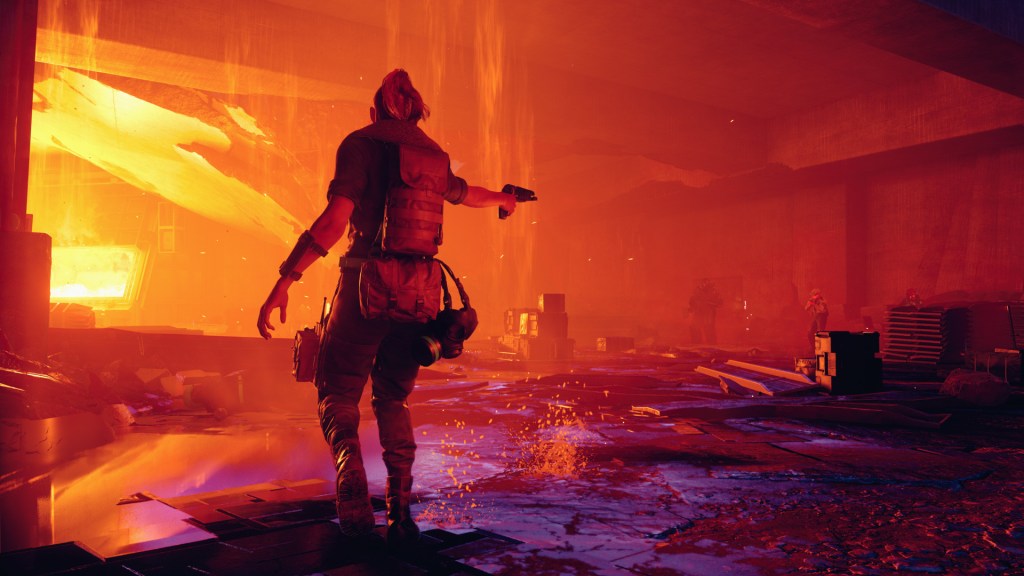
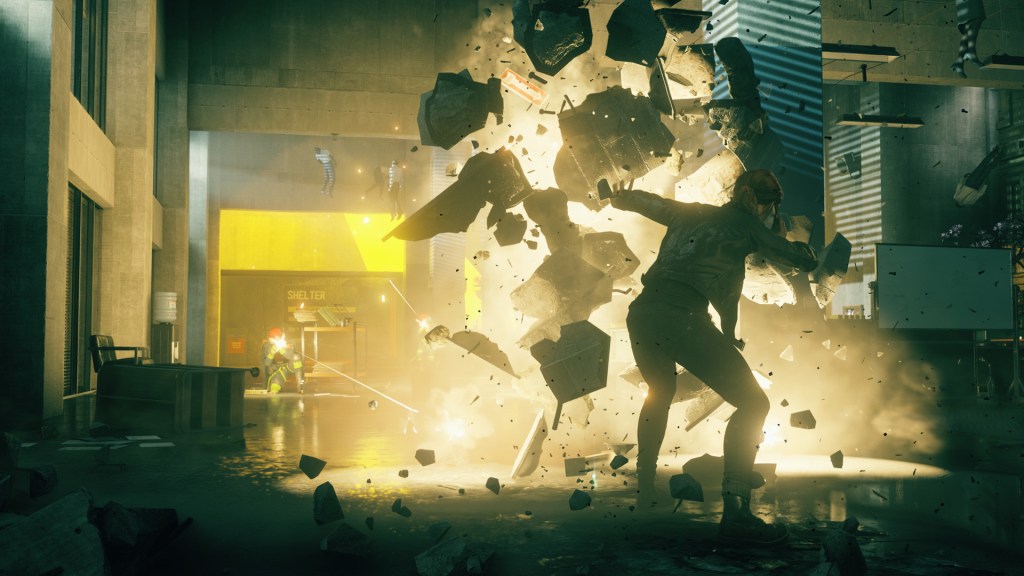
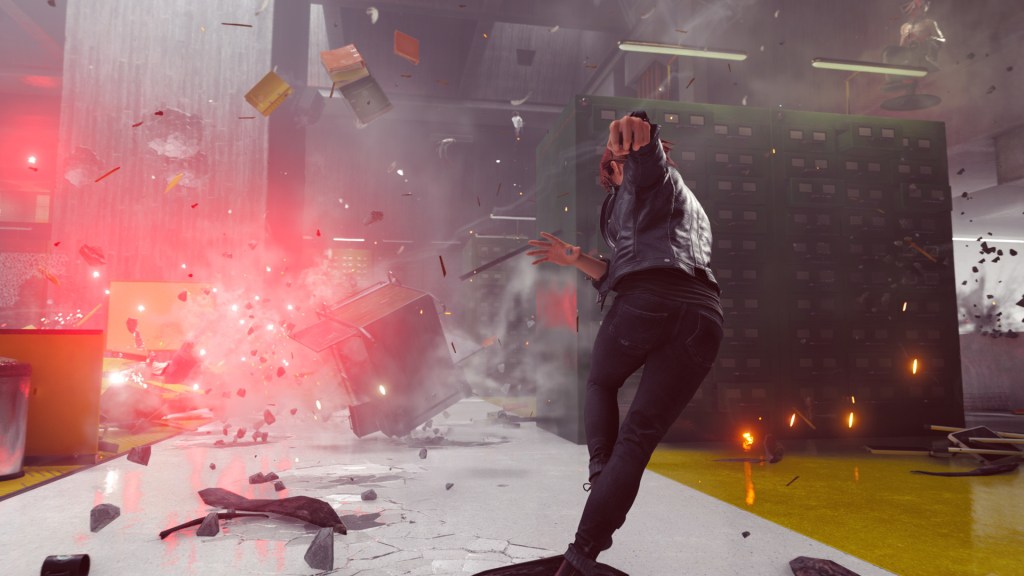
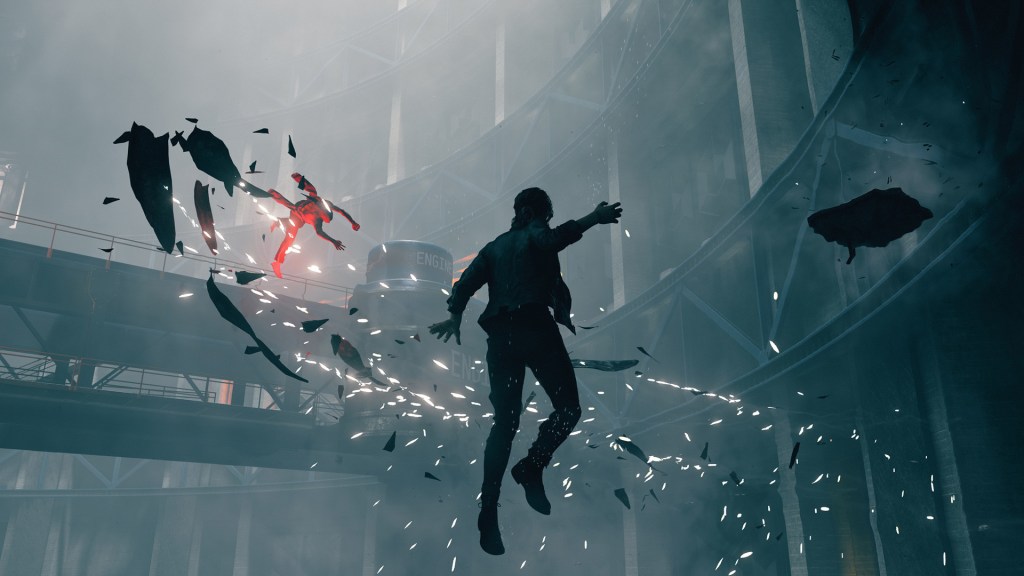
The core of the gameplay in Control is its combat. It plays as a third-person-shooter, and in all honestly it can be described as serviceable. You have a gun that can change into five different forms. Additionally, you unlock powers like telekinesis, mind-control, shielding, and levitation. I appreciate that the combat is fast-moving. Moving around makes it difficult for enemies to hit you or pin you down. Additionally, enemies drop health when killed so you have to keep moving to reacquire some valuable health. It all works fine, but it feels like it is missing something.
The best part of the combat is that it simply feels good. Picking up and launching pieces of the environment sounds and looks phenomenal. The destructible environment is top-tier. Everything can be ripped from its hinges, thrown, and explode. Wreaking havoc around the FBC and watching enemies get obliterated by fire extinguishers, fax machines, or chunks of concrete is addicting. It is a feast for the eyes and ears.
A big issue with the combat is that the telekinesis ability, called launch, is just way too powerful. I love that the dominant strategy utilizes launch as it is the best aspect of the combat. But it’s too dominant. Most enemies can be killed in a single usage of launch. And there is never a shortage of stuff to launch. The only weakness is that it uses energy, which needs some time to recover when you run out. What ends up happening is that in every single encounter in the game, with no exceptions, is that you spam launch until you run out of energy. Then you use your gun of choice until your energy recovers so you can spam launch again. The guns are pitifully weak when compared to launch. If some of the other powers or the guns were stronger, some alternative strategies could have been viable and fun to try.
Another issue with the combat is that the enemies are boring. For some reason, in a game centered around the paranormal and extradimensional, most of the enemies are boring humanoids. Many of them function as regular humans with guns. Others have some supernatural powers. They rarely pose a threat, and it’s just baffling that in a game with such brilliant concepts that they leaned on humanoids. Again, the combat is fine. It’s serviceable. But most of the time it boils down to “spam launch at the red guys”.
Mirroring the disappointing combat, the main story also fails to capitalize on the excellent concept that Control has. Jesse has some compelling motivation to delve into the FBC. And after experiencing paranormal events in her childhood, she feels at home at the FBC. But the actual story involves a lot of running around to find something, realizing its not there, and then going on a wild goose chase. Control has such a cool concept, but it feels underutilized in the main story. The side stories go farther into the weirdness that Control should exemplify.
After reading the dossiers and documents that uncover the lore of Control, I expected more of the narrative of Control. I expected layers upon layers of conspiracy. I wanted to be shocked. But the main story was normal, not paranormal. The ending in particular was extremely unfulfilling and doesn’t even try to answer the few interesting questions the game asks. In a game with such a fascinating setting and weird concepts, I was extremely disappointed that the driving forces behind the plot were an evil red presence and a good blue presence.
While I can appreciate the fact that Control tried to do something different with its concept, it falls into the pitfalls of many modern games. Bloating the game with random mechanics is never a benefit. There’s no reason for Control to have crafting system. Finding a secret to only be rewarded with a meaningless “House Memory” crafting material is deflating. There’s also upgrades to weapons and abilities to be found, but sorting through a menu to find the “more damage” augmentation is tedious. Not to mention there is a pointless carrying limit, meaning that you frequently have to sift through your inventory to dump the bad upgrades.
Another bit of bloat is the random quests. The side quests in general are great. They delve deep into the lore and world of Control. But for some reason there are random radiant quests. These randomly pop up and have you chase down groups of randomly spawned enemies. There are also expeditions and board containment quests that also are randomly generated to acquire more upgrades and crafting material. These just feel like bloat that water down the experience.
One of the single most disappointing aspects of Control for me was how poorly it utilized its naturally horrifying concept. It is missing the element of cosmic horror, fearing the unknown and unknowable. Jesse is just so powerful that it’s hard to be scared of anything that could be lurking around the corner. None of the enemies, aside from some optional side quest bosses, invoke that feeling of terror. Moreover, Jesse’s reactions to the world itself makes it hard to ever be truly afraid. After cleansing a cursed television that mind-controlled people and watching their heads explode, Jesse’s reaction could be summed up to “Huh too bad”. The was a unique opportunity here to lean into the natural anxiety and fear that the unknown instills. Unfortunately, Control does not even scratch the surface of these ideas.
I love that Control leaned into being different and weird. It’s not afraid to hide lore in tucked-away documents. It stays away from many modern conventions like quest markers and mini-maps, and the game is better for it. But while Control has a unique concept and setting, it just doesn’t bring these ideas into the gameplay or story. Nothing is egregiously bad, but it feels like a waste of such a creative setting. It is for these reasons I give Control a 6.5/10. Control could have defined the genre of New Weird, but instead it’s a serviceable 3rd-person-shooter in a unique universe.
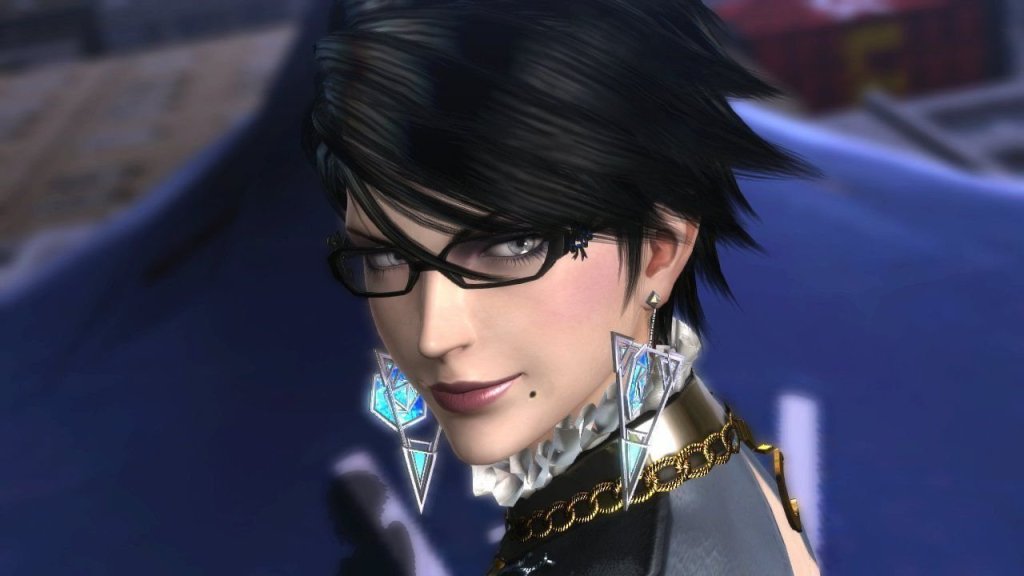
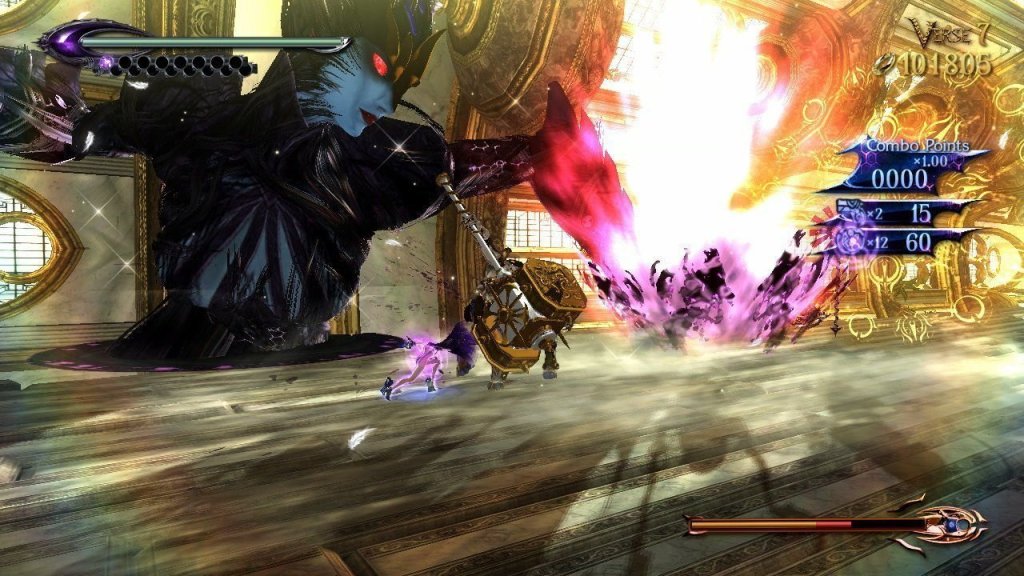
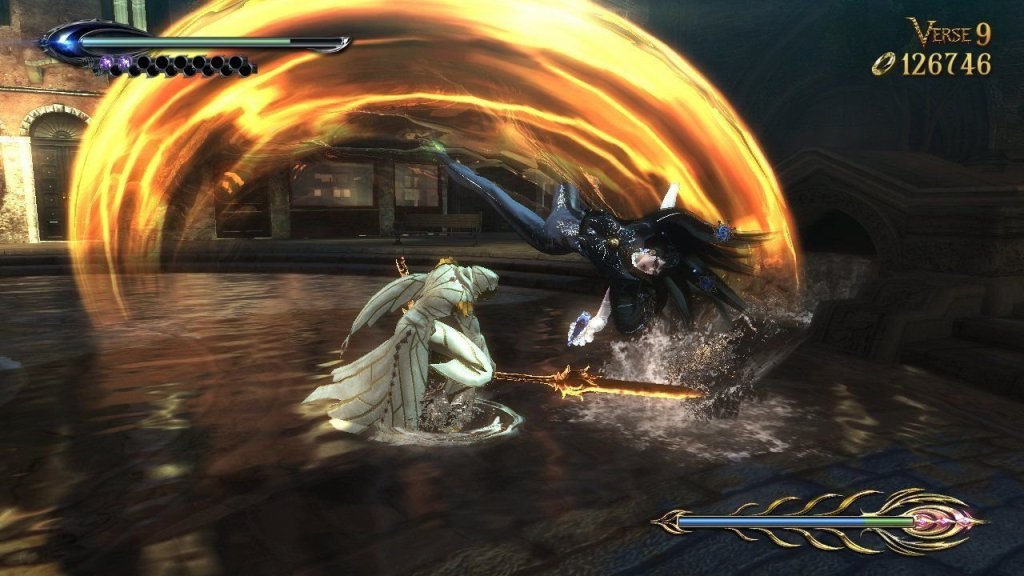
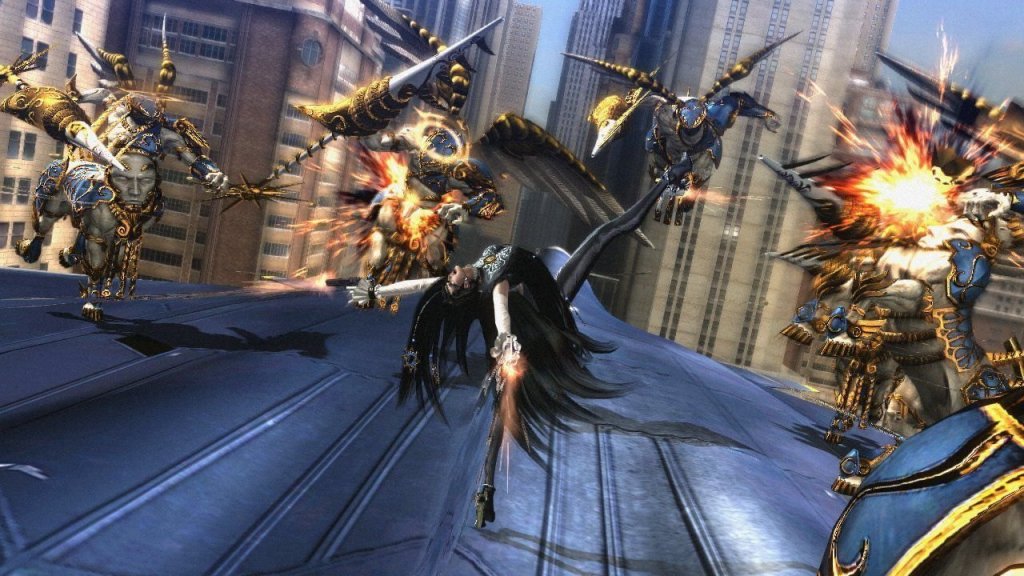
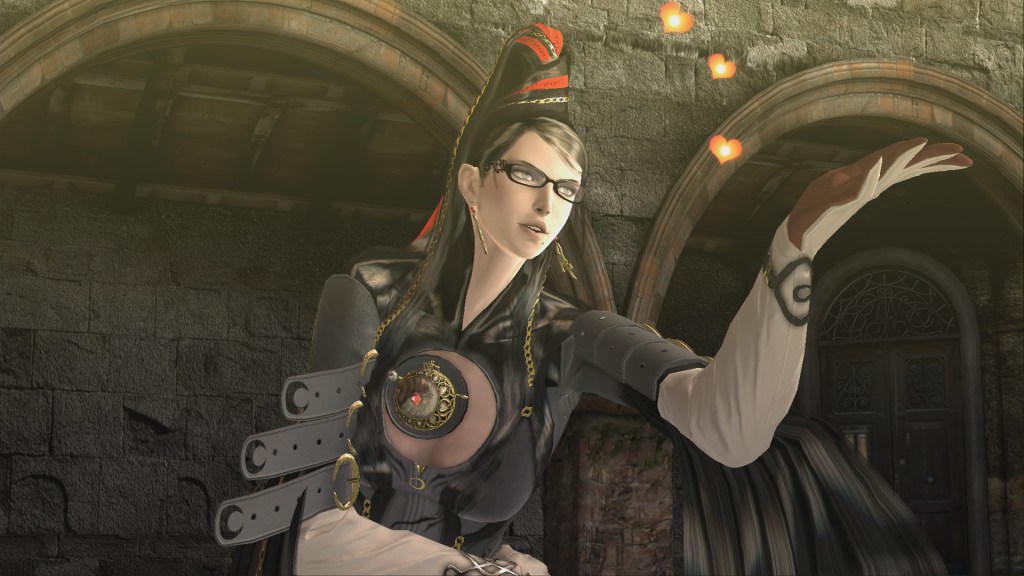
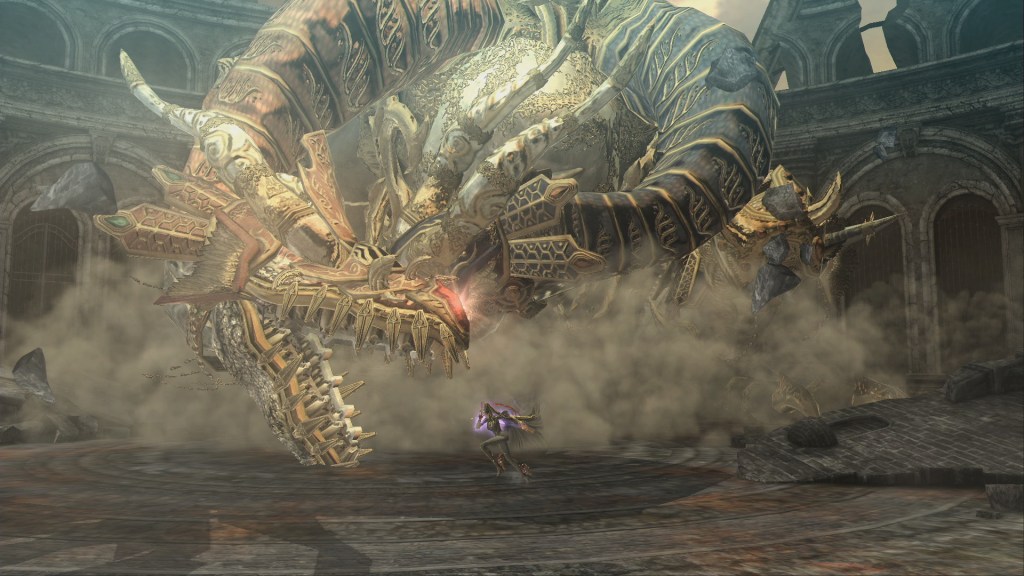
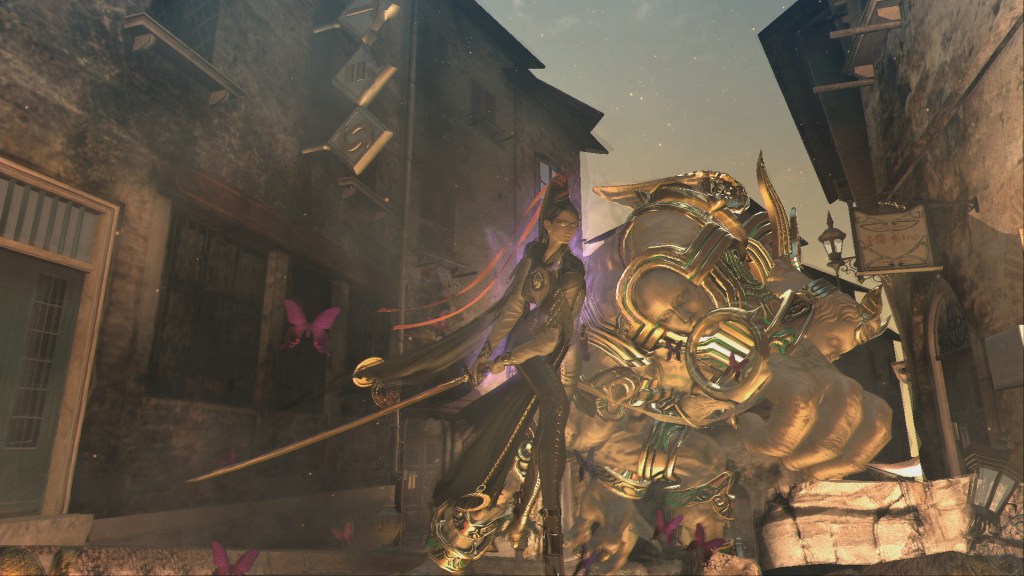
In my review of Bayonetta, I praised the game for being a more approachable character action game while maintaining a high level of potential complexity. Bayonetta 2 polishes this concept to an absurd degree, improving on many of the faults of the original game. Despite Bayonetta being an excellent action game, it had some glaring faults such as its dull color palette, overabundance of frustrating gimmicks, and punishing QTE sequences. Bayonetta 2 alleviates all of these issues, making it an even better experience for general audiences.
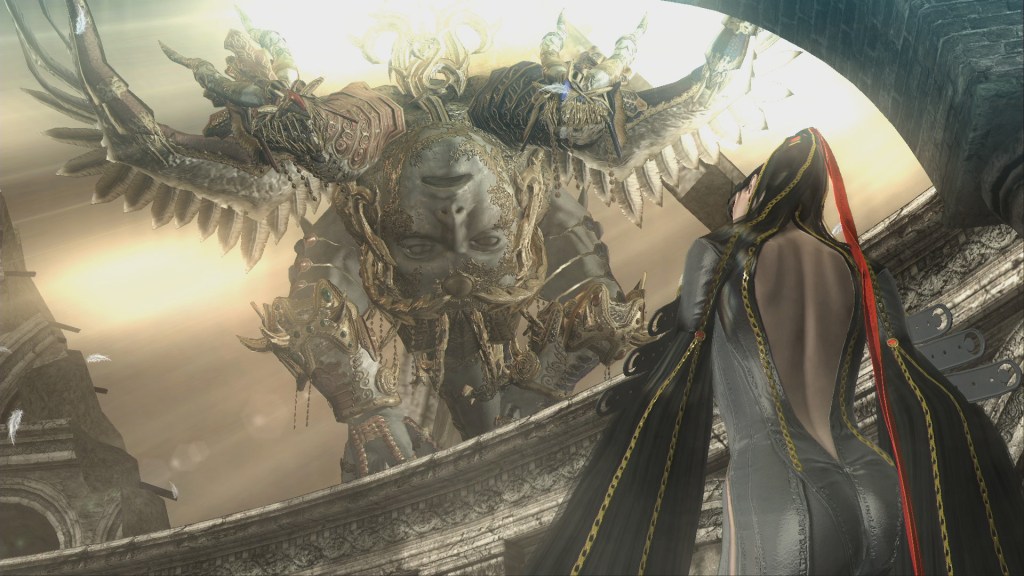
The most immediately obvious improvement that Bayonetta 2 makes is the art direction and use of vibrant colors. I lamented about the dull browns and grays that dominated the landscape of the original Bayonetta. In the prologue alone Bayonetta 2 obviously puts emphasis on livening up the color scheme. The environments are far more memorable and pleasant to look at because of this. It makes the spectacular animations and set pieces pop even more. It may seem like I am being overly nitpicky when complaining about the original game’s dull colors, but I’m adamant that for a game all about being stylish and sexy that it should have been more appealing to the eyes. I have to applaud Bayonetta 2 for overhauling this aspect.
Thankfully, Quick Time Events (QTEs) have been greatly diminished in Bayonetta 2. Dying because you didn’t press the X button in half of a second feels cheap and unearned. Even worse, it stops you from being able to just watch and enjoy spectacle cutscenes because you are always on edge waiting for a QTE if you know that it is a possibility. I’m glad that these have been removed. There is still the occasional button mashing QTE, but you know when it’s about to happen and you can’t die as a result of it, so it’s far less egregious than the QTEs in cutscenes.
Another feature that I’m happy was renovated was the gimmick sections. Bayonetta had a couple of levels that were outright frustrating to play because they relied heavily on arcade gimmicks. Bayonetta 2 remedies this by reducing the amount of non-combat sections there are in the game and also polishing them further. Riding the demonic horse or jet fighter in Bayonetta 2 is far better than riding the motorcycle or rocket in its predecessor. They’ve added additional attacks to make these sections more engaging. Additionally, these sections are far shorter so they feel less intrusive this time around. I still prefer the actual combat to these sections, but now they serve as welcome switch-ups rather than frustrating interruptions.
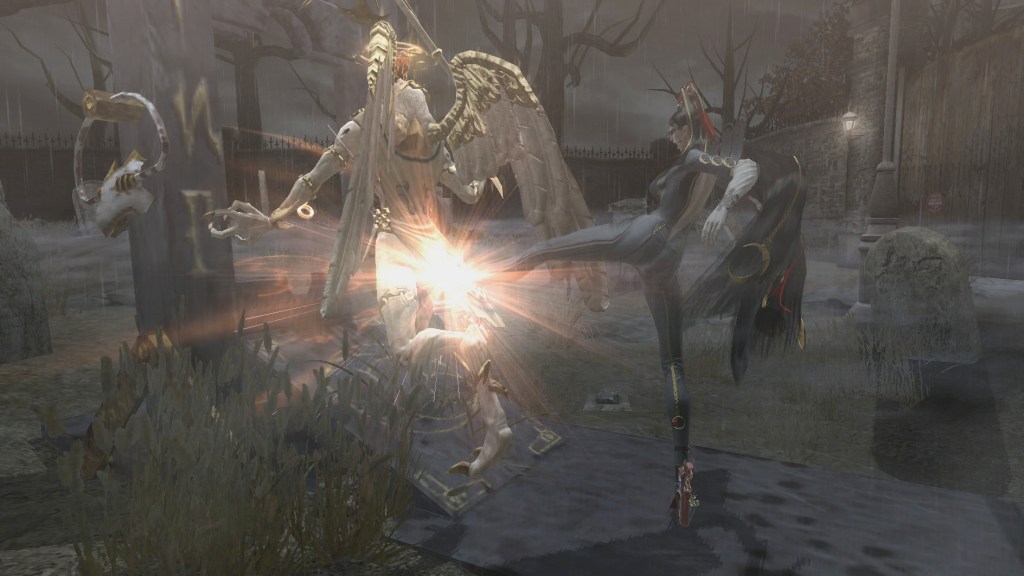
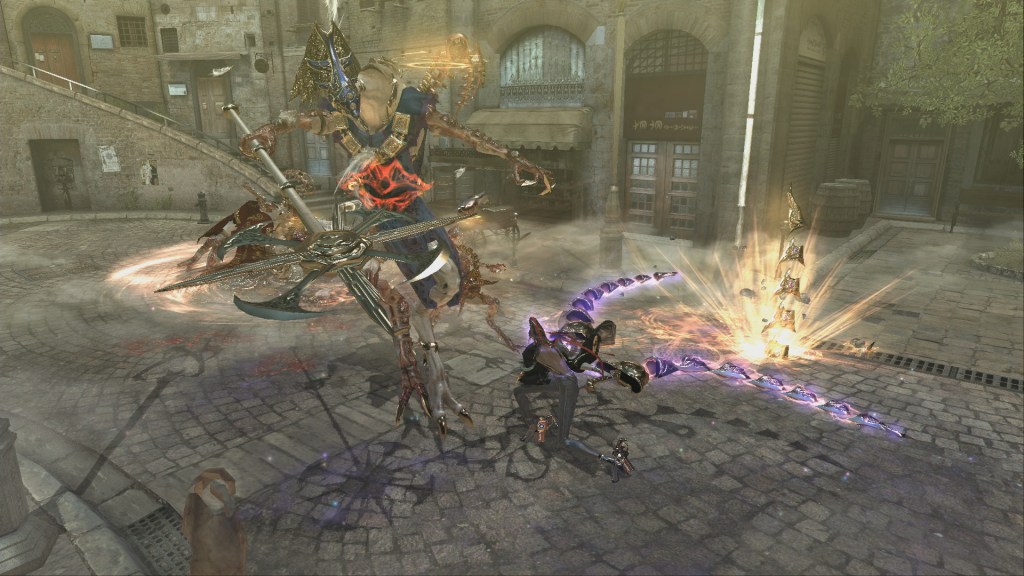
The combat of Bayonetta is lauded for its approachability and deep complexity. Bayonetta 2 implements the combat in a near identical way, with a few changes. The most noticeable change is that the “Normal” difficulty of Bayonetta 2 is easier than its predecessor. While I did enjoy overcoming some of the more challenging encounters that the original Bayonetta offered, I felt more inclined to try new combos and techniques when the damage was turned down a bit.
The other major addition to combat is a new ability called Umbran Climax. When you have a full magic gauge you can activate it, letting Bayonetta channel her demonic powers. It essentially turns all of your attacks into Wicked Weaves, making them do more damage, have wider area of effects, and staggers enemies. While I do think that Umbran Climax is a fun spectacle, it does feel too powerful. There rarely feels like there’s a purpose to using the magic gauge for Torture Attacks or using accessories when Umbran Climax is just so potent.
Ultimately, the combat of Bayonetta 2 is strikingly similar to its predecessor, and that is for the best because it truly is some of the greatest combat you will find in an action game. I will mention that at the very highest levels of gameplay Bayonetta 2 may not be as satisfying. Larger enemies do not stagger easily, making it challenging to keep up combos. Additionally, many enemies can block or dodge in the middle of your combo. Personally, these things did not bother me, and I doubt they will bother most players. But if you are the type who likes to go for Pure Platinum medals on the highest difficulty, then these small irritants may be a far greater problem.
The story of Bayonetta was complete nonsense, and while I do think that Bayonetta 2 is better in this regard, it still spends too much time on its narrative aspects. I actually quite like the conclusion of Bayonetta 2, as it retroactively makes Bayonetta make more sense. But I wish PlatinumGames would realize that people play these games for the action, spectacle, and characters. These games aren’t meant to be masterpieces of storytelling, and that’s fine. But the writing and dialogue is just hard to sit through sometimes. It wouldn’t be such a problem if the game didn’t have two and a half hours of cutscenes in a relatively short game. Spending a quarter or a third of the game length in cutscenes for a game that should be all about the action feels excessive and unnecessary.
The only major fault of Bayonetta 2 is that is very much derivative of the original. I don’t mean this in a disparaging way or that Bayonetta 2 is not enjoyable. In all honesty, I vastly prefer Bayonetta 2 to Bayonetta. It polishes the formula in many ways, removing the undesirable aspects and making technological improvements. However, Bayonetta 2 is relatively risk free, and while it’s not a bad thing to give the players more of what they want, it’s hard to hold it in the same regard as Bayonetta which made all the critical innovations. Bayonetta 2 may be a more enjoyable game, but it’s a far less important one when compared to Bayonetta.
In nearly every way, Bayonetta 2 is an improvement over Bayonetta. It cleans up many of the frustrating aspects that made me scratch my head while playing Bayonetta. It maintains the high level of combat that the series has become known for, and it is accessible to newcomers due to the emphasis on dodging and Witch Time. Despite this, Bayonetta 2 will have a hard time taking the spotlight from Bayonetta; it’s a great follow-up but it owes everything to its predecessor.
After the brutal and challenging adventure known as Elden Ring, I felt like I needed a more relaxed game. I was extremely excited to start Spiritfarer, a cozy journey where you escort spirit passengers on their path to the afterlife. At first, I was enthralled with Spiritfarer, I think it was a novel idea. A game that tackles the themes of death and mental health in a healthy manner surely can be impactful for many people. But I found that Spiritfarer is frankly just too long for the limited amount of actual gameplay that it contains.
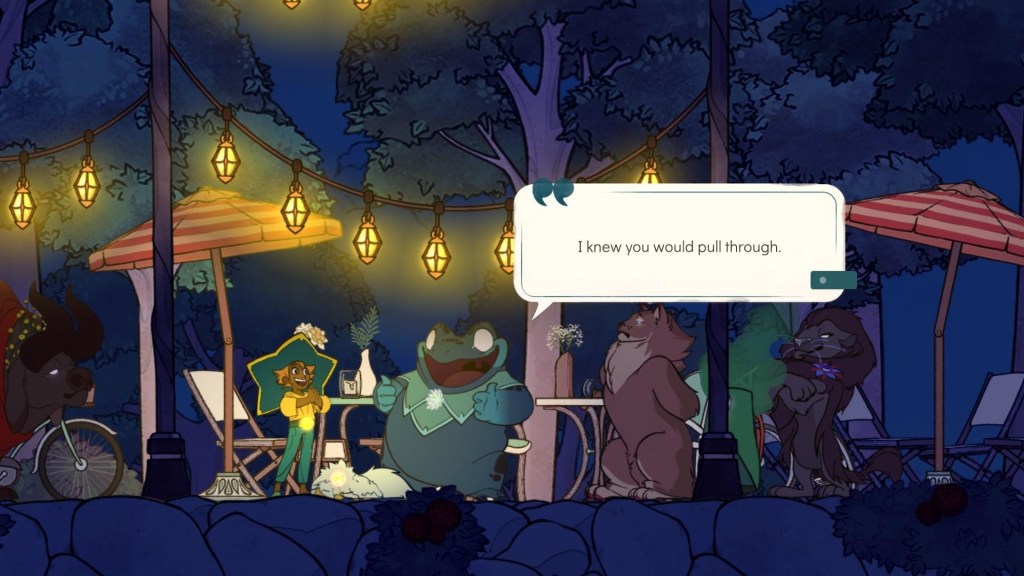
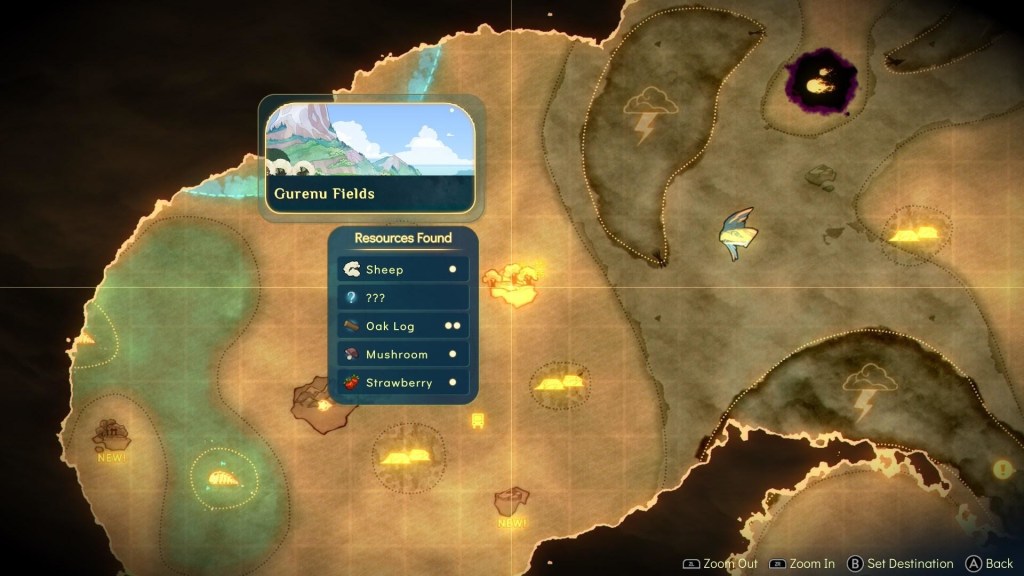
The premise of Spiritfarer is that you play as Stella, a young woman who has entered the spirit realm and is given the important role of escorting spirits to the afterlife. You sail the seas in your little boat, stopping at islands along the way and talking to local spirits. Some of whom will become passengers on Stella’s vessel. As occupants on the ship, you will have to fulfill their desires and requests until they feel they are ready to move onto the afterlife.
Spiritfarer engages with the idea of death and moving on in an elegant fashion. Spirits become familiar friends on the vessel. Talking to you, sharing their memories, and hanging around as you carry out your quests. Then suddenly they decide their time has come to an end, and you must bring them to their final destination. These tearjerking moments are equal parts depressing and gratifying. As you share your last moments with the characters you’ve come to know and love, you realize that it wasn’t meant to last forever and sometimes people are just ready to move on. It’s sad, but death is real, and Spiritfarer harbors lessons for everyone.
There is overarching plot in Spiritfarer. Astute players may be able to predict what is happening early on in the journey. Mysteriously, Stella seems to know all of the spirits that join her on the ship from their previous lives. Unfortunately, I felt that the interconnected story elements fell a little flat. Stella’s story is very sparsely spread out across the entire 30+ hour game, with much of it needing to be inferred. The game focuses more on the individual spirits backgrounds and their stories.
Truthfully, I also felt that the self-contained stories about each character also were underwhelming. Somehow, Spiritfarer is simultaneously underwritten and overwritten. Characters have a ton of dialogue, sometimes it seems to never end. But at the same time much of that dialogue is entirely fluff, not revealing anything meaningful about the spirit, their background, or their personality. A lot is left to the player to be inferred, which is fine, but it did feel like there was big chunks of the story cut out. Which makes sense when you learn that there is an entirely separate artbook which does contain more details about Stella and the characters.
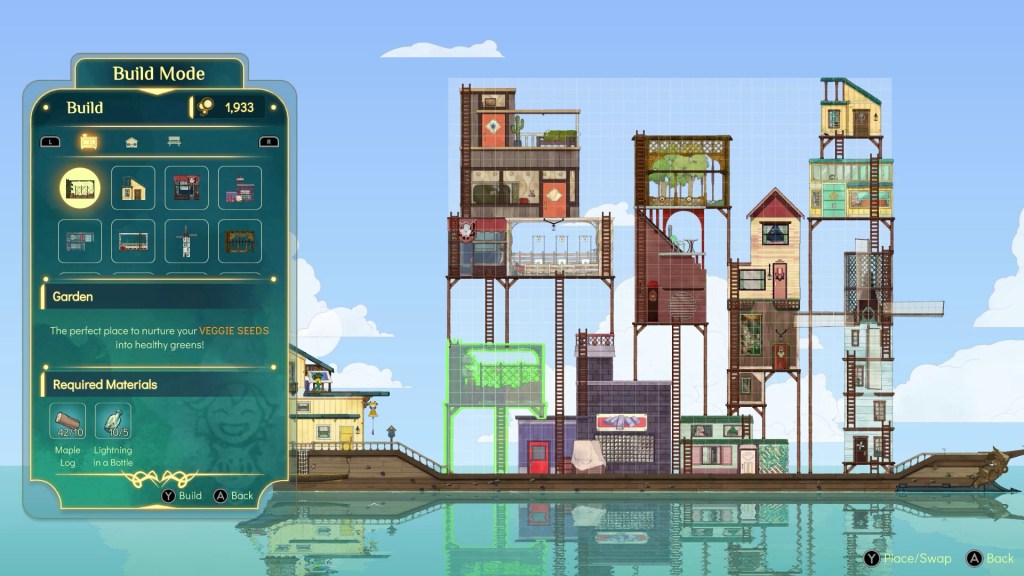
When I began playing Spiritfarer, I was enthralled with its relaxing gameplay. I have never been a huge fan of life-simulation games akin to Animal Crossing, but I initially thought that Spiritfarer would be different. There’s plenty of resource management to upgrade your ship, some platforming elements, minigames to refine resources, and an actual narrative. But disappointingly, all of these elements lose their luster after a few hours and the game just does not evolve in any significant manner in its long runtime.
Take for instance the resource management. You need resources like wood, cloth, glass, etc., to construct new buildings. Generally, you collect raw resources while visiting islands and then refine them into materials to build things. To refine resources, you use specific buildings that each have their own mini-game to complete, rewarding bonus materials if you do well in the mini-game. The mini-games are fine at first, but become a complete time-sink as the game progresses. Some of them feel like they are specifically designed to waste your time. Mashing a button to hammer steel or waiting for metal to melt is just not interesting. Not to mention having to tend to crops and feed the chickens and direct the ship to its destination.
A huge opportunity was missed in Spiritfarer, which when I began the game, I thought for sure would be implemented. While spirits inhabit your ship, they have a mood level. You can keep them happy by feeding them food they enjoy, hugging them, or doing certain activities. The spirits are supposed to reward you with things when they are in a good mood. But the rewards are completely meaningless garbage. I’m not going to go out of my way to keep a spirit happy if all I get for it is a single wooden plank every two hours.
It really feels like there was an intention here to have spirits actually do the jobs they enjoy doing. The woodworker should chop logs in the lumber mill, the seamstress should sew fabric, the chef should make food in the kitchen. It’s so bizarre that as the game progresses, you unlock dozens of stations to create materials, but the spirits who obviously enjoy the activities don’t ever interact with them. Instead, the player has to juggle a bunch of time consuming mini-games that get tiresome after the third time you’ve played them.
I thought my ship would eventually transform into a self-sustaining colony. I could direct the ship and explore the islands and take care of whatever tasks I need to while the spirits partake in their hobbies and craft resources so long as they were in a good mood. Instead, they just kind of hang around on your ship, asking to be fed and occasionally giving you some lengthy dialogue about nothing in particular. I would have been far more attached to the characters if they actually felt like they were dynamic parts of the journey that assisted me instead of just being annoying chatty statues.
Unfortunately, most of the quests in Spiritfarer are also uninspiring. While I love the idea of helping the lost souls on your ship and fulfilling their final requests, the mechanical execution of quests is just lazy. Sailing back and forth between islands just to collect a single item or talk to another character for one minute is the epitome of fetch quests. Quests that incorporated some platforming or exploration felt far better than the repetitive fetch quests.
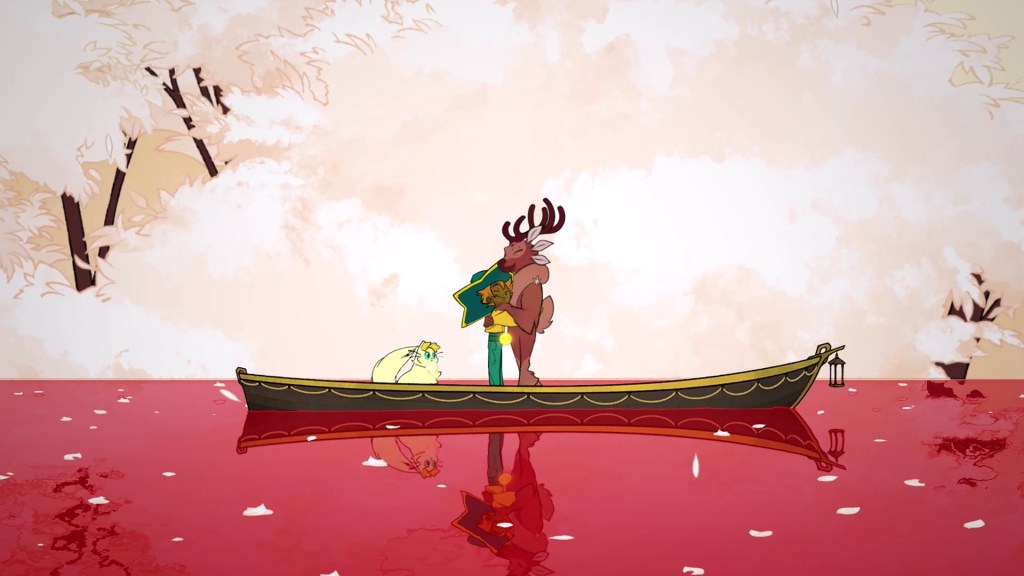
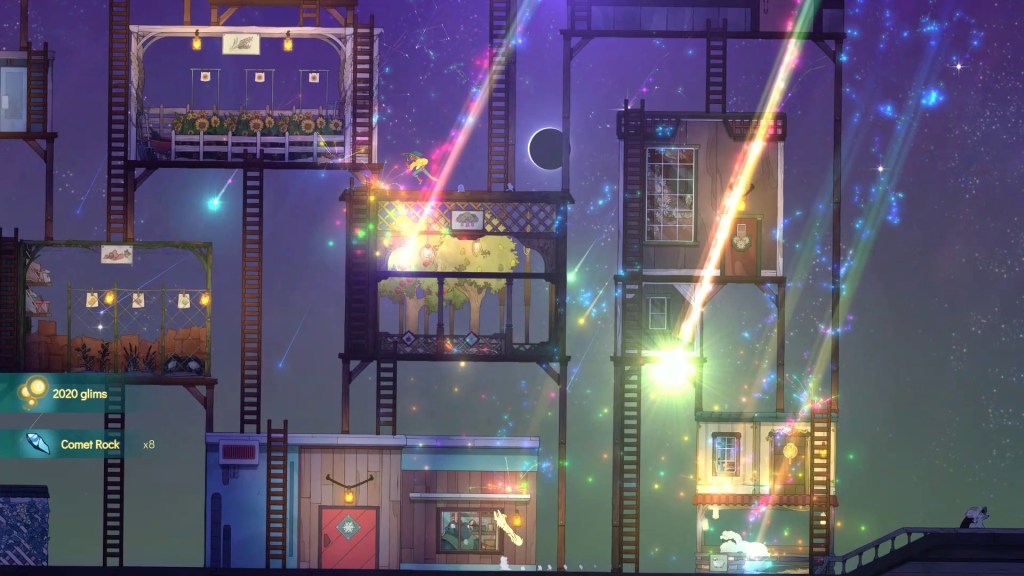
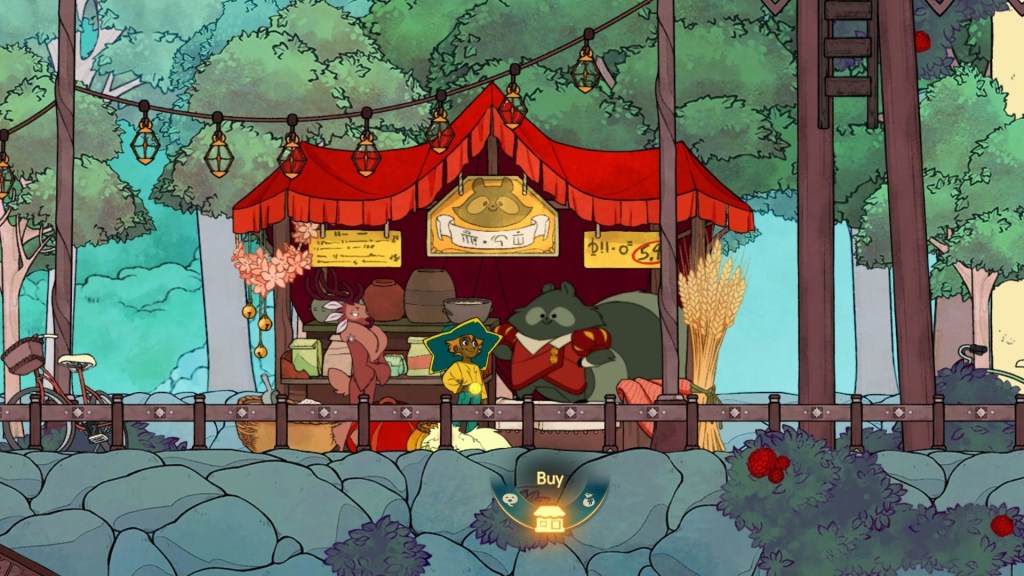
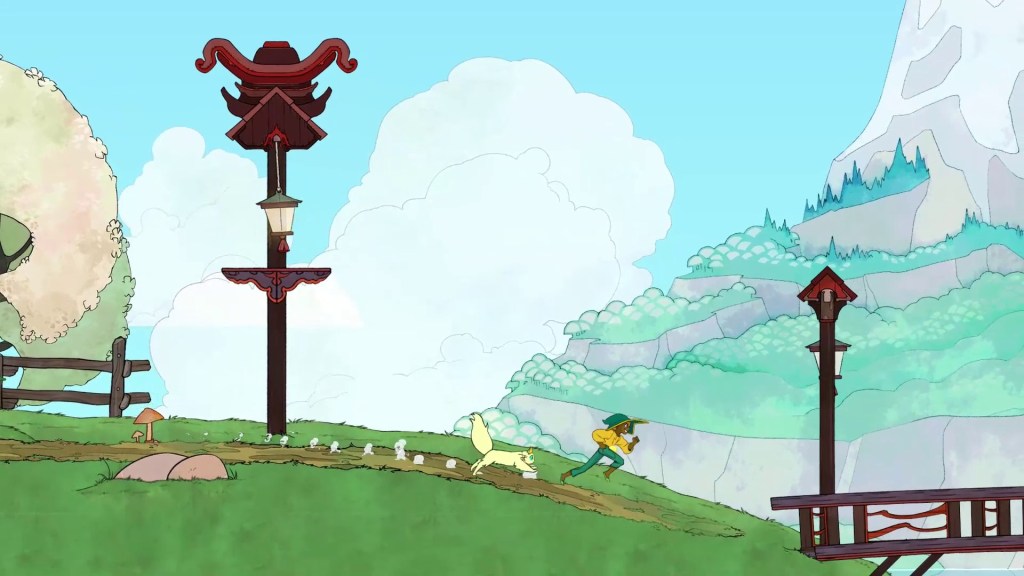
Spiritfarer is an undeniably gorgeous game. The art direction, character designs, and detailed animations are really the star of the game. I loved watching the characters just go about their business, or watching Stella’s cat chase her little ball. Moreover, the concept of sailing and building a community on this supernatural ferry is supremely cozy. This is admittedly what drew me into Spiritfarer, I just wish the gameplay or story did its part to keep my interest.
One of the most common issues that I’ve seen after playing and reflecting upon hundreds of games is that many of them are just too long for their own good. For some reason gamers love to spew nonsense about the amount of “hours per dollar” they get out of a game, leading to bloated experiences. If a movie or an album was eight hours long, it better have an extremely good reason, and even then, it would get lambasted by reviewers and the public. Why do we treat games differently? Honestly, if Spiritfarer was half or even a third of its current length of nearly 30 hours, it would be far more enjoyable. The mini-games and sailing back and forth doesn’t get nearly as repetitive or grating if you don’t have to keep doing it over and over. Spiritfarer simply wears out its welcome far prior to completing the game.
I really wanted to enjoy Spiritfarer. It’s central theme of memento mori and mental health are conveyed in a comforting environment. The game is visually stunning. But the overarching gameplay and story just aren’t enough to keep a fairly lengthy game entertaining for the full duration. It is for these reasons that I give Spiritfarer a 5/10. I seem to be in the minority as most people loved Spiritfarer, and I’m willing to admit that maybe I just have a strong aversion to games like Spiritfarer and Animal Crossing. Clearly a lot of love and care went into the making of Spiritfarer and I wish I could praise and recommend the game. But sadly, Spiritfarer misses some opportunities and is ultimately tedious.
I feel the need to preface any review of character action games with the fact that I am not particularly good at these games, and I rarely gain any level of mastery of their systems. I think it’s important to state this because character action games often thrive when you put in the time to really master their systems, so I frequently miss out on deep mechanics. That being said, I believe that Bayonetta is the most approachable character action game that I have played. I enjoyed the Devil May Cry series, but I often felt that I was just scratching the surface of what was possible in those games. But in Bayonetta, I felt much more comfortable executing combos and performing advanced techniques.
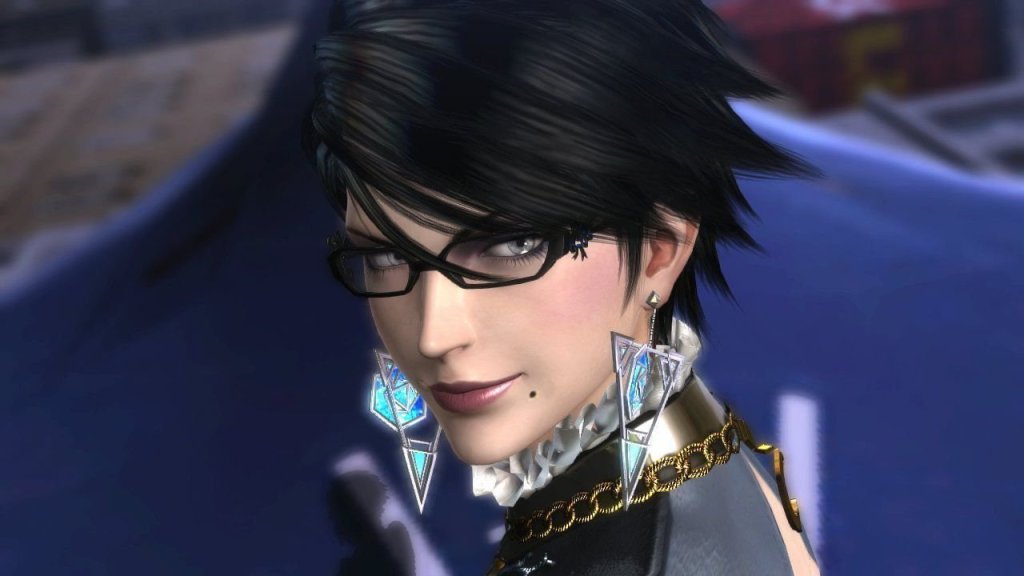
Before diving into the complex combat mechanics of Bayonetta, it should be no surprise that I need to mention the character design. There has been no shortage of controversy surrounding the gratuitously sexualized main character. The game’s director, Hideki Kamiya has made it clear that he wanted Bayonetta to be a sexy character. She has the build of a supermodel, regularly gets into sexy poses, makes plenty of innuendos, and even goes almost fully nude when utilizing her witch powers.
While I’m typically grossed out by hypersexualized characters in video games or television, Bayonetta is not the typical character that serves as eye candy. She’s an undeniable badass who toys with her opponents. She is totally in control of her own sexuality. She has a cheeky personality that pokes fun of her angelic opponents and their puritan values. I think this is fine and even a subversion of a common misogynistic character type. However, I think Bayonetta takes the sexual aspects too far in many places. While she is meant to be a sexual character, there are many sequences and scenes that are clearly meant just to be eye candy for the player. Zooming in on her assets while she sensually dances objectified her rather than empowering her.
While there’s no doubt that Bayonetta is a badass and sexy character, the game’s actual story absurd. Story has never been a central aspect of character actions games, and I can’t fault Bayonetta too hard for its nonsensical story when it is clearly not the focus of the game. But there are a ton of cutscenes, cinematics, and exposition dumps that get in the way of actually interacting with the fun parts of the game. I suppose a nonsensical and over the top story is better than a boring, monotonous one. But I wish Bayonetta was paced more evenly instead of leaving all of the story to the very end of the game.
The real appeal to character action games like Bayonetta is obviously the action. Weaving together complex combos, juggling enemies like they are ragdolls, unleashing powerful attacks, and looking stylish while doing it. While I like to say I’m not good at these kinds of games, Bayonetta felt extremely approachable for players who are inexperienced in the genre. There are a few key traits to Bayonetta that I believe makes it so easy to get into. Those being simplistic combos and the emphasis on dodging.
I’ve always had a really time hard in Devil May Cry games trying to learn all the different combos. You had a single attack button and had to combine directional inputs and correct timings in order to execute combos. Not to mention style switching and changing weapons. Bayonetta has two attack buttons, punch and kick. Hitting these buttons in different orders will result in different combos. Between load screens, you can play around in practice mode and look at the long list of all the possible combinations. Learning a few simple combinations can take the player a long way.
It was much simpler for me to just memorize “punch, kick, punch” then having to learn a bunch of directional inputs and timings. Bayonetta does a fantastic job emphasizing the use of the combos because the final attack of each combo is an extra powerful hit called a Wicked Weave. The player is taught that finishing combos is vital because so much of the power is in the final attack.
Another interesting thing about the combos in Bayonetta is that each individual attack is meant to be held. Bayonetta has guns attached to her hands and feet, and when you execute a punch or kick you can hold down the button to shoot. This does not break combos, and it does a surprising amount of damage. I quite like this feature because it discourages simple button mashing, and instead gives the player some brief moments to think about what they’re doing. I don’t have to frantically hit buttons to pull off combos, and I can take my time and am rewarded for it.
The biggest separator between Bayonetta and Devil May Cry is the emphasis on dodging. Bayonetta has a dedicated dodge button, and it is obvious that it is vitally important. If you dodge right when an enemy attack is about to hit you, you’ll activate Witch Time. This temporarily pauses time, allowing you to unleash some big combos on powerless foes. I love this feature as an inexperienced player as it really allows me to try out some cool attacks. Also, it just feels badass to dodge a hit and the last second and get rewarded with a few seconds of Witch Time.
Dodging in Bayonetta has a slightly more advanced mechanic tied to it called dodge offset. If you execute it properly, you can continue your combo right where you left off. Dodge offset is definitely something that takes some getting used to, but it is a vital trick to learn if you really want to master Bayonetta. Considering that much of your damage is part of the Wicked Weave at the end of a combo, maintaining that combo is important. This is a brilliant addition as it allows players to achieve higher mastery while utilizing and combining the core mechanics of Bayonetta: combos and dodging.
While I did not master Bayonetta myself, I can say there is plenty of complexity for those who do really want to dive deep. A long list of combos and unlockable attacks, dodge offset, a few different weapons to try out, and unlockable accessories. The accessories and magic meter are things that you are unlikely to even tinker with in your first playthrough. Similar to Devil May Cry, you will be graded at the end of each chapter if you want to challenge yourself. There is plenty of content to try, and it will take plenty of times to really master Bayonetta if that is what you are looking for.
While I do think Bayonetta herself and the other characters in the game look superb, unfortunately much of the environment design is pretty drab. Bayonetta is from the era in gaming where everything was dull brown and grey. The set pieces themselves were spectacular, but the environment was just boring. It’s odd because the character and enemy design is fantastic. The enemies all adhere to the angelic theme quite well. Bayonetta is a really well thought out character, and all her animations are fluid and graceful. The game looks really good outside of the dull environments.
Hideki Kamiya is known for his love of old school arcade games, for better or worse. Both Bayonetta and Devil May Cry were inspired by sitting in an arcade and trying to reach a high score on a game you’ve played many times before. But Bayonetta has some strange arcade gimmick levels that just abysmal. There’s one where you ride a motorcycle down a highway and another where you ride atop a rocket. Both of these levels are obviously throwbacks to old arcade games, and both are awkward, break the flow of the game, and just go on for way too long. It’s only two levels but the game really doesn’t have many levels in total, so these levels are particularly painful.
Another frustrating relic is the reliance on Quick Time Events (QTEs). During cutscenes, a button prompt could flash for a half a second and if you miss it, you instantly die. During certain fights, you have to mash a button extremely quickly or you will take significant damage. And when finishing off a boss or using a special Torture Attack you have to mash a specific button. QTEs are rarely a fun feature in games, especially in the case of Bayonetta because they have tight timers. If you don’t know the QTE is coming or what button to press, you can’t possibly react quick enough. It’s not a big deal for veteran players who are seeking high grades as they known when one is coming up, but it often feels like a cheap and unavoidable death for first timers.
Overall, I think Bayonetta is my favorite character action game. While it has its flaws like the annoying gimmicks, poor story, and drab environments, the combat is just too good to be brought down. Beginners can make use of simplistic combos and Witch Time. Advanced players have plenty to master like dodge offset, various weapons, and special accessories. While she is a controversial character who I think is overly sexualized, it’s undeniable that Bayonetta is one of the best designed and memorable characters in gaming. If you like action games, do yourself and favor and give Bayonetta a try.
Despite being one of the most prolific and well-known series of all time, The Legend of Zelda has few notable spin-offs. At first glance, it seems odd that a crossover was made with Crypt of the NecroDancer, a rhythm based roguelite game. As a game series known for its carefully crafted adventures, the randomly generated roguelite worlds seems antithetical to what The Legend of Zelda is known for. While I do think Cadence of Hyrule: Crypt of the NecroDancer Featuring The Legend of Zelda has fun combat, the roguelite formula does not lend itself well to the traditional The Legend of Zelda style.
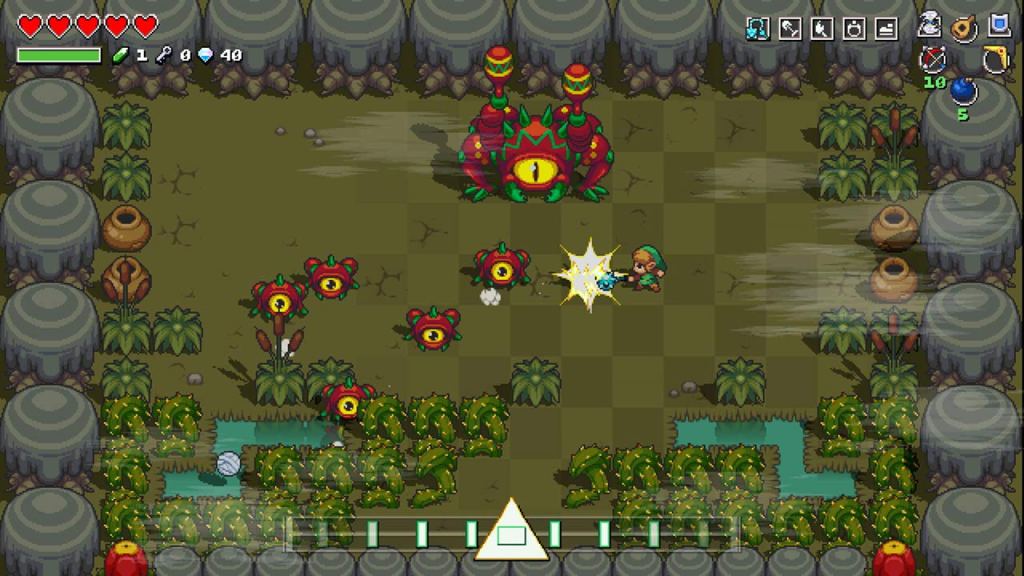
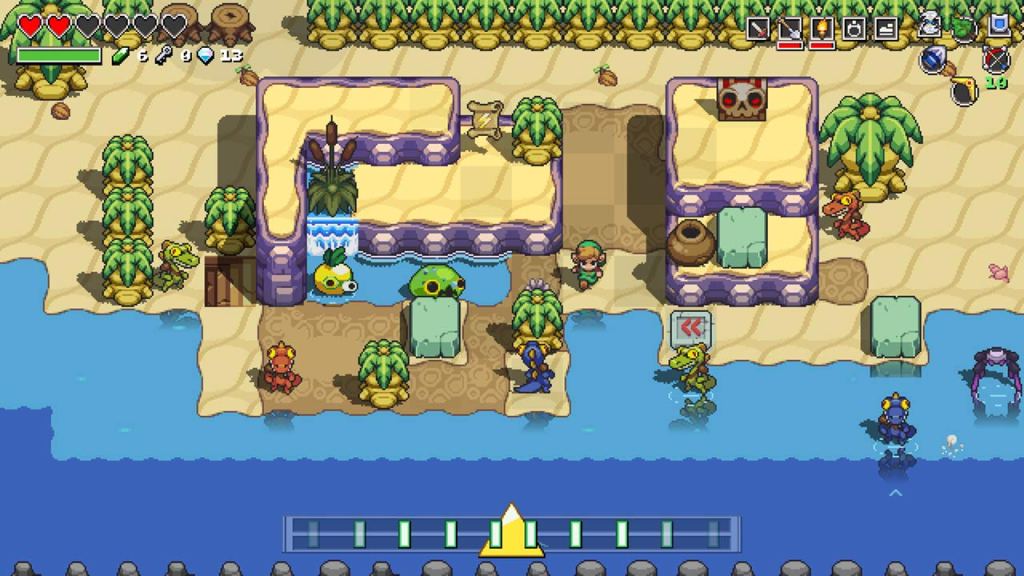
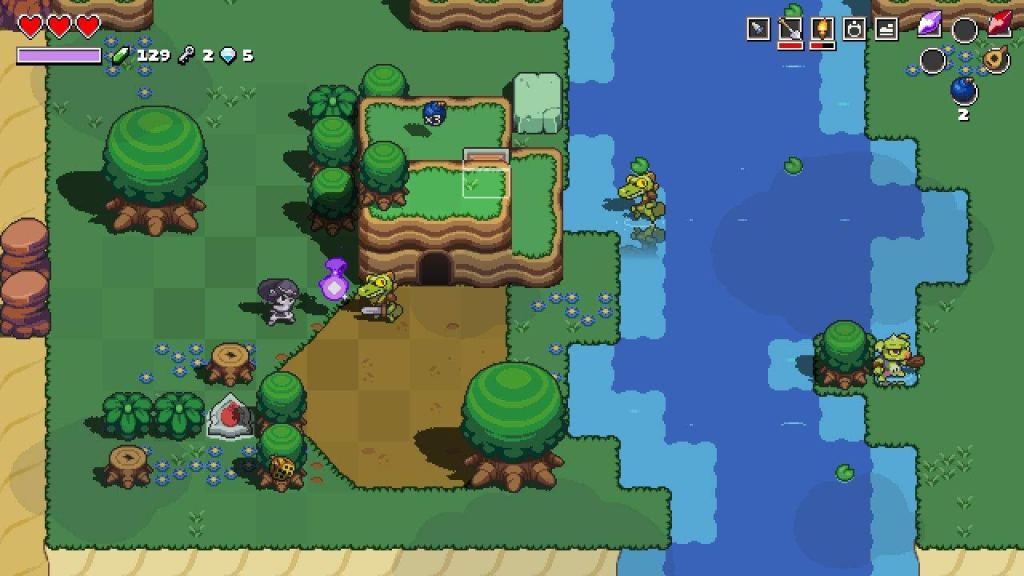
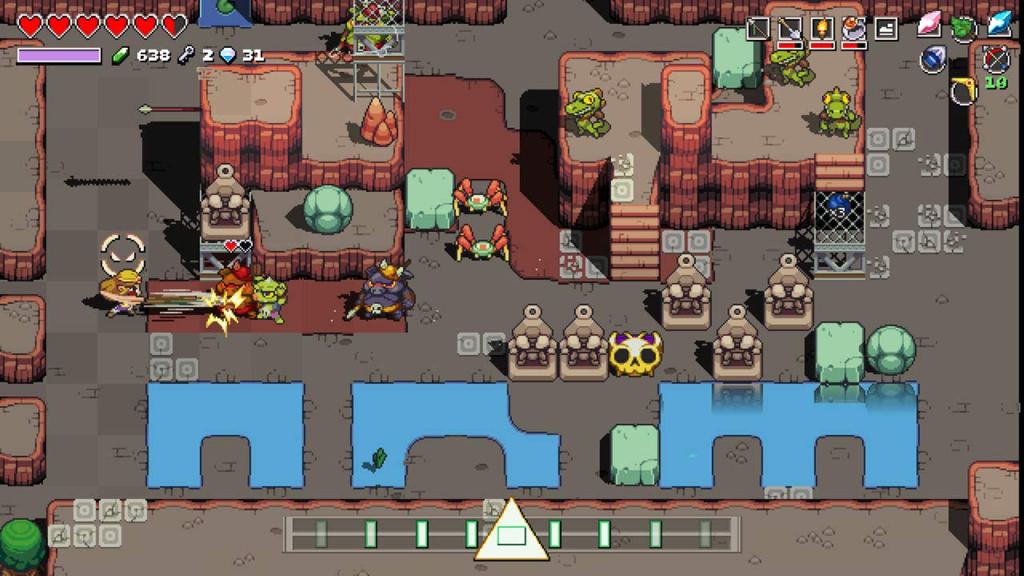
The strongest aspect of Cadence of Hyrule is without a doubt its presentation. The modern version of the classic top-down The Legend of Zelda world and characters is phenomenal. The sprites are clean, the colors are vibrant, and the animations are fluid. Being a game with a heavy emphasis on music, Cadence of Hyrule knocks it out of the park with its remixes. The Legend of Zelda series is brimming with memorable tracks, and Cadence of Hyrule brings them all back with style. It truly is fantastic how identifiable yet fresh all the tunes are, they are top tier remixes.
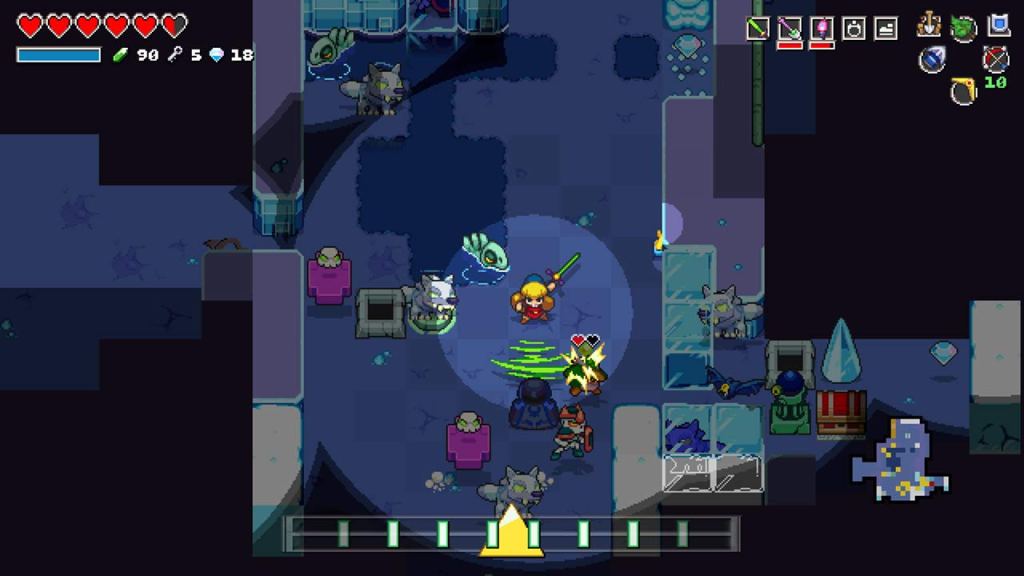
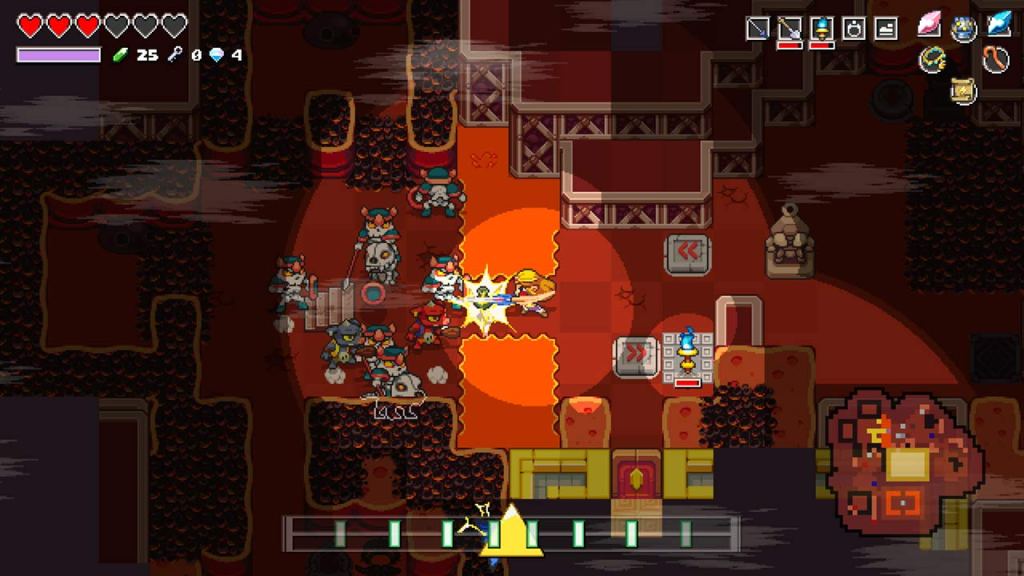
Crypt of the NecroDancer is a unique roguelite dungeon crawler in which you move to the beat. On every beat of the song, you have a small window to move in a direction. Enemies also move in a similar fashion, each with their own patterns. Some only move if you step directly in front of them, some move predictably every couple of beats, and some move erratically. It’s definitely an interesting twist on traditional dungeon crawling. Movement is essentially turn-based, but you have to think quickly and time your inputs to the beat.
It can be remarkably tricky to get a handle on the beat-based movement of Cadence of Hyrule. The majority of my deaths in the game came from the first hour or so while I was figuring out the rhythm and how to maneuver. I was pretty frustrated initially by constantly missing the beat, but eventually it becomes second nature to sync to the rhythm. I appreciate the fact that there was an optional mode to disable the timing-specific beat system. In fixed-beat mode the enemies move only when you move. While I did not personally activate this mode, I think it was an important inclusion given the initial awkwardness of the beat system.
There is a bit of an awkward difficulty curve in Cadence of Hyrule due to this system. Traditionally, games should get progressively more difficult as you keep playing as a way to test your mastery. Unfortunately, I felt that Cadence of Hyrule was the most difficult at the very beginning. The combination of learning how to move and having no health or weapons made for a brutal beginning. As soon as I got a grasp on how to play, got some health upgrades, and got a more powerful weapon the game became pretty easy aside from the very last dungeon. I wish some of the mid and late game content took more mastery, as I was able to steamroll most screens without much regard for strategy.
Despite the uneven difficulty curve, I do think the movement and combat in Cadence of Hyrule is enjoyable. It’s a solid twist on traditional top-down adventure games. Once you get in the rhythm, it becomes natural to strategize on the fly. It’s fun to learn the enemies’ patterns and they best approaches to deal with them. Maneuvering around each battle becomes second-nature, unless you lose the beat. While it’s not a system that fits every game, I think it is fantastic and creative approach. Especially when paired with the glorious soundtrack.
It’s important to note that Cadence of Hyrule is not a true roguelite, but instead is much closer to being a more traditional adventure game with intermittent checkpoints. While there are some roguelite elements like losing some items upon death and a randomized map, I felt that it was closer to a traditional The Legend of Zelda game than I initially expected. To be honest, I wish they went even farther in ditched the roguelite formula altogether for this spin-off.
The randomized overworld just does not work well in a The Legend of Zelda game. These games are about exploration and progression. They are carefully crafted adventures that carefully guide the player in where to go, every element is intentionally placed. Unfortunately, I felt that Cadence of Hyrule just felt forgettable outside of a few distinct locations. Most screens are just generic layouts filled with enemies. There are some puzzles and upgrades to be found around the world, but ultimately the sense of adventure is lacking in comparison to the main series.
A key facet of a roguelite is to provide some variation between subsequent runs, to keep things fresh. I had no desire to play Cadence of Hyrule multiple times because I felt there was nothing remotely different after a single run. You will always unlock the same upgrades, weapons, and items. The only difference may be the order. The overworld is randomized between runs, but that really doesn’t accomplish the goal of replayability. It doesn’t really change anything that the desert area is now in the Northwest instead of the Northeast for example. You can improve your score between runs, but really that’s not a compelling reason to be a roguelite as plenty of games have a scoring system.
Truthfully, I believe Cadence of Hyrule would have been more enjoyable if it entirely abandoned its roguelite aspects. If the world was more intentionally designed like a traditional The Legend of Zelda game, it would have been more enjoyable to explore. The roguelite elements add nothing when there are plenty of checkpoints and there are always the same weapons between runs. I can appreciate the rhythm-based movement and combat that comes from Crypt of the NecroDancer, but the other elements just don’t work as well in Cadence of Hyrule.
Overall, Cadence of Hyrule is a fun mash-up that has some flaws as a result of its DNA. While I love the fact that an indie developer got a chance at The Legend of Zelda, and I think they did the series justice, I felt that it was missing the sense of adventure. The presentation is extraordinary, and the combat is fun once you get the hang of it, but to me exploration is key to the series. The randomized world of Cadence of Hyrule made exploration uninteresting and repetitive. It is for these reasons I give Cadence of Hyrule a 6/10. While I enjoyed Cadence of Hyrule, more than anything it made me yearn for a new top-down The Legend of Zelda game in the classic style.





 stephensopinions