Spiritfarer (2020)

After the brutal and challenging adventure known as Elden Ring, I felt like I needed a more relaxed game. I was extremely excited to start Spiritfarer, a cozy journey where you escort spirit passengers on their path to the afterlife. At first, I was enthralled with Spiritfarer, I think it was a novel idea. A game that tackles the themes of death and mental health in a healthy manner surely can be impactful for many people. But I found that Spiritfarer is frankly just too long for the limited amount of actual gameplay that it contains.
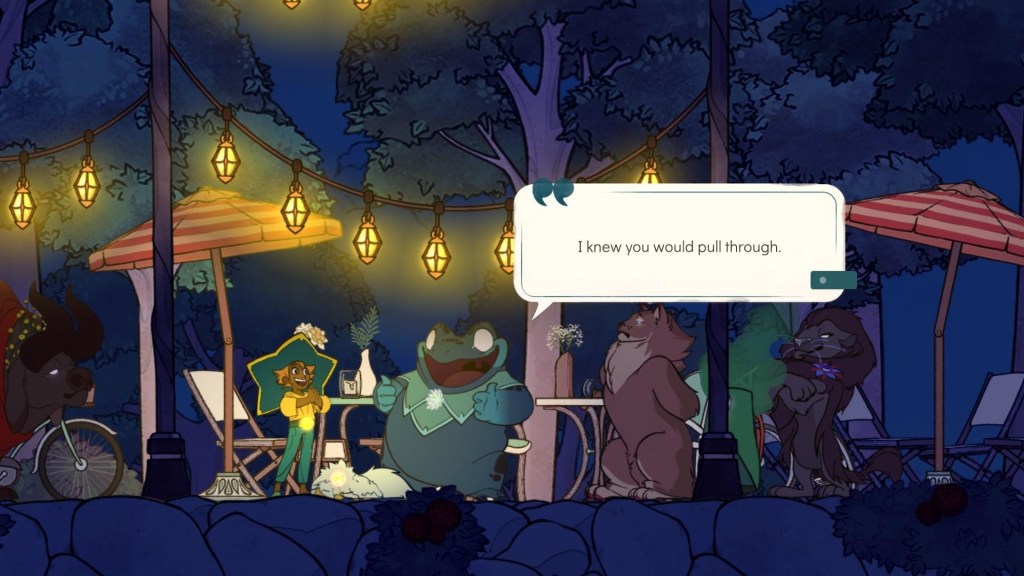
The premise of Spiritfarer is that you play as Stella, a young woman who has entered the spirit realm and is given the important role of escorting spirits to the afterlife. You sail the seas in your little boat, stopping at islands along the way and talking to local spirits. Some of whom will become passengers on Stella’s vessel. As occupants on the ship, you will have to fulfill their desires and requests until they feel they are ready to move onto the afterlife.

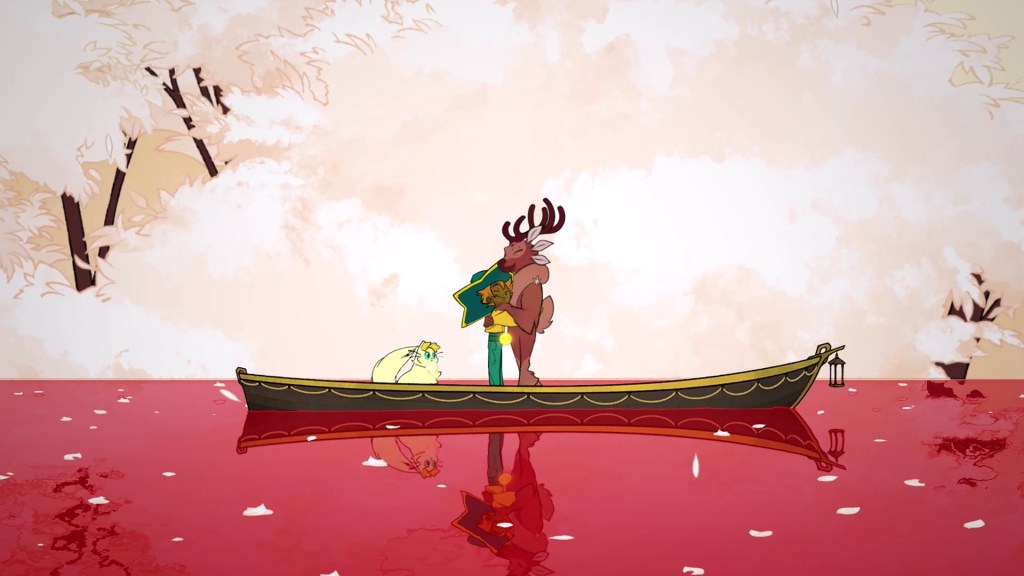
Spiritfarer engages with the idea of death and moving on in an elegant fashion. Spirits become familiar friends on the vessel. Talking to you, sharing their memories, and hanging around as you carry out your quests. Then suddenly they decide their time has come to an end, and you must bring them to their final destination. These tearjerking moments are equal parts depressing and gratifying. As you share your last moments with the characters you’ve come to know and love, you realize that it wasn’t meant to last forever and sometimes people are just ready to move on. It’s sad, but death is real, and Spiritfarer harbors lessons for everyone.
There is overarching plot in Spiritfarer. Astute players may be able to predict what is happening early on in the journey. Mysteriously, Stella seems to know all of the spirits that join her on the ship from their previous lives. Unfortunately, I felt that the interconnected story elements fell a little flat. Stella’s story is very sparsely spread out across the entire 30+ hour game, with much of it needing to be inferred. The game focuses more on the individual spirits backgrounds and their stories.

Truthfully, I also felt that the self-contained stories about each character also were underwhelming. Somehow, Spiritfarer is simultaneously underwritten and overwritten. Characters have a ton of dialogue, sometimes it seems to never end. But at the same time much of that dialogue is entirely fluff, not revealing anything meaningful about the spirit, their background, or their personality. A lot is left to the player to be inferred, which is fine, but it did feel like there was big chunks of the story cut out. Which makes sense when you learn that there is an entirely separate artbook which does contain more details about Stella and the characters.
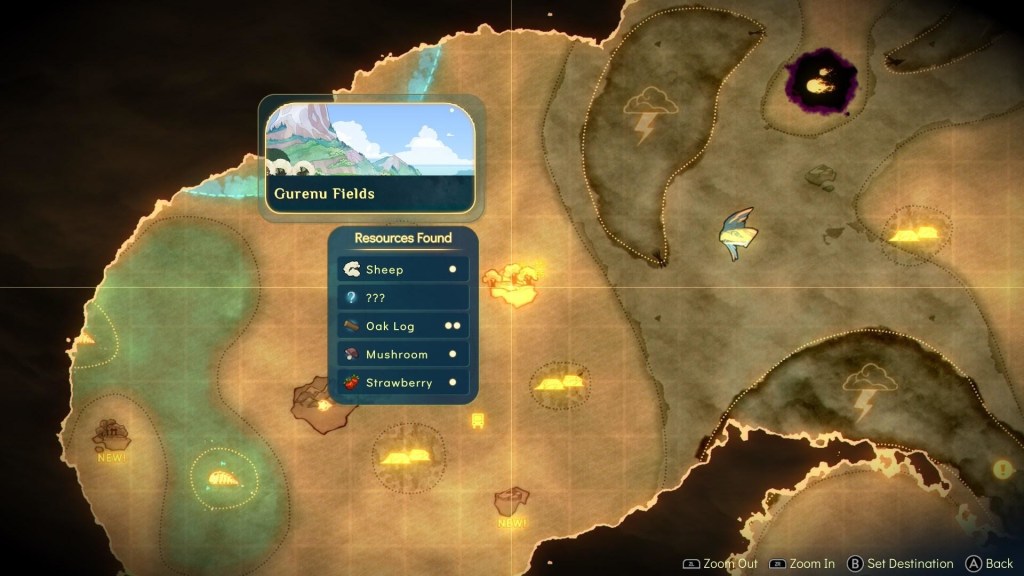
When I began playing Spiritfarer, I was enthralled with its relaxing gameplay. I have never been a huge fan of life-simulation games akin to Animal Crossing, but I initially thought that Spiritfarer would be different. There’s plenty of resource management to upgrade your ship, some platforming elements, minigames to refine resources, and an actual narrative. But disappointingly, all of these elements lose their luster after a few hours and the game just does not evolve in any significant manner in its long runtime.

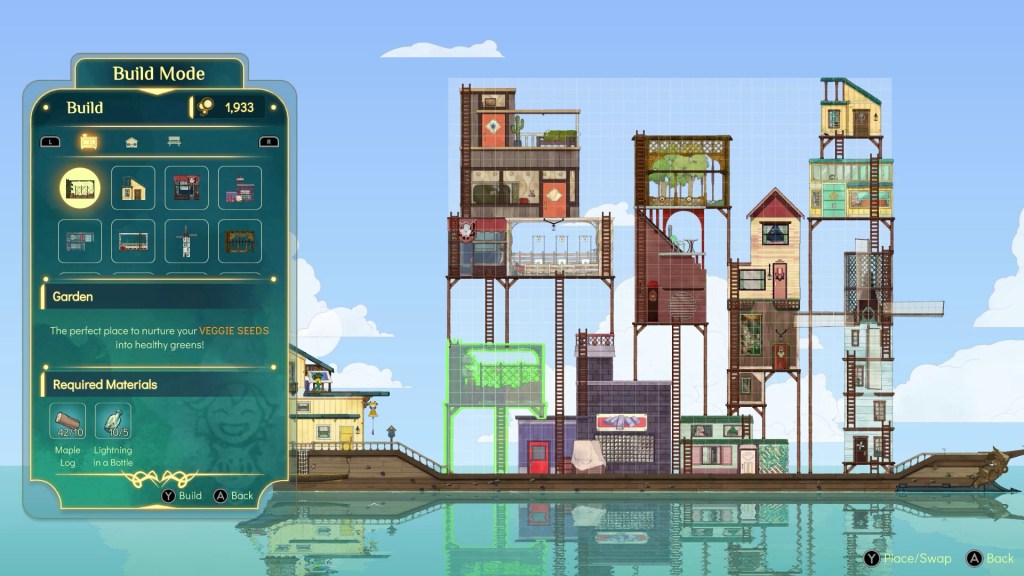
Take for instance the resource management. You need resources like wood, cloth, glass, etc., to construct new buildings. Generally, you collect raw resources while visiting islands and then refine them into materials to build things. To refine resources, you use specific buildings that each have their own mini-game to complete, rewarding bonus materials if you do well in the mini-game. The mini-games are fine at first, but become a complete time-sink as the game progresses. Some of them feel like they are specifically designed to waste your time. Mashing a button to hammer steel or waiting for metal to melt is just not interesting. Not to mention having to tend to crops and feed the chickens and direct the ship to its destination.
A huge opportunity was missed in Spiritfarer, which when I began the game, I thought for sure would be implemented. While spirits inhabit your ship, they have a mood level. You can keep them happy by feeding them food they enjoy, hugging them, or doing certain activities. The spirits are supposed to reward you with things when they are in a good mood. But the rewards are completely meaningless garbage. I’m not going to go out of my way to keep a spirit happy if all I get for it is a single wooden plank every two hours.

It really feels like there was an intention here to have spirits actually do the jobs they enjoy doing. The woodworker should chop logs in the lumber mill, the seamstress should sew fabric, the chef should make food in the kitchen. It’s so bizarre that as the game progresses, you unlock dozens of stations to create materials, but the spirits who obviously enjoy the activities don’t ever interact with them. Instead, the player has to juggle a bunch of time consuming mini-games that get tiresome after the third time you’ve played them.
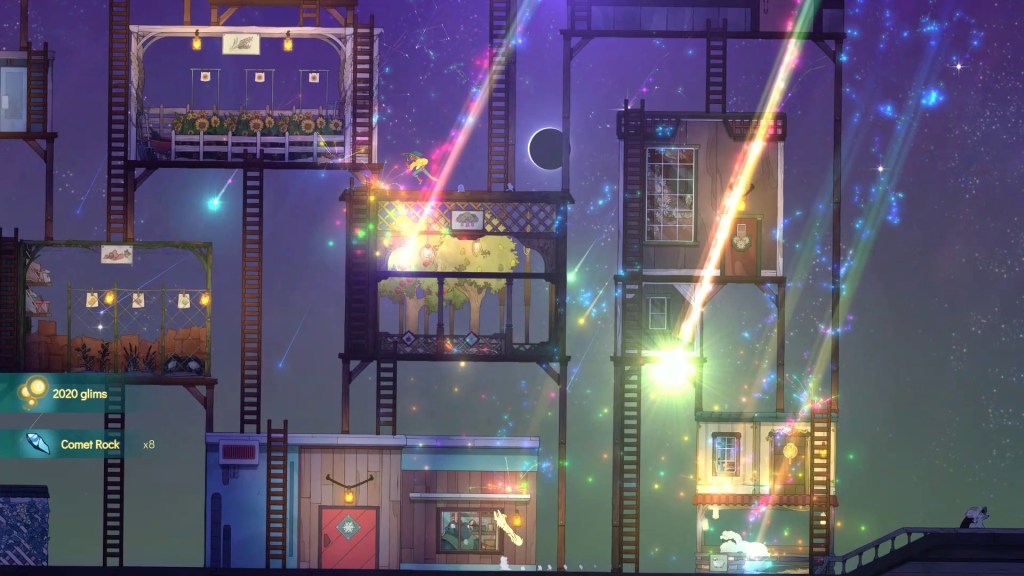
I thought my ship would eventually transform into a self-sustaining colony. I could direct the ship and explore the islands and take care of whatever tasks I need to while the spirits partake in their hobbies and craft resources so long as they were in a good mood. Instead, they just kind of hang around on your ship, asking to be fed and occasionally giving you some lengthy dialogue about nothing in particular. I would have been far more attached to the characters if they actually felt like they were dynamic parts of the journey that assisted me instead of just being annoying chatty statues.

Unfortunately, most of the quests in Spiritfarer are also uninspiring. While I love the idea of helping the lost souls on your ship and fulfilling their final requests, the mechanical execution of quests is just lazy. Sailing back and forth between islands just to collect a single item or talk to another character for one minute is the epitome of fetch quests. Quests that incorporated some platforming or exploration felt far better than the repetitive fetch quests.
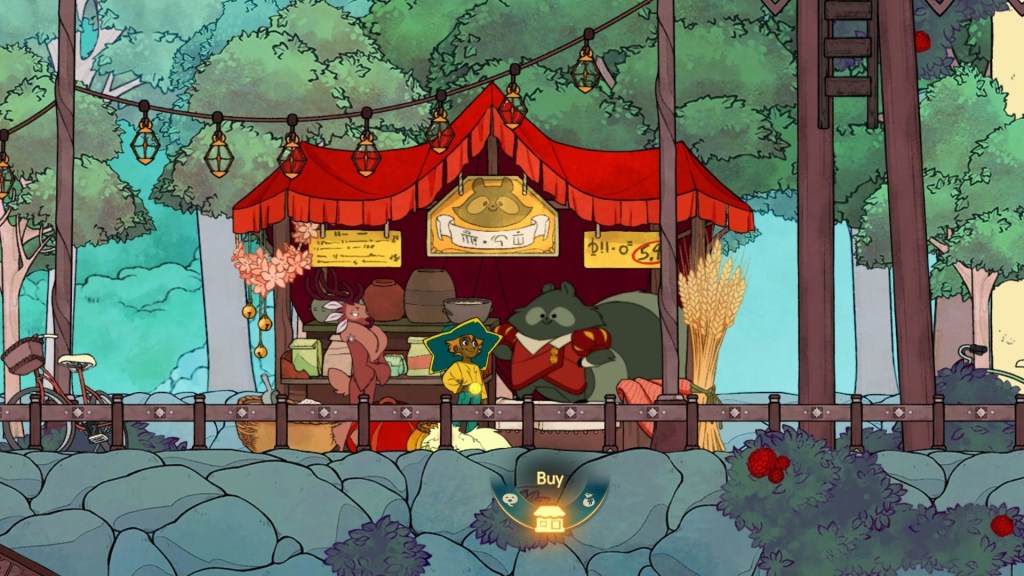
Spiritfarer is an undeniably gorgeous game. The art direction, character designs, and detailed animations are really the star of the game. I loved watching the characters just go about their business, or watching Stella’s cat chase her little ball. Moreover, the concept of sailing and building a community on this supernatural ferry is supremely cozy. This is admittedly what drew me into Spiritfarer, I just wish the gameplay or story did its part to keep my interest.

One of the most common issues that I’ve seen after playing and reflecting upon hundreds of games is that many of them are just too long for their own good. For some reason gamers love to spew nonsense about the amount of “hours per dollar” they get out of a game, leading to bloated experiences. If a movie or an album was eight hours long, it better have an extremely good reason, and even then, it would get lambasted by reviewers and the public. Why do we treat games differently? Honestly, if Spiritfarer was half or even a third of its current length of nearly 30 hours, it would be far more enjoyable. The mini-games and sailing back and forth doesn’t get nearly as repetitive or grating if you don’t have to keep doing it over and over. Spiritfarer simply wears out its welcome far prior to completing the game.
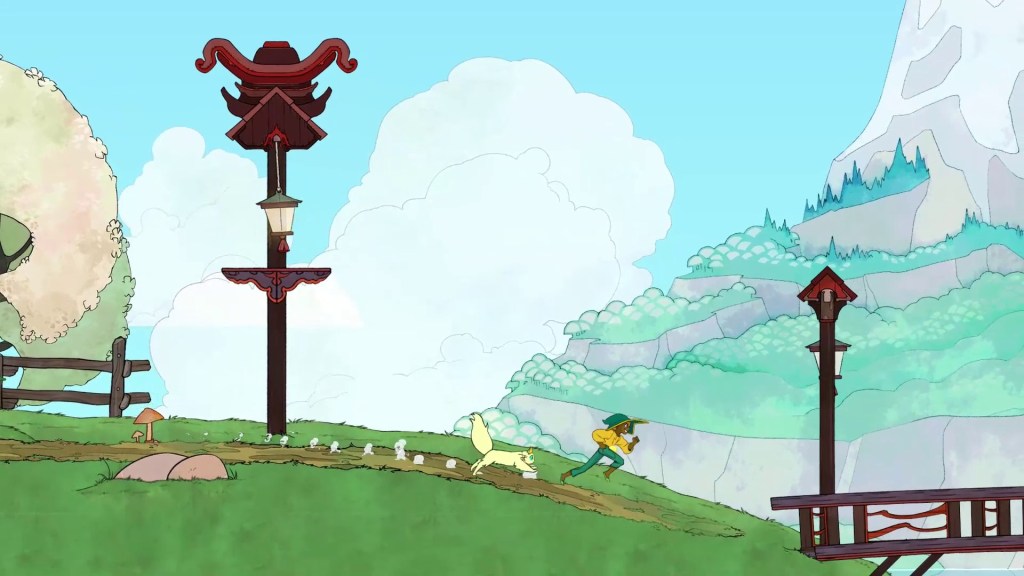
I really wanted to enjoy Spiritfarer. It’s central theme of memento mori and mental health are conveyed in a comforting environment. The game is visually stunning. But the overarching gameplay and story just aren’t enough to keep a fairly lengthy game entertaining for the full duration. It is for these reasons that I give Spiritfarer a 5/10. I seem to be in the minority as most people loved Spiritfarer, and I’m willing to admit that maybe I just have a strong aversion to games like Spiritfarer and Animal Crossing. Clearly a lot of love and care went into the making of Spiritfarer and I wish I could praise and recommend the game. But sadly, Spiritfarer misses some opportunities and is ultimately tedious.
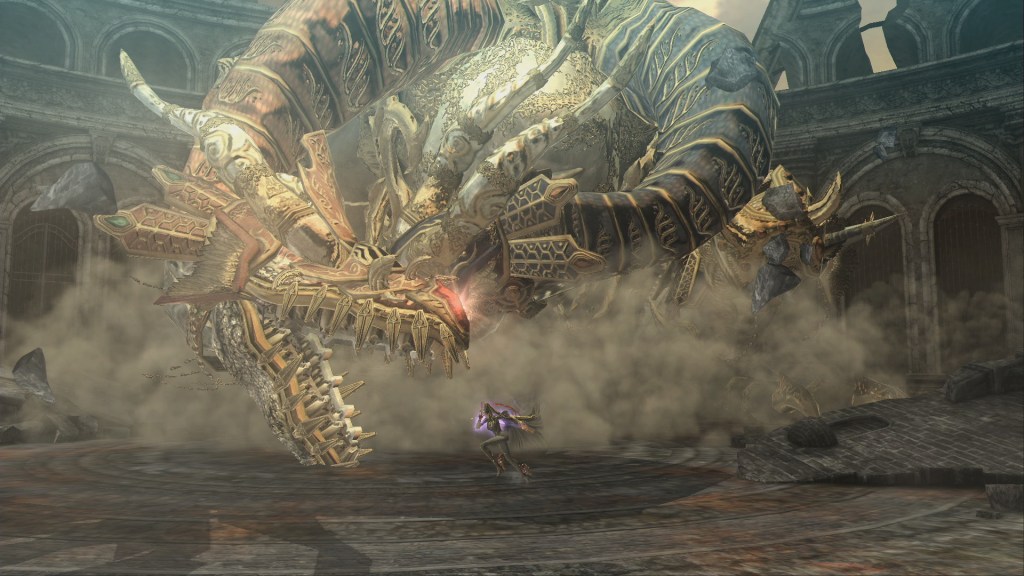
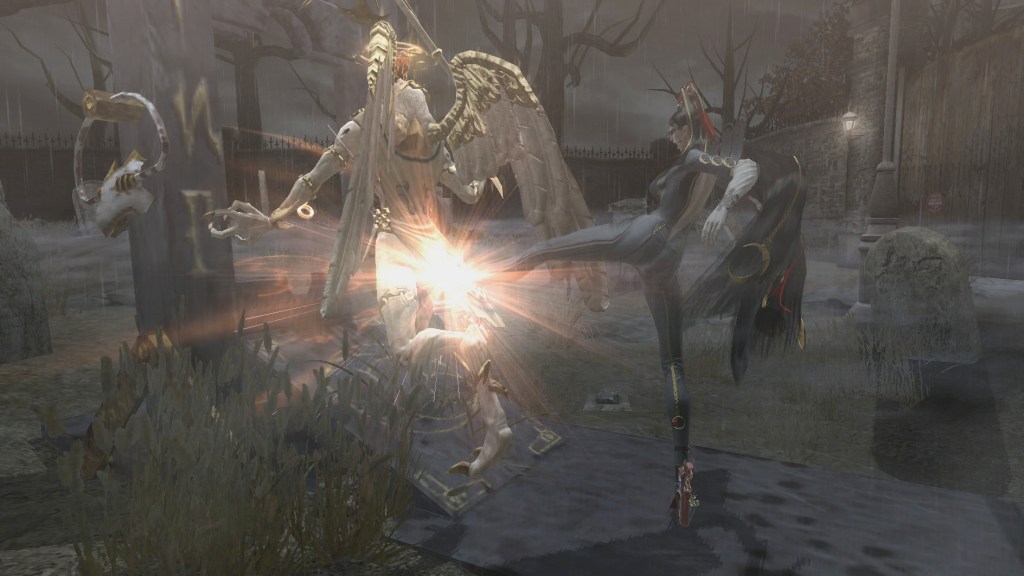
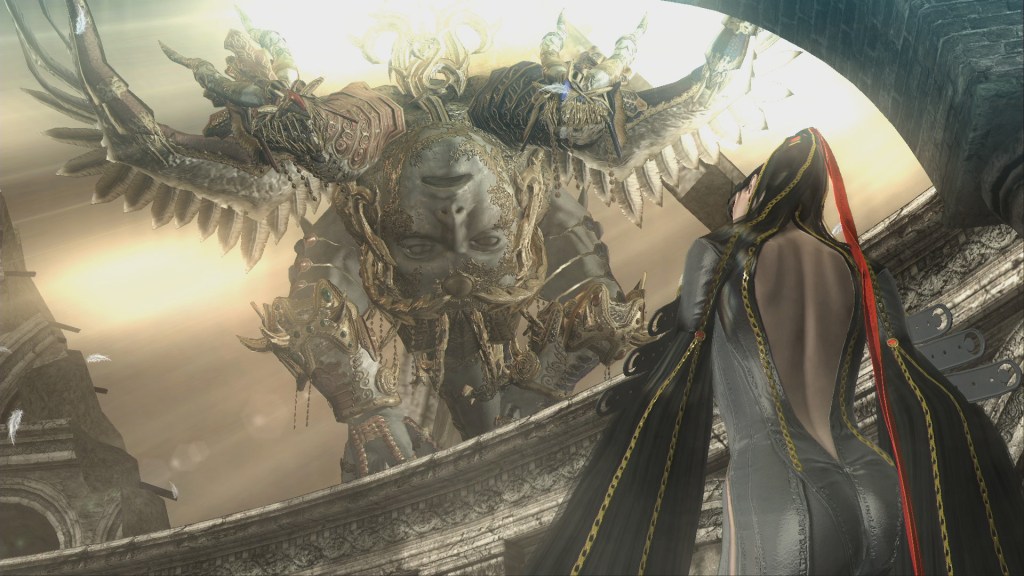
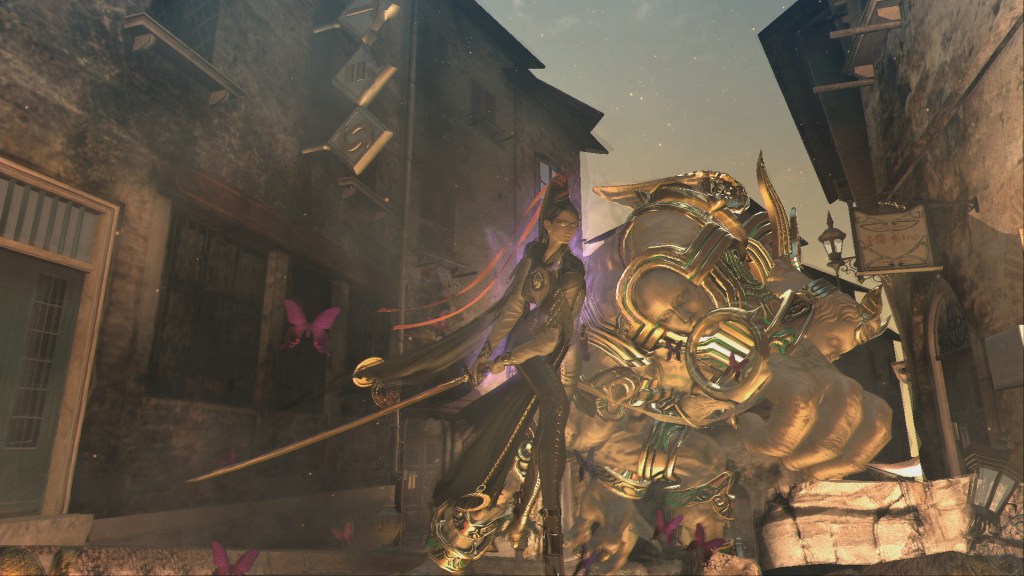
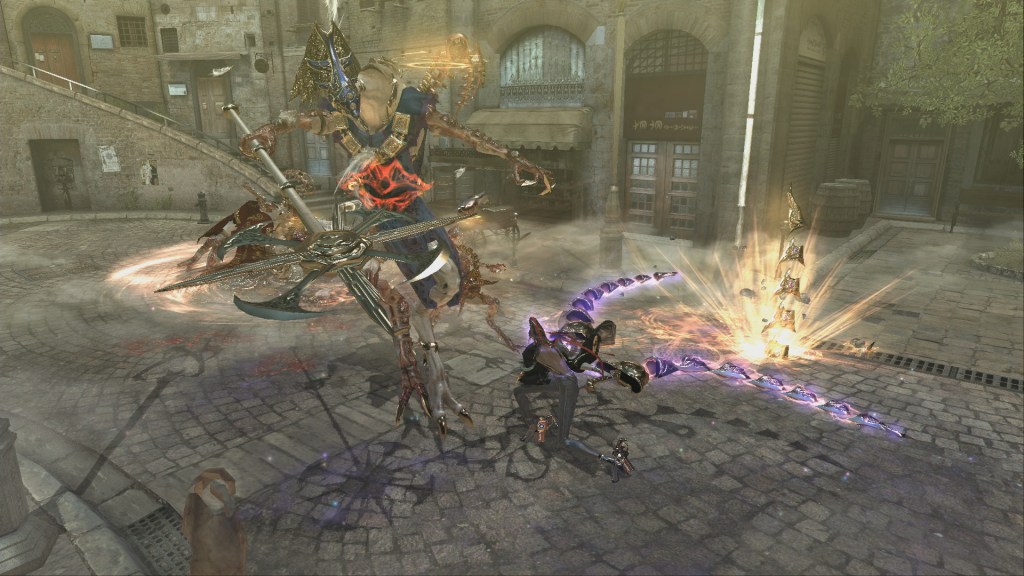
Bayonetta (2009)

I feel the need to preface any review of character action games with the fact that I am not particularly good at these games, and I rarely gain any level of mastery of their systems. I think it’s important to state this because character action games often thrive when you put in the time to really master their systems, so I frequently miss out on deep mechanics. That being said, I believe that Bayonetta is the most approachable character action game that I have played. I enjoyed the Devil May Cry series, but I often felt that I was just scratching the surface of what was possible in those games. But in Bayonetta, I felt much more comfortable executing combos and performing advanced techniques.

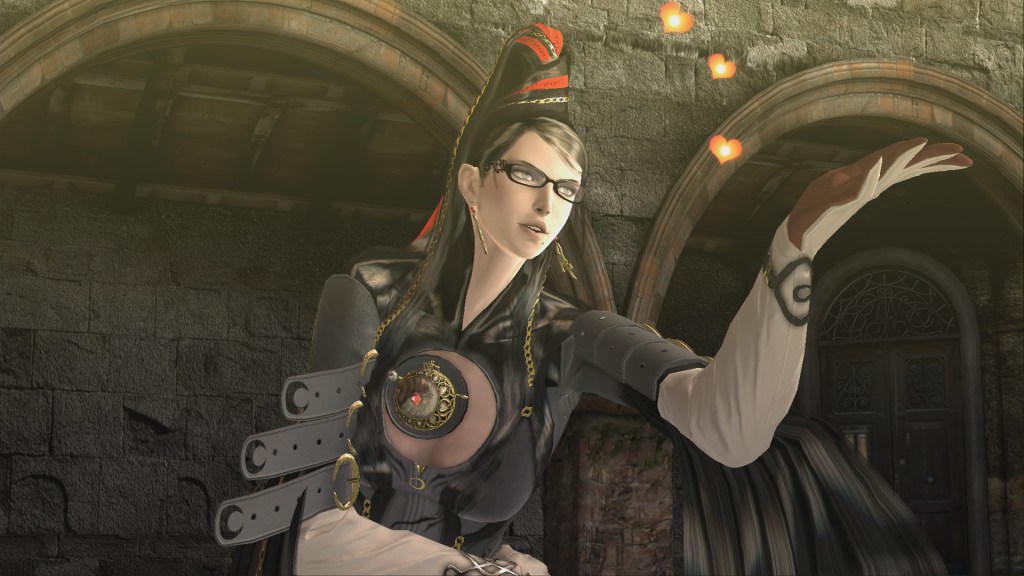
Before diving into the complex combat mechanics of Bayonetta, it should be no surprise that I need to mention the character design. There has been no shortage of controversy surrounding the gratuitously sexualized main character. The game’s director, Hideki Kamiya has made it clear that he wanted Bayonetta to be a sexy character. She has the build of a supermodel, regularly gets into sexy poses, makes plenty of innuendos, and even goes almost fully nude when utilizing her witch powers.

While I’m typically grossed out by hypersexualized characters in video games or television, Bayonetta is not the typical character that serves as eye candy. She’s an undeniable badass who toys with her opponents. She is totally in control of her own sexuality. She has a cheeky personality that pokes fun of her angelic opponents and their puritan values. I think this is fine and even a subversion of a common misogynistic character type. However, I think Bayonetta takes the sexual aspects too far in many places. While she is meant to be a sexual character, there are many sequences and scenes that are clearly meant just to be eye candy for the player. Zooming in on her assets while she sensually dances objectified her rather than empowering her.

While there’s no doubt that Bayonetta is a badass and sexy character, the game’s actual story absurd. Story has never been a central aspect of character actions games, and I can’t fault Bayonetta too hard for its nonsensical story when it is clearly not the focus of the game. But there are a ton of cutscenes, cinematics, and exposition dumps that get in the way of actually interacting with the fun parts of the game. I suppose a nonsensical and over the top story is better than a boring, monotonous one. But I wish Bayonetta was paced more evenly instead of leaving all of the story to the very end of the game.

The real appeal to character action games like Bayonetta is obviously the action. Weaving together complex combos, juggling enemies like they are ragdolls, unleashing powerful attacks, and looking stylish while doing it. While I like to say I’m not good at these kinds of games, Bayonetta felt extremely approachable for players who are inexperienced in the genre. There are a few key traits to Bayonetta that I believe makes it so easy to get into. Those being simplistic combos and the emphasis on dodging.

I’ve always had a really time hard in Devil May Cry games trying to learn all the different combos. You had a single attack button and had to combine directional inputs and correct timings in order to execute combos. Not to mention style switching and changing weapons. Bayonetta has two attack buttons, punch and kick. Hitting these buttons in different orders will result in different combos. Between load screens, you can play around in practice mode and look at the long list of all the possible combinations. Learning a few simple combinations can take the player a long way.

It was much simpler for me to just memorize “punch, kick, punch” then having to learn a bunch of directional inputs and timings. Bayonetta does a fantastic job emphasizing the use of the combos because the final attack of each combo is an extra powerful hit called a Wicked Weave. The player is taught that finishing combos is vital because so much of the power is in the final attack.

Another interesting thing about the combos in Bayonetta is that each individual attack is meant to be held. Bayonetta has guns attached to her hands and feet, and when you execute a punch or kick you can hold down the button to shoot. This does not break combos, and it does a surprising amount of damage. I quite like this feature because it discourages simple button mashing, and instead gives the player some brief moments to think about what they’re doing. I don’t have to frantically hit buttons to pull off combos, and I can take my time and am rewarded for it.

The biggest separator between Bayonetta and Devil May Cry is the emphasis on dodging. Bayonetta has a dedicated dodge button, and it is obvious that it is vitally important. If you dodge right when an enemy attack is about to hit you, you’ll activate Witch Time. This temporarily pauses time, allowing you to unleash some big combos on powerless foes. I love this feature as an inexperienced player as it really allows me to try out some cool attacks. Also, it just feels badass to dodge a hit and the last second and get rewarded with a few seconds of Witch Time.

Dodging in Bayonetta has a slightly more advanced mechanic tied to it called dodge offset. If you execute it properly, you can continue your combo right where you left off. Dodge offset is definitely something that takes some getting used to, but it is a vital trick to learn if you really want to master Bayonetta. Considering that much of your damage is part of the Wicked Weave at the end of a combo, maintaining that combo is important. This is a brilliant addition as it allows players to achieve higher mastery while utilizing and combining the core mechanics of Bayonetta: combos and dodging.

While I did not master Bayonetta myself, I can say there is plenty of complexity for those who do really want to dive deep. A long list of combos and unlockable attacks, dodge offset, a few different weapons to try out, and unlockable accessories. The accessories and magic meter are things that you are unlikely to even tinker with in your first playthrough. Similar to Devil May Cry, you will be graded at the end of each chapter if you want to challenge yourself. There is plenty of content to try, and it will take plenty of times to really master Bayonetta if that is what you are looking for.

While I do think Bayonetta herself and the other characters in the game look superb, unfortunately much of the environment design is pretty drab. Bayonetta is from the era in gaming where everything was dull brown and grey. The set pieces themselves were spectacular, but the environment was just boring. It’s odd because the character and enemy design is fantastic. The enemies all adhere to the angelic theme quite well. Bayonetta is a really well thought out character, and all her animations are fluid and graceful. The game looks really good outside of the dull environments.

Hideki Kamiya is known for his love of old school arcade games, for better or worse. Both Bayonetta and Devil May Cry were inspired by sitting in an arcade and trying to reach a high score on a game you’ve played many times before. But Bayonetta has some strange arcade gimmick levels that just abysmal. There’s one where you ride a motorcycle down a highway and another where you ride atop a rocket. Both of these levels are obviously throwbacks to old arcade games, and both are awkward, break the flow of the game, and just go on for way too long. It’s only two levels but the game really doesn’t have many levels in total, so these levels are particularly painful.

Another frustrating relic is the reliance on Quick Time Events (QTEs). During cutscenes, a button prompt could flash for a half a second and if you miss it, you instantly die. During certain fights, you have to mash a button extremely quickly or you will take significant damage. And when finishing off a boss or using a special Torture Attack you have to mash a specific button. QTEs are rarely a fun feature in games, especially in the case of Bayonetta because they have tight timers. If you don’t know the QTE is coming or what button to press, you can’t possibly react quick enough. It’s not a big deal for veteran players who are seeking high grades as they known when one is coming up, but it often feels like a cheap and unavoidable death for first timers.

Overall, I think Bayonetta is my favorite character action game. While it has its flaws like the annoying gimmicks, poor story, and drab environments, the combat is just too good to be brought down. Beginners can make use of simplistic combos and Witch Time. Advanced players have plenty to master like dodge offset, various weapons, and special accessories. While she is a controversial character who I think is overly sexualized, it’s undeniable that Bayonetta is one of the best designed and memorable characters in gaming. If you like action games, do yourself and favor and give Bayonetta a try.

Cadence of Hyrule (2019)

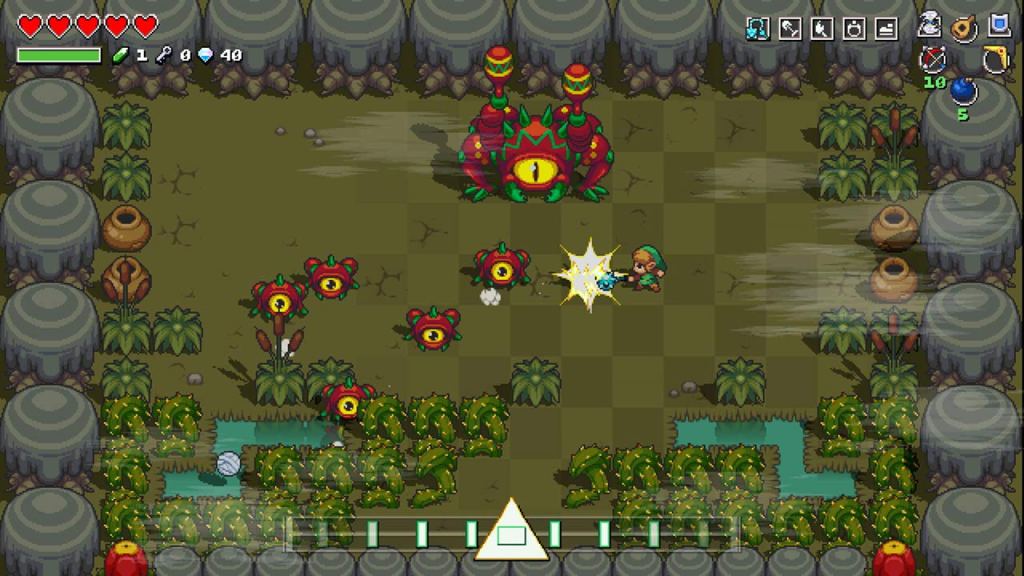
Despite being one of the most prolific and well-known series of all time, The Legend of Zelda has few notable spin-offs. At first glance, it seems odd that a crossover was made with Crypt of the NecroDancer, a rhythm based roguelite game. As a game series known for its carefully crafted adventures, the randomly generated roguelite worlds seems antithetical to what The Legend of Zelda is known for. While I do think Cadence of Hyrule: Crypt of the NecroDancer Featuring The Legend of Zelda has fun combat, the roguelite formula does not lend itself well to the traditional The Legend of Zelda style.

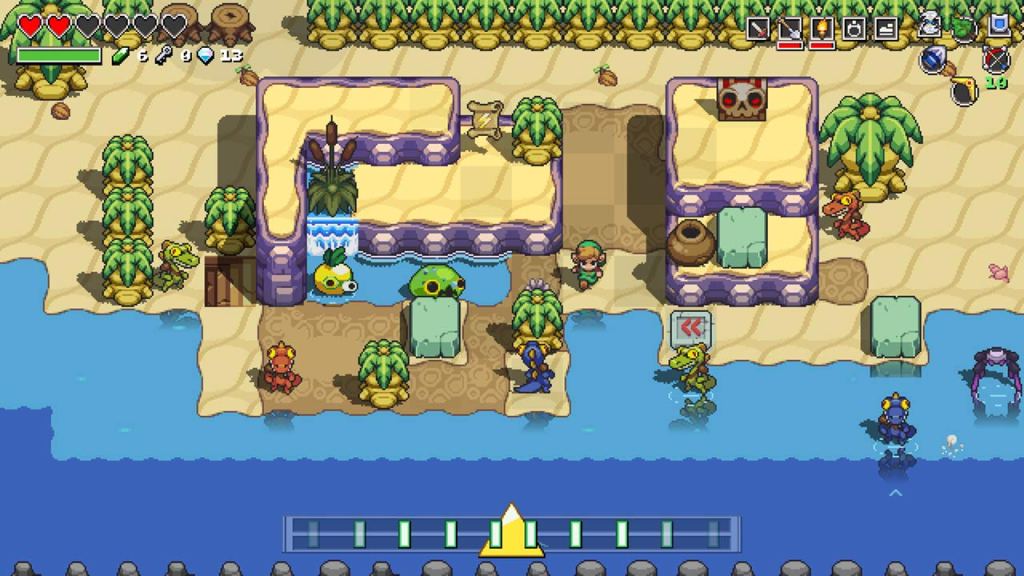
The strongest aspect of Cadence of Hyrule is without a doubt its presentation. The modern version of the classic top-down The Legend of Zelda world and characters is phenomenal. The sprites are clean, the colors are vibrant, and the animations are fluid. Being a game with a heavy emphasis on music, Cadence of Hyrule knocks it out of the park with its remixes. The Legend of Zelda series is brimming with memorable tracks, and Cadence of Hyrule brings them all back with style. It truly is fantastic how identifiable yet fresh all the tunes are, they are top tier remixes.

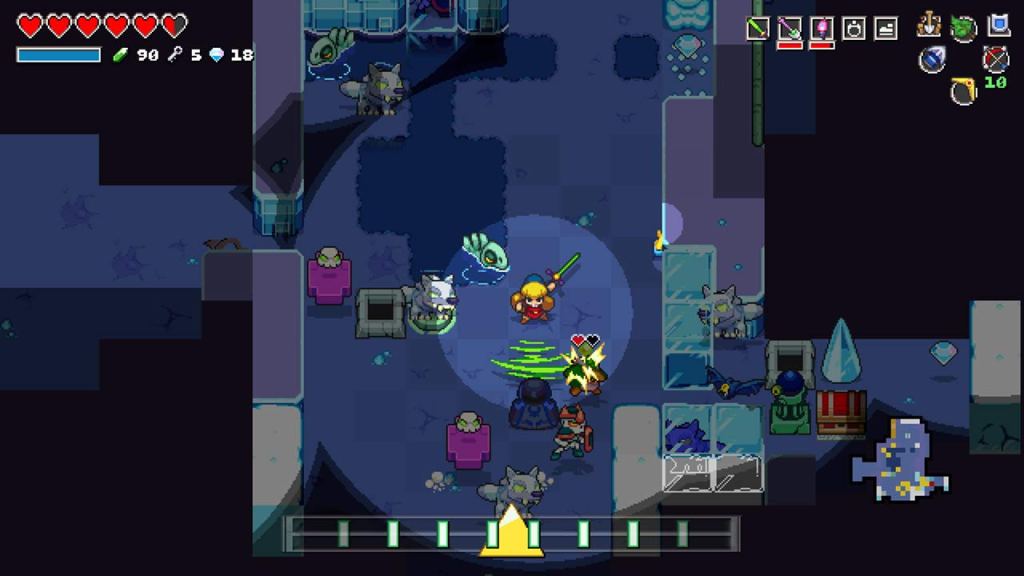
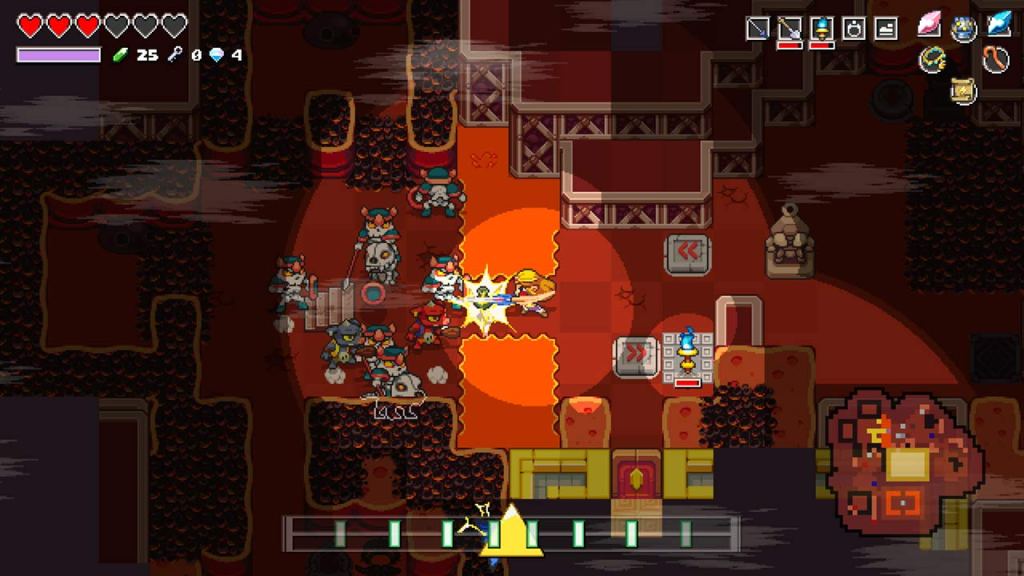
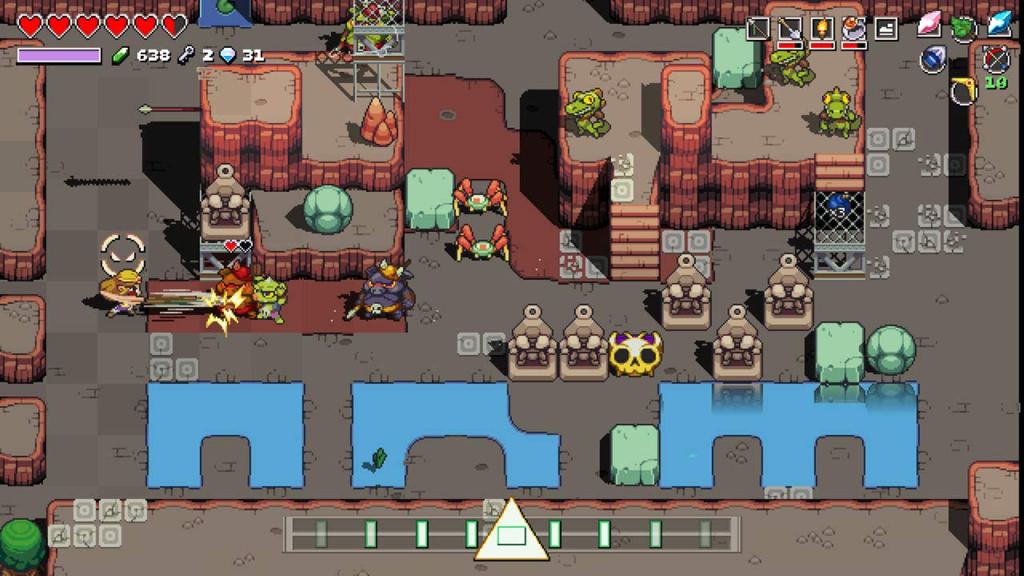
Crypt of the NecroDancer is a unique roguelite dungeon crawler in which you move to the beat. On every beat of the song, you have a small window to move in a direction. Enemies also move in a similar fashion, each with their own patterns. Some only move if you step directly in front of them, some move predictably every couple of beats, and some move erratically. It’s definitely an interesting twist on traditional dungeon crawling. Movement is essentially turn-based, but you have to think quickly and time your inputs to the beat.

It can be remarkably tricky to get a handle on the beat-based movement of Cadence of Hyrule. The majority of my deaths in the game came from the first hour or so while I was figuring out the rhythm and how to maneuver. I was pretty frustrated initially by constantly missing the beat, but eventually it becomes second nature to sync to the rhythm. I appreciate the fact that there was an optional mode to disable the timing-specific beat system. In fixed-beat mode the enemies move only when you move. While I did not personally activate this mode, I think it was an important inclusion given the initial awkwardness of the beat system.

There is a bit of an awkward difficulty curve in Cadence of Hyrule due to this system. Traditionally, games should get progressively more difficult as you keep playing as a way to test your mastery. Unfortunately, I felt that Cadence of Hyrule was the most difficult at the very beginning. The combination of learning how to move and having no health or weapons made for a brutal beginning. As soon as I got a grasp on how to play, got some health upgrades, and got a more powerful weapon the game became pretty easy aside from the very last dungeon. I wish some of the mid and late game content took more mastery, as I was able to steamroll most screens without much regard for strategy.

Despite the uneven difficulty curve, I do think the movement and combat in Cadence of Hyrule is enjoyable. It’s a solid twist on traditional top-down adventure games. Once you get in the rhythm, it becomes natural to strategize on the fly. It’s fun to learn the enemies’ patterns and they best approaches to deal with them. Maneuvering around each battle becomes second-nature, unless you lose the beat. While it’s not a system that fits every game, I think it is fantastic and creative approach. Especially when paired with the glorious soundtrack.  

It’s important to note that Cadence of Hyrule is not a true roguelite, but instead is much closer to being a more traditional adventure game with intermittent checkpoints. While there are some roguelite elements like losing some items upon death and a randomized map, I felt that it was closer to a traditional The Legend of Zelda game than I initially expected. To be honest, I wish they went even farther in ditched the roguelite formula altogether for this spin-off.

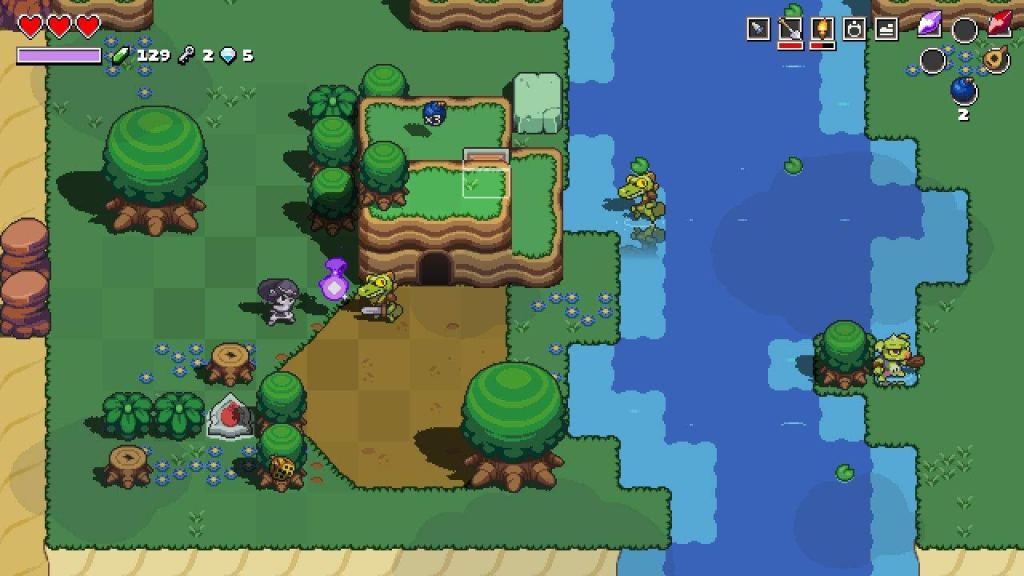
The randomized overworld just does not work well in a The Legend of Zelda game. These games are about exploration and progression. They are carefully crafted adventures that carefully guide the player in where to go, every element is intentionally placed. Unfortunately, I felt that Cadence of Hyrule just felt forgettable outside of a few distinct locations. Most screens are just generic layouts filled with enemies. There are some puzzles and upgrades to be found around the world, but ultimately the sense of adventure is lacking in comparison to the main series.

A key facet of a roguelite is to provide some variation between subsequent runs, to keep things fresh. I had no desire to play Cadence of Hyrule multiple times because I felt there was nothing remotely different after a single run. You will always unlock the same upgrades, weapons, and items. The only difference may be the order. The overworld is randomized between runs, but that really doesn’t accomplish the goal of replayability. It doesn’t really change anything that the desert area is now in the Northwest instead of the Northeast for example. You can improve your score between runs, but really that’s not a compelling reason to be a roguelite as plenty of games have a scoring system.

Truthfully, I believe Cadence of Hyrule would have been more enjoyable if it entirely abandoned its roguelite aspects. If the world was more intentionally designed like a traditional The Legend of Zelda game, it would have been more enjoyable to explore. The roguelite elements add nothing when there are plenty of checkpoints and there are always the same weapons between runs. I can appreciate the rhythm-based movement and combat that comes from Crypt of the NecroDancer, but the other elements just don’t work as well in Cadence of Hyrule.

Overall, Cadence of Hyrule is a fun mash-up that has some flaws as a result of its DNA. While I love the fact that an indie developer got a chance at The Legend of Zelda, and I think they did the series justice, I felt that it was missing the sense of adventure. The presentation is extraordinary, and the combat is fun once you get the hang of it, but to me exploration is key to the series. The randomized world of Cadence of Hyrule made exploration uninteresting and repetitive. It is for these reasons I give Cadence of Hyrule a 6/10. While I enjoyed Cadence of Hyrule, more than anything it made me yearn for a new top-down The Legend of Zelda game in the classic style.

Untitled Goose Game (2019)

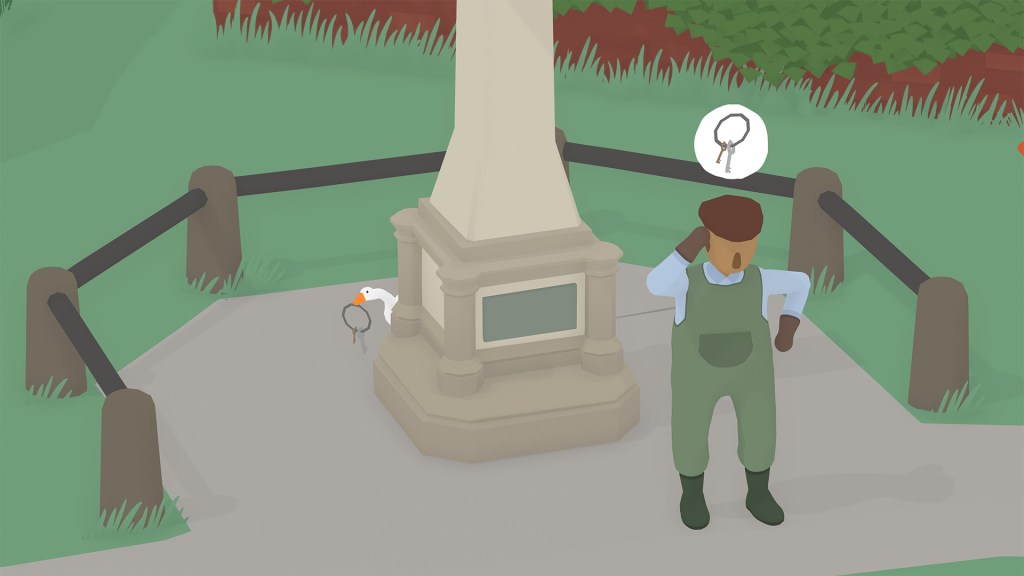
As I’ve grown older, I’ve come to appreciate the condensed, more focused experiences of shorter games. Time is at a premium, and I’d rather a game contain only the very best ideas and executions of its premise rather than be bloated and go on for way too long. Untitled Goose Game is one of the best examples of “short but sweet” in the gaming industry. You play as a horrible goose whose only goal is to annoy and antagonize the residents of a quaint town.

Untitled Goose Game is a rare kind of game. It’s a pure experience, built with a singular purpose of having the player be a goose. There is no bloat. You start the game and are told how to move, grab things, honk, and flap your wings. There’s not a lengthy tutorial explaining how to interact with the NPCs or steal items. There are no dialog sequences or a written story; the story is instead told through the environmental storytelling. I really appreciate it when a game trims the fat and trusts the player to figure things out. It leaves the joy of discovery and problem solving in the player’s hands rather than it being spoon-fed to them.

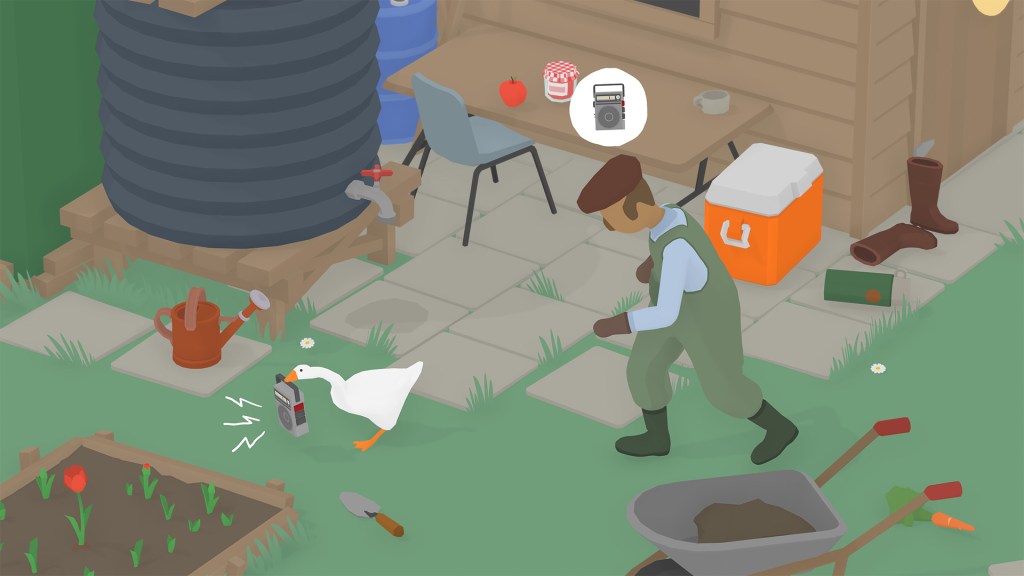
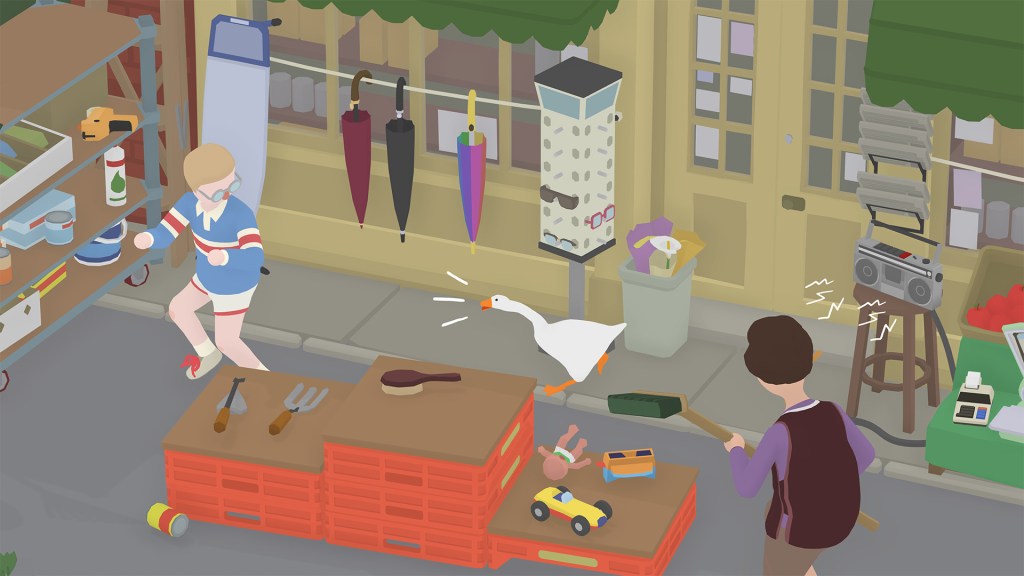
The game consists of a few different areas in the village to play around in. Each area has a list of mayhem inducing tasks, but leaves the player to figure out how they want to accomplish those tasks. From stealing vegetables to have a picnic, to chasing a terrified boy until he hides in a phone booth, to pulling the stool out from an old man trying to sit down, the goose is an arbiter of chaos. At its heart, Untitled Goose Game is a mix of puzzle game and stealth game. It’s up to the player to figure out how to finish their list of disorderly deeds, but usually you have to be somewhat stealthy to prevent the pesky humans from undoing your hard work.

Part of the fun that comes with being a goose is just messing about and being an absolute pain in the ass. While the list of tasks is solid guidance on what to do to progress the game, there is a ton of other fun interactions to engage with. I loved just exploring the tiny town and finding what items I could mess with. It almost feels like a modern Hitman game in the sense that the developers thought of so many different interactions and possibilities in the context of being a goose.

There’s no debating that Untitled Goose Game is short. The main game can be completed in a couple of hours, and while there is some bonus content in the post-game, the meat of Untitled Goose Game can be experience in an afternoon. A common sentiment among gamers is that “hours per dollar” is a valuable metric in judging a game’s worth. This is a garbage way of determining if a game is good. It’s how we end up with 100+ hour games that are filled with repetitive and unnecessary bloat. I’d rather have a short, focused experience than one that drags on for way too long and outlives its entertainment. My most common complaint with many games is that they are too long and up being tedious as you drag towards the finish line. Untitled Goose Game is an absolute delight that is the perfect length for its premise.

Overall, Untitled Goose Game is the perfect game to sit on the couch with your friends or family and just be goofy for a few hours. There’s something genuine and pure about the Untitled Goose Game, it’s just fun. It may not blow anyone’s mind, and it certainly isn’t going to revolutionize the industry, but there’s nothing wrong with just having some plain old fun. It is for these reasons that I give Untitled Goose Game an 8/10. Be a goose, cause some chaos, honk at bystanders, steal what is rightfully yours, and chase children to your hearts content.

Hades (2020)

I always try to be wary about external hype when going into a new game. It can alter your expectations, making you overly critical. Alternatively, hype potentially blinds you from issues if you buy into the narrative too hard. That being said, it was extremely difficult to avoid the talk around Hades. Being the indie darling of 2020, winning a plethora of awards, including multiple Game of the Year awards and even a Hugo Award, made it hard to ignore Hades. I had high expectations going into Hades, and while I believe it is an excellent game, I don’t quite get a lot of the unanimous and unquestioned praise that it has received.

As a roguelite, Hades is all about battling your way through the layers of the underworld to escape to the surface. You play as Zagreus, the son of Hades, who has recently discovered the true identity of his birth mother and that she lives outside of underworld. Every time you die, you are sent right back to the beginning. Don’t fret though, Hades is all about progression, whether or not you succeed in any individual escape attempt.

A large factor in the appeal of Hades is that it is always moving forward. Even when you fail, it’s not painful. Not only do you bring back valuable materials to power up for future runs, but you also get the pleasure of conversing with the gods who reside in the hub. They always have new dialogue, often revealing new story tidbits. They have complex relationships with Zagreus and the other gods, which you get to hear in bite-sized chunks after every run.

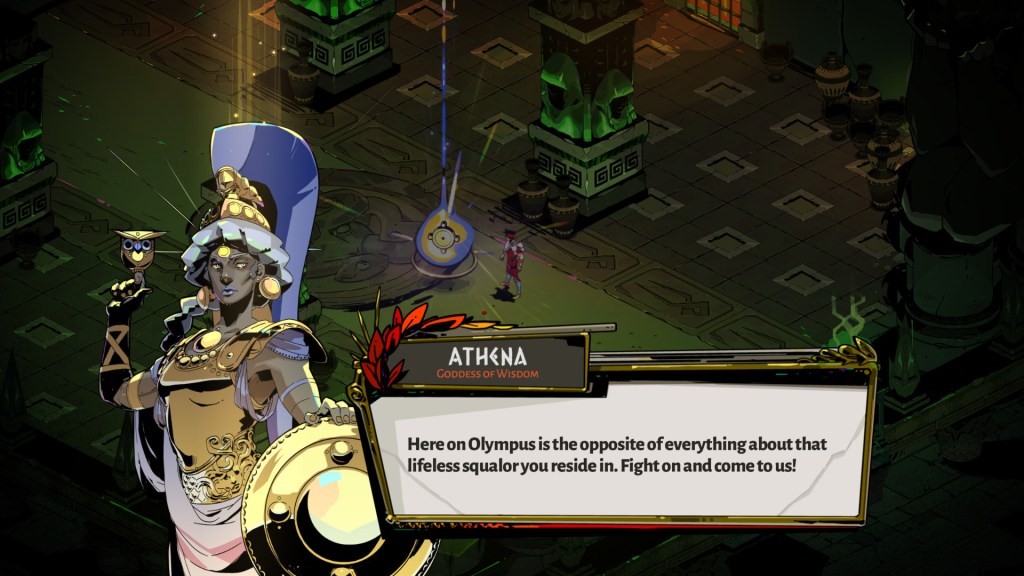
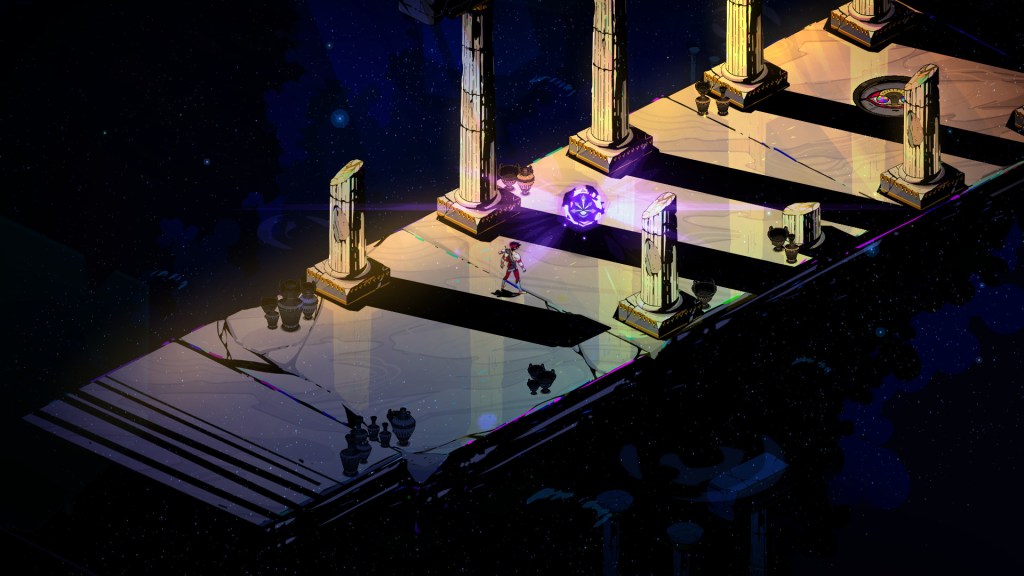
During your escape, you are also offered assistance by the gods of Mt Olympus. As you play the game you will talk to them, furthering your relationships and learning more about them. The quality and sheer quantity of writing here is absurd. In dozens of hours playing the game, I don’t think there was a single repeated line. And the writers did a phenomenal job giving each of the gods a distinct personality. All of the dialogue felt believable, not like the cheesy or over-dramatic dialogue that is more common in video games.
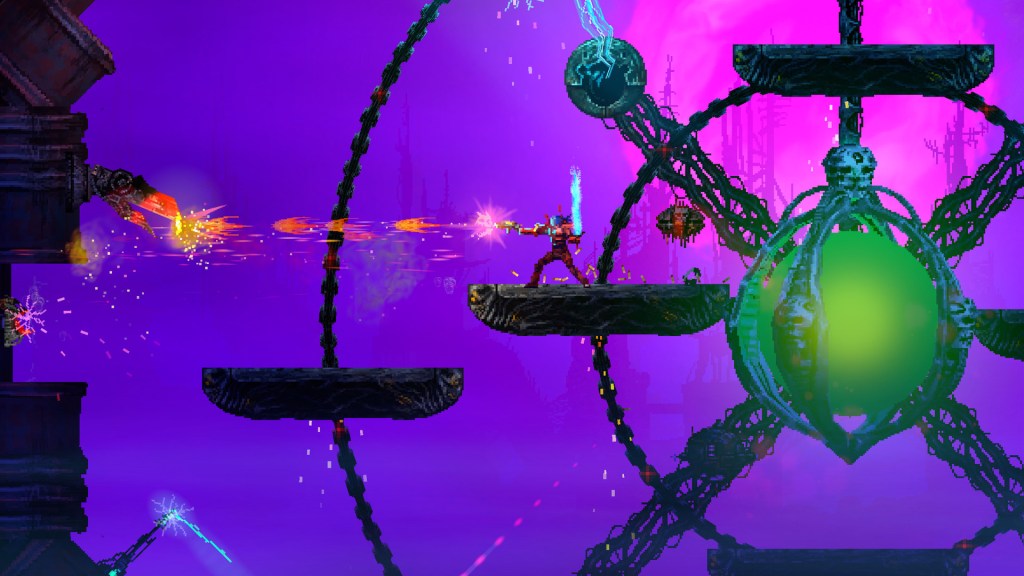
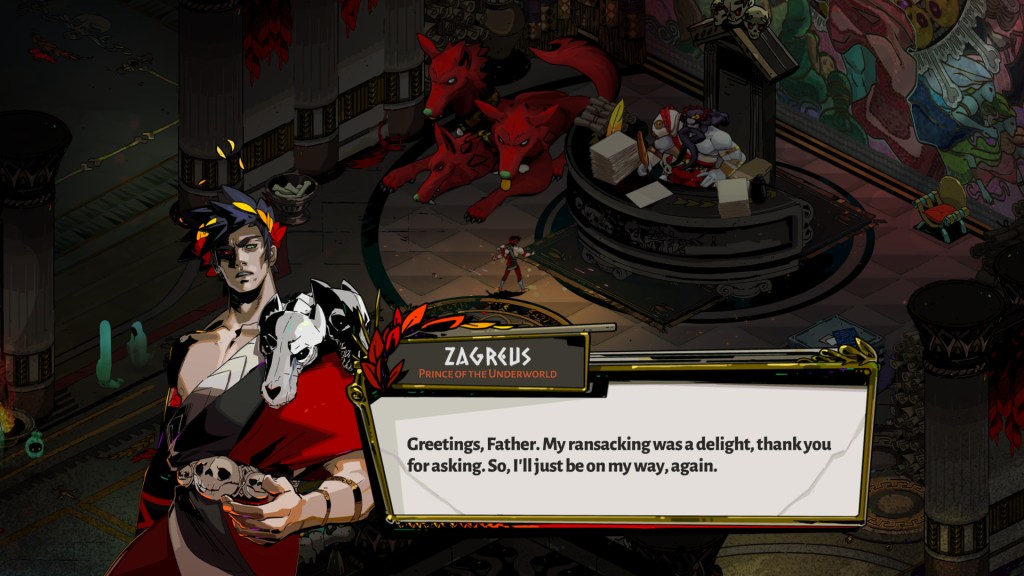
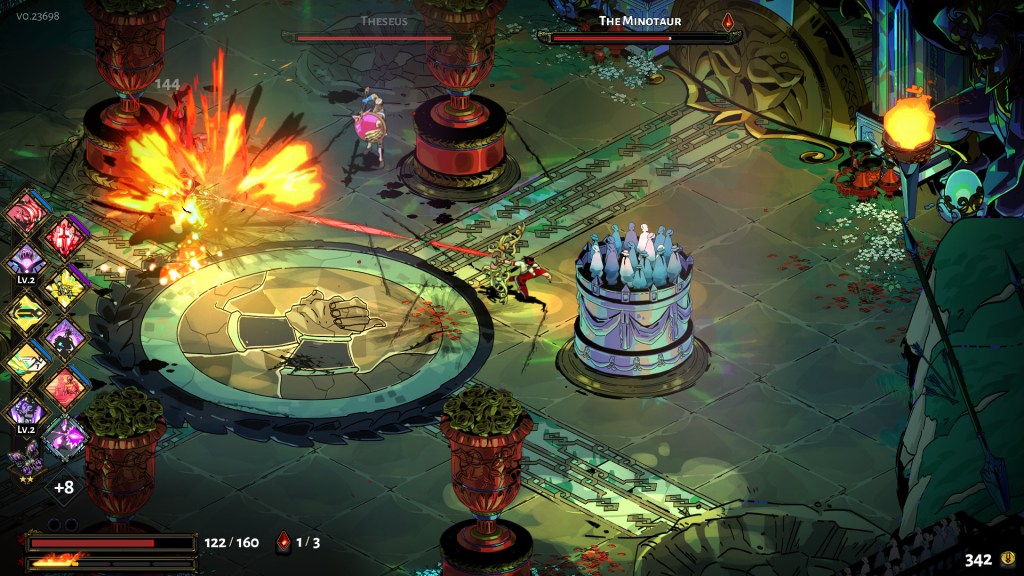
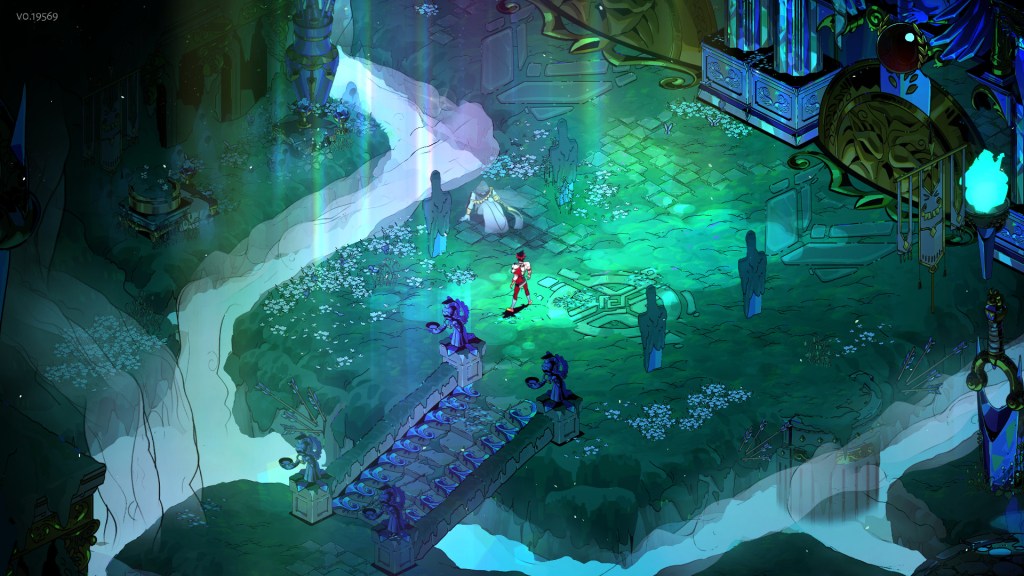
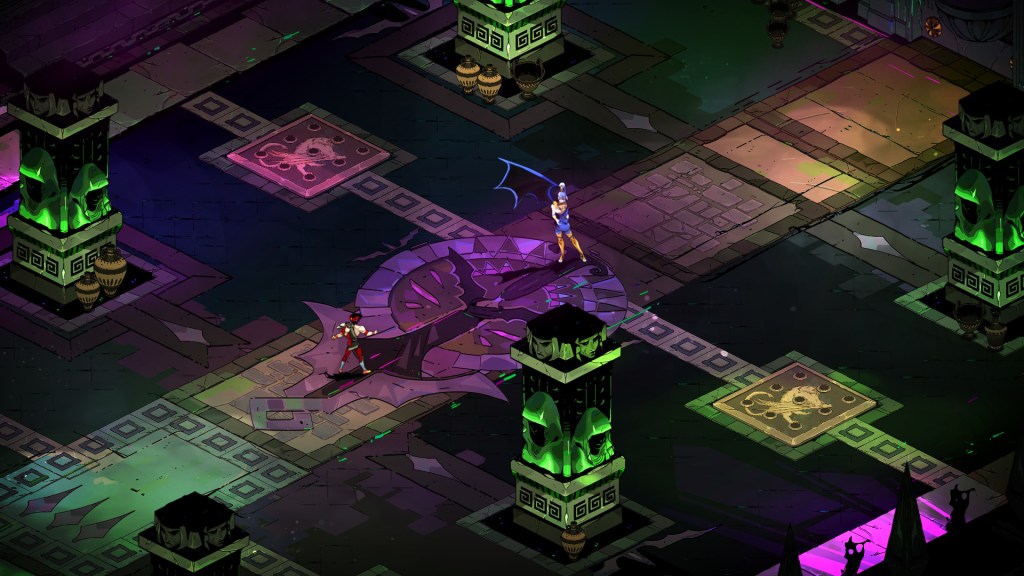
The writing was only further brought to life by the artistry of the game. The voice actors gave tremendous presence and fitting personality to the characters. Hermes is a fast talker, Athena is stoic, Zeus is confident but quick to anger, Demeter is cold, and so on. Every line is excellently delivered. Furthermore, the art style that Supergiant Games is known for is absolutely phenomenal. It brings the mythical gods to life. The aesthetic is downright gorgeous, both in combat and when conversing with the gods.
Your first attempt to escape the underworld will be nigh impossible. With little knowledge of the enemies and obstacles in your way, and a complete lack of any permanent power-ups, you stand nearly no chance. But it won’t be too long before you are on the doorstep of Greece, Hades does a phenomenal job marrying your skill progression with your character progression to create an engaging gameplay loop. As you clear rooms and make it deeper in each run, you earn different currencies to purchase permanent upgrades.

While each upgrade may seem individually weak, they quickly add up to drastically increase your power. The further you make it in each run, the more currency you earn. This creates an engaging loop in which every run you get better at playing the game while also increasing Zagreus’ strength, guaranteeing that you will steadily make more and more progress. If you are skilled at the game you will power up faster, while if you are doing poorly, you may not earn a ton of currency at first. This is genius as it allows the player’s skill to progress in parallel with their upgrades.

I had a blast with Hades while building up to successfully complete my first run. I felt myself getting closer and closer with each attempt. Gaining power and hearing more of the story as I talked to the gods. But after reaching the end for the first time, I felt that the successive runs quickly grew repetitive. There is plenty of variety to be found in Hades, choosing a weapon, the aspect of the weapon, and the randomized boons between runs does greatly increase variety. But still that variety felt stunted in comparison to other games in its genre. Furthermore, the goals after escaping the underworld felt more centered on grinding instead of an ultimate achievement.

I understand that the roguelite genre is all about replayablity. Repetition is baked into the genre, and it is totally understandable that Hades follows suit. But Hades lacks variety between runs to keep things interesting. You always fight through the same four areas with the same four bosses. Thematically it makes sense, but it can get stale without interesting boon combinations. On each run you acquire boons from the gods that act as power-ups for that run. Zeus boons electric enemies, Poseidon knocks enemies around with waves, Artemis gives critical strike, Dionysus poisons enemies with wine, so on and so forth. But ultimately many of the boons just feel like different flavors of the same thing: more damage.

You can get some really interesting combinations of boons that synergize well together, but it felt like most of the time boons are just colorful ways to up your damage. The real variety between runs feels like it comes in the weapon selection. There are six weapons to start the run with, each with multiple unlockable aspects that modify how the weapon behaves. Additionally, on each run you can find two hammers which further transform the weapon. For example, you can find a rapid-fire modifier for the bow, or make the spear bounce between enemies when you throw it. Its these huge modifications in playstyle that opens up interesting variety between runs. But the boons and level designs often do very little to make each run feel distinct.

My other major issue with the grind of Hades is that the ultimate goal is focused on grinding rather than accomplishing something. To truly “beat” the game and see the end credits you need to achieve ten successful escape attempts. To further relationships in the epilogue, you need many more. I prefer a format like Enter the Gungeon in which there are concrete goals like beating a final boss or unlocking a new character. Hades just feels like you are supposed to play it a lot. It gets frustrating when I’ve beaten the game 7 times in a row on progressively higher difficulties but need to do it 3 more times just to see the end credits.

While I do think Hades can be repetitive, I do appreciate its in-depth difficulty system. After your first successful clear, you can choose to increase the “heat” of any subsequent runs. There are dozens of different options to toggle, many of which can drastically change a run. You can add timers to force yourself to move quickly, add more powerful enemies, make traps more dangerous, give bosses more potent move sets, so on and so forth. Every time you play on a new heat level with a given weapon, you will be able to attain rare resources, which encourages the player to keep upping the challenge.

The aspect that I think defines Hades as a roguelite is how it handles the randomization aspect. Games like The Binding of Isaac and Enter the Gungeon can be extremely volatile. In one run you may get extremely powerful combinations of weapons and buffs, and in the next you get absolute garbage that makes it nigh impossible to succeed. Randomization is the lifeblood of roguelites and roguelikes, as few people would want to play the same game over and over with little variety. But conversely, if the game is too random, it can be immensely frustrating to be stuck in a run where you have gotten nothing of value. Hades handles this in an interesting way by allowing to player to choose what bonuses they will be acquiring.

You are almost always given an option between multiple rooms, with the reward of the room being visible before you even enter. That way you can decide which god’s boons will fit your build and choose accordingly. You won’t get stuck getting a mishmash of useless bonuses. Moreover, when choosing a boon from a god you will get a choice between three different boons. There is still some randomization on which gods will be available and which boons they will offer, but the combination of choosing which reward you want and getting a choice of three boon different options minimizes the odds that you get undesirable bonuses.

I am torn on how randomization is handled in Hades. Minimizing the frustration of getting unlucky runs is fantastic, but perhaps Hades leans too far in letting the player choose their benefits. The game can never really have any incredibly powerful unrestricted boons, as the player would choose it every single time. As a result, it’s exceedingly rare to get truly crazy combinations of bonuses that feel game-breakingly powerful. Much of the appeal from playing roguelites comes from wanting to see what overpowered build you can cook up next. In Hades I always felt like I had a powerful build, but nothing overpowered.

An underrated aspect of Hades is how much information it provides on what different things actually do. It clearly and concisely describes which attacks are being enhanced, and exactly what the bonus is. This sounds obvious, but I constantly had to play Enter the Gungeon with a wiki tab open because the game simply does not tell you what the different weapons or their synergies are. I greatly appreciate how Hades gives the player all the information they need to make informed decisions.

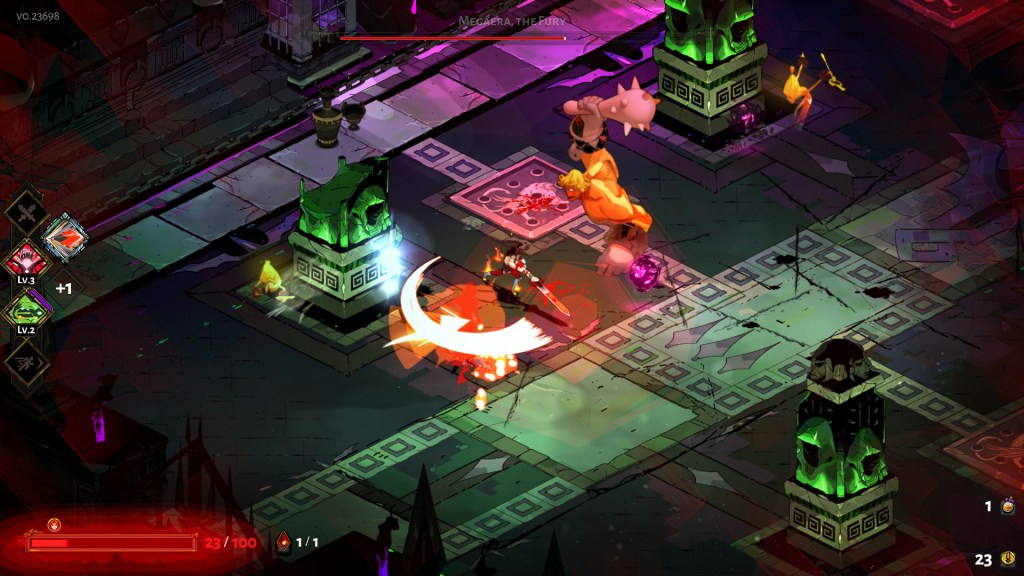
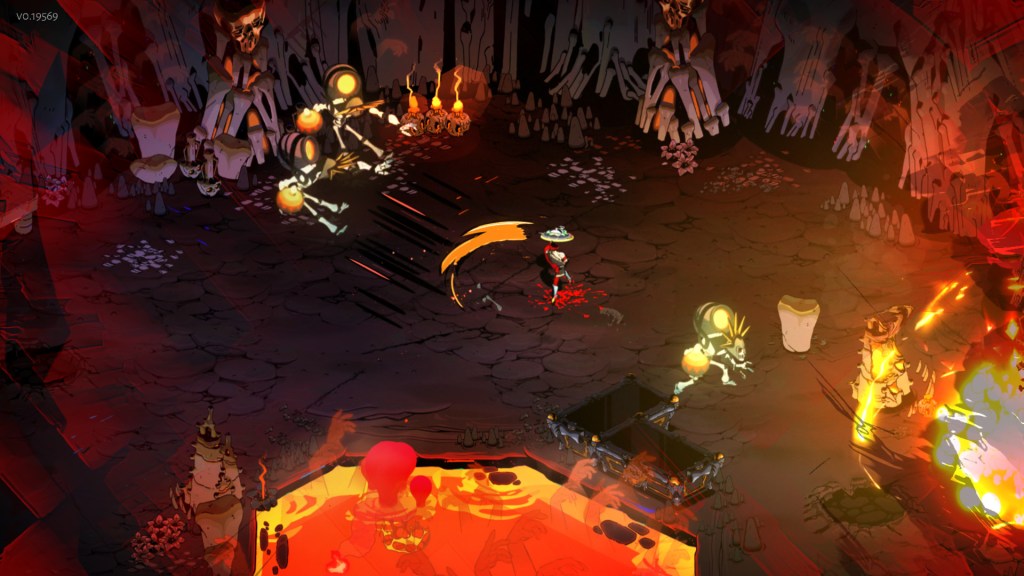
The gameplay as a whole is extremely fun as a simple beat-‘em-up. Hades feels like a modern arcade game, smashing through waves of weak enemies with a limited moveset. There aren’t any crazy combos, and the many of the enemy types are glorified punching bags. It’s fun to unleash hell on mobs, and Hades has great visual and audio feedback. The bosses are where I felt the meat of the challenge was, as you had to be fairly familiar with their movesets in order to avoid damage.

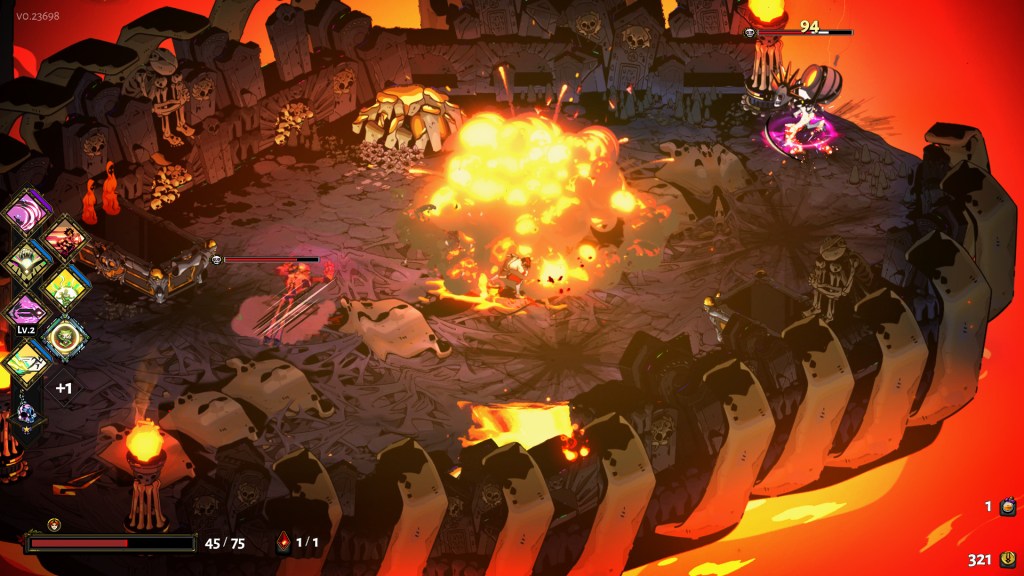
The combat is nothing revolutionary, but it is addictive. I did feel like at times it could be a bit button-mashy. Because of how snappy your controls are, it can be a pretty effective strategy to dash around a bunch and mash the attack button. Enemies that don’t have armor and are not bosses can easily be stun-locked if you just keep hitting them, making spamming attacks very potent. My only other issue is with the visual clarity, as the battlefield can quickly become cluttered with hyper-stylized visual effects. It can often be tricky to read what enemies are doing when there are a dozen different flashy visual effects firing off as you attack. But I ultimately don’t think it’s a huge issue considering that Hades is not a game that demands perfection or precise timing.

Overall, I believe Hades is a different breed of roguelite. With a heavy focus on meta-progression and character development, there is always something to work towards. It abandons some of the genre’s traditional frustrations like the influence of luck and lack of information. Hades was a ton of fun to play until I had a few clears under my belt, which is when I began to miss the truly random builds and combinations that I could acquire in other roguelites. It is for these reasons I give Hades an 8.5/10. It is a spectacularly well-crafted game, but it doesn’t boast the infinite replayabilty of the other games in its genre.

Donkey Kong Country: Tropical Freeze (2014)

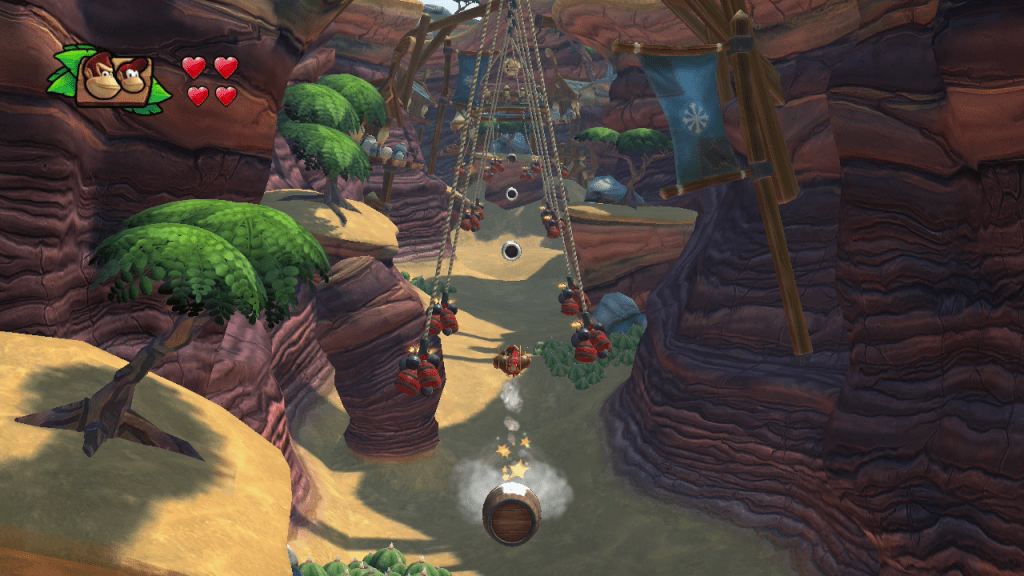
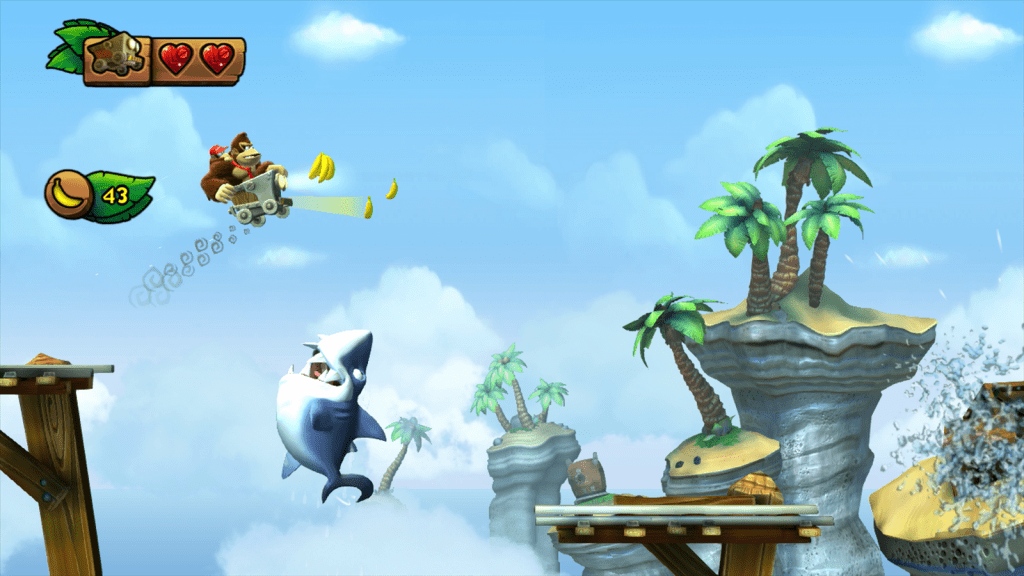
Great old school platformers can be tough to come by in modern gaming. While there are some retro gems out there like Celeste, Shovel Knight, Sonic Mania, and A Hat in Time, it feels like major studios have mostly abandoned the concept of a pure platformer. Sure, plenty of games have platforming aspects to them, but it is rarely the focal feature. When a game like Donkey Kong Country: Tropical Freeze comes along, anybody who is a fan of platformers should stop what they are doing and play it as soon as possible. It’s a fantastic game consisting of imaginative and fun visuals, superb difficulty, and tightly-crafted level design.

As far as Nintendo platformers go, Donkey Kong Country games have always been the most challenging of the bunch. That being said, I was impressed with how approachable Donkey Kong Country: Tropical Freeze was. The first zone of the game was fairly straightforward, and the difficulty of the game slowly ramped up as time progressed. There are tons of powerups that you can buy if you need an extra boost, and if you are really struggling there is a Funky Kong mode available on the Switch port that serves as an easy mode. But what’s more impressive is the numerous hidden aspects that can crank up the difficulty for experienced players looking for a challenge.

In each stage there are hidden puzzle pieces for completitionists to hunt down. While I ignored those for the most part, the more visible “K-O-N-G” letters were my main focus. The letters are easy to spot, but often require a more difficult or risky jump to collect. And if you collect all four letters in every level in a zone you unlock a secret stage. The secret stages are where the meat of the game’s challenge was for me. I found most of the regular levels to be tricky enough that I needed to play well, but not perfectly. The secret stages often required such precision and timing that I felt like I really needed to master them. And if you manage to conquer all the secret stages, you unlock a challenging hidden zone with three more devastatingly difficult levels. And if you succeed in that you unlock Hard Mode.

Of course, you can entirely ignore the puzzle pieces, letters, hidden exits, secret levels, the bonus zone, and Hard Mode entirely. But the fact that all of these things were included as extra little ways to incrementally tune up the difficulty was wonderful. Letting the player pick what is important to them is a great way to introduce some optional difficulty instead of just giving the player five different difficulty modes at the start. But the most impressive thing about Donkey Kong Country: Tropical Freeze was how the level design facilitated multiple styles of play.

A majority of the standard levels in Donkey Kong Country: Tropical Freeze are designed such that you can mostly take your time and think about what you are doing before you make the leap. While there some frantic and exciting sequences requiring you to move quickly, it’s a game that can be taken at whatever pace the player desires. But something interesting happens when you try to go as fast as possible through a level. You realize that everything lines up perfectly. As you bop from one enemy’s head to another to maintain your momentum, the platforms and enemies seem carefully placed to facilitate this level of speed. That’s because they are. While every level seems like a standard platforming stage at first glance, there is a deeper complexity behind the speed running curtain. I was extremely impressed by the level of thought and effort put into every single level in the game.

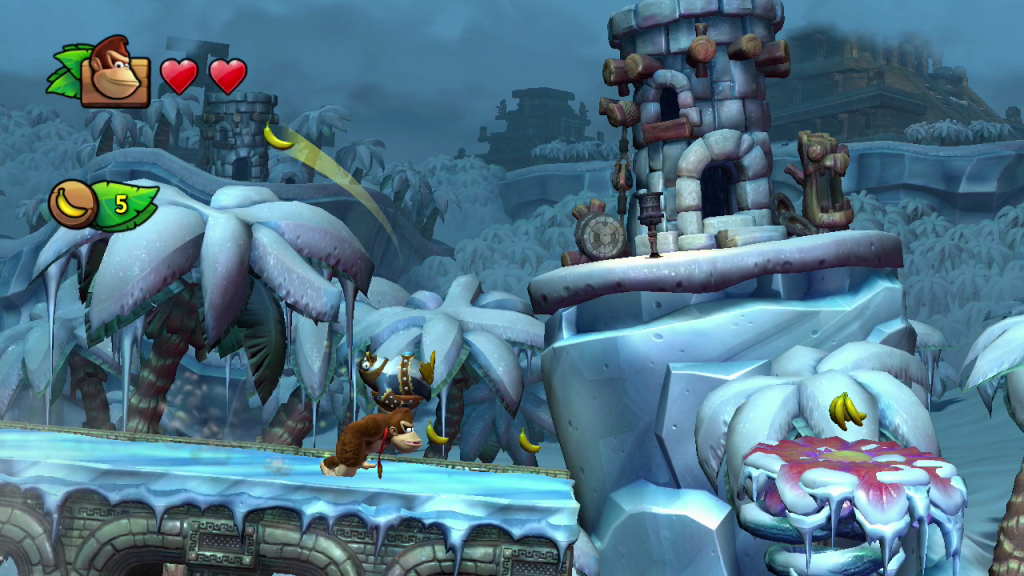
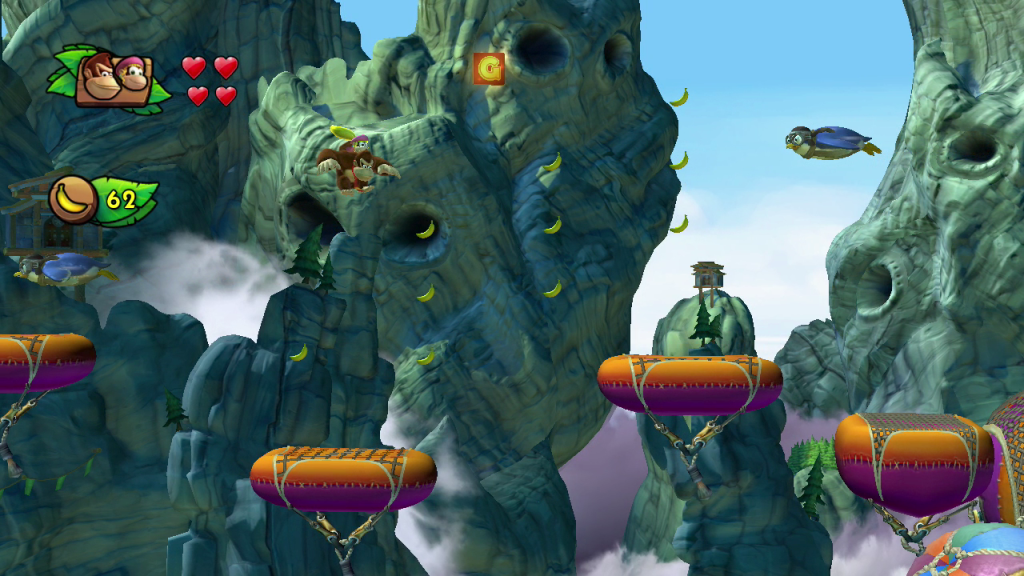
On top of the effort put into the gameplay and flow of each level, there was also a tremendous amount of care put into the visual experience. There are so many fun settings that make it feel like you are running and jumping through an animated movie. Not only is the background a spectacle, but the visuals tie into the gameplay. You can ride a rhino and dodge fireballs as a volcano erupts in the distance, or swing between decorative floats during a Lion King like celebration in the savannah, or jump between platforms as an avalanche sweeps away the platforms below you. There are tons of memorable stages that will go down as some of my favorite platforming levels of all time.

My only complaints with Donkey Kong Country: Tropical Freeze are fairly minor. It could be frustrating to get to the end of a level, notice that there is a secret exit, and realize that you have the wrong power-up to access it. This meant that you would have to restart the entire stage with a certain Kong partner and make it all the way to the end without dying or taking more than 2 hits of damage. I say this is minor because these are completely optional stages, but still, I rarely enjoy having to redo a level through no fault of my own.

Furthermore, I was not a huge fan of the boss fights at the end of each world. They were often pretty long with no checkpoints. They usually had three phases, getting progressively more challenging every three times that you hit them. But I found that the first and second phases were simple, and the final phase was fairly difficult. It could take a few attempts to learn the final phase patterns, and having to go through the entire boring lead-up every time could be a bit boring.

Overall, Donkey Kong Country: Tropical Freeze is an excellent platformer in a world deprived of the genre. It combines imagination, visual spectacle, and exciting gameplay to create a spectacular experience. The level of care put into the level design is astounding. Whether you are someone new to the genre or an experienced platformer player, you can definitely find what you are looking for in Donkey Kong Country: Tropical Freeze.

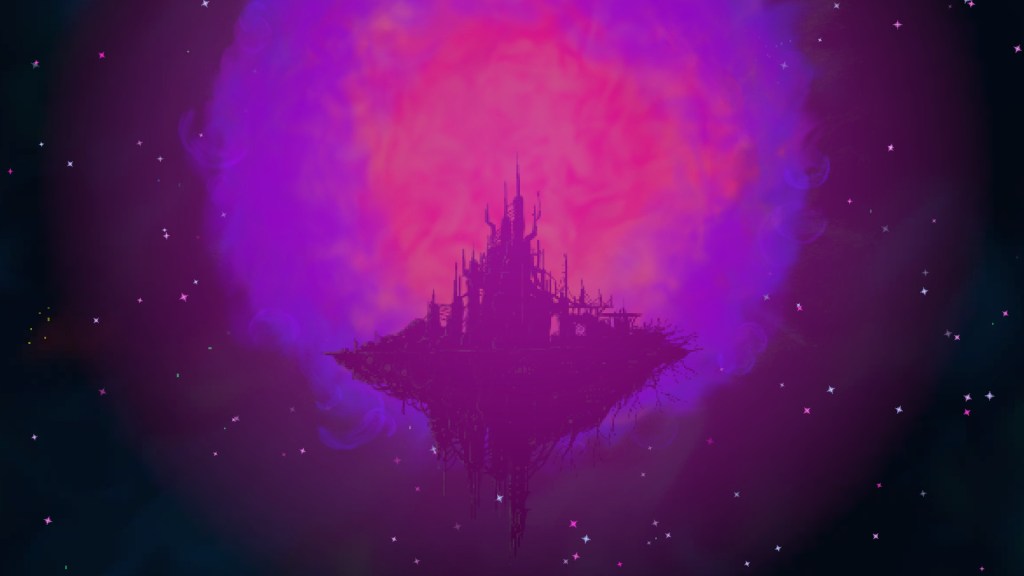
Valfaris (2019)

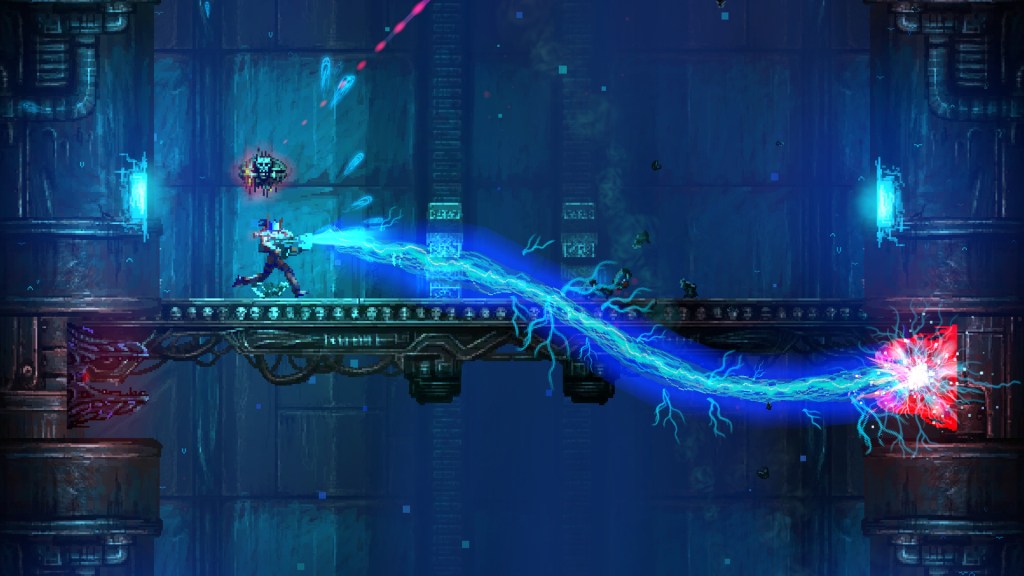
Sometimes you just need to take a break from the massive open world RPGs and the like and dive into some old-school shooters. Valfaris is a modern indie game that was clearly inspired by the past. Its roots stem from the genre of run-and-guns that began with the classic Contra. Initially I was skeptical of Valfaris; I felt like it was nothing more than a stylized throwback without anything to make it standout. But I was wrong, even though Valfaris is from an ancient genre it manages to be unique by virtue of its carefully crafted level design.

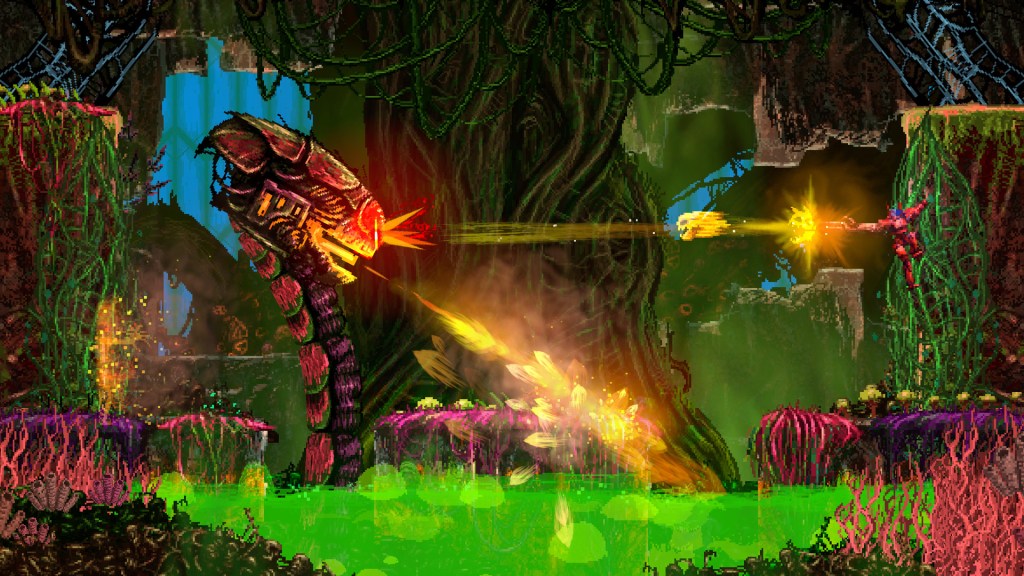
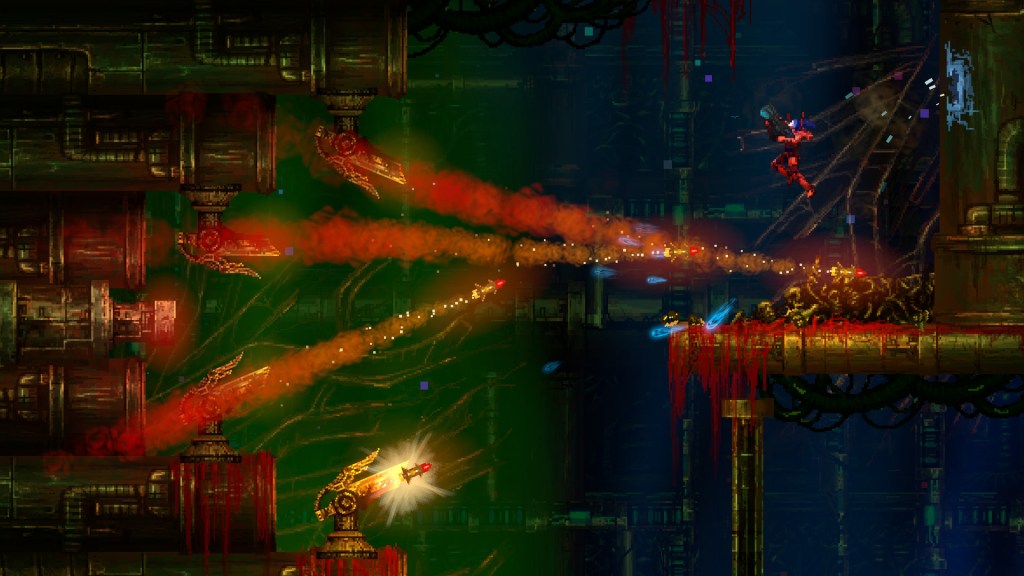
Valfaris is an old-school run-and-gun that plays heavily with the themes of metal. The game reminds me quite a bit of DOOM stylistically, the key difference being that in Valfaris you are obliterating aliens instead of ripping demons apart. The music is appropriately metal, pumping the player’s adrenaline without becoming too hectic or distracting. I will mention that the visual sprites could sometimes be a little messy and hard to read.

I appreciate the game’s commitment to the theme, and individually all of the artwork is great. However, when the environments, backgrounds, enemies, projectiles, and animations are all together sometimes the screen would be difficult to read. This could be a little frustrating in more challenging portions of the game as you may not have even seen the attack or enemy that damaged you.

Where Valfaris shines isn’t in reinventing the genre, but instead it is the tightly designed levels that makes Valfaris enjoyable. Run-and-gun games are historically difficult, and Valfaris is no exception. However, I very rarely felt like the game was being unfair. The time between checkpoints felt perfectly designed. The tension created by weathering a horde of enemies, praying that a safe haven would be right around the corner is exhilarating. The absolute relief when hitting a checkpoint after a challenging section cannot be understated.

Moreover, the enemy design in Valfaris is superb. Most enemies are absolute cannon fodder, letting you shred your way through a level. But there are a few tougher baddies scattered about to up the challenge. Keeping on your toes, making sure none of the weaker grunts damage you while dodging the more elite aliens is a careful balancing act. But the key that makes Valfaris so engaging is that it follows the historical strategy that staying in motion is the best way to avoid damage.

Being aggressive, firing your gun constantly, swinging your sword at nearby enemies, and just moving around is the best defensive tactic. Staying in one place and shooting at enemies as they come is ineffective. They will catch you with stray shots and many enemies spawn from hives that will keep pumping out threats until you destroy their nest. That feeling of rushing in and causing havoc is superb.

Without a doubt my favorite aspect of Valfaris were the bosses. Every single one felt punishingly difficult the first time I encountered them. But fairly quickly I realized how predictable their patterns were and how consistently I could dodge them. I never felt like I got lucky, but instead that I mastered the boss and every one of their attacks. Without a dodge-roll, and your only defensive tool being a shield that saps your energy, running around and positioning yourself correctly becomes all the more important. It’s not a game of reactions, but a game of learning to stay mobile.

Valfaris gives the players an absolute arsenal of weapons to choose from for being a fairly short game. Surprisingly, each weapon is extremely unique and has different use cases. The difference in damage, range, spread-pattern, and special effects make every weapon fun to test out. I believe they are all fairly viable, although some are inevitably more powerful than others. You can equip a single sidearm, a melee weapon which deals high damage and restores energy, and a powerful main weapon that consumes energy when used.

It’s fun to test out different loadouts. But a critique that I have is that the upgrade system hampers the player’s ability to try new weapons. There are limited materials that can be used to upgrade your weapons, so once you start upgrading one it feels like you are committed to that choice. Especially once you get to the later part of the game you probably have a max-level weapon and aren’t going to want to swap it out for a fresh new one. I wish I didn’t feel so constricted when upgrading my weapons so that I could have experimented with some of the interesting choices that the game offers.

An interesting aspect of Valfaris is how it encourages and rewards risk in different ways. The most obvious is with the concept of Resurrection Idols. One of these can be found in every section between checkpoints, and extra ones can be found by diligent explorers. It costs a single Idol to activate a checkpoint. But if you choose not to activate the checkpoint and push forward, you get to keep the Idol. For every extra Idol you hold you gain bonus maximum health and maximum energy. I personally never took the risk and skipped a checkpoint, but it is an interesting risk for more experienced players to choose to gain a permanent bonus.

Moreover, at the end of every level there is a machine in which you can exchange bonus Idols for weapon upgrade materials. Effectively trading max health and energy for more power. The risks surrounding Idols and how to spend them is definitely an appreciated player choice. Another way the game handles risk is by encouraging the player to run around and slash at enemies. Melee attacks generate energy, which can be used for your heavy weapons and shield. So, if you want to play it safe and stay at range with your sidearm you can, but if you want to cause mayhem you need to slice up aliens to power your destructive rocket launchers and such.

Overall, Valfaris is an excellent modern run-and-gun. It’s hard to stand out in a sea of games that all stem from a genre that started 35 years ago. But Valfaris masterfully captures the thrilling side-scrolling action that defines the genre. The best way to describe it is 2D DOOM. Which is a pretty high compliment to give to any shooter. Despite a few minor issues like messy visuals and stunted upgrade paths, I believe Valfaris is an excellent game. It is for these reasons I give Valfaris an 8/10. While not being anything mind-blowingly new or innovative, Valfaris is the essence of run-and-gun.

Minit (2018)

An often-repeated idea in many gaming spaces is a game is only as valuable as how many hours of entertainment it provides. Games that provide dozens or hundreds of hours of content are hyped up, while games that are shorter or have a defined end are seen as a waste of money. I vehemently disagree with this mindset. Extremely long or open-ended games are usually bloated with tons of filler or subpar content. I much prefer shorter games that have a well-defined structure that isn’t beaten to death over the course of 100 hours. An extreme example of bite-sized experience is the indie game Minit.

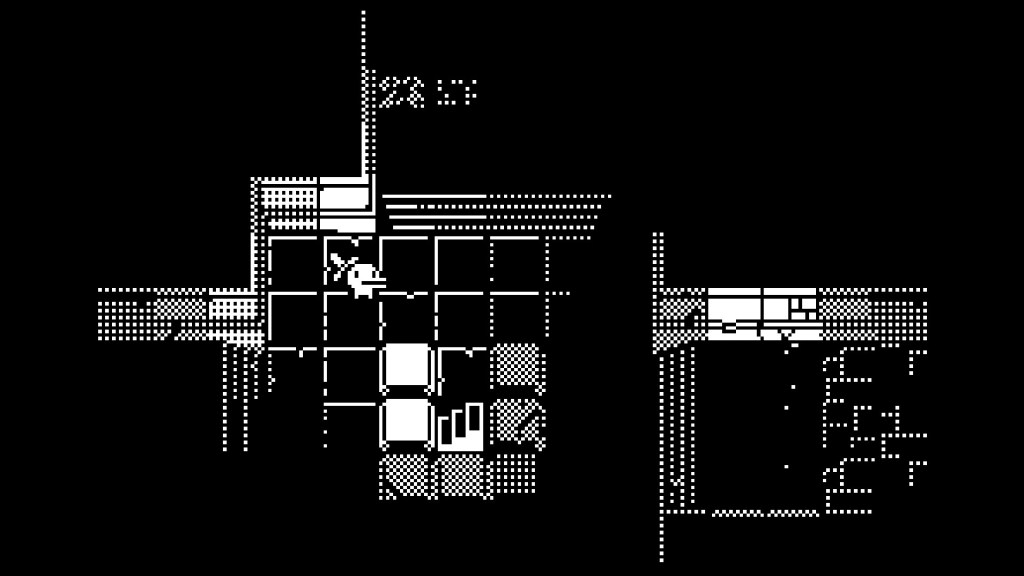
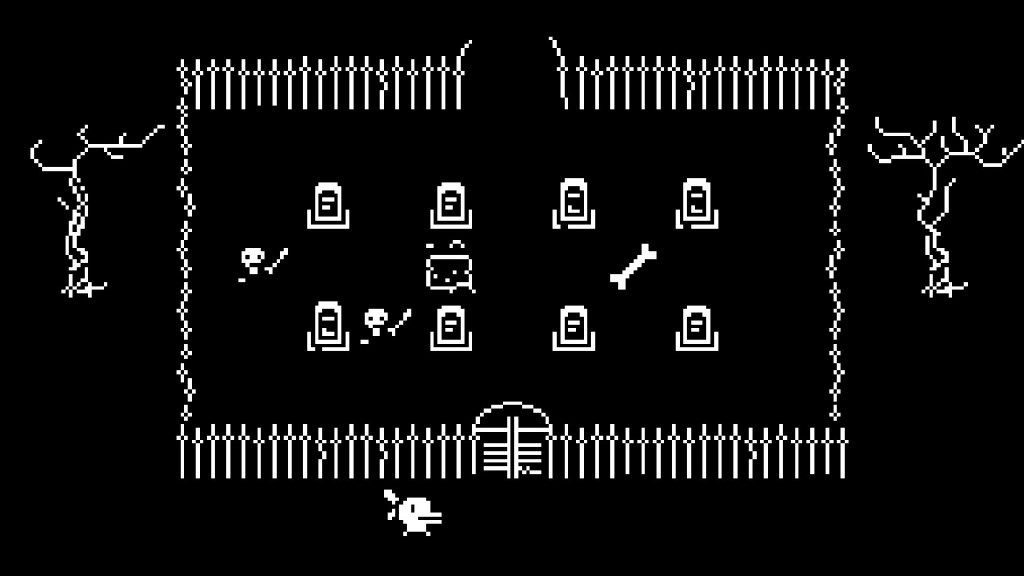
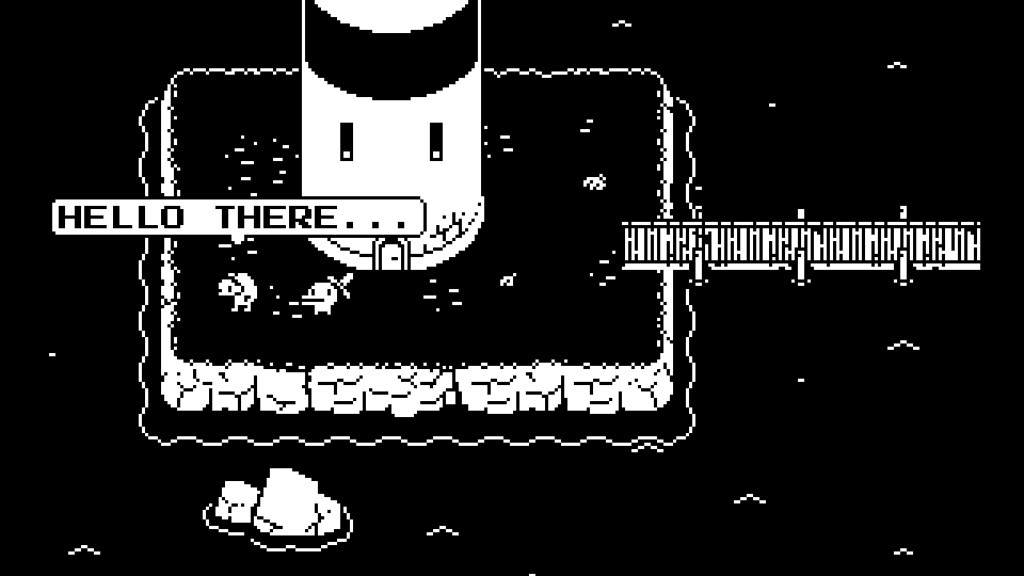
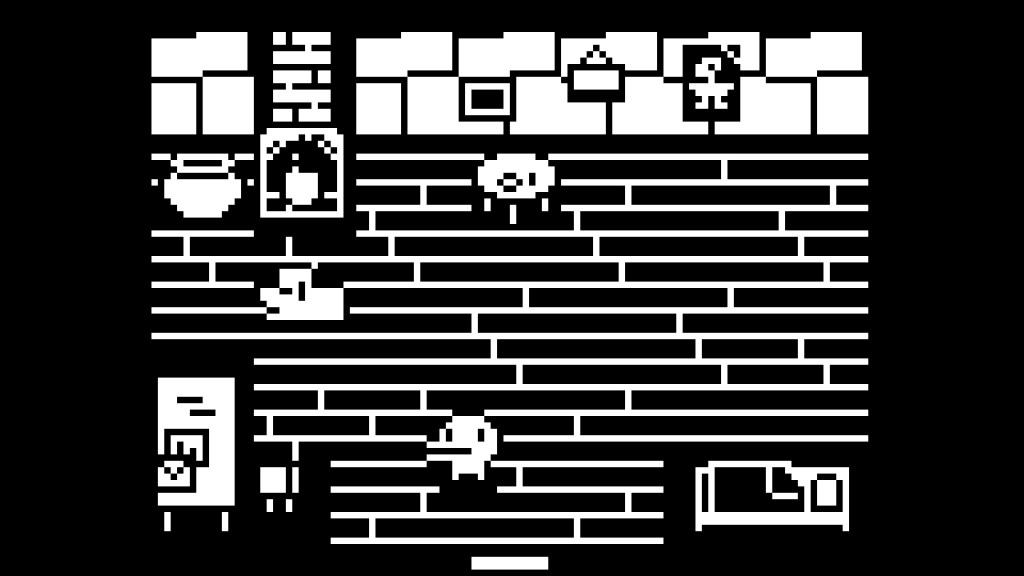
Minit is a top-down adventure game that is clearly inspired by the original The Legend of Zelda games. Like the adventure games of old, you run around the world with sword in hand, solving puzzles and conquering foes. The twist of Minit is that every 60 seconds you die and are reborn at your home base. Every minute is a frantic rush to progress forward in some way, whether it be exploring a foreign area, solving a puzzle, or unlocking a new item.

Dying and respawning every minute causes the player to think about what they want to achieve in such a short time frame. Minit is incredibly tightly designed, I was shocked quickly I could traverse the world. I initially assumed that I would frequently run out of time having achieved nothing in a minute, but the map is so compact and dense that it was always simple to discover something of interest. The interconnected nature of the world allowed for quick navigation. Unlocking new items would allow access to previously inaccessible areas, and exploring these areas often revealed shortcuts to other parts of the map.

One of my main gripes with Minit was that it infrequently actually made use of its timer mechanic outside of just resetting the cycle. I do enjoy the concept of only having a minute in each cycle, as it forced such tight game design and pushes the player to carefully route their path through the world. However, most of the puzzles, exploration, and combat never utilize this mechanic at all.

There are a few clever uses such as interacting with a man who speaks very slowly, so if you want to hear what he says you must reach him early in the cycle. But for the most part the only impact that the minute long cycle has on the game is emoti the player to move quickly and with purpose. Interestingly, you could remove the minute long cycle and the game would still function perfectly well. I do think that it is still a worthwhile addition in how it motivates the player to maneuver through the game.

A common sentiment in many gaming spaces is the idea that games as a product should provide you with a sufficient amount of content to justify their price. I don’t wholeheartedly agree with this line of thinking as it is how we end up with 100-hour slog fests with repeated and tedious content. I much prefer if games deliver a focused experience, only including the very best that the designers had to offer. That being said, Minit is short. Incredibly short. Minit took me a little over an hour to complete. Even if I went hunting for all the hidden collectibles, I doubt it would’ve taken me more that 2 hours to 100% complete the game.

To be honest, I was refreshed with how short Minit was. It definitely did not overstay it’s welcome, which is one of the most pervasive issues that I have with games. But I think Minit is too extreme on the other end of the spectrum. There were definitely more ideas that could have been explored. Especially considering that the game barely scratched the surface when it came to time or cycle-based mechanics.

Overall, Minit is a short but sweet adventure harkening back to the games of yesteryear. I quite enjoyed the use of the minute long cycles and how they influenced the world design, but it felt underused when it came to game mechanics. If anything, Minit is a fun little adventure if you don’t feel like committing to a grandiose globetrotting RPG that spans dozens of hours. But if you are looking for a more comprehensive experience, you may have better luck elsewhere.

Subnautica (2018)

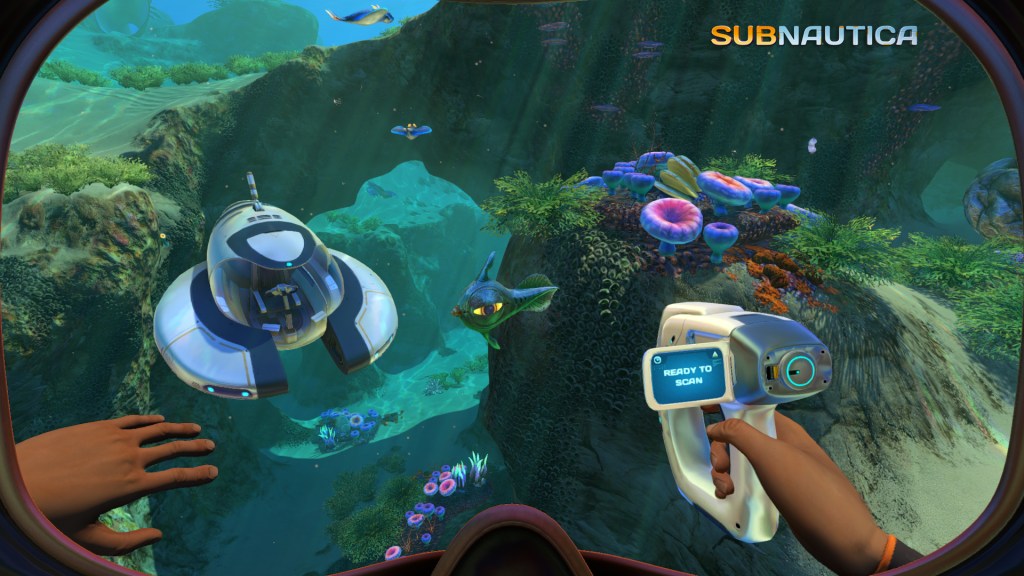
As a genre, survival games can be repetitive and uninspired. Many of them follow the same generic formula of gathering resources, building a base, and making sure you have enough food to survive. Most of these games have no end goal, they just kind of peter out after a while. Despite not being a fan of the genre, Subnautica caught my attention because it was different. The setting, story, and ultimate goal make it a survival game that stands out among its peers. With a higher emphasis on exploration and discovery as opposed to resource collection, Subnautica felt right up my alley.

As the giant spacefaring vessel Aurora plummets towards an unnamed ocean planet, life pods are jettisoned into the open waters with the few survivors of the crash. You begin your journey in one of these life pods. Equipped with some basic survival necessities like a couple days’ worth of food and water, you realize that you are going to need to take a dive into the alien waters to have any chance at survival.

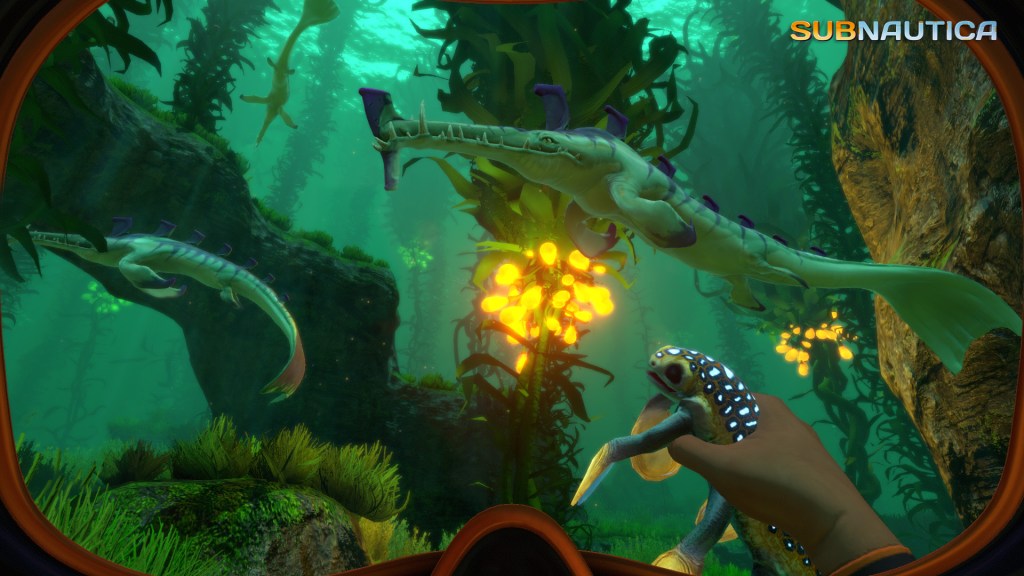
As you dip your toes into the shallow waters around your life pod, you can start collecting resources. Catching fish to be turned into sustainment, and gathering minerals and other natural resources to start crafting new items. In the beginning hours of Subnautica, you cannot stray far from the water’s surface. With limited oxygen you need to frequently swim back to the surface to breathe. To travel farther and dive deeper you are going to need to craft some new equipment.

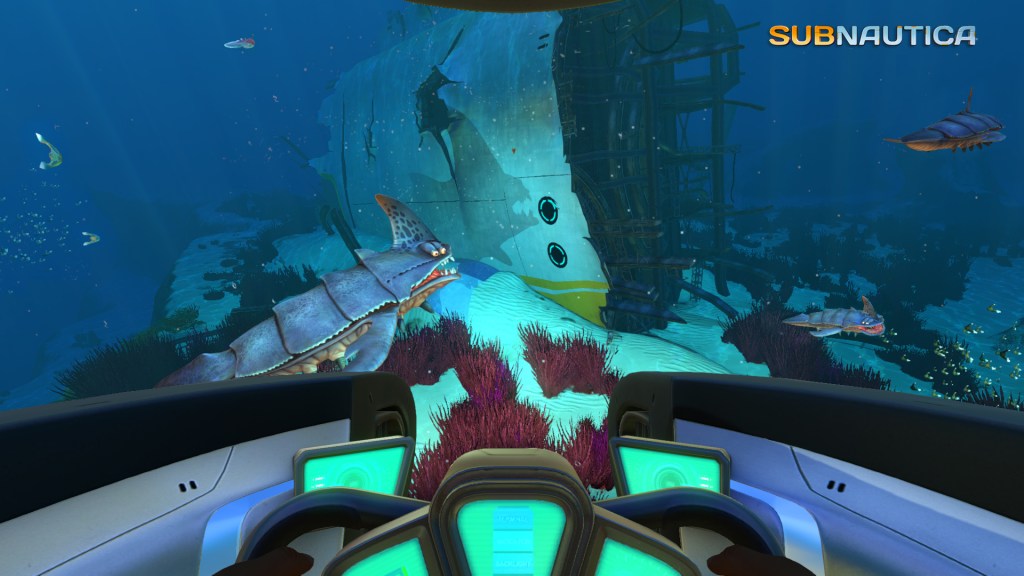
Like any survival game, Subnautica has a rather nebulous tech tree. While there is no defined path of equipment and upgrades that needs to be strictly followed, you will find it hard to progress until you craft the necessary upgrades. For example, to dive deeper you are going to want to get faster swimming fins and an oxygen tank. In the deeper waters you will find resources to craft vehicles that let you dive even deeper. And from there you can discover upgrades that can let you dive even deeper still. There is a defined gameplay loop of collecting resources to build new technology which in turn lets you go deeper to collect new resources that lets you build newer technology.

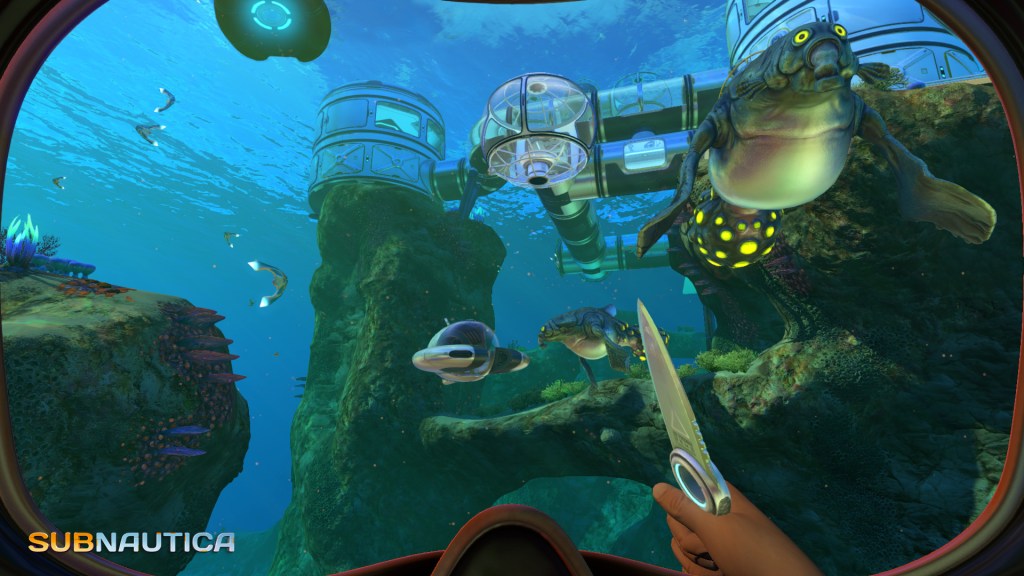
This is all pretty standard for a survival game so far, but Subnautica deviates from its peers in a few ways. The first being that the world is not procedurally generated. The world is predefined, and there is nothing to guide you but your own navigation skills. There is no map that shows you all the biomes, you have to use your compass and some landmarks to remember where you are. Beacons can be placed that make navigation simpler, and the giant crashed ship Aurora serves as an obvious visual anchor of where you are at all times. I liked the decision to leave exploration and discovery to the player’s own ingenuity instead of there being a map that you need to unveil. It cements the fact that you are on an alien planet, with nothing but your own resourcefulness to guide you.

The most important aspect that makes Subnautica stand out is its story. Most survival games are just about surviving, upgrading your gear, and building a base. You just play until you get bored. Subnautica has all those things, but you always have the ultimate goal of leaving the planet. You begin getting messages on your life pod’s radio from other life pods. This brilliantly nudges the player forwards to discover new biomes and technologies. You may be apprehensive at first to stray far from the safe shallow water near your life pod, but you will want to know what happened to the other survivors.

Eventually, your curiosity will be what drives you to delve into the deep, dark, and terrifying ocean. You need to know what happened to the Aurora, and the alien structures that you find will certainly pique your interest. I found that the story of Subnautica was a decent sci-fi tale. It does a phenomenal job at always leaving breadcrumbs for you to discover and make you want to learn more about the world and its secrets. Truthfully, I would’ve quit Subnautica fairly early on if it didn’t appeal to my sense of exploration and discovery.

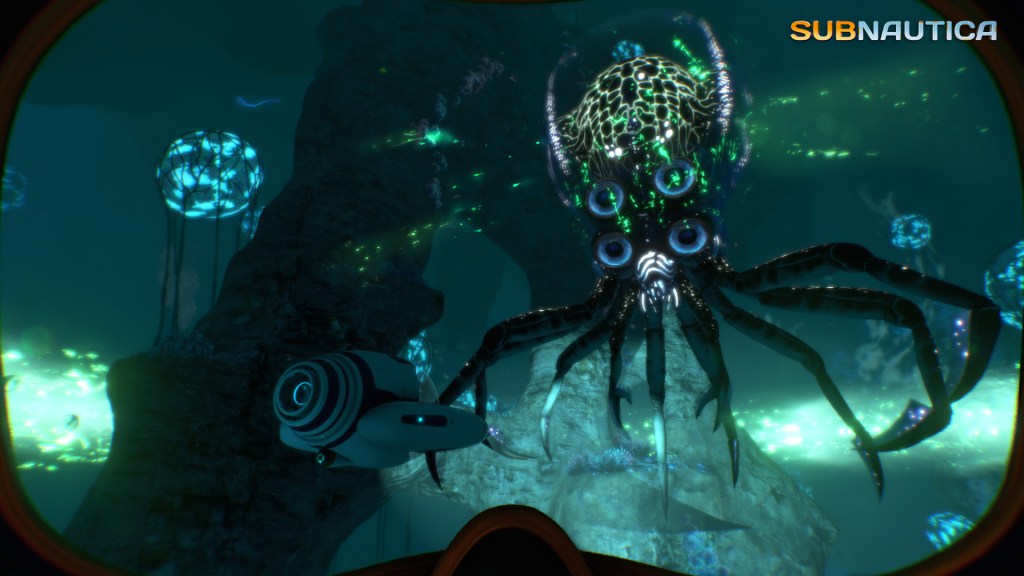
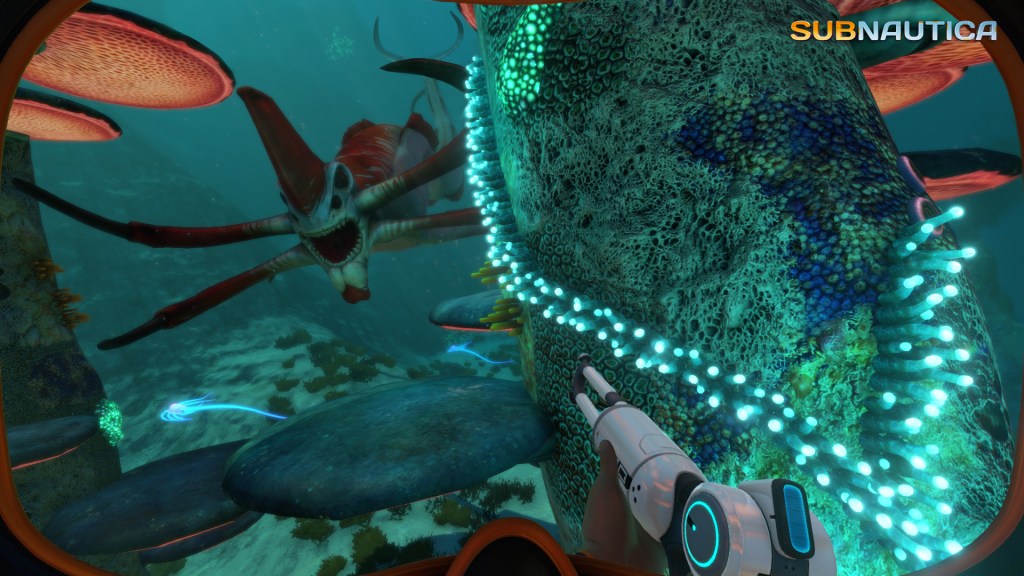
Aside from the story, the other strong aspect of Subnautica is how genuinely terrifying it is. It’s not like a conventional horror game with grotesque monsters. You must contend with the flora and fauna of the world, some of which are hostile, and some of which are gargantuan. But these creatures don’t exist just to chase you down and kill you like something out of Resident Evil, they have habitats that they happily exist in regardless of your interference. There is no point in battling these beasts, you simple avoid them or use tools to inhibit them long enough for you to get away.

The brand of terror in Subnautica is one that exists almost entirely within the player’s mind. Primal fears like the fear of the dark, fear of the ocean, and fear of the unknown are constantly triggered. You cannot see 360 degrees around you, so there is a constant fear that some predator is lurking just behind you. Traversing into dark waters is always terrifying, you never know what is lurking there. There’s a magic to how unsettling and petrifying Subnautica can be despite not being a horror game at all.

Subautica has its fair share of issues, many of which are common for the survival game genre. Since the game has a tech tree and obvious upgrade paths, it can occasionally be frustrating to get stuck with absolutely no idea of how to acquire the next upgrade or what it even is. You need blueprints to build most new pieces of equipment, and finding these blueprints can be like searching for a needle in a haystack.

For example, one of the most obvious objectives the player has is to board the Aurora and scavenge it. But you need a laser cutter to open many of the sealed doors. It took me ages to find the necessary blueprints to build the laser cutter. They are often found in wreckages scattered on the ocean floor, but it is all too easy to glance over the blueprint while scavenging or miss the wreckage all together. This happened to me numerous times throughout the game, and it was immensely frustrating to aimlessly scour the entire ocean for wreckages that may or may not contain the blueprint I needed.

The worst example I can think of was when I had all but completed the game, I still had not unlocked the giant submarine vehicle. I never came across the necessary blueprints. This was doubly aggravating because I needed to build the submarine to finish the final piece of my spaceship. I spent hours exploring every inch of the world for that blueprint, for no reason other than to build a submarine that I didn’t even really need. I already completed the story; I was mere moments away from blasting off the planet forever.

 Additionally, Subnautica also has the classic issue of tedious resource collection that many survival games have. Towards the end of the game in particular the escape rocket requires a ton of resources. All of which the player has likely already collected plenty of times. I guess it serves as a final victory lap as you acquire the copious amounts of titanium and copper necessary to blast off, but by that time in the game I felt like I had already proven my mastery of the ocean.

The most objective flaw of Subnautica is the overwhelming number of technical issues. Although many of the game’s flaws have been getting patched through the years, its hard to ignore how buggy it was on launch and how it still is poorly optimized. The two big issues in particular are the framerate and the draw distance. While the framerate has improved over the years, there are still hiccups. But the more frustrating issue is the draw distance. In a game where exploration is the main mechanic, I should be able to see what is 50 meters in front of me.

This is what leads to the player missing many important wreckages or other landmarks. They swim around a biome, thinking they’ve fully explored it, but some pieces just hadn’t rendered. In many areas of the game, it makes sense that visibility is low. In dark zones or dusty terrain it makes sense to have obscured vision, but in the open ocean I should be able to see more than a few dozen meters in front of me.

Overall, Subnautica is the best survival game that I’ve played. It’s unique setting, sci-fi story, and actual tangible progression makes it more appealing to me than most other survival games. The perhaps unintentional terror and fear that it strikes into the player is something that cannot be forgotten. Nothing gives you chills more than when entering a new biome and you get warned that there are multiple hostile leviathan creature lurking about. All that being said, it still has many of the tedious aspects that plague survival games. It is for these reasons I give Subnautica a 7.5/10. The ocean may seem inhospitable, but I’m sure most people will quickly grow fond of the watery planet that you call home in Subnautica.

Call of Cthulhu (2018)

Reproducing Lovecraft’s unique genre of horror in visual mediums is a challenging task. Lovecraft’s primary theme was that the unknown and unknowable were horrifying. The feeling of existential dread is more powerful when you imagine some terrifying reality, which is why many visual mediums struggle to reproduce that feeling. Call of Cthulhu is obviously inspired by Lovecraft, the question whether it can effectively replicate the cosmic horror that he was so keen on.

The premise of Call of Cthulhu is that you are a drunken investigator who has trouble getting a case. When approached by a wealthy man, you cannot deny their request to look into the death of his daughter, Sarah Hawkins. She, along with her husband and child, died in a house fire that was deemed an accident. Sarah’s father seems to believe there was more to the story, and he cites that there is a strange nature surrounding Sarah. As an artist she primarily painted deeply unsettling pieces, and her father believes that her disturbing art has a connection to her death.

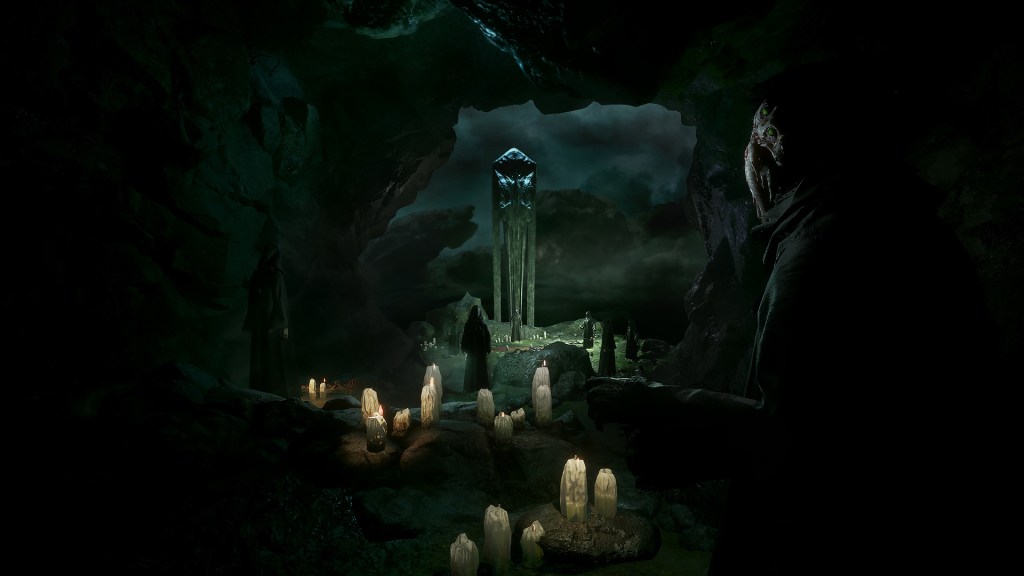
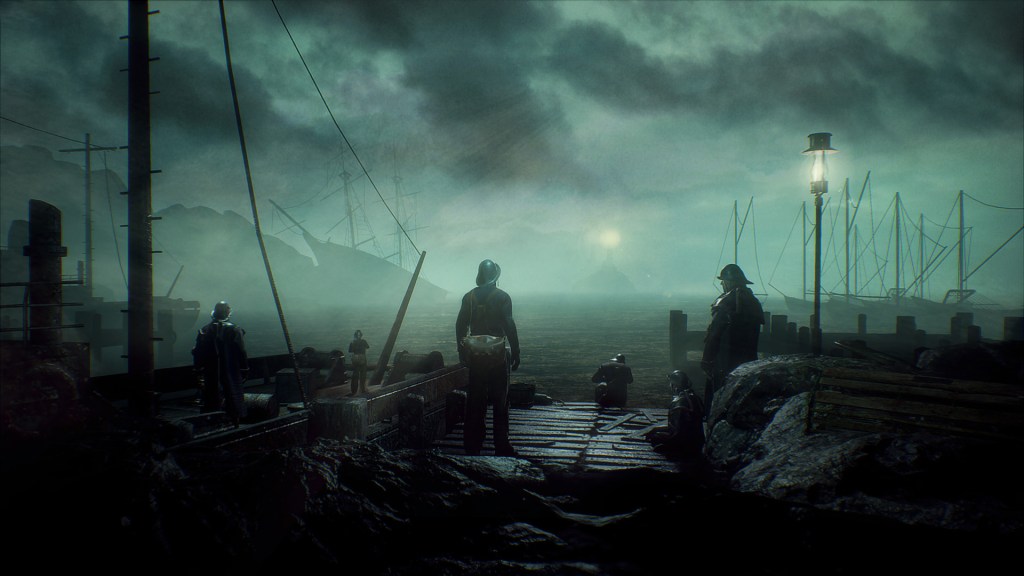
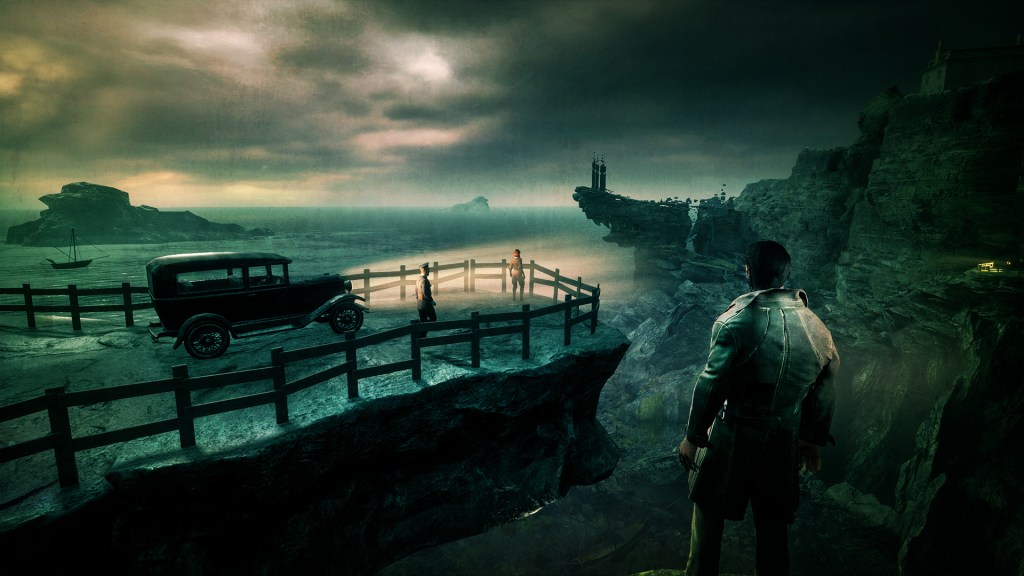
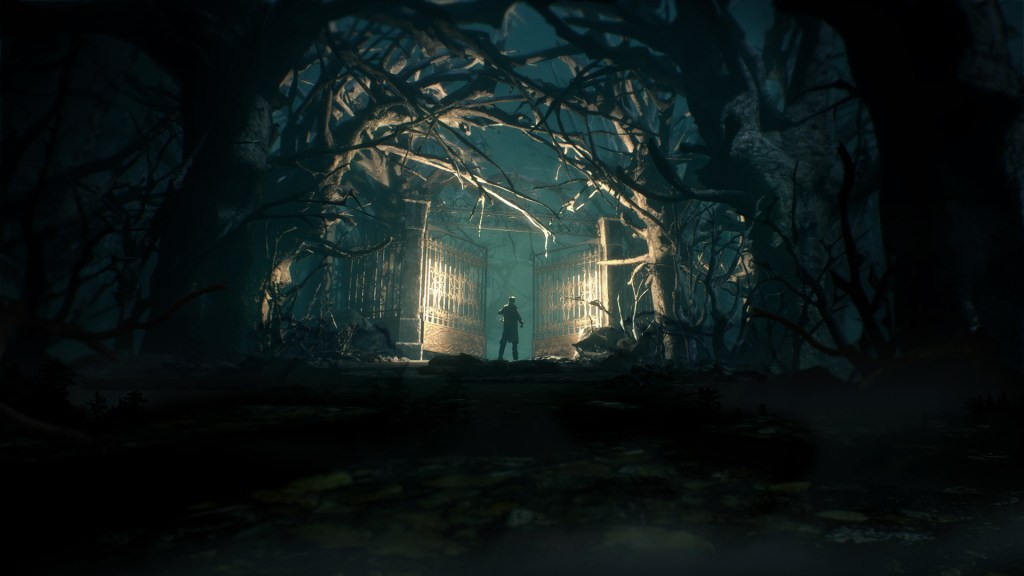
You travel to an ominous island off the coast, and you quickly establish that something is terribly wrong here. The town is dilapidated, the citizens all seem delusional, and nobody seems to want you there investigating their business. Over the course of the game, the story will continue to unfold as you unravel the dark secrets of the island. It is a fairly standard Lovecraftian tale, rife with cults, sea monsters, and unspeakable horrors. 

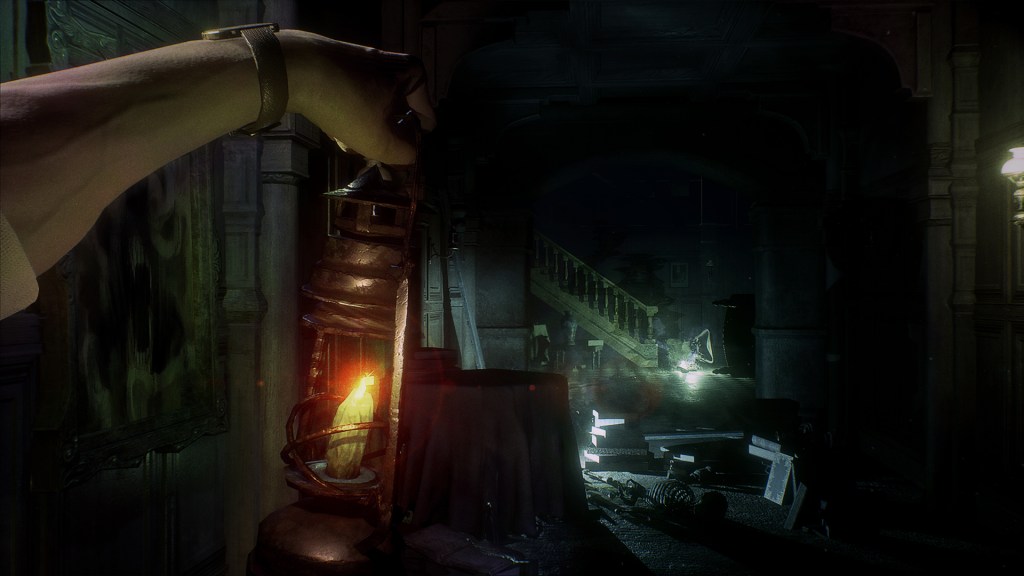
The story and atmosphere of Call of Cthulhu is by far the games strongest appeal. The atmosphere itself is fantastic. The entire world is dark, dingy, misty, and all-around unsettling. There are a variety of environments and set pieces that fit perfectly in a Lovecraftian setting. The game also does a phenomenal job at distorting reality. A common theme in Lovecraft’s mythos is madness, and Call of Cthulhu replicates that well. There are many sequences that will have the player questioning what events are actually occurring and which ones are dreams or insanity within the main character’s thoughts. What is less successful is the implementation of the story.

While I do think the narrative had some interesting moments, I don’t think it was particularly memorable or enough to carry a game. I was interested in the mystery aspects of the game, trying to deduce what was happening on the island. But for the most part, I think the story pulled in too many different directions instead of focusing on a couple of stronger and more fleshed out ideas. It almost feels like a collection of Lovecraft’s greatest hits, there are so many different elements at play in a fairly short game. Most of the characters get pitiful screen time, and it feels like each aspect of the story was rushed and barely came together in a cohesive manner. But my larger issue with the plot is a common complaint amongst most Lovecraft inspired media.

Unexplored places like the cosmos and deep ocean were central to Lovecraft’s stories, as they are real places that are unsettling to most people. What lies within them may be so inconceivable and terrifying that it would drive men to madness. At this point, most people who are familiar with Lovecraft already know about the Cthulhu mythos, the references to the occult, and the recurring imagery of the deep ocean. It feels like the writers of these newer stories are missing the point when they directly rip these concepts. 

A successful modern Lovecraft adaptation would have to make the consumer uncomfortable. There would need to be unknown elements, things that don’t make sense and are incomprehensible. The feeling that humanity is insignificant when compared to what could possibly be lurking in the unknown reaches of the cosmos. Not just rehash the same themes and monsters that we’ve been seeing for a hundred years. Ironically, the most I’ve felt the signature cosmic horror feeling is in games that weren’t directly inspired by Lovecraft’s work. Visiting Dark Bramble in Outer Wilds, the BTs in Death Stranding, and the Mimics in Prey are all examples of this. It’s not a coincidence that I loved all of those games. 

As a game with a focus on story elements, it shouldn’t come as a surprise that the actual gameplay is pretty mediocre. There is a mishmash of various elements, with some RPG investigation taking the forefront most of the time. Aside from that there is stealth, puzzle solving, exploration, and combat. These range from inoffensive at best to frustrating at worst. But none of them really take up a significant portion of time and can be gotten through fairly quickly. I appreciate that the developers at least understood that gameplay was not the core focus of the game and didn’t let it get in the way too much.

The only gameplay element that was prevalent for the entire game was the RPG investigations. You essentially search for clues and chat with NPCs to gain information about whatever you are investigating. There are some options that will essentially require a dice roll depending on your skill levels. It’s a little odd that they relied on RNG instead of just pure stat checks here, there really wasn’t any need for a randomness element to be incorporated. This isn’t a game about exploring many different options. If I make a strong character, I should be able to pry open stuck doors. And if I make a charismatic character, I should be able to pass more speech checks. Not have to rely on some dice roll that really adds nothing except for a failure state.

My other gripe is perhaps expecting a little too much for a game without a focus on gameplay. As it stands, investigations are just ways of disseminating information. You click on a clue and the game will tell you its significance, and questioning characters is just an exercise in exhausting all of the dialogue options. I wish there was some actual investigating here. Make the player use their brains to figure out a scene, not just tell them after clicking on enough clues. 

Overall, Call of Cthulhu is an at least competent Lovecraft experience. It doesn’t have riveting gameplay. It isn’t innovative in any capacity. And the story is just a rehash of the stories that we all know already. Despite this, it does have its moments of unsettling atmospheric horror. It is for these reasons I give Call of Cthulhu a 5/10. While it’s not revolutionary by any standard, it manages to craft a disconcerting world that will draw you in.