In the heyday of the Nintendo Wii, everything utilized motion controls. It was the core feature of the console, and of course The Legend of Zelda could not miss the opportunity to implement sword fighting with the Wiimote. And there is no doubt that The Legend of Zelda: Skyward Sword attempts to maximize the use of motion controls. Unfortunately, a handful of issues with the nature of motion controls along with some questionable design decisions make this my least favorite of the 3D The Legend of Zelda titles.
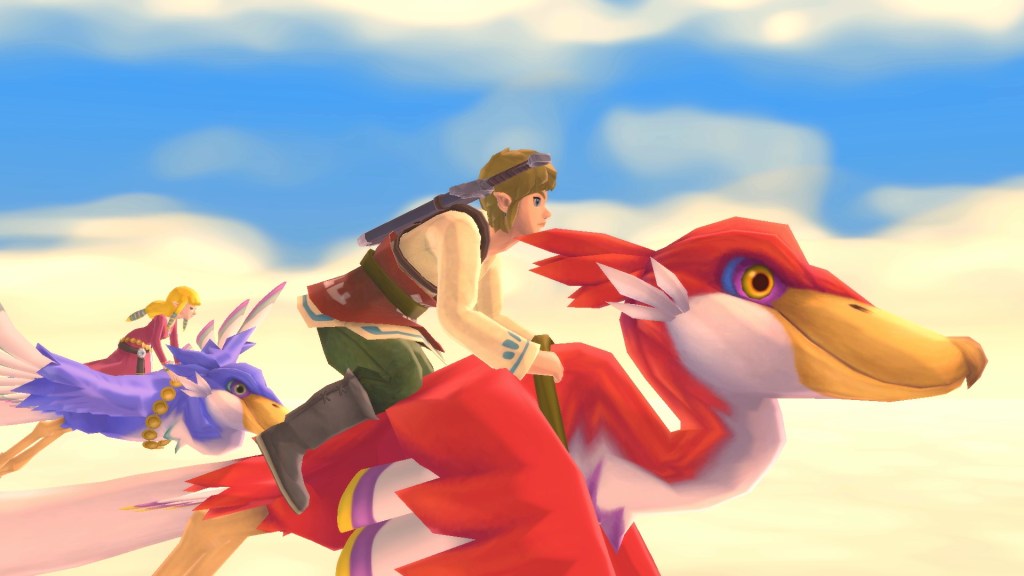
Skyward Sword has an incredibly unique setting in the series. The last remnants of humanity live on a flying rock, high above the clouds. They’ve built a small community and learn to take to the skies by flying on the backs of their loyal Loftwing birds. Rumors of the surface are nothing but folklore until Zelda gets swept into a vortex and plunges below the clouds. The player of course sets out on a journey to rescue their friend by exploring a handful of locations.
The best moments of Skyward Sword are when the player is left to explore, solve puzzles, fight enemies, and conquer dungeons unimpeded. There’s no doubt that the game boasts some of the best dungeons in the entire series. There’s some wildly creative ideas and well-crafted trials that are the highlight of the game. The desert area in particular has dungeons that make use of timeshift stones that create localized pockets of the past. Using these stones to reveal ancient devices and to clear away millennia of sand to progress forward is a phenomenal idea for puzzles. And the dungeons in the forest are wonderfully atmospheric and serene. Even the moments leading up to dungeons are interesting and unique, utilizing new mechanics and ideas that slowly ramp up in the classic The Legend of Zelda fashion.
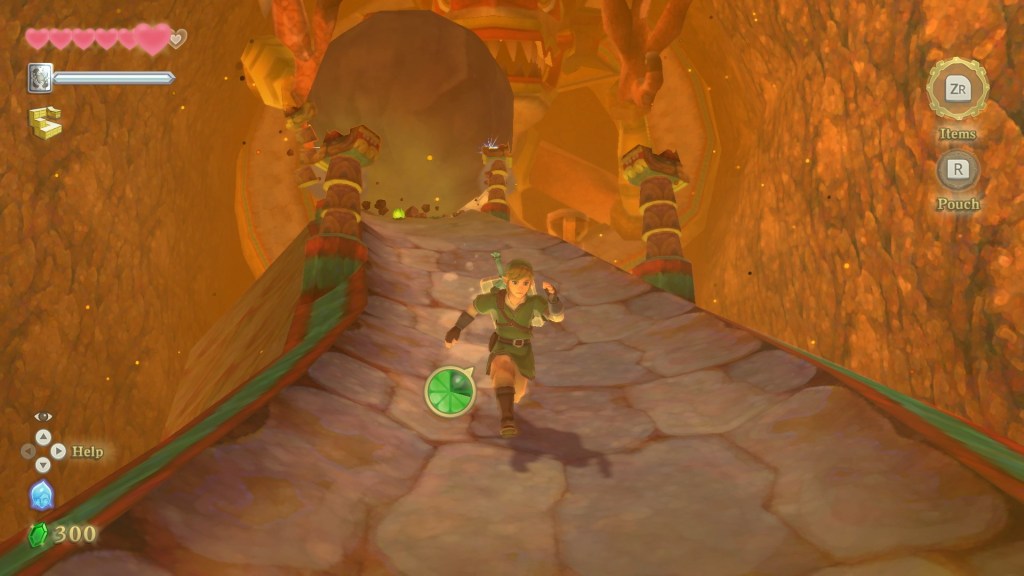
Unfortunately, moments in which Skyward Sword lets the player play without interruption are fleeting. From the outset, the game bombards the player with text and cutscenes. The game constantly stops in its tracks to spew unnecessary dialogue, breaking the flow of gameplay. The biggest culprit of this is the spirit of your sword, Fi. She regularly will appear, stating the obvious. It often feels like the game is treating you as if you were stupid, halting progress to tell you “I have calculated the place that you are going towards has an 80% probability of being the correct direction”. The excessive handholding not only feels like an insult to the player’s intelligence, but it also actively impedes the player from having fun.
When I think of The Legend of Zelda, I think of adventure and exploration. The structure of Skyward Sword is far more linear and constrained than the other games in the series. Outside of the starting town in the sky, there are only 3 main areas: forest, volcano, and desert. The game revisits these biomes multiple times each, often revealing new areas that were previously hidden. Occasionally these retreads are interesting because there are spirit trials that test your navigational knowledge of these familiar zones. But after the third visit to each area, I was longing for something fresh. And it didn’t help that the last third of the game felt padded out with unnecessary fetch quests, repeated boss fights, and retreading.
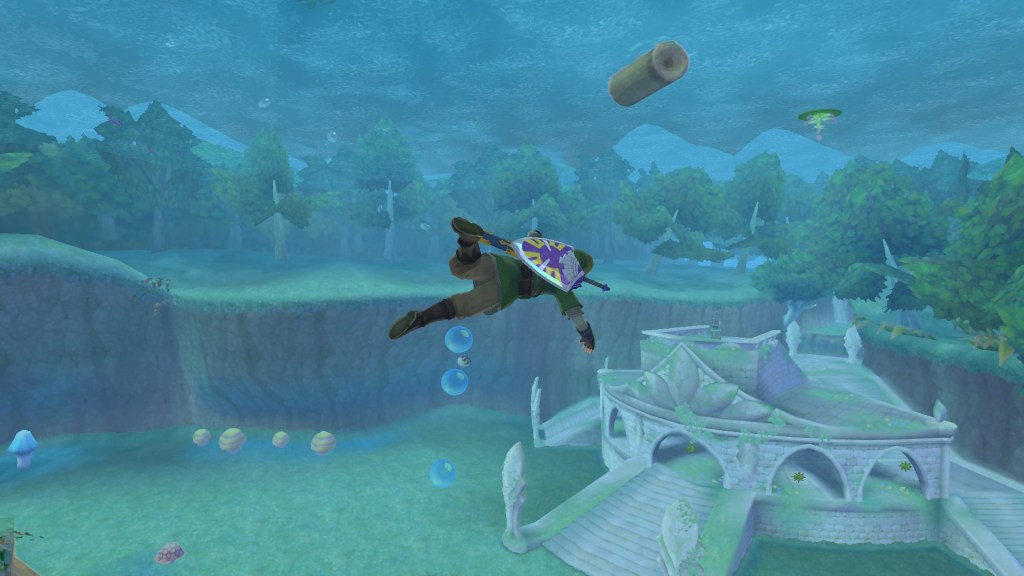
It’s worth mentioning that each zone is completely isolated. The only way to go from the forest to the desert for instance is to find a statue, teleport to the sky, fly to the appropriate hole in the clouds, then drop down into the desert. It feels disjointed, and the sky ends up being a giant level select screen rather than its own thing. And it doesn’t help that flying is a dreadfully boring affair. There’re rarely any obstacles or anything to do in the sky, just fly in a straight line. And because of the motion controls, you’re forced to keep your hand pointed straight, waggle the remote to flap upwards, occasionally pointing downwards to gain some speed. It’s tedious and uncomfortable.
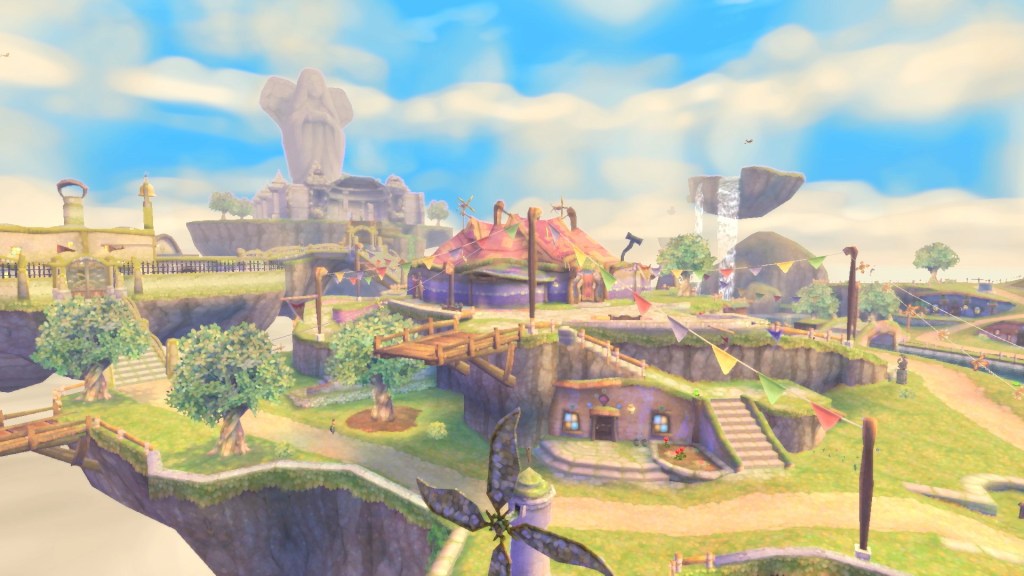
The sky itself is completely devoid of anything. There’s a bunch of tiny islands with practically nothing on them. And there’s occasionally a floating rock with an enemy that shoots rocks at you. That’s it. It’s pretty uninteresting mechanically and visually. Flying should be exciting and thrilling but it’s just boring and cumbersome in Skyward Sword. The one redeeming aspect of the sky is that the game’s main town, Skyloft, is amazing. It’s dense, has cozy hobbit houses for its residents, lots of side quests to discover, and a central town bazaar that hosts all of the shops. Skyloft has a ton of personality to it and I love it, even if the surrounding sky is a barren wasteland.
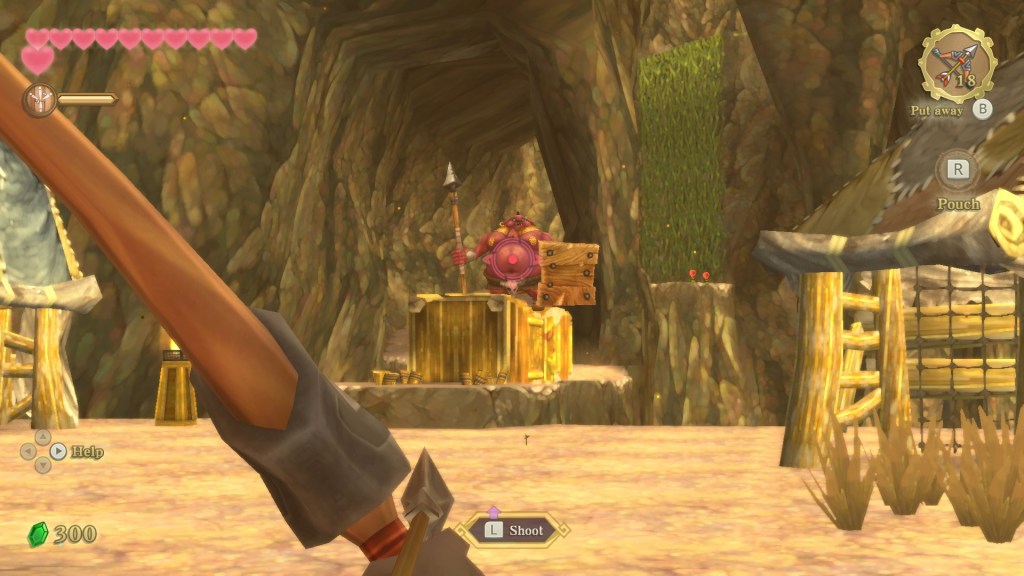
Even though motion controls never really caught on past the Wii era outside of some niche uses, I appreciate how dedicated Skyward Sword is to this control scheme. Nowadays, motion controls are a gimmick, but Skyward Sword was fully committed to maximizing its use of motion controls. The sword fighting, aiming the slingshot and bow, puzzles, and even basic movement all incorporated motion controls in some way. I don’t think it was always successful, but I appreciate that the developers didn’t treat the game’s central mechanic as just a gimmick, but as the guiding principle of design. It’s a unique scheme that helps Skyward Sword stand out from all the other The Legend of Zelda games. When it works, the motion controls are immersive and give a tangible, weighty feel to your actions. You aren’t just pressing buttons, but swinging your arms and aiming your controller like you would a sword and bow respectively. Unfortunately, the motion controls don’t always work.
It’s an extremely common occurrence in Skyward Sword for the motion controls to just not quite do what you want them to do. Many of the game’s enemies and obstacles require specific directional inputs, and having your attacks rebuked because the game reads your stab as a slash is frustrating. Unfortunately, motion controls will never match the preciseness of traditional button controls. When you press a button, you know exactly what will happen. When you try to swing horizontally, the game may interpret a slight diagonal angle and cause a misfire. Despite the fact that Skyward Sword is a fairly easy game, it is consistently frustrating due to the flukiness of the motion controls.
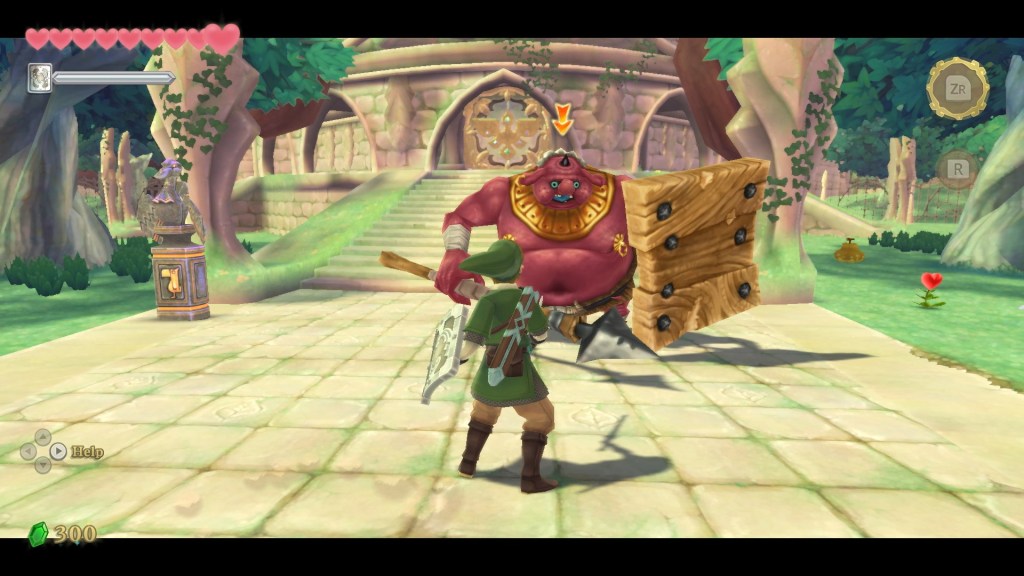
Another factor in the frustration of Skyward Sword is the enemy design. The game clearly wanted to emphasize the motion controls in sword fighting. Most enemies need to be hit from a specific angle to deal damage, and enemies with swords constantly block in different directions, requiring you to attack where they aren’t blocking. This is fine, the problem is that many of these sword-wielding enemies read your inputs and instantly block wherever you decide to attack. If they are holding the sword to their left, you try to swing at their right side, but the game instantly snaps their sword to the right to block your hit. I found it more effective to just flail around randomly rather than take my time to strike precisely because the enemies would just block my attacks if I tried to fight the “proper” way. It really is a shame because the sword fighting is the area where the motion controls could have shined, but it’s way simpler to use other strategies rather than engage in a proper duel.
My final gripe with motion controls is that they make the entire experience mentally exhausting. There is no break from them. You will always be fumbling trying to make the game do what you want it to do. I want to just be able to play for a few hours, get absorbed with the world, and go on an adventure. But the motion controls constantly break the spell of immersion, which is the exact opposite effect that they should have. Even when flying in a straight line you need to focus on keeping your wrist straight. There’s no escape from fighting the controls, which makes the entire game a drag.
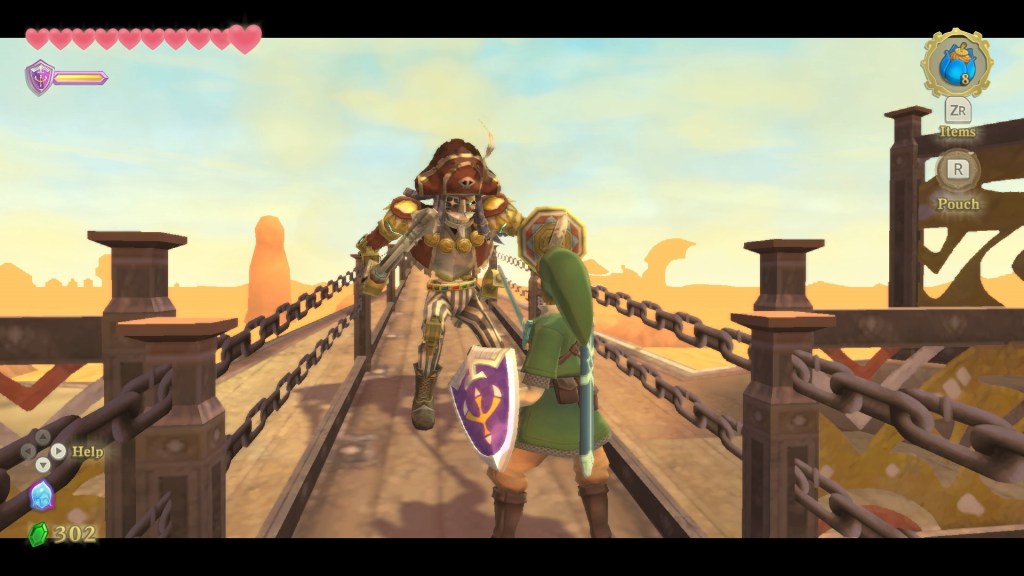
I actually quite like the presentation of Skyward Sword. Visually, it’s a middle ground behind the cartoonish Wind Waker and the more realistic Twilight Princess. I think it’s a happy medium, and the impressionist environments are quite pleasant to look at. At a distance, the environments look painted with visible brush strokes and streams of light. I do think the game lacks scenic vistas due to the isolated nature of the areas, but it is pretty nonetheless. The soundtrack is fully orchestrated, and despite it being perfectly enjoyable it doesn’t have that memorable quality that The Legend of Zelda is known for.
I don’t really play The Legend of Zelda games for their stories, but I was pleasantly surprised by Skyward Sword in that aspect. It follows the same good vs evil as every other game in the series, but what makes this entry stand-out is its characters. There’s a handful of character arcs in the game that demonstrate actual growth, which is something rare in the series. I don’t think the story is revolutionary by any means, but I was pleasantly surprised by it.
I played the game in the recent HD remaster for the Switch, which came with a number of quality-of-life changes. The remaster reduced the number of interruptions that Fi forces upon the player. It also fixed one of the most infamous bugs of all time in which every item would halt the game to display a description every play session. I’m glad that the remaster did away with these intrusions, because even in the remaster there are a painful number of halts that kill the pacing.
Overall, Skyward Sword is my least favorite of the 3D The Legend of Zelda games. Despite having some of the best dungeons in the series, there’s just far too many massive problems that I have with the game. The disjointed world, the constant interruptions, and the imprecise motion controls firmly cement Skyward Sword as the worst in the series. I appreciate its attempts to be unique and have a novel control scheme, but motion controls never reached the level of refinement that would be needed for anything other than some gimmicks. Still, it’s worth playing Skyward Sword for its cleverly designed dungeons.
 stephensopinions