As I’ve gotten older and life has gotten busier, I’ve come to appreciate the importance of pacing in games. While many players may prefer hundred-hour-long RPGs, I would much rather play a compact experience that doesn’t pad out its length with sprawling open worlds or endless side quests. Pragmata is the perfect example of a game that masterfully paces out its content, and its unique spin on combat makes it one of my favorite modern third-person-shooters.
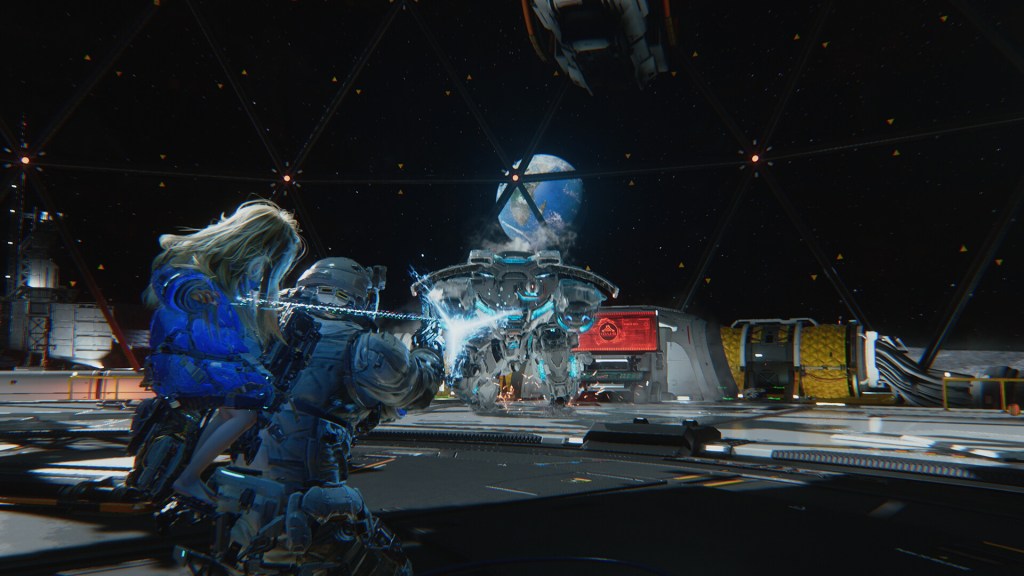
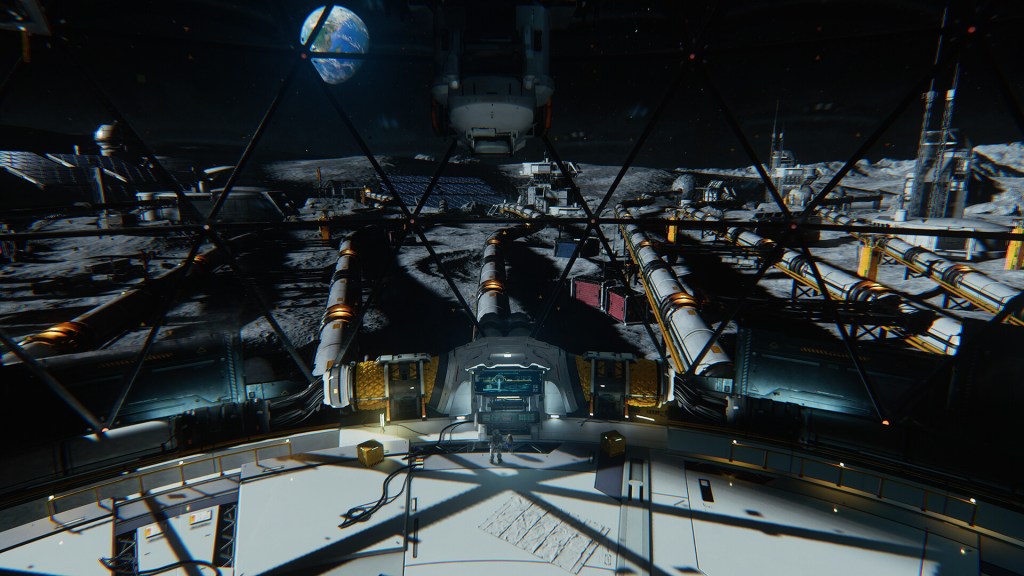
Pragmata takes place in a future where the Moon has been industrialized. A corporation, Delphi, has built a complex that harvests Lunafilament, a unique resource with unparalleled utility in 3D printing technology. Hugh and a team of engineers have been dispatched to the Moon to investigate recent radio silence from the Moon base. Upon arrival, all humans seem to have mysteriously vanished. Hugh quickly discovers that a rogue AI has taken over the base and is manufacturing robots to dispatch his team. Hugh is only saved because he encounters Diana, a specialized robot that takes the form of a little girl.
While we don’t know why Diana exists quite yet, or why the all-seeing security system has gone rogue, Hugh and Diana form an immediate bond as they set off to investigate. I was pleasantly surprised by the lack of the increasingly common “small child teaches gruff old man to love again” trope. There’s never tension or conflict between Hugh and Diana, just a wholesome father-daughter relationship as she learns what it means to be human. The writing can feel a bit stiff at times, Diana has natural dialogue for a 7-year-old, but I found that some of Hugh’s lines were a little cheesy.

The story itself I think is fine. Most of the plot happens towards the end as the truth of Diana’s origin is revealed, most of the game is just the journey to the finale. The narrative is more about Hugh and Diana and their relationship, which was pleasant, but their instant connection meant that there wasn’t a ton of character growth to fuel the plot. I wish the story explored its worldbuilding concepts a bit deeper. I would’ve loved seeing some commentary on the implications of Lunafilament, the material that can be used to clone anything. What would happen to industry and life on Earth if this was made readily available? The game very briefly touches on how AI displaces workers, which is definitely a poignant topic in today’s world. But it could’ve been far more interesting to explore how AI and the ability to manufacture everything with ease could lead to a post-scarcity society, or if the company in charge had more nefarious goals. As it stands, the story is alright, but it won’t blow anyone away.
The combat is the highlight of Pragmata. It puts a unique spin on its third-person-shooter gameplay: dynamic hacking. You quickly discover that bullets do negligible damage to the reinforced exteriors of the robot enemies, but Diana can hack them to briefly separate their armor, allowing you to deal real damage. When hacking an enemy, a small grid appears, and navigating to the goal node exposes the robots. It starts simple, 4×4 grids with nothing but a start and end node. But as you progress the grids grow and block off tiles, forming mazes. There are other nodes that you can equip that have additional effects such as stuns, damage multipliers, or mind-control.
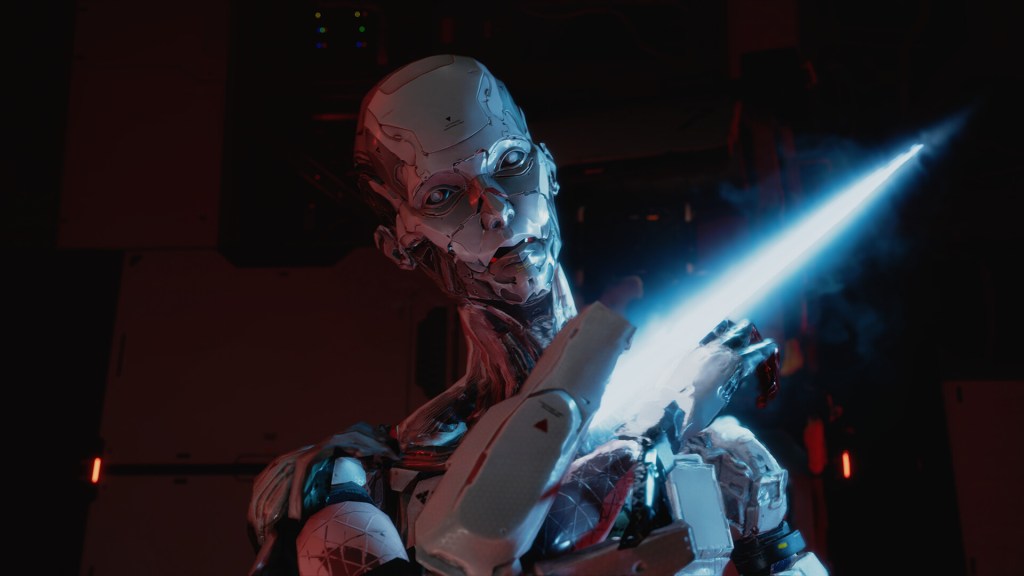
In isolation, hacking is a super simplistic mini-game. But the genius is that inserting it into the middle of combat makes the entire experience far more dynamic. Dodging attacks and hitting back is the basis of most action games, so throwing a wrench into that formula was a fantastic idea. My mental bandwidth could no longer only be concerned with dodging and shooting but now I had to contend with solving small mazes, deciding which nodes I wanted to use, and which enemies to hack. It feels a bit awkward at first, trying to teach your brain a new task, but the controls are seamless and the end result is both strategic and immensely satisfying.
Since you need to hack enemies to deal damage, the developers were smart in allowing the player to deal massive damage in the short openings that you get. There are four categories of weapons: primary, attack, tactical, and defense. Primary weapons have infinite regenerating ammo, but the others have limited capacity. Primary ammo regeneration is a bit slow and other weapons drop frequently, encouraging the player to actually use their other tools instead of holding onto them for a rainy day. The non-primary weapons all feel incredibly powerful and satisfying to use. A single shotgun blast or charged laser beam will eviscerate most enemies. That’s not to say that there isn’t a fair bit of challenge, having to juggle hacking, dodging, aiming at weak points, and ammo management makes those moments where you can just blast a robot to dust all the more satisfying.
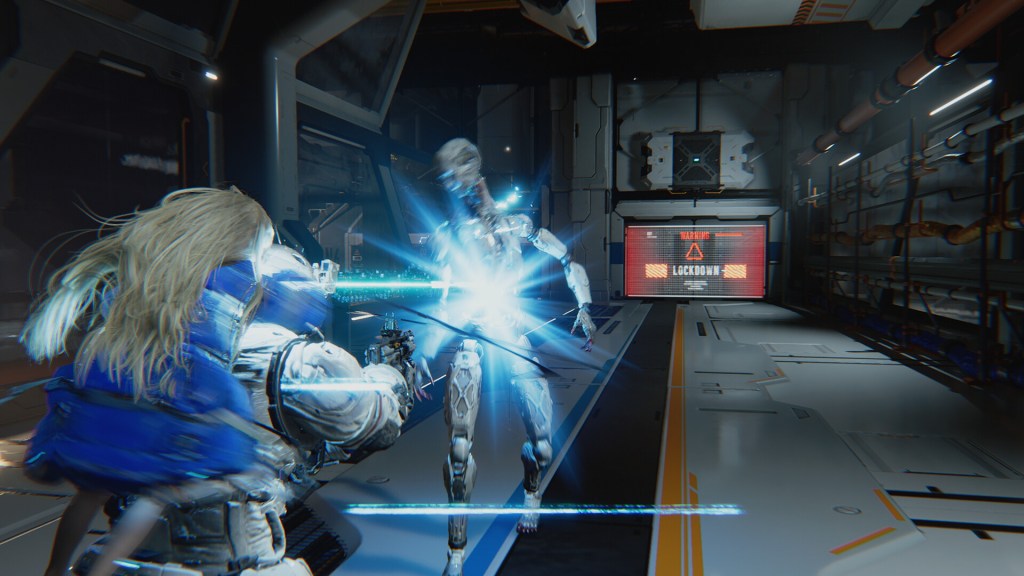
Additionally, the tactical and defense weapons are fantastic as well. Electromagnetic nets that stop enemies in their tracks, decoys to distract foes, deployable shield zones, and grenade launchers to knock robots to the ground. Pragmata doles out all these tools at a fair pace, letting the player experiment and find out what you like best. Most of the weapons and tools are balanced well and they feel powerful, truly giving the player the choice to select what they like best. There’s also a progression system in which you can upgrade your preferred weapons, making them even more potent as you face tougher and tougher enemies.
What most impressed me about Pragmata was its pacing. I often find that many modern games drag out their campaigns and fill the world with fluff under the illusion of providing more “content”. I see all too often online discussions where players treat a lengthy run time as an objectively good thing. With a full time job, house projects, and now a kid, my gaming time is limited. I love when a game respects my time and doesn’t pad itself out with an unnecessary open world, mindless side quests, or a repetitive campaign. Pragmata briskly moves from zone to zone, each introducing new weapons and enemies. There are some hidden upgrades to find but they aren’t far off the beaten path.
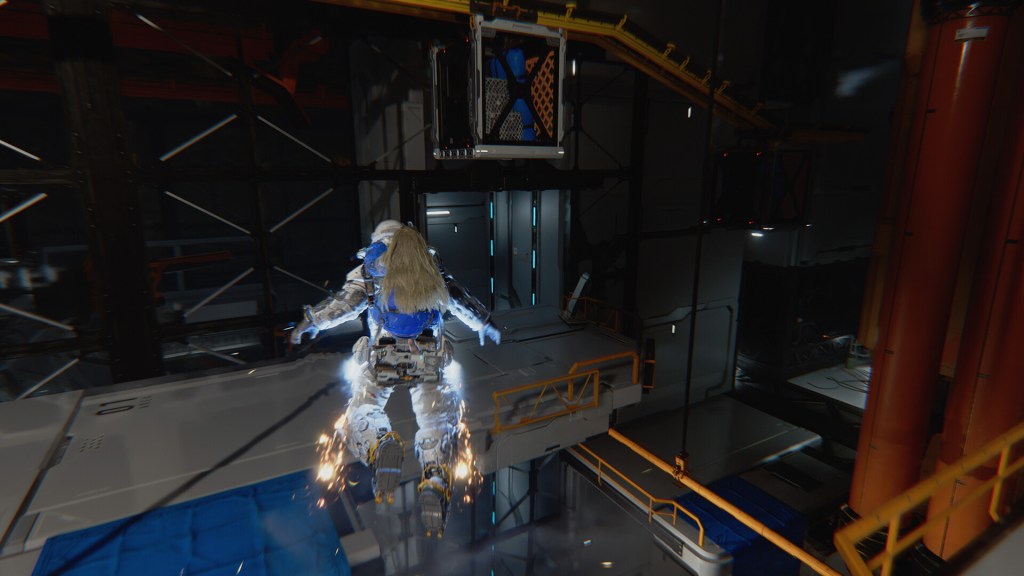
There aren’t any side quests and each area is fairly linear. There is some incentive to explore but ultimately you could get through each main area in only an hour or two. I appreciated how quickly the game was willing to move on. Introduce some new enemies, give the player a couple new weapons to test out, a new biome to gaze on, and a boss at the end to cap it off. It doesn’t linger, and this is the kind of game that could easily overstay its welcome. Hacking enemies during combat is a unique twist, but it could’ve gotten stale and tedious in a poorly paced game. For people who want more out of the game, there is a set of 30 training missions that test your skills, as well as 10 post-game challenges. I enjoyed the game enough to do all of these, but I’m glad that the developers kept the main campaign so lithe and kept some content as an optional bonus.
The thing that disappointed me the most about Pragmata was how it didn’t quite utilize its setting to its maximum potential. I was drawn in by the prospect of a sci-fi shooter taking place on the Moon, but it feels like so much of the game just takes place in sterile metal corridors. Each area that you progress to is its own biome, and the concepts behind the biomes are great. A neon metropolis showing off the industrial capabilities of the 3D printers, a more naturalistic area with trees showing that even organic material can be printed, and the Lunafilament mines on the surface of the Moon. There are unique ideas here, and when the game shows them off it’s great. But all too often those are just pretty exteriors while most of the actual action takes place inside of rectangular aluminum rooms. And outside of the mining operations biome, you could easily forget that the game takes place on the Moon at all.
Overall, I had a fun time with Pragmata. I wasn’t blown away by it, but I appreciated its unique ideas and stellar pacing. I hope more developers take note of the niche of not overly long AAA games. I’m tired of 100 hour long monstrosities, unless they really are something special. The hacking during combat was a unique twist that made even simpler encounters feel intense. And even if the game’s setting and story weren’t fully realized, they were a decent hook that got me interested in the first place. It is for these reasons that I give Pragmata a 7.5/10. I can’t wait to revisit the satisfaction of hitting a hacked enemy with a fully charged laser piercer blast in the inevitable sequel.