Mario + Rabbids Kingdom Battle (2017)

As a lover of tactical RPGs, I am upset that I let Mario + Rabbids Kingdom Battle sit on my shelf for nearly 7 years. While the game seems like a bizarre concept, it is an incredibly well-made game. It innovates on common systems such as hit rates, movement, and special abilities to make for a surprisingly deep tactical experience. While playing it safe is often the key to success in other tactics games, Mario + Rabbids Kingdom Battle encourages aggression and fast-paced play. And while I still think the concept is odd, it somehow works.
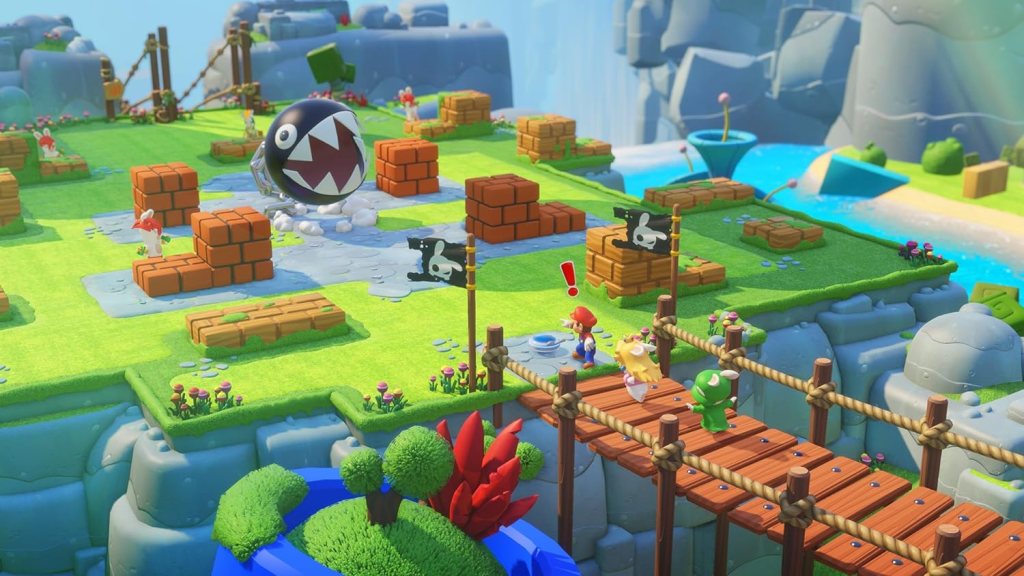
When this game was announced as a mash-up of Mario and Rabbids in which they would use guns in turn-based tactics battles, I thought there was no way it would be good. It felt like 3 diametrically opposed things being merged into some bizarro concoction. But it actually works. Mario and his pals team up with a handful of Rabbids cosplaying as Mario characters to take down the out-of-control virus that is corrupting everything.

The Mushroom Kingdom, as always, is a fun backdrop for the adventure. It’s bright, colorful, and has a set of classic areas to explore. Walking around the world only serves as a breather between battles, but I enjoyed soaking in all the wacky details. The invasion of Rabbids has left the Mushroom Kingdom and its denizens in chaos. And the Rabbids are strewn about, causing mayhem with their signature brand of physical comedy. Luckily, I think the Rabbids were toned down a bit in terms of their obnoxiousness. They are infamous for how annoying their schtick can be, so I’m glad that it was reduced to more reasonable levels.
Aside from the concept, Mario + Rabbids Kingdom Battle surprised me in how many smart ideas it had. One of the biggest examples of this is the 0/50/100% hit rate system. In most other tactical RPGs, whenever an attack is initiated, there is a complex formula to calculate the odds of the attack landing. This is a core mechanic to games like XCOM in which the player tries to optimize their odds of success while staying in a safe position to minimize enemy hit rates. But the issue I’ve always had with XCOM is how outrageously bad it feels to carefully enact a strategy that relies on a 97% shot, but it fails and you are severely punished. It’s just how odds work, but that doesn’t stop it from feeling terrible.

In order to combat this feeling of getting unlucky, Fire Emblem implements its own system. It amplifies the percentages under the hood, so a high percentage like 90% is really closer to 98%, while a low percentage like 20% is more like 8%. While it is directly lying to the player about odds, I think it works wonderfully because the player shouldn’t be basing their strategies on low percentage attacks. It just makes the game feel better and doesn’t make you feel like you got unlucky as people are notoriously bad at estimating odds. Mario + Rabbids Kingdom Battle gets around this conundrum entirely by boiling down hit rates to 3 categories: 0%, 50%, and 100%. If attacking an enemy fully behind covered, you will not hit them. If they are partially behind cover, you have a 50/50 shot. And if they are in the open or you flank them, you a guaranteed to land a hit.

I think this system is genius because of how simple it is. You are encouraged to flank enemies, as you can’t reliably hit them otherwise. There’s no frustration in missing a high-percentage attack because they simply don’t exist. You almost always know beforehand whether the attack will hit, and hitting 50/50s should be seen as a bonus, not a core part of your strategy. You can’t blame luck when you miss a coin flip. There are other forms of statistics in the game, like weapons that have a range of damage they can inflict and can occasionally trigger special effects. But like with the 50/50 shots, you shouldn’t rely on special effects or max damage attacks as they are uncommon. If playing well, you always know when an attack will hit and the base amount of damage it will do, anything on top of that is a bonus. This simplified hit system is such an intelligent mitigation technique of the player feeling unlucky when playing tactical games.
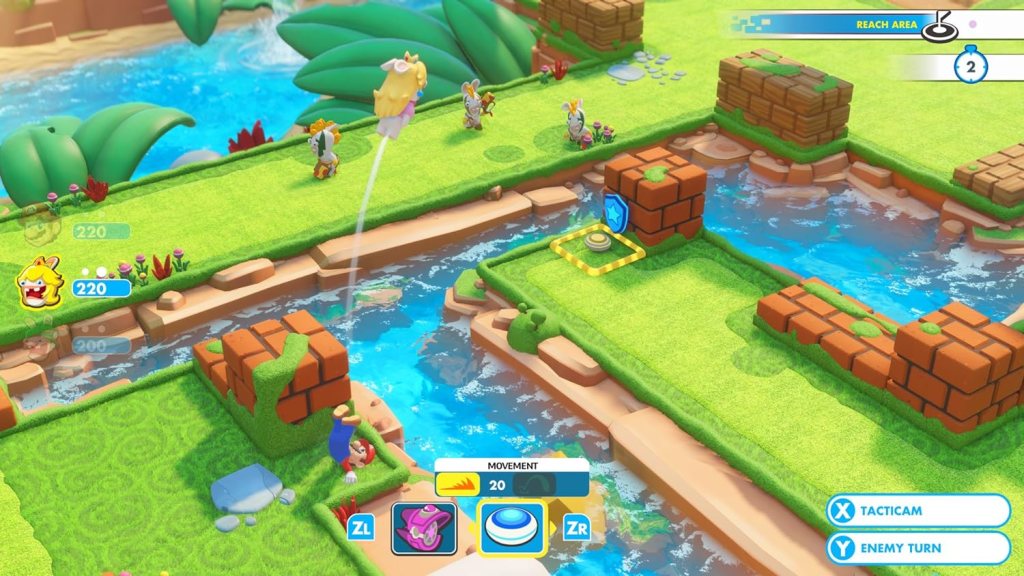
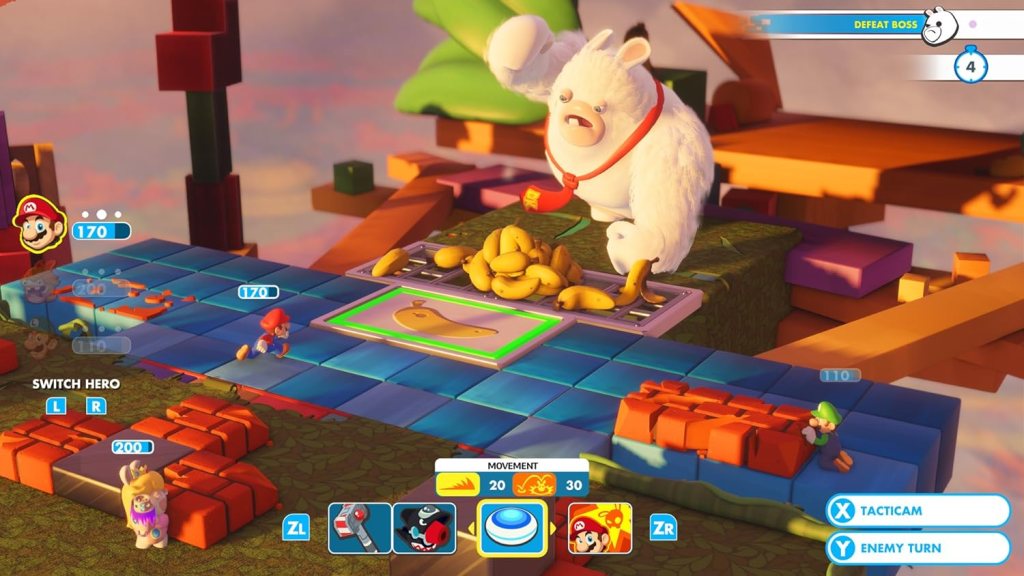
Even though the hit system is simplified, Mario + Rabbids Kingdom Battle has a surprising amount of depth. The battles are small, you only can control 3 characters in relatively compact maps against a handful of foes. But each turn brings so many possibilities that it’s staggering. Each character has two weapons, two special abilities, and some extreme mobility. On a single turn for a single character, you will be able to move, dash through an enemy or two to deal damage, jump off a teammate for extended movement, attack an enemy with your weapon of choice (which also have a reasonable chance to trigger special effects), and decide if you want to use a special ability. And you can take these actions in any order you want. The breadth of options here is immense. 

All of the possibilities available to both the player and the opposition make for some extremely dynamic battles. The extreme mobility and combat capabilities paired with destructible environments make it difficult to predict exactly how any given turn will play out. This encourages aggressive play. You should maximize your own capabilities to take out as many enemies as possible before they get the chance to retaliate. Every turn feels like a mini-puzzle as to how to get the most out of your character’s actions. Moreover, if you want to get a “perfect” score on every stage then you have to complete the battle in a set number of turns, further encouraging you to play aggressively. I love that flanking and going on the offensive is the best strategy, as many other tactical games encourage turtling and playing overly safe.

Mario + Rabbids Kingdom Battle can actually be pretty tricky at times. Enemies can easily flank and position themselves to deal massive damage. Boss fights are multi-staged affairs with unique mechanics. And there’s tons of enemy variety sporting different weapons and effects to watch out for. This makes for some fun challenges as you learn how to utilize your characters effectively. The upgrade system encourages you to specialize your characters to bring out their strengths.
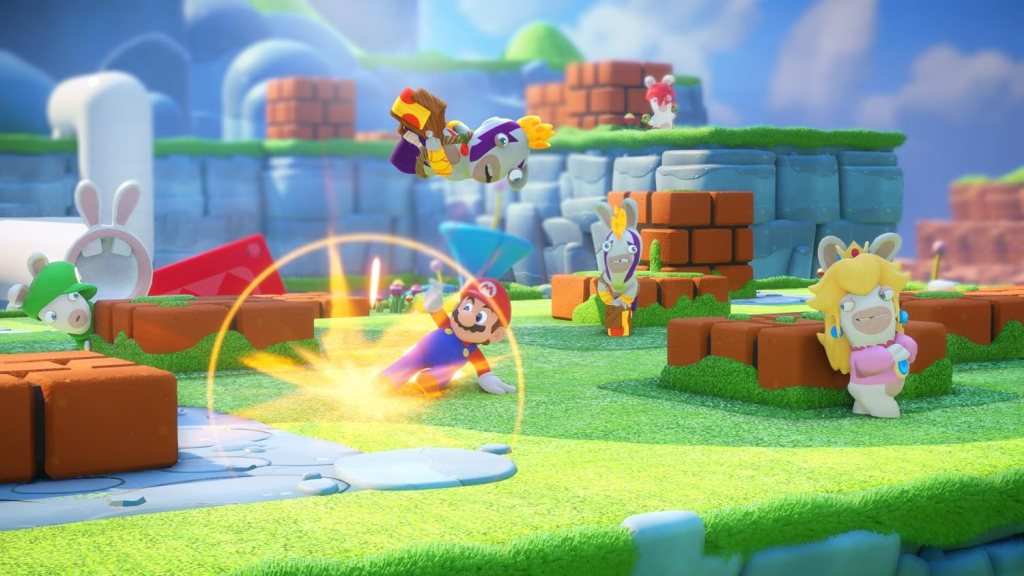
My only complaint about the gameplay is that I wish it encouraged more experimentation with party members. You can only have 3 in any given battle, and 1 of those is required to be Mario, leaving only 2 options for other members. All the characters were unique and had some interesting abilities to be utilized, but I never really strayed from my core party because I didn’t need to. My setup of Mario, Luigi, and Rabbid Luigi was more than capable of taking on any of the main campaign and all of the bonus levels. Maybe if the game didn’t have such restrictive limitations on my party, I would’ve tried different characters. Another option is if there were challenges that encouraged the use of members that you haven’t utilized that showcased each character’s niche.

Aside from gameplay, I did have a handful of minor gripes about the user interface and user experience. The camera during battle left a lot to be desired. I wish you could freely rotate it and zoom out to see the entire battlefield. It wasn’t a huge deal as most maps are tiny, but some of the missions are massive and it can be difficult to grasp which route to take to the goal. Another improvement that I would’ve liked to see is the ability to toggle enemy movement and attack ranges. You can do this for a single enemy in a special menu, but there’s no way to leave it on for when you are actually making a move. You just have to memorize their range if you are trying to keep a character out of harm’s way.

The biggest issue I had with the user experience is just how long everything takes. There’s a panning camera shot at the beginning of the battle, a celebratory animation when you win, and a ton of seemingly random cinematic animations that occur during battle. These cinematic animations can happen anytime, whether you are just sliding for a little bit of damage, attacking normally, or triggering an ability. They do look nice, but this is a fairly lengthy game with a ton of battles. You are going to be seeing the same animations over and over and over. The battles themselves are only a few turns long, but they can take a while simply because there are so many actions and superfluous animations. You can speed up enemy turns which is a great feature, but I would’ve liked options to be able to speed up all animations and disable the cinematic animations altogether.
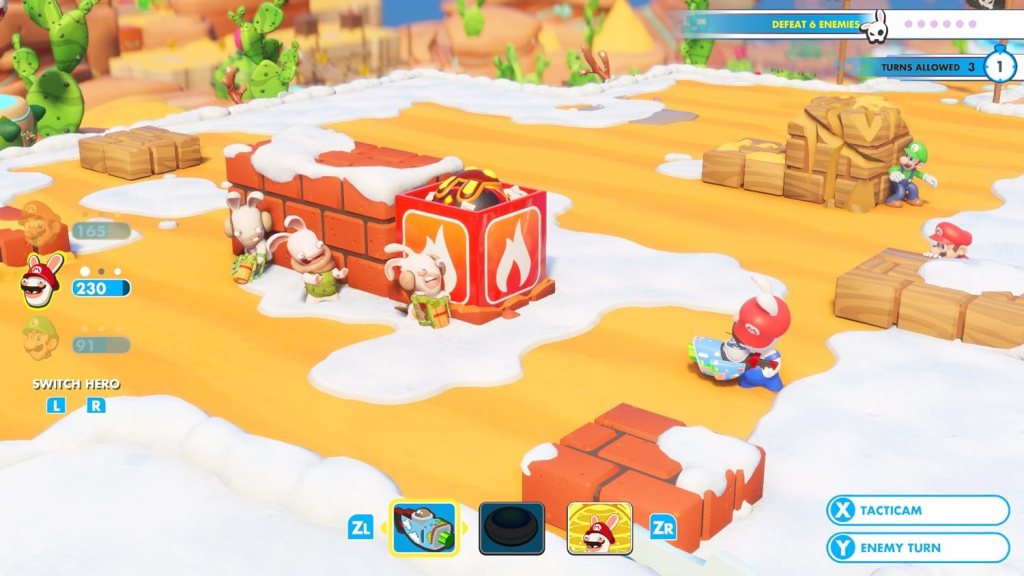
Overall, I was shocked how much I enjoyed Mario + Rabbids Kingdom Battle. I thought the game would be too simplistic to be engaging, but I was proved completely wrong. Every turn has so many dynamic possibilities that lends to aggressive play. The 0/50/100 hit percentage system was a genius method of alleviating frustration and encouraging flanking maneuvers. Despite a few little UI hiccups, Mario + Rabbids Kingdom Battle is a phenomenal strategy game. If you are like me and have Mario + Rabbids Kingdom Battle sitting on your shelf, do yourself a favor and give it a try.
Pikmin 2 (2004)

Pikmin 2 is the perfect example of an excellent game that torpedoes itself with an abundance of repetitive and poor-quality content. Despite making plenty of improvements over its predecessor, the majority of Pikmin 2 is spent engaging with its worst content: caves. I wanted to love this game as much as I loved the original Pikmin, and truthfully it surpasses the original game in many ways. But unfortunately 75% of the game is at best dull, and at worst frustrating.

To start with the positive, Pikmin 2 delivers more content than its predecessor. There’s more Pikmin varieties, there’s more enemies, there’s more treasures, there’s more hazards, and there’s even an additional playable character. This is all fantastic. I liked having two captains to control as it allows for more multitasking, which is a core component of the Pikmin series. One captain can oversee a group of Pikmin knocking down a wall, while the other captain can command the Pikmin to attack enemies and replenish their numbers.

The two new Pikmin varieties both are unique and integral to your success. Purple Pikmin are heavy but slow. They can carry 10x the weight of normal Pikmin, and they are incredibly effective in combat. They deal bonus damage and stun enemies upon landing from a throw. White Pikmin are faster than normal Pikmin, are immune to poison, can find treasures underground, and deal massive poison damage to an enemy that attempts to eat them. Both of these varieties are powerful, but are cleverly balanced by their rarity.

Both purple and white Pikmin do not have their own motherships, and as such you cannot use the normal chips and enemy corpses to spawn more of them. Instead, you come across colored flowers that you have to sacrifice other Pikmin into five at a time. This heavily limits how many of these special Pikmin that you will have. While the purple Pikmin in particular are incredibly powerful in combat, I felt nervous bringing large quantities around because losing just a handful of them could be catastrophic. I think this was a great way to balance these new varieties. Having powerful Pikmin at your disposal is very fun, but limiting their quantity makes them risky to use.

Another welcome addition is the inclusion of sprays. You can spend time having Pikmin collect berries that will be refined into two varieties of sprays: bitter and spicy. The spicy spray speeds up your Pikmin and increases their attack power. The bitter spray turns enemies to stone briefly. I enjoyed how these provided some additional decisions to make during combat. You could use them to make encounters much easier, but you had a limited quantity of them unless you spent a ton of time farming them. I saved them for dire situations or tricky boss fights, and I appreciated their inclusion.

When I played the original Pikmin my biggest issue with the game was the poor AI. I haven’t done any sort of extensive testing, but I definitely feel like this was improved in Pikmin 2. They seem to not get stuck on random bits of geometry as often. They don’t get distracted by grass as much. They are quicker to pluck and faster to respond to the whistle. I still had some occasional woes when trying to dismiss Pikmin into groups, but overall, I appreciated how much more responsive they were overall.

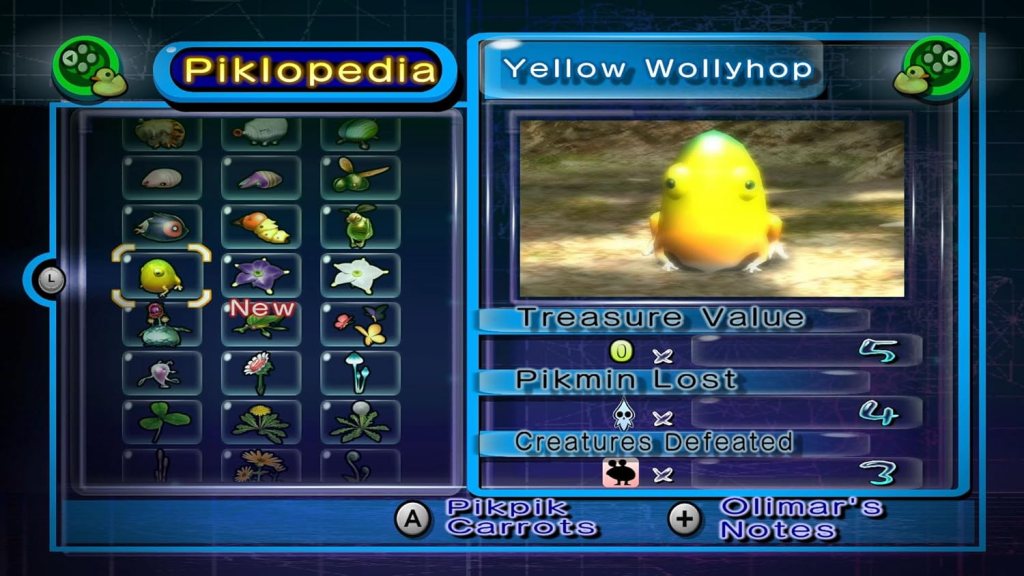
While I didn’t spend a ton of time reading the entries, I loved the Piklopedia. This journal has fun descriptions of both the enemies and the treasures that you collect. These have a lot of personality and charm. They’re funny and a great addition for people who want to delve more into the world of Pikmin.

The gameplay loop of Pikmin 2 is almost identical to the original. Instead of crash landing on Earth, you voluntarily journey there to collect treasure to alleviate your company’s debt. You command your troop of Pikmin to knock down barriers, fight enemies, and collect goodies. A major difference however is that Pikmin 2 lacks a maximum number of days. In the first game, you had 30 days to collect 30 parts. With each day being roughly 15 minutes, there was a sense of urgency to get something done with every second. 

The looming time limit in Pikmin was something that many players felt anxious about, but I think it was a critical element of gameplay. It encouraged the player to maximize their time and take risks. You could leave a troop of Pikmin to knock down walls or carry things back to base, but there was always the worry that they could be intercepted by hungry enemies. And even if you had a couple minutes left in the day, there was always the question of what you could do with your time. Whether it be replenishing your Pikmin supply, feeding them nectar to upgrade them, or knocking down barriers to make the next day easier, I wanted to maximize my time. 

Thirty days was plenty generous unless you were wasting a ton of time, but the looming threat of failure was crucial. This isn’t present in Pikmin 2 at all, as you have an unlimited number of days to accomplish your goals. There’s no rush to do anything, you can play incredibly safe and not have to do any risky multitasking. You don’t have to squeeze every second out of the day, as you can just go to the next day with no downside as the timer approaches night. The lack of urgency was definitely unfortunate, but it was a minor issue when compared to the biggest flaw of Pikmin 2: caves.

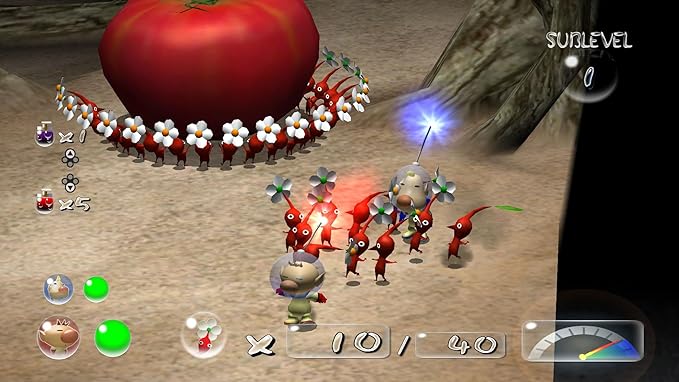
Before I begin ranting about caves, I want to make it clear that I genuinely think that they are a good idea. They act as dungeons in which you progress floor by floor with no opportunity to replenish your Pikmin. They have a heavy emphasis on combat, each floor is packed with enemies and there is usually a boss at the end. Defeating the boss usually yields a special treasure with a unique upgrade such as immunity to electricity. I think this is all great. Entering a cave is anxiety inducing as you don’t know what lies ahead, and losing Pikmin can devastate your odds of success. This is all great, but the caves have a few issues: bland aesthetics, monotonous gameplay, and frustrating level design.

There are 14 caves in the game, and even shortly after beating the game I can only really remember 4 of them. And 2 of those I only remember because they were infuriating. A big reason why caves aren’t memorable is because they are just plain ugly and bland. Many of them are just big dirt pits with little to distinguish themselves. Moreover, the levels are semi-randomly generated, so they can’t make up for forgettable visuals with interesting level design.

 Most of the caves lack anything to make them unique. Just floor after floor of basic battles with no end in sight. And many of these caves can take upwards of an hour to complete. It grows old quickly. There are a couple of good examples in Pikmin 2 of what caves could be: Submerged Castle and Glutton’s Kitchen. 

Submerged Castle is easily the best in the game. You have to work quickly to recover treasures in this water-filled cave, because a nightmarish blob appears after 5 minutes on each floor to steamroll your Pikmin. This is a unique mechanic that encourages you to move quickly, but even if you aren’t fast enough there are strategically placed pipes that allow you to hide from the monster. Glutton’s Kitchen is nearly as horrifying, but it is memorable nonetheless. It takes place in a child’s playset of building blocks and a wooden train set. Fat breadbugs try to steal your treasures and drag them back to their dens. The combination of being visually distinct and having a central mechanic is vital in making caves more interesting. It’s a shame that none of the other caves live up to the quality of these two.

I have to mention that my entire experience was left on sour note because of the final caves in the game. They were memorable for the wrong reasons. They felt completely unfair. Every floor was a cramped nightmare filled with dangerous enemies. Not to mention traps such as bombs, rocks, and enemies falling from the sky. I don’t mind a bit of elevated difficulty, but the difficulty spike here is egregious. There are so many ways that you could instantly lose half your army deep into a dungeon. The saving grace here is that you can hard reset to the beginning of the floor.

I don’t think relying on frequently resetting your system is a great mechanic, but it feels necessary here. There are so many catastrophic things that can happen, and it often feels unavoidable. Due to the randomized nature of enemy placement, some configurations are far, far harder than others. The final dungeon, Dream Den, has many floors that feel like the developers just threw every enemy they could into cramped rooms. These aren’t cleverly designed challenges, they are meat grinders that require unsatisfying tactics to succeed.

Like I previously mentioned, you can always just reset and hope for a better outcome or easier layout, but there are some ways that you can combat the tougher encounters. You can play super carefully, going through each floor with no Pikmin at first, triggering every trap. Then abuse the enemy AI to bait them out one at a time. This is time consuming and feels a little cheap as you are just bypassing every obstacle. You could also use purple Pikmin and bitter spray as they are surefire methods to simplify tougher fights, but these are very limited resources unless you spend time farming them. Truthfully, some of the floors in the later dungeons feel like absolutely no thought went into them and they weren’t even playtested.

In my perfect world, Pikmin 2 would have cut down the number of caves dramatically. Instead of 14 repetitive caves, having 5 unique and intentionally designed caves would be a massive improvement. The caves would have their own aesthetic themes and unique mechanics to make them interesting. Each floor would be designed with care and there would be thought into the layout and enemy placements. I understand that randomization can increase replayability, but in the main campaign I wanted purposefully designed dungeons. Randomized dungeons could’ve been a great challenge mode.

I was let down by the number of poor-quality caves in Pikmin 2. Even without a day limit to encourage efficiency, I still was having a great time up until I started delving into the caves. The vast majority of the game is spent in the caves, and it’s by far the worst aspect of the game. More isn’t always better, and Pikmin 2 would’ve been greatly improved by cutting the number of caves in half and spending more time carefully designing them. It really is a shame because Pikmin 2 gets so much right, it just sabotages itself with an abundance of uninteresting and occasionally aggravating content.