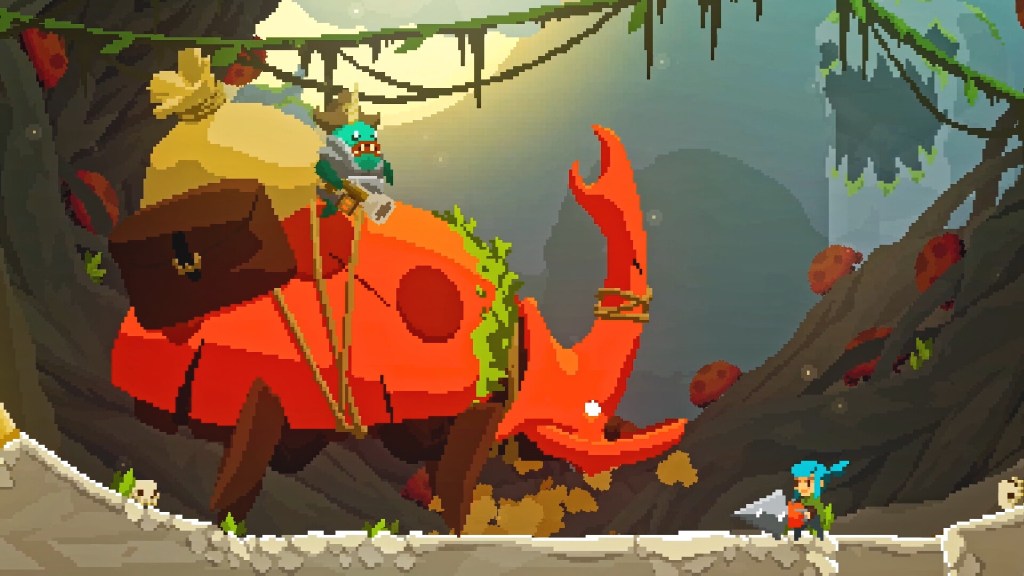
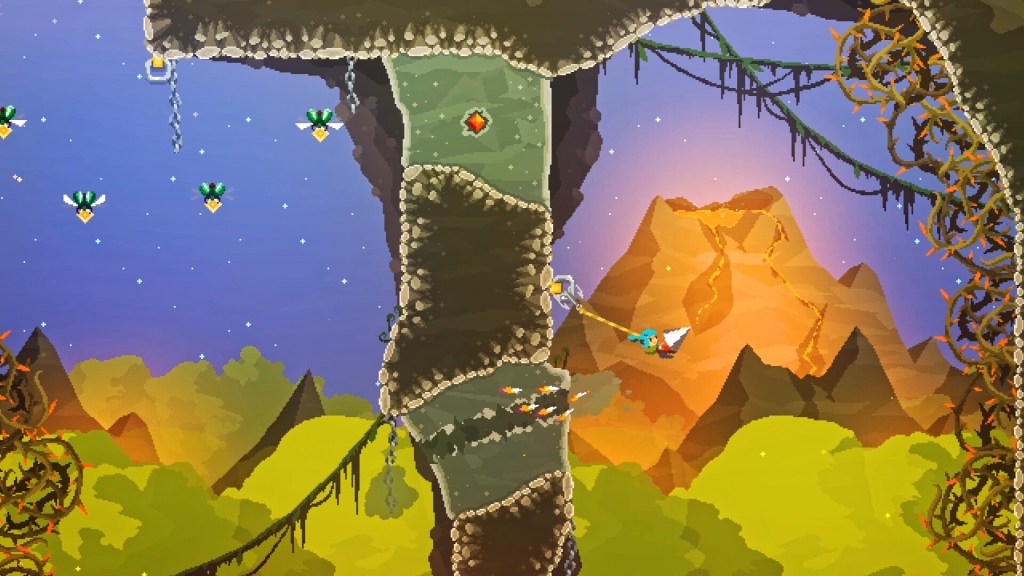
Hollow Knight: Silksong (2025)

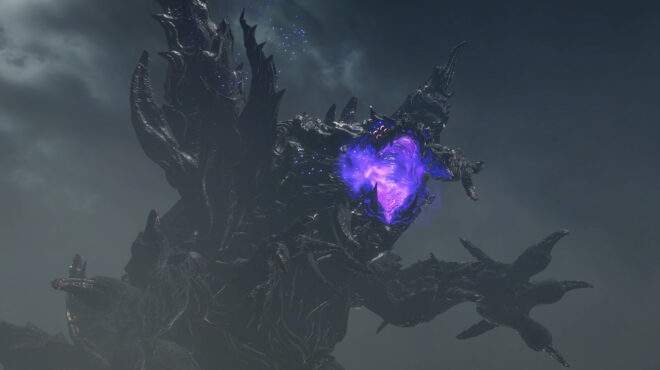
No game may have been more highly anticipated than Hollow Knight: Silksong. Team Cherry surprised the world in 2017 with the debut of Hollow Knight, and one of their Kickstarter funding goals promised a second playable character: Hornet. That promised DLC expanded in scope until it eventually became its own standalone game. It’s been over 6 years since the game was first revealed and after the long wait I wondered if the lightning-in-a-bottle of the original could be recreated. But after playing the game, I can confidently say that Silksong picks up right where Hollow Knight left off. For my thoughts on Hollow Knight, check out my review from when the original was released.
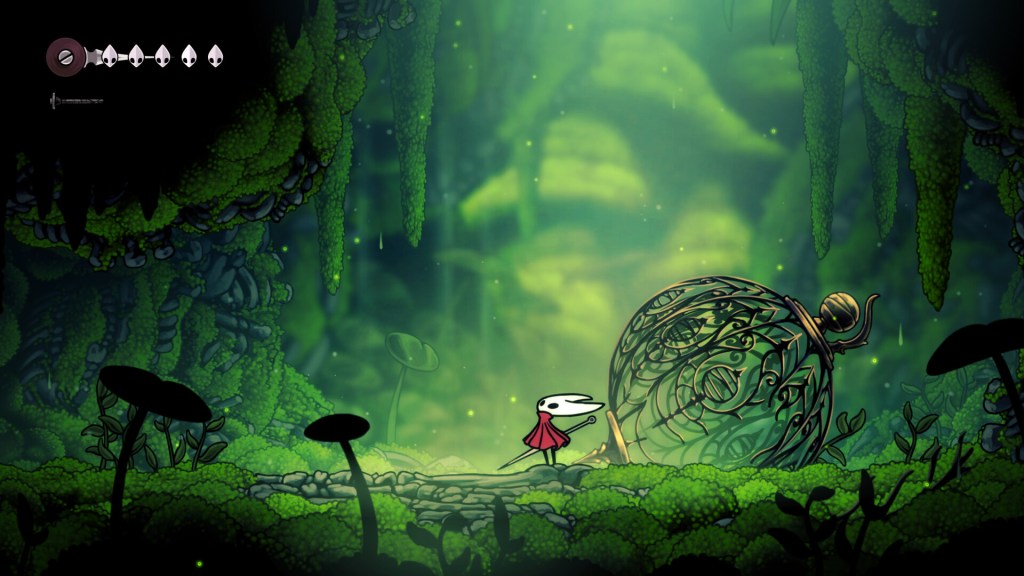
The brilliance of Silksong begins with its world. Kidnapped by religious zealots, Hornet arrives in the land known as Pharloom. It’s inhabited by numerous varieties of bugs, but the common thread connecting them is religious devoutness. It’s clear that Pharloom is a kingdom that has crumbled into dust, only whispers and tradition carry the travelers to summit the peaks where the holy Citadel stands.

As a metroidvania, Silksong frees its players to explore and discover organically. With nothing but the nebulous goal of reaching the Citadel as your guide, you set out on a blind journey. Silksong takes inspiration from the storytelling of FromSoftware’s games such as Dark Souls and Elden Ring. Taking in the dying world around you, piecing together the puzzle of what happened through vague texts and environmental storytelling. Nothing is directly told to you, but the world and its artistry wonderfully communicate what kind of place Pharloom once was.
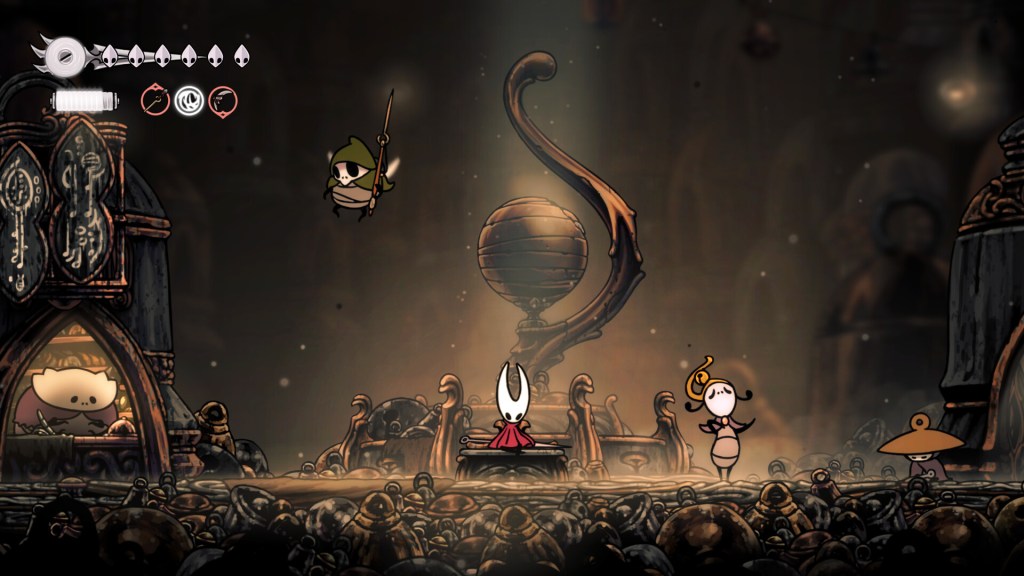
Take for instance the Underworks, a mechanical nightmare of pipes, gears, and valves beneath the Citadel. The opulence of the Citadel is powered by these dingy chambers. It is here where workers tirelessly labor to maintain the holy grounds that they never see. When they attack you for your intrusion, they only drop a pittance of rosaries, the currency of Pharloom. As you’ve progressed through the game you’ve gained increasingly more rosaries in each area from tougher foes, but the Underworks represent the poor dregs of the Citadel. There’s even a hidden room in which you can run on a treadmill to generate power, only to be rewarded with a single rosary for the effort. And it is here in the Underworks where the benches which have been the universal sign of rest and have acted as your checkpoints of safety incur a cost of 15 rosaries for a single use. Without any dialogue or text, Silksong portrays a dystopian society where a class is exploited and drained to fuel the grandiosity of an empty cathedral.

It’s these vignettes and partial truths of the past that make exploring Pharloom so compelling. The art and sound design of Silksong is also top-notch. An enormous amount of care was put into making each area distinct and filled with details. It’s from these details where the hidden stories are filled with life. The music is equally compelling, often harboring somber moods as you explore this crumbling kingdom. Yet frantic melodies make an appearance when engaging with any of the numerous bosses of Silksong.
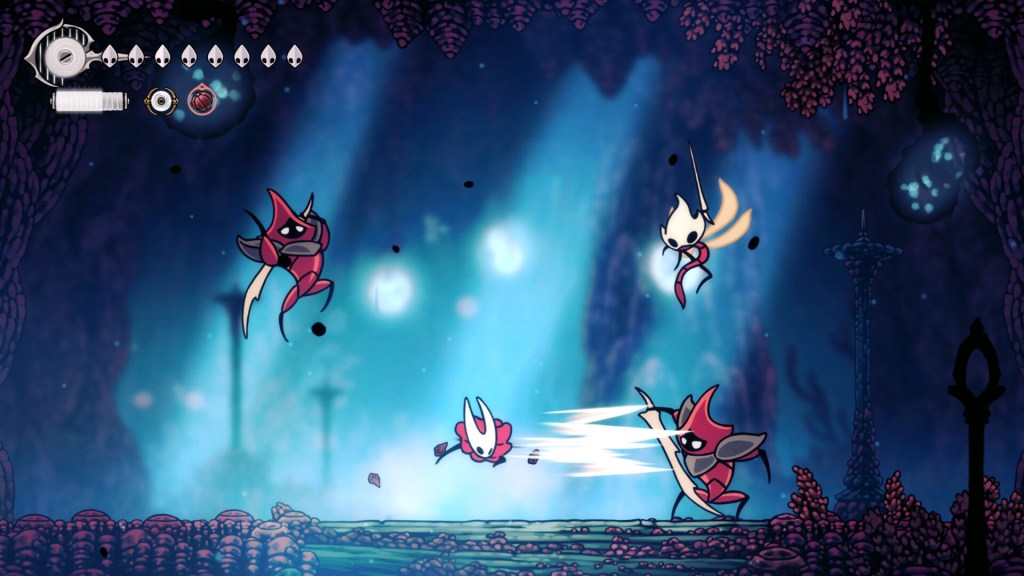
The gameplay of Silksong is that of traditional 2D metroidvania. You explore massive areas, fighting enemies, platforming across dangerous pits, and collecting hidden boons to increase your power. The major upgrades that you find act as keys that unlock new paths in the world, as well as being purposeful in combat. What I love about Silksong is its non-linearity and its reluctance to guide the player. It is up to you to figure out where to go, often you have to choose at random between forks in the road. When you enter a new area, you are blind, there is no map until you find the mapmaker. You’re forced to rely on instinct and curiosity. I find this more compelling than being given explicit directions. Each path has something to be discovered, but the further you wander from a resting place, the more risk you incur.

Pharloom is a harsh place, filled with enemies, obstacles, and traps. Resting at a bench acts as a checkpoint, restoring your health and letting you respawn there if you die. And if you die, you lose all the currency you are holding, and you only get a single chance to reclaim it. The game design makes the world incredibly dangerous, and you can take nothing for granted. Every time you hit an enemy, you generate a single pip of silk, and nine pips of silk are required to heal. Getting hit at all is costly, and extreme caution is warranted when traversing Pharloom. I personally love this feeling of playing on a knife’s edge. You can never let your guard down or brute force your way through obstacles. You have to master your movement and your arsenal.
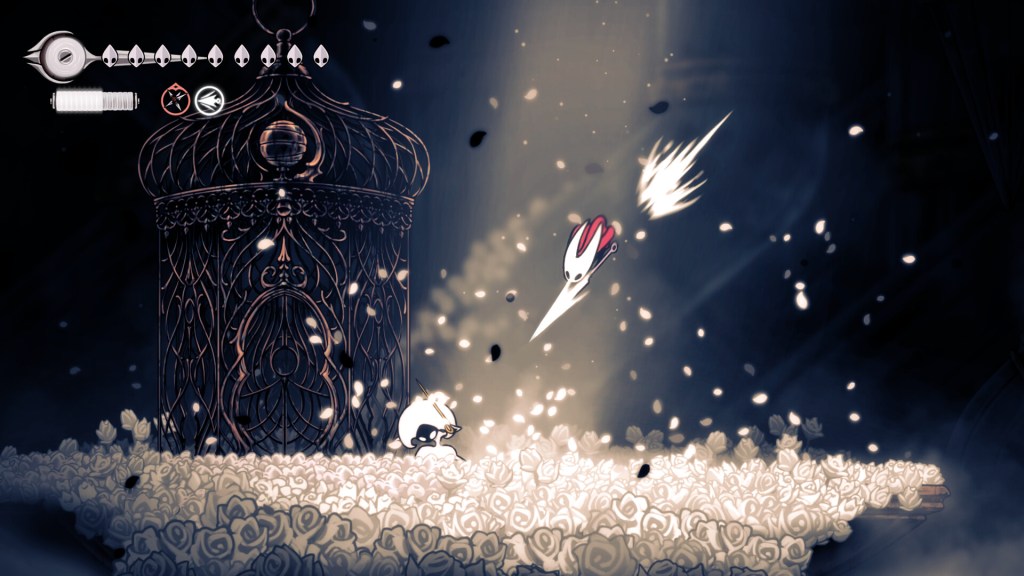
What makes Silksong stand out from its predecessor is the number of tools available to the player. Hornet is a much nimbler protagonist than Ghost from the first Hollow Knight. She acquires many different tools to dodge and evade. But this agility comes at a cost, as she is also much more fragile than Ghost. As the game progresses, many enemies and traps deal two ticks of damage rather than one. This happens fairly early on in the game. While there has been an uproar online about this steep spike in difficulty, I wasn’t offput by this at all. I thought the difficulty was well-balanced to provide an adequate level of challenge. Silksong is the sequel to Hollow Knight, and it was originally intended as DLC. It makes sense that it picks up where Hollow Knight left off. Furthermore, Hornet is swift and has so many more tools at her disposal to make encounters easier. Making use of these tools makes the game so much more approachable.

Not only do you unlock various movement options, but spells, crests, and tools also can be found to customize your moveset. Spells are powerful abilities that cost silk to use. Tools come in the form of both equipped passive bonuses and accessories that you can deploy in combat such as throwing needles or caltrops. And crests are complete game-changers as they entirely alter Hornet’s attacks and innate abilities. For example, the Beast crest modifies the basic heal to instead be a life-stealing effect when you claw at enemies. I found that tinkering with the different options and finding combinations that I liked was immensely enjoyable.
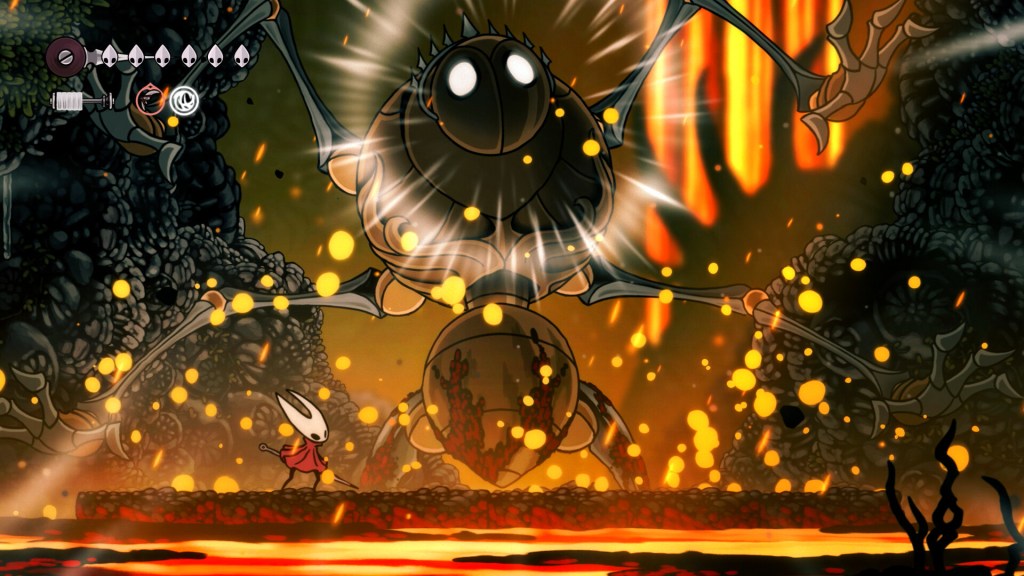
The boss fights of Silksong are the cherry on top of the already excellent gameplay. They all have distinct attack patterns and arenas that make them stand out from one another. But I was most impressed by the lack of restraint shown by Team Cherry. Most bosses only have 3 or 4 attacks, limiting the number of tells and timings that you have to memorize. I was able to easily find openings and gain confidence on the tougher foes, transforming the fights into a dance as Hornet nimbly evades blows and returns damage with her needle. The design of these fights has a knack to seem intimidating at first, but quickly become manageable once you learn the patterns.

As a metroidvania, discovery is a key aspect of the gameplay loop. Finding secrets, uncovering new areas, and remembering where to use your new abilities are part of the fun. For the most part, Silksong nails this. The lack of guidance makes these discoveries more organic and rewarding. But I do have a minor gripe with some of these well-kept secrets. I don’t mind when minor rewards such as health upgrades or tools are well-hidden, they are bonuses for having a keen eye. But I was disappointed by how many major areas were so incredibly concealed. I missed a handful of these areas initially, and only found them when I was aiming for 100% completion. One or two of these areas being secret is fine, but Silksong is a massive game and finding the fake walls leading into these secret zones is like finding a needle in a haystack.
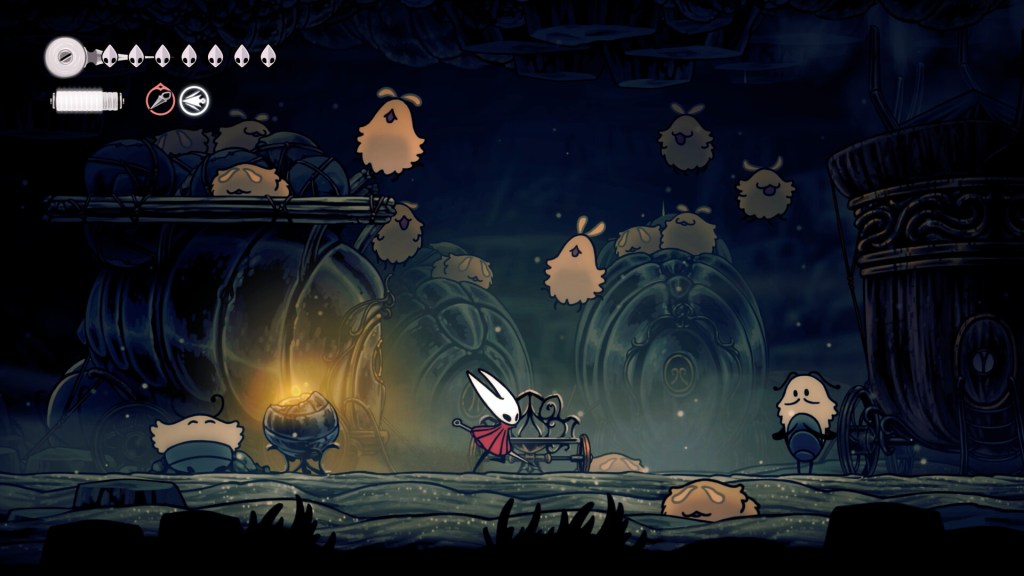
My other minor issue with Silksong is its propensity for dull fetch quests. There are dozens of quests in the game, many of them being fun journeys that result in a boss fight or extra bit of lore. But there are also many repetitive fetch quests that have you slay some number of nearby enemies. The majority of the time these enemies are the same ones you’ve been fighting for hours at this point. These kinds of quests are just dull and act as padding, which the game doesn’t need at all since it is already so huge.

After such a long wait, I was a bit nervous that Silksong wasn’t going to live up to its sky-high expectations. But I was thoroughly impressed with the immersive world and tight gameplay. It is a continuation of Hollow Knight, but it doesn’t feel totally derivative because Hornet plays so differently from Ghost. The ability for the artistry of the world to tell a wordless story is truly special. It is for these reasons that I give Hollow Knight: Silksong a 9.5/10. If you haven’t played either of the Hollow Knight games, do yourself a favor and play the best metroidvanias of the last couple decades.
The Legend of Zelda: Skyward Sword (2011)

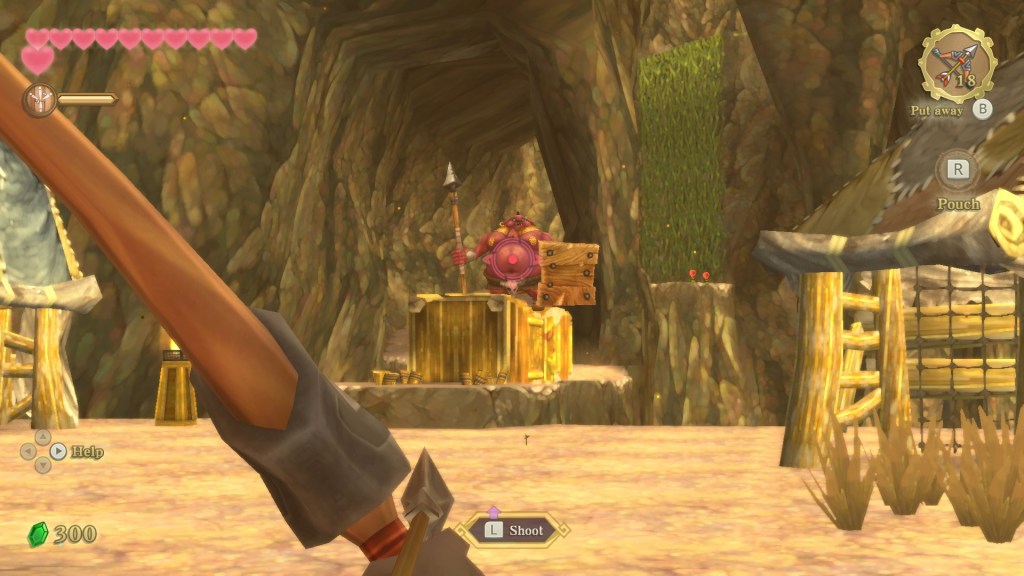
In the heyday of the Nintendo Wii, everything utilized motion controls. It was the core feature of the console, and of course The Legend of Zelda could not miss the opportunity to implement sword fighting with the Wiimote. And there is no doubt that The Legend of Zelda: Skyward Sword attempts to maximize the use of motion controls. Unfortunately, a handful of issues with the nature of motion controls along with some questionable design decisions make this my least favorite of the 3D The Legend of Zelda titles.

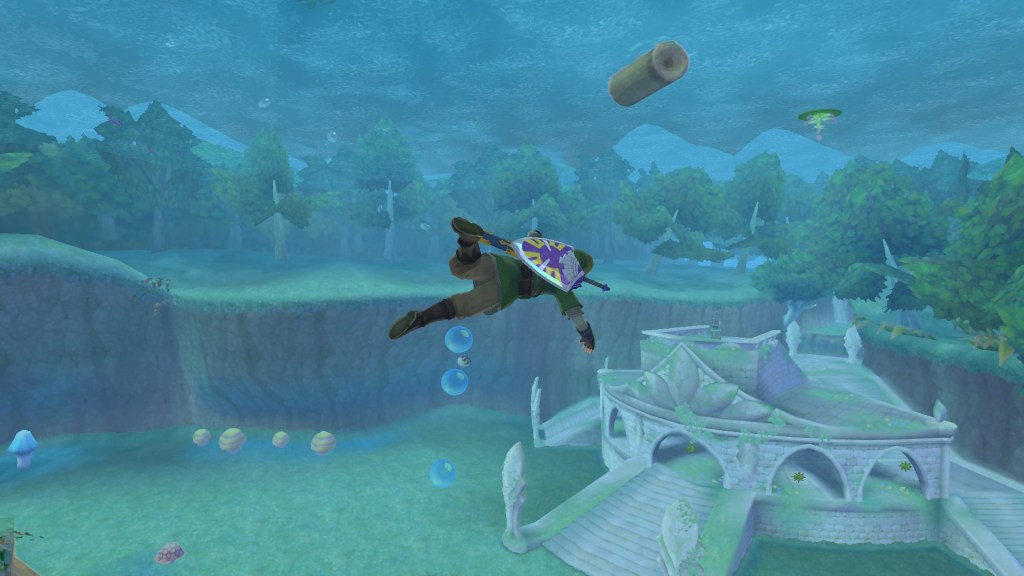
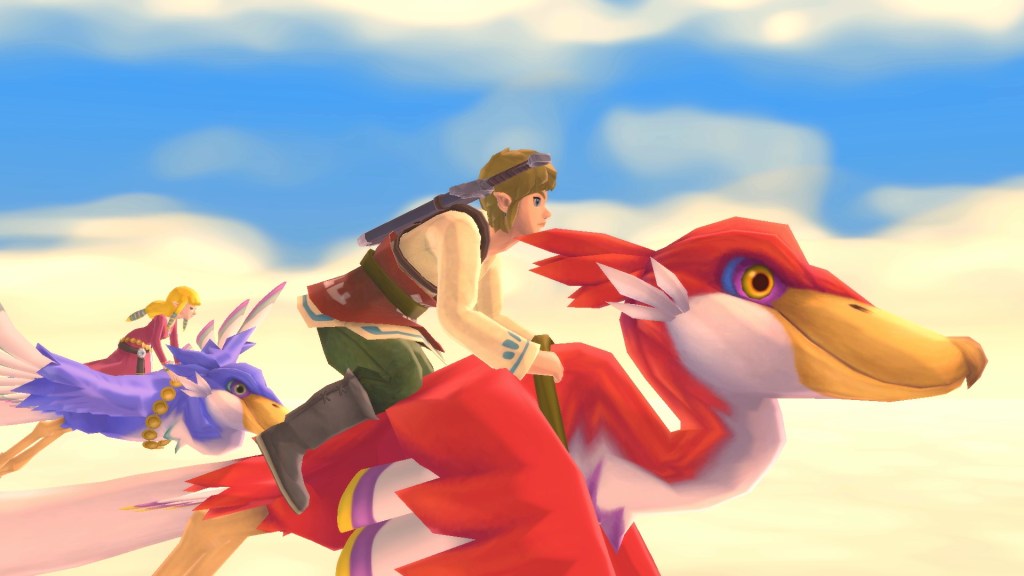
Skyward Sword has an incredibly unique setting in the series. The last remnants of humanity live on a flying rock, high above the clouds. They’ve built a small community and learn to take to the skies by flying on the backs of their loyal Loftwing birds. Rumors of the surface are nothing but folklore until Zelda gets swept into a vortex and plunges below the clouds. The player of course sets out on a journey to rescue their friend by exploring a handful of locations.

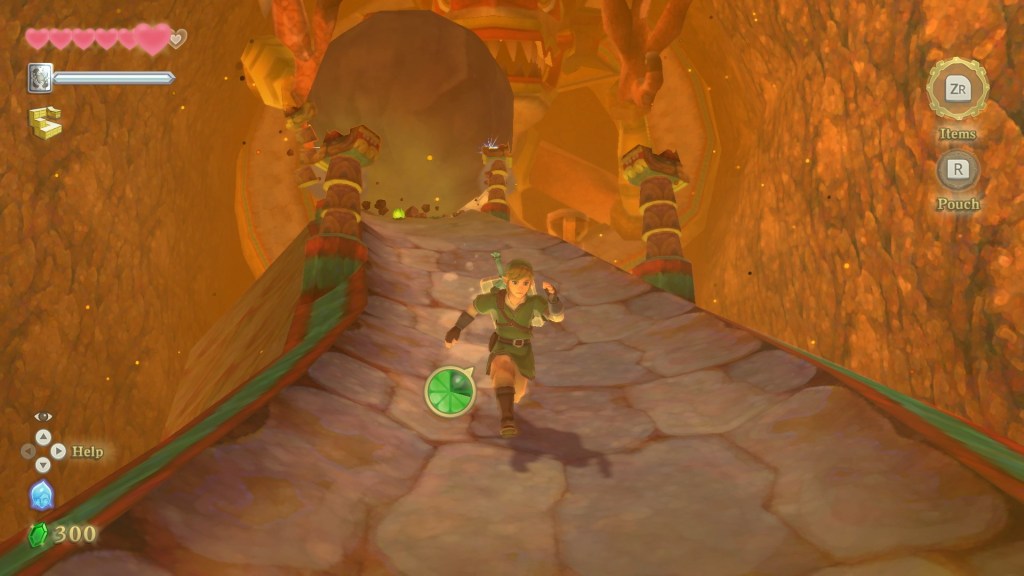
The best moments of Skyward Sword are when the player is left to explore, solve puzzles, fight enemies, and conquer dungeons unimpeded. There’s no doubt that the game boasts some of the best dungeons in the entire series. There’s some wildly creative ideas and well-crafted trials that are the highlight of the game. The desert area in particular has dungeons that make use of timeshift stones that create localized pockets of the past. Using these stones to reveal ancient devices and to clear away millennia of sand to progress forward is a phenomenal idea for puzzles. And the dungeons in the forest are wonderfully atmospheric and serene. Even the moments leading up to dungeons are interesting and unique, utilizing new mechanics and ideas that slowly ramp up in the classic The Legend of Zelda fashion.

Unfortunately, moments in which Skyward Sword lets the player play without interruption are fleeting. From the outset, the game bombards the player with text and cutscenes. The game constantly stops in its tracks to spew unnecessary dialogue, breaking the flow of gameplay. The biggest culprit of this is the spirit of your sword, Fi. She regularly will appear, stating the obvious. It often feels like the game is treating you as if you were stupid, halting progress to tell you “I have calculated the place that you are going towards has an 80% probability of being the correct direction”. The excessive handholding not only feels like an insult to the player’s intelligence, but it also actively impedes the player from having fun.

When I think of The Legend of Zelda, I think of adventure and exploration. The structure of Skyward Sword is far more linear and constrained than the other games in the series. Outside of the starting town in the sky, there are only 3 main areas: forest, volcano, and desert. The game revisits these biomes multiple times each, often revealing new areas that were previously hidden. Occasionally these retreads are interesting because there are spirit trials that test your navigational knowledge of these familiar zones. But after the third visit to each area, I was longing for something fresh. And it didn’t help that the last third of the game felt padded out with unnecessary fetch quests, repeated boss fights, and retreading.

It’s worth mentioning that each zone is completely isolated. The only way to go from the forest to the desert for instance is to find a statue, teleport to the sky, fly to the appropriate hole in the clouds, then drop down into the desert. It feels disjointed, and the sky ends up being a giant level select screen rather than its own thing. And it doesn’t help that flying is a dreadfully boring affair. There’re rarely any obstacles or anything to do in the sky, just fly in a straight line. And because of the motion controls, you’re forced to keep your hand pointed straight, waggle the remote to flap upwards, occasionally pointing downwards to gain some speed. It’s tedious and uncomfortable.

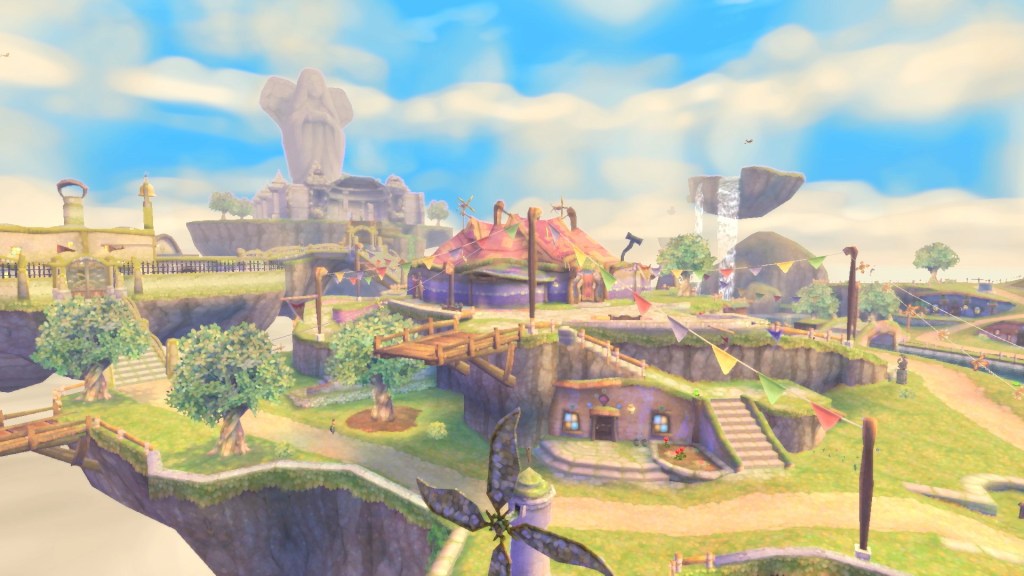
The sky itself is completely devoid of anything. There’s a bunch of tiny islands with practically nothing on them. And there’s occasionally a floating rock with an enemy that shoots rocks at you. That’s it. It’s pretty uninteresting mechanically and visually. Flying should be exciting and thrilling but it’s just boring and cumbersome in Skyward Sword. The one redeeming aspect of the sky is that the game’s main town, Skyloft, is amazing. It’s dense, has cozy hobbit houses for its residents, lots of side quests to discover, and a central town bazaar that hosts all of the shops. Skyloft has a ton of personality to it and I love it, even if the surrounding sky is a barren wasteland.

Even though motion controls never really caught on past the Wii era outside of some niche uses, I appreciate how dedicated Skyward Sword is to this control scheme. Nowadays, motion controls are a gimmick, but Skyward Sword was fully committed to maximizing its use of motion controls. The sword fighting, aiming the slingshot and bow, puzzles, and even basic movement all incorporated motion controls in some way. I don’t think it was always successful, but I appreciate that the developers didn’t treat the game’s central mechanic as just a gimmick, but as the guiding principle of design. It’s a unique scheme that helps Skyward Sword stand out from all the other The Legend of Zelda games. When it works, the motion controls are immersive and give a tangible, weighty feel to your actions. You aren’t just pressing buttons, but swinging your arms and aiming your controller like you would a sword and bow respectively. Unfortunately, the motion controls don’t always work.

It’s an extremely common occurrence in Skyward Sword for the motion controls to just not quite do what you want them to do. Many of the game’s enemies and obstacles require specific directional inputs, and having your attacks rebuked because the game reads your stab as a slash is frustrating. Unfortunately, motion controls will never match the preciseness of traditional button controls. When you press a button, you know exactly what will happen. When you try to swing horizontally, the game may interpret a slight diagonal angle and cause a misfire. Despite the fact that Skyward Sword is a fairly easy game, it is consistently frustrating due to the flukiness of the motion controls.

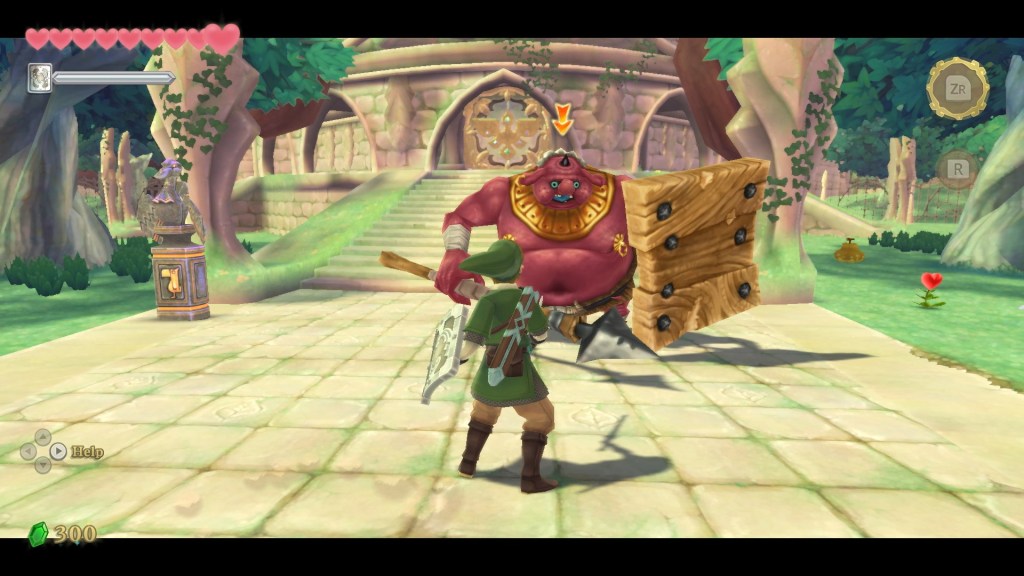
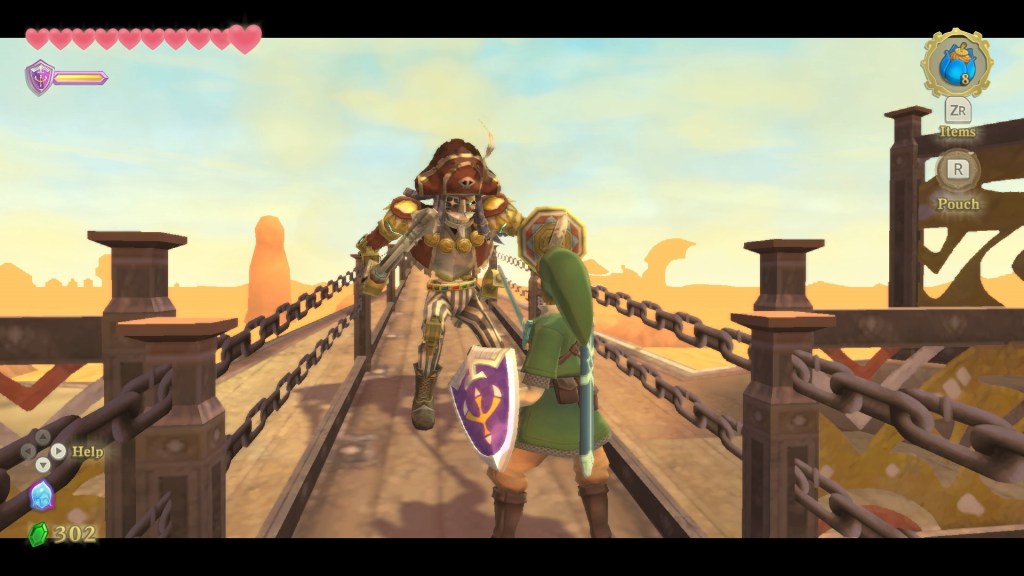
Another factor in the frustration of Skyward Sword is the enemy design. The game clearly wanted to emphasize the motion controls in sword fighting. Most enemies need to be hit from a specific angle to deal damage, and enemies with swords constantly block in different directions, requiring you to attack where they aren’t blocking. This is fine, the problem is that many of these sword-wielding enemies read your inputs and instantly block wherever you decide to attack. If they are holding the sword to their left, you try to swing at their right side, but the game instantly snaps their sword to the right to block your hit. I found it more effective to just flail around randomly rather than take my time to strike precisely because the enemies would just block my attacks if I tried to fight the “proper” way. It really is a shame because the sword fighting is the area where the motion controls could have shined, but it’s way simpler to use other strategies rather than engage in a proper duel.

My final gripe with motion controls is that they make the entire experience mentally exhausting. There is no break from them. You will always be fumbling trying to make the game do what you want it to do. I want to just be able to play for a few hours, get absorbed with the world, and go on an adventure. But the motion controls constantly break the spell of immersion, which is the exact opposite effect that they should have. Even when flying in a straight line you need to focus on keeping your wrist straight. There’s no escape from fighting the controls, which makes the entire game a drag.

I actually quite like the presentation of Skyward Sword. Visually, it’s a middle ground behind the cartoonish Wind Waker and the more realistic Twilight Princess. I think it’s a happy medium, and the impressionist environments are quite pleasant to look at. At a distance, the environments look painted with visible brush strokes and streams of light. I do think the game lacks scenic vistas due to the isolated nature of the areas, but it is pretty nonetheless. The soundtrack is fully orchestrated, and despite it being perfectly enjoyable it doesn’t have that memorable quality that The Legend of Zelda is known for.

I don’t really play The Legend of Zelda games for their stories, but I was pleasantly surprised by Skyward Sword in that aspect. It follows the same good vs evil as every other game in the series, but what makes this entry stand-out is its characters. There’s a handful of character arcs in the game that demonstrate actual growth, which is something rare in the series. I don’t think the story is revolutionary by any means, but I was pleasantly surprised by it.

I played the game in the recent HD remaster for the Switch, which came with a number of quality-of-life changes. The remaster reduced the number of interruptions that Fi forces upon the player. It also fixed one of the most infamous bugs of all time in which every item would halt the game to display a description every play session. I’m glad that the remaster did away with these intrusions, because even in the remaster there are a painful number of halts that kill the pacing. 


Overall, Skyward Sword is my least favorite of the 3D The Legend of Zelda games. Despite having some of the best dungeons in the series, there’s just far too many massive problems that I have with the game. The disjointed world, the constant interruptions, and the imprecise motion controls firmly cement Skyward Sword as the worst in the series. I appreciate its attempts to be unique and have a novel control scheme, but motion controls never reached the level of refinement that would be needed for anything other than some gimmicks. Still, it’s worth playing Skyward Sword for its cleverly designed dungeons.

Bayonetta 3 (2022)

Bayonetta 3 is one of the most frustrating games I have ever played. It’s got such enjoyable core gameplay with a ton of skill expression, but the game constantly interrupts the player with a barrage of annoying gimmicks that get in the way. Mini-games aren’t new to Bayonetta, and having a few to provide some levity and a break from the high-octane combat is understandable. But Bayonetta 3 takes the concept way too far, to the point where it feels like the traditional combat is a minority of time spent in game. I suggest reading my thoughts on Bayonetta and Bayonetta 2 to get full context for the rest of this review. 

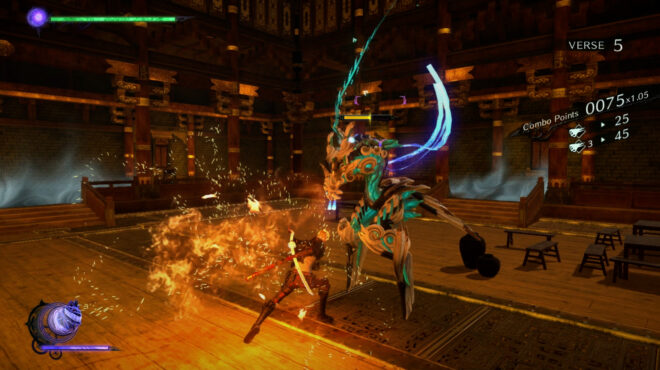
The combat of Bayonetta 3 follows the same formula as its predecessors. Weaving together punches and kicks, using your guns to maintain combos, and slowing down time through well-timed dodges. This iteration abandons the Umbran Climax mechanic from Bayonetta 2, which I think was smart because it was far too powerful. Instead, Bayonetta 3 introduces Demon Slave, a mechanic which lets the player summon a demon to control and fight with. 

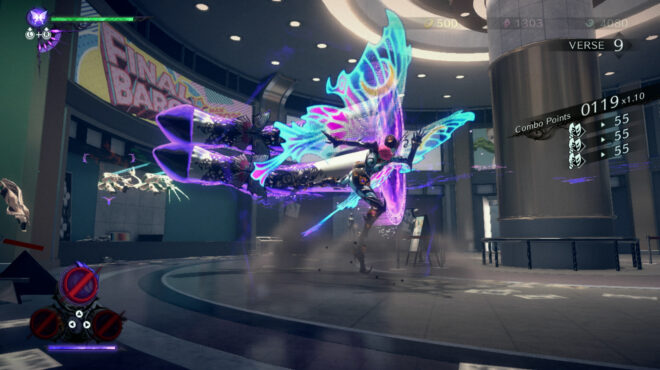
Demon Slave is a much-welcomed addition as it adds a ton of potential for skill expression and mastery. While summoning a demon you cannot control Bayonetta, which means it’s ill advised to always be summoning as you would be a sitting duck for enemies. Instead, you’re encouraged to weave in summons for a couple of attacks in the middle of your combo, letting you extend your combos and deal massive damage without putting yourself at risk. There’re eight main demons to unlock through the course of the game, each having their own abilities to experiment with. Charm enemies with Madam Butterfly, lay tracks for the Wartrain to run over foes, or you or make it rain blood with the frog demon Baal.

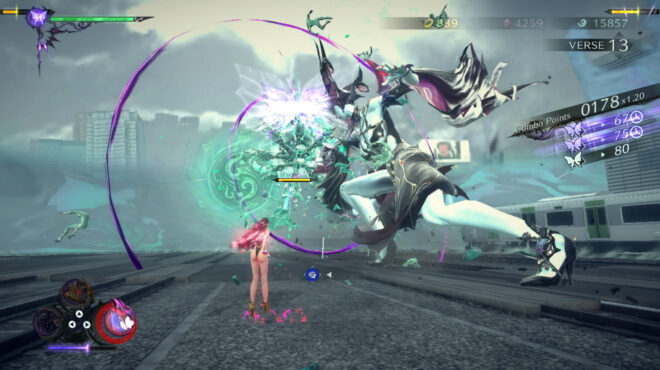
Like its predecessors, Bayonetta 3 has a variety of weapons to unlock and play with. The combination of weapons and demons allows the player to really express themselves to the fullest. Combining different weapons and demons gives a ludicrous amount of potential for mastery. Action games like the Bayonetta series are about more than simply defeating your enemies, but looking cool while doing it. The Demon Slave mechanic provides a ton of spectacle as a godzilla-like demon breathes unholy fire while Bayonetta dances to control it like a puppet. It looks cool and it is a ton of fun to decimate enemies with your demonic pets.

The cost of such grandiose spectacle is visual clarity. Both the player’s demonic summons and the enemies in this game are massive, often occupying the entire screen. Combine that with fast-paced action and colorful effects for an assault on the eyes. I often had an extremely difficult time parsing what was happening on the screen. The camera really struggled and often got stuck inside the bodies of the behemoth demons and enemies. It’s unfortunate because outside of these hiccups, the combat is amazing.

While I did love the core combat of Bayonetta 3, I was shocked by how infrequently the game lets the player partake in it. There’s an abundance of cutscenes, gimmicky sections, and alternate character chapters that disrupt the game’s flow. The Demon Slave mechanic isn’t limited to combat, the game has numerous sections that highlight the other capabilities of the summonable monstrosities. I wouldn’t mind having a few traversal challenges, puzzles, or mini-games tied to Demon Slave, but there’s just way too many interruptions. Sometimes I just want to fight bad guys, not slowly pick up statues and place them on a scale with my bird-demon. Or play the world’s slowest game of rock-paper-scissors as Godzilla. These sections just aren’t very fun. Having a wall of text thrown at you to learn a whole new control scheme for a brief mini-game is clunky and ruins the pace of the game.

Aside from the gimmick sections, Bayonetta 3 is also plagued by the non-Bayonetta chapters. A new character, Viola, is a major player in the story and gameplay. Compared to Bayonetta’s wide array of weapons and demons, Viola only has a single weapon and single demon. She is way less interesting to play than our titular hero, and her control scheme takes a lot of getting used to because it is wildly different from Bayonetta’s. There’s also a handful of chapters featuring Jeanne which serve as a side-scrolling espionage mission. The Jeanne chapters aren’t terrible, but on top of all the other interruptions I found myself wishing that I could just play as Bayonetta some more.

To be honest I don’t particularly care about the story of the Bayonetta series that much. The characters are definitely memorable and quirky, but the plots have always been a convoluted mess. Bayonetta 3 is no exception to this. While I’m not shocked that I found the story of Bayonetta 3 to be dumb, I was surprised by how much time was spent on it. There’s 4 hours of cutscenes in a 14-hour game. For a story-driven game that’s an acceptable ratio, but this is Bayonetta. I want action, I want spectacle, I don’t want to watch hours of cutscenes of a nonsensical story.

The premise of the plot is that the multiverse is under threat by some force known as Singularity. We travel to alternate universes to see alternate versions of Bayonetta and collect special gems to be used to travel to Singularity’s universe and defeat him. You repeat the universe-hopping schtick a bunch of times without much plot advancement until the very end, at which point things go from boring to ridiculous. Again, I wasn’t expecting a narrative masterpiece. But between the gimmicks, Viola chapters, and Jeanne chapters I had no patience left for long, drawn out cutscenes with little substance.

It really is a shame that Bayonetta 3 is crammed with so much superfluous content. It’s the perfect example of “less is more”. It possibly has the best combat in the series, and therefore some of the best combat in all of gaming. But the game is dragged down by a bombardment of underbaked gimmicks, boring alternate characters, and never-ending cutscenes. It is for these reasons that I give Bayonetta 3 a 5.5/10. It is by far my least favorite entry in the series, but if you can look past all of the junk, there is a treasure trove of amazing combat to be uncovered.

Kirby and the Forgotten Land (2022)

Kirby is a series that I’ve always wanted to love more than I actually did. The cute, pink, puff ball is just so endearing. I have fond memories of playing Kirby: Nightmare in Dreamland and Kirby & the Amazing Mirror a bunch when I was a kid. The games are always so vibrant and joyful. But after a couple attempts at playing Kirby: Planet Robobot as an adult, I figured I had outgrown the series. It was an extremely well-made game with a ton of charm and creativity, but the lack of challenge or any meaningful friction meant I found myself growing bored after playing for more than a few minutes. Kirby: Planet Robobot is often discussed as the pinnacle of modern Kirby games, so I decided that my time would be better spent playing other platformers. That was until Kirby and the Forgotten Land was revealed, the first time Kirby would truly jump into 3D.

The primary issue I have with most Kirby games is the lack of friction. The games are meant to be introductory platformers for children and new players, so it is understandable that they are designed to be extremely easy. But you can often just float over most of the levels, and Kirby’s powerful abilities mean most enemies are barely a threat. Kirby is also a fairly slow-moving protagonist, so the act of going through levels can feel lethargic and boring. I want to be clear that I don’t think that this is a fundamental problem with the Kirby series, it is Nintendo’s introductory-level platformer and designed so that children can play successfully. I just prefer the elevated challenge and speed of series like Super Mario and Donkey Kong Country.

Despite my reservations about the Kirby series, I wanted to try Kirby and the Forgotten Land because I love 3D platformers and wanted to see how the pink protagonist would fare in this new environment. I have to say, the jump to 3D did wonders for Kirby. The additional complexity of 3D environments suits the series marvelously. The game maintains the slower pace that the series is known for, but 3D levels allow for more engaging exploration and more creative level design. 

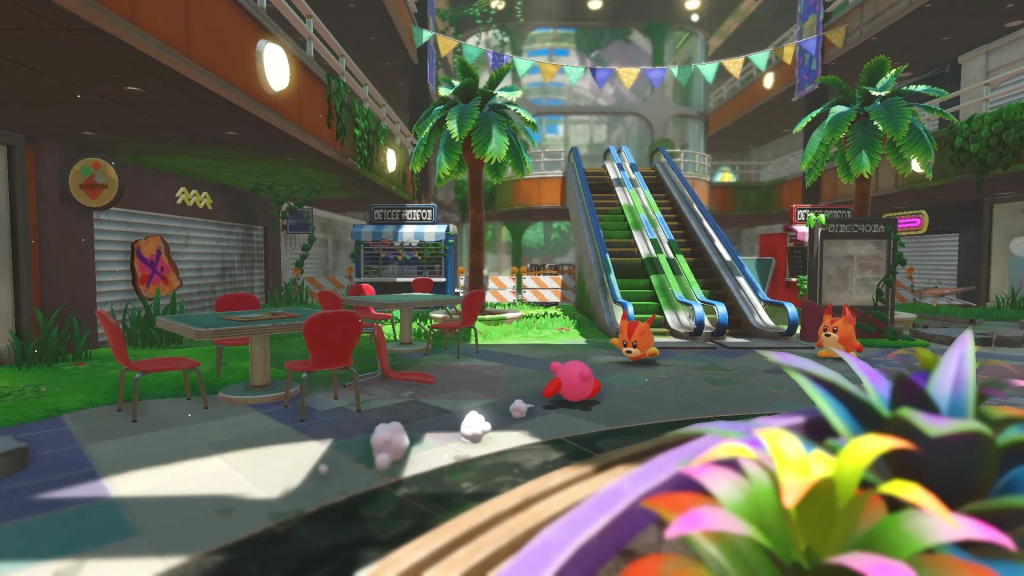
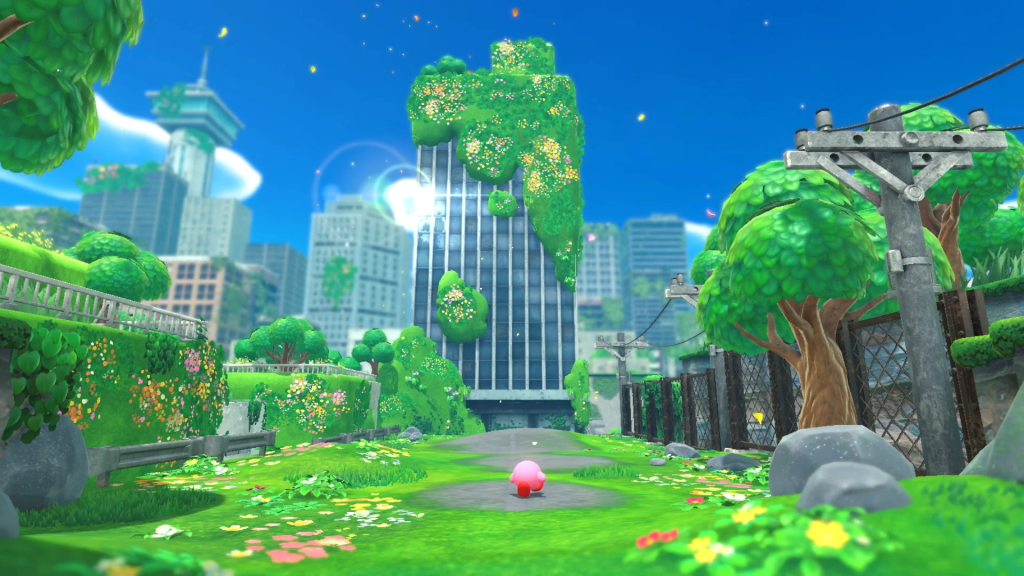
The game takes place on a post-apocalyptic Earth where genetically mutated animals have taken over what’s left of the civilization. The setting is quite different from the normal fantastical Kirby affair, and I loved the juxtaposition of Kirby’s silliness with the more grounded environment. The first major zone is a derelict city that is now overgrown with vegetation, and each following locale is an equally surreal place for Kirby. I particularly enjoyed the amusement park and its numerous attractions; riding roller coasters and exploring dimly-lit funhouses was a blast.

The levels are in the “course clear” category, meaning they are fairly linear platforming challenges with a goal at the end. While I do think Kirby would thrive in a more exploration-driven open environment like in Super Mario Odyssey, I also think that maintaining the linearity from the 2D entries in the series was a good idea for a first foray into 3D space. You can tell that a ton of love and care was poured into the levels in Kirby and the Forgotten Land. There are so many little details and things to discover. The world is just so vibrant and charming to spend time in.

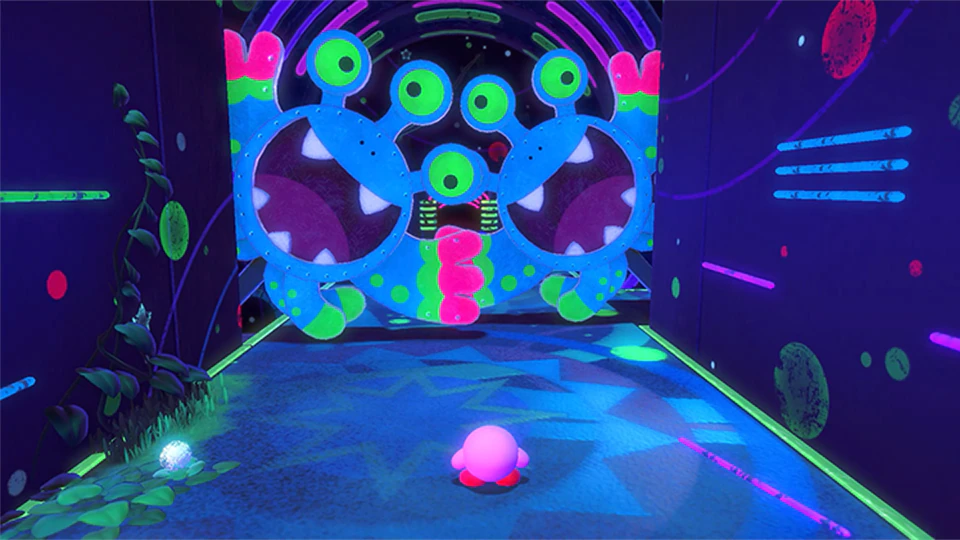
An aspect that I loved about the level design is the creativity. Nearly every level has some unique idea or gimmick that is central to its design and theming. I love the escalation of each idea through individual levels. For example, navigating a simple maze in the dark evolves into a pitch-black funhouse with narrow ledges, creeping enemies, and moving obstacles. There’s a handful of “Mouthful” abilities that let Kirby utilize common real-life objects. You can use vending machines to shoot cans at enemies and destructible terrain, or use traffic cones to smash through leaky pipes and launch upwards, or zip around a race track as a Kirby/car amalgamation. Not only are these abilities fun departures from standard gameplay, their inherent visual goofiness fits Kirby perfectly.

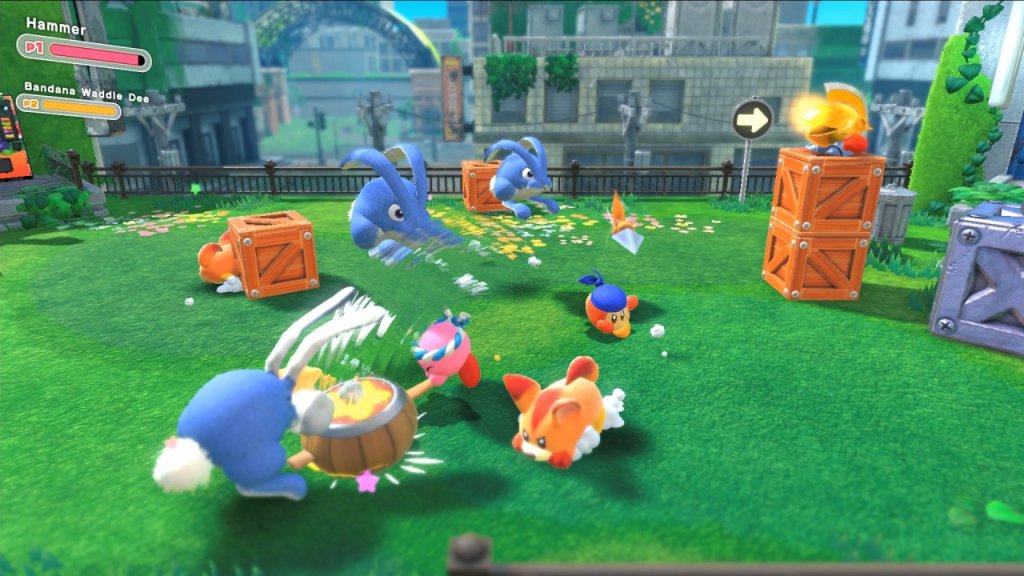
Even though the levels are relatively linear, there is incentive to explore. In every standard level there are hidden Waddle Dees to be rescued who can later be found in your hub town. Furthermore, there are secret challenges that will reward you with even more Waddle Dees. I think encouraging exploration is a great thing when so much heart and detail is poured into these levels. My one complaint is that some of these secret challenges are quite obtuse and are difficult to discover on your own. If you miss a challenge, you only get to see it revealed upon clearing the stage, and even then, only a single challenge is revealed at a time. Meaning if you miss a few challenges, you may be replaying the same level three or four times searching for its secrets. I think just revealing all of the challenges upon first completion of the stage would be a happy medium between letting the player discover things on their own and preventing having to replay the same level over and over.

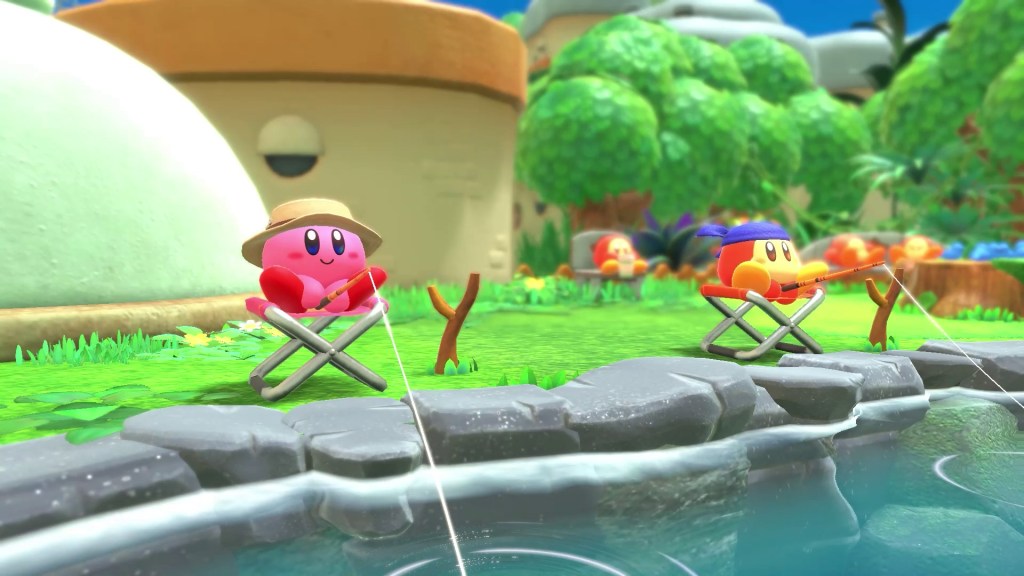
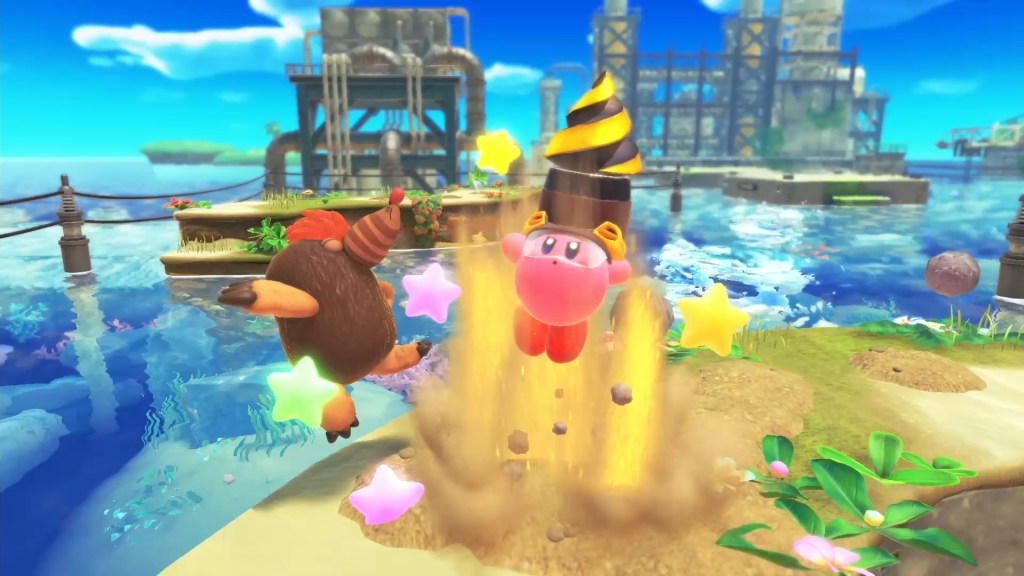
The exploration aspects tie in quite nicely with how progression works in Kirby and the Forgotten Land. As you rescue Waddle Dees, the hub town will slowly expand and add new features. There are collectible trophies in capsule machines, mini-games such as fishing, consumable items to purchase like health and attack boosts, and coliseum to challenge a gauntlet of bosses. But the big addition is the blacksmith. Here is where you can upgrade Kirby’s classic copy abilities to more powerful versions of themselves. Not only are these raw damage increases but they also modify the abilities with additional effects. Bombs become homing explosives that track enemies, the drill ability creates buzzsaws that bounce around the arena, crash slows time in addition to its traditional massive damage. All these upgrades are fun to experiment with, especially because the game is lacking some classic abilities such as stone and beam.

The main resource to power-up the abilities are stars that are earned by completing Treasure Road levels. These are separate stages from the main levels. They are typically very short and require the player to clear the stage using specific copy abilities or Mouthful abilities. I quite enjoyed doing these because they forced me to experiment a bit and can provide a decent challenge if trying to beat the target time. You aren’t required to beat the target time to earn your reward, but I found it very fun to optimize and learn how to get the most out of my abilities in these 30-second challenges.

Like any Kirby game, Kirby and the Forgotten Land is extremely easy. But the level design, exploration aspects, and progression kept me from getting bored like I did when playing many of the 2D Kirby titles. There’s even a difficulty selection when you are starting a new file which is a great addition. I would’ve loved to see an “very hard” option because even hard mode was a bit too easy for a majority of its play time. I think Kirby has the capability to be an excellent 3D platformer/brawler, and the post-game showcases that untapped potential. 

The fairly extensive post-game has remixed levels and amped-up bosses that I thoroughly enjoyed. The bosses in particular were so much more challenging than their base-game forms. And the final coliseum challenge was a real gauntlet that had me sweating on its secret final boss. Moving into 3D space allowed the developers to get creative with boss movesets and really force the player to learn how to position and dodge. And I loved experimenting with the different copy abilities to see which ones fit my playstyle and which ones thrived against certain bosses. That being said, the vast majority of regular enemies, mini-bosses, and bosses outside of the post-game were pushovers. To be fair, that is to be expected in a Kirby game, but I would’ve loved some more difficulty options to appeal to players who want a bit more challenge.


I’m glad that despite my hesitations around the Kirby series that I decided to give Kirby and the Forgotten Land a chance. It’s a delightful switch-up from the traditional formula and the new 3D environments mesh wonderfully with the slower pace of Kirby. It’s apparent that a ton of care and love was poured into the world and levels of this game. Each stage is a delight to explore, even if the game is a bit too easy. It is for these reasons that I give Kirby and the Forgotten Land an 8/10. I hope the future of Kirby holds more games like this one, because I want more.

Stephen’s Favorites of 2024

I feel like 2024 was the first year where I at least tried to keep up with recent releases. I wanted to highlight the games from this year that were my absolute favorites. Of course, as someone with a full-time job, a family, and other hobbies, I didn’t get to play every major release of this year. There were plenty of games on my radar that I didn’t get around to such as Indiana Jones and the Great Circle, Lorelai and the Laser Eyes, and the remake of Silent Hill 2. Here are all the 2024 releases that I managed to play:

Now let’s get into my favorites of the year.

UFO 50

UFO 50 is a truly unique experience and we may never see anything like it ever again. It’s a collection of 50 retro games made by the fictional company UFO Soft. It’s an absolutely astonishing collection in both breadth and depth. Every classic genre is included, but no entry is a simple imitation of an actual retro game. Every game has a unique twist. There are so many gems in the collection. You could easily sink hundreds of hours into UFO 50 and still have games you’ve barely touched. The creators behind UFO 50 describe it as a blend of retro aesthetics with modern game design knowledge, and they absolutely nailed that aspiration. Read my full review here.

Astro Bot

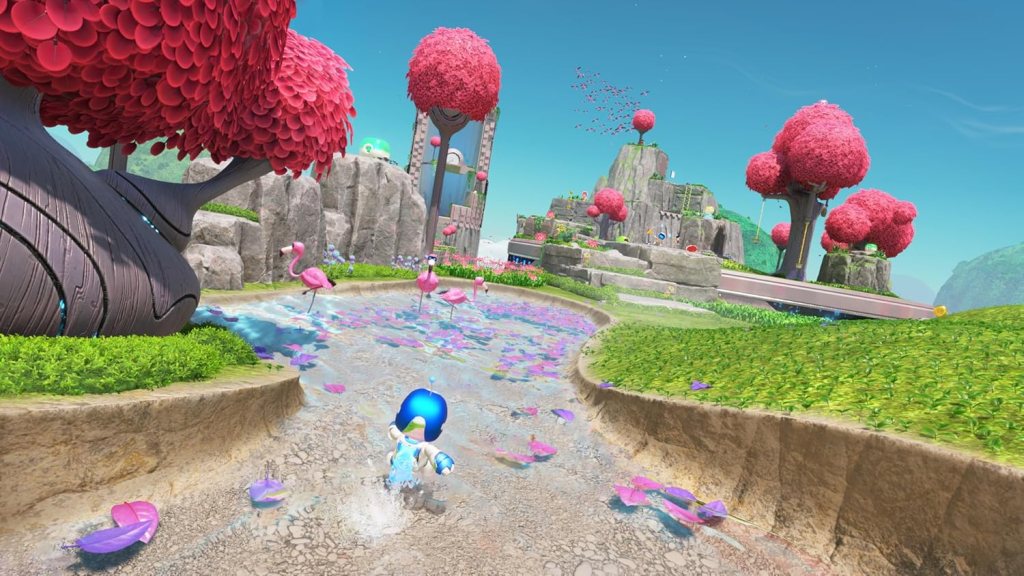
Astro Bot may not be the most innovative game out there, but damn is it fun. The joy I got from exploring its wonderfully detailed levels was reminiscent of playing Super Mario Galaxy as a kid. Every level had some sort of set piece, theme, or unique power-up that had me smiling. And I loved visiting the hub world to try to identify all the robots dressed up as classic Playstation characters. Astro Bot is just wholesome fun. Read my full review here.

Balatro

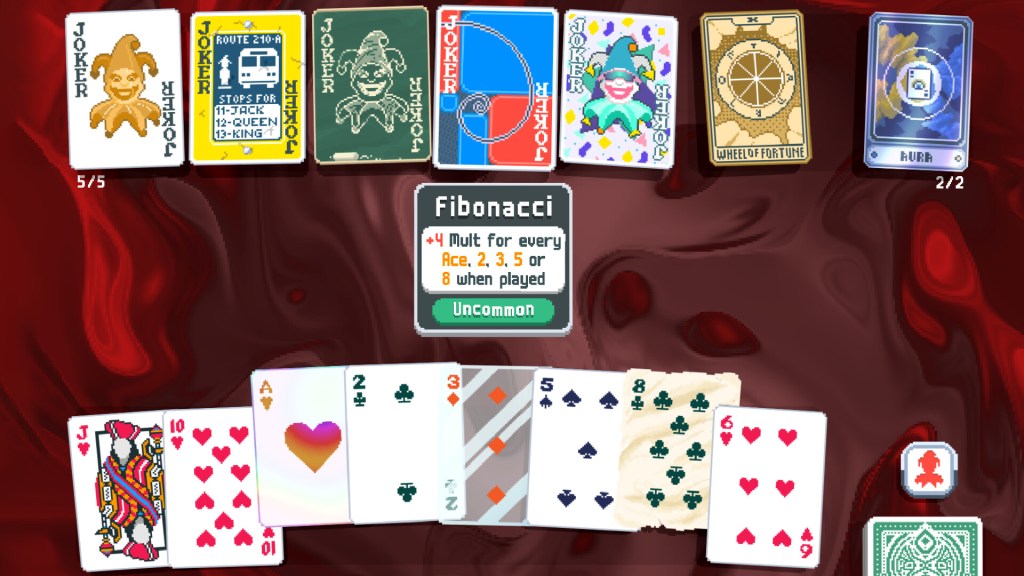
Balatro is the most addicting game on my list. In this roguelite deck-builder you play poker hands to score points. As you progress through a run, you can modify your deck in a multitude of ways. The main way to increase your score is by acquiring jokers which vary wildly in their effects. The sheer randomness of Balatro is what makes it shine. There are so many different ways to build a successful run and every time you play, you’ll think you found a new overpowered combo. Read my full review here.

Animal Well

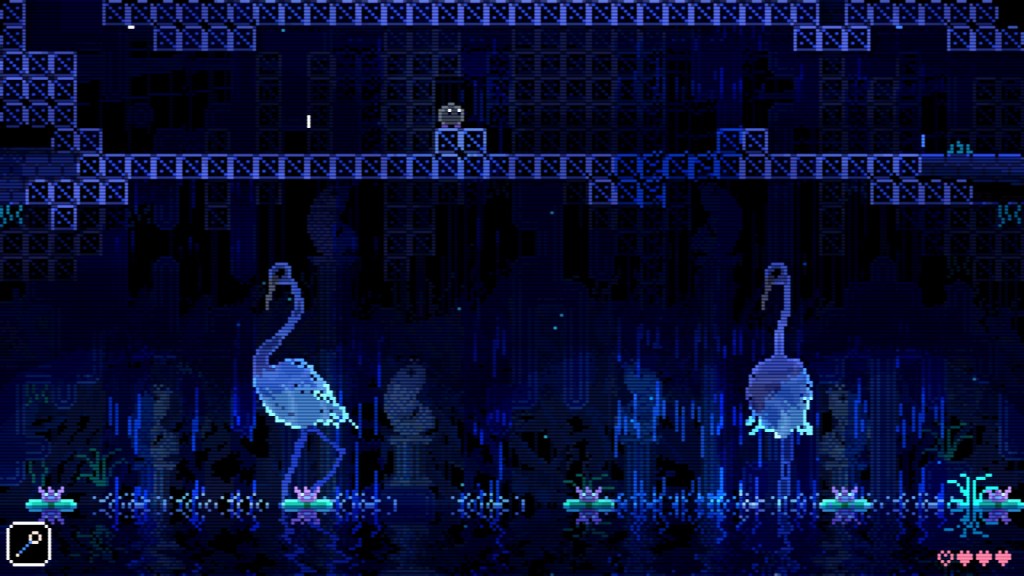
Animal Well is a surreal metroidvania. It’s a labyrinth full of mystery. Figuring out how to explore and interact with the world and the animals was enthralling. Without any guidance, the world is up to you to discover. Secrets upon secrets are layered atop each other, some requiring a dedicated community to unearth. It’s one of the most atmospheric games that I’ve ever played with ethereal visuals and echoey auditory effects. Read my full review here.

Pikmin 4 (2023)

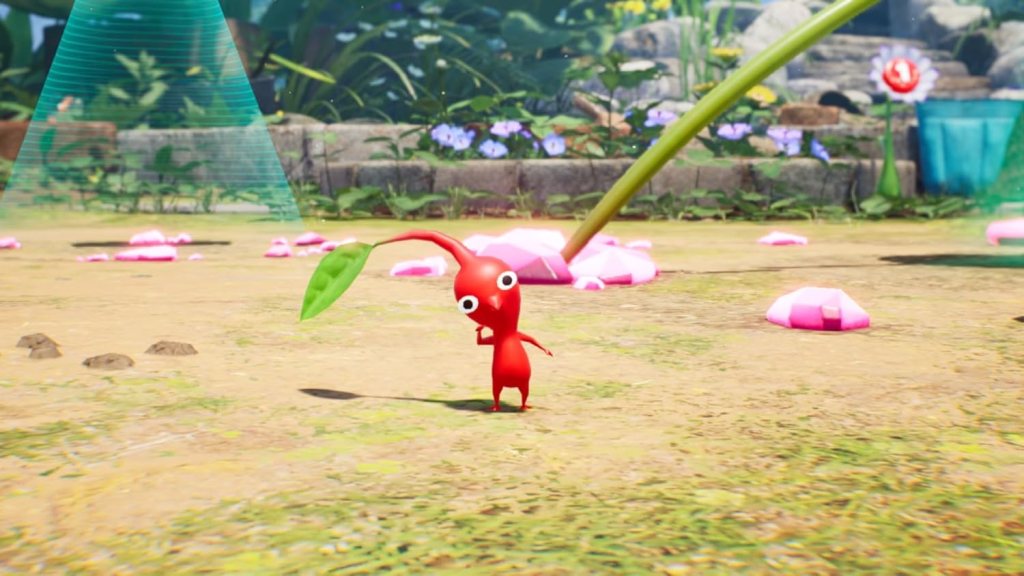
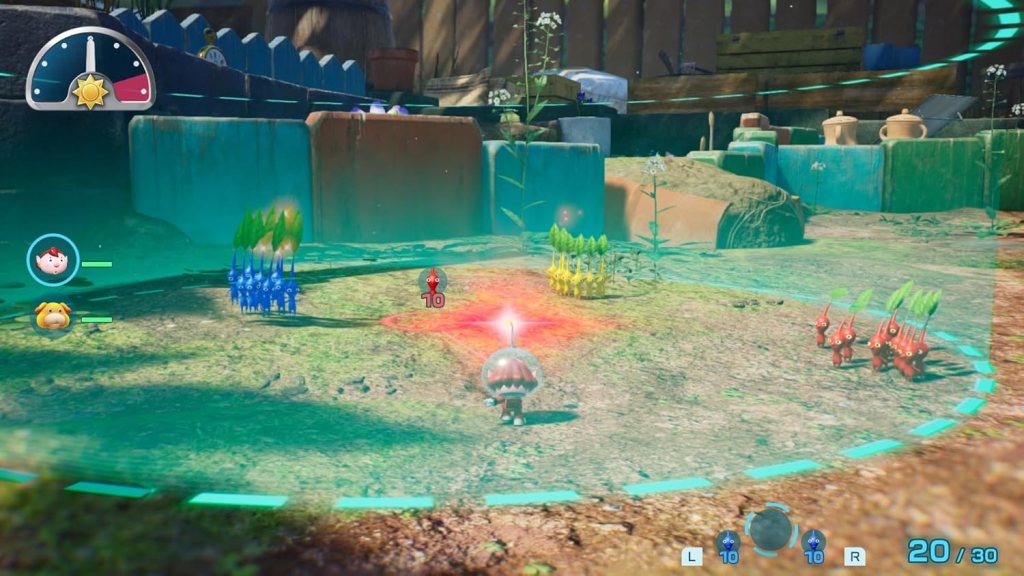
Pikmin has always been a series that has had underwhelming sales numbers. The cutesy aesthetics paired with the horrific reality that you will lead your squad of adorable little guys to their brutal demise means that the audience for these games is limited. I suspect people are discouraged by the time limit or the stress of having your pikmin get eaten, electrocuted, lit on fire, or otherwise killed. After the long hiatus following the release of Pikmin 3, it feels like Pikmin 4 is an attempt to appeal to a larger audience. In some ways, this is a fantastic thing. Pikmin 4 is the biggest, most complete game in the series. On the other hand, the concessions made in hopes of attracting new players actively harm the game.

Like every other game in the series, Pikmin 4 is a real-time-strategy game where you grow hordes of cute creatures known as pikmin to complete tasks for you. They are fairly brainless, so they form a symbiotic relationship with the player. You lead them around and command them to fight enemies, retrieve treasures, and carry pellets back to base so that more pikmin can sprout. Individually, each pikmin is weak, but as an intelligent swarm they can conquer the environment and tackle massive foes.

The most impressive aspect of Pikmin 4 is its scale. This game is bigger than its three predecessors combined. And it combines all the elements from the previous games to deliver the most complete experience. Every zone is a sprawling playground to explore with dozens of treasures to find. Caves make a return from Pikmin 2, but are intentionally designed rather than relying on randomized layouts. Challenges from Pikmin 3 are now woven into the main campaign and are honestly my favorite aspect of the whole game. Every type of pikmin makes an appearance. It’s genuinely impressive how much they managed to squeeze into this game.

The larger areas don’t feel overwhelming as they are somewhat split into smaller zones. As you explore there are predetermined spots for you to move your ship and the pikmin’s onion to, making it easier to haul treasures and grow more pikmin without having to run all the way back to the original landing site. Much of the game’s content is also found in the caves. While I wasn’t a fan of caves in Pikmin 2 due to their repetitive nature and random layouts, I think Pikmin 4 executes on the idea much better. They have intentional design to challenge the player on their puzzle-solving, combat, and navigation skills. I still much prefer the open surface areas to caves, and I do think that Pikmin 4 has a handful too many caves, but the dungeon-crawling they provide is a fun detour from the open-ended exploration.

Aside from caves, there are also Dandori challenges to be discovered as you explore. Dandori is the art of strategizing and executing a plan for maximum efficiency. To me, this is one of the strongest aspects of the Pikmin series. Dandori challenges come in two forms: time trials and battles. The time trials are 5–10-minute challenges in a small arena where you have to strategize how to get all the treasure as fast as possible. I loved solving each of these challenges like it was a puzzle. Figuring out where I should start, which pikmin to pluck, which enemies to defeat, and what order to do things was quintessential Pikmin. Getting all the platinum medals on these time trials was challenging but achievable, and it was my absolute favorite aspect of Pikmin 4.

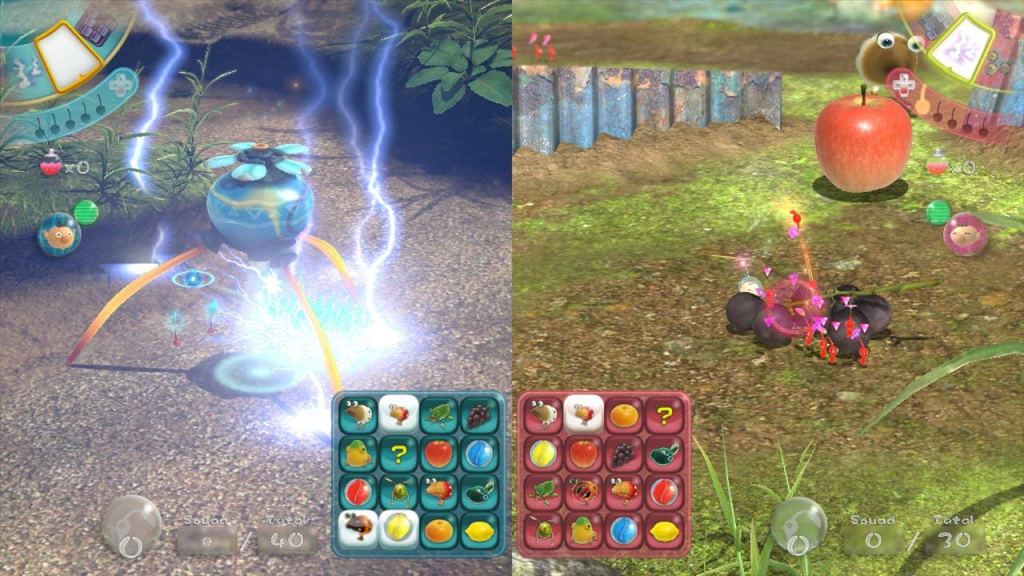
The Dandori battles on the other hand had a major flaw in their execution. These battles are similar to the time trials, but you are facing an opponent with their own army of pikmin. You both try to collect treasures to gain points, and it is a frantic experience as treasures and enemies frequently respawn. There’s also power-ups and items to sabotage your foe. I really like the idea behind these battles and there is an extra layer of depth as you have to consider which treasures are worth fighting over. But the big issue I have is that for some reason these battles have a split screen view. Half the screen is dedicated to the AI opponent’s point-of-view. It makes playing these battles feel super claustrophobic and hard to tell what’s going on. I don’t think I ever looked at the opponent’s screen to see what they were doing. At the very least, this should have been a toggleable feature so I could turn it off and focus on my own strategy.

Another major shakeup to traditional Pikmin gameplay is the inclusion of night expeditions. These are missions solely focused on defending your base from enemies. You command a new variety of pikmin, called glow pikmin, which excel at combat. These missions are fairly short and aren’t particularly difficult, but I did enjoy taking a break from normal daytime exploration to partake in some frantic defense. Ultimately, I think Pikmin 4 attempts to appease every aspect of the series’ fanbase. Between the combat focused night expeditions, optimization heavy Dandori challenges that require multitasking, dungeon crawling caves, and the laidback exploration of regular areas there is something for everyone to enjoy. 

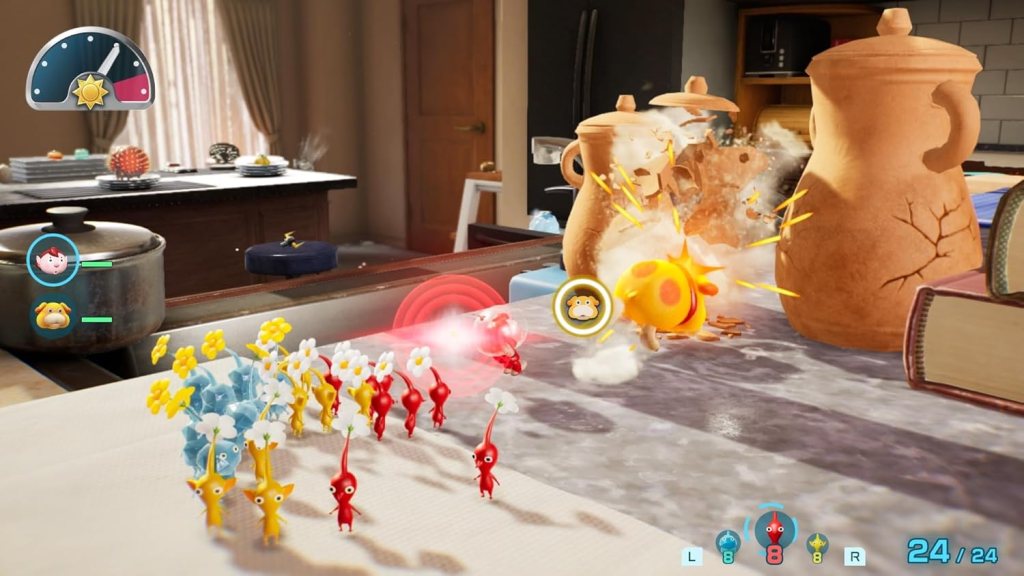
Not only does Pikmin 4 impress with the scope of its gameplay, but it also is one of the best-looking games on the Nintendo Switch. The environments, characters, and creatures all look fantastic. More importantly, I love the environments of the game. Every area is obviously inspired by micro-slices of Earth. A backyard garden becomes a massive area to explore. The shifting tide on the beach leads you to climb a sandcastle. My favorite area is the inside of a house. Figuring out how to navigate the furniture in the living room and kitchen is a great mix-up from the more naturalistic environments that Pikmin is known for. I really do love the focus on the environments created by humanity. It inspires imagination about what sort of life exists at the micro scale on our planet. Who knows, maybe there are little aliens running around collecting bottle caps and buttons when we aren’t looking.

Despite everything that Pikmin 4 does right, it also makes a ton of mistakes in an effort to appease new players. The issues are immediately apparent from the start as Pikmin 4 has one of the most painful tutorials I’ve ever played. The game takes forever to let the player start playing. And when it does, it constantly wrests control away from you to give you a tutorial on even the most straightforward of mechanics. Even after the tutorial the game throws giant text boxes on the middle of the screen during gameplay. After playing for 30 hours, I don’t need my vision obstructed by a tip telling me that there are pikmin at my base ready to be plucked. 

There’s just too much talking in general. The original Pikmin was an isolated, alien experience. After every day the characters talk on and on about nothing. Despite the large cast of characters, I can’t remember anything about any of them. In Pikmin 4 you take the role of a member of the rescue corps on a mission to rescue characters stranded on Earth. The rescue corps sets up a base where everyone you rescue hangs out. I appreciate the idea of having a cozy hub to hang out in, but it’s extremely barren and all the characters just feel like they are stapled on. I wish some temporary buildings or structures would be built as you progressed. Like having shops for items, upgrades, and cosmetics rather than just having those characters stand around in the open. I would have loved it if this hub had some personality.

Gameplay wise, there’s a wealth of issues. First and foremost is the control scheme. The game forces automatic lock-on on the player, with no way of toggling it off. The result is that many combat encounters are dumbed down to a single button press. You no longer have to aim your cursor; the game takes that skill out of the equation and guarantees that your thrown pikmin will land on target. The mechanic also becomes unwieldy during late-game encounters with many enemies because the automatic lock-on is incredibly “sticky”. A frequent annoyance is trying to prioritize a high-threat enemy but the game decides to prioritize random treasure or other tasks.

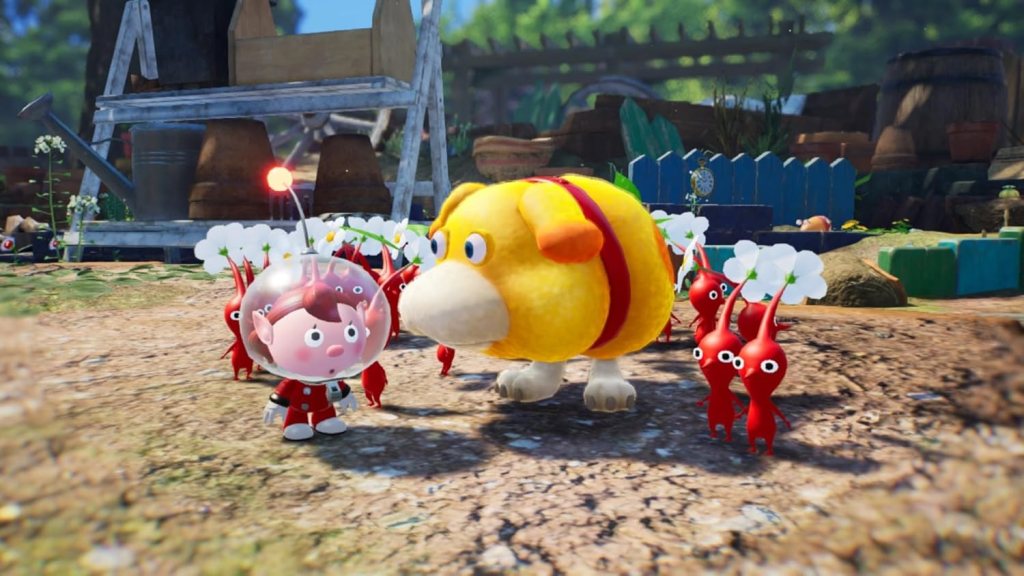
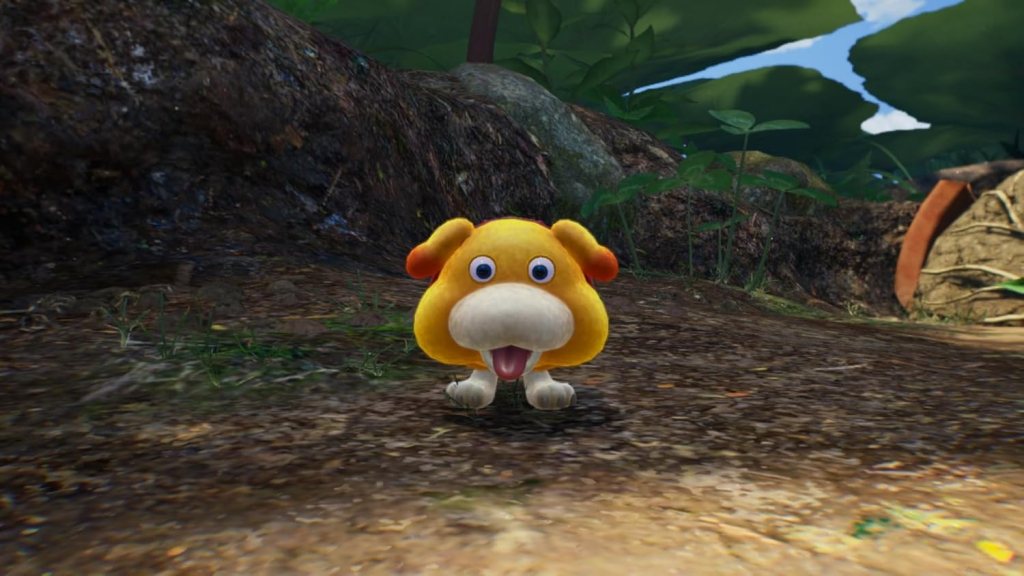
Pikmin 4 provides the player with a massive toolset. There’s a robust upgrade system that not only increases your health and elemental resistances, but also provides utility such as calling all idle pikmin to your side. There’re purchasable items such as bombs and stunning lightning to be used on tougher enemies. But the biggest addition to your arsenal is Oatchi. Oatchi is an alien dog trained to assist in rescue missions. Listen, I love dogs, and it’s hard not to love Oatchi, but Oatchi borderline breaks the game. 

The problem with Oatchi is that Oatchi is too good at everything. Oachi can fight enemies and can defeat most of them single handedly. Oatchi can carry heavy objects. You can ride on Oatchi’s back with your squad of pikmin. This is particularly useful because it makes it remarkably simple to have your squad of pikmin avoid enemy attacks. In previous games, having a squad of 100 pikmin could be unwieldy to control, but now it’s a breeze with Oatchi. You can also charge at enemies which deals damage, stuns them, and flings your entire squad of pikmin on their back. The vast majority of enemies are decimated by the combo of being stunned and having 100 pikmin attacking them. It genuinely feels like the game isn’t designed for the havoc that Oatchi can wreak. It’s until the final boss of the post-game that I encountered an enemy that felt designed with Oatchi in mind.

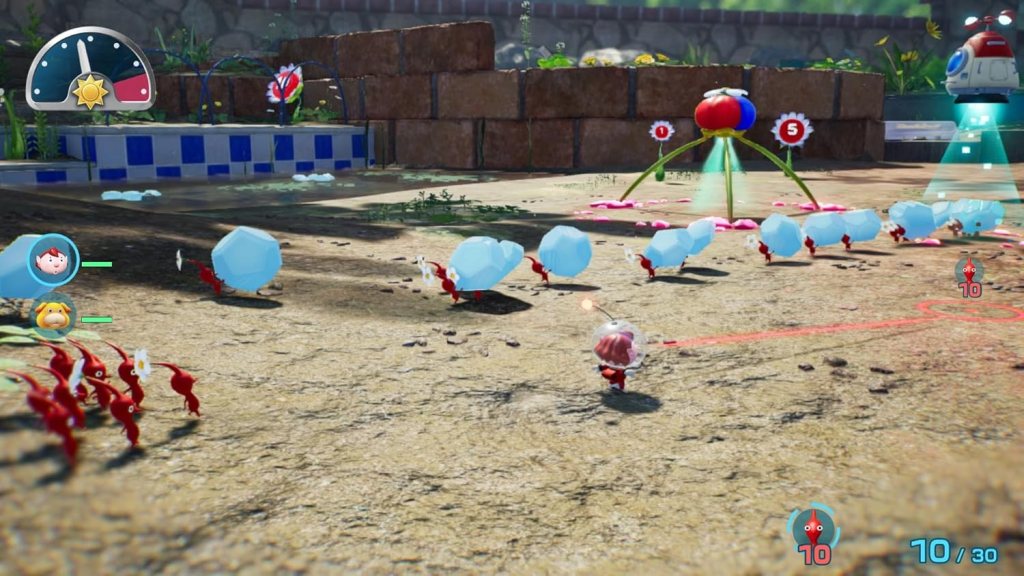
Aside from Oatchi, another major addition is the inclusion of ice pikmin. This new type of pikmin can freeze bodies of water if enough of them are occupying it. This is a great strategic addition as it creates traversable paths for your squad, but at the temporary cost of dozens of pikmin. In combat, ice pikmin are extremely overpowered as they can rapidly freeze enemies. This is balanced by having ice pikmin do less damage, but just a handful of them is enough to freeze enemies while the rest of the squad deals the damage. They are at least somewhat kept in check by the fact that your supply of ice pikmin is limited until very late in the game.

I think there was massive potential with providing the player all these overpowered options such as items, Oatchi, and ice pikmin. It could be framed that beating the game is a foregone conclusion, but maximizing your efficiency to do it quickly is the point. There’s only one Oatchi, so choosing what to have them do could be an interesting decision. Picking the optimal place to use items to save time could be fun. Ice pikmin would be more balanced by their lack of damage if you had to go quickly. But unfortunately, I don’t think Pikmin 4 does a good job at encouraging this efficiency by default.

For a game that emphasizes the concept of Dandori, there is very little need for speed outside of the Dandori challenges. There is no day limit in Pikmin 4. Every individual day has a timer, but it’s irrelevant since you can just end the day and start a new one rather than risking running out of time while doing a task. Dandori challenges and some of the post-game content are my favorite aspects of the game because they do put some pressure on the player. Having to think about the best way to use the tools available to you and what route to take is engrossing even if the combat is on the easier side.

The major flaw of Pikmin 4 is that it lacks an edge. There’s no element to provide friction that inhibits the player from just steamrolling the whole game. The wealth of new tools makes most combat encounters easy. Without a time limit there is no need to optimize and think about how to tackle exploration efficiently. There’s not even a significant number of puzzles like were present in Pikmin 3. As I played, I often felt that I was just going through the motions, that the game just kind of plays itself. I really would’ve appreciated something that made the moment-to-moment gameplay a tad more thoughtful. I’m ok with the game being relatively easy, but there still needs to be a threat to keep the player engaged.

The Pikmin series is one of evolution. You could never say that it’s stagnating or failing to implement new ideas. I love the grandiosity of Pikmin 4; it certainly feels like the ultimate Pikmin experience. But the lengths gone to attract new players makes the experience feel neutered. The automatic lock-on, the drawn-out tutorial, the lack of an overarching time limit, and the overpowered tools that the game provides all dull the edge that the series once had. It is for these reasons that I give Pikmin 4 a 7/10. Every game in the series has something to offer, and while Pikmin 4 may lack friction, it’s a solid collectathon with a ton of content.

Pikmin 3 (2013)

It should be no surprise that the 9-year gap between Pikmin 2 and Pikmin 3 led to massive visual and technical improvement. Not only does the game look better and feel smoother to play than its predecessors, but it further enables one of the best aspects of the Pikmin series: multitasking. What makes me excited about the Pikmin series is that the games aren’t necessarily iterative sequels. Each one of the games has its own unique structure that places emphasis on different aspects of the series. The first Pikmin was all about time management, Pikmin 2 focused more on combat and reacting to sticky situations, and Pikmin 3 hones in on multitasking. For full context, you can read my reviews of Pikmin and Pikmin 2.

The game begins not with our beloved Captain Olimar, but instead we follow the story of a crew of 3 new characters. Alph, Brittany, and Charlie have been tasked with searching the galaxy for a new source of food as their planet faces starvation. They crash land on Earth and lose critical ship parts that they need to get back home. As they track down the ship parts, they also discover the bounty of fruit that grows on Earth and set out to collect all the seeds that they can to revitalize their own planet.

The structure of Pikmin 3 is more objective based than its predecessors. You are often given an obvious goal to pursue whether it be tracking down a signal to a ship part or trying to rescue a crew member. There’s no looming 30-day limit like in the original Pikmin, but you do need a steady supply of fruit juice to stay alive. As you explore the world you collect fruit, partly to bring the seeds back home, but also to turn into juice for immediate nourishment. It’s more lenient than a set day limit, but I do appreciate that there was some form of time limit. Even if you’ll probably have way more fruit than you need, having that motivation to maximize every day is a good thing.

Having 3 crew members to control is just the beginning of how Pikmin 3 emphasizes multitasking. You can switch between them freely and have each character control their own horde of Pikmin. You often need to solve puzzles that require you to toss the crew across gaps or on higher up platforms. But the big addition is the “go here” functionality. When you open the map, you can click on a spot and command the character that you are controlling to walk there automatically with their horde of Pikmin. This enables the player to have all 3 characters be actively doing something and allows them to optimize for speed. You could be fighting enemies with Alph, have Charlie walk back to the base to pluck Pikmin, and have Brittany lead her horde to a new location all at the same time.

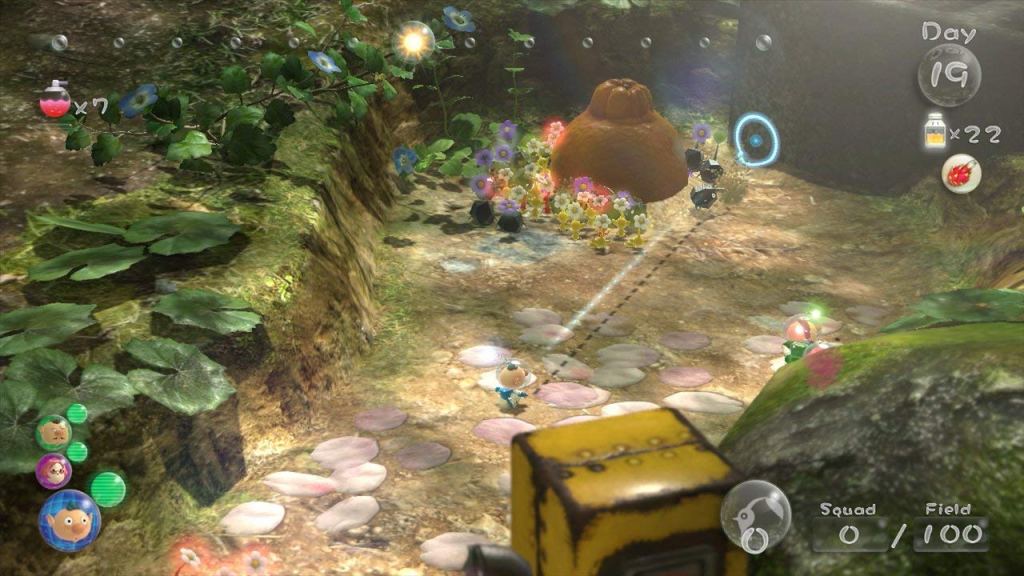
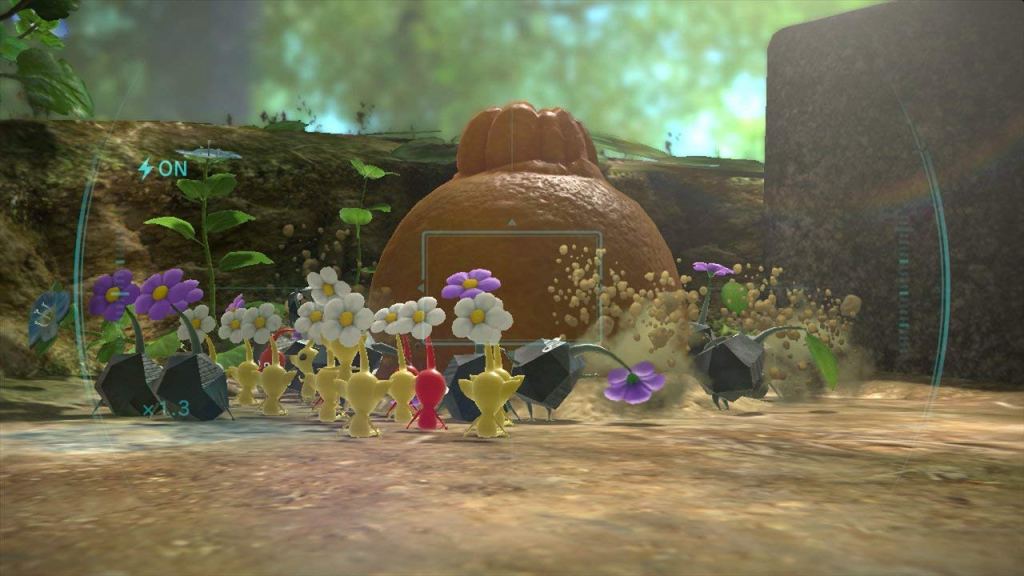
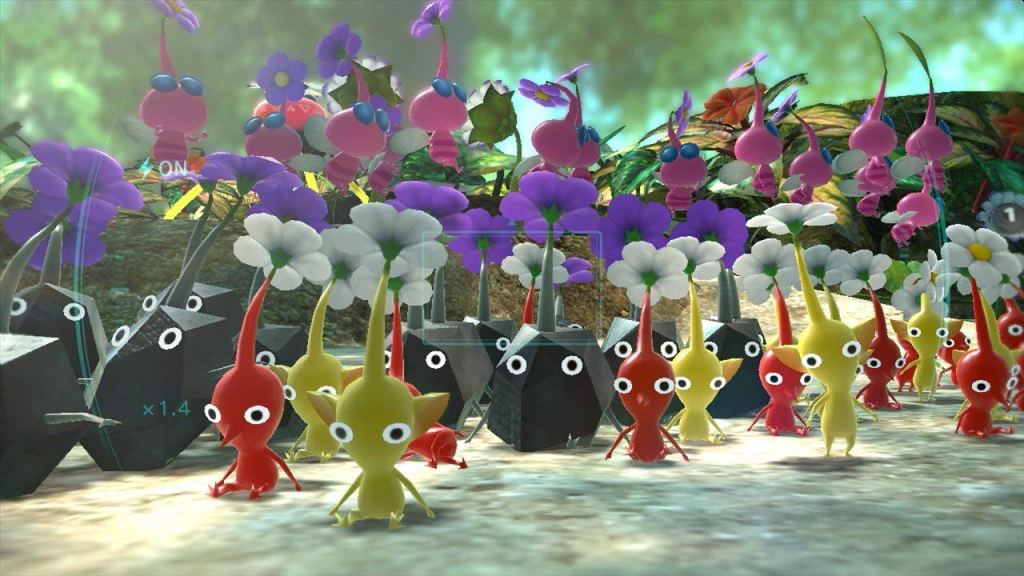
I also enjoyed the addition of both new Pikmin types. Pikmin 3 excludes the Purple and White Pikmin from Pikmin 2 and replaces them with Rock and Flying Pikmin. Not only are they adorable, but they have distinct strengths and weaknesses. Rock Pikmin can shatter crystals and do a ton of damage if thrown on an enemy, but they cannot latch onto enemies for repeated hits like other Pikmin types. Flying Pikmin can soar over terrain to carry objects and are great at dealing with airborne enemies, but they deal low damage overall. Both these new types are useful without being overwhelmingly powerful like the Purple Pikmin were.

There is also a plethora of quality-of-life improvements that make Pikmin 3 a much smoother experience than its predecessors. The Pikmin AI is much better in general and they rarely, if ever, get caught on terrain or fall off ledges. Instead of haphazardly swarming you can now use the specialized charge attack to order your Pikmin to rush at an enemy or item. But one of the bigger changes is the lock-on functionality. In previous games you constantly had to be aiming your cursor at whatever you were tossing your Pikmin at. In Pikmin 3, you can just lock onto your target and throw with confidence knowing your Pikmin would land on target.

The downside of having so many quality-of-life improvements is that it also results in the game being significantly easier than its predecessors. Without worrying about Pikmin killing themselves in frustrating fashion you can command your Pikmin with much more confidence. The charge attack makes it simple to burst down enemies quickly. The lock-on functionality makes it exceptionally easy to run circles around enemies. While I don’t think aiming should be the primary focus of a real-time strategy game, I do think it was a meaningful skill expression to keep the cursor on enemies as you kited. I’m torn on the inclusion of lock on because of this. Moreover, I feel like Pikmin 3 enemies have reduced health for whatever reason, making the game even easier. Basic enemies are just too easy to takedown and don’t pose much of a threat.

Even though regular enemies were a bit too easy, I did enjoy the dynamic boss battles that Pikmin 3 offers. They aren’t super challenging by any means, but they are fantastic spectacles with interesting arenas and mechanics. Figuring out how to exploit the boss’ weakness is an enjoyable experience, and it can be a little tense if you are running out of time during the day. Even if they are easy, I had fun with them. But if you are looking for a real challenge, you’ll have to look towards the mission mode.

The mission mode in Pikmin 3 is additional content outside of the campaign. These are timed challenges with a few variations: treasure hunt, battling enemies, and boss battles. These are specifically tailored maps that you really have to plan out routes and optimize if you want to get a platinum medal. I spent a good amount of time getting a handful of platinum medals on the treasure hunt missions. I think this was an excellent inclusion because it lets players play around with optimization, time management, and multitasking without having to replay the entire game.

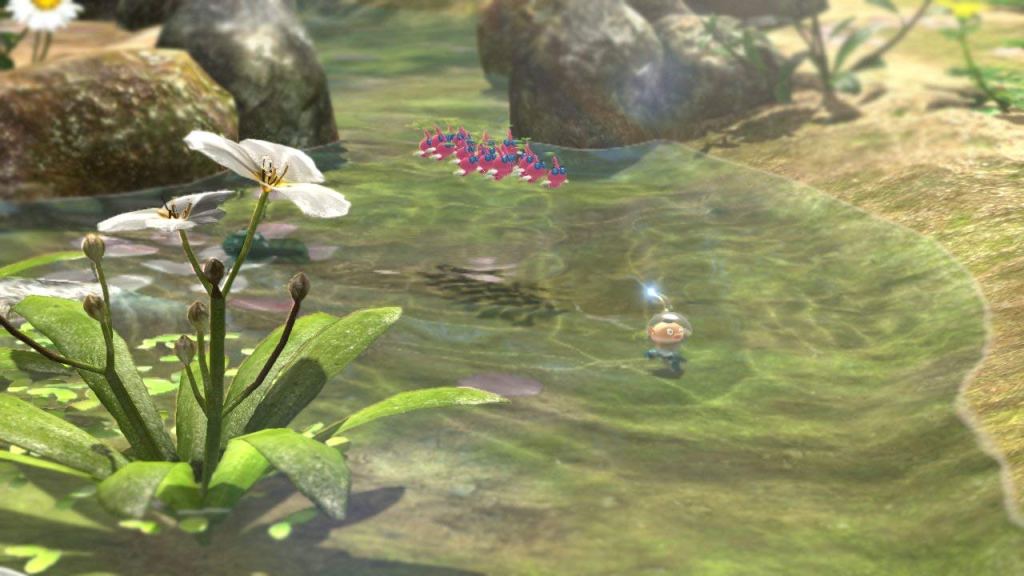
Pikmin 3 is one of the best-looking games of its generation with wonderfully detailed microbiomes. It hones in on one of my favorite aspects of the Pikmin aesthetic: miniature naturescapes. Every level is like a little terrarium to explore with towering foliage, streams with lily pads to hop across, and dark caverns filled with bioluminescent plants. The visual fidelity and environmental design are absolutely superb. And I love that there is an occasional rainy day to add some ambiance even if it doesn’t have any gameplay implications.

I personally played Pikmin 3 on Nintendo Switch with the remastered Pikmin 3 Deluxe edition.  Aside from being graphically enhanced, it has some gameplay changes like having a bigger whistle radius, being able to call loose Pikmin back to the ship, and the charge attack only using the Pikmin type that you have currently selected. The game originally was designed for the Wii U and made use of the gamepad for the map, but I didn’t have any frustrations with having to open the map separately. There are also some new additions such as the Piklopedia and new side stories for Olimar and Louie. Overall, this is the best way to play the game.

I don’t think Pikmin 3 is my favorite in the series. It may be because of nostalgia, but the structure of the original Pikmin was just so compelling. The tense 30-day limit to find all your critical ship parts provided a real sense of urgency. I do appreciate that Pikmin 3 did reintroduce some time limit with the juice system. The focus on multitasking and the ability to order all 3 characters at the same time is superb. And of course, Pikmin 3 is technically and visually impressive. It certainly has my favorite environments, levels, and bosses of the series thus far. I will always vividly remember riding a lily pad downstream on a rainy day as dandelions tower overhead. I can’t wait to finally give Pikmin 4 a try.

Paper Mario: The Thousand-Year Door (2004)

Growing up, Paper Mario: The Thousand-Year Door was one of my favorite games to play. To this day many of its imaginative areas stick out in my mind as hallmarks of excellence. I was excited for the remaster to be released so I could revisit a staple of my childhood. Playing through the game now resolidified my confidence that Paper Mario: The Thousand-Year Door is one of the greatest RPGs of all time. The game oozes charm, character, and creativity from every crevice.

In classic Mario fashion, the game opens with Peach getting kidnapped, but not by Bowser this time. The mysterious X-Nauts have captured her as Peach found a map to the legendary treasure underneath the city of Rogueport. The treasure is behind the locked Thousand-Year Door which can only be opened by collecting the 7 Crystal Stars. The game follows Mario as he hunts down the Crystal Stars in a variety of locales. And what a fantastic set of locales they are.

From the very start of the game, it is apparent how creative Paper Mario: The Thousand-Year Door is. Rogueport is a run-down, grimy, and crime ridden city that serves as your hub. The city center has a few establishments but the gallows in the middle makes it abundantly clear what kind of city this is. The art, atmosphere, and slimy characters make Rogueport a standout location. And that’s just the beginning. As the game progresses you will encounter a handful of unique and charming areas. Glitz Pit is one of my favorite areas in any video game. This flying wrestling arena begins innocuously as you climb the ranks to claim the champion’s belt, but it slowly injects mystery and intrigue into its cramped halls. Paper Mario: The Thousand-Year Door is full of creative ideas and memorable places, each with their own episodic story to tell.

Part of what makes Paper Mario: The Thousand-Year Door so charming is its cast of characters and writing. Through your adventures you will encounter a ton of characters brimming with personality. Each of Mario’s partners has their own distinct character traits and motivations. Even side characters that don’t have a ton of relevance to the story feel genuine. The writing is just filled with charm and wit. While the game relies plenty on humor, it does have its serious moments of bravery, introspection, and self-sacrifice. And the character’s expressive animations go the extra mile to bring life to these paper cutouts. 

A common complaint that many people have with turn-based RPGs is that the combat is boring. Oftentimes it can boil down to selecting your most powerful attack and watching animations ad nauseam. While Paper Mario: The Thousand Year Door might not have incredible levels of depth it does have one key thing going for it: interactivity. Mario and his partners have a variety of attacks, each with their own button prompts to execute for better results. It may be as simple as pressing the “A” button at the right time, or holding back on the analog stick and letting it snap back at the apex of a hammer swing, but there is a fantastic tactile feeling to the otherwise simplistic combat. The timings are fairly generous but I think that is a good thing because of the necessity of landing these bonuses. You are going to have a very hard time if you don’t learn these prompts and fail to execute. I like that because even though choosing an attack may be fairly straightforward, you aren’t relegated to just watching an animation play. You have to be actively engaged to maximize your output.

Aside from the active aspect of combat, I also love how customizable your strategy can be. A prominent component of this is the badge system. As you explore, you collect a variety of badges that can be equipped at the cost of BP (which can be earned on level-up). These BP can range from extra defense when you are low HP, to special attacks that cause status effects such as sleep, to a raw damage buff. The more generalist and powerful badges cost a ton of BP so it can be fun to experiment with different builds. Moreover, there are a handful of different partners to fight alongside to choose from. While you can swap them around as you please, I think many people are going to have one or two favorites that they default to. Between badges and partner selection, there’s a solid amount of customization to how you approach combat.

Apart from combat, another aspect that many RPGs get wrong that Paper Mario: The Thousand-Year Door gets right is pacing. Many RPGs are notoriously long games that could take months of regular play to complete. Paper Mario: The Thousand-Year Door is a relatively brisk adventure comparatively. But it doesn’t feel rushed either. A complaint that I had about Super Mario RPG was that while I appreciated how quick it moved from place to place, it often felt rushed and I had no time to truly soak in the world. Paper Mario: The Thousand-Year Door sits in the Goldilocks zone of pacing; every chapter is just right in length. There’s enough time to become familiar with every area and to tell an interesting story in every chapter, but it never overstays its welcome either. Overall pacing is something that is crucial yet incredibly hard to perfect, but Paper Mario: The Thousand-Year Door does a great job at it.

Unfortunately, a pacing problem is also my sole issue with Paper Mario: The Thousand-Year Door. While every chapter and the game itself is paced wonderfully on the whole, I do think there are some moment-to-moment drags. Structurally, many chapters play out similarly: opening with Mario venturing into a new area, learning about the area, discovering the antagonist, fighting through a bunch of bad guys to reach the boss, resolving that chapter’s conflict, and then closing out by seeing what Peach and Bowser have been up to in the meantime. The problem is that all the combat is packed right into the middle of the chapter. 

I typically want there to be a healthy mix of combat, story, and exploration throughout but all the talking bits are concentrated at the beginning and end of every chapter. Completing one chapter, the in between sections, and then starting a new chapter can often feel like ages have passed without any combat. And even if I think the combat is solid for an RPG, it can get repetitive if it’s all I’m doing in the middle of a chapter. I wanted story to break up the combat. And I wanted combat to break up the story. I think this issue is minor in the grand scheme of things, but I definitely would’ve liked to have story and combat less isolated from one another.

When I played the game this time around, I tried the remaster that was released for the Nintendo Switch. I can confidently say that this is the definitive way to play the game. The game’s presentation has been improved with improved visual fidelity and new expressive character animations. The soundtrack has been wonderfully redone but there is also the option to use the old version if that’s what you prefer. There’s some great new quality of life changes such as quick swapping partners while exploring and an increased inventory size. Some areas have a new shortcut to cut down on tedious backtracking. And there are new optional bosses for players who don’t want the adventure to end. It’s an all-around excellent remaster with some nice touches.

There’s a reason that Paper Mario: The Thousand-Year Door is a legendary RPG. It’s a game that looms over the rest of the genre as the benchmark for excellence. Paper Mario as a series in particular has had a hard time living up to this peak. It’s charming cast of characters, creative locales, and intriguing episodic chapters make for an unforgettable adventure. The combat allows for some customization and its active nature keeps it from being a turn-based snooze fest. If you are a fan of RPGs, Paper Mario: The Thousand-Year Door is a game that you cannot miss.

Super Mario RPG (2023)

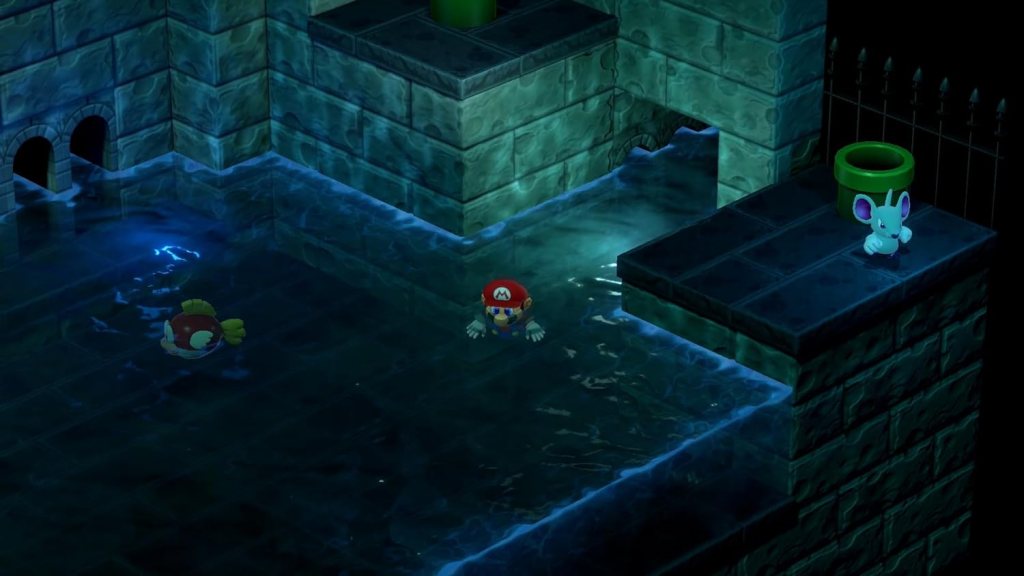
Turn-based RPGs are often some of the longest video games that exist. They can easily exceed dozens of hours, if not hundreds. I’m often put off from many of these games as I feel they are bloated with repetitive content and grinding. But Super Mario RPG is the rare case of an RPG that went in the opposite direction. It’s an intentionally short and sweet experience. You move so quickly through the zones and dungeons that there’s no chance to be overcome by tedium. It’s a game that relies on novelty rather than a grandiose story and scope.

Super Mario RPG is a wacky game. There’s plenty of goofy characters, ridiculous situations, and slapstick comedy. While many RPGs focus on slowly building up an ever-escalating story, Super Mario RPG moves at a breakneck pace through silly scenarios and never gets tiresome. A giant sword has fallen from the sky and destroyed Bowser’s castle and the army of sentient weapons is threatening to steal all the Star Pieces to prevent any wishes from coming true. It’s not a super engaging story, but it is helped by the characters.

There’s a ton of unique characters introduced in Super Mario RPG, the main ones being Geno and Mallow. Geno is a stalwart spirt from space that inhabits a wooden doll, while Geno is a young emotional cloud who was adopted by the Frog Sage. Bowser also gains his signature braggadocious personality as he assists Mario and company on their journey. While the story itself won’t keep you on the edge of your seat, the characters and their goofy interactions makes the adventure far more charming. After playing this game, I hope that Nintendo allows future RPGs set in the Mario world to create new characters, as that bizarre decision something that has been holding back the Paper Mario series for years.

The biggest strength of Super Mario RPG is just how snappy everything is. From the story, to the progression, to the battles. The battles in particular are a blessing. First and foremost, there are no random encounters. You can just walk past enemies that you don’t want to deal with. Despite being turn-based, the battles themselves are remarkably fast-paced. Animations and text boxes are snappy, health pools aren’t overinflated, and there isn’t too much fanfare that slows things down. I often get in and out of the easier encounters in 30 seconds to a minute.

Thankfully, this is not a game that you have to grind for experience to complete. I found that I naturally gained plenty of levels and equipment from just playing normally to beat the game. The game is definitely on the easier side, the only major hurdles are the bosses. I enjoyed the simplicity of basic bosses but I also appreciated when I had to use a little more strategy during the elongated boss fights. The combat is fairly basic, but I appreciated the simplicity of straightforward attacks and abilities.

One aspect that I enjoyed about combat in Super Mario RPG is that it is interactive despite being turn-based. By timing button-presses during tight windows of opportunity during animations you can increase your own damage or block damage from enemy attacks. I liked learning all the timings for the different weapons, abilities, and enemies. The game has a system that hints towards the correct timings if you miss it too many times, but the hint goes away once you start succeeding again.

Progressing through the game is absurdly fast. The game is maybe 12-15 hours long, but it’s crazy how many areas they crammed into the game. I never got exhausted in any zone as they just went by so fast. Every area has its own little story and characters like a typical RPG, but it doesn’t drag anything out. I think this is mostly to the games benefit, but some of the areas and towns I would have liked to spend a bit more time in. It’s hard to really get invested in any of the side characters, stories, or areas when you only spend 30 minutes to an hour there. Still, I’d rather be left wanting more than feel exhausted at the end of a game.

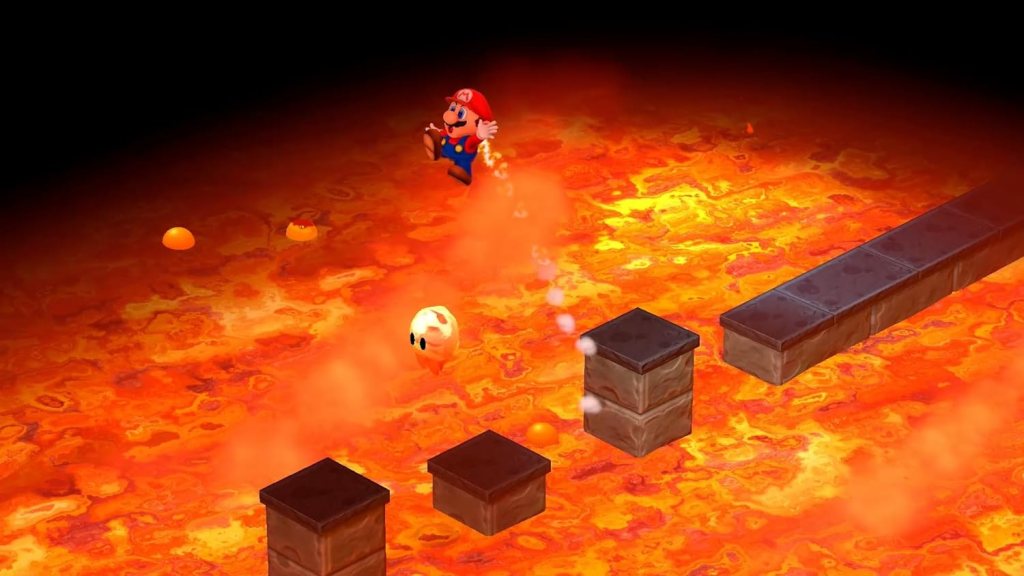
My only major complaint about Super Mario RPG is the janky mini-games and platforming. Many of the game’s side activities are mini-games such as Yoshi racing, minecart riding, or drifting down a river in a barrel. I think all these are all wonderfully fun ideas, but I never quite got a hang of them. They often feel like they go on for far too long and have underwhelming rewards. Anything platforming related in particular just felt awkward do the camera angles. 

I never played the original Super Mario RPG: Legend of the Seven Stars that this game was based on. However, from what I can tell Super Mario RPG is a fairly faithful remake. It added a lot of quality-of-life features like more frequent saves and being able to quick-swap party members. Additionally, the player has access to powerful special attacks after filling up a gauge as a reward for successfully timing attacks and blocks. I will say that while all these features are nice, they do make an already pretty easy game even easier. Personally, I didn’t mind the easier experience but perhaps more hardcore RPG fans might be let down by the lack of challenge.

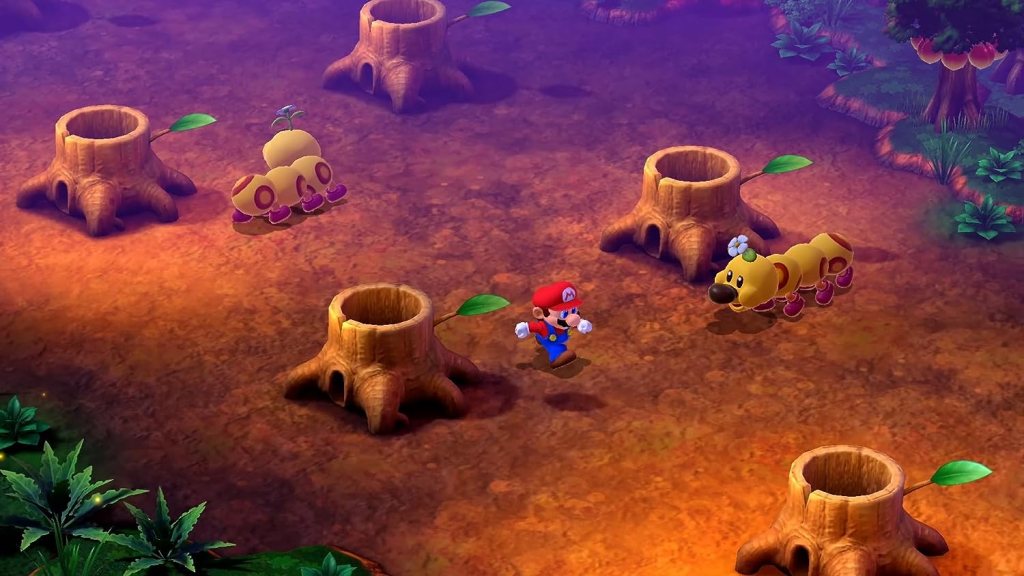
Aside from the quality-of-life updates, the most important change that the remake made was to the visuals. Super Mario RPG does a phenomenal job of modernizing the original art style while keeping its toy-like feel. The games vibrant visuals and bright color palette make it feel like a wonderland. There’s also a handful of cutscenes in the same style that look great.

Overall, I was pleasantly surprised by Super Mario RPG. It was a rollercoaster of goofy characters and classic environments. It’s not an RPG that you should reach for if you want a crazy story with twists and turns, but its smaller scope lets it speed through content at a breakneck pace. It goes to show that not every RPG needs to be a hundred hours long and that people can appreciate a more concise adventure. It is for these reasons that I give Super Mario RPG an 8/10. It’s not a grand adventure, but it is a fun one.

Pepper Grinder (2024)

Pepper Grinder is a wonderfully retro game. Its detailed pixel art, gorgeous environmental backdrops, charming cast of characters, and focus on fun gameplay concepts made me feel like I was playing a classic SNES platformer.  Pepper Grinder may be short, and it may not do anything revolutionary, but it is remarkably polished and is purely distilled fun. There’s no fat on this game, every level has its own ideas and mechanics that put a twist on the drilling and digging platforming.

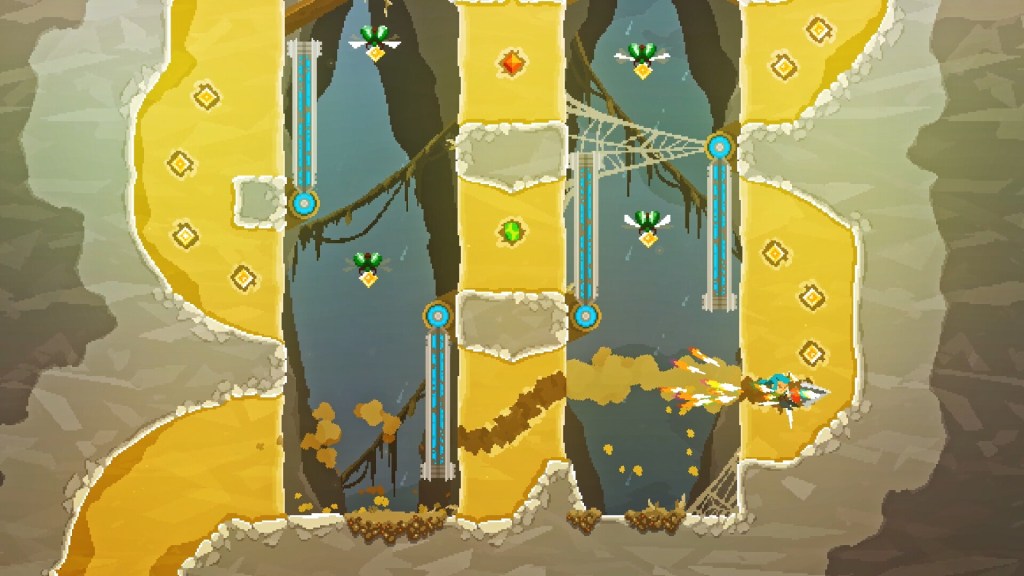
 The key mechanic in Pepper Grinder is the drill. You tunnel through sand, earth, and snow, avoiding obstacles along the way. As you pop out of the ground you can boost yourself and launch yourself from platform to platform. It’s a remarkably smooth mechanic that the entire foundation of the game is built upon. Digging through the ground is intuitive to control, fast-paced, and allows for some creative level design. And Pepper Grinder delivers that in spades.
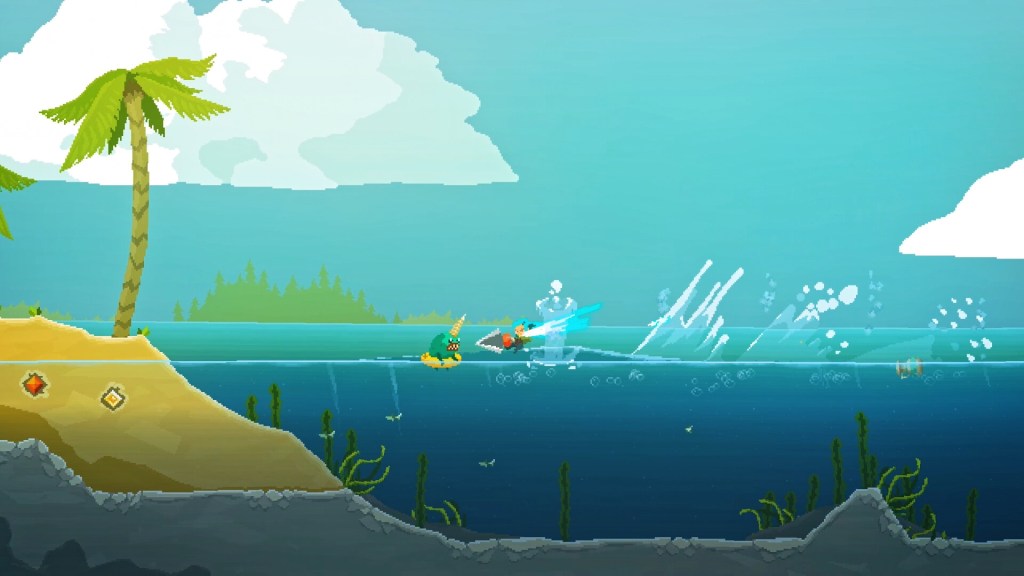
While it may be a short game, Pepper Grinder makes up for that with the sheer variety in its levels. Every level is distinct in some way. There are grapple points to swing between patches of earth, falling chunks of snow to flow through, cannons that blast you across the sky, gatling guns to mow down enemies, and a variety of locations to explore. One minute you’ll be gunning down goons in a volcano and the next you will be diving in shark-infested waters and splitting boats in half.

What makes Pepper Grinder feel like a retro game is its charm. There’s no dialogue or much of a narrative at all. The main character, Pepper, washes up on shore and has her treasure stolen. The rest of the adventure is just using her newfound drill to hunt down her missing treasure. But what makes the game so endearing is the visual story that is told. Traveling through the lands and encountering a handful of friendly faces like a farmer mole and a friendly giant is reminiscent of SNES era games such as Super Mario World and Super Mario World 2: Yoshi’s Island. And this retro influence is also obviously present in the art style of Pepper Grinder.

The game is full of lovingly crafted pixel art and animations. The levels, environments, and characters all come to life in its high-fidelity pixel art style. Even with the bright colors and fast-paced platforming, I felt that visual clarity was extremely good. I never lost track of where I was or where I was supposed to be going. The presentation is further bolstered by a great soundtrack of mixed genres: jazz, rock, drum and bass, and even drum and bass. 

There’s no arguing that Pepper Grinder is a short game. There’s only two dozen or so levels and each can be completed in 5-10 minutes. But I don’t think being short is necessarily negative. The developer obviously did not want to pad that game out with repetitive levels or filler content, which can be seen from how every level has its own gimmick or trick. Additionally, there are 5 hidden coins in every level to be found if you are interested in collectible hunting. And I found quite a bit of fun in the time trial mode, trying to get the gold medal on every level. It never felt overly challenging, but I loved finding shortcuts or optimizations to spare a few seconds.
The only major flaw with Pepper Grinder is the boss fights. There are only four of them, but none of them are particularly fun. They are neat concepts, but are unfortunately in cramped arenas that feel awkward to maneuver in. The last boss in particular is a huge difficulty spike, I could see tons of players giving up before seeing the credits because of how frustrating that fight can be. And to make matters worse, if you are doing the time trial mode you will have to deal with 30-second unskippable cutscenes on every single attempt of every boss. Truly maddening.
Pepper Grinder definitely isn’t a revolutionary game. It doesn’t dwell on any of its ideas or mechanics. If you are looking for a platformer that slowly evolves as the player gets better, Pepper Grinder may not be for you. It’s a game that delivers on a fun and fluid base movement system while throwing a bunch of different ideas at the player. Sure, many of those ideas could be explored further and expanded upon, but I appreciate the brevity of the game. And if you are looking to master the game’s mechanics, time trial mode can provide a decent but reasonable challenge.

I love when a game focuses on just being fun. And that’s what Pepper Grinder is. It may be on the shorter side, but that’s only because there is not any fat on this game whatsoever. Every level is its own idea. And the basic drilling movement is just pure fun. Although it doesn’t do anything revolutionary it manages to feel nostalgic and reminiscent of classic Nintendo platformers. It is for these reasons that I give Pepper Grinder a 7.5/10. Definitely give this game a shot if you want a quick burst of platforming fun.