Dredge (2023)

On the surface, Dredge does not appear to be anything special. Mostly, it’s a simple fishing game with some resource management and exploration. But Dredge is more than the sum of its parts. Its systems work together to create an addictive loop that it’s easy to sink hours into. But where Dredge really shines is in its quaint, yet unsettling atmosphere. 
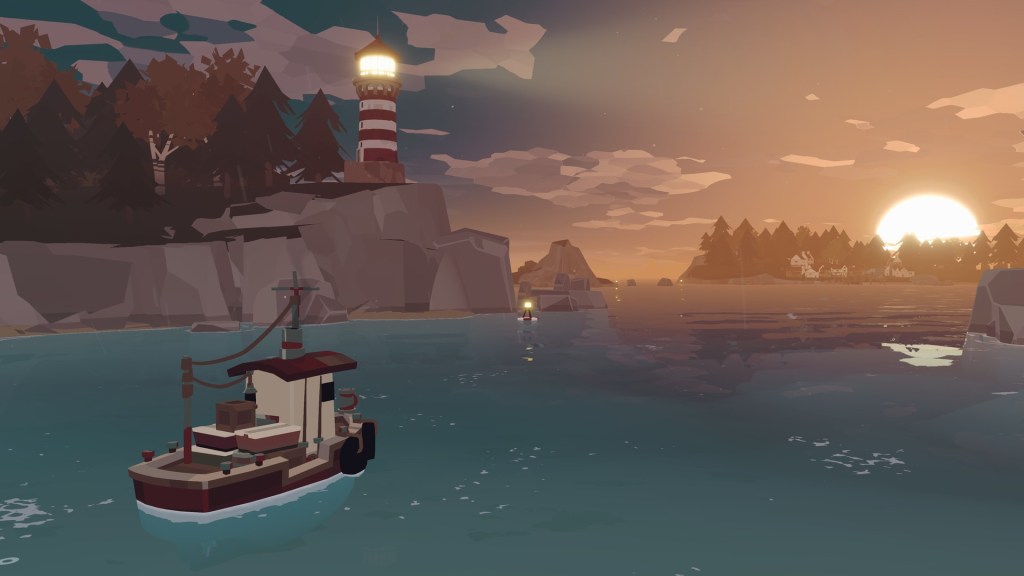
You play as a fisherman who has crashed along the shore of the small town of Greater Marrow. The mayor provides you with a boat, as long as you promise to sell your fish to the town to repay your debt. There’s something quite unsettling about the town, as inhabitants whisper about the previous mayor and fisherman who disappeared. Nevertheless, the town is a safe haven for your travels across the ocean. The lighthouse is an ever-present beacon, guiding the player back to the safety of the harbor no matter where you roam.

Traveling the seas is fairly relaxing most of the time, but if you aren’t watching the clock, you could find yourself in the pitch-black night. As you spend time away from the safety of a dock at night the panic meter quickly fills. Ghostly apparitions and eldritch abominations stalk your small ship, causing you to frantically navigate to a port. Yet in this panic it is easy to become hopelessly lost and crash upon the rocks. There’s an effect that I quite like when the panic meter fills in which terrain is often invisible until you get very close to it. This is excellent as it punishes the player for panicking and not cautiously steering, and it is thematically appropriate as a terrified captain is prone to making errors and splintering their vessel on the rocks.
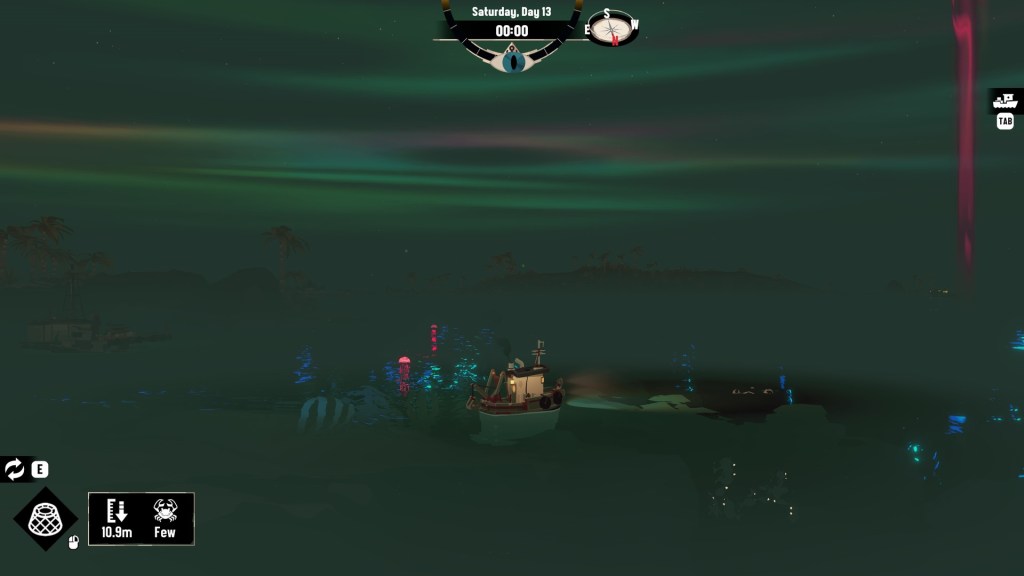
The juxtaposition of safe ports and disquieting darkness is something that I adore. There’s something charming about how a little bit of light and comfort can become such a powerful motivator when surrounded by uncertainty. Dredge is dotted by little towns and floating platforms that serve as shelter. The imposing aesthetic also fuels the contrast between the night and day of Dredge.

The art of Dredge is highly stylized, relying on low-poly silhouettes and shadows. This low-poly approach is utilized wonderfully to create cozy towns and calming waters. Yet, in an almost impressionist fashion, Dredge plays with light and shadows to create more ominous scenes and characters. The standard fish that you become familiar with often can be seen as “aberrations”, deformed and disturbing versions of themselves that suggest that there is something wrong with these waters.
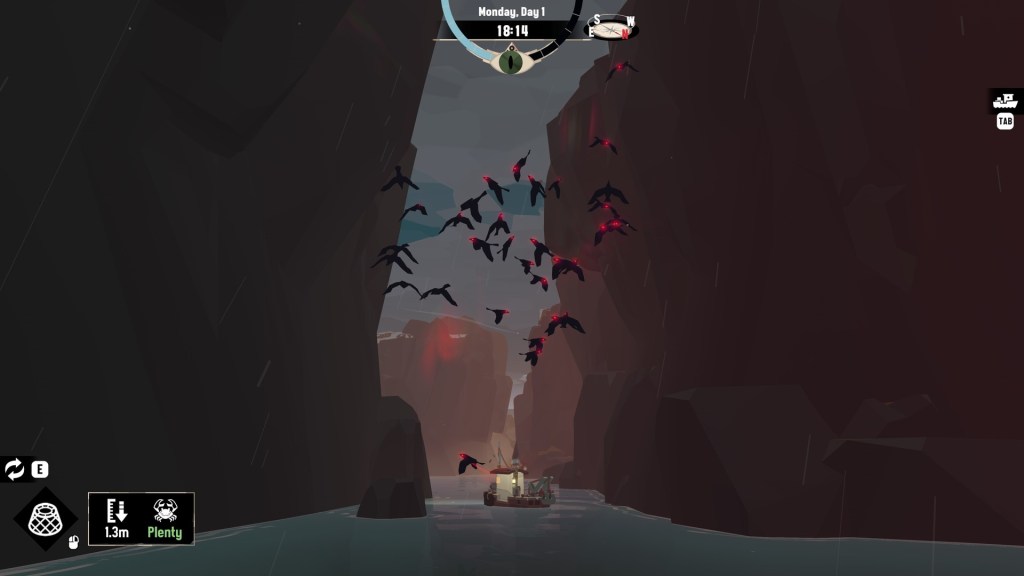
While it’s obvious that Dredge nails the atmosphere and vibes of a spooky fishing game, I think its rudimentary gameplay systems also complement each other quite well to make for a game that’s hard to put down. There are four main components to gameplay: fishing, inventory management, upgrading, and exploration. All of these are relatively simple in isolation, but the quick cycling between them kept gameplay fresh.

For a fishing game, the actual act of fishing is simple. It’s a minigame in which you time a button press to reel in the fish faster. There are some variations in what the timing wheel looks like and how it functions, but the basic idea is always the same. The only other mastery involved with fishing is identifying the silhouettes of the species of fish to know which one you’re reeling in. Inventory management is similarly straightforward. You have limited capacity on your boat and need to decide what equipment to bring. Moreover, you have to arrange any of your catches or plunder to maximize the relatively limited capacity of your cargo hold. It’s not necessarily difficult, but the awkward geometry of the fish and cargo hold does engage your brain to fit the pieces together. The other component to inventory management is just deciding what is even worth a spot in your hold, as it fills up quickly.
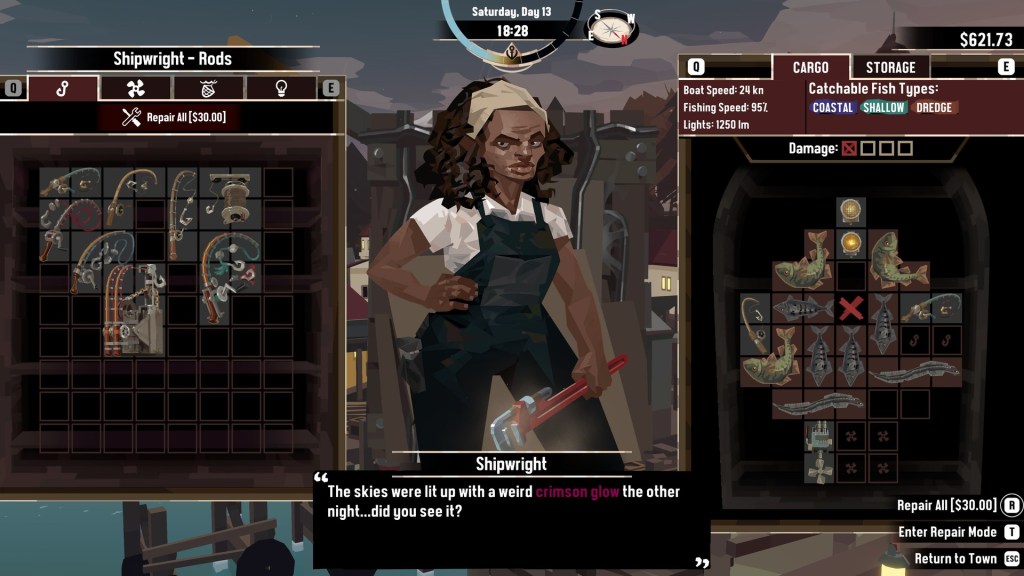
Through maximizing your inventory space and fishing efforts, there are numerous avenues to improve your boat. You can use your yields to upgrade your rods, engines, trawl nets, crab pots, lights, and cargo space. There are so many ways to improve that it always feels like you’re on the cusp of the next one. The upgrades feed into the other avenues of gameplay as it allows you to catch different varieties of fish, have a larger inventory, and explore new areas. While none of the gameplay aspects are complex or deep, they embrace the spirit of brevity to ensure that Dredge never gets stale. They feed into each other for a rapid feedback cycle that it’s easy to get sucked into.

My one desire for Dredge would be to lean more on the night-time terrors. The game rarely encourages the player to make the intimidating trek out into the treacherous night sea. The atmosphere at night is thick and eerie, but aside from a couple of night-only fish there’s rarely a reason to take the risk. Moreover, I wish that being out at night was slightly more threatening. While it’s initially anxiety-inducing, I quickly realized that it was only a little more treacherous than standard sailing. The Lovecraftian atmosphere and spooky vibes are only captivating if the world is actually dangerous. Once the illusion is broken, the game isn’t nearly as suspenseful.
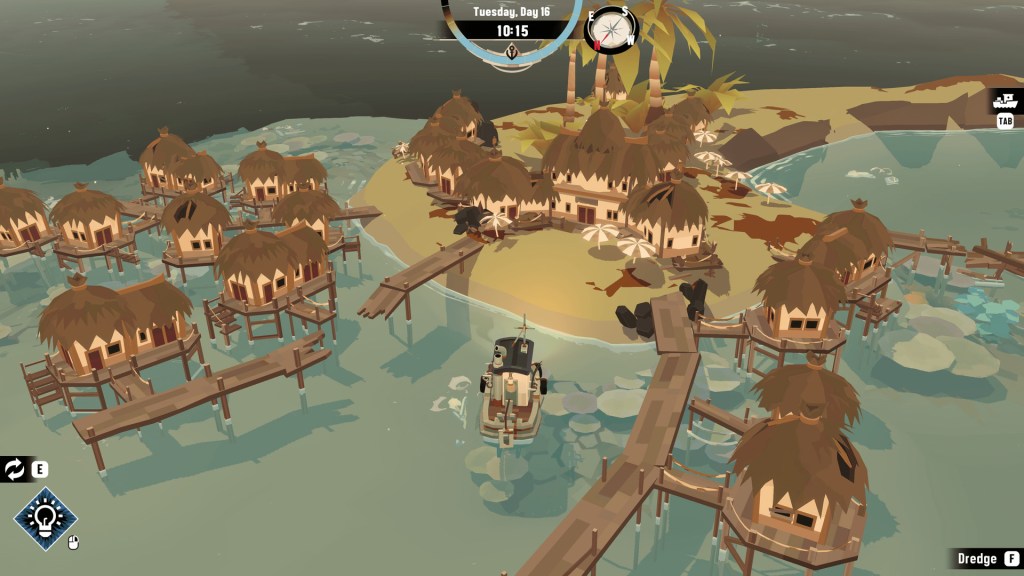
In a year full of smash-hit indie games, I’m glad I chose to play Dredge this spooky season. Its ambience is impeccable. The warm and cozy feeling of taking port under the safety of the lighthouse after frantically evading terrifying monstrosities is magical. While the gameplay doesn’t do anything spectacular or novel, it all fits together quite nicely and knows not to overstay its welcome. It is for these reasons that I give Dredge an 8/10. Dredge has mastered the art of being relaxing while being disquieting, and I love that.
Call of Cthulhu (2018)

Reproducing Lovecraft’s unique genre of horror in visual mediums is a challenging task. Lovecraft’s primary theme was that the unknown and unknowable were horrifying. The feeling of existential dread is more powerful when you imagine some terrifying reality, which is why many visual mediums struggle to reproduce that feeling. Call of Cthulhu is obviously inspired by Lovecraft, the question whether it can effectively replicate the cosmic horror that he was so keen on.

The premise of Call of Cthulhu is that you are a drunken investigator who has trouble getting a case. When approached by a wealthy man, you cannot deny their request to look into the death of his daughter, Sarah Hawkins. She, along with her husband and child, died in a house fire that was deemed an accident. Sarah’s father seems to believe there was more to the story, and he cites that there is a strange nature surrounding Sarah. As an artist she primarily painted deeply unsettling pieces, and her father believes that her disturbing art has a connection to her death.

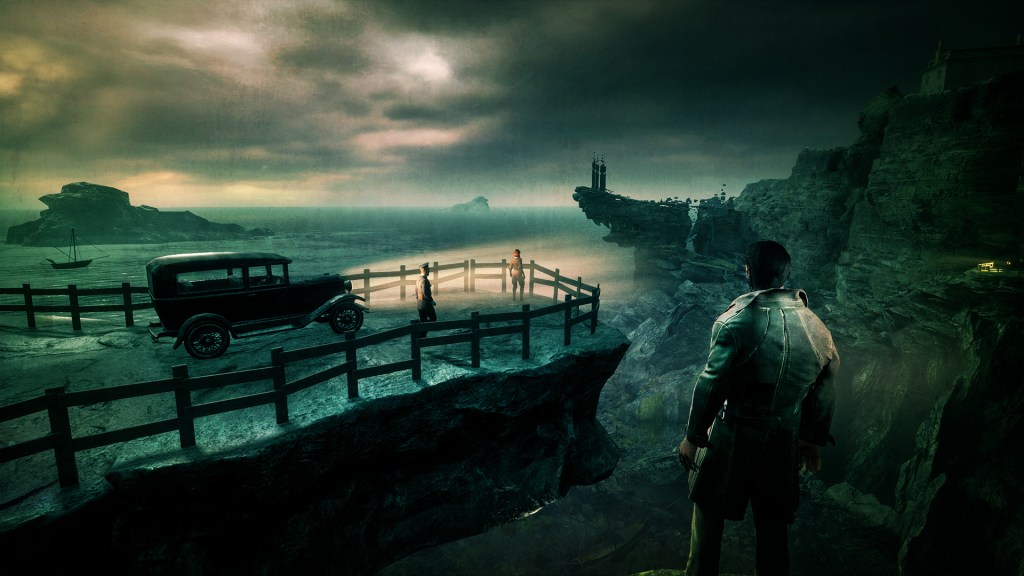
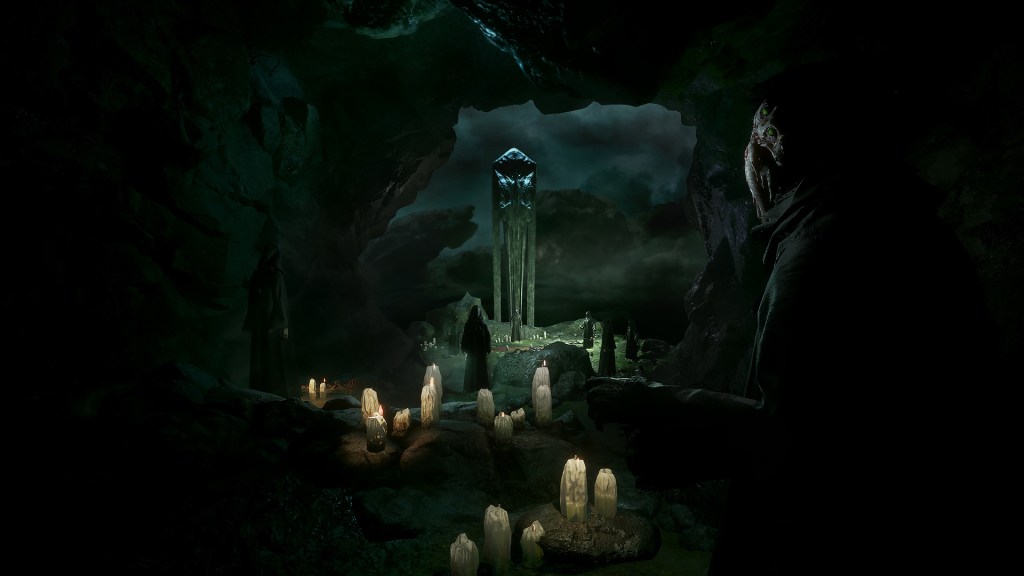
You travel to an ominous island off the coast, and you quickly establish that something is terribly wrong here. The town is dilapidated, the citizens all seem delusional, and nobody seems to want you there investigating their business. Over the course of the game, the story will continue to unfold as you unravel the dark secrets of the island. It is a fairly standard Lovecraftian tale, rife with cults, sea monsters, and unspeakable horrors. 

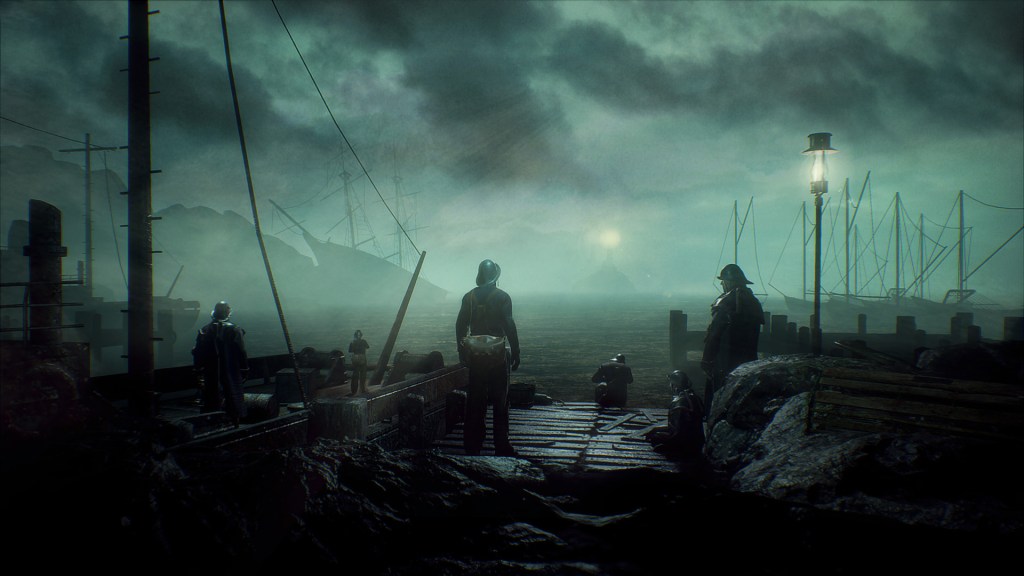
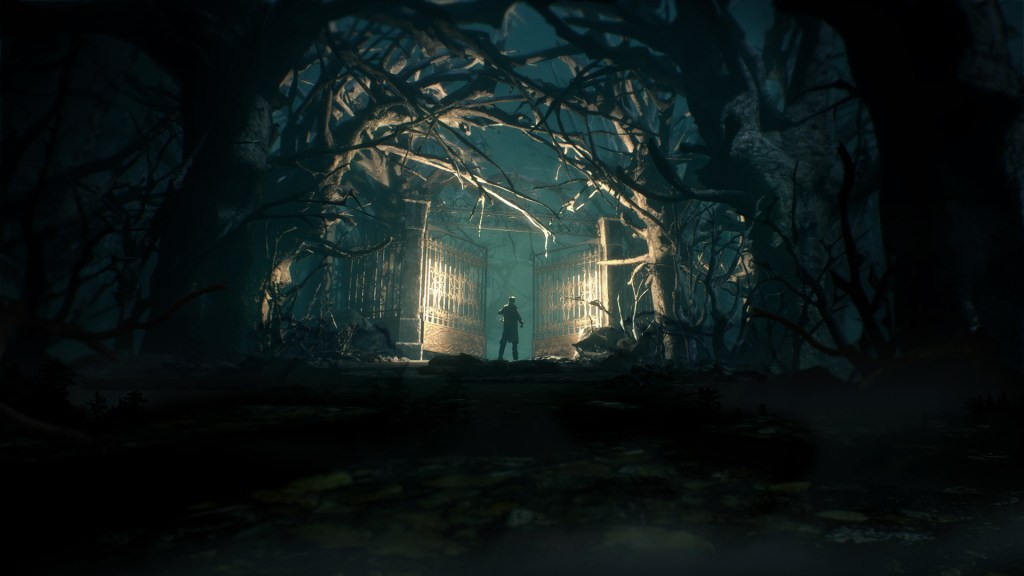
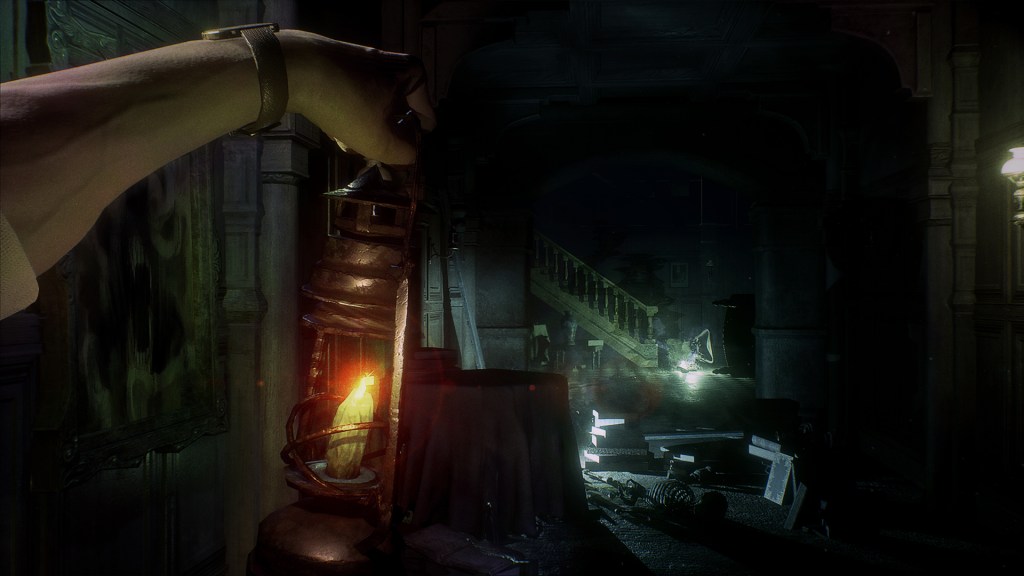
The story and atmosphere of Call of Cthulhu is by far the games strongest appeal. The atmosphere itself is fantastic. The entire world is dark, dingy, misty, and all-around unsettling. There are a variety of environments and set pieces that fit perfectly in a Lovecraftian setting. The game also does a phenomenal job at distorting reality. A common theme in Lovecraft’s mythos is madness, and Call of Cthulhu replicates that well. There are many sequences that will have the player questioning what events are actually occurring and which ones are dreams or insanity within the main character’s thoughts. What is less successful is the implementation of the story.

While I do think the narrative had some interesting moments, I don’t think it was particularly memorable or enough to carry a game. I was interested in the mystery aspects of the game, trying to deduce what was happening on the island. But for the most part, I think the story pulled in too many different directions instead of focusing on a couple of stronger and more fleshed out ideas. It almost feels like a collection of Lovecraft’s greatest hits, there are so many different elements at play in a fairly short game. Most of the characters get pitiful screen time, and it feels like each aspect of the story was rushed and barely came together in a cohesive manner. But my larger issue with the plot is a common complaint amongst most Lovecraft inspired media.

Unexplored places like the cosmos and deep ocean were central to Lovecraft’s stories, as they are real places that are unsettling to most people. What lies within them may be so inconceivable and terrifying that it would drive men to madness. At this point, most people who are familiar with Lovecraft already know about the Cthulhu mythos, the references to the occult, and the recurring imagery of the deep ocean. It feels like the writers of these newer stories are missing the point when they directly rip these concepts. 

A successful modern Lovecraft adaptation would have to make the consumer uncomfortable. There would need to be unknown elements, things that don’t make sense and are incomprehensible. The feeling that humanity is insignificant when compared to what could possibly be lurking in the unknown reaches of the cosmos. Not just rehash the same themes and monsters that we’ve been seeing for a hundred years. Ironically, the most I’ve felt the signature cosmic horror feeling is in games that weren’t directly inspired by Lovecraft’s work. Visiting Dark Bramble in Outer Wilds, the BTs in Death Stranding, and the Mimics in Prey are all examples of this. It’s not a coincidence that I loved all of those games. 

As a game with a focus on story elements, it shouldn’t come as a surprise that the actual gameplay is pretty mediocre. There is a mishmash of various elements, with some RPG investigation taking the forefront most of the time. Aside from that there is stealth, puzzle solving, exploration, and combat. These range from inoffensive at best to frustrating at worst. But none of them really take up a significant portion of time and can be gotten through fairly quickly. I appreciate that the developers at least understood that gameplay was not the core focus of the game and didn’t let it get in the way too much.

The only gameplay element that was prevalent for the entire game was the RPG investigations. You essentially search for clues and chat with NPCs to gain information about whatever you are investigating. There are some options that will essentially require a dice roll depending on your skill levels. It’s a little odd that they relied on RNG instead of just pure stat checks here, there really wasn’t any need for a randomness element to be incorporated. This isn’t a game about exploring many different options. If I make a strong character, I should be able to pry open stuck doors. And if I make a charismatic character, I should be able to pass more speech checks. Not have to rely on some dice roll that really adds nothing except for a failure state.

My other gripe is perhaps expecting a little too much for a game without a focus on gameplay. As it stands, investigations are just ways of disseminating information. You click on a clue and the game will tell you its significance, and questioning characters is just an exercise in exhausting all of the dialogue options. I wish there was some actual investigating here. Make the player use their brains to figure out a scene, not just tell them after clicking on enough clues. 

Overall, Call of Cthulhu is an at least competent Lovecraft experience. It doesn’t have riveting gameplay. It isn’t innovative in any capacity. And the story is just a rehash of the stories that we all know already. Despite this, it does have its moments of unsettling atmospheric horror. It is for these reasons I give Call of Cthulhu a 5/10. While it’s not revolutionary by any standard, it manages to craft a disconcerting world that will draw you in.