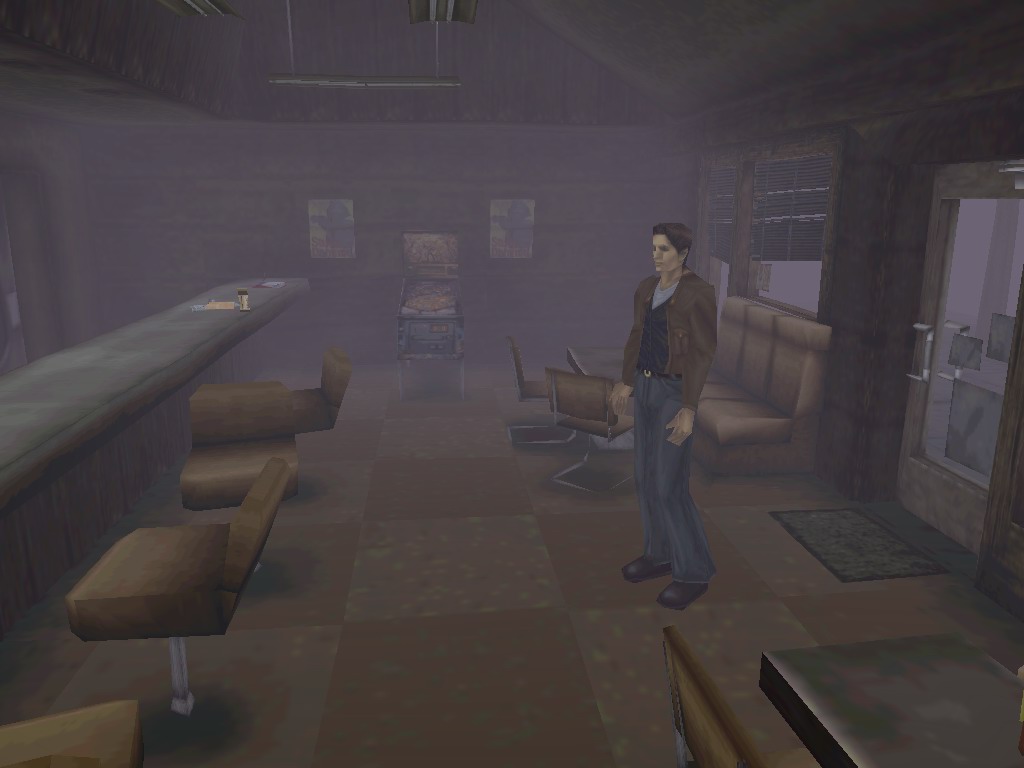
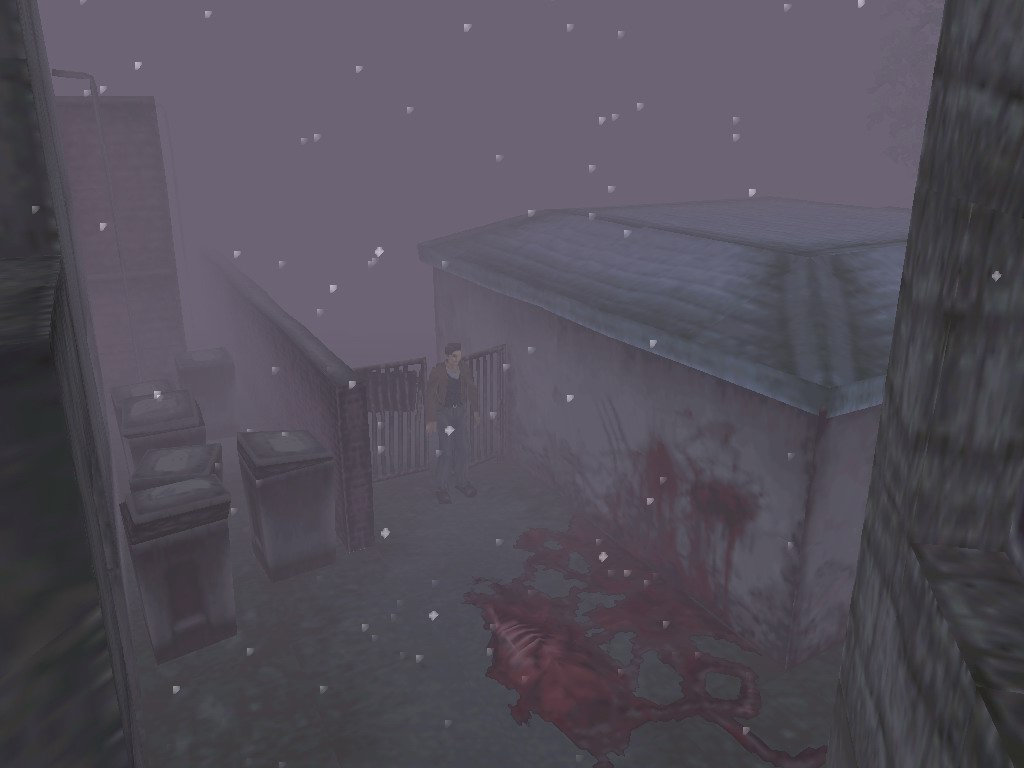
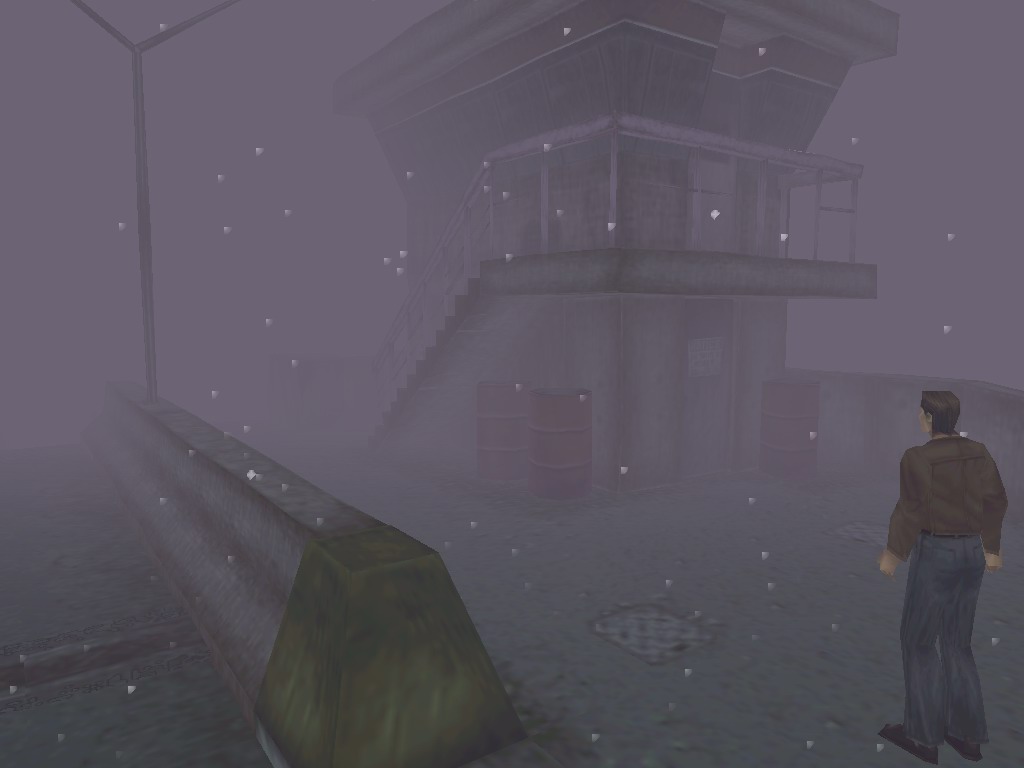
Horror and terror are not the same emotion. Horror is the shocking, revulsed feeling after witnessing a heinous event. Games like Resident Evil thrive on the sort of disgust caused by its horrifying mutants. Terror, on the other hand, the sense of dread and building anxiety when you know something awful is about to happen. It’s the deep-seated instinct meant to warn you that something is wrong and that you are in danger, even if you can’t see it yet. Terror is the focus of Silent Hill. The thick mist covering the abandoned town, the static of the radio, the disquieting music; everything about the game puts you on edge.
Silent Hill begins with a car crash on a wooded road in the fog. Harry Mason wakes up in a small-town cafe, separated from his young daughter, Cheryl. It’s immediately apparent that something strange is happening, as there are no residents in the town other than the policewoman who rescued him. Harry sets out to explore the town shrouded in fog, with ominous craters blocking the roads and bizarre monsters stalking him.
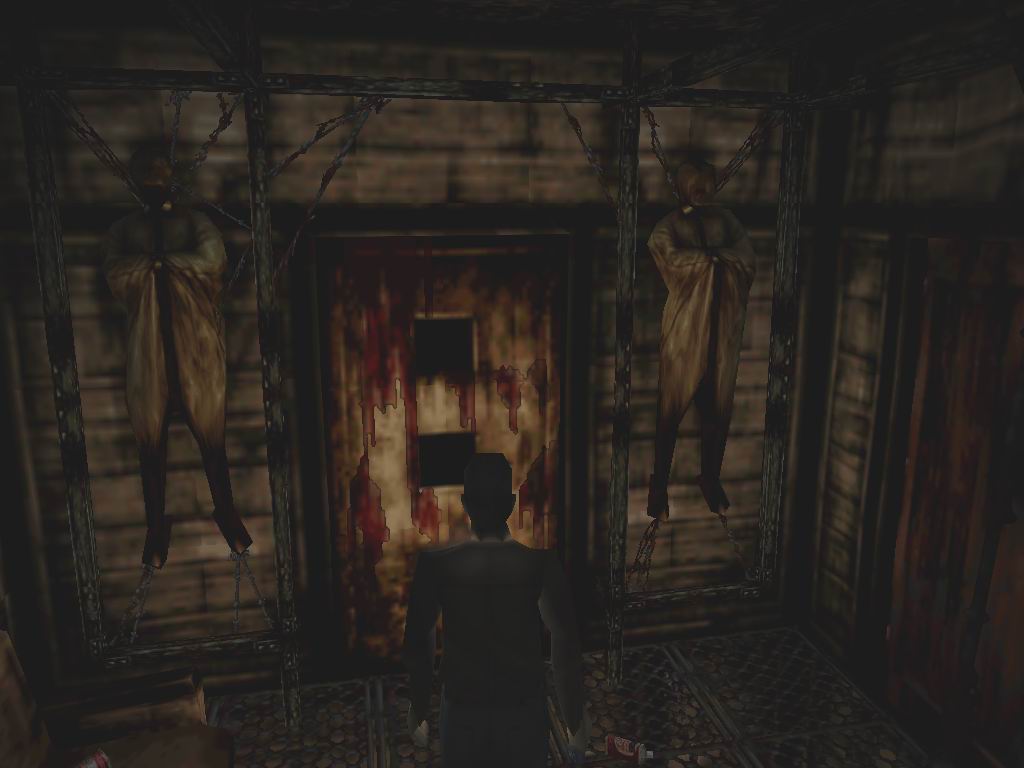
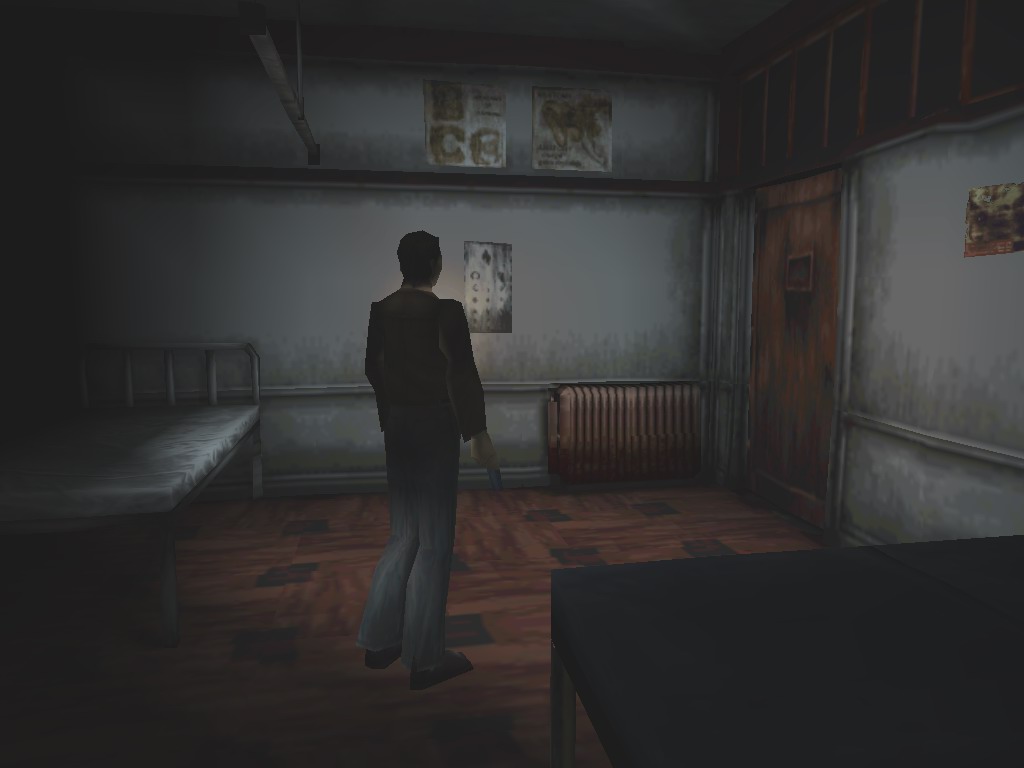
As you progress through the game, you uncover hints as to the cultish conspiracy that has engulfed the town. Demonic symbols are scrawled on the ground and riddles are scrawled in blood on the walls. The few residents that remain whisper of the occult and insinuate sins that swallowed the sleepy town. You track Cheryl to the school, the hospital, the amusement park, and through the eerie streets. The world transforms into a nightmarish reflection of itself, filled with rusty and grimy metal surfaces. The metallic tinkling footsteps and distorted, echoing music is deeply disquieting.
The story of Silent Hill is solid, especially when compared to its contemporaries such as the early Resident Evil games. The supernatural world and psychological horror are so much more compelling than straightforward zombie or monster plot. You intrinsically know that something is deeply wrong with the town, and there is some connection to Cheryl. The locations you visit seem to indicate traumatic memories, despite never having been to the town before. Every aspect of the game is disturbing and atmospherically oppressive.
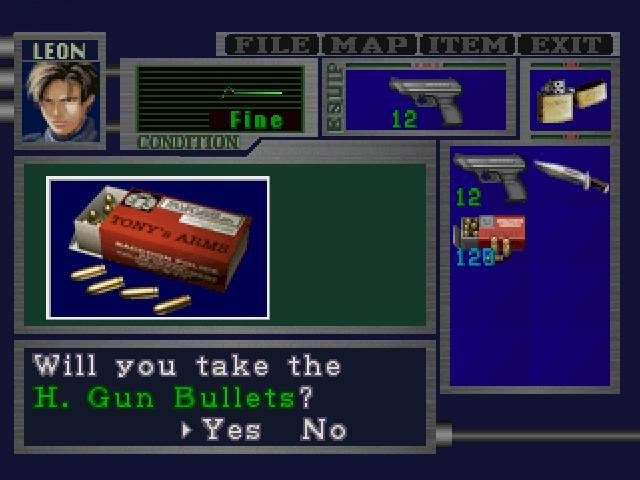
At its core, Silent Hill is a survival horror game. You explore the world, collecting resources such as health packs, ammunition, weapons, and items to solve puzzles. The streets are filled with enemies such as rabid dogs, flying leathery screamers, and knife-wielding ghouls. There are far more enemies than there are bullets, meaning you will have to think carefully when you want to fight back and engage the enemy. The game encourages the use of melee weapons such as crowbars and sledgehammers to conserve ammo, but it forces you to get up close to the monsters, risking damage or being overrun with multiple enemies.
While the individual enemies are somewhat easily avoided, there’s a constant anxiety due to the scarcity of resources. Moreover, the game’s visual and audio design further cause unease. The thick fog obscures your vision; you can’t see more than a few feet in front of you. You have a radio that emits static when an enemy is nearby. You know that there are enemies all around you, but you can’t see them. You have to roam the town filled with dead-ends and maze-like corridors with the persistent knowledge that monsters are right outside your field of vision. The anxiety is further heightened by the distorted and disturbing soundtrack constantly thrumming in your ears.
Silent Hill also contains a handful of cryptic puzzles. These are woven into the themes of the game by using occult symbols, macabre visuals, and strange riddles. These are much more cerebral than the lock-and-key puzzles featured in the early Resident Evil games. You have to discern meaning from seemingly nonsensical texts. While I do enjoy these kinds of puzzles, there was one in particular that I thought was very tricky to work out with many different ways that the hint could be interpreted.
The thing about playing older games like Silent Hill is that you have to be prepared for some clunky controls. Moving around 3D spaces was still in its infancy, and control schemes were not universal. Silent Hill utilizes tank controls, making movement a bit clumsy if you aren’t used to having to rotate to move in different directions. Luckily, the camera does follow the player quite a bit, making it a bit easier to deal with the movement rather than the jarring transitions of the fixed camera angles from Resident Evil. Still, the tank controls are a relic of the past that can be tricky to deal with.
Silent Hill is the terror counterpart to the horror of Resident Evil. Instead of zombies and gore and bombastic action, there’s a thick fog, static-filled radio, and cryptic riddles scrawled in blood. It’s an incredibly unsettling game, and every decision was made to achieve that goal. It has an uncanny ability to unnerve and cause panic with its masterful atmosphere and hellish soundscape. Despite its age, Silent Hill is a piece of art. It is the video game manifestation of a nightmare.
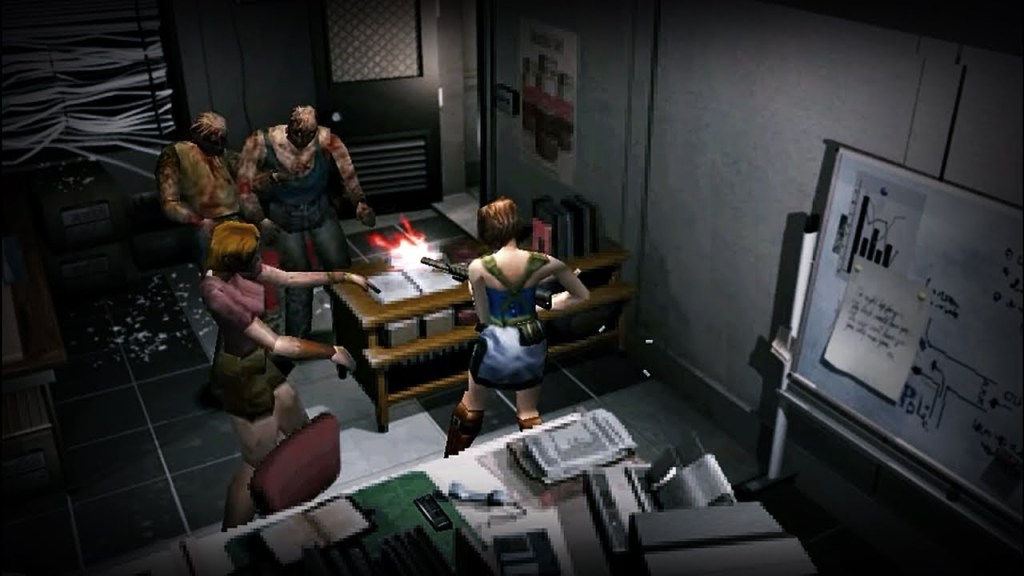
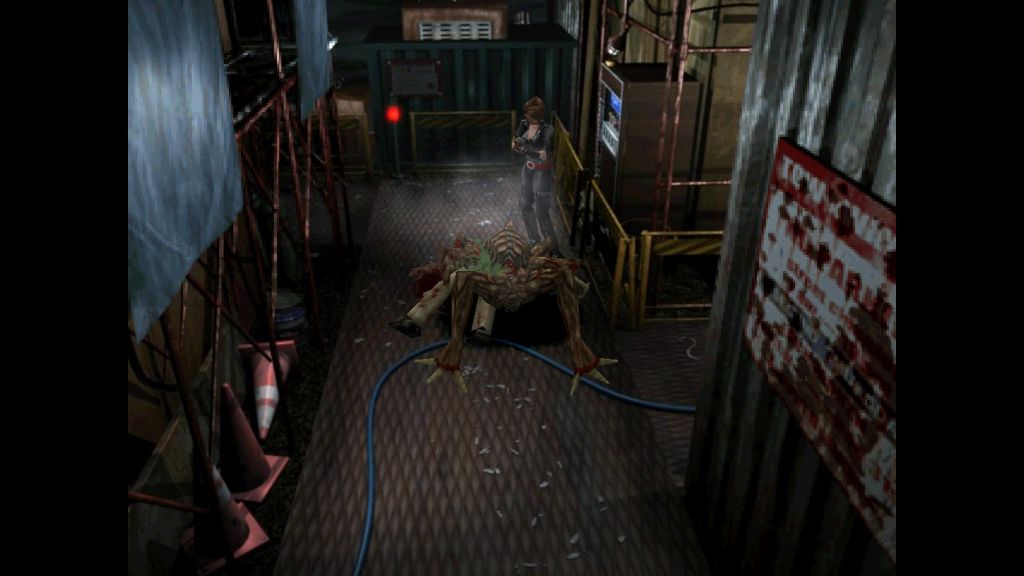
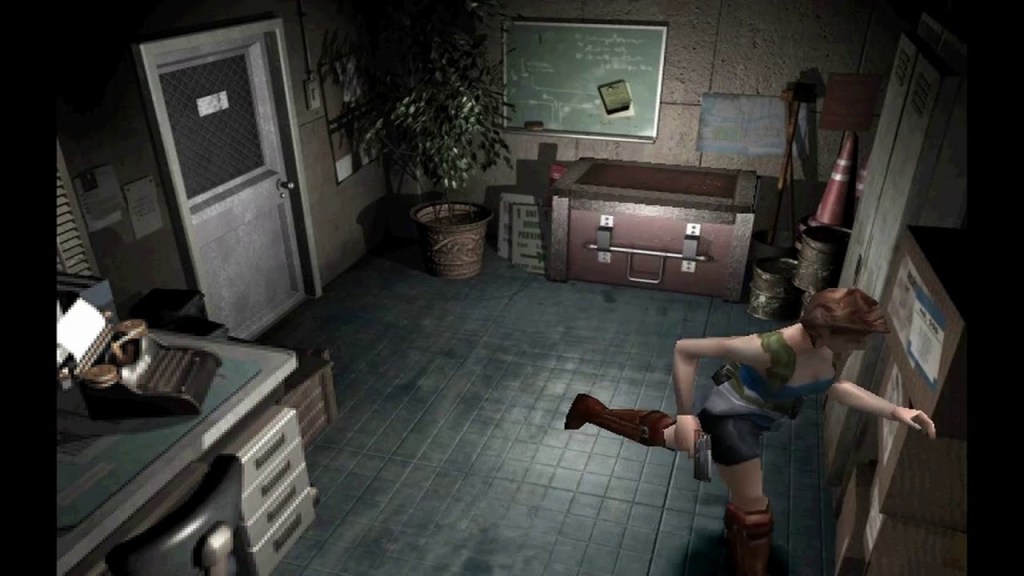
The first two Resident Evil games are known for their dense environments that function as puzzle boxes. In comparison, Resident Evil 3: Nemesis is a sprawling action game. The increase in scope leads to a bombastic finale for the original trilogy. It doesn’t just retread the same ideas from its predecessors; it escapes from the narrow hallways of the mansion and police station and sets the player loose in the chaotic ruins of Raccoon City. While I did prefer the tighter experiences of the first two games, I did appreciate how Resident Evil 3: Nemesis expanded the scope and scale of the series.
After returning to the city after escaping the mansion, Jill Valentine finds herself back in Raccoon City. But all of her rescue team colleagues have disappeared, and the city is aflame with zombies roaming the streets. A horrible mutant, Nemesis, is programmed to hunt down Jill as she is one of the remaining members of the team responsible for foiling Umbrella’s schemes.
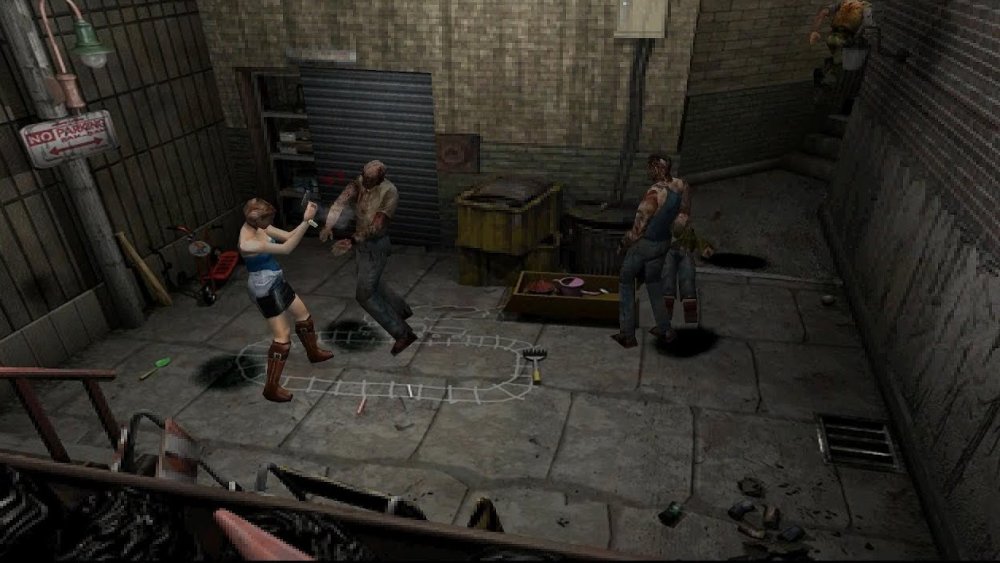
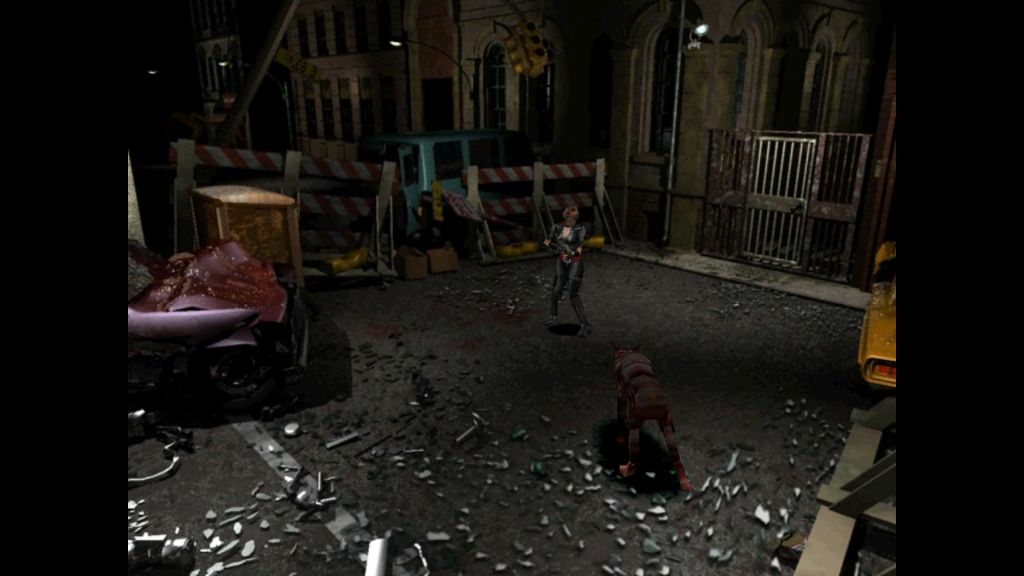
From the outset, Resident Evil 3: Nemesis is far more open than its predecessors. You will be roaming the streets, ducking in and out of numerous buildings to acquire the resources needed to proceed. I appreciated the change in environment, and the expanded scope allowed for a variety of different scenarios. Instead of spending the whole game in a single building, you’ll be heading to workshops, a cozy restaurant, an ominous clocktower, a zombie-filled hospital, and a sinister park. The larger streets allow for hordes of zombies and more action-fueled gameplay.
The main threat of Resident Evil 3: Nemesis is its namesake, the bioengineered mutant Nemesis. He roams the streets, hunting down Jill. There’re quite a few scripted chase sequences throughout the game in which the player can elect to run from Nemesis or fight him. Fighting him is risky and consumes a ton of ammunition, but rewards the player with weapon parts to upgrade your arsenal. And it is in this that the game’s key philosophy becomes clear: an emphasis on player choice.
The first two games in the series of course had some decision making around if and when to consume resources such as ammo, health packs, and save ribbons. But the primary driver of those games were its lock-and-key puzzles. Discovering objects and information to be used elsewhere in the world to unlock a previously blocked path. Of course, that still exists in Resident Evil 3: Nemesis, but to a lesser extent. Instead, this iteration of the series constantly wants the player to make choices to alter their experience.
There are the obvious choices like fighting or running from Nemesis, it presents an upfront risk and hefty cost to potentially become stronger later. There are also frequent binary choices presented in quicktime events that lead you down slightly different paths. But there are some more subtle decisions being made as well, none being as crucial as the ammo crafting system. Throughout the game gunpowder is scattered in two main types. Combining gunpowder in different quantities creates different types of ammo. Do you want to spend a ton of gunpowder to create immensely powerful freeze rounds? Or stockpile a few boxes of gunpowder type B to create extra shotgun ammo? Or do you desperately need ammo now so you spend a box of gunpowder type A for a handful of handgun bullets? The player has so many ways to tackle the game, showcasing the game’s strength of player choice.
Having so many possibilities makes Resident Evil 3: Nemesis a prime candidate for replaying, and this is further supported by the randomization aspect of the game. Items and enemies are partly randomized, making every play through a little different. While I think I prefer the multiple characters of Resident Evil 2 that change the route significantly, having randomized aspects and tons of decision making is hugely impressive for a horror game from 1999.
The increased scope of Resident Evil 3: Nemesis, came at a cost. The dense environments of the first couple of games were deemphasized in favor of increased action. Truthfully, I kind of missed the tighter environments. Trying to figure out how to escape the cramped hallways of the mansion or the police station was somehow cozy. It sounds insane for a horror game, but becoming intimately familiar with the puzzle-box worlds was a comforting experience despite the threat of zombies lurking around every corner. While exploring the chaotic ruins of Raccoon City was a welcome change-of-pace, I miss the more atmospheric and oppressive corridors of the first two games.
Paradoxically, despite mixing up the formula, this entry also feels derivative of its predecessors when it comes to horror. While the series stories can often feel like schlock-horror, the real risk of unknown enemies makes traversing the world terrifying. You never know what dangers you will come across, threatening you to lose huge chunks of progress. Careful navigation is imperative, leading to a subconscious fear of any new enemies. The problem with Resident Evil 3: Nemesis is that there aren’t any new enemies. The first game obviously was novel and every enemy stoked fear, and the sequel introduced the hulking super-enemies like Mr. X who followed you around. This time around, you’ve seen all the basic enemies before, and Nemesis himself is a retread of the concept of Mr. X. There aren’t any new threats, and if you’ve played the first two games it’s unlikely that you will be scared by the retreaded ground of the third game.
As a finale to the original trilogy, I think Resident Evil 3: Nemesis did an excellent job at escalation. The burning city and hordes of zombies make Spencer Mansion look downright calm in comparison. The introduction of ammo crafting as well as randomized enemy and item placement emphasizes the importance of decision making in this entry in the series. But despite these strengths, I missed the denser worlds and more novel experiences that the first two games provided. Resident Evil 3: Nemesis marks a clear shift towards more action and away from the escape rooms of the first games in the series. And even though I enjoy the former, I prefer the latter.
It’s rare to find a sequel that is a complete and total improvement from the original. More often than not, I find that sequels often are weaker than their predecessors. It makes sense because for an original work to be successful enough to create demand for a sequel it has to have something special about it. But sequels often just ride on the success of their predecessors. That’s not the case with Resident Evil 2. Resident Evil 2 iterated on every aspect of the original, polishing and refining the bones of the iconic survival horror title as well as adding its own unique ideas. I encourage you to read my review of the original Resident Evil to better understand my perspective on its sequel.
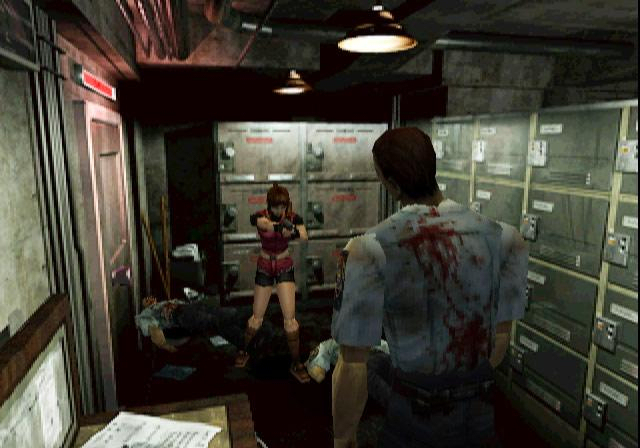
Resident Evil 2 is the first game ever directed by Hideki Kamiya, who is now renowned in the industry for his work on Devil May Cry, Bayonetta, and Ōkami. Kamiya focused on the story, scraping and reworking the first drafts of the game. The main characters, Claire and Leon, end up in the zombie-infested Raccoon City. They get trapped in the sprawling police station, which owes its grandiose architecture and eclectic decoration to the fact that it was originally an art museum. The diverging paths of Claire and Leon are excellently interwoven to encourage the player to play both paths to see how they work together and how the events of the story unfold.
The writing and presentation of the story are definitely the biggest improvements from the first game. The voice acting, while still a little stilted, is so much better than the often comedic delivery in Resident Evil. Character models also got a glow-up, giving Claire and Leon more detail and fidelity. The writing in particular went from cheesy to actually thoughtful and character-driven.
While searching for her brother Claire quickly becomes an elder sister figure to Sherry, a young girl who is one of the lone survivors of the outbreak. Leon has a brief romantic relationship with the spy Ada Wong, who’s murky motivations leave you wondering if she is even on your side until the end. Even minor characters like the police chief are memorable. When you first meet him, you wonder how he survived, and something is very obviously off about him, but he gets more disturbing as you learn more about him. I wouldn’t say Resident Evil 2 is a masterpiece of storytelling, but the thriller plotlines and thoughtful characters are well-done, especially for a game of its age.
Resident Evil 2 is a survival-horror puzzle box. Like its predecessor, action takes a backseat to managing your resources and devising a strategy to escape the police station. With limited ammo, limited health-items, and limited saves, you have to think carefully about where to go next. While most enemies can be easily dispatched with the handgun, conserving ammo for the more challenging encounters is prudent. Both Claire and Leon have terrifying and monstrous entities that stalk them throughout the game, adding an additional element of tension as you never know when you’ll have to run for your life. You may think you can hold off on saving as you are only planning on going down the hall, but one of these bulky beasts could be waiting for you in a place you previously thought was safe.
The core gameplay remains largely the same from the game’s predecessor. Manage resources, solve some puzzles, navigate the zombie-filled halls of a creepy building, and occasionally shoot your way through tight spaces. While there are some new weapons, I think the most notable improvement is the diverging paths of Claire and Leon. Replaying the game is a whole new experience with new equipment, enemy placement, puzzles, and bosses. In some instances, you can even affect the world in the other character’s story. Playing both paths even unlocks the true ending and final boss fight.
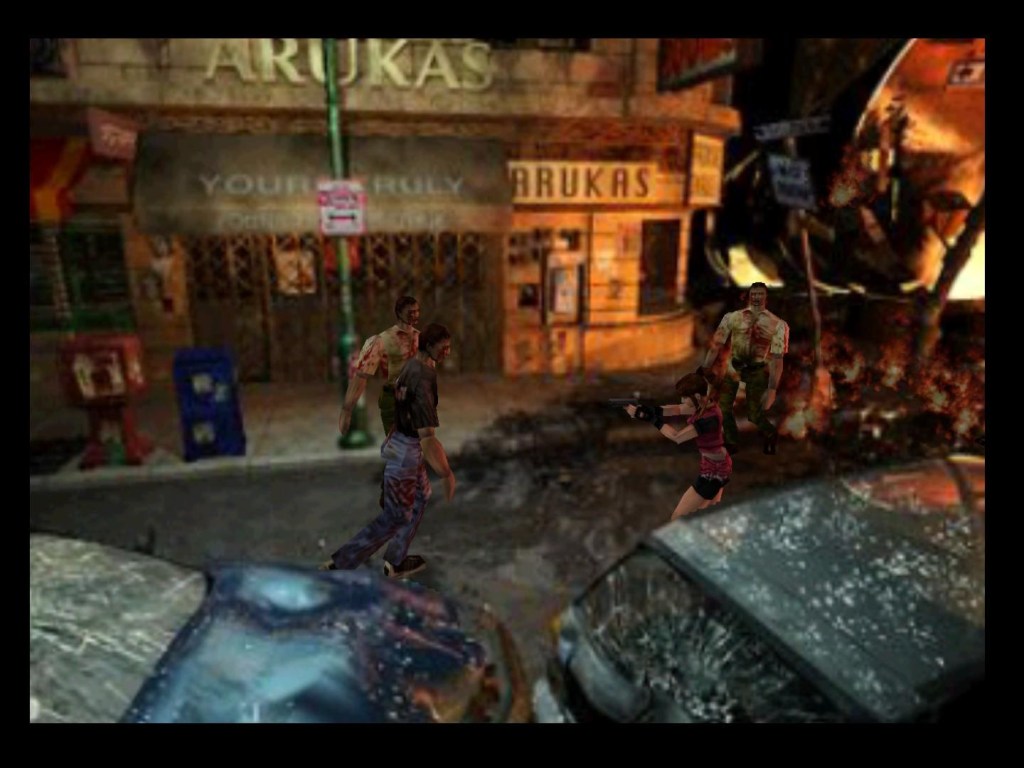
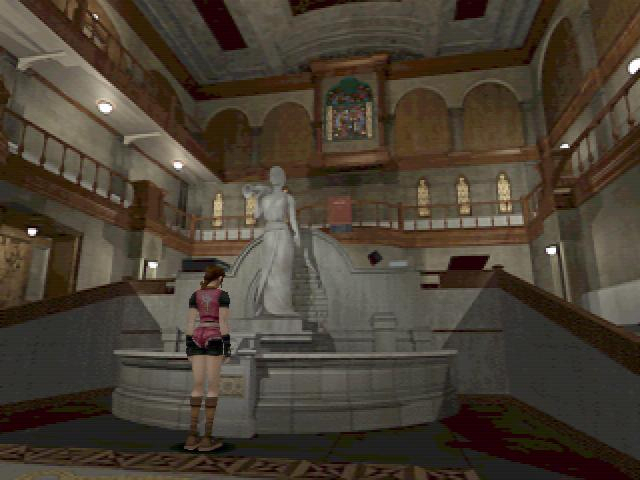
I loved the setting of Resident Evil 2. There are some brief urban sequences as you arrive in Raccoon City, running through the fires, wreckage, and hordes of zombies. There’s a sense of mayhem that is only calmed when you arrive in the police station. The police station being a repurposed art museum gives it a ton of character. From the floor layout, to the architecture, to the décor of paintings and busts, there’s a lot of charm. From there, the game descends further and further down into the grimy tunnels and secrets below the station.
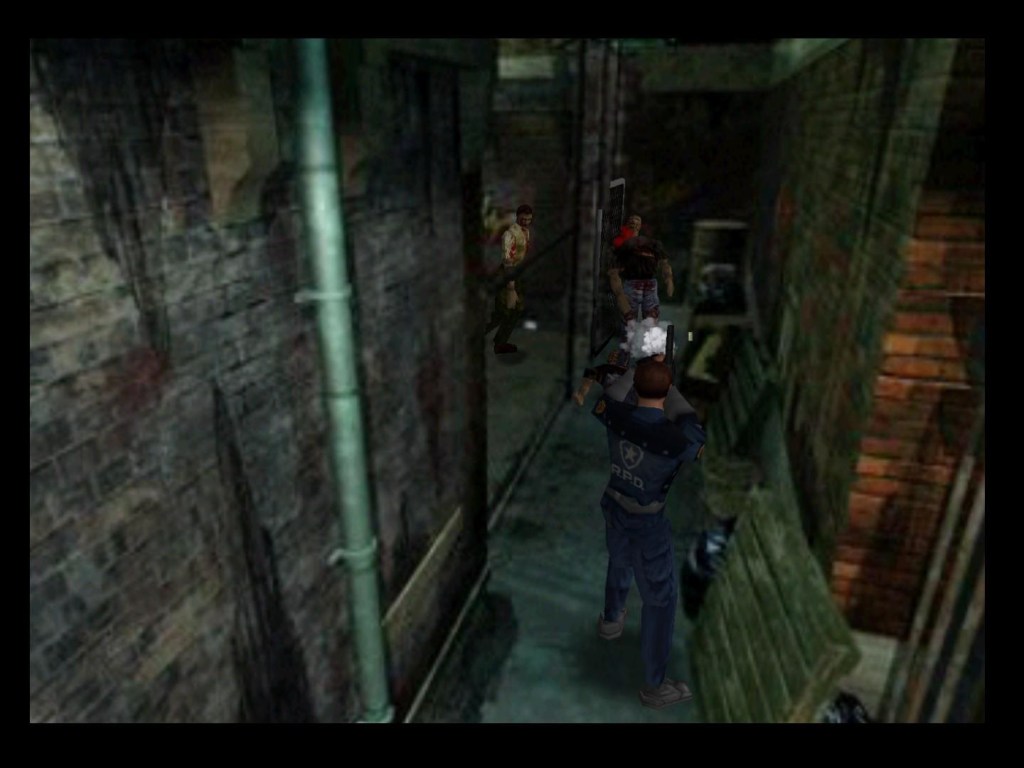
My biggest problems with the game are a result of its age. Movement is still using tank-based controls, which can be supremely awkward to get used to. Especially because of the frequently-shifting camera angles. While I did get used to it after a while, more precise movement was challenging. It’s particularly frustrating when trying to run past zombies or turn during a boss fight. The dated graphics also lessens the horror and tension. The horrifying creatures just look like splotchy and blocky figures, and the fixed camera perspectives mean you rarely get surprised or snuck-up on.
Overall, Resident Evil 2 is a shining achievement in sequel development. It improved on every aspect of the original: story, characters, setting, presentation, and gameplay. The inclusion of two separate characters with their own stories and remixed gameplay was brilliant and excellently executed. While there is no doubt that the game shows its age in a couple places, once you get adjusted to the control scheme it is still a joy to play. I can’t wait to continue through the series and see how it develops from here, and I am particularly excited to revisit the recent remake of this all-time classic game.
Alan Wake II is insane. There’re layers upon layers of meta references buried within the spiraling madness that makes up the game. Remedy’s previous games never really clicked with me, but Alan Wake II did have my brain working overtime to decode the entangled threads of narrative that are sewn in a chaotic tapestry of nightmares. I highly value uniqueness, and the ability to push the gaming medium forward into a weird and strange direction is something that I applaud Alan Wake II for. It’s not without its flaws as there are quite a few things that I took issue with, but this is a truly bizarre game in the best way possible.
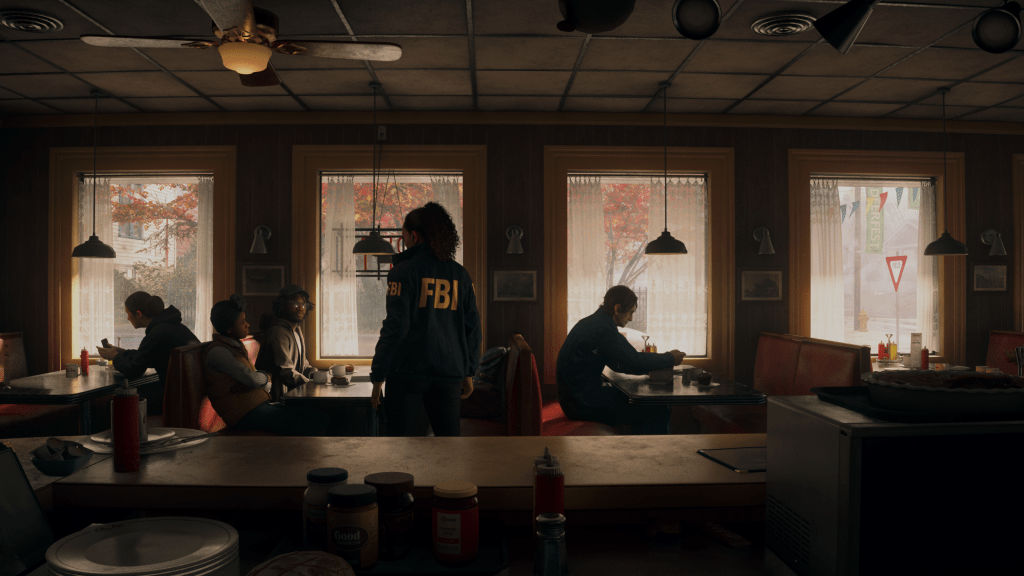
The story of Alan Wake has long been dormant. The basic premise is that the titular character, Alan Wake, is a best-selling author that gains the power to influence the world with his writing. On a trip to the remote Pacific Northwest town of Bright Falls, Alan got sucked into a horror story in which he sacrifices himself to rescue his wife from a dark presence. Alan is now trapped in a nightmarish dream reality while a doppelganger of his, called Mr. Scratch, is terrorizing the real world. In parallel with Alan’s story, a new protagonist named Saga Anderson and her partner Alex Casey arrive in Bright Falls to investigate a string of mysterious disappearances.
Saga investigates the quaint towns and the dense wilderness of the Pacific Northwest. A murder cult seems to be the cause of numerous disappearances, and she tries to deduce their goals and motives. While on the case, she learns of the dark presence and how an ever-changing horror story is coming to life. I enjoyed how the player could enter Saga’s “Mind Place” to put together the facts of the case. Her Mind Place is a cozy cabin with clues and papers strewn about. You use a big board to pin clues into place and make revelations about the plot. I do think this aspect might’ve been slightly overused, as there isn’t a ton of actual deduction or gameplay involved here. Mostly you’re just putting known pieces in place to move forward. Nevertheless, I enjoyed the noir vibes.
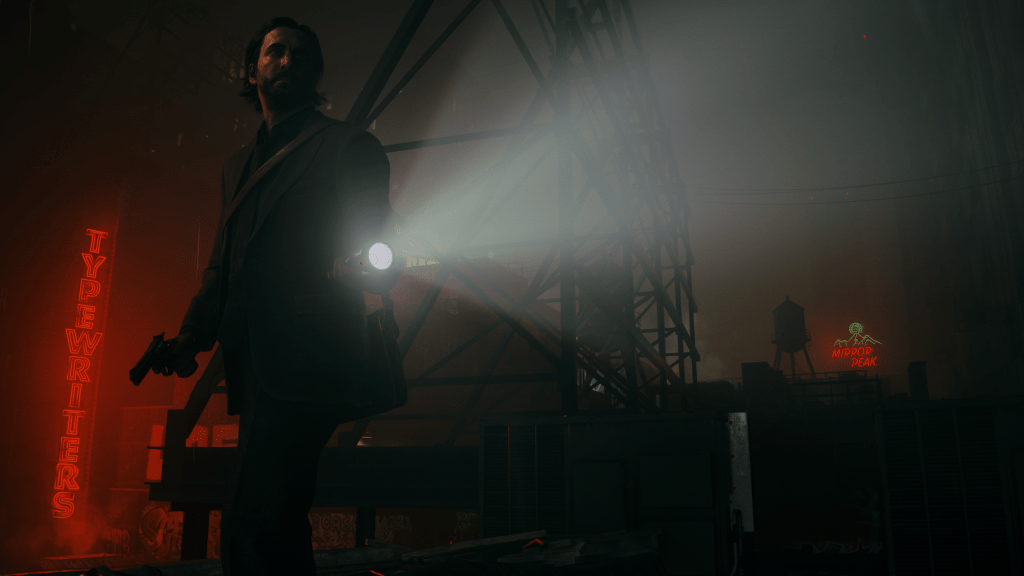
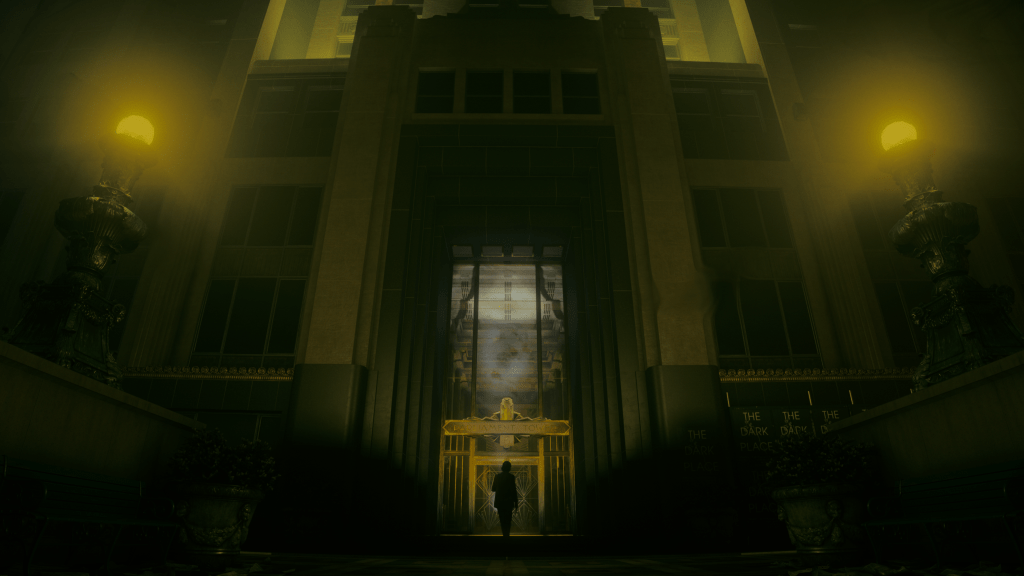
While Saga explores the real world, Alan is trapped in a labyrinthian nightmare. This is where things truly get weird. He wanders around an ever-shifting urban environment, rife with confusing dream logic. He’s caught in a surreal loop, desperate to escape. He has to use his abilities to write his way out of the loop. Alan visits numerous atmospherically dense locations such as a hotel, subway, and movie theater that were homes to ritualistic murders. As you explore these locations, you move pieces around on a storyboard to alter the plot and move forward. I absolutely adored how tense these sequences were. There’s a sense of dread of what you are going to see when you move a new horrifying plot element into place. One particularly haunting transformation was seeing how an ordinary hotel turned into a ghoulish scene where blood was scrawled across every wall and the hallways were strewn with gored bodies.
The seamless use of mixed media is part of what defines Alan Wake II. The transitions between game and live-action are incredibly well done and fuel the metanarrative aspects of the story. Remedy has a wonderful cast of actors that portray their characters expertly. It blurs the lines between what is real and what is dream logic. There’s a full 15-minute artistic short film that can be found which serves as a pivotal plot point of the imaginary murder cult in Alan’s dream reality. And that film uses the actor who also plays Alex Casey who is the main character in Alan’s detective novels, and that same actor also plays a different Alex Casey who is Saga Anderson’s partner in the real world. And that actor is the creative director of the game: Sam Lake. Who also plays other characters in Remedy’s expanded universe. There’re layers upon layers of references to unwind. Alan Wake II references itself, its predecessor, other games within its universe, and heavily leans on tropes from detective and horror media.
I find that media with heavy meta elements can often feel pretentious, but that’s not the case with Alan Wake II. The game knows that it can be ridiculous at times, and isn’t afraid to point this out. The writers clearly had fun with this game and they embraced the weirdness. Take for example the commercials that play on the TVs throughout Bright Falls. Two of the side characters write, direct, and star in their own goofy productions about their side businesses. Such as their coffee-themed amusement park with a moose as a mascot. I love that despite its metanarrative elements and complicated story, Alan Wake II doesn’t take itself too seriously.
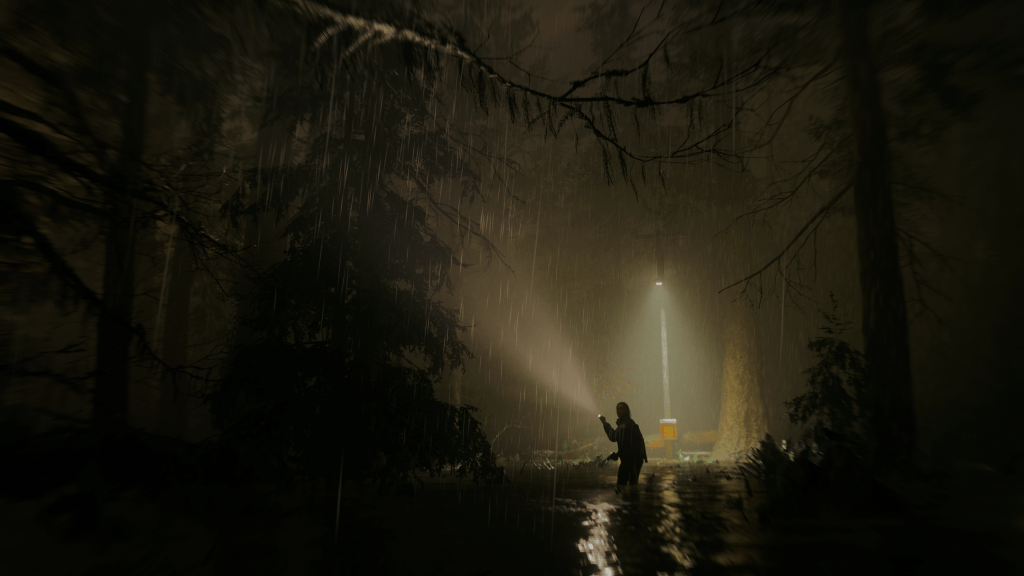
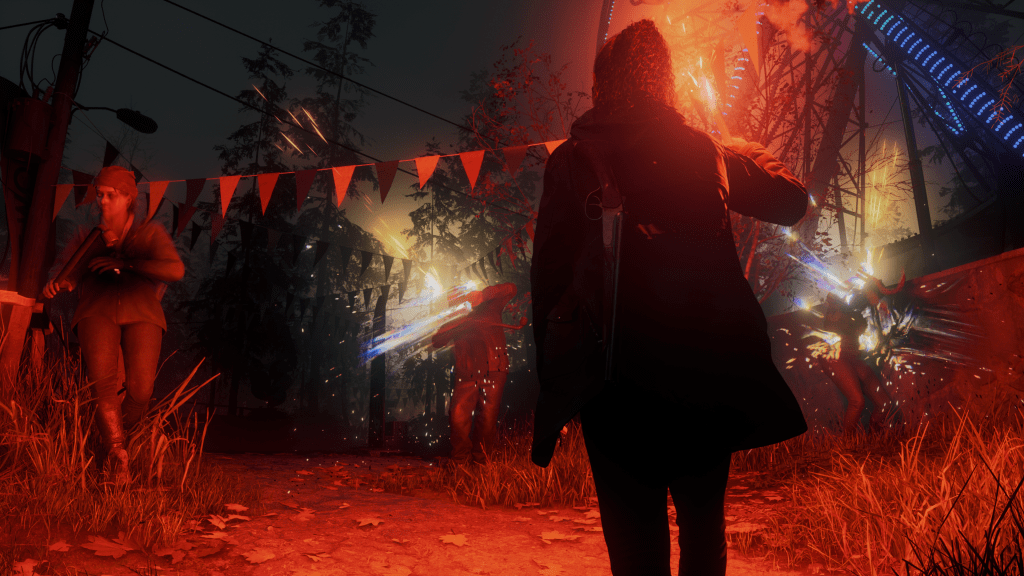
Where Alan Wake II really shines is its thick atmosphere. The sharp contrast between the two protagonist’s settings created some phenomenal variety. As Saga you have to explore dense woods, small towns, and other rural locales. Conversely, Alan is trapped in an urban nightmare. Dirty streets, highrises, and buildings such as hotels dominate his perspective. Both settings are eerie. Saga wanders through thickets as cultists and possessed wolves stalk her. Shadows whisper and lunge at Alan as he navigates through nonsensical streets and corridors. Darkness envelopes both characters, and the safety provided by a break room or an abandoned hut is spirit-lifting as these are your only beacons of safety. The game’s spectacular visuals add to the sense of immersion, as Alan Wake II is a fantastic game to look at.
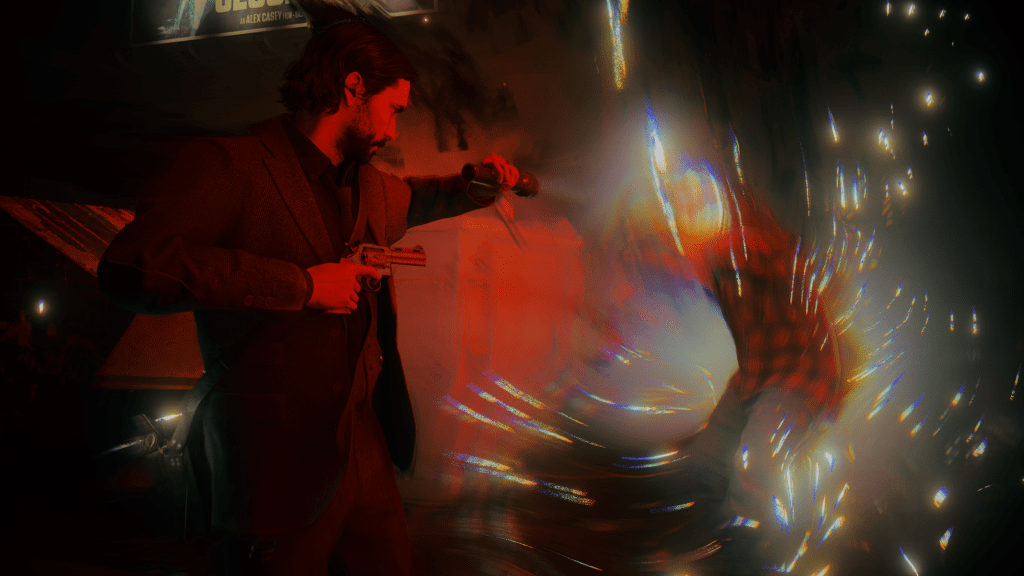
The gameplay of Alan Wake II was something that I was worried about. When I played the original Alan Wake I thought the setting and atmosphere were amazing, but the game was marred by an absolutely abysmal combat experience. Luckily, Alan Wake II keeps the premise of its predecessor but vastly improves upon it. To fight enemies, you need to focus your flashlight on them to break through their darkness shield. From there, it functions like a standard third-person-shooter. I quite liked how impactful all the weapons felt. The visual and auditory feedback was appropriately visceral, and enemies reacted strongly to being shot, especially if hit in a weak spot. I thought combat was fun overall, and the fast-moving enemies always kept me on my toes. That being said, there are a few issues that bothered me.
The first issue was the absolutely abysmal enemy variety. There’s only a handful of enemy types in the game, I found myself battling the same couple basic variations throughout the entire twenty-hour experience. Moreover, there is a ton of fluctuation in the number of enemies that the game throws at the player. There are times when you can go for what feels like hours without any combat, especially at the beginning of the game. And conversely, there were sections of the game that I couldn’t catch a breath because the game kept bombarding me with respawning cultists. Both of these extremes are negative. Too few encounters is an issue because it can get boring to just walk around with no threat of combat, and too many encounters kills the tension as it turns what should be frightening foes into a shooting gallery.
While Alan Wake II undoubtedly improved upon the gameplay of its predecessor, I still found it to be fairly clunky. Reloads are extremely time-consuming and easily interrupted, which is aggravating. However, I think the biggest cause of this is the camera. The over-the-shoulder camera is great for immersion, but I wish it zoomed out a tad during combat. When enemies get up close, the game feels unpleasantly claustrophobic and I had a difficult time adjusting the camera. I found myself saying “I can’t even see what’s going on” fairly often. There are also a ton of enemies that zip and teleport around, leaving me desperately rotating the camera to keep up. But as soon as the enemies were in my sights again, they just teleported away again.
Aside from the camera, I found that the environmental design also was a significant source of frustration for me. While the game looks astonishing, I found myself confused and turned around quite often. I think having a mind-bending dreamscape that intentionally causes the player to get lost is great. But there were plenty of ordinary places that just felt poorly signposted. Organic and detailed environments are great, but I felt that they got in the way of navigation. I love that there was no mini-map or objective markers, but the environment did not lend itself to intuitive pathfinding. But my biggest frustration with Alan Wake II was its dynamic resource economy.
An important aspect of any survival horror game is resource management. Having a limited number of bullets, healing items, and inventory space makes fights far more intense. Tension builds faster when you only have a handful of ammunition to dispatch enemies. Every encounter is terrifying knowing that it could deplete your resources. Alan Wake II does have limited resources, but its implementation is inelegant. It utilizes a dynamic system, doling out items based on how much the player already has in their inventory. If you’re running low on supplies, the game will give you more stuff, but if you are already rich in ammunition, you’ll get very few or no resources at all. At first glance, this seems like it makes sense as it ensures that the player never has too much or too little, but I find that this system undermines the entire point of resource management.
The point of having limited resources is the threat of running out. The helplessness of having no ammo to protect yourself. Having to explore and scavenge for resources can be anxiety-inducing. But there’s rarely any real threat of running out of resources in Alan Wake II. The game throws resources at you when you’re running low. And there’s little reason to thoroughly explore areas for more stuff because you get diminished amounts once you have a surplus. I found it frustrating that I was punished for scavenging, often opening a container to find it completely empty. Not only have I wasted my time, but I can never open that container again so I have permanently lost potential resources. Maybe it wouldn’t have been so aggravating if it wasn’t so obvious that the game is doing this.
For a game with such impeccable atmosphere, it’s a shame that immersion is so easily broken by something as simple as resource management. It’s obviously apparent that Alan Wake II is limiting your ammo once you open a container and there’s nothing in it. You can also game the system by stuffing excess ammo into your safe room box before going out to scavenge for resources. The game only cares about what’s currently in your inventory, so you can fake being low on ammo to get more. Breaking immersion is a sin in a game like this, and I often found myself pulled out of the world and into crunching numbers to determine whether or not opening a container was worth it.
Alan Wake II is a difficult game for me to judge. I can respect its artistic vision, the blending of genres, the use of mixed media, and of course how the story is open to many interpretations. But the game flounders a bit when it comes to basic elements such as combat, navigation, and resource economy. It’s tough to claim that this is a must play game when it falters at the basics. But Alan Wake II is a must play game. It’s unique. It’s innovative. And it pushes gaming forward as an artistic medium. It is for these reasons that I give Alan Wake II a 9/10. Even if its video-gamey elements are clunky, the unfaltering artistic vision of Alan Wake II makes it a can’t miss experience.
You are trapped in a dark cabin in the woods, playing a game of cards that determines your fate. Inscryption blends a multitude of genres to deliver a game that you never know where it will lead next. Tension permeates the experience as you attempt to unravel the dark secrets hidden within. Inscryption is a truly unique experiment, and it all revolves around a simple card game.
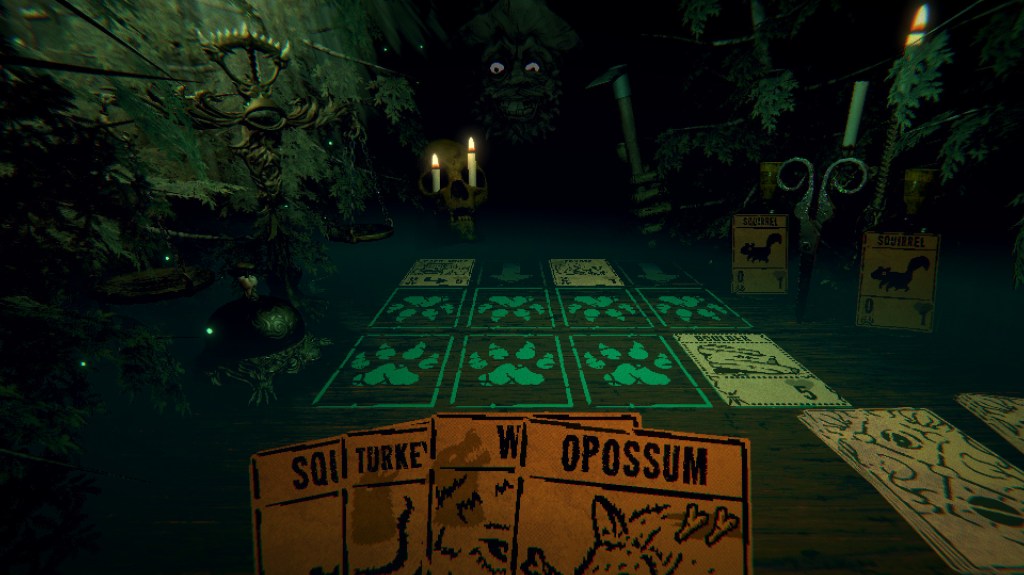
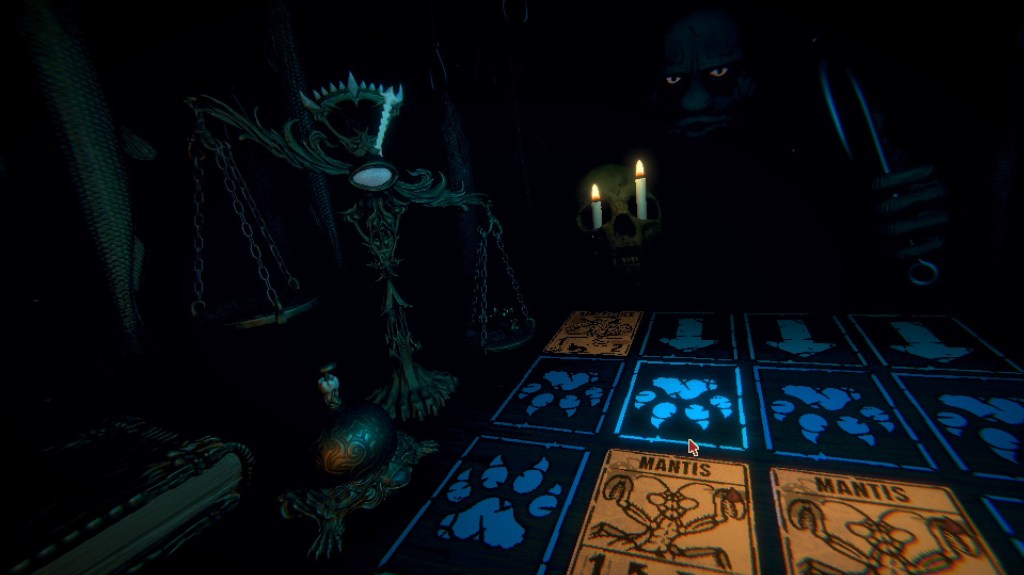
In every act of the Inscryption, you will be playing some variation of the titular card game. The card game itself starts remarkably simple. Whoever deals five damage more than their opponent first, wins the game. Cards have the basic stats like attack and defense, as well as special abilities. It’s all straightforward and easily understood by anyone vaguely familiar with trading-card-games. While I appreciate that the game starts simple and gradually gets more complex, I also think that it is almost too easy to find the winning strategies that almost guarantee success.
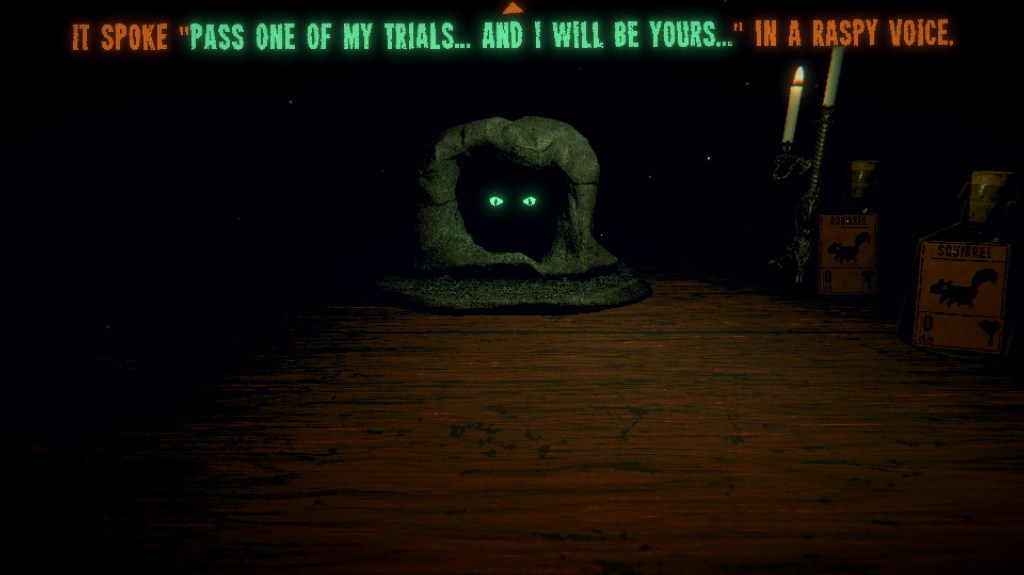
You sit across from a mysterious and deranged figure, who sets up tabletop adventure in which you traverse encounter to encounter playing cards. As you defeat his scenarios, you are also given the opportunity to improve your deck. Gaining new cards, adding stats to existing cards, combining cards of the same type, or sacrificing a card to give its ability to another card are some options that you may encounter.
Once I understood the basics of the game, I found it a bit repetitive. It’s pretty easy to leverage events to power-up a single card or two that let you win each round almost immediately. The central card game is just too simple. I never felt like I was building a coherent deck that relied on a synergistic strategy. Instead, I almost always found myself making use of totems to boost the ubiquitous Squirrel card, as it was needed as the foundation to summoning any other creature. After that, I just needed to stall until I drew one of my boosted cards to wreak havoc.
The game was designed this way on purpose, you unlock powerful boosts, items, and cards after playing a few rounds. It becomes difficult to lose without a blundering horribly. The game was intentionally made easy so the player can progress the story. But when the central mechanic is playing cards, and I master the card game after only completing 25% of the game, the following 75% can get a bit dull. The game does mix up the decks periodically throughout the course of the experience, which is a welcome change to keep things fresh.
While I found the card game itself to be a little too simple, there is more to Inscryption than playing cards. You can explore the claustrophobic and dingy cabin, interacting with objects in hope that they will help you escape. This was the strongest aspect of Inscryption. The atmosphere and anxiety of playing cards when you are trapped. Every draw, every move, every decision brings you closer to being a victim. Your only hope is to use the cabin’s secrets to your advantage.
The card game pairs well with the atmosphere. It’s designed to be tense, to be played on a knife’s edge. The metallic tinker on the scale as you take damage is chilling feedback that you are a single mistake away from having your candle blown out. The nature of sacrificing cards to summon more powerful ones means you are always careful about what cards you are playing, as momentum plays a pivotal role in keeping your side of the board healthy. In the most desperate of situations you can utilize items, many of which have horrifying implications. Even though I knew it was just a game, I always felt a sense of revulsion whenever I used a pair of pliers to rip out a tooth to add a point of damage to the scale.
Inscryption is cloaked in layers upon layers of metafictional storytelling and genre switching. The nature of the game slowly reveals itself as the player progresses. In an effort to remain spoiler free, I will not delve deep into this aspect of Inscryption. I enjoyed going down the rabbit hole of Inscryption and revealing the deep dark conspiracies within.
Uniqueness is becoming more and more of a virtue as I play games. The ability for a game to be different. To be weird. To experiment. Inscryption is that kind of game. It may not have the best deck-building or card game mechanics, but the context around that simple card game is what breathes life into Inscryption. It is for these reasons I give Inscryption an 8.5/10. If you are even vaguely interested in Inscryption, don’t read or watch any more about it and play it for yourself.

 stephensopinions