No game may have been more highly anticipated than Hollow Knight: Silksong. Team Cherry surprised the world in 2017 with the debut of Hollow Knight, and one of their Kickstarter funding goals promised a second playable character: Hornet. That promised DLC expanded in scope until it eventually became its own standalone game. It’s been over 6 years since the game was first revealed and after the long wait I wondered if the lightning-in-a-bottle of the original could be recreated. But after playing the game, I can confidently say that Silksong picks up right where Hollow Knight left off. For my thoughts on Hollow Knight, check out my review from when the original was released.
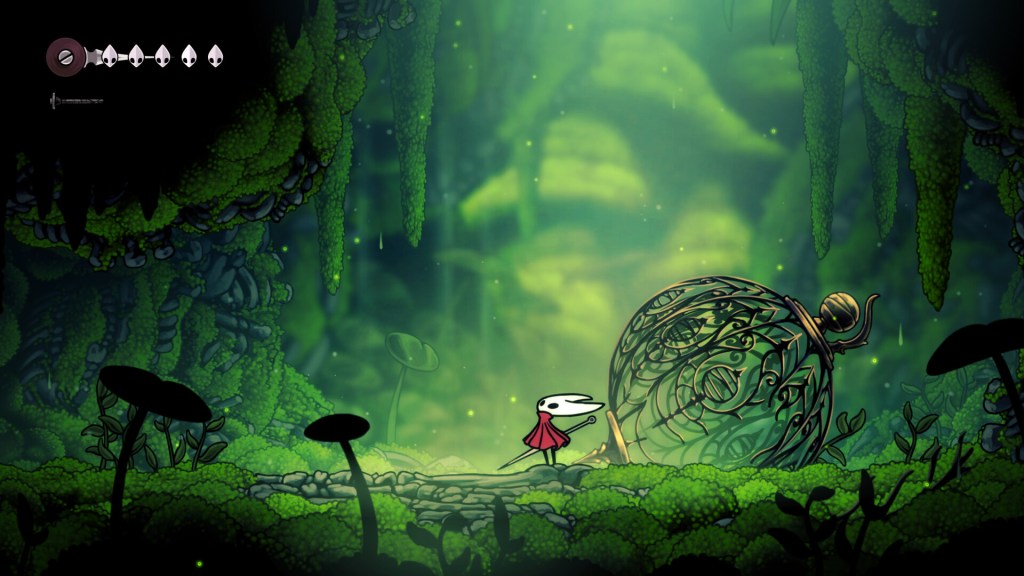
The brilliance of Silksong begins with its world. Kidnapped by religious zealots, Hornet arrives in the land known as Pharloom. It’s inhabited by numerous varieties of bugs, but the common thread connecting them is religious devoutness. It’s clear that Pharloom is a kingdom that has crumbled into dust, only whispers and tradition carry the travelers to summit the peaks where the holy Citadel stands.
As a metroidvania, Silksong frees its players to explore and discover organically. With nothing but the nebulous goal of reaching the Citadel as your guide, you set out on a blind journey. Silksong takes inspiration from the storytelling of FromSoftware’s games such as Dark Souls and Elden Ring. Taking in the dying world around you, piecing together the puzzle of what happened through vague texts and environmental storytelling. Nothing is directly told to you, but the world and its artistry wonderfully communicate what kind of place Pharloom once was.
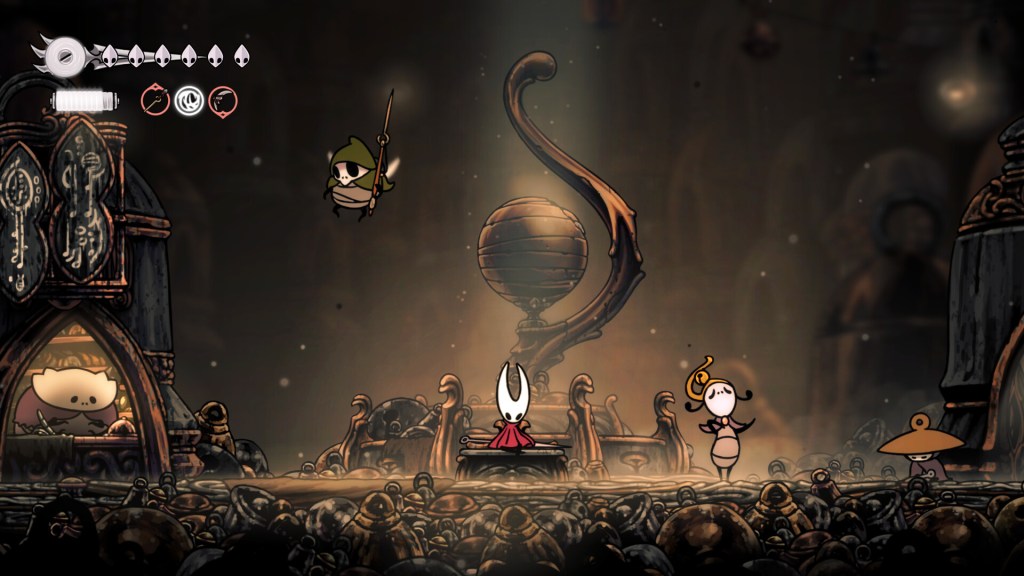
Take for instance the Underworks, a mechanical nightmare of pipes, gears, and valves beneath the Citadel. The opulence of the Citadel is powered by these dingy chambers. It is here where workers tirelessly labor to maintain the holy grounds that they never see. When they attack you for your intrusion, they only drop a pittance of rosaries, the currency of Pharloom. As you’ve progressed through the game you’ve gained increasingly more rosaries in each area from tougher foes, but the Underworks represent the poor dregs of the Citadel. There’s even a hidden room in which you can run on a treadmill to generate power, only to be rewarded with a single rosary for the effort. And it is here in the Underworks where the benches which have been the universal sign of rest and have acted as your checkpoints of safety incur a cost of 15 rosaries for a single use. Without any dialogue or text, Silksong portrays a dystopian society where a class is exploited and drained to fuel the grandiosity of an empty cathedral.
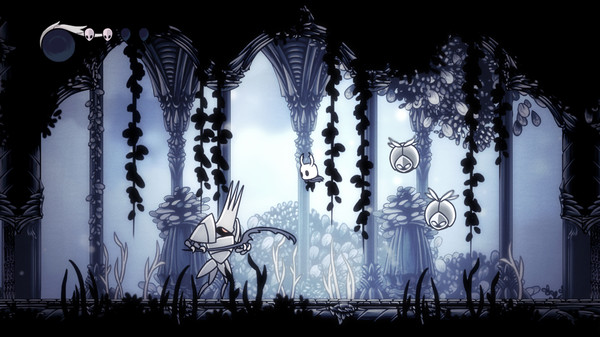
It’s these vignettes and partial truths of the past that make exploring Pharloom so compelling. The art and sound design of Silksong is also top-notch. An enormous amount of care was put into making each area distinct and filled with details. It’s from these details where the hidden stories are filled with life. The music is equally compelling, often harboring somber moods as you explore this crumbling kingdom. Yet frantic melodies make an appearance when engaging with any of the numerous bosses of Silksong.
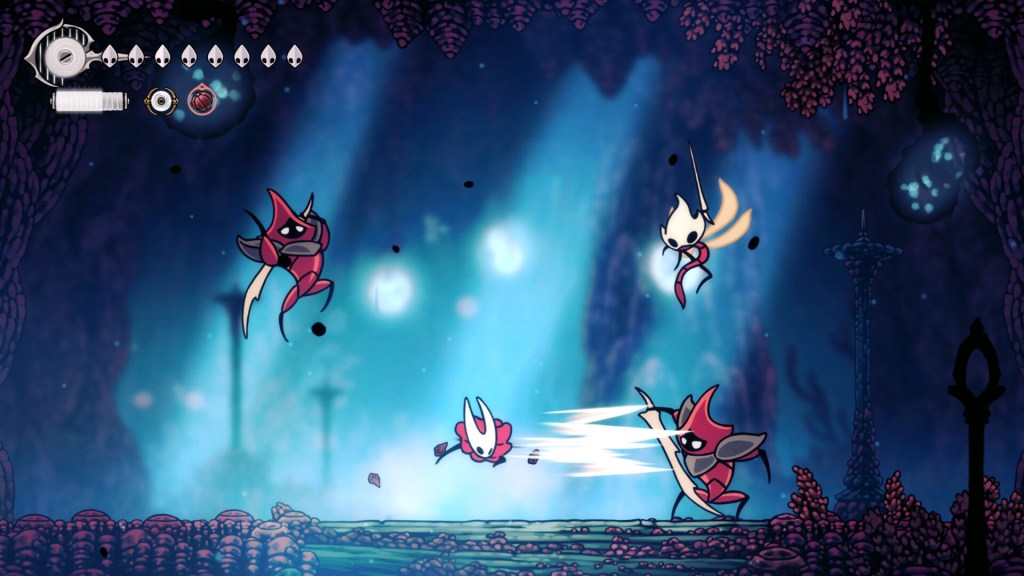
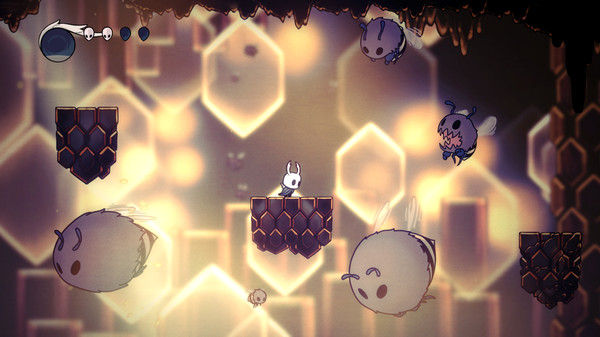
The gameplay of Silksong is that of traditional 2D metroidvania. You explore massive areas, fighting enemies, platforming across dangerous pits, and collecting hidden boons to increase your power. The major upgrades that you find act as keys that unlock new paths in the world, as well as being purposeful in combat. What I love about Silksong is its non-linearity and its reluctance to guide the player. It is up to you to figure out where to go, often you have to choose at random between forks in the road. When you enter a new area, you are blind, there is no map until you find the mapmaker. You’re forced to rely on instinct and curiosity. I find this more compelling than being given explicit directions. Each path has something to be discovered, but the further you wander from a resting place, the more risk you incur.
Pharloom is a harsh place, filled with enemies, obstacles, and traps. Resting at a bench acts as a checkpoint, restoring your health and letting you respawn there if you die. And if you die, you lose all the currency you are holding, and you only get a single chance to reclaim it. The game design makes the world incredibly dangerous, and you can take nothing for granted. Every time you hit an enemy, you generate a single pip of silk, and nine pips of silk are required to heal. Getting hit at all is costly, and extreme caution is warranted when traversing Pharloom. I personally love this feeling of playing on a knife’s edge. You can never let your guard down or brute force your way through obstacles. You have to master your movement and your arsenal.
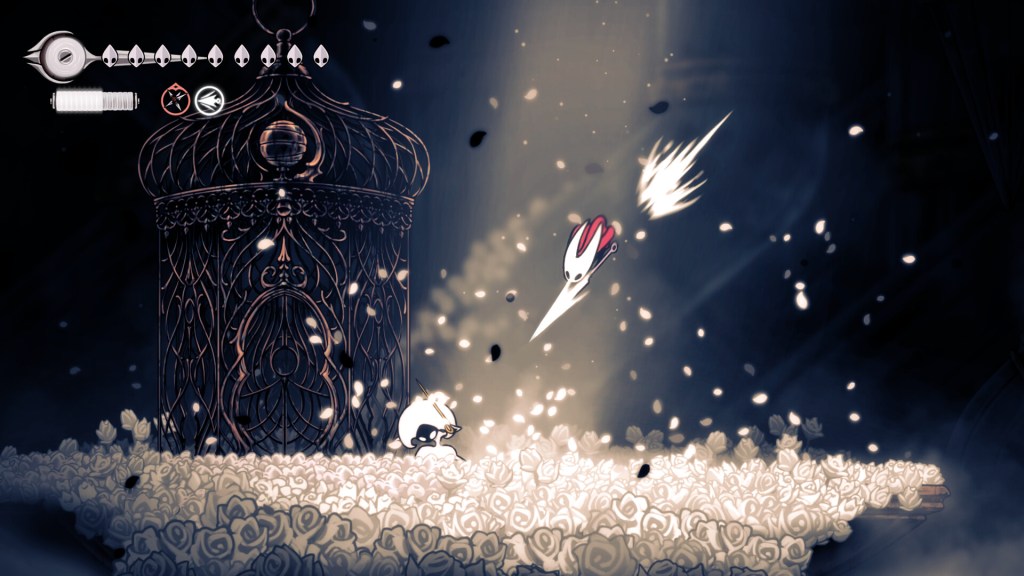
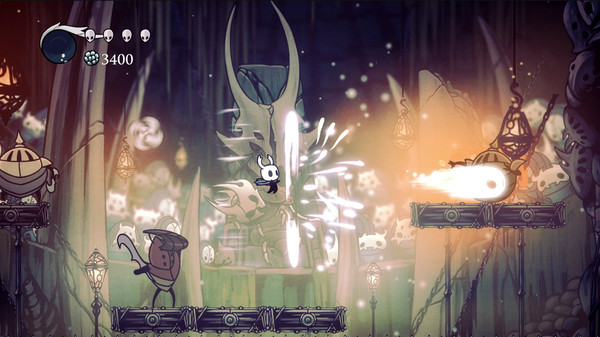
What makes Silksong stand out from its predecessor is the number of tools available to the player. Hornet is a much nimbler protagonist than Ghost from the first Hollow Knight. She acquires many different tools to dodge and evade. But this agility comes at a cost, as she is also much more fragile than Ghost. As the game progresses, many enemies and traps deal two ticks of damage rather than one. This happens fairly early on in the game. While there has been an uproar online about this steep spike in difficulty, I wasn’t offput by this at all. I thought the difficulty was well-balanced to provide an adequate level of challenge. Silksong is the sequel to Hollow Knight, and it was originally intended as DLC. It makes sense that it picks up where Hollow Knight left off. Furthermore, Hornet is swift and has so many more tools at her disposal to make encounters easier. Making use of these tools makes the game so much more approachable.
Not only do you unlock various movement options, but spells, crests, and tools also can be found to customize your moveset. Spells are powerful abilities that cost silk to use. Tools come in the form of both equipped passive bonuses and accessories that you can deploy in combat such as throwing needles or caltrops. And crests are complete game-changers as they entirely alter Hornet’s attacks and innate abilities. For example, the Beast crest modifies the basic heal to instead be a life-stealing effect when you claw at enemies. I found that tinkering with the different options and finding combinations that I liked was immensely enjoyable.
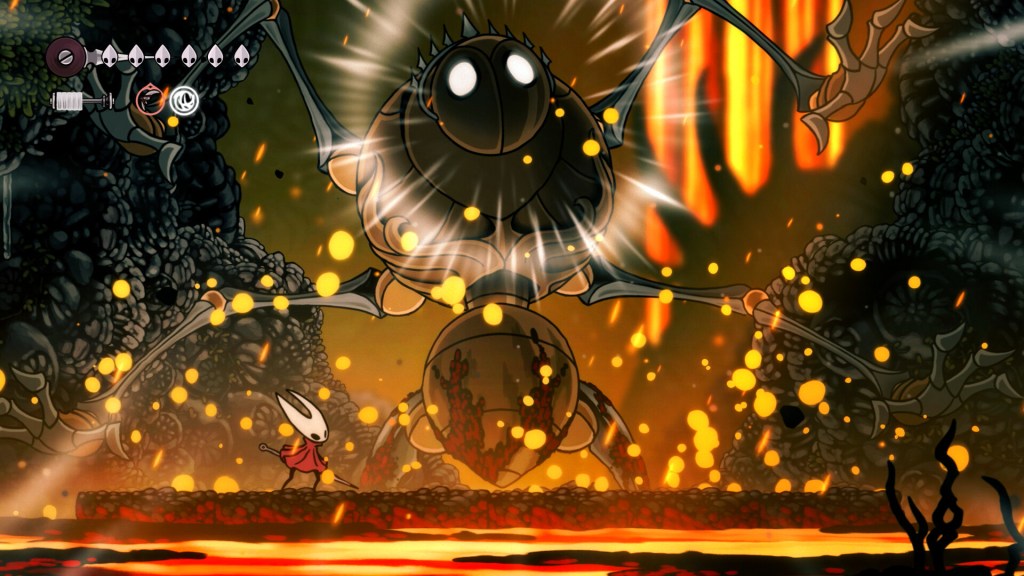
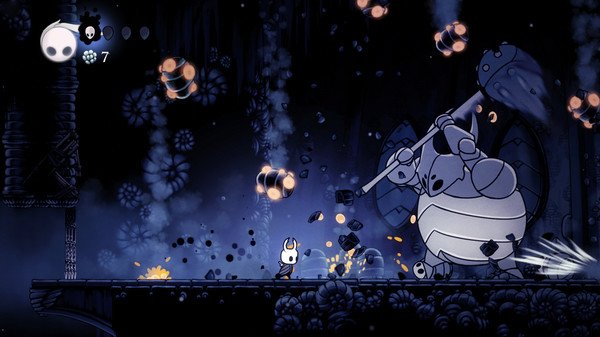
The boss fights of Silksong are the cherry on top of the already excellent gameplay. They all have distinct attack patterns and arenas that make them stand out from one another. But I was most impressed by the lack of restraint shown by Team Cherry. Most bosses only have 3 or 4 attacks, limiting the number of tells and timings that you have to memorize. I was able to easily find openings and gain confidence on the tougher foes, transforming the fights into a dance as Hornet nimbly evades blows and returns damage with her needle. The design of these fights has a knack to seem intimidating at first, but quickly become manageable once you learn the patterns.
As a metroidvania, discovery is a key aspect of the gameplay loop. Finding secrets, uncovering new areas, and remembering where to use your new abilities are part of the fun. For the most part, Silksong nails this. The lack of guidance makes these discoveries more organic and rewarding. But I do have a minor gripe with some of these well-kept secrets. I don’t mind when minor rewards such as health upgrades or tools are well-hidden, they are bonuses for having a keen eye. But I was disappointed by how many major areas were so incredibly concealed. I missed a handful of these areas initially, and only found them when I was aiming for 100% completion. One or two of these areas being secret is fine, but Silksong is a massive game and finding the fake walls leading into these secret zones is like finding a needle in a haystack.
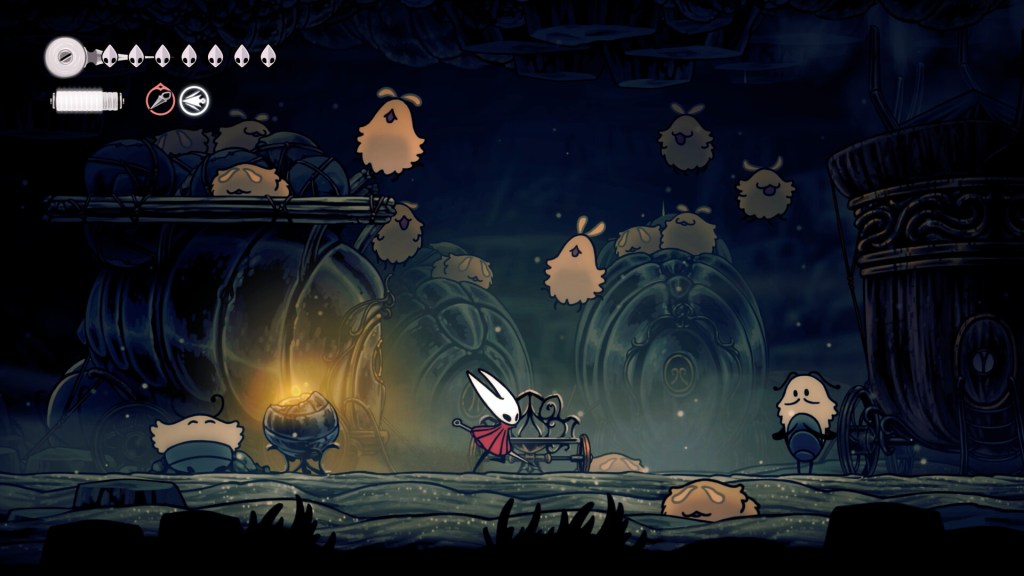
My other minor issue with Silksong is its propensity for dull fetch quests. There are dozens of quests in the game, many of them being fun journeys that result in a boss fight or extra bit of lore. But there are also many repetitive fetch quests that have you slay some number of nearby enemies. The majority of the time these enemies are the same ones you’ve been fighting for hours at this point. These kinds of quests are just dull and act as padding, which the game doesn’t need at all since it is already so huge.

After such a long wait, I was a bit nervous that Silksong wasn’t going to live up to its sky-high expectations. But I was thoroughly impressed with the immersive world and tight gameplay. It is a continuation of Hollow Knight, but it doesn’t feel totally derivative because Hornet plays so differently from Ghost. The ability for the artistry of the world to tell a wordless story is truly special. It is for these reasons that I give Hollow Knight: Silksong a 9.5/10. If you haven’t played either of the Hollow Knight games, do yourself a favor and play the best metroidvanias of the last couple decades.
 stephensopinions