Thronebreaker: The Witcher Tales (2018)

Gwent is one of the best “game within a game” examples ever. In The Witcher 3: The Wild Hunt, the player can take a break from monster slaying to sit down and play the card game known as Gwent. I probably spent more time in taverns playing this addicting minigame than I spent actually adventuring. I was elated to hear that there was a fully-fledged roleplaying game that utilized Gwent as its main mechanic. Yet my actual experience with Thronebreaker: The Witcher Tales was more of a rollercoaster than the fun revisit to Gwent that I was expecting.

My first moment of confusion was during the tutorial, when I realized that this version of Gwent was monumentally different than what I played in The Witcher 3: The Wild Hunt. In the original version of Gwent, each game would have three rounds, and the player to win two rounds won the match. The interesting facet was that you only had ten cards for the entirety of the match. You may win a round, but if you played too many cards doing it, you were in a poor position to win the match. It was interesting as the players had to come up with powerful combos that only required a few cards, or use cards that allowed them to gain tempo on their opponent. You had to know which round to intentionally lose and how to bait your opponent to playing their good cards too early. It was a game of strategy and momentum.

The Thronebreaker: The Witcher Tales version of Gwent is substantially different for the most part. Most battles do not even retain the standard 3-round format. The majority of matches in this game are single round affairs, which to me is missing such a crucial aspect of the original game. When the game is only a single round, it just becomes an arms race of who can play the most powerful cards and combos. Previously, you had to play your powerful cards at optimal times such that you wouldn’t waste them on an already won round, now it doesn’t matter.

Truthfully, the original version of Gwent had its own fair share of balance problems, but I would’ve liked to see the design team work on fixing those problems rather than just changing the entire format. The three round battles do still exist, but they aren’t plentiful. Eventually, the new version of Gwent did grow on me, but it was incredibly off-putting the first time I played Thronebreaker: The Witcher Tales. The original version needed changes to rebalance it and keep it fresh, but it didn’t need an entire overhaul.

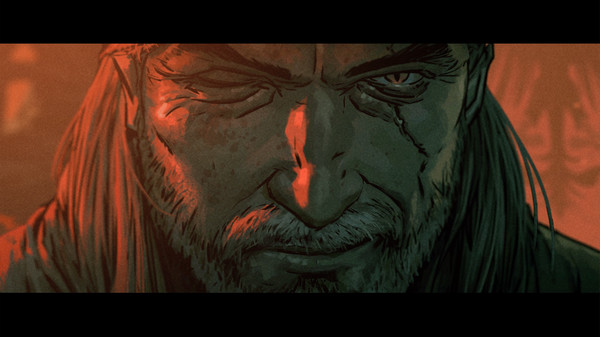
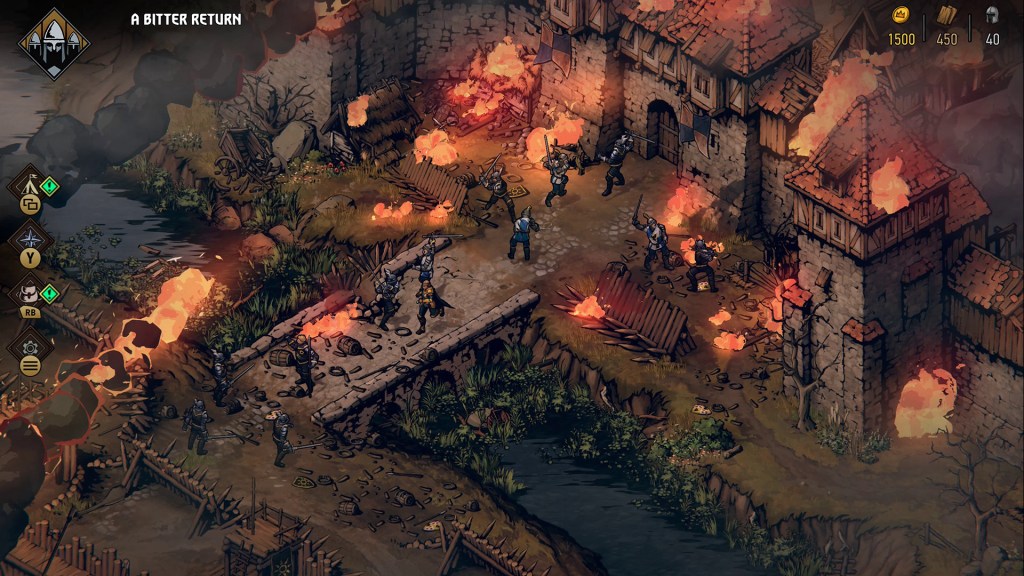
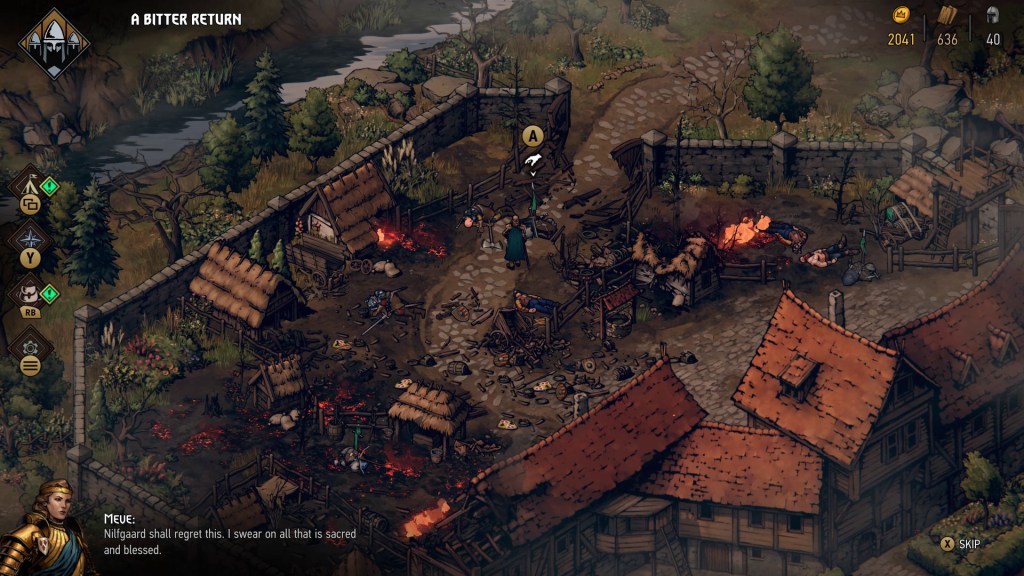
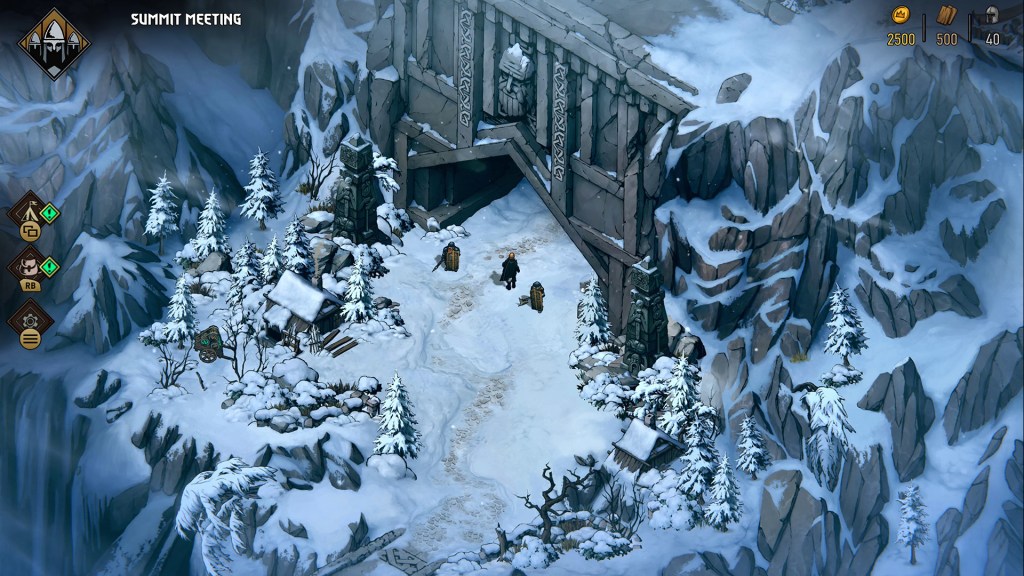
Thronebreaker: The Witcher Tales follows the story of Queen Meve and her campaign against Nilfgaardian invaders. This war precedes the events in the mainline trilogy of The Witcher. You play as Queen Meve, the ruler of Lyria and Rivia, during an invasion of her homeland. The warrior queen is conspired against and forced from her throne, and the game follows her adventure to rebuild her army and retake her kingdoms. In typical fashion of the series, there is an abundance of decisions to make, often with no obvious answer. The game plays as a top-down point-and-click adventure game, and the battles are represented by the card game Gwent. As you travel across the various areas you will have to make many moral and strategic decisions regarding your army and subjects.

The presentation of the game is top notch. The artwork, voice acting, story, and interactions with the various characters in the game was the absolute highpoint of the experience. The story itself was fairly intriguing, but the characters and decision making carried the game. You meet various important figures throughout the game who you can recruit to advise Queen Meve and join her army. But every decision has potential for backfiring completely. You may want to recruit an elf who was being attacked by humans, but maybe that elf is a spy and will betray you and sabotage your army.

Each decision not only has ramifications not only in the story, but in regards to your army as well. Recruiting new characters lets you use their special card during battles. But be careful, as a bad decision may lead to you losing resources like gold or soldiers. The universe of The Witcher is a tumultuous one, there are many factions vying for power. Subterfuge is a common tactic to weaken opposing forces. Be aware that whoever you decide to recruit and rely on may at some point betray you.

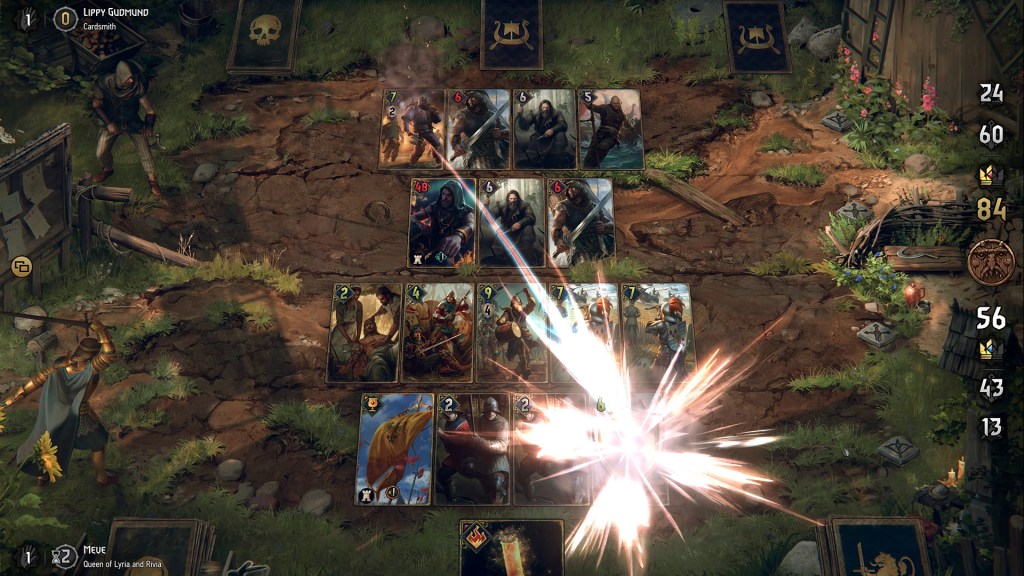
As previously mentioned, the core “action” in the game is represented through the card game Gwent. You can modify your army by swapping out cards and building a deck that fits your needs. To craft or upgrade cards, you gather three resources as you explore: gold, recruits, and wood. You use these resources to supply the war machine, which of course is represented by your deck of cards. The deck building aspect of the game is pretty fun, as cards have various effects that you can find synergy between. There are many different strategies that can be played around with. You can make a deck that spams the board with tons of cards, or focus on just powering up a few specific cards, or you can use cards that deal damage to your opponent’s cards. There are a lot of different options to try out, and the game is not shy about introducing new sets of cards to experiment with.

Despite feeling a bit frustrated at the differences between the original Gwent and this new version, the card game variation of Thronebreaker: The Witcher Tales eventually did grow on me. The cards in this game are much more complex than its predecessor. Each card has a unique effect, which you can often chain together for some synergistic combos. Finding out which cards worked well together was a lot of fun. Perhaps the most interesting encounters were the frequent “puzzle battles”. In these battles the player is given a preset hand and a special objective. Usually there would be a specific order of operations in how to play the hand to complete the battle. These were nice detours from all of the standard Gwent encounters, as those could grow repetitive very quickly.

Thronebreaker: The Witcher Tales is a fairly long game; it takes about 30-35 hours to complete. For the amount of content in the game, that is too long. Gwent can be a lot of fun, and I was invested in the story and characters, yet I was burnt out entirely by the time I reached the end of the game. I think the problem stems from the fact that once you build a sufficiently powerful deck, you can just steamroll every single encounter the same exact way. By the second or third chapter in the game I had created a deck that easily dealt with nearly every battle, and I didn’t really have to think much outside of the more unique puzzle battles. This led to many of the encounters feeling very same-y and repetitive. This was exacerbated by the fact that the 4th and 5th chapters of the game are filled to the brim with repetitive battles that have absolutely no impact or relationship to the story.

The repetitive nature of the game could have been at least somewhat avoided if the game encouraged the player to craft multiple decks or to at least switch it up from time to time. While you do unlock plenty of cards during a playthrough, you still need to use resources to craft them. This disincentivizes the player from trying out new decks unless they absolutely need to. If you have a deck that works well, there’s no need to waste resources that you may need later. The odd thing is that the game forces the player to switch up their deck in the transition from chapter one to chapter 2, then never does this again. I understand not wanting to force players to stop using decks that they may enjoy using, but they could have at least encouraged rebuilding your deck from time to time.

My last complaint with the game may be a petty one, but I absolutely despise the design of the final boss. I played on the highest difficulty available, and for the most part the game was never too challenging. But the final boss was an absolutely insane difficulty spike that felt blatantly unfair. He has multiple abilities that are individually so overpowered that just having one would be plenty challenging.

His first ability makes it so any card that you destroy will automatically be replaced by a card in his deck, so it becomes detrimental to destroy any of his cards. His next ability allows one of his cards to get a 10-point strength boost every turn, which is a fairly large amount. For reference, one of Queen Meve’s possible abilities boosts a card by only 4 points, and it has a 4-turn cooldown. Finally, he has numerous cards that are so absurd they feel like a joke. One in particular allows him to draw 3 extra cards and also boosts every one of his cards by 2 points. In a game where you can’t draw cards outside of special circumstance, having a card that allows you to draw just one extra card would be valuable, let alone three extras and a power boost to go along with in.

I pretty much steamrolled the entirety of Thronebreaker: The Witcher Tales up until this final encounter. In fact, this was initially an unwinnable encounter for me. My deck was tailored to do damage and destroy enemy cards. Yet this tactic is literally unusable against the final boss, since destroying his cards just causes another to spawn in its place. I had to scrap my entire deck and rebuild it from scratch specifically designed to beat this one encounter. Even then it took me numerous tries to finally be successful. It just is not a fair fight under any circumstance.

Overall, my experience with Thronebreaker: The Witcher Tales was all over the place. I initially was not happy with the changes to the key formula of Gwent. It eventually grew on me and I had a lot of fun for a few chapters. The worldbuilding, art, story, decision making, and characters were all top-notch. Then the prolonged ending and absolutely aggravating final boss left a poor taste in my mouth. It is for these reasons that I give Thronebreaker: The Witcher Tales a 6.5/10. This is a game that could have benefitted from cutting out a bunch of superfluous content and focused on just the key battles instead.

Super Mario 64 (1996)

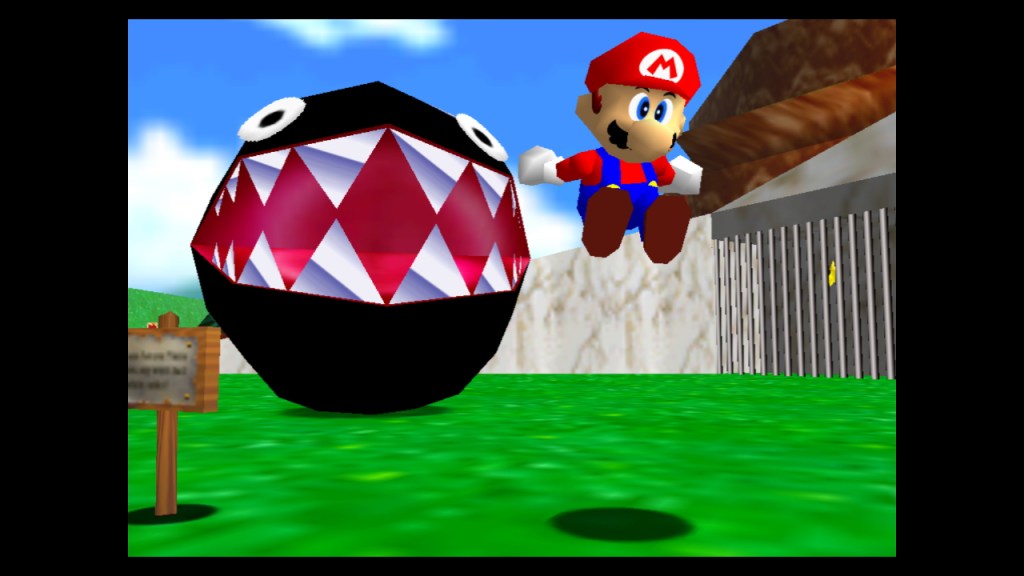
Super Mario 64 is one of the most influential games of all time. It may not technically be the first 3D game created, but it certainly began the trend that would dominate the industry for decades. Nearly twenty-five years later, does this cornerstone of gaming history still hold up? The short answer: somewhat. There are certain aspects of Super Mario 64 that I wish its successors adopted, but there are bound to be some age-related issues. As gaming has progressed through the years, we have become accustomed to certain trends.

One more modern trend that I glad Super Mario 64 was not subject to was on overly lengthy tutorial. The absolute worst part of any game is the painful amount of time spent reading text on how to play and trying to decipher all of the games intricate systems. I prefer a more natural learning curve, let the player figure it out on their own. Super Mario 64 does just that, it provides a couple paragraph textbox that tells you what each button does, then it lets you jump right into the game. The exterior of Peach’s Castle serves as a playground for the player to become accustomed to running and jumping around in 3D space, something that was probably very new to anybody playing this game on release. This lack of handholding is also wonderful for players who are already familiar with the control scheme, as it lets you jump right into the game without going through a lengthy tutorial.

The premise of Super Mario 64 is the same of any other Super Mario game: run and jump around some obstacles to beat levels, and eventually face off with Bowser to save Princess Peach. What made Super Mario 64 so revolutionary was that it was in 3D, which is a technology that not many games had utilized previously. Not only was the game in 3D, but it made major strides to make movement in a 3-dimensional space feel fluid, natural, and fun. Compared to its contemporaries, Super Mario 64 was extraordinary when it came to just controlling the main character. The development team spent a ton of time fine-tuning Mario’s speed, momentum, weight, and mobility options. The end result is that just the act of running and jumping around is fun, rather than the cumbersome nightmare that many other games from the early 3D era are.

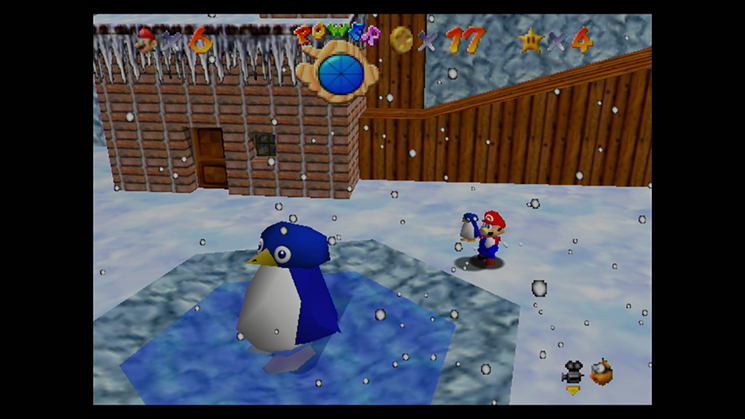
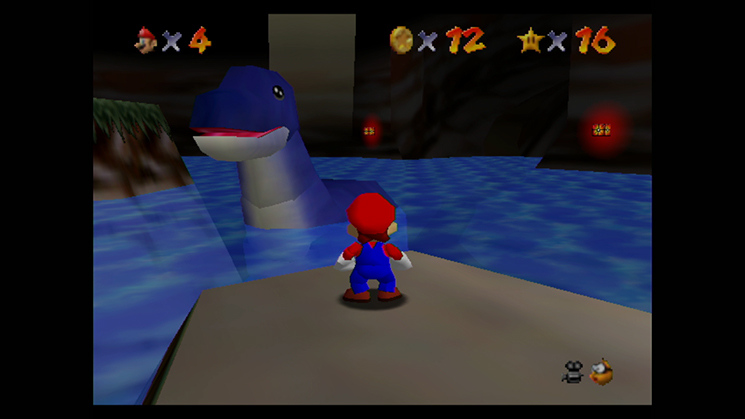
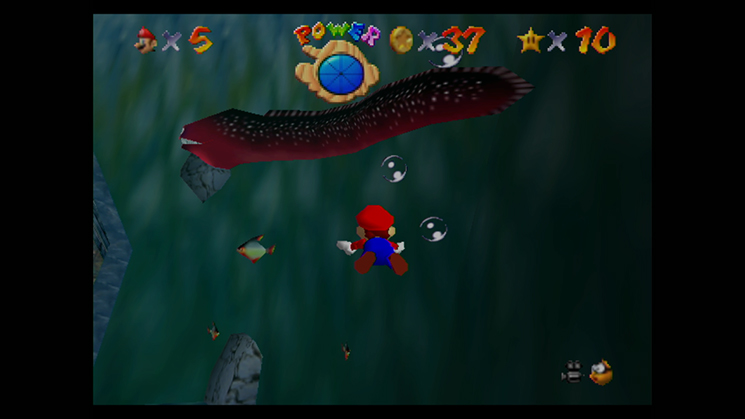
The hub of Super Mario 64 is one of the most memorable in all of gaming. Peach’s Castle contains portraits which the player can jump into to access the individual worlds. There are plenty of secrets scattered throughout the castle for the player to uncover. Each world contains seven levels, each rewarding a star. As you collect more stars, you can access more parts of the castle. Levels can be a variety of challenges, ranging from straightforward platforming gauntlets to boss battles to collecting 100 coins. My favorite feature in Super Mario 64 that is absent in its successors is that you can collect the stars in whatever order that you like. Once you enter a world, all the stars are available to be discovered. It’s up to the player to figure out where each star is and how to reach it.

Most of my issues with Super Mario 64 are a result of the game’s age. While the controls were revolutionary at the time, they can be a bit tricky to get used to compared to more modern 3D platformers. Mario is a bit slippery, and his momentum can often get you into trouble. One thing that I never figured out was simply turning around. Sometimes, when turning around Mario will just instantly face in the direction you point, which feels natural. Other times, he does a weird 180-degree rotation that often got me killed. When I’m facing a ledge and want to turn around, the last thing I want to happen is for Mario to move forward and then right to complete his turnaround. Lastly, the slopes in this game are absolutely brutal. If you do as much as come into contact with a slope, be prepared to start slipping and sliding away for what feels like an eternity.
Some other issues I assume are due to technical limitations. Every world has a star in which the player must hunt down and collect 100 coins. The problem is that regular coins have an awful draw distance, meaning you can’t see them if you are more than a few meters away. It can be frustrating to find coins when you can’t even see them unless you are close enough. As an early 3D game, Super Mario 64 is a bit ugly truthfully. Some of the game’s worlds and obstacles lack character. There are lots of big grey rectangular concrete platforms. Many areas just seem contrived, like they were solely made to be platforms to be jumped on rather than a coherent world. I appreciate the more natural environments of this game’s successors.

By far and away the largest issue with Super Mario 64 was its camera. While having camera that the player can rotate in 3D space was absolutely brilliant at the time, the technology was obviously in its infancy. I grew infinitely frustrated with how the camera would often get stuck in unsatisfactory angles, or it would refuse to rotate when I needed it to. Many jumps became orders of magnitude more difficult simply because the camera was in an awful position. Again, it’s hard to fault the game too much as this was brand new technology. Nevertheless, people who have never played this game before will inevitably struggle with the camera.

Truthfully, I never played Super Mario 64 in its heyday. In fact, the game is a few days older than I am. By the time I played Super Mario 64, all of its groundbreaking design ideas just became standard throughout the industry. In all honesty, Super Mario 64 is probably the least enjoyable 3D Super Mario game for me to play. The wonky camera, occasionally slippery controls, and a few boring environments made it so I was often wishing to play the game’s successors instead. Yet as I revisited the series as a whole, I found myself appreciating Super Mario 64.

The fact that each world was an unchanging arena in which the player could discover stars in any order is something that I found myself longing for in the other Super Mario titles. The sense of discovery and exploration was something that wasn’t matched until Super Mario Odyssey. Not to mention that Peach’s Castle is a magnificent hub, which seems to be a relic in the series now. Only Super Mario Sunshine had a comparable hub to hangout in. I vastly prefer the open-ended mission structure in Super Mario 64 over the more railroaded linear levels in Super Mario Galaxy. The game just feels like a genuine adventure. You visit themed worlds and explore them to collect stars and save Princess Peach. There is no fluff, there is no filler, it’s just pure fun.

Overall, if you grew up with Super Mario 64 it is definitely worth a revisit for nostalgia’s sake. Even if you’ve never played it, I do recommend giving it a shot just to experience it. Super Mario 64 may be outshone by more modern games on a technical level, but there is a level of care and effort put into the game that is difficult to describe. It’s obvious why this game was so revolutionary, and many modern games could learn a thing or two from Super Mario 64.

Link’s Awakening (2019)

Remakes are always tough to review, considering that they can be approached in many different manners. Some remakes are a complete reimagining of the original, others try to fix glaring issues, and some are just a modernization. Link’s Awakening fits into the final category. A few quality of life changes, an updated art style, and a couple new features bring the 1991 Gameboy game into the modern era. The question is: did they do enough? There are some aspects of the game that are too faithful to a nearly 30-year old handheld title that was heavily limited by its hardware.

The remake of this classic title may be a tad too faithful to its origins. To be fair there were some much needed improvements, but I’d say the game is a slightly modernized clone of the original. The biggest, and most important change, was an update to how the inventory works. In the original game, Link could only equip two items at a time, including his sword and shield. Since you virtually always needed your sword equipped, you constantly had to swap around the second slot depending on which item you needed. This was a giant inconvenience that has been mostly eliminated in this remake.

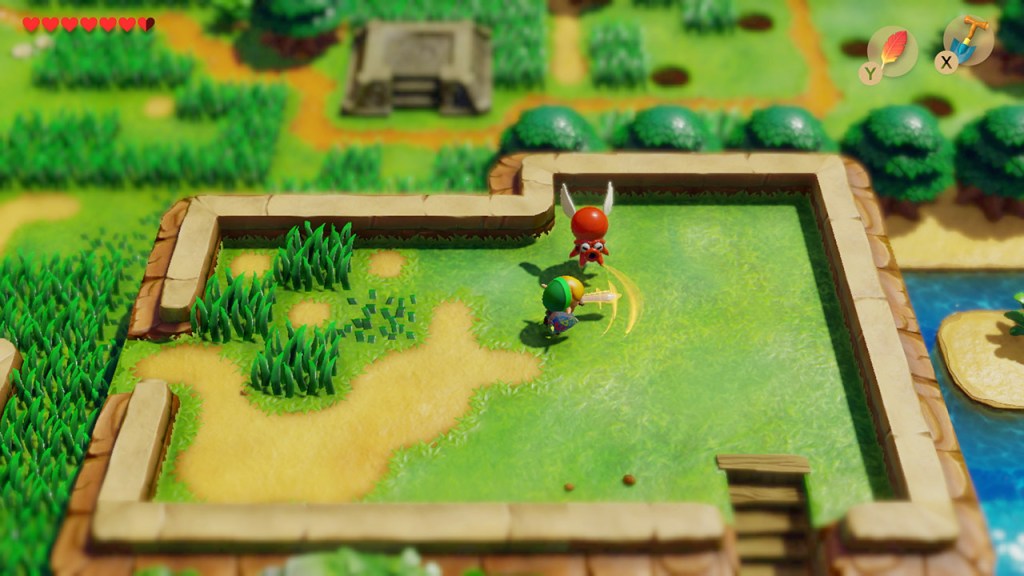
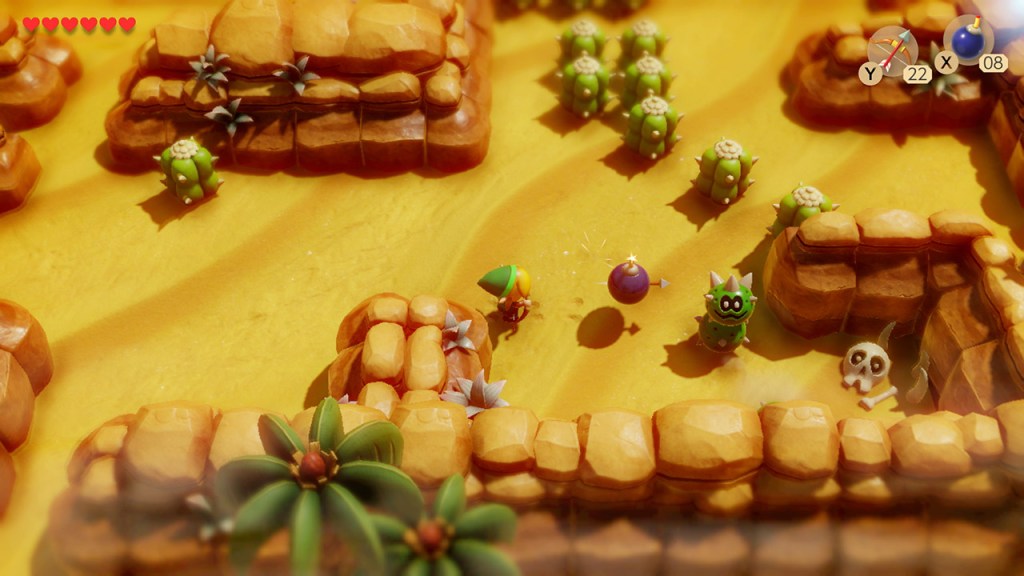
In the new Link’s Awakening the sword, shield, Power Bracelet, and Pegasus Boots are all permanently equipped once you obtain them. There is much less swapping around items and fiddling around in menus. Still, there could have been more “default” items mapped to buttons. Roc’s Feather for instance was one of my most used items, meaning it had to take up an item slot of most of the game. While the new permanently equipped items are an improvement, it could’ve been taken a step further.

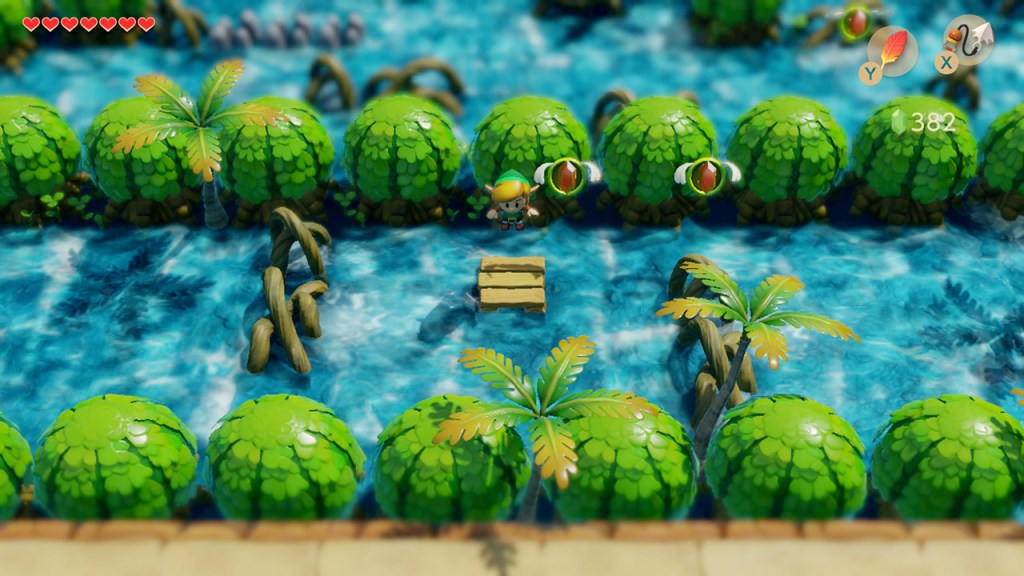
Other than the way items are handled, the only other major change to the game was its visuals. The new art style is a bit odd, and I’m not a huge fan of it. While it does look alright, it makes everything look like a doll or a toy. To me, The Legend of Zelda games embody adventure, and playing as a shiny plastic toy just does not match the vibe of an epic quest. One other thing that was added to the new version of the game was Dampe’s shack. This feature lets the player build their own dungeons using pre-built rooms. It’s not really worth even talking about this feature, as it’s so restrictive and useless that it may as well not exist.

As far as The Legend of Zelda games go, Link’s Awakening is one of the more bizarre entries. There are classic Super Mario enemies like Goombas, there are rarely seen The Legend of Zelda items like Roc’s Feather, and there are plenty of self-aware jokes. It is somewhat jarring to have a The Legend of Zelda game make jokes that reference the fact that is a game. There is an explanation for these strange occurrences, but Link’s Awakening has a distinctly surreal vibe. Link’s Awakening is filled with meta humor, which definitely makes it one of the more unique The Legend of Zelda games.

The most appealing aspect of Link’s Awakening to me was how dense the world is. The map itself is actually pretty tiny, it only takes a couple of minutes to traverse from one end to the other. Despite this, it was designed in such a way that the world has plenty of distinct zones and areas that are jam packed with things to discover. Whenever I acquired a new item, the first thing I would do is search around the map for where I might be able to utilize it to uncover any secrets. Every screen has something hiding in it, and Link’s Awakening does a great job at encouraging the player to keep exploring.

The reason why the game does such a great job at prompting exploration is because it lacksany semblance of handholding. There is a helpful owl who may give the player the idea of where they need to go, but figuring out how to get there is a whole other beast. It really is up to the player to scour the map for any sign of how to progress. For the most part, I enjoyed being left to discover things for myself. That being said, there can be cryptic sections of the game that seem like a relic of the past. The infamous trading quest to acquire the boomerang is one of the best examples of this. You repeatedly trade one item for another in a lengthy sequence, not knowing who wants your current item. It amounts to having to wander around and talk to a bunch of NPCs, praying that they will trade for whatever item you currently have.

Plenty of enemies are designed in a similar manner, in that they require a specific method to defeat them and you must keep guessing until you figure that method out. The worst example of this was the Armos Knight boss. I spent a good chunk of time hitting this boss with all my different items and attacks to figure out how to damage it. As it turns out, you need to hit the boss at a very specific time, in a very specific spot, with a very specific attack. I usually try not to complain about isolated incidents, but this example it felt like something was very wrong. There was really no indication at all of the required timing, weak point, and required weapon.  

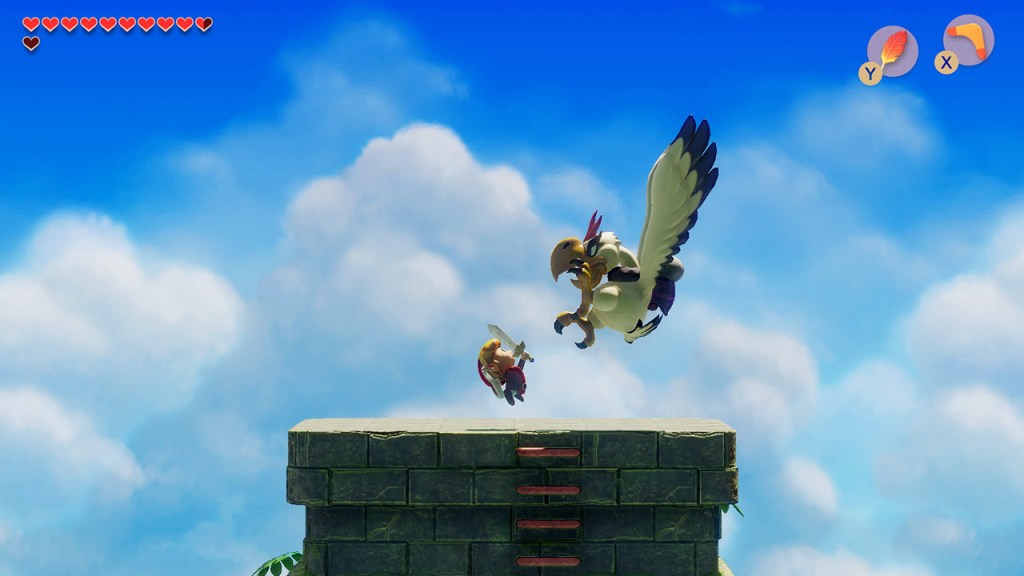
An important aspect of almost any The Legend of Zelda game are its dungeons. The dungeon design of Link’s Awakening is pretty basic, which was disappointing to me. None of them were particularly bad or frustrating, just boring. The only dungeon that stood out was the Eagle’s Tower, as that had an interesting theme and central puzzle idea. Every other dungeon just reused the same basic formula of hitting switches and gathering keys. Moreover, the boss design was fairly forgettable as well. This is potentially because the bosses were tremendously easy to defeat.

Overall, I think Link’s Awakening suffers from being a nearly 30-year old Gameboy game. A shocking revelation, I know. But I am somewhat disappointed that the developers did not really take the opportunity to modernize Link’s Awakening. Don’t get me wrong, it’s still a fun game, but you can definitely tell that is a relic from a bygone era. It is for these reasons that I give Link’s Awakening a 7/10. A respectable piece of The Legend of Zelda history, but it’s not going to impress anybody in the modern day.   

ibb & obb (2013)

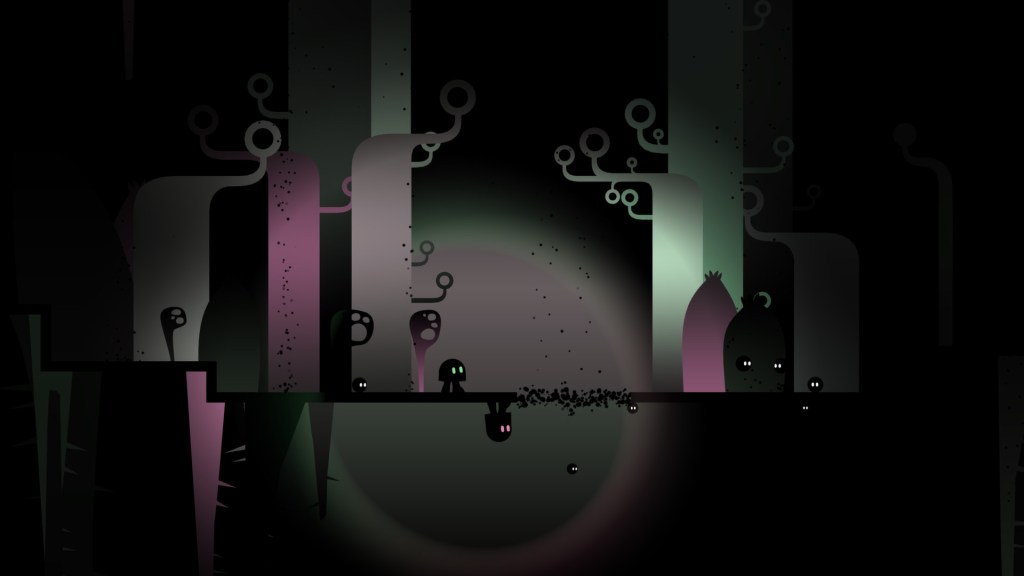
True coop games are hard to come by. Many titles shoehorn in a coop experience, but rarely are games obviously and intentionally designed around having multiple players. ibb & obb is a game that must be played with two players, meaning that everything in the game was designed with that in mind. I thought I was going to play a simple and cutesy puzzle-platformer with my friend, and ibb & obb certainly started out that way.

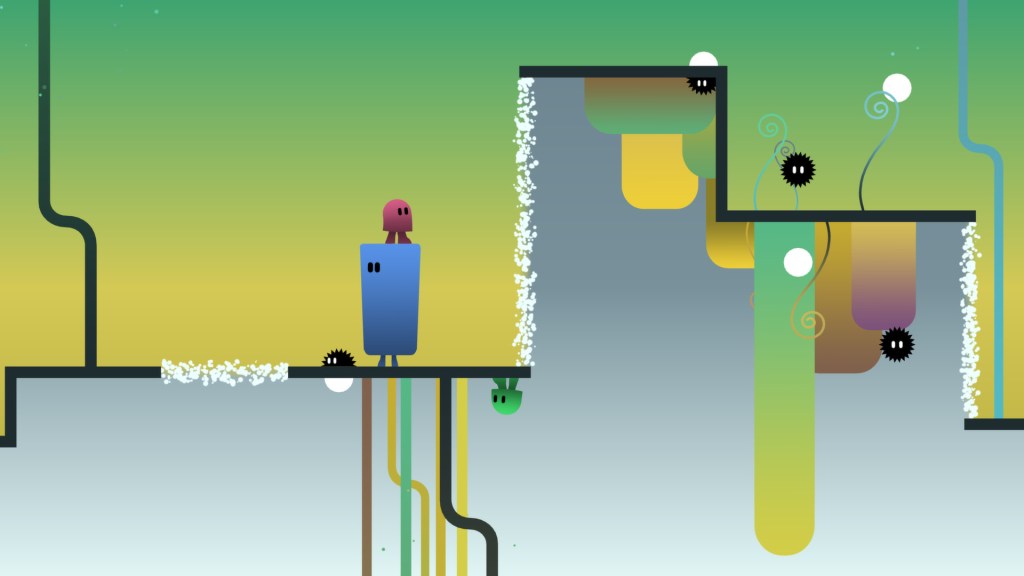
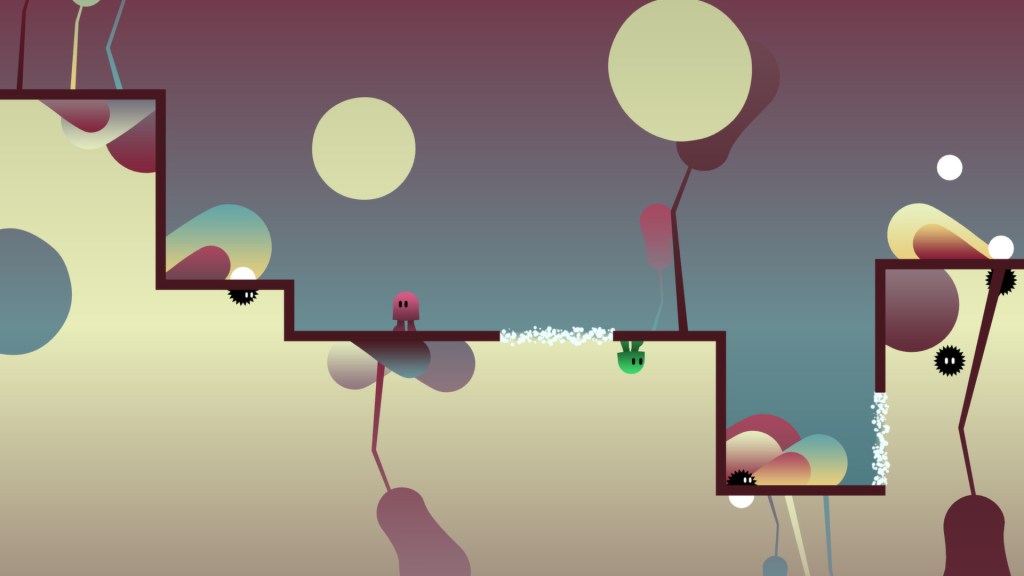
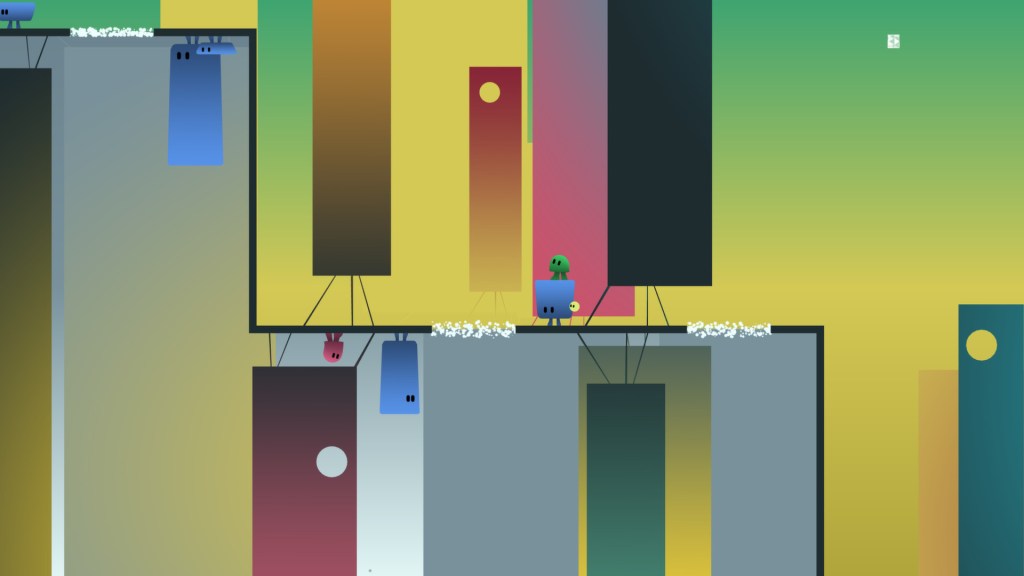
In ibb & obb you play as two little blobs, unsurprisingly named ibb and obb. These little guys are pretty unremarkable, the only thing they can do is jump. Each level has a mix of platforming and puzzle challenges blocking the way forward. Some levels make use of new mechanics that change the landscape of the stage. You and your partner must assist and cooperate with each other, one player cannot simple carry the other. There are certain obstacles that require ibb, others that require obb. Moreover, both players need to complete the aforementioned challenges before moving on. Meaning one player completing a trick series of jumps is simply not enough.

The puzzles of ibb & obb generally utilize some augmentation of gravity. Whether it be reversed gravity, or using bouncy pads to store momentum and bounce higher, you are going to have to get used to a variety of new gimmicks that change the way the game plays. Most of these mechanics are welcome additions, as they can add fun little twists to the more traditional platforming puzzles. The game starts remarkably relaxed, there are few enemies, the jumps are forgiving, and the puzzles are simple. But as you progress through this short adventure, the levels build on each other and become increasingly difficult.
My friend and I began the game with the intention of finding all of the collectibles. Since the game was easy enough, we wanted to challenge ourselves by hunting down the shiny little orbs in every level. We quickly gave up on that goal once the levels started to become sadistic. Just beating each stage became challenging enough. What started as a chill and relaxing platformer suddenly became brutally difficult. The puzzles often required finnicky jumps and obtuse maneuvers. Many times, we would ask ourselves if what were doing was even the intended solution because it was so precise and time-consuming to pull off. But the more aggravating part of ibb & obb was when the platforming sections began to ramp up in difficulty.
A key aspect of the game is that when one player dies, you both die. You both need to pull off a platforming challenge simultaneously. This transforms any moderately difficult obstacle into something far more insidious. Using basic probability, let’s say there is a section that you can conquer one in every five attempts. When both partners need to complete that section in the same attempt, now you only have a one in twenty-five chance of success. You become significantly more unlikely to succeed when both players are required to complete the challenge on the same attempt.
This is an issue that is ingrained in the way the game was designed. The whole game is built around the fact that if one player dies, both players die. You rely on each other, so this mechanic cannot be simply stripped away without fundamentally changing the game. If I were to suggest a fix, it would be to keep the level design on the easier side. Difficulty quickly compounds when both players need to succeed at the same time. I think ibb & obb would have served better as a relaxing adventure through and through. Instead, it lures you with some calm and simple stages, then proceeds to ramp up the difficulty exponentially. 

Overall, I’m not sure that I can fully recommend ibb & obb. I enjoy the aesthetic of the game, and can definitely get behind a coop puzzle-platformer. I thoroughly enjoyed the beginning of the game, but my friend and I grew frustrated with it quickly. By the time our journey came to an end, we were more than ready to move on, never looking back to collect whatever secrets lay hidden in each stage. Even as a fan of difficult games, I think having to rely on both players to succeed at the same time is a recipe for irritation. We had some fun moments with the ibb & obb, but ultimately it does not join the short list of “great coop experiences”.

Outer Wilds (2019)

It’s rare that I get to play a game that is like nothing I’ve ever played before. Some games use innovative or unique ideas, but usually follow a previously established formula. Outer Wilds is a game that I can say is genuinely a special experience. It is the best candidate in the argument video games as an art form, and I hope that everybody gets to play and enjoy it as much as I did. Outer Wilds is a sci-fi tale filled with mystery, discovery, existential-dread, and hope. There is no violence or conflict, just a lone alien exploring their solar system. If you want to play this game, and I highly recommend you do, please do not read any further and go play it for yourself. I avoid discussing spoilers, but this truly is a game that should be experienced with no prior knowledge.

The premise of Outer Wilds is similar to that of The Legend of Zelda: Majora’s Mask, the world as you know it is destroyed in some unstoppable cosmic calamity. In Outer Wilds, this equates to a 22-minute loop that resets whenever the player dies. At the end of the loop, the star in center of the solar system collapses and goes supernova. For some mysterious reason, the player character retains all their knowledge of the previous loops, but everyone around them seems blissfully unaware of the impending doom.

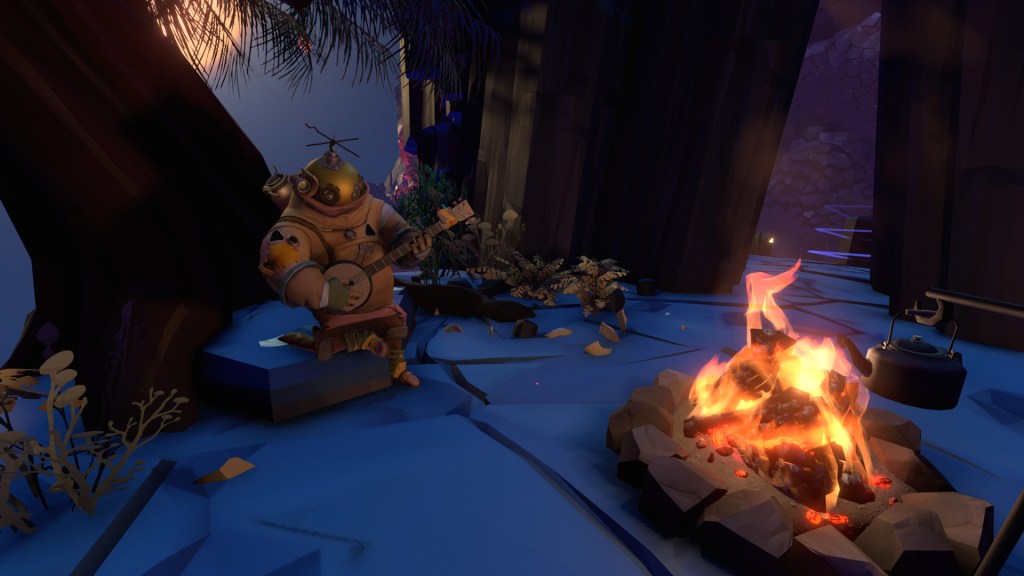
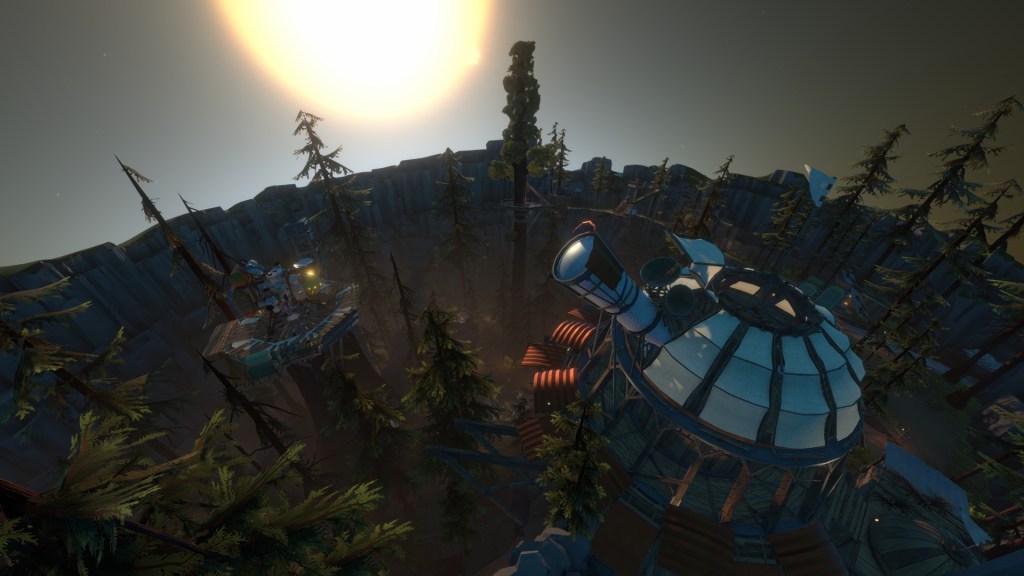
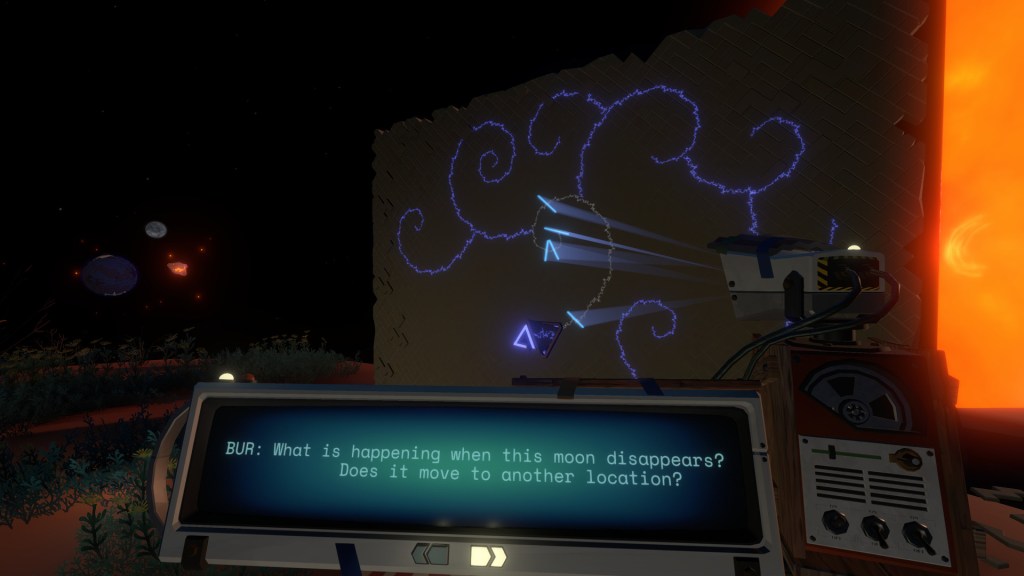
You play as a young alien, destined to explore the planets of the solar system. You fly a rinky-dink spacecraft around the void of space, examining and gathering knowledge of an ancient alien race that once inhabited the solar system. Perhaps, by piecing together any clues and text that you find, you may be able to uncover the secrets of the solar system. This is no ordinary solar system after all. It’s filled with incredibly interesting planets and other… things. The Hourglass Twins for instance are two tiny planets that orbit around each other. The gravity between the two shifts sand back and forth, revealing structures as time passes. Brittle Hollow on the other hand is a shell of a planet held together by a black hole in its core. Every location in the game has some intriguing feature about it, which all become essential to unveiling the cosmic mystery ahead of you.

As I mentioned previously, there is no combat or violence in Outer Wilds. You simply travel around the solar system, gathering information left by the alien race which came before you. The scale of the game is tiny, making it easy to get around quickly within the 22-minute time limit. Knowledge is progress. There are no levels or experience or any tangible form of progression. Instead, the knowledge gained is used to unlock and explore new areas. It is almost a sort of puzzle game in this sense. The alien texts that you read will give you hints and subtly guide you on where to go next. It’s reminiscent of a treasure hunt where one clue leads to the next.

Part of the brilliance of Outer Wilds lies in how smooth this treasure hunt of knowledge was. You could start on any planet, gather some information, and that would lead you to another planet or location. Combining some clues may lead to another important site. Luckily the game keeps track of all the information you find in the ship log. It outlines everything you find in a concise manner, and links together certain components. It even lets you know if you have missed information in an area that you explored. I never got the feeling of not knowing where to go, there was always something obvious to explore and discover.

The idea of cosmic horror is poorly represented in most media. It is the existential anxiety that accompanies the knowledge that life itself is exceedingly fragile when faced with the uncontrollable, unknowable, and unfathomable dangers of the universe. We don’t know what’s out in space. We barely even know what’s on our own planet. I am far more terrified when learning about false vacuums, gamma ray bursts, or black holes then I am of traditional horror monsters. Humanity doesn’t know much about these phenomena, but we know enough that space is ruthless and there is nothing we can do about it. Humanity could blink out of existence in an instant, and we wouldn’t know it was coming and there would be no way to prevent it. No piece of media captures this feeling better than Outer Wilds.

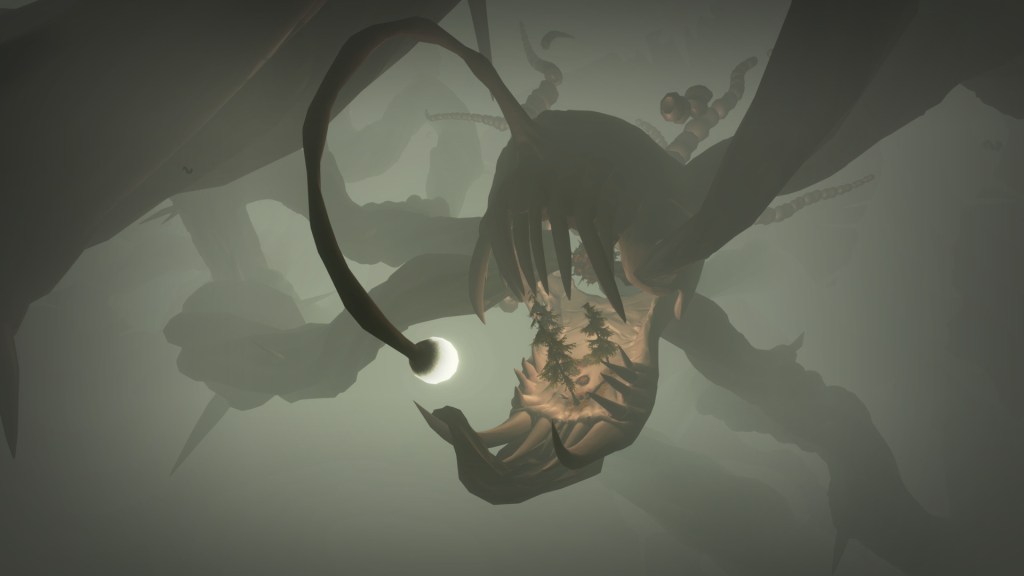
I was genuinely terrified when facing down the blackhole in the center of Brittle Hollow. What would happen if I fell in? Equally as anxiety inducing was the hopelessness when I crashed my ship and was launched into the void of space. The feeling of vulnerability and powerlessness pervades Outer Wilds. No matter what you do, the star explodes every 22 minutes, but you continue on anyway. Hoping to somehow defeat inevitability. Despite Outer Wilds triggering my existential dread, I came away from the game uplifted and hopeful. I won’t spoil the ending, but I was satisfied by the conclusion. All the secrets and knowledge you learn throughout the game culminates in one final loop, in which the fate of the universe becomes apparent. It may be melancholic, but it was equally peaceful and reassuring.

My solitary issue with Outer Wilds was with its controls. Getting used to the controls, flying the spacecraft in particular, has a bit of a learning curve. There were countless times that I flung myself into the star while trying to land on the innermost planets. Not to mention that the various celestial bodies have their own gravitational pull. Getting used to different gravity on each planet can be jarring. Luckily Outer Wilds is not a platformer, so it’s not like you need to make precise jumps or maneuvers very often. Nevertheless, there were a few instances where I was mildly irritated by how difficult it was to safely land my spacecraft.

Outer Wilds has quickly become one of my favorite games of all time. Exploration is underutilized in most games, and this game does it better than anything I’ve played before. This is a game like no other, and it captures feelings that are rarely explored in media. I wish I could hop back into my tiny wooden spaceship and experience Outer Wilds for the first time again. It is for these reasons that I give Outer Wilds a 10/10. It may not be like any game that you’ve played before, but Outer Wilds is a quintessential work of science-fiction and gaming.  

Opus Magnum (2017)

While I love Zachtronics’ style of puzzle games, they are notoriously unapproachable. I struggle to recommend Zachtronics games to people because they are not traditional puzzle games, they are extremely difficult, and it is difficult for new players to learn the rules and mechanics of the games. SHENZHEN I/O for example includes a 30-page PDF manual that explains the programming language of the game, most people are going to see this and just skip the game thinking that it’s not worth the effort. While I love these games, I cannot fault anybody for not being interested in them. It seems to me that Opus Magnum is Zachtronics attempt to create a simpler, more traditional, and approachable puzzle game. It is the most beginner-friendly game of the Zachtronics line-up, and it does a phenomenal job at capturing what makes these games so engaging while also remaining accessible for new players.

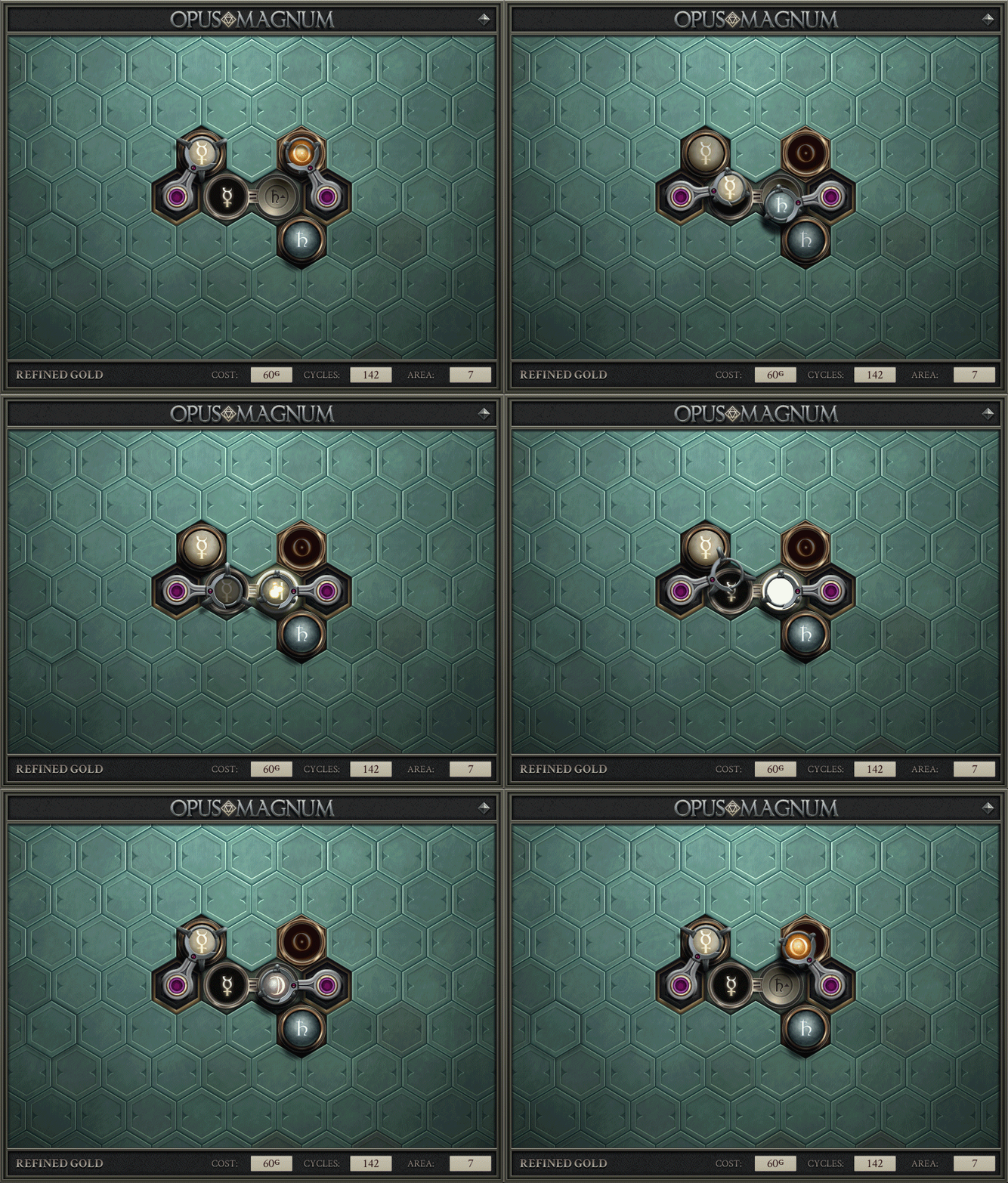
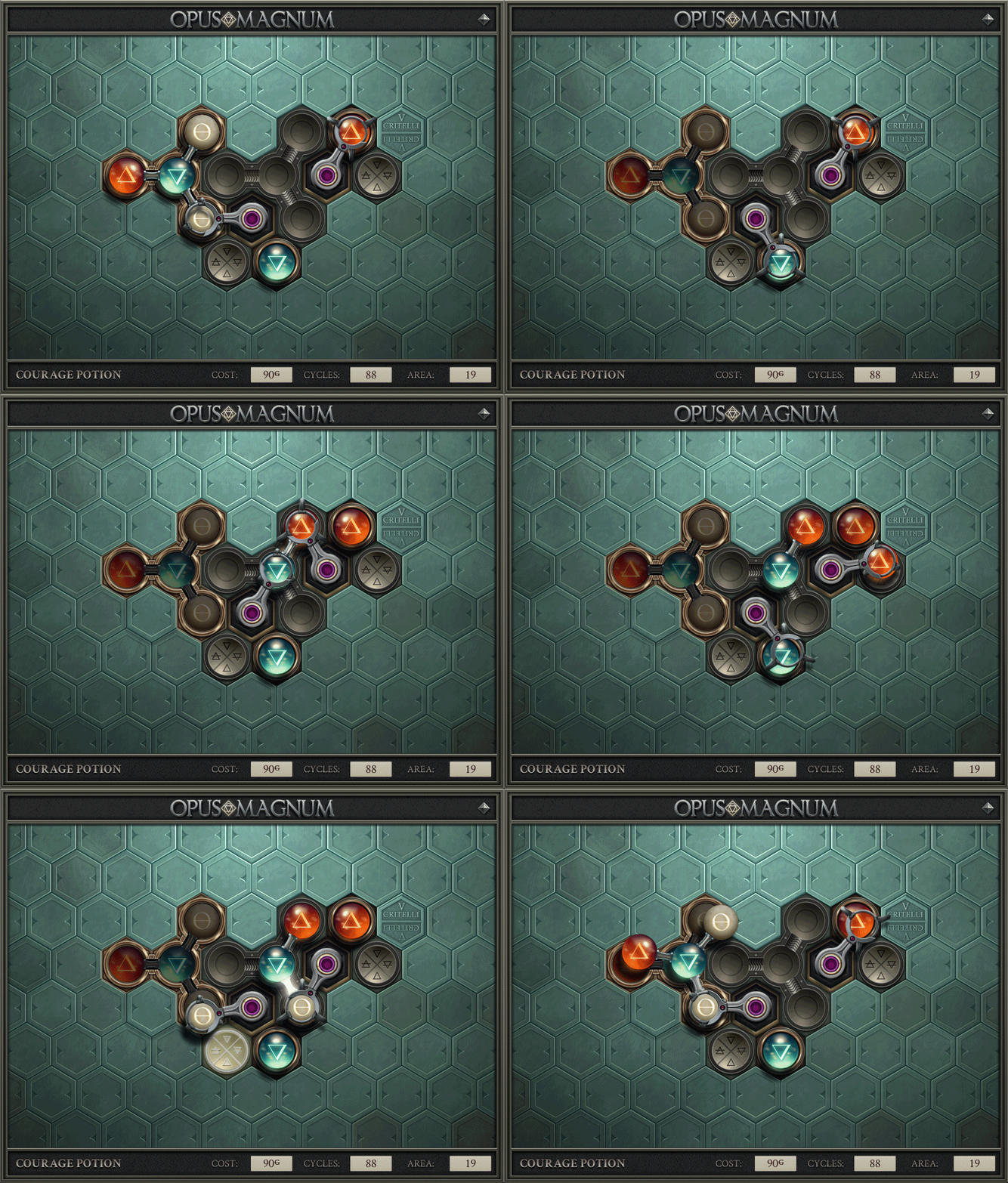
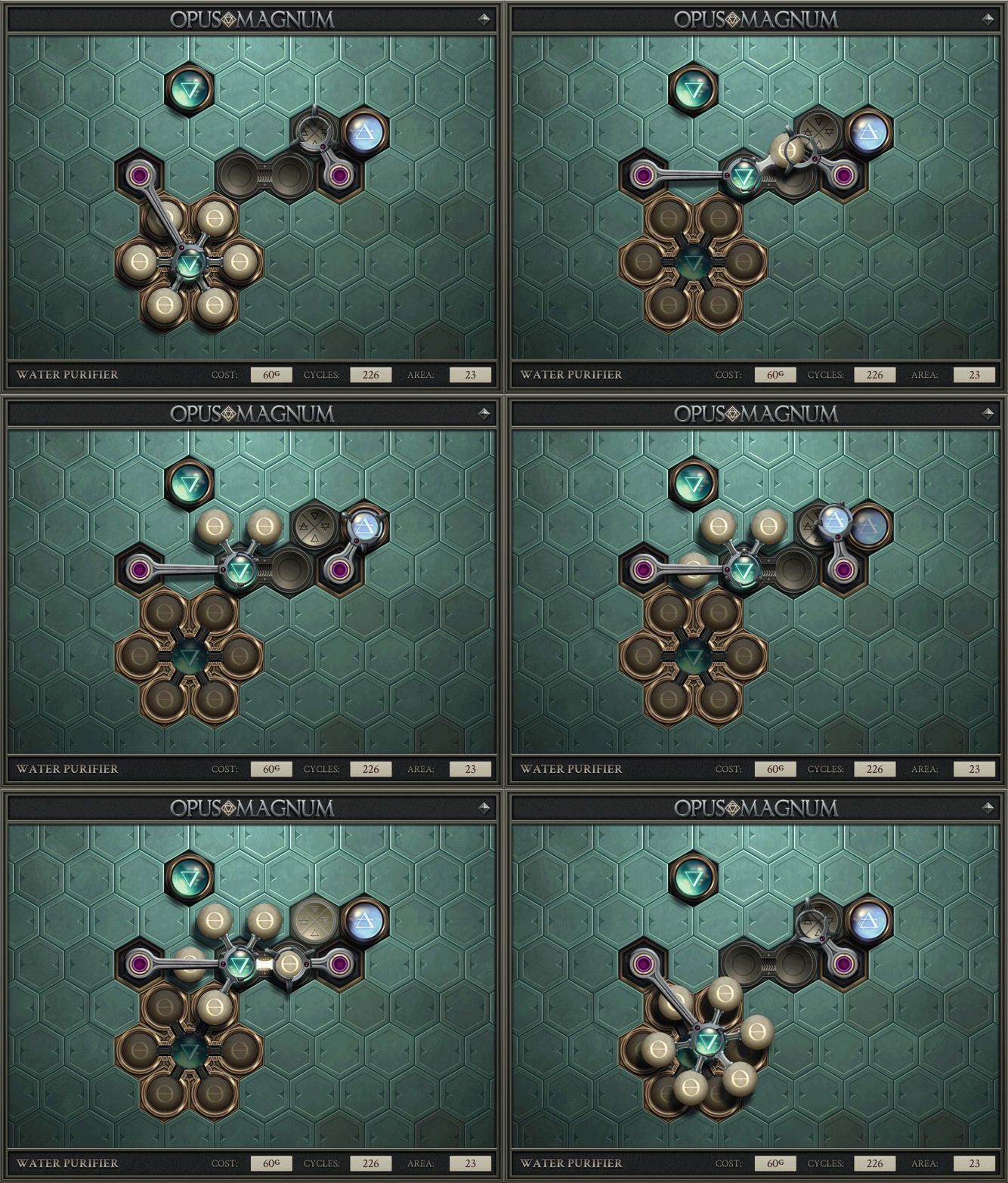
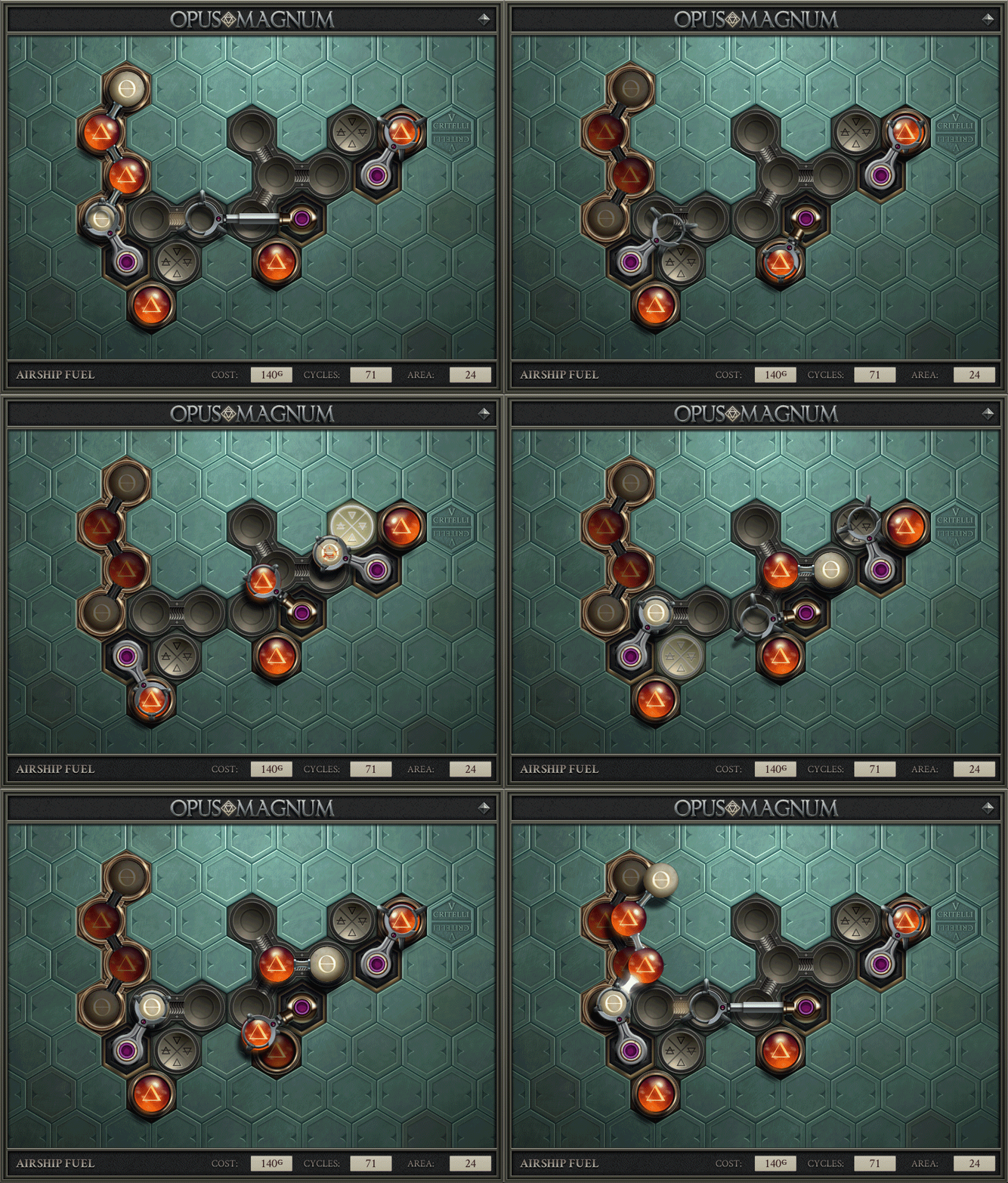
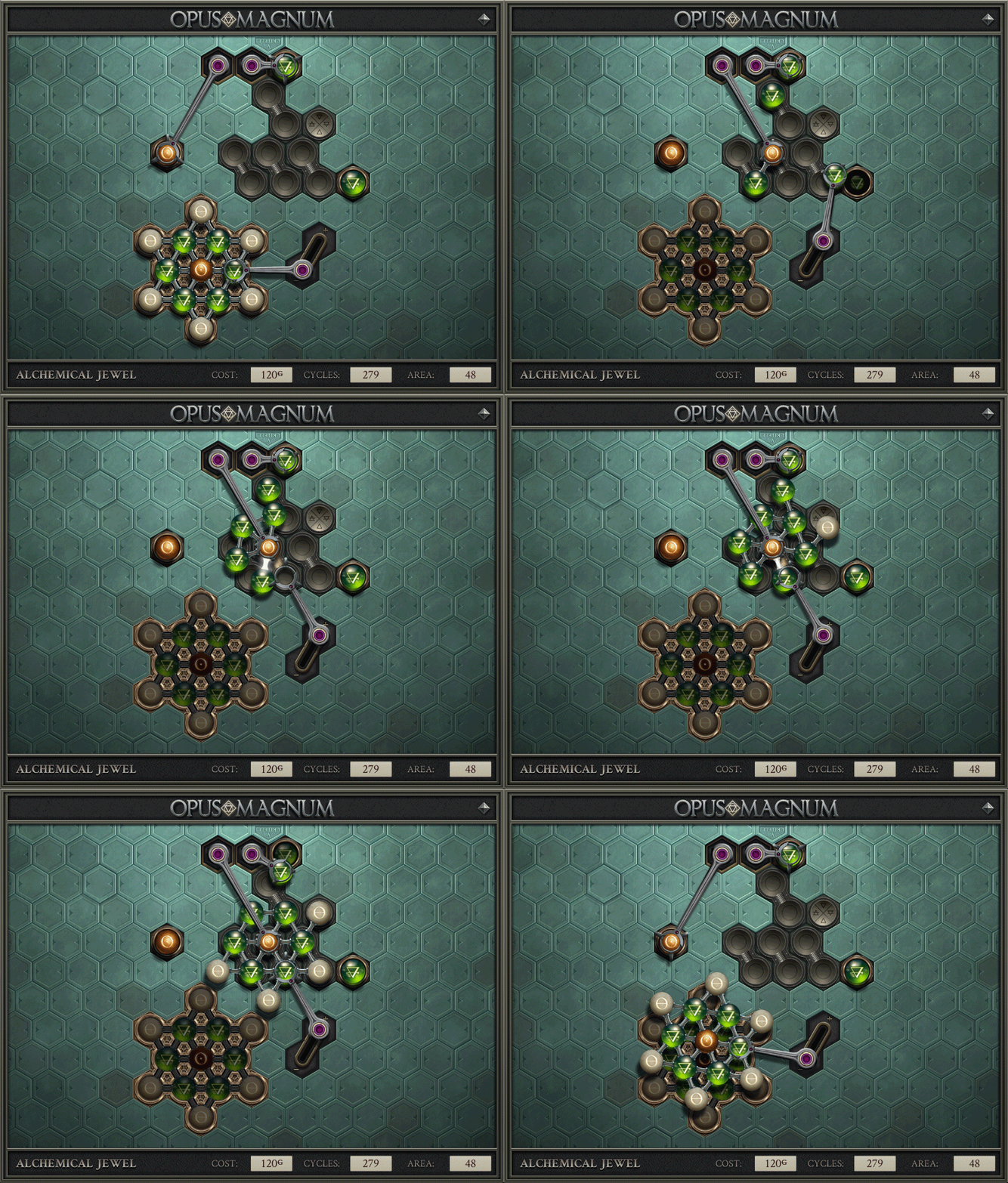
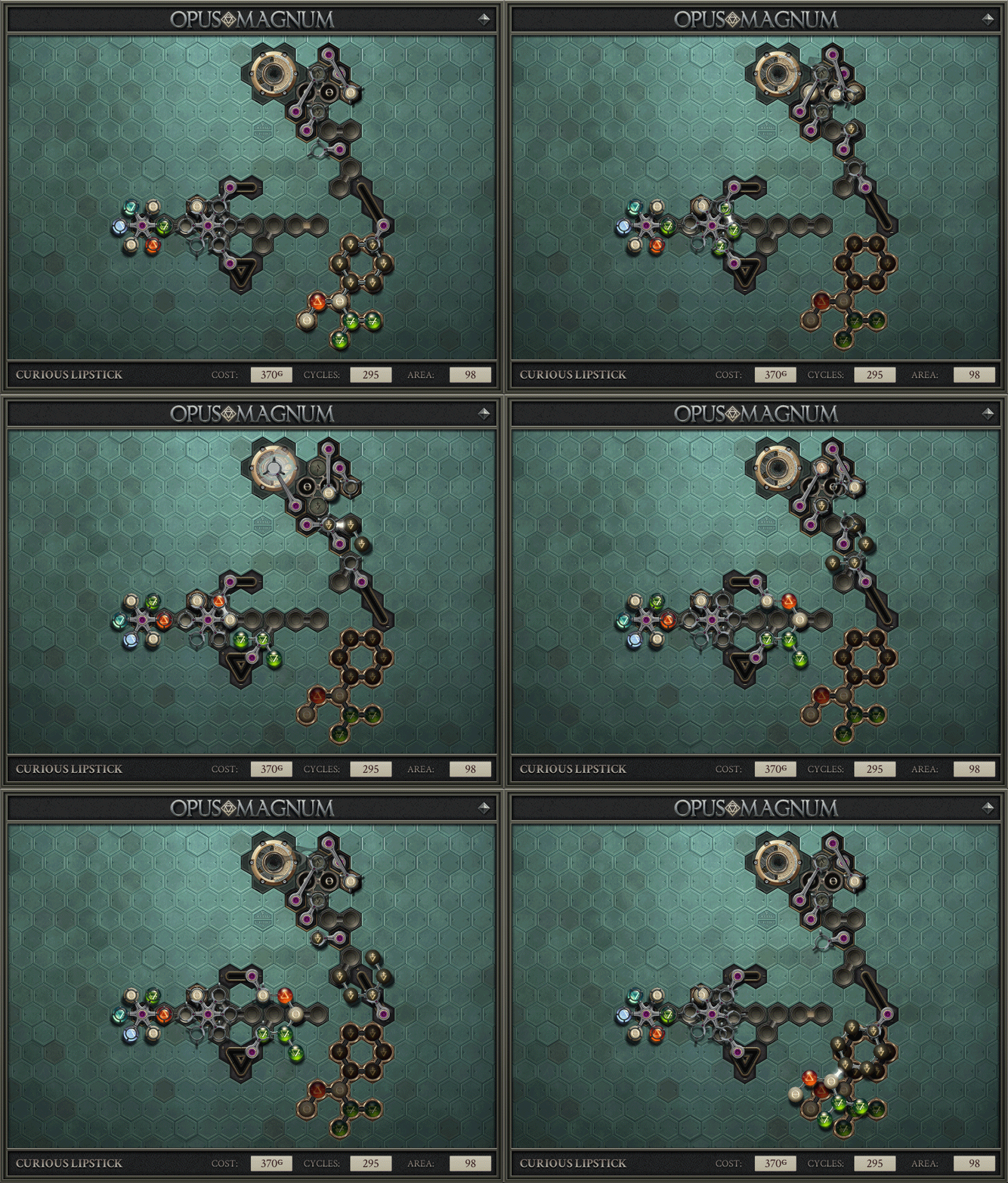
Opus Magnum is all about alchemy. The game takes place in a fantasy-steampunk setting, and you use machines to combine and arrange different elements into new products. Each puzzle has a few starting “reagents”, which are some arrangement of colored orbs representing elements. You must place and give instructions to a set of machines to take these reagents and in some way assemble them to make a final “product”. This assembly may involve combining elements, decoupling compounds, or changing the reagent’s composition altogether. The series of mechanical arms and tracks that you place must repeat their actions ad infinitum, continuously changing the reagents into products.

There is a sort of mechanical satisfaction to be found when looking at the completed creations that the player devises. Every time I completed an objective, I would just sit and watch it run for a while. The concept of Opus Magnum helps it stand out from the other Zachtronics games, since it is easier to grasp what is happening at a glance. The rote mechanical creations of Opus Magnum are inherently satisfying. Moreover, the game’s simplicity makes it more approachable to newcomers. In SHENZHEN I/O, the player had to learn a programming language to play. Opus Magnum is comparably simple: move and combine the given colored orbs to form new shapes.

The beauty of Opus Magnum comes from its straightforwardness. Anybody could grasp what is happening. While the puzzles increase with complexity as the game progresses, the core concept of moving orbs around remains the same. There are quick tutorials to show the player the basics, and there are no restrictions when building a solution. You can place as many mechanical components that you want; you have infinite space to make your solution, and your solutions can be slow and inefficient so long as they get the job done. In every way, Opus Magnum is a perfect introduction to Zachtronics games.

There are two critical aspects that I enjoy in Zachtronics games: freedom and optimization. In most puzzle games there is an intended solution to every puzzle. Occasionally you can find an unintended technique that the developers missed, but for the most part the designers of puzzle games try to push the player to a specific answer. Zachtronics games on the other hand are all about creative freedom. You are given a set of starting resources and an end goal, that’s it. Whatever way you can turn the reagents into the product is acceptable. As a programmer, this emulates the process that I go through when trying to code something. I love thinking through the different methods or algorithms that I could use and testing my ideas.

Another aspect of Zachtronics games that mirrors real life programming is optimization. It’s one thing to get a working solution, but it’s an entirely new beast when making a “good” solution. The lead designer of Civilization IV, Soren Johnson, knew the dangers of optimization in games. “Given the opportunity, players will optimize the fun out of a game”. I find this idea to be unfortunately true. Many games are ruined by exploits or techniques that once discovered; the player will use repeatedly. The fun is drained away once you know the optimal methods of playing. Often times what is fun and what is optimal are at odds, but players tend to gravitate to doing what is optimal; it is just human nature. Zachtronics games tackles this issue by making optimization part of the core experience. It is the game.

In Opus Magnum there are three optimization categories: cost, cycles, and space. Each mechanical component you place has a cost, and your solution’s cost is the sum of all of its components’ costs. The game works in discrete time, each moment is an opportunity to move or rotate a component. Each moment is one “cycle”, and the game keeps track of the total cycles it takes for your solution to make a certain number of products. Lastly, the number of hexagons that your solution interacts with is the total space. Once your solution is complete, the game will show you a leaderboard histogram of the three categories, comparing how you did to others who played the game.

Opus Magnum and other Zachtronics games utilize human nature’s desire to be optimal. If you wanted to, you could play each puzzle four times, with entirely different solutions. Your first solution, a cost-efficient solution, a cycle-efficient solution, and a space-efficient solution are all going to be completely different. You certainly don’t have to replay each puzzle to get a perfect score in each category, I found it satisfying enough to try to make an overall “good” solution on my first try. I tried to balance all of the categories, and this inherent draw to make clean or efficient solutions is addicting. Furthermore, the more effective solutions are elegant and astounding to watch.

The simplicity of Opus Magnum is a double-edged sword. While it is perfect to ease new players into the genre, it will probably bore some veterans. It is possibly the easiest Zachtronics game, for better or worse. The concept of moving colored orbs around is simple to grasp, but I found it to get a little repetitive. While in SHENZHEN I/O I was making various electronics that required vastly differing algorithms, I felt like the puzzles in Opus Magnum all resolved to the same core concepts. I rarely felt like I was solving new problems, instead I was just rearranging the elements into different shapes.

What stands out the most about Opus Magnum compared to its predecessors is how unrestricted it is. In SHENZHEN I/O, each puzzle had a limited workspace, you couldn’t place as many components as you wanted. Moreover, each component had limited memory to fit instructions onto. The largest and most expensive part could only fit 14 lines of code onto it. You had to make your algorithms compact. Opus Magnum doesn’t have these restrictions. You have infinite money, time, and space. The game comes with its own set of challenges, like making sure that parts are synchronized and don’t collide with each other. But this just requires more testing than it does ingenuity.

Unfortunately, I felt that working out an initial solution was more a matter of persistence than it was intelligence. In previous games, a puzzle often times felt daunting or insurmountable. I often questioned how I could complete the task under the conditions. When I did eventually devise a working solution, I felt intelligent and clever. When working on a puzzle I often had to step away and just think about how I could even approach it. Many ideas were formulated when I was making sandwiches or taking a shower. I didn’t have this experience with Opus Magnum. With no restrictions, each puzzle is initially just a matter of brute force.

I didn’t need ingenuity or creative techniques, just the persistence to keep trying and adjusting. That gratifying feeling of “I did it” was mostly absent in my time with Opus Magnum. There were a few times that I made a particularly elegant solution, but other than that I wasn’t proud of my creations. The game doesn’t push the player to create sophisticated machines, it will accept any ugly or inefficient solution. Interestingly, there are puzzles in the post-game that have restricted space, but by then I had mostly had my fill of Opus Magnum.

Overall, I believe Opus Magnum to be the Zachtronics game for beginners. Its simplicity makes it far more approachable than its predecessors. It doesn’t have any restrictions, it has plenty of tutorials, and it is conceptually simple. But all of that comes at the cost of what may appeal to veteran players. I didn’t find myself having to ever think really hard, or come up with some ingenious solution. I found that rearranging the elements was only fun for so long, it lacked the complexity of previous titles. It is for these reasons I give Opus Magnum a 7.5/10. It’s a great game to get started in the Zachtronics anthology, but veterans may find it underwhelming.

Far Cry 4 (2014)

Every once in a while, I get an overwhelming urge to play a big open-world game. There is a sense of freedom that these games encourage: you can go anywhere and do anything. I saw Far Cry 4 sitting in my Steam library from some sale long ago, and I remembered playing Far Cry 3 back in high school and loving it. I decided to give Far Cry 4 a go, and I was promptly reminded why I am not a huge fan of Ubisoft’s brand of open-world games. They lack soul.

5

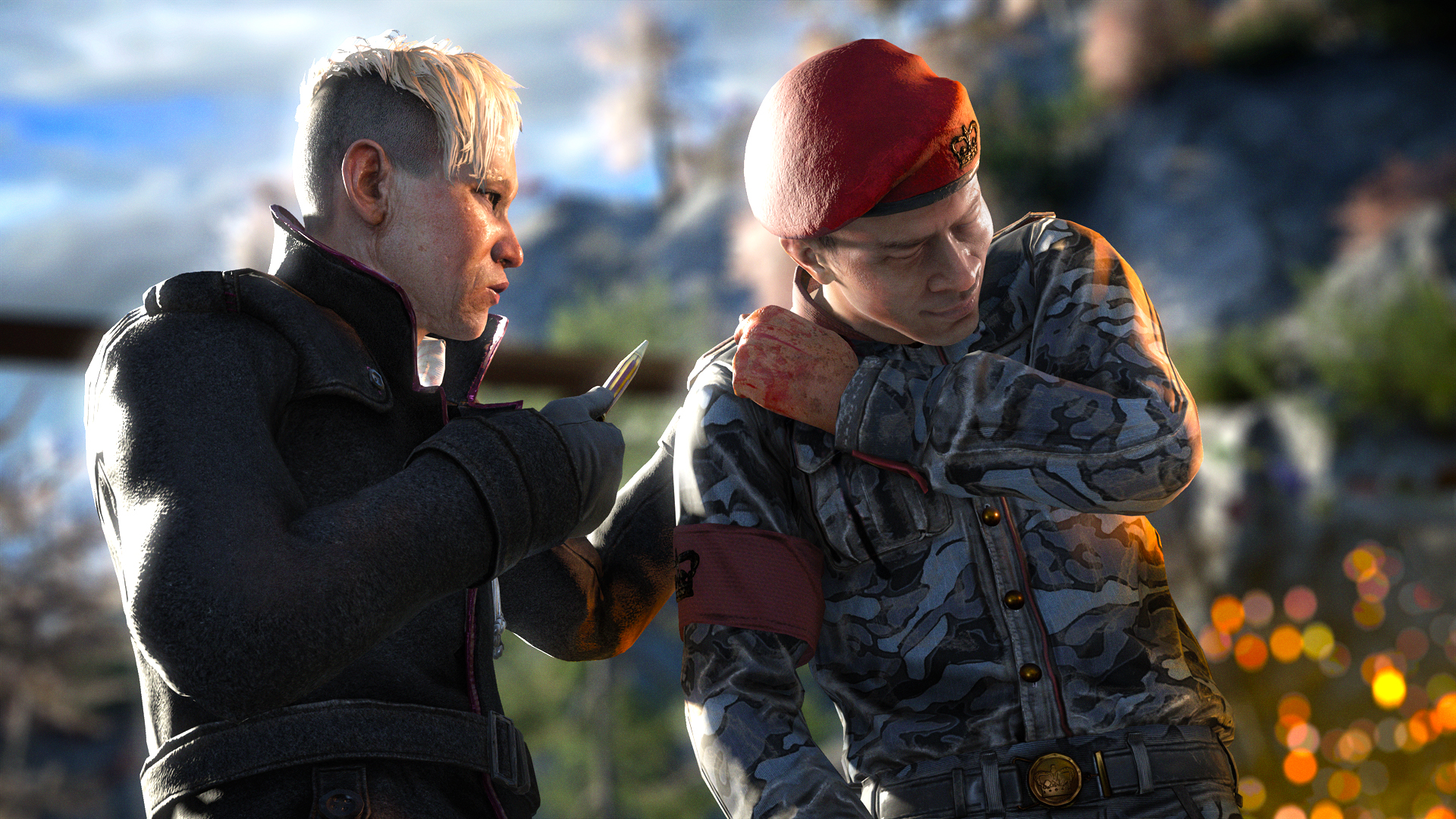
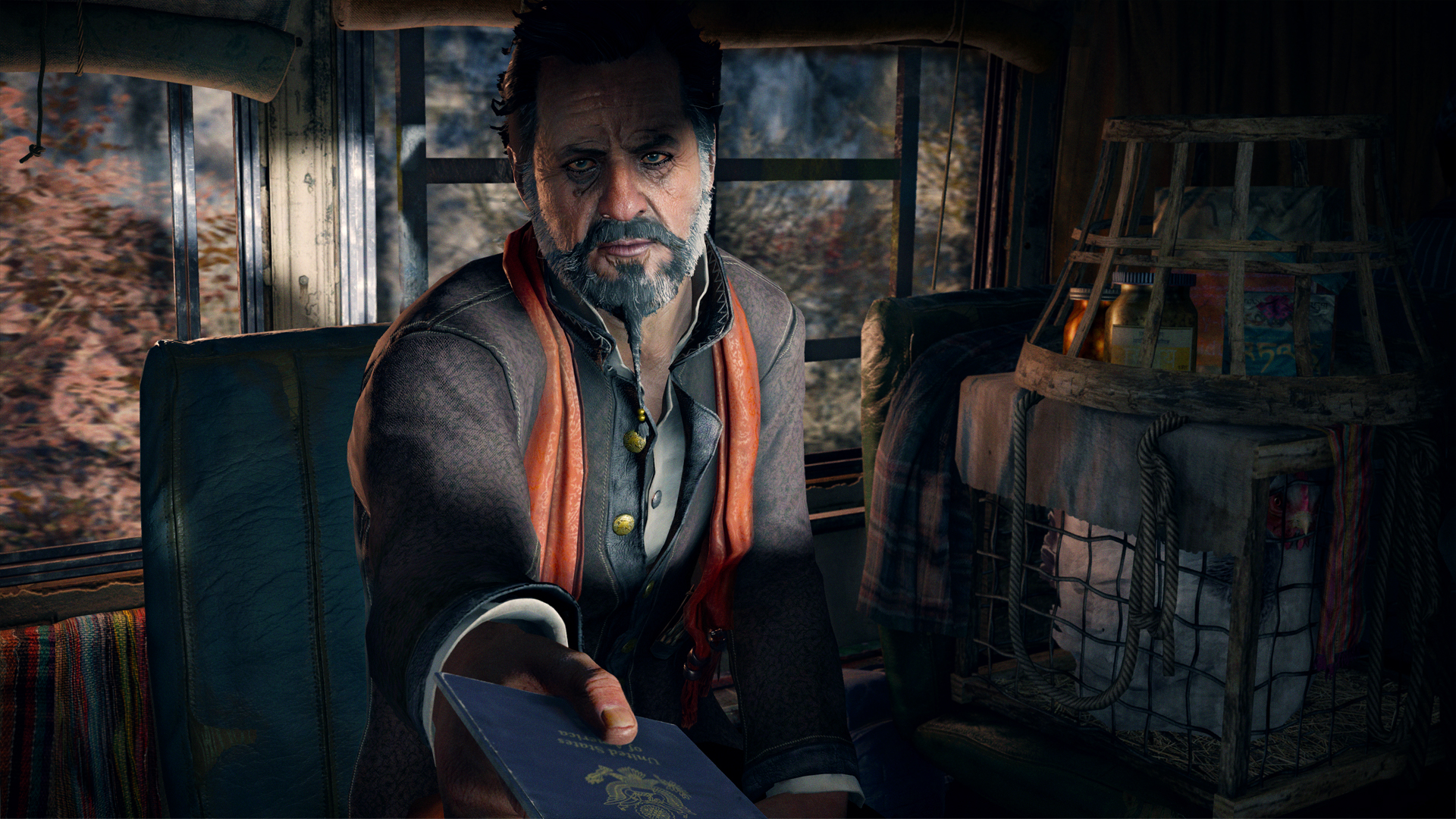
In Far Cry 4 you play as Ajay, an American on a journey to spread his mother’s ashes in her home country of Kyrat. This fictional country resides in the Himalayas, and is wrought with corruption, civil war, and strife. Ajay lands himself in the middle of a struggle between the Golden Path, a rebel group looking to overthrow the government, and Pagan Min, a ruthless dictator who uses his Royal Army to crush all opposition.

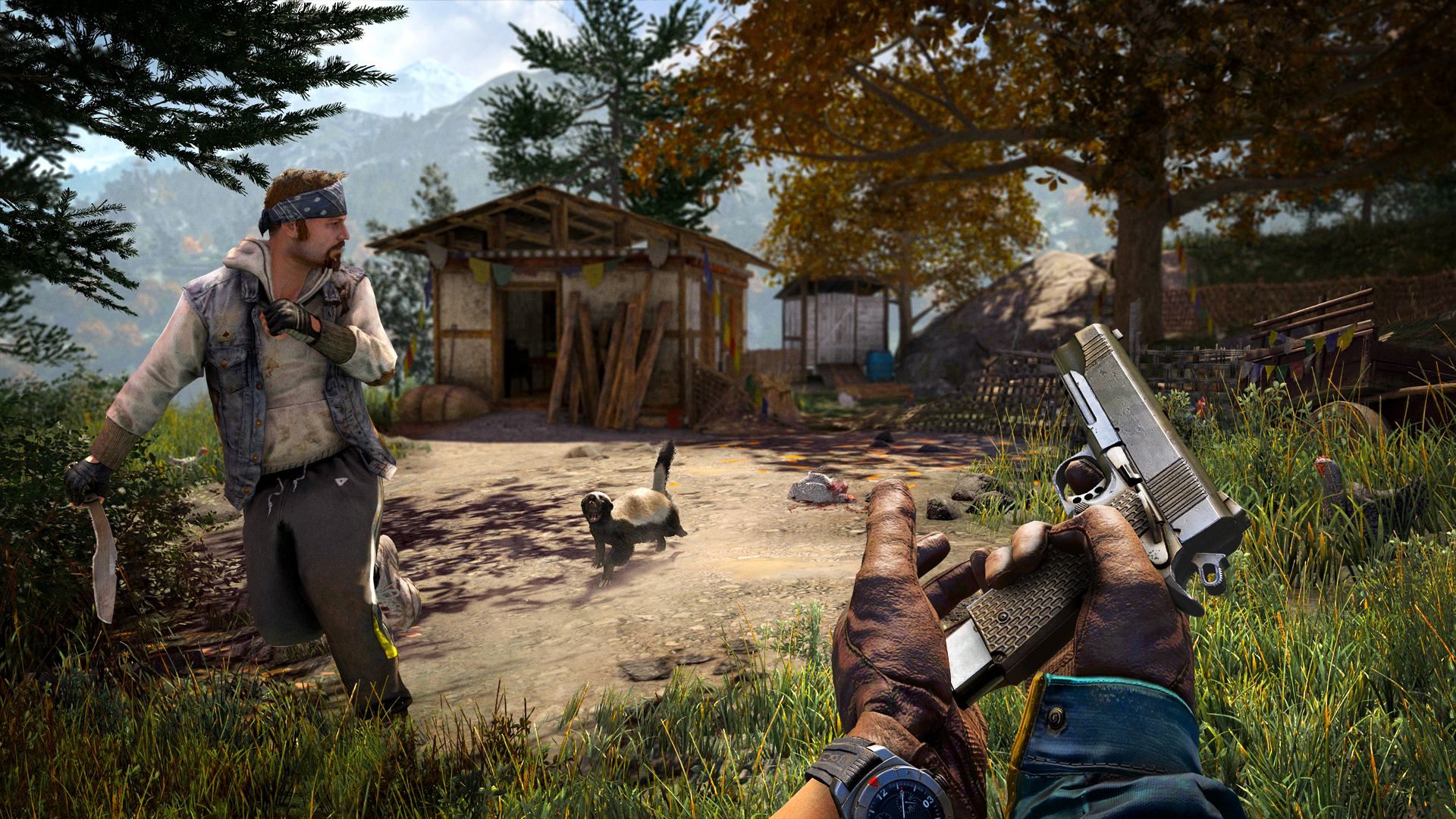
What stands out about any of Ubisoft’s games are their enormous open-worlds. Kyrat is vast, beautiful, and dense. As you travel through Kyrat, there are literally hundreds of activities to partake in. Some are quests, some are random encounters, some are collectibles, and some are tasks to gain control of Kyrat. As a first-person shooter intending to allow the player for a myriad of combat options, Far Cry 4 does a few things correctly. The game does not take itself too seriously, and it allows the player to feel like a powerful super-soldier. While this is at a disconnect from the story of being an average American with no combat experience, it does allow for quite a bit of fun as wreak havoc through the luscious countryside of Kyrat.

4

One of my favorite aspects of Far Cry 4 was that it has a knack for organically creating memorable moments in combat. Many first-person shooters fall into the pattern of hiding behind cover and taking out a couple of enemies when you pop your head up. Far Cry 4 is filled with bombastic and over-the-top scenes, and they don’t rely on pre-determined set pieces. Raining grenades on an enemy convoy from your gyrocopter, watching as single rhino annihilates an encampment, or riding on the back of an elephant to crash the gates of a general’s fortress, this game can spontaneously create some outrageous moments.

Despite the flashes of fun, I found Far Cry 4 got dull and repetitive quick. One of the causes of this is that the world is too dense, but many of the tasks are just repeats. There are hundreds of collectibles, but they are never interesting to find. There are tons of side-quests, but really there are only a few different types that end up being replicated over and over again. Wild animals and random encounters with enemies are frequent as you travel across Kyrat, constantly impeding you as you try to just go from point A to point B. You can make the argument that the player can simply ignore the side content if they aren’t interested in it, but that’s the whole purpose of an open-world game. When I play an open-world game, I want to experience the world and complete interesting quests, not do the same racing mini-game or free-the-hostages side quest over and over again. Outside of the main story, there are no characters or stories to be told. Just repetitive content to fill a giant world.

3

Moreover, you cannot simply ignore the side-content. You begin the game with a pitiful inventory size, so you need to hunt animals for their pelts. The game constantly bombards the player with random enemy encounters, so you need defeat outposts and fortresses to be able to safely across the map. The map itself is completely shrouded until you climb each radio tower to unveil a small portion. These activities can all be reasonably fun, but doing them twenty times each just kills enjoyment that could have been had. Sure, you could ignore it all, but it’s such a large chunk of the game’s content and feels almost necessary by design.

Despite being such a large world with opportunities for biodiversity, each area in the game feels identical to the last. It’s a hilly region with a lot of trees, and sometimes a river. That’s it. That is every area in the game. Even the landmarks and marked areas on the map are completely uninteresting. There may be caves, small buildings, or farms that are marked by the game to be explored, but there is genuinely nothing of substance here. Maybe there are some treasure chests with money, but I was swimming with cash despite never looking for it.

2

The world has no life to it. There are no interesting characters or storylines to be discovered. Everything in the game seems to be designed as a task to be checked off on big list. Go here, do this monotonous side quest, hunt 2 rhino, take down 100 propaganda posters. It’s content for the sake of being content. No soul, care, or interesting ideas found their way into this game. The only unique and intriguing areas in the game were reserved for the main story missions. But the actual explorable open world is just barren.

Possibly the biggest sin that Far Cry 4 commits is how derivative it is. It has been eight years since I played Far Cry 3, yet I was hit with a wave of déjà vu as I played Far Cry 4. It’s the exact same structure. An inexperienced American gets dropped into a conflict in a lush country. There is some psychopathic villain who seems somewhat empathetic towards you. You climb radio towers to unveil the map, you hunt the local fauna, you take over enemy settlements, you do some mundane sidequests, and you help a rebel group with questionable leadership take over the country. It every way, Far Cry 4 just feels like Far Cry 3 in a slightly different country. If you’ve played Far Cry 3, or almost any Ubisoft game for that matter, you’ve already experienced what Far Cry 4 has to offer.

1

Overall, I grew bored of Far Cry 4 remarkably quickly. After a couple of hours, you could legitimately experience almost everything the game has to offer. It’s forgettable, unoriginal, and dull. There are some fun moments to be had, but they are fleeting and buried under layers of monotony. Blowing stuff up with a grenade launcher can only take the game so far. Far Cry 4 is the video game equivalent of Wonder Bread; while it is not outright bad or offensive, there is nothing remarkable about it, it’s just boring.

Metro 2033 (2010)

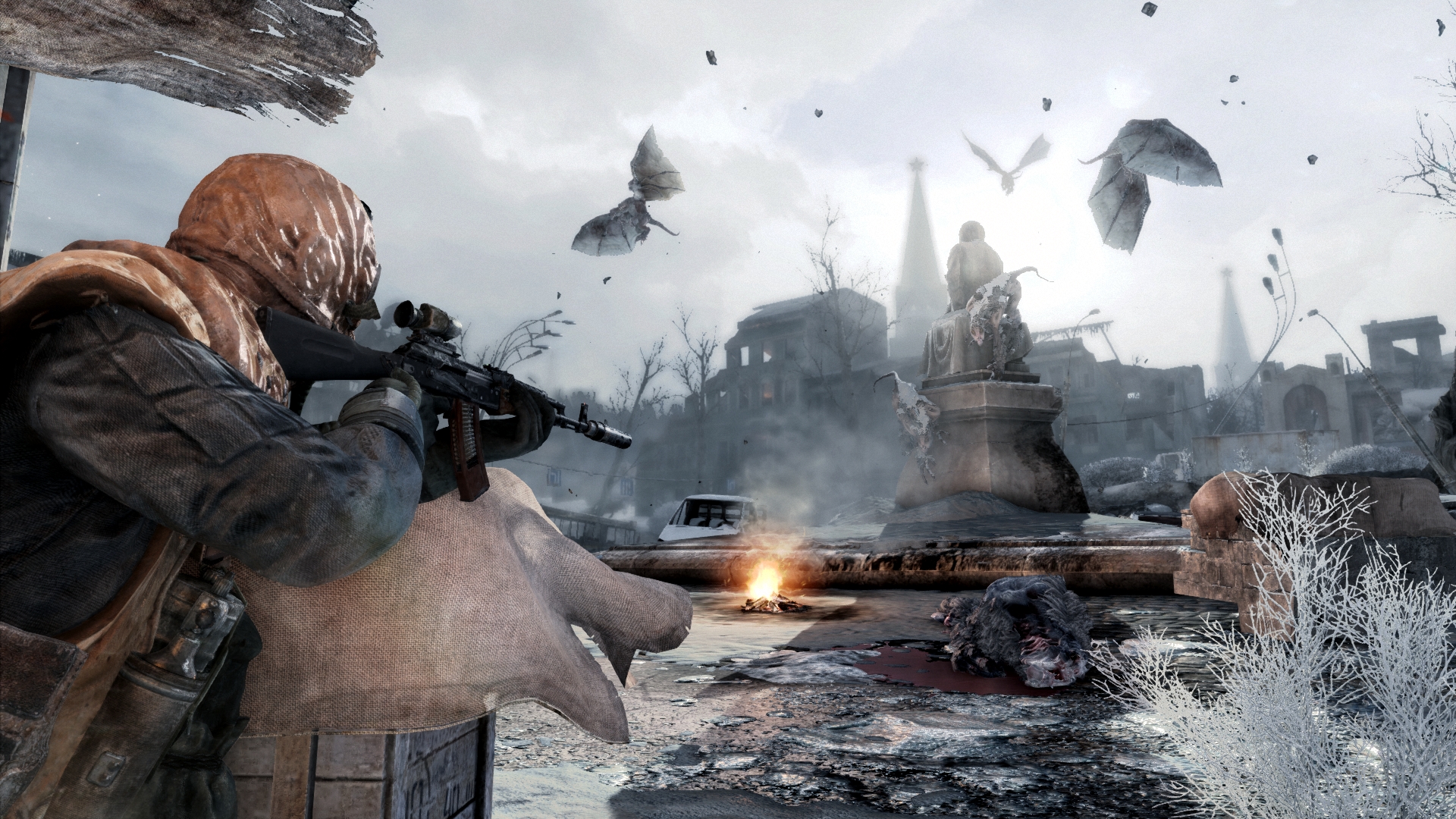
I didn’t know what to expect when I booted up Metro 2033. I had a vague idea of what the game was about, but I was excited to try a cult classic. After playing Metro 2033, I can see why it has a niche appeal. The best way I can describe it is that the game is an unpolished gem. It has a rough exterior: a handful of bugs, some mechanical missteps, and a lack of polish. But with a little refinement, this could have been a truly phenomenal game. It harbors an engaging atmosphere, tense environment, and an immersive gameplay loop.

3

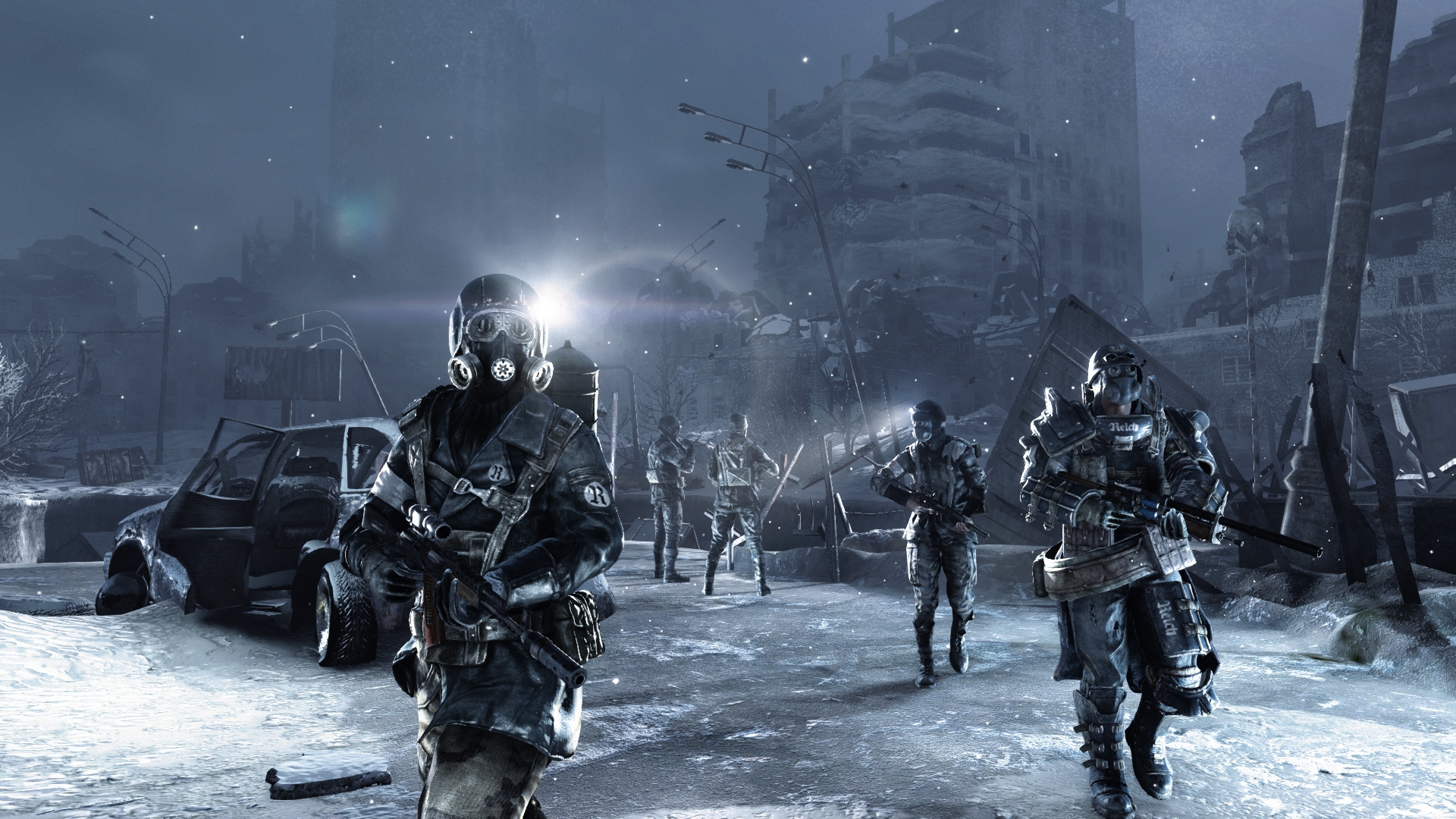
You play as a young man living under Moscow after a nuclear war. The metro stations under the city have become one of the last bastions of civilization. Each station serves as a community, and the tunnels connecting them are the lifeblood of the few remaining people on the planet. People have separated into different factions and humanity has descended into tribalism. The radiation has caused new life to evolve, and these new monstrous beings are threatening the few communities that are left. The main character is tasked with traveling through the metro to inform one of the main factions that the threat of monsters is rapidly escalating, and something must be done.

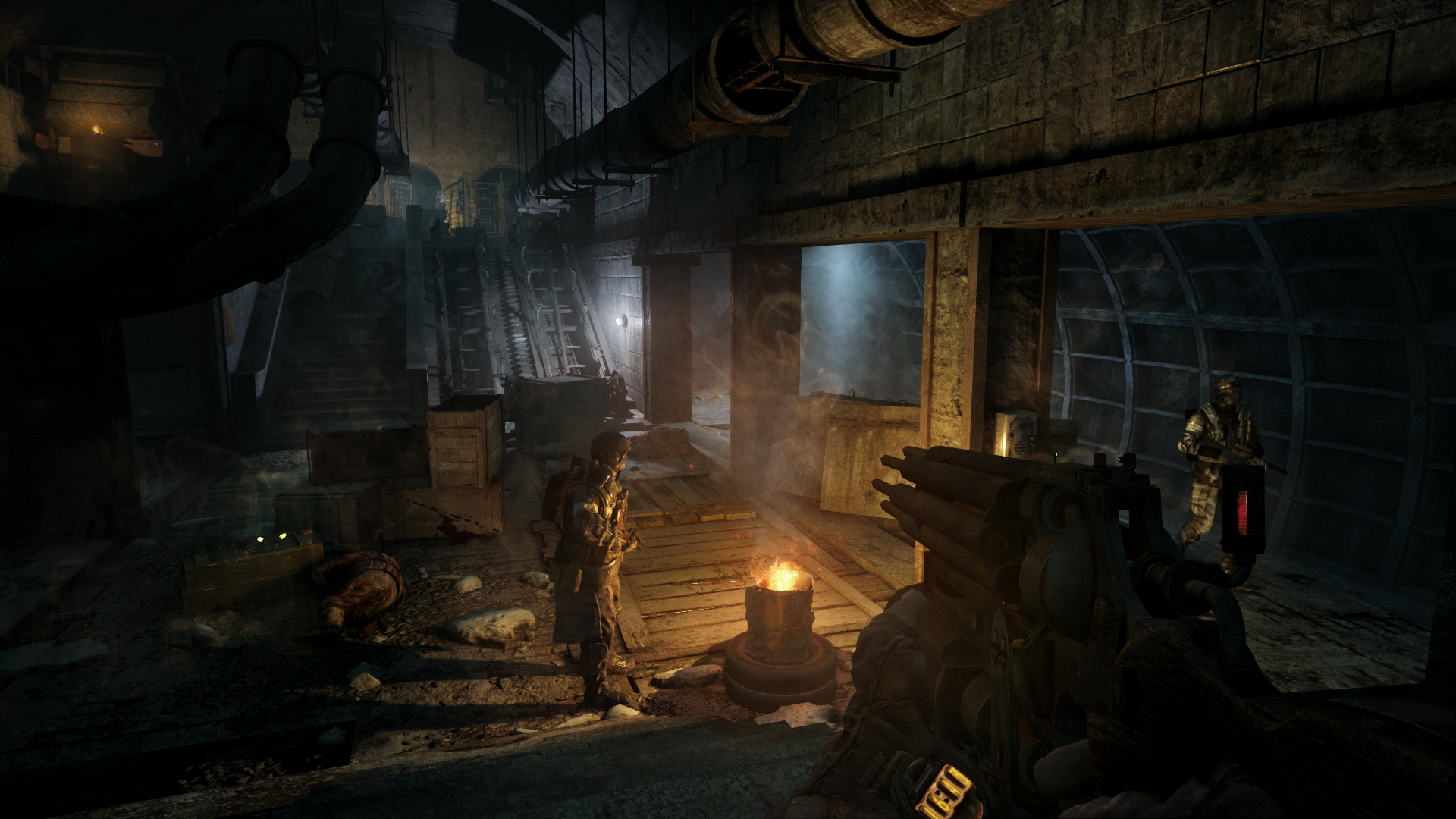
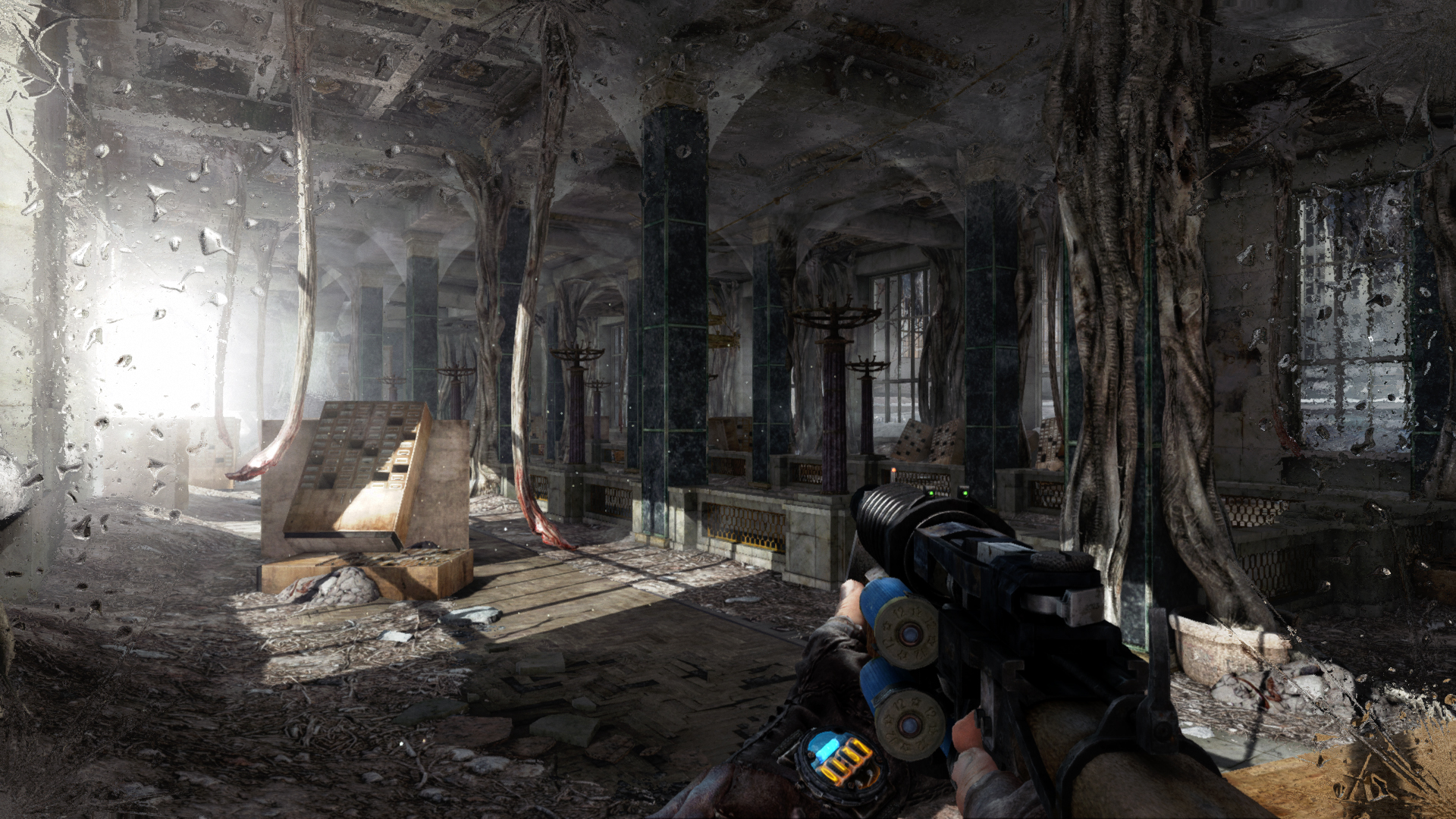
Metro 2033 is both a survival horror game and a first-person shooter. The game has a heavy emphasis on limited resources. Gas mask filters, ammunition, and med-kits are the primary tools that you are going to need to survive. Mask filters in particular are critical: if you spend time in an irradiated area you need to have a working gas mask. You cannot purchase extra filters outside of the first station in the game, so you are obligated to scrounge and scavenge to survive. This is when the game is at its best. Creeping through dark and claustrophobic environments, not knowing what awaits around the corner builds tension and anxiety. There is a desire to move quickly, as to not waste precious air on your current filter. But you also want to be vigilant to collect any ammo and filters that may be lying around.

5

The feeling of tension permeates Metro 2033. You want to be stealthy and avoid enemies as to not waste ammo and med-kits. But go too slow and you may run out of filters. There is a brilliant dynamic at play. The seesaw between preserving filters and preserving other resources is rarely balanced, and depending on your current state in the game you may favor one thing far more than the other. During the starting sections of the game I took my time, avoiding enemies like the plague as to not waste precious ammo. As the game progressed, I accrued a small arsenal of ammunition but I was running out of working mask filters. I started to move more quickly, making use of my scavenged ammo to dispatch foes rather than avoid them.

One of the best aspects of Metro 2033 is its immersive nature. The HUD is fairly minimalistic, and only appears when it needs to. The setting, despite being a bit sci-fi, feels grounded in reality. The subways beneath Moscow were genuinely designed to act as shelters during the Cold War. The fact that factions have sprouted and are vying for control of the metro feels realistic and prompts me to wonder more about the game’s world. The scarcity of mask filters, the importance of ammunition, and a few other mechanics also immersed me in the gameplay. Instead of having a menu to display objectives and important information, the character keeps a journal that keeps all of those details. Light also plays an important role in the game. While you have a flashlight at your disposal, it must be kept charged. If you don’t have an opportunity to recharge it then you can always rely on the lighter to illuminate a small area. Metro 2033 is just filled with these minor details, but combined they equate to a genuinely immersive experience.

1

I loved the atmosphere and world of Metro 2033, but I wanted way more of it. As you travel through the metro you rarely spend more than a brief moment at each station. There is very little to explore or interact with at these hubs of human activity. I wish I could converse with some of the NPCs at these locations to get a deeper understanding of the game’s world. I would’ve loved to learn the ideology and genesis of each station’s community. Yet instead they act as fleeting seconds of respite between the dingy and claustrophobic tunnels between them.

Despite this game having some great ideas, they are buried underneath some frustrating technical issues. One particularly insidious bug was one that would stop text and dialogue from displaying, or cut it off short. While it was annoying to miss flavorful conversations because of this glitch, it was far more irritating when it led to me missing critical information. There were four instances that the game never displayed info that it was supposed to. It never showed how to charge the flashlight, it didn’t have text to prompt the player to use the lighter to burn cobwebs, and it never displayed the information on gas mask filters and how to change them. After a quick google search all of these things were supposed to be in the game, but just never initiated for me for whatever reason. Interestingly I played the game on the ‘Redux’ version, which is supposed to be a remaster. I’m not sure if this version causes this bug, or if it was something present in the original.

2

This same glitch led to my most aggravated moment while playing. In one part of the game, a character is supposed to tell you information on a new enemy type and how to deal with them. This new monster apparently can be avoided by staring them down, after a few seconds they will back away. However, if you look away or shoot at this enemy, they will immediately go on a rampage. I never got this important bit of info. The conversation never triggered. So, I fought these enemies as I would any other enemy. But these foes have enormous health pools and kill the player in a single hit. I would legitimately empty hundreds of rounds of precious ammo to no avail. After brute forcing my way through this section, I found out how it was supposed to be played. It was disappointing because I actually now think that these were an interesting enemy. They build anxiety and tension as you stare them down. But my experience was marred by a bug in the game.

My final issue with the Metro 2033 is that the game occasionally drifts away from its strengths. Most of the game can be played as a stealthy scavenger, but there are moments that just devolved into standard FPS gameplay. Metro 2033 is at its best when it is tense, gritty, and anxiety inducing. But it turns into a generic FPS when having to partake in extended firefights. Luckily this didn’t happen too often, but there were enough examples of this that I have to talk about it. The game’s actual FPS mechanics are passable, but they certainly aren’t its strength.

4

Metro 2033 is a lovable mess. Sure, it has plenty of technical issues, an unfinished world, and a few mediocre sections. But it also fosters some genuinely immersive gameplay and world design. The game attempts to make the player feel like they actually are the main character. It’s odd how such minor and seemingly important things can make a game feel so much more genuine. The diary, lighter, mask filters, minimalistic HUD, and flashlight all seem like they are just minor things but they are critical to making Metro 2033 feel immersive and realistic. Despite the game being a bit messy in its execution, I did enjoy my time with Metro 2033 and I am excited to play its sequels.

Baba is You (2019)

It is a rare occasion in which I get to play a truly innovative game. Games that push the boundaries of a unique concept can be difficult to come by. That is why I was excited to try the acclaimed puzzle game Baba is You. This indie game presents an elegant idea: rules are meant to be broken. This is a game about rules, and how you can manipulate them to reach your goal.

1

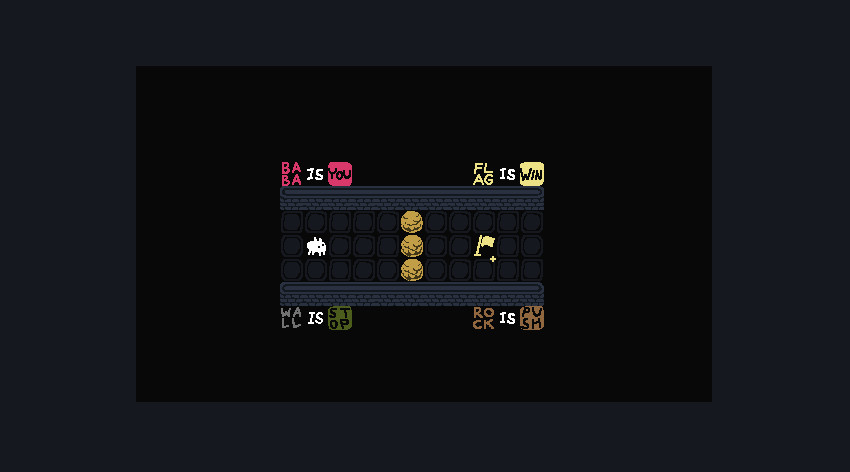
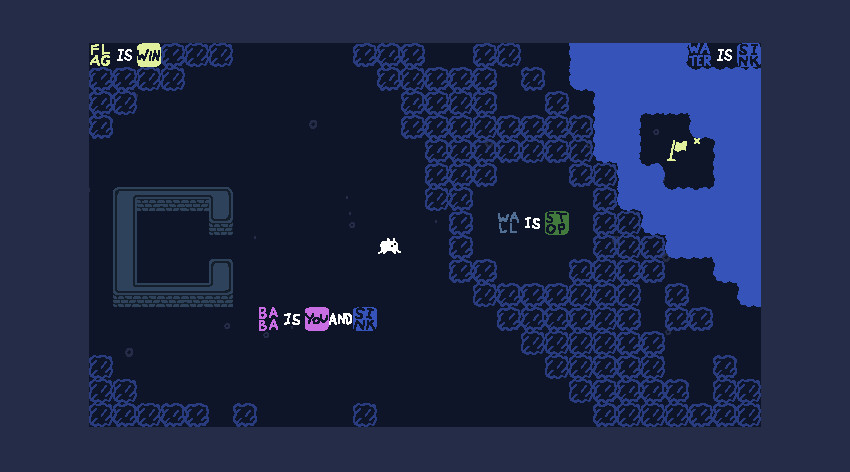
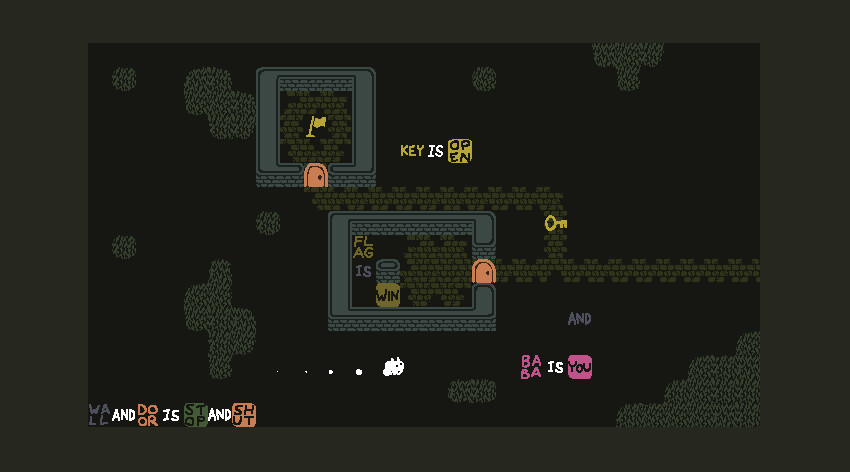
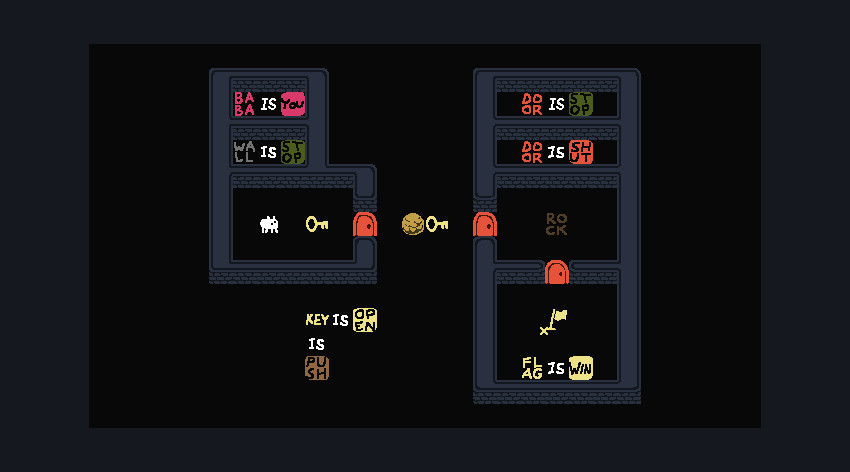
Like many puzzle games, the premise of Baba is You is to get to the goal. The genius of the game is that the rules are ever changing. Each level is a square grid, and each rule is simply laid out for the player. It starts innocuous enough; the first level begins with rules such as “flag is win”, “Baba is you”, and “wall is stop”. You are a little white creature called Baba, you must make your win to the flag to win, and any wall in your way will stop you. What makes this game special is that the player can manipulate the rules as each word is movable. For example, you can push the word “wall” to break up the sentence “wall is stop”. Now that rule no longer exists, and you can freely walk through walls. Moreover, you can use whatever words are given to you to form new rules. In the previous example, you could use the given words to make “wall is win” to change the win condition of the level.

The idea behind Baba is You is absolutely phenomenal. In every game that I have played, rules are concrete. Through tutorials, text, or simple trial and error the player must deduce the mechanics of the game and how everything interacts. In Baba is You, every level has its own ruleset laid out in plain sight. It’s up to the player to manipulate those rules to their advantage. Breaking up sentences to invalidate troublesome barriers, or forming new rules that could prove useful. As the game progresses, new words begin appearing that could drastically change how levels need to be approached. Part of the beauty of the game is that despite the ever-changing rules, the win condition always remains the same: whatever object is “you” needs to be touching whatever is “win”. This inevitable end-state of any puzzle is a helpful starting point to begin thinking about how you can achieve victory.

6

The most critical aspect to any puzzle game is its level design. Challenges must be creative and fully utilize the games mechanics, while at the same time having relatively simple solutions that are not obtuse. If you’ve played many puzzle games, I’m sure that you’ve run into a roadblock and after finally stumbling into the solution you say “how the hell was I supposed to figure that out”. Designers must avoid this feeling while simultaneously crafting puzzles that force you to think. Baba is You has fantastic level design. Most solutions are simple to execute and don’t require some obscure mechanic. The designs are ingenious in that most levels require some trick or tactic that any other level hadn’t utilized yet, but remain simple and seem obvious once you discover the solution.

Moreover, Baba is You utilizes its unique premise to challenge preconceived notions. Most gamers are going to have internal habits that are going to be broken. You are going to make false assumptions about how to beat a level, and the developer was fully aware of that. Many of the levels have this uncanny quality to exploit the player’s desire to immediately attempt an obvious solution. It baits you into using an object the same way that you’ve used it so many times before, but that assumption will only lead you away from the goal. Many times, you feel so close to solving a puzzle, but in reality, you are so far off from the correct solution.

2

Additionally, for a game that is all about breaking rules Baba is You is remarkably good at stopping unintentional or “cheese” solutions from working. Again, it felt like the developer thought of every way a person could attempt to solve a level and prevented everything but the intended solution from working. The final note on level design that I want to touch on is the ability for each level to foster an “aha!” moment. It’s a great feeling when you figure out some trick that you hadn’t thought of before that makes the puzzle a breeze. Baba is You excels at creating those sensations when a level finally clicks.

One of the most important aspects to Baba is You is how relatively easy it is to get into. Some of my favorite puzzle games are notoriously unapproachable. Stephen’s Sausage Roll and SHENZHEN I/O are both confusing and cumbersome for new players, and as a result many people don’t give the games a fair chance. Baba is You is comparably simple to pick up and play. The game starts with extremely easy levels for the player to grasp the basics. Moreover, while there are over 200 individual levels, you only need to complete a few dozen to beat the game. You can pick and choose which levels you want to do, so if you get stuck on one particularly troublesome puzzle, you can skip it entirely and try something else.

3

Despite Baba is You being easy to pick up, it can be an extremely challenging game. While the beginning sections of the game are there to ease new players in, there is plenty of optional content that will test even the most veteran puzzler. The final few sections of the game in particular are insane. These parts are entirely optional, but they utilize a rapidly expanding ruleset and rely on meta solutions. How you complete one puzzle may affect another puzzle, and how to get to the next puzzle is dependent on how you completed a previous puzzle. I don’t want explain too much, as it may ruin the surprise for people who do want to experience these sections. It suffices to say that Baba is You truly maximizes the potential of its concept and it boasts plenty of difficult content.

My single point of contention with Baba is You comes from the moments where a level truly stumps the player. Baba is You relies on players to experiment with the rules on their own, nothing is explained outright. It is up to the player to figure out how each rule and object interacts. For the most part, this is a good thing. It respects the player’s intelligence and rewards creative use of rule manipulation. It also fosters those “aha” moments I spoke of before. The problem arises in that it can be a common occurrence where a puzzle completely stumps the player.

4

The issue is that nearly every single level in the game relies on some trick to complete it. Once you figure out the trick, the level seems elegant and simple. But if you haven’t figured it out then the puzzle is quite literally impossible. In other puzzle games, there is usually a series of moves or steps to get to the goal; you can make intermittent progress towards the finish as you figure out each individual step. Baba is You on the other hand relies on grand revelations and “aha” moments, so it may so happen that you stare at a puzzle for an hour and have made no progress. While these moments are frustrating, I do have to commend the game for providing a way to avoid this. As previously mentioned, you don’t have to complete every puzzle to beat the game. If one is stumping you, you can avoid it entirely. While I did end up 100% completing every puzzle in the game, any moment of frustration was self-inflicted because the game provides the option to circumvent any particularly tricky levels.

5

Something about Baba is You clicked for me in a way no other puzzle game has. It has a truly remarkable premise and incredibly designed logic-based puzzles. In a way, it reminds me of the enjoyable side of programming. Logically stringing together rules and statements to solve some problem is inherently satisfying to me. It is for these reasons that I give Baba is You a 10/10. I highly recommend this game for anybody who enjoys puzzles as it may be the best puzzle game ever made.

Feudal Alloy (2019)

I’ve discussed a decent amount of indie metroidvanias since starting this website. It’s not surprising considering how many of these kinds of games are made. It stands to reason that new games in this niche must do something special to stand out, or risk being forgotten in an oversaturated market. Feudal Alloy looked promising to me, it had an interesting concept and setting, and I had hoped that it would do enough to at least be a decent metroidvania. Unfortunately, this game feels unfinished in every regard. Every aspect of the game could use polishing, and some components are missing entirely.

1

The idea behind Feudal Alloy is undoubtedly intriguing: you play as Attu, a fish-controlled robot in a medieval world. Attu was a resident of a farming town that produces oil for all of the robots, but a dastardly group of bandit robots ransacked the village and stole all of the resources. With sword in hand, Attu sets off on a quest to reclaim what was stolen. As a metroidvania you must progress through a sprawling world, collecting upgrades that allow you to progress further and further. Without a doubt, the best aspect of Feudal Alloy is its art style. The hand drawn characters and environments are appropriately detailed and are imaginative. It pains me to say that the positive aspects of Feudal Alloy end there.

6

Like most metroidvanias, as you roam the tunnels and rooms of the expansive map, you will run into enemies. The combat is pretty standard, you can swing your sword to damage foes, and you must avoid damage by jumping or moving out of the way. You eventually unlock some additional techniques such as dashing, the ability to throw bombs, blocking, and unleashing electrical discharges to stun enemies. The game at least has a thematic stamina system, as you use Attu’s various abilities he will begin to overheat. If Attu reaches his heat limit, he will no longer be able to attack or dash, and will need to cool off before continuing. It functions as most stamina systems, but it was a nice touch that it thematically fit the game.

The combat is all pretty typical, there is not much here that stands out from any other game. If anything, it can fill a bit stiff and unreliable at times. The hitboxes of Attu and enemies feel a little inconsistent. While it’s not frustratingly bad, the game is definitely lacking the buttery-smoothness of one if its peers: Hollow Knight. The aerial combat in particular is pretty clunky. Jumping above enemies and slashing them from above does not bounce Attu high enough, so you end up just falling straight into the enemy and taking damage. The biggest disappointment in the combat department is its lack of bosses. There are only two bosses in the entire game. Instead, there are an abundance of challenge rooms which bombard the player with wave after wave of normal enemies. These kinds of rooms are fine once in a while, but they felt like filler for where a unique boss should have been. It definitely seems like there were supposed to be more bosses, but the developers just put these challenge rooms in their place to save time.

2

As a metroidvania, exploration is a key aspect of Feudal Alloy. The player must figure out where to go, and what new paths can be traversed when an upgrade is found. Similar to the combat, Feudal Alloy follows a pretty standard exploration formula but with some flaws. The environments are pretty similar looking, and landmarks are essentially non-existent. It can be difficult to remember any important locations and how to get there since everything just blends together visually. Moreover, some parts of the map just don’t make geometric sense. It’s hard to explain, but when looking at the map, rooms just don’t line up with where the doors physically are. For example, the map will show a door on the left side of the room, but in reality, the door is on the floor. These inconsistencies can make navigation difficult.

5

The other big problem that I had with the exploration was the lack of proper secrets. Sure, there are a ton of hidden paths and secrets to find, but not a single one of them is rewarding in the slightest. Most of them contain a stash of money, but money is virtually worthless. The only other prize you could find is a new piece of gear to equip, but that rarely felt helpful. You can buy health potions and coolant to restore stamina with the money you find, but these are extremely cheap and I never worried about running out of money. You could also buy new equipment, but the realistically there was little reason to ever do so.

New gear in Feudal Alloy feels relatively useless. There are five stats: damage, armor, cooling speed, overheat temperature, and health. Armor and health are essentially the same as they both increase how much damage you can take. Similarly, cooling speed and overheat temperature also are functionally comparable. You can’t even tell what your stats are really doing. There’s no way to tell how much damage your dealing or taking, so it’s hard to judge how much a stat increase is doing for you. Moreover, finding or buying new gear rarely feels rewarding. All it does is slightly swap around which stats it gives you. One chest piece may give you one less damage tick, but one more health tick. I didn’t feel like there was meaningful equipment parity or choice since everything was so similar.

3

My final gripe about the game was how it underutilized its story and setting. The couple sentences that I wrote to describe the basis of the story is all that there is in the game. I’m not exaggerating when I say there is a short blurb at the beginning of the game explaining the story, and that’s the extent of the narrative in the game. There are no additional characters, lore, side quests, or even a narrative arc that progresses through the game. Bandits stole the oil and Attu is trying to get it back. That’s it. It’s really disappointing because the setting is actually fairly interesting. I want to know more about the fish-controlled robots, but there is just no worldbuilding of any sort.

4

Overall, Feudal Alloy isn’t a particularly bad game, it’s just not finished. The combat needs fine tuning and there needs to be more bosses. Exploration needs to feel more rewarding, and one way to accomplish that would be to make gear more unique. The environments need to be more distinct so that navigation is more natural. And there needs to be some sort of story, worldbuilding, and lore to utilize the unique setting of the game. It is for these reasons that I give Feudal Alloy a 4/10. This is a game that feels like it is still in the alpha stages of development, as nearly every aspect feels unfinished and unpolished.