The Legend of Zelda: The Wind Waker (2002)

There is no game that can instill a sense of adventure and discovery better than The Wind Waker. While The Legend of Zelda games have a healthy mix of combat, exploration, and puzzle solving, The Wind Waker takes the exploration aspect to the extreme. Vast oceans cover the land of Hyrule and there is treasure and discoveries to be made in every corner and on every island that the world has to offer. Of course, The Wind Waker also has some great combat mechanics and intriguing puzzles tied in with the strong dungeon design. As somebody who can spend hours just exploring the crafted worlds in video games, The Wind Waker is probably my favorite installment of The Legend of Zelda series. I have played both the GameCube version and the Wii U HD remake of the game, and I can definitively say that the remake has made some excellent changes to the timeless title. Most of the changes made in the Wii U version were focused on reducing some repetitiveness as well as tedious tasks that were present in the original. Unfortunately there were still a couple of minor issues that still made it into the HD remake.

While I consider The Wind Waker to be one of my favorite games of all time, there are a couple of small problems that I have with the game. Even though the HD remake of the game speeds up some repetitive or tedious sections, there are still a few instances of the game moving a little too slowly. This is a not a big issue at all, but I do think that a couple of the mini-games or side-quests took a slightly too long with not enough payout. For example, training with Orca is just ten to fifteen minutes of using a repetitive pattern to get through the mini-game. Again, it is really not that big of an issue but they could have afforded to slim down these type of segments. Most of the side-quests in the game were actually extremely engaging and fun, only a select few were problematic. My only other issue with The Wind Waker the game was to easy outside of the final boss and the Savage Labyrinth. Enemies just did not seem to deal enough damage to ever be a realistic threat. While the combat was fun and engaging, it just was not punishing enough if I ever screwed up. So if you want a decent challenge I highly recommend you play on Hero Mode to alleviate this issue.

Although I do not think that the game was hard enough during combat, it was still tons of fun to fight all the different types of enemies. Controlling Link was smooth and using the different combos was simple to master and the use of different tactics was needed for every enemy. I enjoyed the intense sword fights with the Darknuts and trying to outmaneuver the hard-hitting Stalfos. There are plenty of unique and interesting enemies in The Wind Waker and adapting to different situations and enemies was great. There are also some interesting strategies that you can implement by making the enemy drop their weapon and picking it up for yourself. The boss fights were also fun, albeit easy. The dungeons that contained these enemies were also pretty well designed. There were plenty of interesting puzzles to be solved to match the quality of the combat. The Tower of the Gods and the Earth Temple in particular had some really intriguing puzzles. What really stood about the dungeons, and the game as a whole, were the atmospheres that were created.

Whether sailing across a vast ocean, exploring a cavernous mountain, or discovering the secrets of small islands speckled across the sea, The Wind Waker really feels like a true adventure. Every chunk of the ocean has something unique and worth exploring. Enemy strongholds, giant Octos, hidden treasure under the sea, or haunted ghost ship are just a few of the things that you may stumble across while sailing across the sea. I loved the treasure charts and how they made it feel like you really were treasure hunting. I was a little nervous to attempt a 100% on this game as the ocean is so ridiculously vast, but there are many tools at your disposal to find every item. Special treasure charts are there to detail where to find the Heart Pieces, Fairy Fountains, and all other important things scattered across the ocean.  Every island has a purpose and no piece of the world is uninteresting. I spent hours just sailing the high seas and visiting every island to see what it had in store. On top of the sense of adventure, it was extremely relaxing to just sit back and take in the beautiful world of The Wind Waker.

This installment of The Legend of Zelda is in my opinion the most aesthetically pleasing of the series. The cell-shading was masterfully done and the game is just extremely beautiful to look at. All of the characters had very expressive faces and you could easily tell what each character was thinking without the need for much dialogue. Being able to see places like Dragon Roost Mountain or The Tower of the Gods looming over the oceans from leagues away was a great to give a feel for how massive these places really were. I stopped every so often just to take in the scenery around me. It really was a pleasure just to look at the world.

I personally love The Wind Waker and I recommend it to anybody who loves adventure and exploration. I do think that you have to take this game a little slower than most other titles to really appreciate it. While there is plenty of classic The Legend of Zelda elements in The Wind Waker, its world and atmosphere are extremely unique. I do recommend the HD remake on the Wii U over the original version as it cuts down on some of the issues. If you just want to sit down and explore in video games, The Wind Waker is the perfect game for you.


The Legend of Zelda: Ocarina of Time (1998)

I was cautious when starting Ocarina of Time, a game heralded as the best of all time could not possibly live up to the hype, or so I thought. After playing the game I am not sure if I could say that is the best game of all time or even my favorite Legend of Zelda game, but I can say with confidence that is outstanding and certainly one of the most impactful games of all time. It is a quintessential action-adventure and the most classic Legend of Zelda game I can think of. If I were to recommend a Legend of Zelda title to a new player, I think Ocarina of Time is the most representative of what the series is about. I have to preface the rest of this article with the fact that I played the original Nintendo 64 version on the Wii U emulator, so a couple of the issues I will mention with the game were fixed in the 3DS remake of the game.

The first thing that really stood out to me about Ocarina of Time was the controls. For being released in 1998 on a console that time has treated unfavorably Ocarina of Time has pretty tight controls, even by today’s standards. This game introduced Z-Targeting, which allowed players to lock-on to enemies and move around them with great ease. Z-Targeting was a revolutionary advancement in video game controls and it is even still used in some modern games. Occasionally it was a little difficult to lock-on to the correct enemy in Ocarina of Time, but it usually pretty simple to cycle through different opponents until I had targeted the correct one. The sword fighting in this game was remarkably simple but it is some of my favorite sword play in any Legend of Zelda title. The only big issue with controls in this game was aiming. Aiming the Bow, Hookshot, and Boomerang was pretty rough. A single small tap on the control stick would send the pointer across the screen. There were plenty of instances of having to shoot at moving targets with extreme precision and it was usually more frustrating than fun. Even though aiming was unnecessarily difficult it was not so impactful or frequent that it significantly worsened the game.

One of my favorite features in Ocarina of Time was just how alive the world felt. Every area felt unique and it was interesting to see how the world changed from seven year gap between young Link and adult Link. The supporting casts of characters also were memorable and likeable. Watching the grumpy Darunia dance and smile when I played Saria’s Song was a joy and the whole game in general was just charming in that sense.  The world was very fun to discover and explore.  Whether it is uncovering Heart Pieces, finding Golden Skulltulas, or doing side-quests, there were plenty of extra things to do in Ocarina of Time. Everything felt very rewarding as well; it was properly gratifying to complete all of these optional objectives.

One of the core ideas in Ocarina of Time was using music and songs to manipulate the world around you. I absolutely loved this feature as it introduced a number of playable catchy songs on top of the already great soundtrack. Songs can be used to change the time of day, talk to your friend, access different areas, or even teleport to the major dungeons. The songs were such a vital part to the game and they were extremely useful and fun to play. I still occasionally whistle Saria’s Song unconsciously, that says a lot for how catchy these songs are.

The dungeons in Ocarina of Time were pretty stellar for the most part. The first three dungeons were played through as young Link. They were very simple, but rightfully so as they are the first 3D Legend of Zelda dungeons ever, so they are meant as an introduction. I was not a huge fan of the third dungeon, Inside Jabu-Jabu’s Belly. The aesthetic was unappealing, the design was a bit repetitive, and I had to carry around an annoying companion, these factors led to a mediocre dungeon. Luckily most of the following dungeons were so amazing that it made up for it. Most of the adult Link dungeons had great themes, puzzles, enemies, and bosses. The Forrest Temple, Fire Temple, Spirit Temple, and Inside Ganon’s Castle in particular were my favorites. All but one of the adult Link dungeons I would describe as phenomenal, the one outlier is the Water Temple.

I could write an entire thesis on how much I hate the Water Temple, but I will attempt to keep it brief. The biggest issue with this dungeon was the frequent use of the Iron Boots. In order to sink in water you have to equip the Iron Boots, and to rise to the surface you need to take them off. This would not be a big issue if you could assign the Iron Boots to a button like most other major items, but you have to go into the menu every time you want to equip or unequip them. This slows process to a grinding halt whenever you want to descend of ascend in water. Often times I would have to go into the menu twice within three seconds just to use the Iron Boots. The dungeon’s design in itself was an interesting concept but it was poorly executed in my opinion. There were so many branching paths that could be accessed and made this dungeon an incredibly confusing affair. The combination of the Iron Boots and the confusing nature of the dungeon made it incredibly tedious and slow. The mini-boss and the boss of this dungeon were also pretty bad in my opinion as they were ridiculously easy and felt like they were just a formality instead of actually interesting bosses. The Water Temple is a pretty big stain on the otherwise clean Ocarina of Time.

While I may not think Ocarina of Time is the best game ever I cannot deny its greatness and the magnitude of its achievement, especially considering its age. It is the best representation of what the Legend of Zelda series is all about. It still holds up pretty well today, although I recommend getting the 3DS version as it fixes a number of the flaws in the original game. It was definitely an enlightening experience for me, getting to see the roots of one of my favorite series was great. Ocarina of Time is the highest rated video game of all time, and I am certain that it deserves a playthrough by anybody and everybody.

Owlboy (2016)

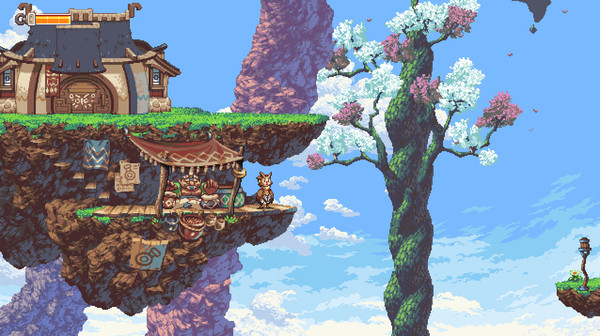
I have to admit that I am a sucker for indie games, metroidvanias, and pixel art. Clearly Owlboy was made for me, as it has all of these elements and more. This game was a highly anticipated indie title as it has been development for nine years and I was curious to see how it would turn out. I was more than pleasantly surprised, from the first moments I was gripped by the polished and charming visuals, as well as the heart-wrenching tale of Otus. The unique combat and movement systems were a boon and kept me engaged throughout the course of the game.

owlboy1

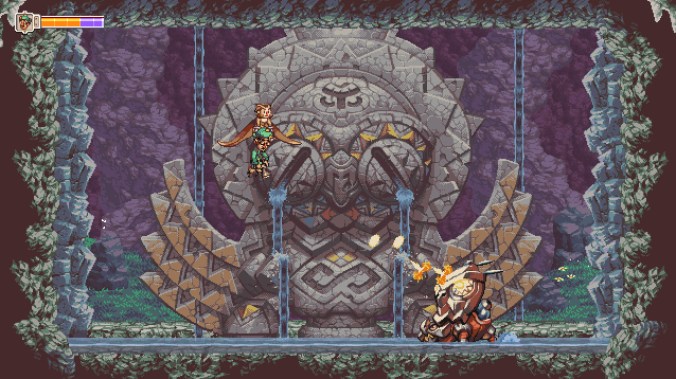
Owlboy had a very interesting take on combat. Otus, the main character, is an owl and as such he cannot fight enemies by himself, but he can fly. He enlists the help of his best friend Geddy, a human mechanic and soldier to help him fight enemies. It felt extremely smooth and natural to carry Geddy around and both aim and dodge enemies at the same time. Otus also recruits a few other unlikely friends to join his ragtag band of heroes; all of these characters have unique combat mechanisms and utility to allow Otus to access different parts of the world. At first I was worried that carrying around these different characters would become tedious, but it was extremely easy to get a grasp on how the combat worked. Controlling Otus was a blast and his variety of movement options led to some entertaining fights as I dipped and dodged hordes of enemies.

owlboy2

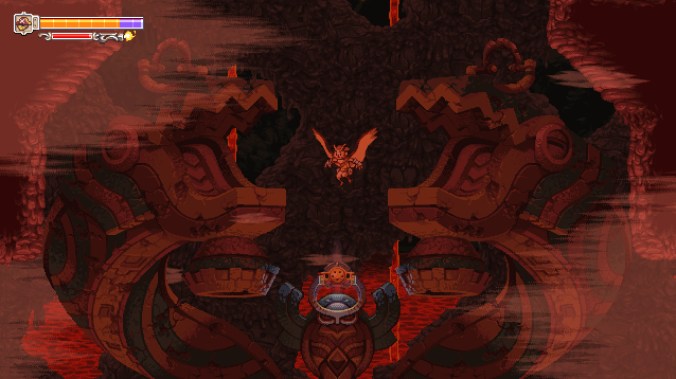
The dungeons in this game were fun and they all had unique concepts and ideas that made them enjoyable. I do think that they did seem to run on a bit too long and got a little repetitive at times, but for the most part they were very well designed, especially the boss battles. I absolutely loved all of the boss battles in this game; they were all fast-paced, challenging, unique, and intense.  Having the ability to fly seems like it would make any platforming non-existent, but that is not true. The game is cleverly designed to have challenging platforming sections despite being able to fly. There are also some stealth sections to add some flavor and variety to the game.

The gameplay was fantastic, but that was not the only thing that kept me interested in Owlboy. The hi-bit style of pixel art was masterfully done and it led to some beautiful visuals. There seems to be a trend in indie games to have great soundtracks, and Owlboy is no exception.  Calming and relaxing songs to match the aesthetic of Otus’ home of Vellie, and intense songs to match the high octane boss battles.  I was also very surprised by the quality of the story. Very few games manage to leave me wondering and interested even after the game has ended, but Owlboy did precisely that. Throughout the entire game there is an air of mystery, but not until the end of the game did I realize the scope of these small hints and mysteries. The game’s story is not that interesting in the beginning, but it is setting up and alluding to the wonder-inducing ending.

owlboy3

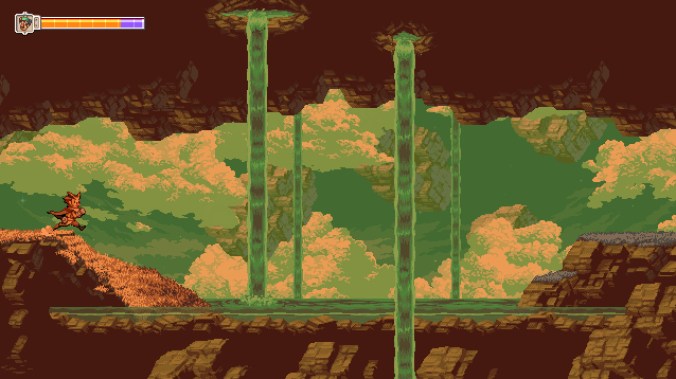
The world of Owlboy is also very well crafted. It does not take long to travel from one point to another and every section of the world has a distinct feel to it.  I only wish that there was a map of the overworld to see how the world really comes together. I did not have a big problem with this because I have been navigating metroidvanias for years, but some players might be thrown off by the lack of a map. In a game that constantly revisits areas and branches out in many different directions I could see how it may be confusing to some people. There was also a couple of interesting side-quests to play and enjoy, the Boguin Cannon in particular was very fun. The characters in Owlboy were also interesting and were memorable. Even characters that I did not like at first grew on me. The game has a consistent motif of friendship that drives the story and adds to the lovableness of certain characters. The game also was plenty silly and funny, there were many moments that had me smiling. The silliness, backstory, and characters of Owlboy and its world is certainly interesting and worth the time.

Owlboy also has plenty of collectibles, in the form of coins. I genuinely enjoyed collecting the coins scattered across the world and reaping the rewards in the form of trinkets. Trinkets could be health increases, goofy hats, or upgrades for your partners. The upgrades were definitely powerful enough to warrant spending time collecting coins to unlock these power-ups. My only complaint is that some of the coins were hidden in really strange spots. Invisible passageways in walls meant that if you want to collect every coin you are going to need to run into every wall, ceiling, and floor in the game to see if there are any hidden hallways. Granted, most of the coins were pretty easy to find and you can get most of the rewards in the game just casually collecting the coins. There were also three Golden Disks which unlock a very interesting secret at the end of the game. I will not spoil anything, but it is 100% worth it to look out for those Golden Disks.

owlboy4

Owlboy has so many elements that I love, and it was one of my favorite games that I have played this year. If you enjoy indie titles, hi-bit pixel art, metroidvanias, lovable characters, and mysterious stories I definitely recommend this game. I am going to give Owlboy a 9/10, it was excellent and I loved every moment of it. Do not hesitate to pick up this title as it is an absolute joy to play and experience.

The Legend of Zelda: The Minish Cap (2004)

The Legend of Zelda: The Minish Cap is a handheld game and was one of the four Legend of Zelda games developed by Capcom. The game focuses around shrinking down to a small size and interacting with the miniature people of the Minish. I really enjoyed shrinking down and how it affected the world of Hyrule and made this game was pretty fun little adventure. That being said the game also had its fair share of issues, most of which could have been easily fixed.

The first thing that comes to mind is Kinstones, which are both a positive and a negative part of the game. This mechanic introduced in The Minish Cap allows you to fuse Kinstones, which you find while exploring Hyrule, with other characters in the game and it gives you a reward. It was fun because it opened up new paths in areas that you have already visited and added an extra layer of exploration. I think it was an interesting idea and I did find it relaxing to go around fusing Kinstones with other characters, but the system had a number of flaws. The first issue is “shared” fusions, which is when multiple characters have the same Kinstone to fuse with. This can get confusing as I was talking to every character and taking mental notes on which character needed what Kinstone, but when I came back most of the fusions were gone after fusing with one person. The next issue was “finicky” fusers, which was when certain characters only occasionally wanted to fuse with me. This was annoying when I was getting all of the fusions but as I was checking all of the characters to see if I could fuse with them I would have to check multiple times just to make sure. My biggest issue with Kinstones however was the rewards. Some of the rewards were great, like Heart Pieces or massive amounts of Rupees, but sometimes the reward for fusing a Kinstone was another Kinstone. That is just nonsensical. I think the system was unique and had potential to be a great new form of collectibles, but fell a little flat in the execution.

While Kinstones were a little disappointingly executed, there is a far worse offender in this game: figurines. There is a shop where you can play a gashapon machine and collect 136 figurines. Each new one that you get decreases the chances of you getting another new one. There was so much wrong with this mini-game and it is possibly the most obnoxious and blatant time waster that I have ever seen in a video game. Of course, you do not need to play it to complete the game, but you need all 136 figurines if you want the last Heart Piece in the game. The last Heart Piece is not even accessible until you defeat the last boss anyway, so there is not even a reason to collect that last Heart Piece other than wanting to 100% the game. It takes about thirty seconds to do one roll of the gashapon, which can equate to one figurine if you are getting one every roll, which you are not since it is a game of chance. You can increase your odds by putting more money in, but it is wildly inefficient to do so. I probably spent three or four hours just on this stupid gashapon. I just watched some Netflix or a Twitch stream while doing it, but I really wonder how this feature made it into the game in this state.

Even though figurines were a mindless grind and were frustrating, The Minish Cap also had some really great features to it that cannot be ignored. The dungeons in this game are extremely fun and memorable. They all had unique concepts and implemented them well in the dungeon designs. Whether I am sailing on a lily pad, shrinking to access new parts of dungeons, digging through tunnels, or flying across cloud tops, the game constantly feels fresh and innovative in its dungeon design. This is partly due to the items in the game; the Gust Jar, Cane of Pacci, Mole Mitts, and Roc’s Cape were all very unique items and allowed for some great puzzles. The bosses in the dungeons were also very fun. Some of the bosses were normal enemies like Chus, but you had to fight them while small which was an interesting way of adding variety to boss battles. While there are only six total main dungeons in the game, they are high quality and that makes up for the small number of dungeons. Also, there are a couple areas that acted like mini dungeons; The Royal Crypt, Mount Crenel, Wind Ruins, Castor Wilds, and the Cloud Tops all were areas that required me to think like I was in a dungeon. The Wind Palace and Dark Hyrule Castle in particular were my favorite dungeons and honestly are some of my favorite Legend of Zelda dungeons that I have played to date.

The land of Hyrule in The Minish Cap was very interesting and I quite liked how the overworld flowed together. Using newly obtained items to access older areas much more easily was a smart idea as this game does have a lot of backtracking because of the Kinstones. Hyrule Town was also very well designed in my opinion, every building and character had a purpose; it was interesting to explore at both normal and small size. The characters in the game were pretty interesting, but unfortunately you do not get to interact with them much other than talking to them once or twice. Ezlo is an interesting companion and is certainly much less annoying and intrusive than a lot of other Legend of Zelda companions. He is more than just a helping fairy and actually has a personality so I quite liked him. As a whole, the shrinking mechanic added an extra layer to exploring the land of Hyrule. Searching for little holes and passageways was certainly interesting and added some variety to the game. Everything about being small was thought out and made sense. The enemies were bugs or small critters, small streams of water became rivers, and areas that were a little larger than Link became entire villages. I personally really liked the shrinking mechanic and Hyrule as a whole in this game.

The Minish Cap was by no means a perfect game, but it certainly was entertaining. The issues with the game were only really bad because I went for 100%, but in a normal play through the problems with the Kinstones and figurines would be a lot less apparent. Overall it was a fun adventure and although it was short it had plenty to do and explore thanks to the shrinking mechanic. It was certainly a very unique Legend of Zelda, both in concept and in execution, and I do think it is definitely worth a play through if you are a fan of the series.

Metroid Prime (2002)

There are very few games that I would consider “must play” titles, and Metroid Prime is included in that group. The game was massively influential to the industry and it still remains one of my favorite games to play to this day. There are not many games that can build an awe inspiring world that is simultaneously so massive that it takes hours to explore and find all of the nooks and crannies which hide secrets, but at the same it is so compact that every room has something interesting in it and it only takes a few minutes to traverse from one corner of the world to the opposite corner. That is probably my favorite aspect of Metroid Prime, the world and its alien atmosphere.

The world of Metroid Prime consists of five major areas that intertwine and entangle to create a cohesive world. Whether I am exploring the destroyed civilization of the Chozo Ruins, the frozen cavities of Phendrana Drifts, the blistering heat of the Magmoor Caverns, the dark and mysterious caves of Phazon Mines, or the rainy and calm surface of the Tallon Overworld, I really feel like I am on the planet of Tallon IV. While the world seems rather large at first glance, it is actually very compact and flows together very well, especially towards the end of the game when all of the items are obtained it is very easy to travel across the planet. The Scanning Visor was a very clever tool that allows the player to “research” all of the different species on Tallon IV to learn about them and also how to defeat them. The Scanning Visor also doubles as a tool to scan the Pirate Logs to learn about the devious plans of the space pirates, or it can scan the walls to read about the Chozo Lore to learn about the species of the Chozo and what happened to them. Also, if I was ever stuck in a room and I did not know how to progress I could scan the room to look for clues on how to proceed forward.

Moving forward always felt natural and quick as I would never spend too long in a single area and I was always acquiring new items. The game is actually deceptively short, but not in a bad way. When I finished the game and saw that I had gotten 100% completion in under fifteen hours of play, I thought to myself “that cannot be right”. There is so much to do in Metroid Prime, whether it is collecting power ups, fighting bosses, battling through hoards of enemies, upgrading Samus’ suit, getting more weapons, solving puzzles, or just exploring the world, it was hard to believe that that was all squeezed into a fifteen hour experience. I felt like I could start up the game and get so much done in only thirty minutes, it was just fantastic. Also, completing the game 100% did not feel like a chore. With some diligent searching in every room as I was progressing through the world I was able to find about 95% of the items. They also are hidden in a variety of ways, some require you to complete a task like double bomb jumping, some need to you to solve a puzzle, and others are just hidden in holes across the world.  Almost every room has an item hidden in it somewhere and it is the player’s duty to sniff it out.  Of course these items are also valuable but not so much so that if you miss out on a couple missile expansions you are severely under-prepared.

The enemy design was also stellar in Metroid Prime. Every enemy was unique and served a purpose. Using the Scanning Visor to learn about how to defeat each enemy also felt satisfying as I would never get stuck on wondering how to beat a certain enemy. All of the minor and major bosses also were very fun to fight and had me on the edge of my seat as I was battling them. All of the different beam weapons also had a distinct purpose and were not just tools to progress in the world. Of course the beams were used to open doors, but they also had very interesting applications during combat. The Power Beam was standard and had no special effects, the Wave Beam tracked enemies and would stun enemies briefly, the Ice Beam shot slowly but it would freeze enemies, and the Plasma Beam was extremely powerful and did a lot of damage. I really enjoyed this aspect as it allowed for some creativity and let the player come up with their own strategy in every room.

I have one exception to the rule that all of the enemies were fun to fight, the Chozo Ghosts. They turn the room pitch black, the game plays extremely loud music, the ghosts teleport around the room very quickly, and they blur the screen if they hit you. They were just really annoying and most of the time I just skipped fighting them and ran through the rooms that they were in. They do not really even do much damage or pose a threat to the player, they are just annoying. I would not mind fighting them occasionally, but in the Chozo Ruins they are very common enemies and often show up in groups of three to bump into me as I was trying to jump from platform to platform. It really says a lot about Metroid Prime that my biggest issue with it was such a minor enemy.

The thing that really shocked me the most about this game were the controls. I originally played this game many years ago on the Gamecube and the controls were great, but this time around I got the full Metroid Prime Trilogy which required me to use the Wii Remote. I have a burning hatred for the Wii Remote and motion controls in general as I feel like they are inaccurate, inconsistent, uncomfortable, and do not add anything to the experience. So I was pretty distraught when I saw that I had to play the Metroid Prime Trilogy using the Wii Remote. To my surprise the Wii Remote and its controls actually worked really well.. Aiming felt natural, and accessing the different beams and visors was easy. Metroid Prime is possibly the only game where I felt like motion controls actually added something interesting that a classic controller could not do.

Overall, Metroid Prime was a fantastic experience in all regards. Tallon IV is one of my favorite worlds in any video game for its atmosphere and alien feel. It may seem daunting and long at first, but the game is actually quite compact has secrets to discover in every room. Metroid Prime is one of my favorite games and I would definitely recommend it to anybody and everybody. I believe that Metroid Prime has cemented itself as one of the greatest games of all time.

The Legend of Zelda: A Link to the Past (1991)

When the topic of the best Legend of Zelda is brought up, A Link to the Past is frequently mentioned as the best 2D Legend of Zelda, if not the best game in the entire series. While I have not played every Legend of Zelda game yet, I have to admit that A Link to the Past thoroughly impressed me in almost every regard. The game is really the true successor to the original Legend of Zelda, and the amount of improvement between the two games is staggering. It is mind boggling to me that A Link to the Past came out in 1991, only five years after the original. The games length, complexity, depth,  mechanics, items, graphics, its dungeons, and its world all feel extremely modern and I feel like this game could have been released this year and still be a solid game.  Unfortunately this was also a bit of a drawback, as the game does show its age occasionally and I had to remind myself that was playing a twenty-five year old game.

While I do feel like this game could have been released this year as an indie title or maybe a handheld game, I do believe that some aspects of the game are dated. The first problem that I had with the game was a combination of two things. The first issue was that Link’s sword hitbox did not overlap with Link’s hitbox, meaning that if an enemy got on top of me, I could not swing the sword to get the enemy off. This is not a terrible mechanic in and of itself, but combined with the fact that Link is very sluggish it can lead to some awkward situations. This combination of the sword’s hitbox and the fact that Link moves slowly means that if an enemy gets on top of you, there is no option but to takes multiple hits instead of just the initial hit from the enemy. This was not that big of a deal but it was certainly frustrating when ever it did happen.

The other aspect of the game that felt dated was how much I had to search for certain items. The game definitely rewards the player for exploration and experience with the game, but I did not want to spend hours looking for the Bottles, Zora’s Flippers, Magic Powder, the Flute, etc.  While I do like the fact that the game rewards the player for exploration, I felt like I spent way more time searching the world for these items instead of playing through dungeons or progressing through the world. There was really no way around spending a ton of time looking for these items either as they were extremely powerful or just necessary to progress. In Super Metroid, for example, there were tons of hidden items to be found around the world that I could spend hours looking for, but they were just small boosts to my character instead of being so strong to the point of being a necessity. I made it pretty far into A Link to the Past without the Bottles to hold Fairies which were basically extra lives, but at some point I realized that the bosses were just too tough for me to fight with only one life. I am usually a huge fan of exploration and discovering items to make my character stronger, but I just did not enjoy how important it was searching for these items.

The game’s modern feel was probably its biggest strength, but the other aspect of the game that really impressed me was the dungeon design. There were a total of thirteen dungeons in the game and I am not going to go in depth with all of them, but they all were well designed in my opinion. Each dungeon had a unique style and way to approach it. Every dungeon had tough monsters to fight, interesting puzzles to solve, rewarding items to be found, and clever boss designs, all of this packed in to an extensive labyrinth to find my way through. My personal favorite dungeon was the Skull Woods, it had multiple entrances hidden in the woods above it and it was like solving a maze as I went in all the different entrances and put the pieces together in my head to figure out how I would make my way through the dungeon. Even though there were thirteen different dungeons each one was of quality design and they were all enjoyable

Despite only coming out five years after the original Legend of Zelda, A Link to the Past made a ton of improvements to the Zelda formula. My personal favorite improvement was just the overall clarity. Walls that could be blown up with bombs had cracks in them, there were no more obscure hints that only confused the player more, all the dungeons were marked on the map, the enemies were a lot more obvious in how to defeat them, and the path to progression was always known. Another massive improvement was the graphics, I am not usually somebody who revels in the newest and greatest graphic improvements, but it is insane how quickly the industry progressed in the five years between this game and the original. I also enjoyed how much more frequently I actually used to items acquired in dungeons. While in the original game I felt like the items were mostly used just to unlock the next area, in this game I actually continued to use the items throughout the game to fight monsters are find secrets hidden across the world. The world itself was also a big improvement in this game. There were people to talk to, mini-games to play, hidden holes with Fairy Fountains or Heart Pieces, and just a lot to explore. Even though there were plenty of things to do, the world was also very compact and concise, so getting from one corner to the map to the other did not take more than a few minutes.

I personally believe that A Link to the Past is where the Legend of Zelda series as we know it was born. While the original Legend of Zelda set the framework and foundation for a great series, this is the game that enhanced the experience so much and many of the mechanics that we know and love today were first introduced in A Link to the Past. The game does have a couple of flaws but fortunately they were not that major. It is seriously impressive to me that this game is twenty-five years old and it still managed to captivate me and entertain me like a recent title would. While I have not played every other Legend of Zelda game to properly compare them all, A Link to the Past was seriously impressive and a great experience.

Wolfenstein: The New Order (2014)

Wolfenstein: The New Order is a continuation of the classic shooter franchise. I have not personally played any of the other Wolfenstein games but I was able to easily jump in as the game was somewhat of a reboot for the franchise and built a new story. The game was solid and had plenty of qualities that I really enjoyed but there were also a lot of flaws in this game. I have played a lot of first person shooters (FPS) and this game attempts to differentiate itself but falls just a little short of creating an entirely new experience. The basic premise of the Wolfenstein games is that the main character, William Blazkowicz, is an American soldier fighting the Nazis. This installment of the franchise takes an interesting twist where the Allied powers lose the war and Nazis now control the world. The story was, in my opinion, the strongest portion of this game.

I was very surprised at the strength of the story in this game. The first thing that surprised me was how quickly and without hesitation the characters are killed off. It always seemed ridiculous to me that in other FPS games how infrequently characters actually died, but this game is not afraid to do so. The story starts off very depressing and makes the player make a difficult choice and at the same time builds up the villain, General Deathshead, to be one of the most evil and sadistic character  in any game. I usually do not feel such hatred for a character, but the game really did a fantastic job at actually making me want to kill the villain. Despite starting strong, I feel like the game is unevenly paced in which most of the story is packed in the beginning and the end of the game. The theme of the game was pretty unique, as it was futuristic and had plenty of advanced technologies but it did manage to keep the gritty feel of World War II. I do not want to spoil anything, but the ending of the game was a bit open ended and I feel like it tries to set up a sequel. On one hand this is a good thing as it leaves you wondering, but on the other hand some people could see it as a cop-out. Most of the major characters are fleshed out well, and the game does give you some small character biographies if you want some more information on any character. Also, there are two alternate timelines in the game that make very minor changes in the story and gameplay. I like this feature as it allows people to replay the game but have a slightly difference experience, but everyone who plays the game is going to have a very similar experience regardless of which timeline they choose. Overall I felt like the first couple missions and the last couple missions had phenomenal story telling but I just wish that the middle bits were also as strong.

The gameplay I also felt mirrored the story in which it started strong but faltered around the middle chapters. While the first thirty minutes of the game are slow and serve as a tutorial, once I began the first mission I was sucked in. The game gives the player four different ways of tackling it and has different perk trees to reflect these choices. While perk and ability trees are not a unique concept, what was interesting about this game was that the perks were not earned through experience or just giving you a skill point to distribute into whatever perk you want, but instead they were achievement based. For example if you stealth kill five commanders you get a perk that reveals the location of all the commanders on the map. I really liked this system as it gave me alternate objectives and tasks during missions as I attempted to complete the main goal. There are four different perk trees, Stealth, Tactical, Assault, and Demolition. Stealth was based on sneaking up behind enemies and taking them out silently. Tactical was about smartly engaging the enemy from a distance and from behind cover. Assault was just DOOM style running and gunning. Lastly, Demolition was all about using explosives to clear spaces. This mix of gameplay options led to some epic moments, for example when I snuck up behind a commander and stealth killed him, then took over the mounted mission gun and mowed down the rest of the enemies from behind before they could react. Unfortunately I felt like there were too many missions that limited all the options that there were supposed to be. Some of map designs felt really lazy and linear, making a lot of missions play out like every generic FPS where I entered a room, posted up behind some cover, kill all the enemies, rinse and repeat until the mission is over. Another issue was the lack of ammunition, there was a plethora of different guns and tools at my disposal but the only guns with reliable amounts of ammunition to find were the Assault Rifle and the Laserkraftwerk. Despite the fact that some missions were limited in the options to tackle it, there were also a lot of really well designed levels that had many different pathways that allowed me to use a mix of the perk trees. Chapters 1, 2, 3, 8, and 13 are in my opinion what the rest of the game should have been when it comes to level design. All five of those missions were very entertaining and allowed me to use a mix of all the different tactics.

Apart from the five fantastic chapters, the rest of the levels were either just too linear or just blatant filler. Chapters 5, 7, and 9 were the most obvious examples of this and they should have just been cutscenes instead of full chapters. All three chapters play out in a very similar fashion and really serve no purpose at all, there are no enemies to fight, no stealth, no puzzles, just walking around to pick up some random item. Some of the other chapters also had some filler sections but these three missions did nothing but lengthen the game. This is really unfortunate because Wolfenstein: The New Order only has sixteen chapters so at least 18% of the game is just filler.

While the level design of the game left something to be desired, the difficulty scaling of the game felt just right to me. I played on the second hardest difficulty “I am death incarnate!” and while the game started off pretty easy it did quickly ramp up and provide some challenge. At no point did I feel like the difficulty was unfair or the game was asking an unreasonable task, but at the same time I knew that if I screwed up I would be punished for it. Unfortunately, a lot of the difficulty in the later stages of the game comes from the overwhelming amounts of “bullet sponges”. These are enemies that have a lot of health and required me to shoot at them for a minute of two to kill a single enemy. I feel like bullet sponges can be implemented properly, but they were not in this case. Since enemies have no health bars I could not even tell if I was damaging the enemies, and since I was shooting at some enemies for a couple of minutes I questioned if some enemies were even killable with bullets or if I needed to find another way to defeat them. Fighting these bullet sponges was occasionally entertaining as I needed to dip and dive out of cover to try to out maneuver them, but they are used way too frequently and there needed to be some sort of indicator that they were actually taking damage. Also, a lot of the enemies just felt inconsistent to me. Some enemies could not spot me when I was standing right in front of them, but I remember in one mission where I was hidden in a vent and a guard twenty feet away spotted me while facing the other direction. Despite the amount of bullet sponges and inconsistent enemies, I really enjoyed the two late game boss fights. Both fights had a cat and mouse feel to them and they did not drag out to long like a lot of video game bosses do. All in all, the difficulty was solid and while it was challenging, it never felt unfair.

The last thing about Wolfenstein: The New Order that I want to talk about is the collectible system. I am somebody who loves getting all of the collectibles in a game, and this game had plenty of them, but I did not get even close to getting all of them. The game has the weird system in which it reveals some of the hidden items locations on the map, but not all of them. So if I wanted to find all of the items I would have to comb the entire map and break open every box and look in every cabinet for items that were frankly tough to spot. I do not mind if the collectibles are hidden and do not show up on the map, but they should at least be easy to spot if that is the case. Despite this issue I really did appreciate how many things there were to collect if the player chooses to do so.

I did not expect much when I first started this game, but it certainly did surprise me with the first couple of chapters in terms of the strength of the gameplay and the impact of the story. If these aspects were carried out through the rest of the game it would have been a phenomenal game, but it does fall flat in the middle, has too much filler, and it has some smaller gameplay issues. For these reasons I give Wolfenstein: The New Order a 6/10. It was extremely fun, engaging, and emotional for a couple of chapters; I just wish that the entire game was like that.


Review Scores

     There is an issue with most major video game reviewers in which even mediocre or bad games receive good scores and therefore deceive consumers. I am not sure if this is a result of a poor critiquing system, corruption, or if it is something else entirely, but it seems like for most major companies a score of 7/10 seems to be an “average game”. Whenever a new Call of Duty comes out you can bet that IGN will give it a 9/10 which is “amazing” on their scale, despite the games just being rehashes of the same stuff every year. When Call of Duty: Advanced Warfare and The Last of Us are only 1 point apart on the scale it is obvious that there is a massive issue. When every game is receiving these high scores, it devalues the scores and hurts games that are actually extremely good. For these reasons I will have my own guidelines for scoring a game.

     I think it is extremely unfair to rate a game after a couple of years have passed. The first main reason why I refuse to give a score to older games is the obvious nostalgia factor. I am prone ignoring the faults of games or brushing them off if I played it during my childhood. The other main issue with older games is that they are going to be underscored if there is no nostalgia involved. Things like hardware issues, technical limits, and just lack of knowledge of what works well in games makes it hard for older games to compete with newer games. This is not a knock on these older games, as they did the best they could with the resources they had. A good example of both nostalgia and underrating games because of their age is Super Mario 64. If you played Super Mario 64 today you would definitely underrate the game because you would have no idea of the impact it made on the gaming industry and how revolutionary it was. On the other hand people who did play the game during their childhood overrate the game and tend to ignore its faults like the wonky controls and strange camera angles. I think reviewing older games is fine but giving them objective scores is tough and difficult to strike a balance, so I am not going to give scores to older games.

The ratings themselves are as follows:

10. Masterpiece, no game is perfect but this is close.

9. Fantastic, the game some faults but they are small and infrequent.

8. Extremely good, it has some obvious issues but they do not detract from the game too much.

7. Very good, the problems are more glaring and do hurt the game a good amount.

6. Good, it is entertaining but has some major problems.

5. Okay, the game has merit but has big and frequent drawbacks.

4. Mediocre, there are some enjoyable parts but for the most part is not so fun.

3. Bad, the game just really has nothing interesting or fun about it.

2. Very bad, the game works but is just a disaster all around.

1. Unplayable, the game is just completely broken and has no redeeming qualities at all.


Fire Emblem: Path of Radiance (2005)

I am currently working my way through a Lunatic run of Conquest, but I can only stand to play maybe one chapter a day without getting overly frustrated. After resetting Conquest Chapter 12 for the fifth time I decided to take a step back and try some of the older Fire Emblem games that I own and have not played in a long time. I have not played Path of Radiance since it came out and barely remembered anything about it, so I spun up my Gamecube and decided to take a crack at it. It was a shock to me just how much of drop in difficulty this game was. I am no expert at Fire Emblem, I have only played and beaten: Sacred Stones, Path of Radiance, Awakening, and Conquest (Hard Mode); and three of those titles are considered the easiest of the Fire Emblem games. While I expect maybe four or five resets for every Lunatic Conquest chapter, I only reset five times in total during my Path of Radiance run, and most of those resets were just pure laziness and recklessness. Granted, I have an American copy of Path of Radiance so there is no Lunatic Mode, so I settled for Hard Mode, but it is still way too easy.

There are a couple of reasons why the game is lacking in difficulty. The first and most obvious reason is that the enemies just suck. For the vast majority of the game my units completely out-leveled, there were un-promoted enemies up until Chapter 26, which is sad considering all of my units were promoted by Chapter 18. Another reason why the game is so easy is that mounted units are completely busted. On top of having far movement range and being able to ignore terrain in the case of flying units, they also have a couple of other things that make them so strong. Being able to move after an action allows them to move forward, attack an enemy unit, and move back to safety all in one move. It allows the player to make aggressive moves with very low risk. Mounted units also have the ability to rescue other units which provides them with a lot of utility on the battlefield. The last reason why the game is so easy is the Bonus Experience (BExp) system, now I love the concept of BExp, but it was poorly done and it allowed for units to get so much stronger than the enemies.

While the BExp does make the game too easy, I think it did have a lot of upsides as well. It encouraged me to play a lot faster and to not turtle because there was a BExp reward if you finished the Chapter in a certain number of turns. Since you could distribute BExp to whatever unit you wanted, it was generally better to finish the Chapter early to get the reward rather than killing all the enemies for their experience. Also, there were interesting BExp rewards in Chapters 11, 15, and 22. Instead of just fighting the opposing army, there were vigilantes, rebels, and priests, who were all enemies for the purpose of gameplay, but there really were not evil in the grand scheme of the game, so if you let them live you would get BExp rewards which was a great way to add an extra spin on the game. Being able to give BExp to whoever you wanted allowed some of the lower-leveled units in the game to catch up without having to invest to much effort into them which was nice. On a side note, the Base Info conversations were also pretty cool despite not adding much to the gameplay. The Info conversations did add some more backstory and character development that I wish was implemented into the more recent Fire Emblem games.

The strongest point of the game for me was easily the story. I felt like the story was extremely engaging and interesting. Every Chapter felt like it had a purpose and was important to the story, which is not something I can say about the more recent Fire Emblem games. The game was also really well paced and it gave a good chunk of story between each chapter, not too much, and not too little. The game also built a very memorable world and every nation played a significant part. It also had a good explanation for why an untrained group of mercenaries was able to essentially defeat an entire army. I also liked how many units were in the game. I think you can get around forty-six different units for your army and you can only realistically use about fifteen of them a playthrough. So if you really want to experience all the different characters you will have to play through the game about three times. Most of these characters were pretty interesting as well and they had good character development throughout the course of the game, and their support conversations were pretty decent as well. The story was easily the high point of this game for me, and it did make up for the fact the gameplay was lacking.

The gameplay in Path of Radiance was not that good in my opinion. While their were some interesting maps, there were a lot of completely forgettable and just all around boring maps. Chapters 24, 26, and 28 all come to mind as maps that were just so similar they kind of melded together in my mind. They all are late game chapters that are in a giant, open, grassy field which have a ton of enemies and spit out even more enemies in the form of reinforcements. In chapters 26 and 28 specifically I can remember thinking “when does it end” in regards to how many enemy reinforcements were spawning. There was also an issue with how many units you could use in each chapter. One chapter you can use eleven units, the next chapter you can use nineteen units, this led to me just using a consistent core of about twelve units because I did not want to invest experience into units that I was only going to use for two or three chapters. Another issue I had was the boss battles that the game tried to implement. I think boss battles are very hard to implement in a turn-based strategy game because there is not really much strategy other than just hoping that your units are strong enough, however that was not the issue I had with these battles. Since I played Path of Radiance before, I did remember the Black Knight fight, so I got my Ike to 20/20 and capped him out in everything but Magic, Luck, and Resistance, meaning he was about as strong as I could possibly make him. Even though he was capped, the Black Knight, Ashnard, and Berserk Ashnard battles all came down to the Random Number Generator hoping that Ike would activate his ability, Aether. The Black Knight fight is a little better than the Ashnard fights because you can run away from it if you get unlucky, while the Ashnard fights you have to restart the whole chapter if you do not get a couple of Aether activations. I got lucky and was able to beat these without resetting, but I could see how people could get unlucky and have to redo the whole chapter.

Here is a small tier list for the units that I used in my playthrough with some reasoning behind it. This is not a comprehensive tier list because I did not get to use every unit in the game, and I may have gotten some bad growths for some units as well. This is just my personal opinion about the most valuable characters for me.

S-Tier

Nobody: I think S-Tier is reserved for a unit who is just incredibly strong and outdoes the rest of the cast (think Seth in Sacred Stones or Ryoma/Xander in Fates), there were none of these types of characters in the game.

A-Tier

Oscar: You get Oscar super early on, hes a mounted unit, and he has great stats. There is not much more too it than that.

Kieran: While Kieran has slightly better stats than Oscar, I think Oscar is slightly better because you get him earlier in the game. Other than that Kieran is extremely strong.

Jill: She is another relatively early game unit, and she is a flier at that. She brings massive utility through her flight and also has great stats.

Reyson: I did not use Reyson that much because I thought he made the game way too easy. Being able to sing (and give an extra move to) to four different units every turn is ridiculous utility. The only reason hes not higher is that he cannot fight on his own and you get him pretty late in the game.

Titania: While Titania does fall off late in the game, she is extremely powerful for the first seventeen chapters or so. She also brings utility through being a mounted unit.

B-Tier

Marcia: Another flying unit, she is comparable to Jill but I think she lacks in the bulkiness department so I could not be too aggressive with her.

Boyd: He was pretty invaluable to me in the early game, but his low defenses and hit/avoid rates made him way too unreliable later in the game.

Ike: Ike was great once he gets Ragnell, but he only gets it for two chapters which is unfortunate. He was pretty mediocre up until that point combat wise. He also lacks in utility because he is foot-locked and sword-locked.

Mist: Once she promotes she is really useful as a mounted healer. She needed a bit of babying to get going.

Ilyana: She is a decent magic user, but her speed was lacking so she did not frequently double-hit the enemy.

C-Tier

Zihark: Pretty strong in a 1v1 scenario but he lacks in utility and is sword-locked.

Haar: Another flying unit, hes decently strong but unfortunately comes really late in the game.

Tanith: Another flying unit, she does not have great stats and she comes pretty late in the game.

Mordecai: I used Mordecai for a couple of chapters as a Smite-bot to give my other units some more mobility. He was useful but did not see much use later in the game.

Volke: I just used Volke on the chapters which required him to open chests. Pretty useful but I did not use him much outside of that.


Overall I really enjoyed Path of Radiance despite its shortcomings. I wish some of the chapters were a little more unique, but there were some good and memorable chapters sprinkled across the game. The story was easily the best of the Fire Emblem games that I have played and I do think that this game deserves a playthrough just for the story. The Base was also pretty cool and I wish more games implemented that system. I cannot wait to play the sequel: Radiant Dawn, once I get a copy.

The Legend of Zelda: Twilight Princess (2006)

The next game on my quest to beat all of the Legend of Zelda games was Twilight Princess. There is not really any reason for skipping ahead so far other than the HD version was on sale and came with the Wolf Link Amiibo. I did not really expect a whole lot when I started up this game; many people refer to it as the worst of the 3D Zeldas. Now, I do have a fair number of gripes with this game, but overall it was very enjoyable. Some issues I had with this game were: the tutorial dragged on for far too long, the Wolf Link portions at the beginning of the game became extremely repetitive, all of the side-quests were collectathons, and overall the game was just too easy. I will go into more detail about these problems later, but I want to start off talking about what made the game good.

The undisputed high points in this game were the dungeons and the clever layouts and puzzles coupled with intriguing mini-boss and boss battles. The first dungeon was the Forest Temple, and it was a good indicator of the dungeon quality in the game. The basis of this dungeon was that the monkey king had been possessed by an evil spirit and all of the other monkeys had been imprisoned. As you solve puzzles and defeat enemies, you set the monkeys free and they follow you around and help you reach new areas of the dungeon. I really liked this concept, I find it incredibly satisfying to help out different species across Hyrule, and it is nice that they return the favor. I was also surprised that the dungeon managed to have some unique puzzles including the Gale Boomerang; since there is a variant of the Boomerang in every Zelda game sometimes the puzzles get repetitive. Overall it was a fun dungeon, especially after playing two hours of boring tutorials and introductions.

The second dungeon was the Goron Mines. It had a similar premise to the first dungeon in which the leader of the Gorons had been corrupted and you have to defeat him; except instead of freeing monkeys, you find the Goron elders scattered across the mines and they will each give you a piece of the key to enter the boss room. There are actually two items that you use a lot in this dungeon, the first being the Iron Boots which you get a little before entering the mines. I thought these boots were boring to use at first, it seemed like you just used them to push down pressure plates, but they got a very interesting use in this dungeon. Some of the walls and platforms on this dungeon had this crystalline layer on them which was magnetic, and the Iron Boots allowed you to stick to walls and it allowed for a very unique and fun experience. You also receive the Hero’s Bow in this dungeon, which led to a massive archery battle in the central room of the dungeon which was almost reminiscent of an FPS as I dipped and dodged between cover, firing arrows whenever possible. This was another very satisfying dungeon to beat.

Oh boy, a water level! As far as water levels in video games go, Lakebed Temple is one of the better ones. One of the issues that many games run into when designing water levels is that the controls while swimming are extremely awkward, it has come to the point where most people dread playing water levels because they are almost always of lesser quality than the rest of the game. Luckily the designers of Twilight Princess realized this and minimized the amount of swimming in this dungeon, thank god. In the portions that I did have to swim in I strapped on the Iron Boots to walk along the seabed, it may have been slower but I did not have to fiddle with the controls at all. This dungeon had a very neat concept in which you release two different streams of water from the opposite sides of the temple and those streams of water ran through the entire dungeon and you could use their effects to reach new areas. As for the item that was received in this dungeon, the Clawshot, I thought it was pretty boring. There was not much to do with it and the puzzles that involved it were nothing more than looking for the next thing to grapple onto. I really liked the concept of this dungeon, but the Clawshot being so one-dimensional made it weaker than the Forest Temple and the Goron Mines.

“I don’t like sand. It’s coarse and rough and irritating and it gets everywhere.” – Anakin Skywalker in the best Star Wars movie. Jokes aside I agree with this sentiment when it comes to video games. I am never really a huge fan of sand levels and the fourth dungeon, the Arbiter’s Grounds, are no exception. The sand really does not add anything other than impeding your movement, and if you stand in it too long you get to slowly watch yourself sink into the sand and die. I kind of liked the concept that you had to hunt down the Poes in Wolf Link form to gather their flames and advance to the next area, but I think it dragged on a little too long. I am still conflicted when it comes to the item received in this dungeon, the Spinner. It is similar to the Clawshot in which you can only really use it in places where the game tells you to use it, but some of the rail riding sequences where you jump back and forth on the rails and avoiding obstacles was fun. I wish this item had more uses because it can be fun to use, but you only get to use at very specific times. This dungeon also introduced an extremely annoying enemy, the Ghoul Rat. These things are invisible to Human Link and swarm on you, slowing you down, until you switch to Wolf Link and spin to get them off of you. It does not sound so bad, but when you have to quickly cross the sands or you die, getting swarmed by the invisible Ghoul Rats is a pain. Between the movement slowing Ghoul Rats, the sand that slows you, and the Poe hunting section that dragged on for too long, this dungeon was just very slow moving and for that reason it is probably my least favorite in the game.

The poorly named Snowpeak Ruins is the fifth dungeon in the game. It is more of a mansion than it is ruins. Anyway, this was probably the most challenging dungeon in the game because it actually houses threatening enemies. Between Chilfos, Freezards, White Wolfos, and Darkhammer, this dungeon had plenty of threats that could kill you if you were not careful. That being said, I think this dungeon had the appropriate level of difficulty while every other dungeon was too easy. The concept of this dungeon was similar to the first two in which Yeta, a Yeti, had been corrupted and made sick by the powerful forces of the Mirror of Twilight. Her poor husband Yeto is trying to make her soup to make her feel better and you have to hunt down the ingredients which are scattered across the dungeon. Of course when the soup does not cure her you have to fight her, but all is well and she is cured at the end, and there is a cute cutscene where Yeta and Yeto are hugging and their love makes a Heart Container. The item acquired in this dungeon is the Ball and Chain, which I really liked. There were not a lot of puzzles using it, but I liked it just because it was really fun to use it combat. Winding it up and throwing it to deal a devastating blow to multiple enemies at once was extremely satisfying. There are also cannons spread across the dungeon in which you can launch cannonballs to blast open previously blocked areas which I thought was cool. Snowpeak Ruins was definitely one of the best dungeons in the game; the Ball and Chain, the difficulty, the cannons, and Yeto and Yeta really made this dungeon very memorable.

I was worried about the sixth dungeon, the Temple of Time. Compared to most other Zelda dungeons, this one is very linear. There is only one path to take, and that is up. Despite this, the Temple of Time had a very clever design. Once you go all the way up, you get the item of the dungeon, the Dominion Rod, which allows you to control certain statues. That is when I realized that I would have to lead a certain statue all the way back down the Temple of Time to open up the boss room. It was very clever because the puzzles and challenges had to be two sided; they had to have puzzles going up as Link, then they doubled as puzzles coming back down with the statue. It was a very unique concept and stands out among a lot of other Legend of Zelda dungeons. The linearity actually worked very well in this case and made for a compelling dungeon. The Temple of Time seemed so simple and plain at first, but turned out to be the most unique dungeon in the game, which I love it for.

The City in the Sky is the seventh dungeon in Twilight Princess. The concept of this dungeon is that the Oocca, which live in the City in the Sky, are all hiding and are afraid of a giant dragon that flies around the city. This dungeon is shaped like a plus sign, with areas at the end of each point and bridges connecting them all to a central hub. As you complete each area the dragon swoops in and destroys the bridge so you cannot return. Luckily the item in this dungeon is the Double Clawshot, which is just an upgrade to the Clawshot. It allows Link to continuously use the Clawshot over and over, leaving him hanging precariously over nothingness. Unfortunately the Double Clawshot suffers from the same problem that the Clawshot does in that you can only use it when the game whats you to. I did like how dangerous this dungeon felt, how you quickly have to Clawshot from one surface to another or a flying Kargaroc will hit you and make you fall to your doom. Overall I feel like this was one of the weaker dungeons in the game because the puzzles were just looking for the next thing to Clawshot onto. It did have some redeemable qualities though: the grandiose feeling, the dangerous atmosphere, and the large scale and epic boss battle. It goes to show how great all of the other dungeons in this game are; even though this was a entertaining dungeon, it was lacking compared to some of the others.

The eighth dungeon in the game is the Palace of Twilight. In this dark and gloomy dungeon you have to retrieve the two Sol orbs to restore the people of Twilight to their normal forms. It is a little similar to Temple of Time in which the puzzles are two sided, the first part of the puzzles is to get to the Sols, and the second part is bringing the Sols back. It is a concept that I really liked and I am glad that it made its way into this dungeon as well. However, my favorite part of this dungeon has to be the boss battle. Zant was the villain for the entire game up until this point and is show to be a powerful sorcerer. The fight with Zant was probably my favorite fight in the entire game because of how often it changes. Essentially, Zant teleports you back to the boss rooms of the previous dungeons and you have to defeat him in each room using the respective items you gained in those dungeons. It takes you back and lets you relive all of the fun battles that you had in the game previously. There is also a sword fighting sequence with Zant where you have to be very quick and on your toes to defeat him as he teleports around the room. It was a very satisfying boss battle and overall a very fun dungeon.

The ninth and final dungeon in the game is Hyrule Castle. This dungeon was pretty unique in that it is one of the few dungeons that really makes use of Wolf Link. Whether it be digging under walls, or using your wolf senses to find the helpful ghosts, Wolf Link was very helpful here. If you are not a completionist like me, this dungeon was pretty short, but if you want to find all of the chests it can take a while. Hyrule Castle was also pretty challenging compared to the rest of the game. Between King Bulbin, Aerolfos, and Darknuts, this dungeon had some hard hitting enemies. I think this dungeon was so short to account for how long the final boss battle is. Ganondorf has four different forms you have to beat, each one being like a full boss battle on its own. First you have to beat Possessed Zelda, which was the classic hitting the energy balls back with the Master Sword battle. Then you have to fight bestial Ganon, it took me awhile to figure out that I needed to be Wolf Link to beat him, but it was pretty easy otherwise. The hardest part was probably fighting Horseback Ganondorf, in which you need to stay close to him on horseback and let Zelda shot him with Light Arrows then you have to run up and bat him with the sword. This was pretty tough to do because I had to get behind Ganondorf who was constantly trying to rush me. The last and final battle sequence was against just regular old Ganondorf. This was probably the easiest of the four battles as you just had to mash the A button a lot then stab him in the chest. Overall it was a long and tiring boss battle, but it gave me a feeling of immense satisfaction.

While the dungeons were very fun, I felt like the Overworld and all of the sidequests were a little lacking. It felt like the designed this massive world, and then realized it was completely barren so they just decided to add in Poes, Golden Bugs, and random Stamp/Rupee chests. The Hidden Skills were actually a nice addition to the Overworld but they are few and far between. There were a lot of areas in the Overworld that were fun, like Lake Hylia, Snowpeak, the Cave of Ordeals, and Castle Town which had a lot of things to do, but a lot of areas were just way too big without much going for them. The Gerudo Desert and all of the Hyrule Fields were massive but there was so little in them that it felt like they were big just for the sake of being big. I also felt this in the beginning of the game when I was doing the portions where you have to collect the Tears of Light as Wolf Link. It was just really repetitive and did not really add much to the game in my opinion. Especially since the first Tears of Light portion follows the long and drawn out tutorial, I can see how somebody would quit this game before even making it to the first dungeon.

I mentioned a couple times previously that I thought this game was too easy. The reason to me is clear why I think this title is so easy and laid back compared to most of the other Legend of Zelda titles. Very few enemies in the game do significant damage. There is plenty of enemies that require tight timing and precision, but they are not nearly punishing enough when you mess up. I think the majority of enemies do not even do over a heart of damage. On top of that, you can switch to Wolf Link and it is not to hard to find spots to dig up hearts if you are running low. If you have ever played a Legend of Zelda game before and want to try out Twilight Princess, I definitely recommend playing on Hero Mode, which prevents enemies from dropping hearts. At least this way you have to try to conserve your hearts.

In conclusion I think that Twilight Princess despite its faults is a enjoyable adventure and a very good game. Most of the issues with the game, like the all of collectathon sidequests, the low difficulty, and the boring at times Overworld are all pretty minor issues. The only really bad thing about this game is how slow it starts off, but if you can make it past the first couple of hours then the game is a lot of fun. The core of the game, the dungeons, is very good and all nine of the dungeons were memorable for their own reasons. Twilight Princess is definitely an underrated game among the rest of the series, I thought it was a very fun a engaging experience, and I would recommend it to anybody who has not played it yet.