NieR: Automata (2017)

NieR: Automata is a lesson in not judging a book by its cover. You may think that it is just a niche Japanese game at first glance, but I encourage you to give it a chance. Yoko Taro, the mastermind behind the cult classic Drakengard series, teams up with Platinum Games, who developed critically acclaimed action games Bayonetta and Metal Gear Rising: Revengeance, to make a truly memorable experience. It is a truly unique, fun, and mind-bending experience provided by NieR: Automata which makes it an unforgettable game. This review will be spoiler free, but I will talk about the unique way that this game is structured.
2

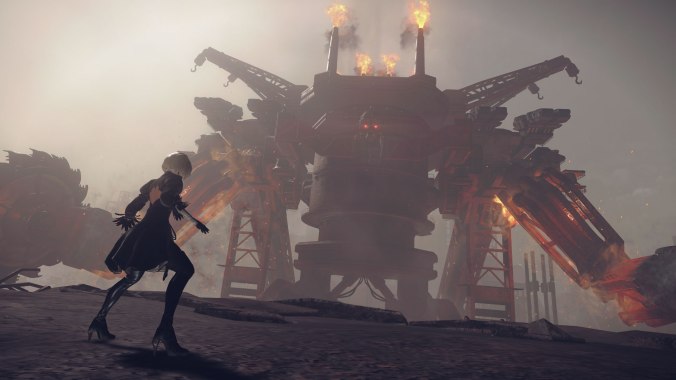
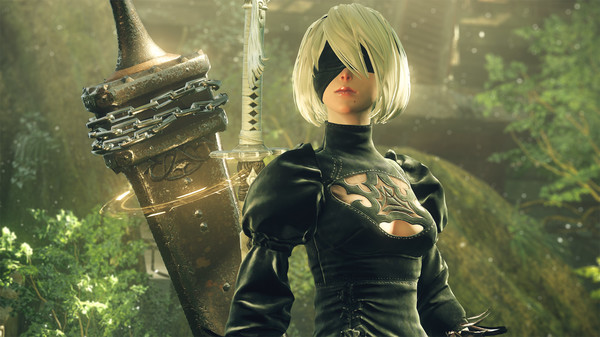
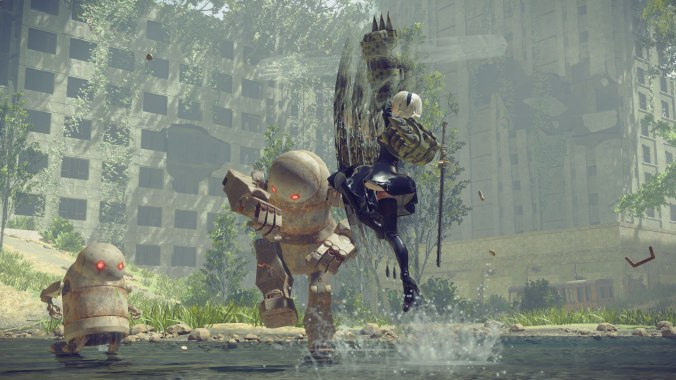
NieR: Automata is the story of a war, not between humans, but between androids and machines. Androids were created by humans, while the machines were created by alien invaders to wipe out mankind. Androids were made to imitate humans, in both physical appearance and in how they act. The machines look more like robots and seemingly are not capable of individual thoughts or emotions. You play as the android 2B who is assigned to fighting the machine forces alongside her partner 9S. 2B and 9S quickly realize that the machines have begun to imitate human behaviors and seemingly developed a consciousness. Throughout the game 2B, 9S, and the machines struggle with existentialist concepts.
7

The world of NieR: Automata is filled with philosophical questions and concepts. The androids and machines frequently question their own purpose and why they exist in the first place. Both in the main story and in side quests the machines and androids have troubles coming to terms with their existence. Interestingly enough, many of the side quests drop hints and introduce you to the concepts before the main storyline runs with these ideas. When the machines develop their own thoughts and freewill, many lose their purpose. The machines find human records and start imitating the info that they have found. Some develop a hobby and take it to an extreme, some form cults and kingdoms, others form villages and settlements. The biggest question asked is are these machines and androids really alive, and is their consciousness real, or just a program? Other questions are posed, for example if we lose our memories, are we still the same person? These are just a few of the questions posed, many more are touched on but you really should experience them for yourself.
6

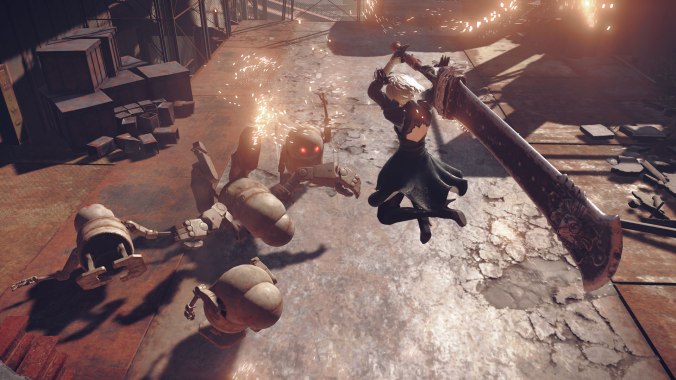
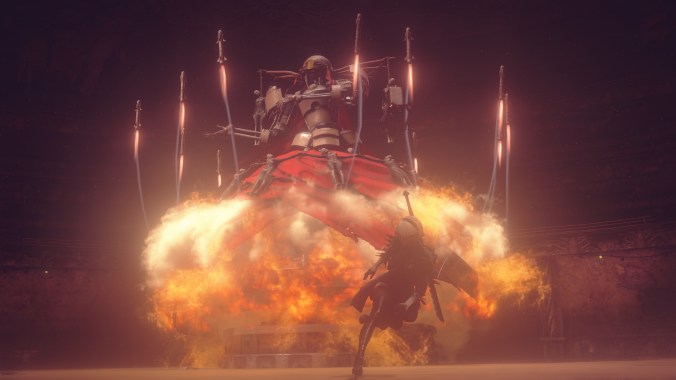
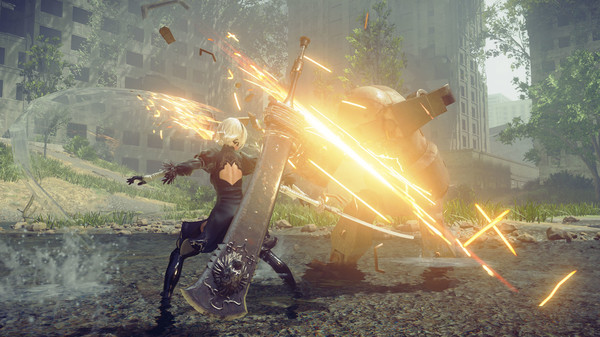
The gameplay of NieR: Automata is fast paced action. It takes a little while to get a hang of the controls, but it is extremely satisfying and fluid once you get used to it. 2B can select two weapons to fight with and string combos together with. You also have access to pods, which are floating robots that you can use to fire a steady stream of bullets at the enemy. Pods also have special abilities like lasers, bombs, the ability to slow time, etc. that the player can use to their advantage. On top of that, you can customize your plug-in chips to give you stats like more damage, healing, speed, among other things. You can even take out elements of your heads up display (HUD) to make room for more combat oriented plug-in chips. All of these elements made for a completely customizable experience with infinite options. You can play with all sorts of different combo options to really step up your game. Unfortunately, for the most part you did not need to learn many combos, I only needed a few basic combos to beat the game. That being said, there is a lot of room for just playing around and testing out all sorts of different moves. Most of the basic enemies in the game were just fodder and easy to defeat, but the boss fights were truly epic and intense, especially as you learn the backstory for the bosses that you are fighting.
4

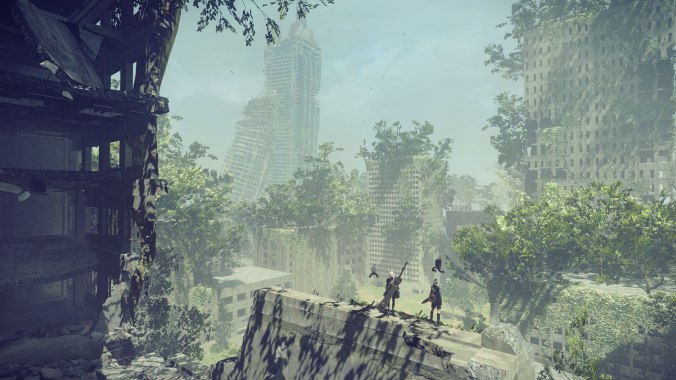
The environment of NieR: Automata is that of a post-apocalyptic planet earth. Most areas reflect this and are bleak, like the city ruins, the desert, and the factory. On the other hand, some sections of the world are beautiful and thriving. The forest and the amusement park are quite elegant. Another interesting aspect of NieR: Automata is the lore. It is technically the next installment of the Drakengard series and it is the sequel to the original NieR. Trust me, you do not need to play those games before playing NieR: Automata. This game is set so far in the future that all that remains of those games are occasional references. That being said, there is a ton of extra lore in the Drakengard and NieR universe. Both in the game and out, there is lots of extra tidbits that you can find. In game, you can find intel which references the past, and out of game there are concerts, books, and stage plays that expand upon this world. This game strikes a nice balance; it is both accessible for newer players, and it allows for more dedicated players to get more info. Something that needs to be mentioned when talking about NieR: Automata is the original soundtrack. It is without a doubt one of the best soundtracks ever created for a video game. It is mostly classical music, but it has a mechanical theme that is evident. The melancholy tone of most of the songs fits the game perfectly. The songs are incredibly memorable and instantly recognizable once you have played the game. What is really cool about the soundtrack is multiple versions of every song were recorded and used so that they blend together seamlessly according to the environment and situation. If you want a taste of the soundtrack, take a listen to this: “A Beautiful Song.” I rarely listen to video game songs outside of the games, but I now often find myself listening to many of the songs from NieR: Automata.
3

The structure of NieR: Automata is incredibly unique. Many modern games have an option to start a New Game+ mode after beating the game. This usually entails a few harder enemies and some new content, but it is mostly the same game. NieR: Automata takes the concept to the next level. There are five main routes in this game, labeled A-E. When you first finish route A, the game prompts you to continue playing as there is more content in the game. This is not a traditional New Game+, route A is only a small portion of what NieR: Automata has to offer, and it would be a shame if anybody stopped playing after beating it. Each route is more like an act of a play or book rather than a full game. You play as different characters to gain different perspectives and different combat options. Routes A and B feel like just a prologue to the story told in routes C, D, and E. Routes C, D, and E are all the same route, just different endings. Once you beat C, you get to play the final sequence again and that is route D, and once you beat D you get to play the final ending, which is route E.
1

Route A introduces you to the world of NieR: Automata and lets you get comfortable in it. It asks you basic philosophical questions and sets up what is to come next. The biggest development in route A is the characters.  Aside from the main characters of 2B and 9S, there is a large cast of side characters, android and machine alike. Many of the machines are quite charming and funny as you get to interact with them. Watching the machines imitate humans by forming families, raising children, and making their own society was very cute. The story of route A is decent, but is obvious that you are missing some pieces to the puzzle. Route B tells the same story as route A, but from the perspective of a different character. This different perspective shows you the story in a separate light, and more facts slowly trickle in as you piece the story together. Routes A and B were certainly great, but the real story is told in routes C, D, and E. These routes are a continuation of the story from A and B, and the game fills in all the holes and answers the questions from the previous routes. The game constantly challenged my pre-conceived notions and changed what I thought. There is so much going on at such a fast pace, just as you are trying to process one big reveal of information, the game hits you with another. Routes C, D, and E have some of the most emotional and impactful moments that I have ever received from a video game. I would wager that these three routes are some of best experiences in any video game, ever. It is truly a thought-provoking adventure, and it is something that you really should play for yourself.

5

While I love NieR: Automata, it does have some issues. The combat is fluid, but after a while it can get a little repetitive. While many of the side quests are interesting from a story perspective, they often boil down “go over there and fetch me this item.” They can be tedious chores, but they are mostly worth it to learn more about the characters. The hacking mini-game is pretty fun once in a while, but I feel like it is overused and can get boring and repetitive. The PC port of the game is poorly optimized and needs work, I recommend getting this game on PS4 instead of PC. My biggest issue with NieR: Automata is routes A and B. Route A would be alright as a standalone game, but it would not be anything special. Route B can get pretty repetitive as it is essentially the same as route A, the new information delivered in this route is too few and far between to make it distinct and different enough from route A in my opinion. While I know that they are just the prologue for routes C, D, and E, I feel like many players missed the memo. I think labeling them “acts” instead of “routes” may provide a big enough distinction to show players that the game has just begun. Along with that, I feel like if routes A and B were somehow combined they would be much more enjoyable and comprehensive experience. They are fine on their own, but are pretty slow paced when compared to route C, D, and E. If you combined them I feel like route A would be a more complete experience with the extra info from route B added, and you would not have to play same story twice just to get a little more info. Looking back on it, I am fine with the way that the game is structured and I understand the purpose of routes A and B, but as I was playing the game I had a different perspective. I enjoyed the game, but I did not understand what made it so special until I made it to routes C, D, and E.
8

I have to say, NieR: Automata has become one of my all-time favorite games. I think it will become a classic title, especially in nerd and gamer culture. The fluid combat, the memorable characters, the desolate environments, the music, the philosophical nature, the melancholy tone, and the unforgettable story truly make this a game worth playing. If any of this sounds appealing to you, definitely pick up this game. I think that is unfortunate that many players stopped part way through routes A and B, as they did not get to really see what made this game so stellar. If routes A and B were combined, I would have no problem calling this game a masterpiece. For these reasons, I give NieR: Automata a 9.5/10. Routes A and B are not quite strong enough, and many players did not see the game all the way through to the end because of it. NieR: Automata is a truly phenomenal game, and it will be remembered as a truly special game.
ABZÛ (2016)

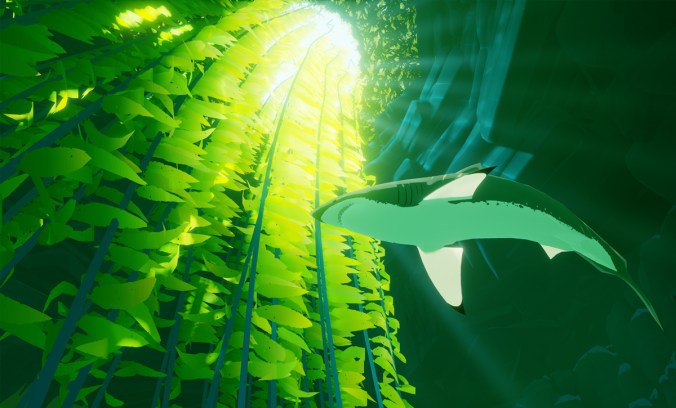
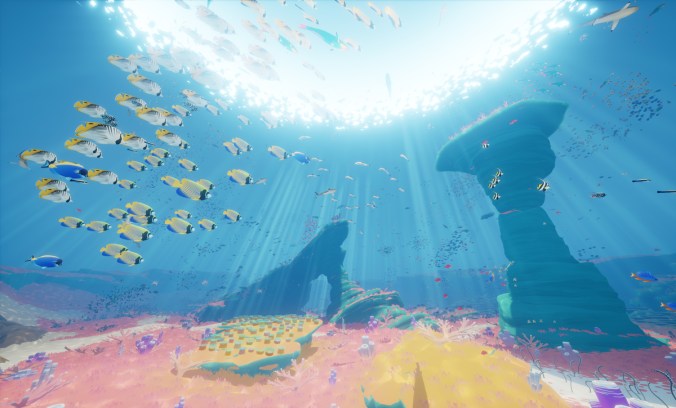
Abzu is the type of game that you will want to sit down with after a long day, turn the lights off, and just relax while playing it. Abzu is an underwater experience made by the developer Giant Squid, who’s founder was the art director for the critically acclaimed games Journey and Flower. While deep sea environments can be dark, disturbing, and unsettling, Abzu manages to achieve the exact opposite. It is a zen-like experience to explore the world Abzu.

Abzu1

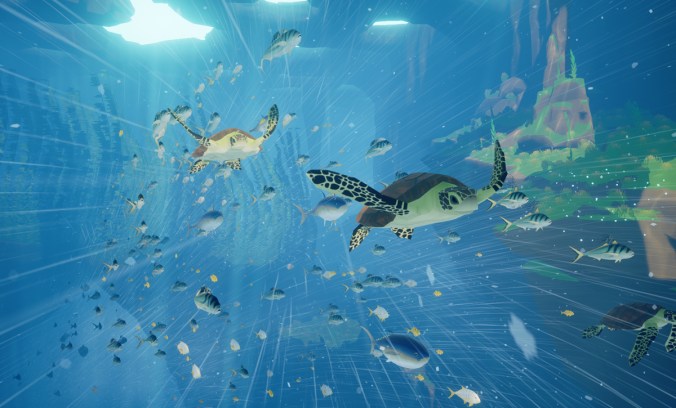
The majority of the gameplay in Abzu is just swimming and exploring the ocean. There are a few puzzles, but they are remarkably simple. Abzu is all about exploring the beautiful unknown, and restoring life and vigor to dying sections of the ocean. Many games with underwater sections often struggle with the controls, but the controls in Abzu are very smooth and easy to get a hang of. There is a vague story told through the environment, but that takes a back seat to the meditative nature of Abzu. Just sit back and chill while hanging out with sea turtles, whales, sharks, and various species of fish. This game is absolutely visually stunning and it creates remarkable atmospheres to be appreciated. The orchestral music in the game enhances the feeling of wonder and discovery as you swim through the underwater landscapes. Abzu is more of an artistic experience than a traditional video game.

abzu2

While Abzu is gorgeous and easy to relax while playing the gameplay is lacking at times. There are eight chapters in Abzu, I was okay with the fact that the first two chapters served as just pure relaxation and discovery, but chapters three and four were just more of the same. The game is only about an hour and a half to two hours, and the first 45 minutes were all very similar and repetitive. Luckily the game picks up a bit in the last half and ends strong. The middle section of the game was just slow, after 45 minutes of swimming around and appreciating the environment, I was ready to move on to something more interesting. That portion of the game just overstayed its welcome a tad too long in my opinion.

abzu3

Abzu is not meant to be a traditional video game, it is more a visual presentation of the beauty of the ocean. If you are looking for action, deep gameplay, or story, you will not find much of it in Abzu. If you just want to sit back and relax for an hour or two, Abzu is the game for you. For what it was, Abzu was a pleasant and memorable experience. I am going to give Abzu a 7/10. It is not groundbreaking or revolutionary, but it was definitely a worthwhile experience.

Limbo (2010)

Limbo is a puzzle-platformer from the Danish independent developers: Playdead. The game is dark, mysterious, and horrifying. A young boy is tossed into a hostile world, and the player must navigate deadly puzzles and environments to escape. I thought the gameplay was alright, but it did have quite a few issues in that department. However, Limbo really shined in its atmosphere and its visuals.

limbo-2

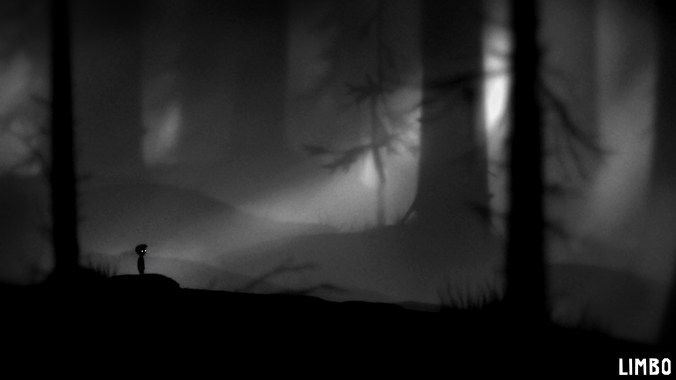
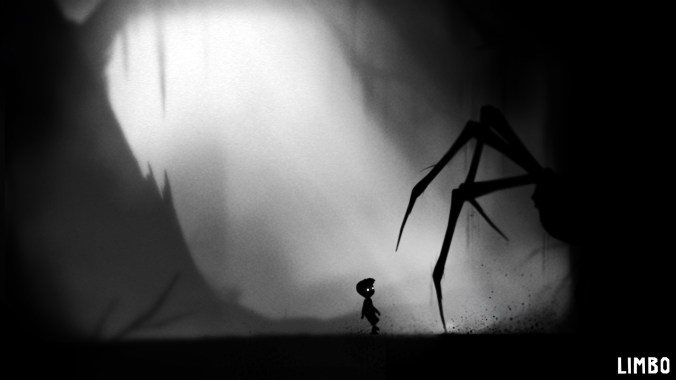
I quite liked the unique art direction in Limbo. The entire game is made up of black and white silhouettes and it solidifies the dark and dingy atmosphere. The world’s hostility is apparent from the start: everything is trying to kill you. Giant spiders, terrifying machinery, mind-controlling parasites, and other children are all trying to hunt you down. There is no music, only ambient sounds that could send a chill down your spine. Watching your character get impaled by a giant spider and flung across the sky just about sums up what this game has in store for the player. The atmosphere and visuals melded into one creepy and disturbing experience.

limbo

The gameplay of Limbo fell a little flat in my opinion. It was a puzzle-platformer, but neither the puzzles nor the platforming were really anything special. The platforming required quite a bit of precision, which is fine, but the character himself is quite awkward so it can be difficult to judge what jumps are possible and what jumps are not. The puzzles had a decent amount of variety which I enjoyed and there were quite a few great puzzles.  Unfortunately, most of the puzzles just ended up being trial-and-error. Often times the puzzle boils down to: “What does this switch do? Oh, it kills you unless you move that box to a specific location beforehand”. There was really no way of knowing how to solve many of the puzzles without dying first. This was really unfortunate as the whole atmosphere of the game was supposed to be disturbing and horrifying, which it was until I figured out that I just needed to run head first into everything and die to make any progress. Things tend to be a lot less scary when they go from “Oh god how do I stop this from killing me?” to “Well I have to let it kill me before I can see the solution”. Luckily, there were plenty of well-placed checkpoints that kept deaths from heavily impeding on progress. The other issue I had with the gameplay was it was just… slow. The main character walked slowly, death scenes (as plentiful as they were) were drawn out, and a large chunk of the game was just pushing around boxes and climbing ropes.

Overall, I think Limbo was alright. For a quick three to four hour game, it does a great job of setting the mood and being memorable. Thanks to its art direction and its atmosphere, Limbo was certainly unique. There is also a sort of beauty in the game’s overall simplicity. I just wish the gameplay held up a little bit better. If you are into moody and dark games, then I would definitely recommend Limbo. If you are looking for great puzzles or platforming, I would look elsewhere.

Firewatch (2016)

Firewatch is an indie title developed by Campo Santo. It is set in the Wyoming wilderness and the main character, Henry, becomes a fire lookout. The game revolves around its beautiful scenery and compelling narrative instead of gameplay and action. I was nervous about how good the game could be when the only real gameplay is just walking around in the wilderness, but I believe it worked out alright. I am going to try to avoid spoilers in this review, as the story is all that this game has and it would be a shame if I were to ruin it for somebody.

The game is about the main character, Henry, and how he isolated himself after his wife develops dementia. He becomes a fire lookout in the middle of a national park, and his only form of human contact is talking with his supervisor, Delilah, over the radio. As the player walks around the park doing mundane tasks you are constantly in conversation with Delilah. The dialogue is witty, humorous, sometimes somber, and most importantly it all feels real. Many games struggle in this regard, conversations often feel robotic, but not in Firewatch. The conversations that the player has could actually happen in real life, and this aspect is further strengthened by the excellent voice acting. As time passes in the game Henry and Delilah stumble upon a mystery and they take it upon themselves to unravel it. Overall this was very compelling and kept me hooked the entire time. The mix of exploring the wilderness, conversing with Delilah, and pondering the mystery kept my brain busy.

Though the narrative and story-telling is where Firewatch shone through, there were also a fair amount of issues with the game. The controls were a bit clunky and tough to get used to, and the game was inconsistent when it comes to what you can traverse and what you cannot. Sometimes you can climb up giant rock faces, other times you cannot even step over a pebble, this occasionally got frustrating as I explored the park. While these issues were minor, there were much bigger problems. Although I really liked the narrative, I wish it was tacked onto more actual gameplay. Firewatch plays itself: you cannot do anything wrong, all you do is walk around, and none of your choices matter. I just want a little more sustenance, because it felt like I was watching a TV show or movie instead of being an active player in the game. My other big issue with the game was the ending. I was extremely disappointed in the way the game ended. I know the old cliché “It is about the journey, not the destination”, but in this case I felt the destination completely invalidated the journey. It felt like the entirety of the game was building up many different plot lines, but most of them just went nowhere. The ending just left a bitter taste in my mouth, after completing the game I was left thinking “That’s it?”

If you are intrigued by the aspect of just enjoying the scenery and narrative of a game, then Firewatch is a great game for you. Unfortunately, if you want anything more than just walking around you are going to be disappointed. Also, if you are planning on playing this game, just prepare your self to be let down by the ending. All in all, I did enjoy Firewatch despite its shortcomings and I thought it was a neat little game. I am going to give Firewatch a 6/10. Its narrative and story-telling are top-notch and other developers should attempt to model it. I just wish there was a little more to this game.

Owlboy (2016)

I have to admit that I am a sucker for indie games, metroidvanias, and pixel art. Clearly Owlboy was made for me, as it has all of these elements and more. This game was a highly anticipated indie title as it has been development for nine years and I was curious to see how it would turn out. I was more than pleasantly surprised, from the first moments I was gripped by the polished and charming visuals, as well as the heart-wrenching tale of Otus. The unique combat and movement systems were a boon and kept me engaged throughout the course of the game.

owlboy1

Owlboy had a very interesting take on combat. Otus, the main character, is an owl and as such he cannot fight enemies by himself, but he can fly. He enlists the help of his best friend Geddy, a human mechanic and soldier to help him fight enemies. It felt extremely smooth and natural to carry Geddy around and both aim and dodge enemies at the same time. Otus also recruits a few other unlikely friends to join his ragtag band of heroes; all of these characters have unique combat mechanisms and utility to allow Otus to access different parts of the world. At first I was worried that carrying around these different characters would become tedious, but it was extremely easy to get a grasp on how the combat worked. Controlling Otus was a blast and his variety of movement options led to some entertaining fights as I dipped and dodged hordes of enemies.

owlboy2

The dungeons in this game were fun and they all had unique concepts and ideas that made them enjoyable. I do think that they did seem to run on a bit too long and got a little repetitive at times, but for the most part they were very well designed, especially the boss battles. I absolutely loved all of the boss battles in this game; they were all fast-paced, challenging, unique, and intense.  Having the ability to fly seems like it would make any platforming non-existent, but that is not true. The game is cleverly designed to have challenging platforming sections despite being able to fly. There are also some stealth sections to add some flavor and variety to the game.

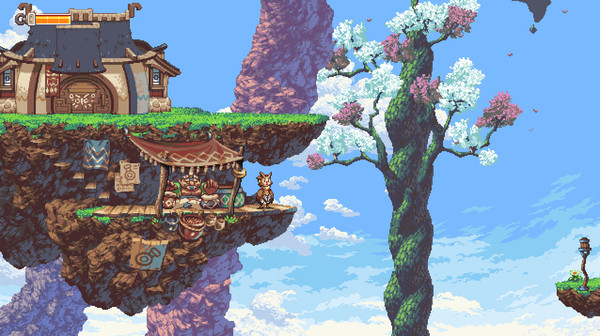
The gameplay was fantastic, but that was not the only thing that kept me interested in Owlboy. The hi-bit style of pixel art was masterfully done and it led to some beautiful visuals. There seems to be a trend in indie games to have great soundtracks, and Owlboy is no exception.  Calming and relaxing songs to match the aesthetic of Otus’ home of Vellie, and intense songs to match the high octane boss battles.  I was also very surprised by the quality of the story. Very few games manage to leave me wondering and interested even after the game has ended, but Owlboy did precisely that. Throughout the entire game there is an air of mystery, but not until the end of the game did I realize the scope of these small hints and mysteries. The game’s story is not that interesting in the beginning, but it is setting up and alluding to the wonder-inducing ending.

owlboy3

The world of Owlboy is also very well crafted. It does not take long to travel from one point to another and every section of the world has a distinct feel to it.  I only wish that there was a map of the overworld to see how the world really comes together. I did not have a big problem with this because I have been navigating metroidvanias for years, but some players might be thrown off by the lack of a map. In a game that constantly revisits areas and branches out in many different directions I could see how it may be confusing to some people. There was also a couple of interesting side-quests to play and enjoy, the Boguin Cannon in particular was very fun. The characters in Owlboy were also interesting and were memorable. Even characters that I did not like at first grew on me. The game has a consistent motif of friendship that drives the story and adds to the lovableness of certain characters. The game also was plenty silly and funny, there were many moments that had me smiling. The silliness, backstory, and characters of Owlboy and its world is certainly interesting and worth the time.

Owlboy also has plenty of collectibles, in the form of coins. I genuinely enjoyed collecting the coins scattered across the world and reaping the rewards in the form of trinkets. Trinkets could be health increases, goofy hats, or upgrades for your partners. The upgrades were definitely powerful enough to warrant spending time collecting coins to unlock these power-ups. My only complaint is that some of the coins were hidden in really strange spots. Invisible passageways in walls meant that if you want to collect every coin you are going to need to run into every wall, ceiling, and floor in the game to see if there are any hidden hallways. Granted, most of the coins were pretty easy to find and you can get most of the rewards in the game just casually collecting the coins. There were also three Golden Disks which unlock a very interesting secret at the end of the game. I will not spoil anything, but it is 100% worth it to look out for those Golden Disks.

owlboy4

Owlboy has so many elements that I love, and it was one of my favorite games that I have played this year. If you enjoy indie titles, hi-bit pixel art, metroidvanias, lovable characters, and mysterious stories I definitely recommend this game. I am going to give Owlboy a 9/10, it was excellent and I loved every moment of it. Do not hesitate to pick up this title as it is an absolute joy to play and experience.

Wolfenstein: The New Order (2014)

Wolfenstein: The New Order is a continuation of the classic shooter franchise. I have not personally played any of the other Wolfenstein games but I was able to easily jump in as the game was somewhat of a reboot for the franchise and built a new story. The game was solid and had plenty of qualities that I really enjoyed but there were also a lot of flaws in this game. I have played a lot of first person shooters (FPS) and this game attempts to differentiate itself but falls just a little short of creating an entirely new experience. The basic premise of the Wolfenstein games is that the main character, William Blazkowicz, is an American soldier fighting the Nazis. This installment of the franchise takes an interesting twist where the Allied powers lose the war and Nazis now control the world. The story was, in my opinion, the strongest portion of this game.

I was very surprised at the strength of the story in this game. The first thing that surprised me was how quickly and without hesitation the characters are killed off. It always seemed ridiculous to me that in other FPS games how infrequently characters actually died, but this game is not afraid to do so. The story starts off very depressing and makes the player make a difficult choice and at the same time builds up the villain, General Deathshead, to be one of the most evil and sadistic character  in any game. I usually do not feel such hatred for a character, but the game really did a fantastic job at actually making me want to kill the villain. Despite starting strong, I feel like the game is unevenly paced in which most of the story is packed in the beginning and the end of the game. The theme of the game was pretty unique, as it was futuristic and had plenty of advanced technologies but it did manage to keep the gritty feel of World War II. I do not want to spoil anything, but the ending of the game was a bit open ended and I feel like it tries to set up a sequel. On one hand this is a good thing as it leaves you wondering, but on the other hand some people could see it as a cop-out. Most of the major characters are fleshed out well, and the game does give you some small character biographies if you want some more information on any character. Also, there are two alternate timelines in the game that make very minor changes in the story and gameplay. I like this feature as it allows people to replay the game but have a slightly difference experience, but everyone who plays the game is going to have a very similar experience regardless of which timeline they choose. Overall I felt like the first couple missions and the last couple missions had phenomenal story telling but I just wish that the middle bits were also as strong.

The gameplay I also felt mirrored the story in which it started strong but faltered around the middle chapters. While the first thirty minutes of the game are slow and serve as a tutorial, once I began the first mission I was sucked in. The game gives the player four different ways of tackling it and has different perk trees to reflect these choices. While perk and ability trees are not a unique concept, what was interesting about this game was that the perks were not earned through experience or just giving you a skill point to distribute into whatever perk you want, but instead they were achievement based. For example if you stealth kill five commanders you get a perk that reveals the location of all the commanders on the map. I really liked this system as it gave me alternate objectives and tasks during missions as I attempted to complete the main goal. There are four different perk trees, Stealth, Tactical, Assault, and Demolition. Stealth was based on sneaking up behind enemies and taking them out silently. Tactical was about smartly engaging the enemy from a distance and from behind cover. Assault was just DOOM style running and gunning. Lastly, Demolition was all about using explosives to clear spaces. This mix of gameplay options led to some epic moments, for example when I snuck up behind a commander and stealth killed him, then took over the mounted mission gun and mowed down the rest of the enemies from behind before they could react. Unfortunately I felt like there were too many missions that limited all the options that there were supposed to be. Some of map designs felt really lazy and linear, making a lot of missions play out like every generic FPS where I entered a room, posted up behind some cover, kill all the enemies, rinse and repeat until the mission is over. Another issue was the lack of ammunition, there was a plethora of different guns and tools at my disposal but the only guns with reliable amounts of ammunition to find were the Assault Rifle and the Laserkraftwerk. Despite the fact that some missions were limited in the options to tackle it, there were also a lot of really well designed levels that had many different pathways that allowed me to use a mix of the perk trees. Chapters 1, 2, 3, 8, and 13 are in my opinion what the rest of the game should have been when it comes to level design. All five of those missions were very entertaining and allowed me to use a mix of all the different tactics.

Apart from the five fantastic chapters, the rest of the levels were either just too linear or just blatant filler. Chapters 5, 7, and 9 were the most obvious examples of this and they should have just been cutscenes instead of full chapters. All three chapters play out in a very similar fashion and really serve no purpose at all, there are no enemies to fight, no stealth, no puzzles, just walking around to pick up some random item. Some of the other chapters also had some filler sections but these three missions did nothing but lengthen the game. This is really unfortunate because Wolfenstein: The New Order only has sixteen chapters so at least 18% of the game is just filler.

While the level design of the game left something to be desired, the difficulty scaling of the game felt just right to me. I played on the second hardest difficulty “I am death incarnate!” and while the game started off pretty easy it did quickly ramp up and provide some challenge. At no point did I feel like the difficulty was unfair or the game was asking an unreasonable task, but at the same time I knew that if I screwed up I would be punished for it. Unfortunately, a lot of the difficulty in the later stages of the game comes from the overwhelming amounts of “bullet sponges”. These are enemies that have a lot of health and required me to shoot at them for a minute of two to kill a single enemy. I feel like bullet sponges can be implemented properly, but they were not in this case. Since enemies have no health bars I could not even tell if I was damaging the enemies, and since I was shooting at some enemies for a couple of minutes I questioned if some enemies were even killable with bullets or if I needed to find another way to defeat them. Fighting these bullet sponges was occasionally entertaining as I needed to dip and dive out of cover to try to out maneuver them, but they are used way too frequently and there needed to be some sort of indicator that they were actually taking damage. Also, a lot of the enemies just felt inconsistent to me. Some enemies could not spot me when I was standing right in front of them, but I remember in one mission where I was hidden in a vent and a guard twenty feet away spotted me while facing the other direction. Despite the amount of bullet sponges and inconsistent enemies, I really enjoyed the two late game boss fights. Both fights had a cat and mouse feel to them and they did not drag out to long like a lot of video game bosses do. All in all, the difficulty was solid and while it was challenging, it never felt unfair.

The last thing about Wolfenstein: The New Order that I want to talk about is the collectible system. I am somebody who loves getting all of the collectibles in a game, and this game had plenty of them, but I did not get even close to getting all of them. The game has the weird system in which it reveals some of the hidden items locations on the map, but not all of them. So if I wanted to find all of the items I would have to comb the entire map and break open every box and look in every cabinet for items that were frankly tough to spot. I do not mind if the collectibles are hidden and do not show up on the map, but they should at least be easy to spot if that is the case. Despite this issue I really did appreciate how many things there were to collect if the player chooses to do so.

I did not expect much when I first started this game, but it certainly did surprise me with the first couple of chapters in terms of the strength of the gameplay and the impact of the story. If these aspects were carried out through the rest of the game it would have been a phenomenal game, but it does fall flat in the middle, has too much filler, and it has some smaller gameplay issues. For these reasons I give Wolfenstein: The New Order a 6/10. It was extremely fun, engaging, and emotional for a couple of chapters; I just wish that the entire game was like that.