Astro Bot is a game for people who love gaming. Not only is it a technical marvel, but it lives by the ethos that games should be fun. While I personally love experimental and mature games that toy with inspiring other emotions such as rage or sadness, the unbridled joy that Astro Bot brought me reminded me of playing games as a kid. It’s reminiscent of all-time greats such as Super Mario Galaxy. It’s a modern day classic that I’m already eager to revisit in a few years’ time.
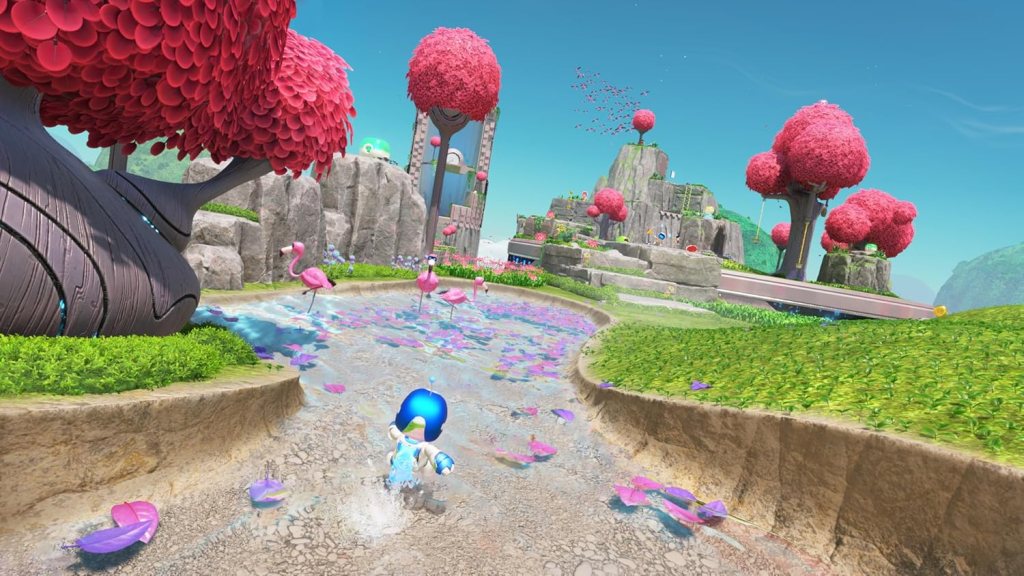
Astro Bot starts with your Playstation-shaped spaceship being destroyed by an alien and having all your robotic allies scattered across the universe. You crash land on a barren planet and have to visit different galaxies and planets to rescue the little bots and repair your spaceship. Each level plays out as a fairly linear course-clear style stage with hidden collectibles scattered about. Astro Bot clearly takes inspiration from Super Mario Galaxy with its approach to level design and reliance on interesting power-ups.
Most levels are a straightforward 3D platforming affair, but there is almost always a power-up or gimmick to keep things fresh. My favorites include the mouse backpack that lets you shrink and explore the nooks and crannies of the level, goggles that let you briefly slow time to avoid speedy obstacles, and a chicken jetpack that blasts you skyward at dizzying speeds. There’s a ridiculous amount of creativity on display in the levels. Each one is like a giant set piece with fantastic theming and spectacle. Whether it’s freeing chained-up starfish, jumping into the mouth of a giant singing tree, or hunting for treasure in sandy villages and stumbling on a Djinn in a lamp, Astro Bot is absolutely brimming with memorable ideas and I don’t want to spoil too many surprises.
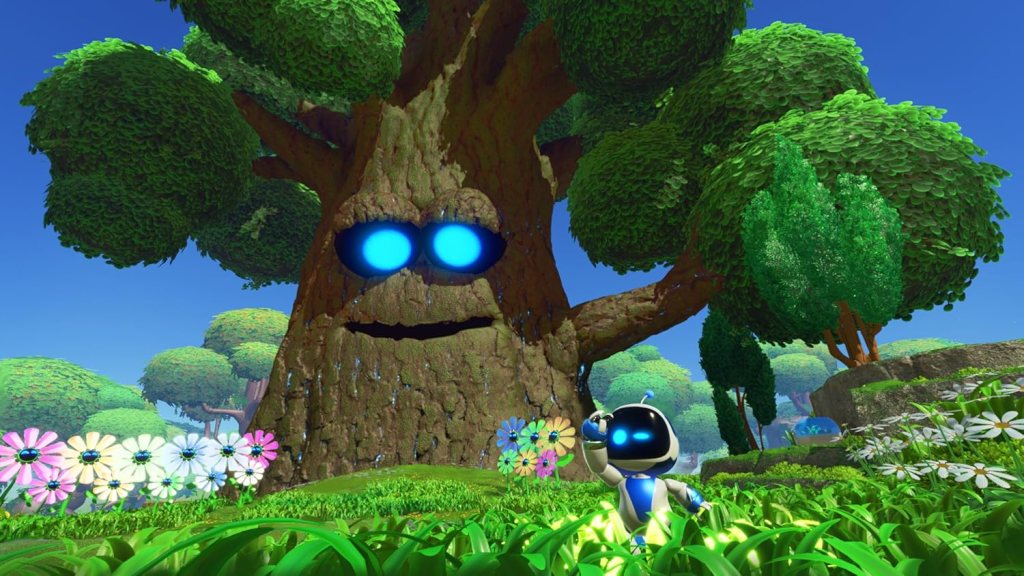
Not only are the levels filled with spectacle, but there is also an unparalleled attention to detail. The developers had a penchant for showing off the physics on tiny objects. Levels are filled with things like acorns, confetti, gems, bolts, and other objects that move seamlessly as you wade through them or forcefully launch them. The game also frequently has destructible environments and set pieces that show off the sophisticated physics. The sound effects as you move about on different surfaces is sublime. Astro Bot makes fantastic use of the PS5 controller’s haptic and audio feedback to really immerse the player. The rain effect in particular is very slick.
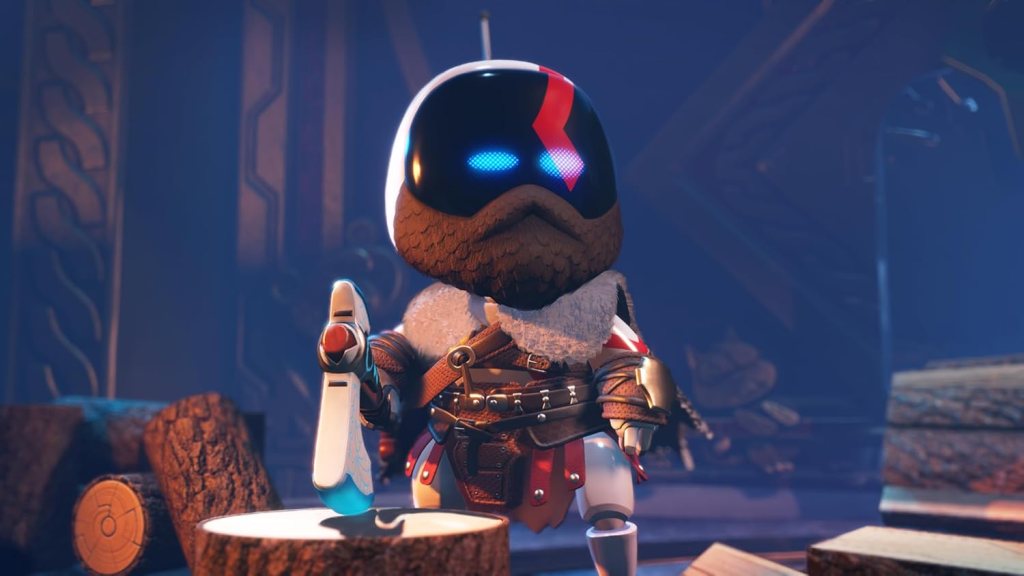
I love collectathons and games with a good hub world, and Astro Bot combines those aspects brilliantly. As you play levels you will be rescuing little robots who will come back to the initially barren crash site. Many of these bots are cameos from classic Playstation games, but they don’t feel like cheap references. Many of the references are fairly obscure and even I had trouble recognizing some of them. But aside from the referential costumes every character has their own comedic blurb that makes it seem like the developers of Astro Bot actually played these games and aren’t using them as cheap references. Furthermore, you can spend coins you collect to acquire accessories for the bots. For example, you can get a cardboard box for the Solid Snake bot to hide underneath. I quite enjoyed walking around the hub world and taking in the characters and scenes from Playstation’s past. It feels like a love letter to gaming.
The one fault I have with Astro Bot is perhaps not a fair one. Because comparing any game to Super Mario is putting it up against the best of the best. But Astro Bot is clearly Playstation’s version of Super Mario, so the comparison is necessary. The main character, Astro, doesn’t have nearly the same movement complexity that Mario has. Astro can run, jump, punch, spin, and briefly hover using lasers. But it doesn’t feel like there is anything to master. I remember playing Super Mario Sunshine a bunch as a kid and trying to master my control on momentum to backflip, wall jump, and hover up to ledges that seemed out of reach. Mario’s moveset is far more complex and the reliance on momentum allows for more mastery for advanced players.
While the movement is simpler, I do think the game benefits from Astro’s fragility. Getting hit once will reset you back to the latest checkpoint. The level design and simple movement lend themselves to a fairly laid-back experience, but you still have to be careful. The game is fairly easy, but it has an edge because a single mistake means death. There are some challenge levels and gauntlets that are decently difficult. Overall, I think the difficulty was tuned quite well for being a family-friendly platformer.
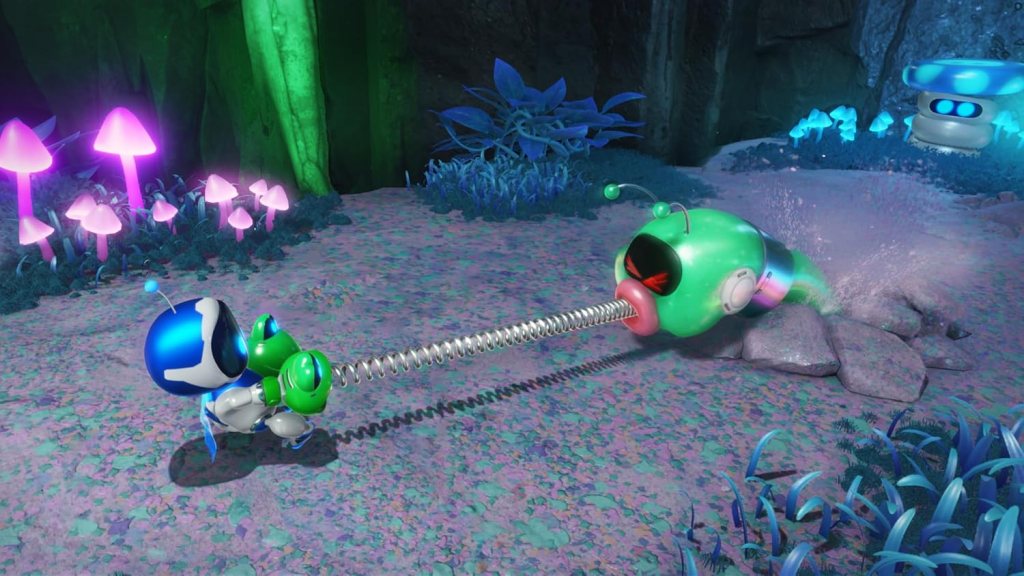
While playing Astro Bot I really didn’t want the experience to end. It’s an absolute joyous adventure that celebrates gaming and the philosophy that games should be fun first and foremost. While Sony has recently focused on more mature storytelling games, I hope Astro Bot signals that there is still a space for polished platformers and collectathons. The variety of levels, attention to detail, spectacular power-ups, and love for older titles makes this a game nobody should miss out on playing. It is for these reasons that I give Astro Bot a 9.5/10. There’s no doubt in my mind that Astro Bot is a modern classic.
 stephensopinions
Pingback: Stephen’s Favorites of 2024 | stephensopinions