City builders are a genre all about optimization. Laying out districts and infrastructure in a logical manner is necessary to grow into a bustling metropolis. Terra Nil is labeled as a reverse city builder, you aren’t tasked with building sprawling cities. Instead, you have to cleanse a planet that has been ecologically destroyed. It’s not a game about careful planning or building, but of restoring the planet to its natural state which can be messy and unorganized. I liked what Terra Nil was trying to do, but I felt like it was missing something.
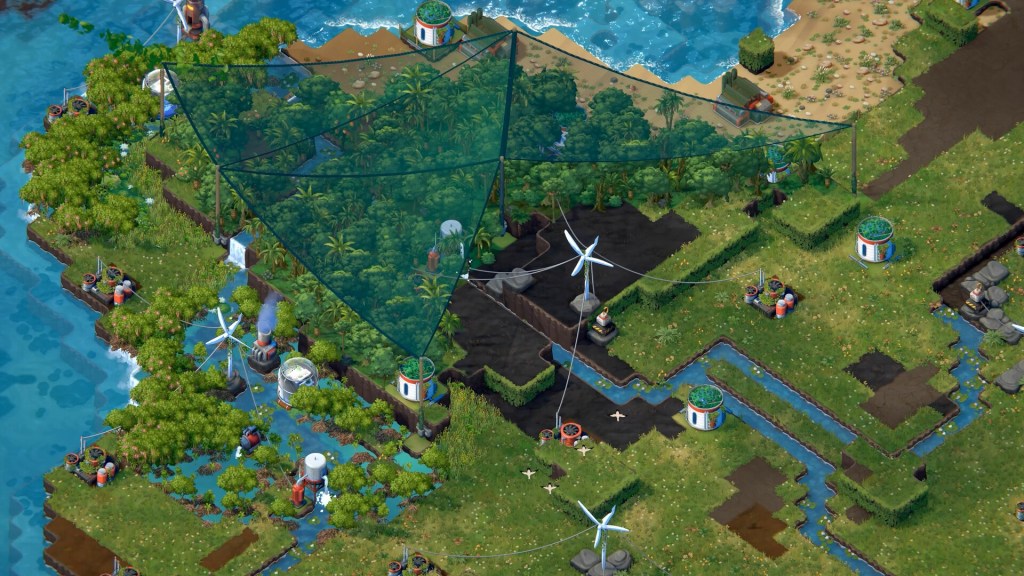
The concept of Terra Nil is superb. It not only is a game about cleaning up the devastation caused by humanity, but emphasizes this idea as a genre reversal of city builders. In city builders you often are searching for ways to optimize your city, exploiting every resource and inch of space that you have to support endless growth. But in Terra Nil you don’t have to be optimal. Everything that you build is a temporary fixture meant to restore the ecosystem and will be eventually recycled.
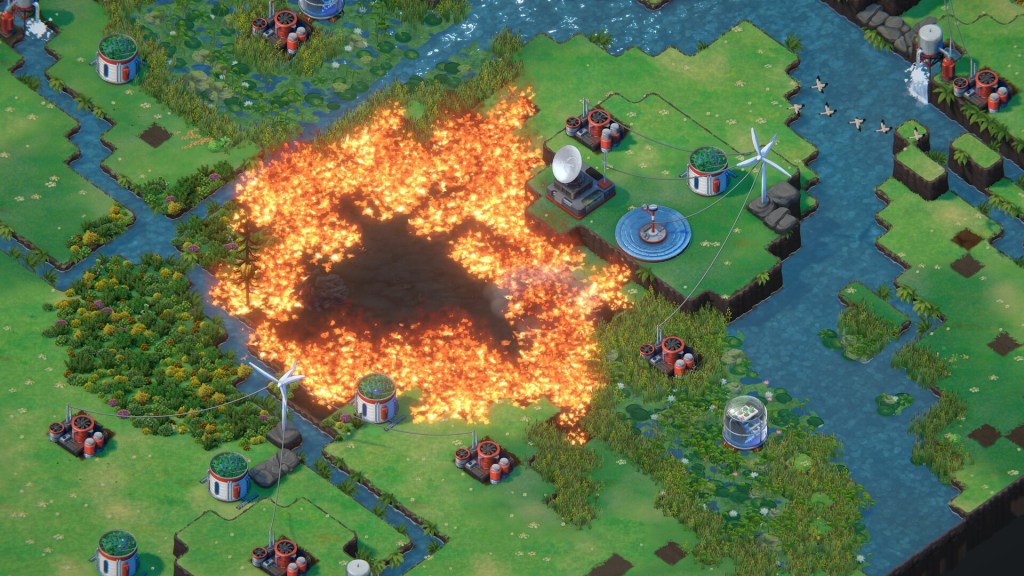
Restoring nature in Terra Nil comes in stages. When you visit an area, your initial goal is to generate some electricity through windmills and other renewable energy sources to power toxin scrubbers to rid the land of chemicals. The next stage is where things get more interesting. You begin to seed forests, rivers, wetlands, tundra, jungles, and whatever other biomes are appropriate for the part of the world that you are working in. There’s a bit of a puzzle element to this, as each biome has requirements to thrive such as needing certain levels of humidity, elevation, or access to water. Some even require you to do a controlled burn to enrich the soil before planting.
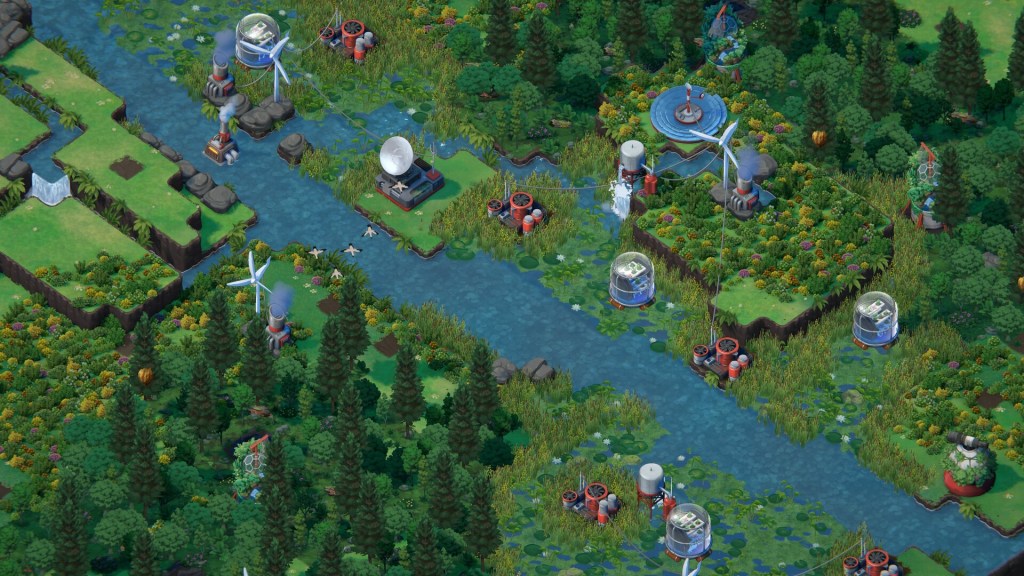
The biome planting phase is definitely where the game shines. You have a single resource: a pool of points to spend on buildings. You get additional points fairly rapidly as your biomes grow. Moreover, you get extra points for completing certain tasks like reaching certain temperatures or humidity levels through weather manipulation. I quite enjoyed these little side tasks not just because they gave points, but also because they had a visual effect on the world such as dragonflies and algae showing up in the wetlands. Rain is the first major milestone in any area as it cleanses any remaining polluted land. Watching as the desolated land slowly transforms into an ecological paradise of different biomes is immensely gratifying. It’s pretty simple but there are light puzzle and strategy elements to plan where you are putting the buildings and biomes.
Once your biomes have been created, identifying where wildlife can thrive is the next step. There’s a handful of species in each area that you are supposed to find, you have to scan small areas that match that species’ habitable requirements. I think this part of the game can be a little tedious as there is a lot of guesswork to figure out what each requirement is. It also can be a bit finicky even when you know the requirements as the radius of the scan is fairly small and it has a lot of trouble when certain species require multiple biomes or a food source. I loved watching animals be reintroduced to the ecosystem, but mechanically it was a bit unsatisfying.
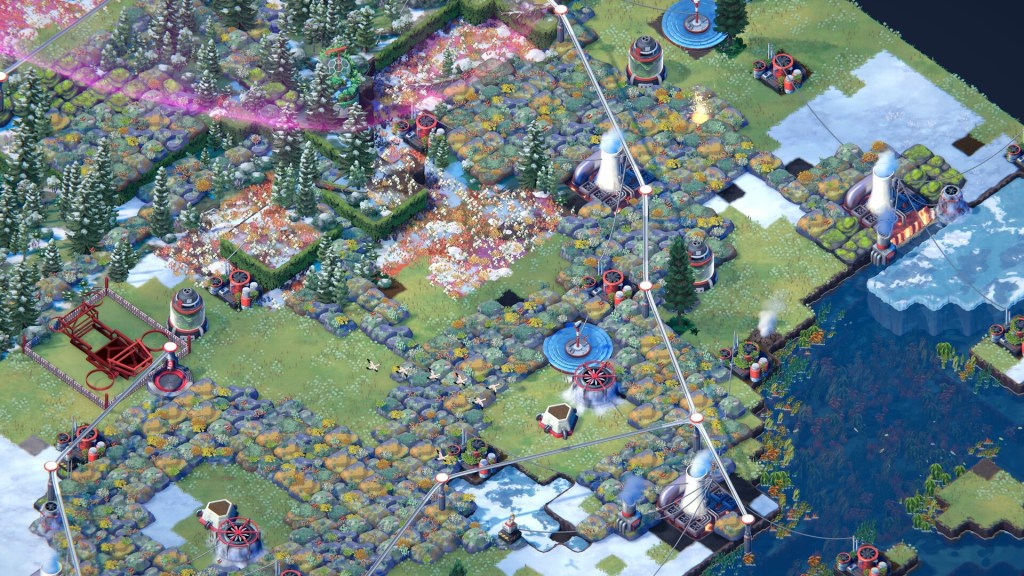
Finally, after you are done planting biomes and identifying fauna it is time to pack up and leave for the next area. You absorb every building into recycling pods and setup collection systems to pick up those pods. In some areas you set up pylons and ziplines that connect to one another and collect the pods from there. In areas with more water, you send out little drone boats that will pick up the recycling pods. It’s a pretty straightforward phase of the game. While I did like cleaning up after myself and fully getting rid of all the buildings to let nature take over, the recycling phase is mechanically just a little barebones.
Being mechanically simplistic is one of the biggest hesitations that I have with Terra Nil. Most phases of the game don’t require much decision making or problem solving, just following a series of predefined steps. The biome creation phase is definitely the most engaging part of the game as you have some decisions about how and where you will attempt to create the biomes. But every other phase is just… too rigid. I don’t think that it is an inherently bad thing to have simpler games. I understand that one of the design philosophies of Terra Nil is to be Zen. But I would’ve liked to see at least some more expression and decision making afforded to the player during the cleansing, fauna, and recycling phases.

That’s not to say the game lacks difficulty. I wouldn’t say it’s a challenging game, but it is possible to run out of points and fail in the 3rd and 4th zones. But once you get over the initial hurdle then you are simply playing out the scenario without much thinking needed. I don’t think the game needs to be more challenging, as it does offer different difficulty options and running out of points is a real issue in harder areas. But depth doesn’t necessarily have to be difficult, Terra Nil does lack depth.
While most phases of the game lack depth and freedom, I will say I was impressed with the variety provided by the different zones. There’re 4 main areas, each with 2 scenarios to play. Aside from having their own unique biomes and fauna, you have to contend with different methods of power generation and terraforming. You will be creating new land in the tropical archipelago, restoring glaciers in the tundra, and repurposing building foundations in decaying urban centers. Terra Nil is on the shorter side, but I am glad that they didn’t repeat the same ideas over and over.
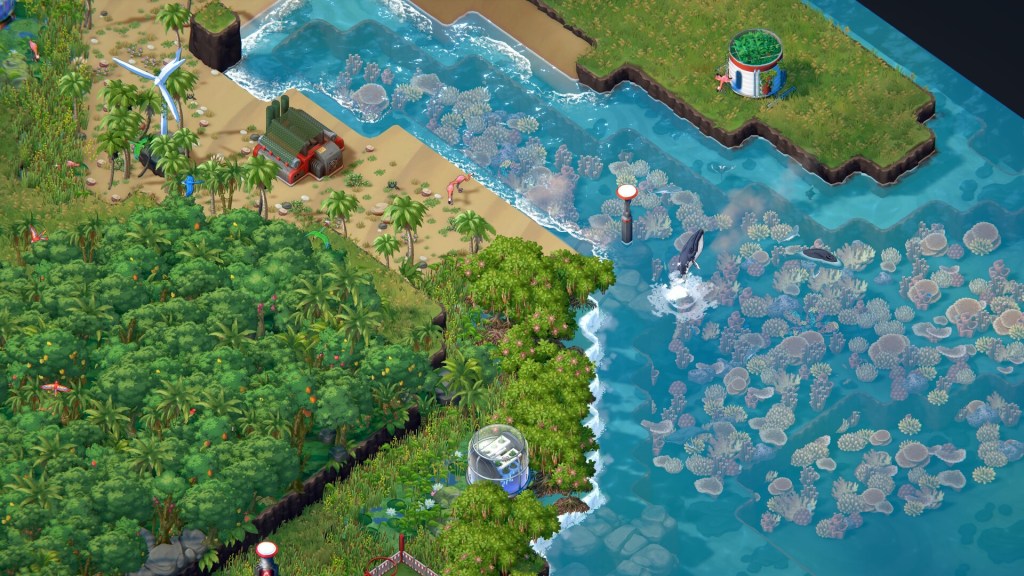
I played the game on the Nintendo Switch and while I was happy that it was available on the platform, I had some noticeable performance issues. Obviously, the Switch is not a computing powerhouse but I did not expect Terra Nil to require a powerful console. Loading screens took a long time, the game crashed once or twice, but the real complaint that I have is that graphical quality is just not great on Switch. This is not meant to be a complaint against Terra Nil, I just wish I knew beforehand that it had a major visual downgrade on the platform. Part of the appeal of the game is watching the beauty of nature as it blossoms, which didn’t look as crisp as it should have on Switch. I recommend getting this game on PC or a more powerful console for a better experience.
Terra Nil succeeds in being the Zen reverse city builder that it set out to be. City builders that demand optimization and ruthless resource utilization are fun, but I enjoyed seeing the reversal of that genre. The quick turnaround of desolate wastelands to thriving ecosystems was fantastic. I wish that most of the phases of that transformation were more mechanically engaging. It is for these reasons that I give Terra Nil a 7/10. If you approach Terra Nil as an ecological Zen Garden, you will have a great time. If you are looking for depth or intertwined gameplay systems you may be let down by its simplicity.
 stephensopinions