On the surface, Dredge does not appear to be anything special. Mostly, it’s a simple fishing game with some resource management and exploration. But Dredge is more than the sum of its parts. Its systems work together to create an addictive loop that it’s easy to sink hours into. But where Dredge really shines is in its quaint, yet unsettling atmosphere.
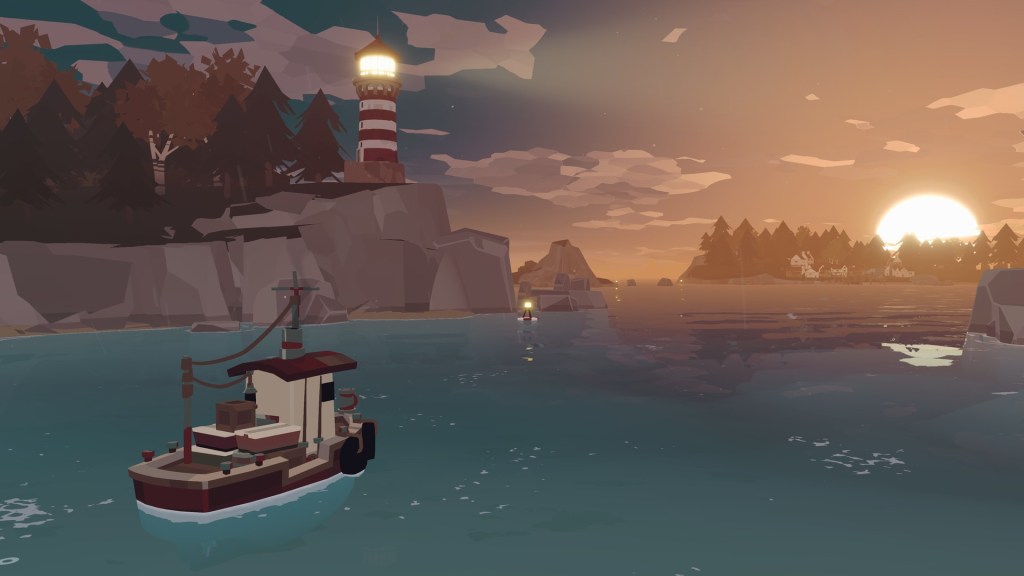
You play as a fisherman who has crashed along the shore of the small town of Greater Marrow. The mayor provides you with a boat, as long as you promise to sell your fish to the town to repay your debt. There’s something quite unsettling about the town, as inhabitants whisper about the previous mayor and fisherman who disappeared. Nevertheless, the town is a safe haven for your travels across the ocean. The lighthouse is an ever-present beacon, guiding the player back to the safety of the harbor no matter where you roam.
Traveling the seas is fairly relaxing most of the time, but if you aren’t watching the clock, you could find yourself in the pitch-black night. As you spend time away from the safety of a dock at night the panic meter quickly fills. Ghostly apparitions and eldritch abominations stalk your small ship, causing you to frantically navigate to a port. Yet in this panic it is easy to become hopelessly lost and crash upon the rocks. There’s an effect that I quite like when the panic meter fills in which terrain is often invisible until you get very close to it. This is excellent as it punishes the player for panicking and not cautiously steering, and it is thematically appropriate as a terrified captain is prone to making errors and splintering their vessel on the rocks.
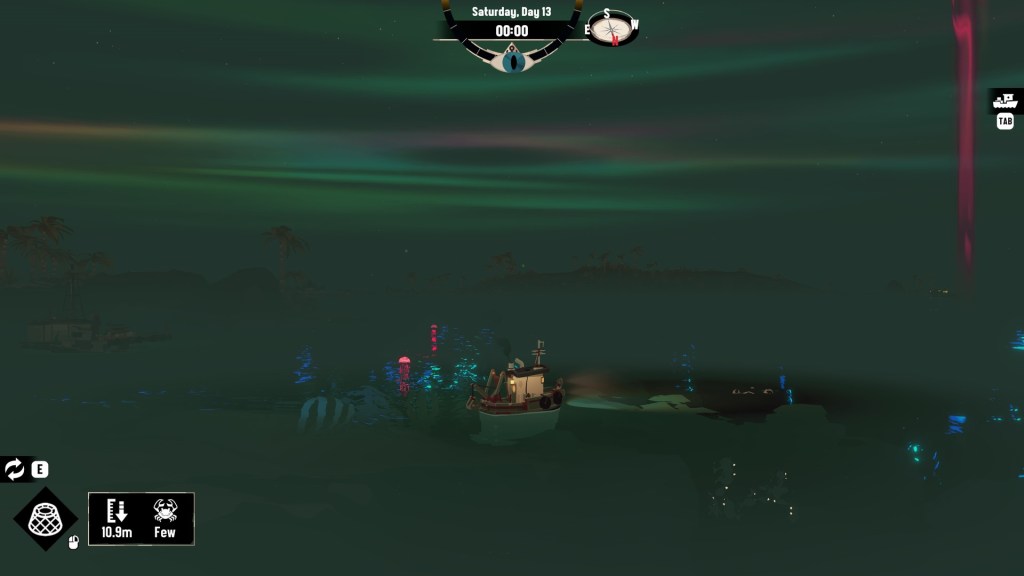
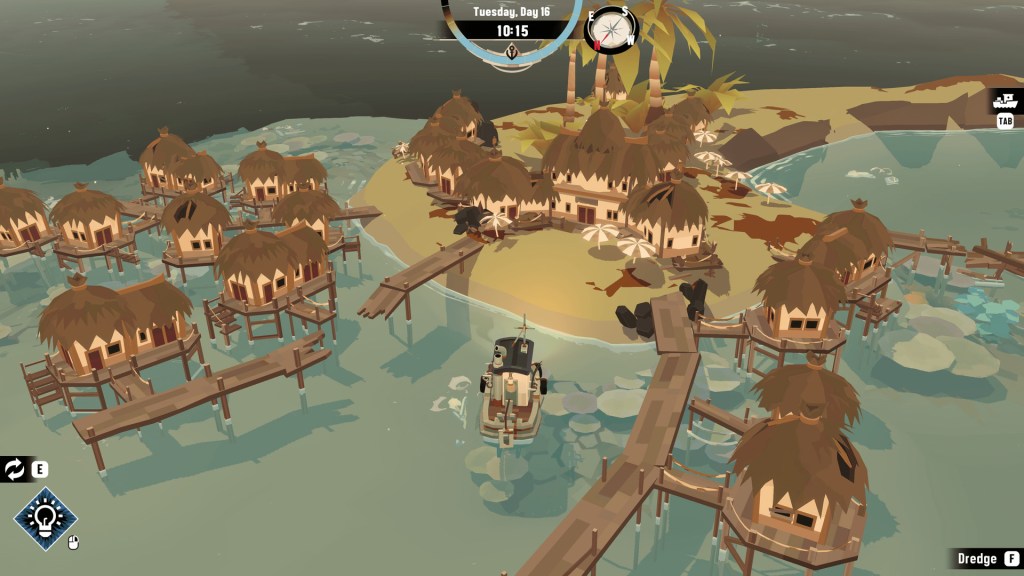
The juxtaposition of safe ports and disquieting darkness is something that I adore. There’s something charming about how a little bit of light and comfort can become such a powerful motivator when surrounded by uncertainty. Dredge is dotted by little towns and floating platforms that serve as shelter. The imposing aesthetic also fuels the contrast between the night and day of Dredge.
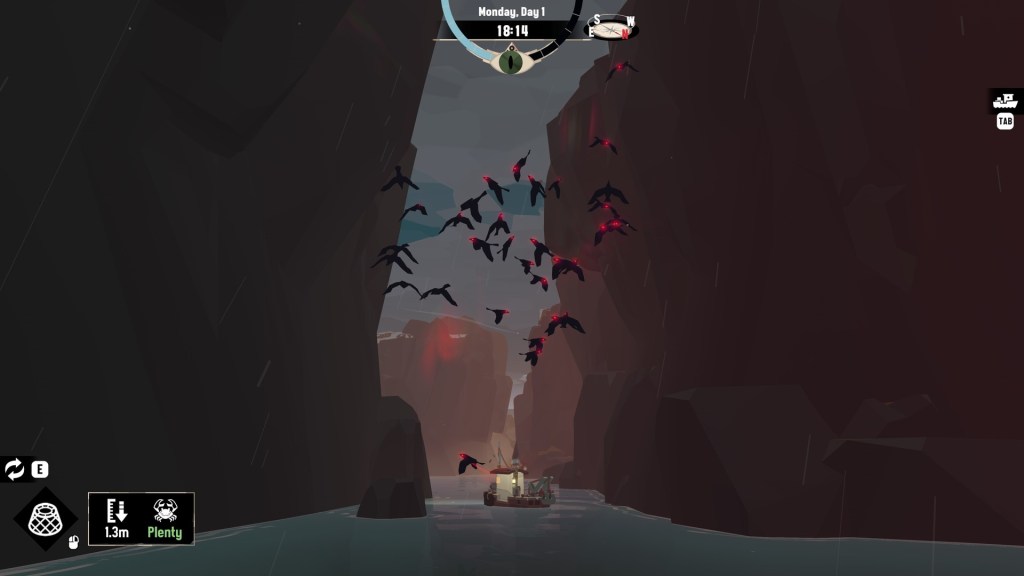
The art of Dredge is highly stylized, relying on low-poly silhouettes and shadows. This low-poly approach is utilized wonderfully to create cozy towns and calming waters. Yet, in an almost impressionist fashion, Dredge plays with light and shadows to create more ominous scenes and characters. The standard fish that you become familiar with often can be seen as “aberrations”, deformed and disturbing versions of themselves that suggest that there is something wrong with these waters.
While it’s obvious that Dredge nails the atmosphere and vibes of a spooky fishing game, I think its rudimentary gameplay systems also complement each other quite well to make for a game that’s hard to put down. There are four main components to gameplay: fishing, inventory management, upgrading, and exploration. All of these are relatively simple in isolation, but the quick cycling between them kept gameplay fresh.
For a fishing game, the actual act of fishing is simple. It’s a minigame in which you time a button press to reel in the fish faster. There are some variations in what the timing wheel looks like and how it functions, but the basic idea is always the same. The only other mastery involved with fishing is identifying the silhouettes of the species of fish to know which one you’re reeling in. Inventory management is similarly straightforward. You have limited capacity on your boat and need to decide what equipment to bring. Moreover, you have to arrange any of your catches or plunder to maximize the relatively limited capacity of your cargo hold. It’s not necessarily difficult, but the awkward geometry of the fish and cargo hold does engage your brain to fit the pieces together. The other component to inventory management is just deciding what is even worth a spot in your hold, as it fills up quickly.
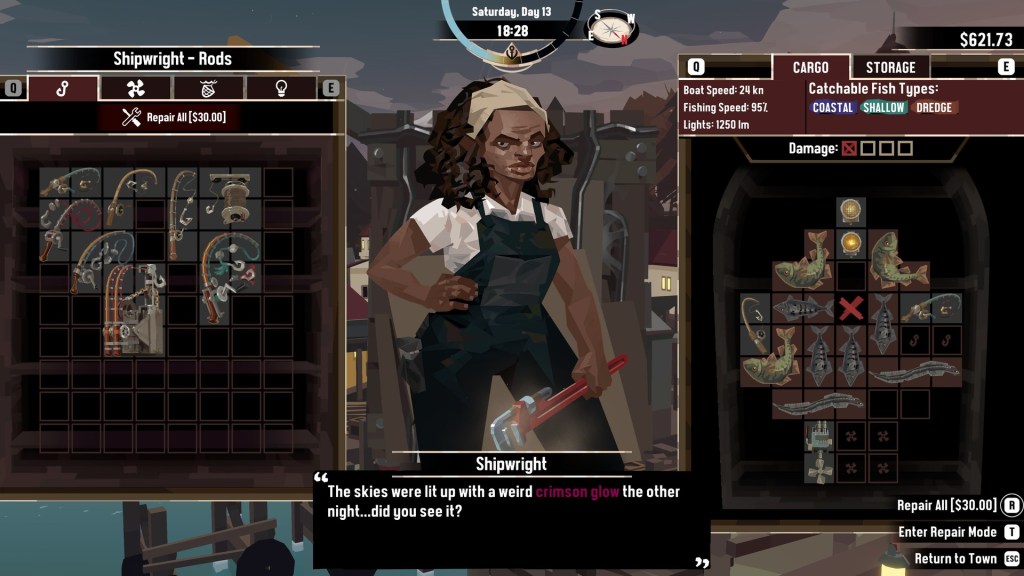
Through maximizing your inventory space and fishing efforts, there are numerous avenues to improve your boat. You can use your yields to upgrade your rods, engines, trawl nets, crab pots, lights, and cargo space. There are so many ways to improve that it always feels like you’re on the cusp of the next one. The upgrades feed into the other avenues of gameplay as it allows you to catch different varieties of fish, have a larger inventory, and explore new areas. While none of the gameplay aspects are complex or deep, they embrace the spirit of brevity to ensure that Dredge never gets stale. They feed into each other for a rapid feedback cycle that it’s easy to get sucked into.
My one desire for Dredge would be to lean more on the night-time terrors. The game rarely encourages the player to make the intimidating trek out into the treacherous night sea. The atmosphere at night is thick and eerie, but aside from a couple of night-only fish there’s rarely a reason to take the risk. Moreover, I wish that being out at night was slightly more threatening. While it’s initially anxiety-inducing, I quickly realized that it was only a little more treacherous than standard sailing. The Lovecraftian atmosphere and spooky vibes are only captivating if the world is actually dangerous. Once the illusion is broken, the game isn’t nearly as suspenseful.
In a year full of smash-hit indie games, I’m glad I chose to play Dredge this spooky season. Its ambience is impeccable. The warm and cozy feeling of taking port under the safety of the lighthouse after frantically evading terrifying monstrosities is magical. While the gameplay doesn’t do anything spectacular or novel, it all fits together quite nicely and knows not to overstay its welcome. It is for these reasons that I give Dredge an 8/10. Dredge has mastered the art of being relaxing while being disquieting, and I love that.
 stephensopinions