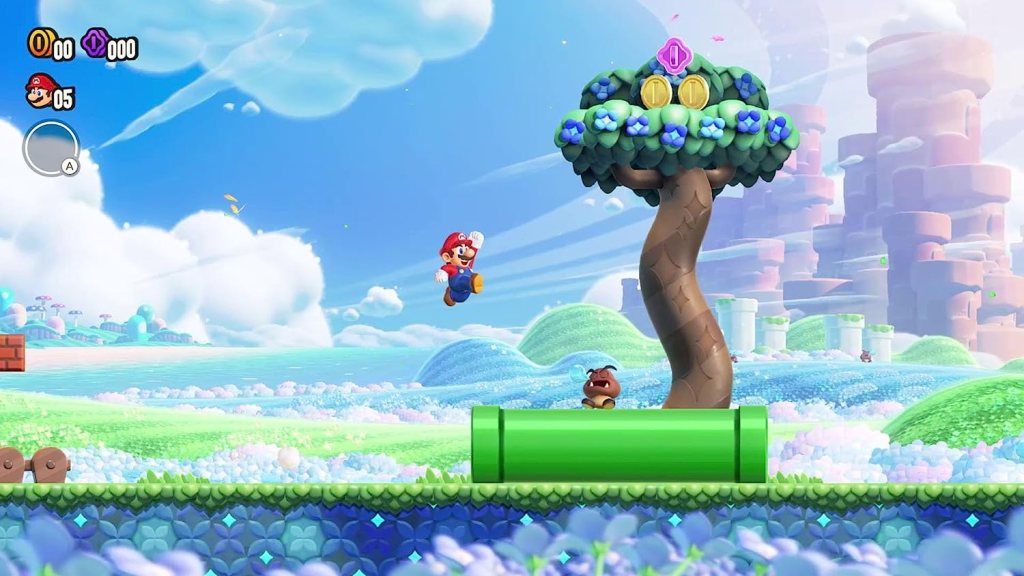
We’ve waited nearly 30 years for the redemption of the 2D Super Mario series. I always found it odd that the last truly notable entries in the series were the Super Mario World games while the 3D Super Mario series has thrived with masterpiece after masterpiece of creative genius. But finally, there’s a return to form with Super Mario Bros. Wonder. Forgive my choice of words, but Super Mario Bros. Wonder is a wonderland of joyous ideas and imagination.
I don’t want to harp too much on the past, but I think context is important. The last four entries in the 2D Super Mario series have been labeled as New Super Mario. These titles have been criticized for being remarkably similar to one another and lacking any sort of major innovation. While being serviceable platformers, they lacked the magic that Super Mario is known for.
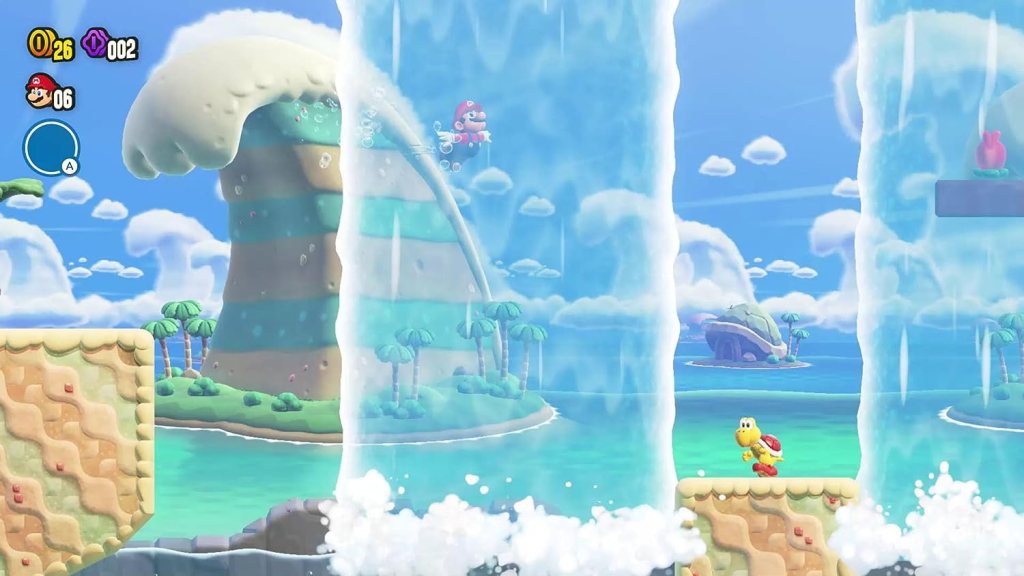
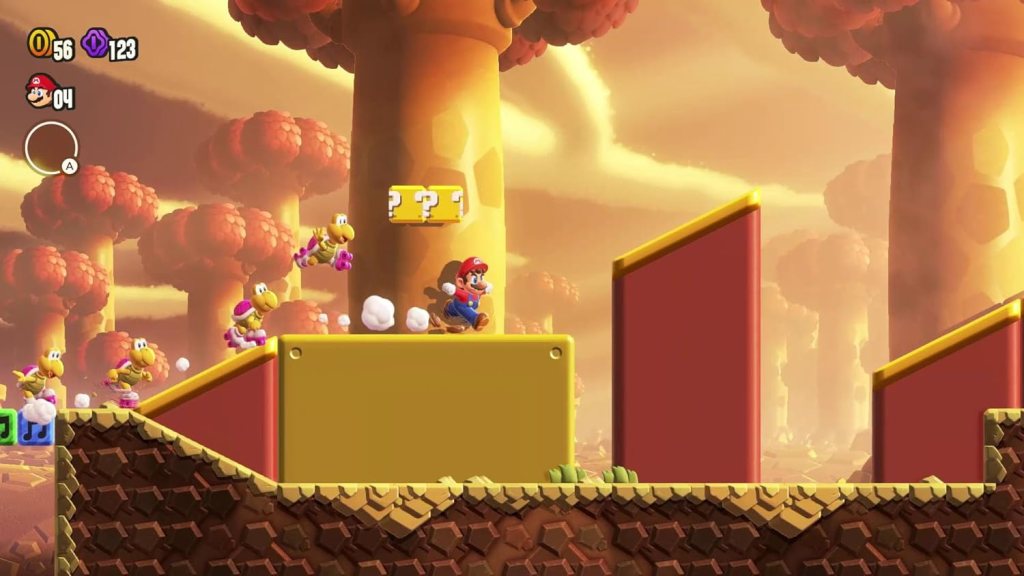
With Super Mario Bros. Wonder, the magic is back. There’s an unparalleled level of creativity on display here. Nearly every single level introduces a new idea. It doesn’t dwell on any single mechanic, but each one goes through a natural progression over the duration of a level. Whether it be a new enemy, new obstacle, or a new gimmick, Super Mario Bros. Wonder takes care to let the player safely interact with its ideas before amping them up. But as the level progresses that idea gets elevated and asks more of the player, and it culminates in a final crescendo: the Wonder Flower.
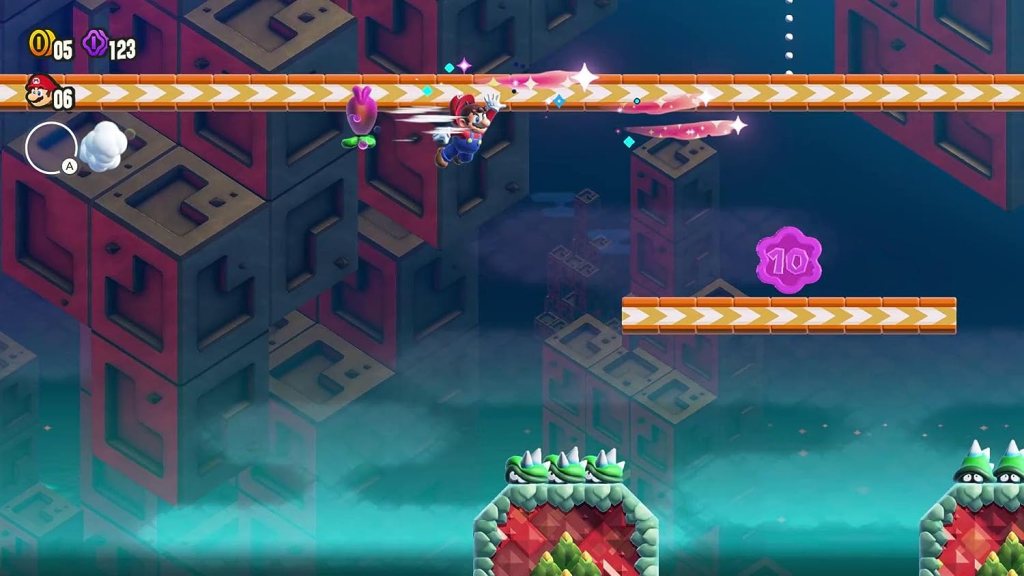
The Wonder Flower serves as the key mechanic in Super Mario Bros. Wonder. Every single standard level in the game has one, and they are wildly imaginative. Towards the end of every level, you can grab the Wonder Flower which transforms the level into something else entirely. Pipes come to life and wriggle around, Piranha Plants leave their pipes and sing, Mario turns into a fast-rolling ball of destruction, and that’s just the beginning. They are all wacky ideas that don’t fit in the classic Super Mario world that we know, but the nonsensical fun and unexpected surprise in every level is glorious.
Super Mario Bros. Wonder is so jam-packed with creativity that it’s absurd. Just the base levels are plenty of fun on their own. Most levels introduce something entirely new to center its design around. And the Alice in Wonderland-esque nonsense that’s triggered when you grab a Wonder Flower serves as a bombastic evolution of the level with wondrous visual effects and marvelous mechanical switch-ups. I couldn’t wait to see what each level had in store for me, and I was always eagerly anticipating what the Wonder Flower would do next.
Apart from the level design, Super Mario Bros. Wonder lets the player express their own creativity with badges. You can equip a single badge to augment your abilities. Some of them provide simple passive bonuses like extra coins or a free power up, others give some additional abilities like being able to glide in the air briefly or get a small height boost when twirling. But there are also a few badges that majorly augment the way the game is played by having you bounce around like a spring, constantly run at high speed, or be invisible. I think the badges are fun options to mix up your abilities. They are never necessary outside of the occasional badge challenge level, which I appreciated. I stuck with a passive badge for most of the game as I felt the action badges would make the game too easy, but I appreciate that they exist for players who do want to have an additional ability. But I did love how badges were utilized for one-off challenges.
In between the non-stop barrage of creative levels there’s the occasional shorter bout. These can be combat focused K.O. arenas, short challenges utilizing badges, search party levels, a Wiggler race, or a celebratory break time. These are all fun little side missions to break up the longer courses. The badge challenges were my favorite as they serve as miniature training grounds to master using a specific badge. The only variant of these bite-sized levels that I didn’t enjoy were the search party levels in which the player has to probe the level for invisible secrets. I think these are meant to be played with friends, but as a solo player it leads to just a lot of jumping around for minutes at a time trying to find hidden blocks.
There’re only a few search party levels so it is not a particularly big issue. In fact, most of my complaints about Super Mario Bros. Wonder are very minor. I thought that the boss fights were a little underwhelming and could’ve made better use of Wonder Flowers. Additionally, while I enjoyed the themed overworld and searching for secret levels, I wish that more courses had secret exits like in Super Mario World. And the little flower guys that are in every level can be annoyingly positive and their plainly spoken English feels out of place in Super Mario.
All of these gripes are minor. The only major thing that I would’ve loved to see in Super Mario Bros. Wonder was some more post-game content. There is a special world with some fantastic levels, but I wanted more of them. These levels were more challenging than the main campaign and often combined Wonder Flowers, badge challenges, and tricky design to make for some highly engaging levels. All things considered, if my biggest complaint about the game is that I wanted more of it, then that’s a pretty good indication of its quality.
I was blown away with how consistently imaginative Super Mario Bros. Wonder was. It’s crammed with tons of brand-new ideas and tricks, and that’s before even touching the Wonder Flower. This is the first time in decades that a 2D Super Mario game has captured the magic, sense of joy, and creativity that oozes from its 3D counterparts. I just couldn’t put down this game, it was a platforming joyride the whole way through. It is for these reasons I give Super Mario Bros. Wonder a 9.5/10. If this is the direction for future Super Mario titles, I am ecstatic and am eagerly awaiting the next release.
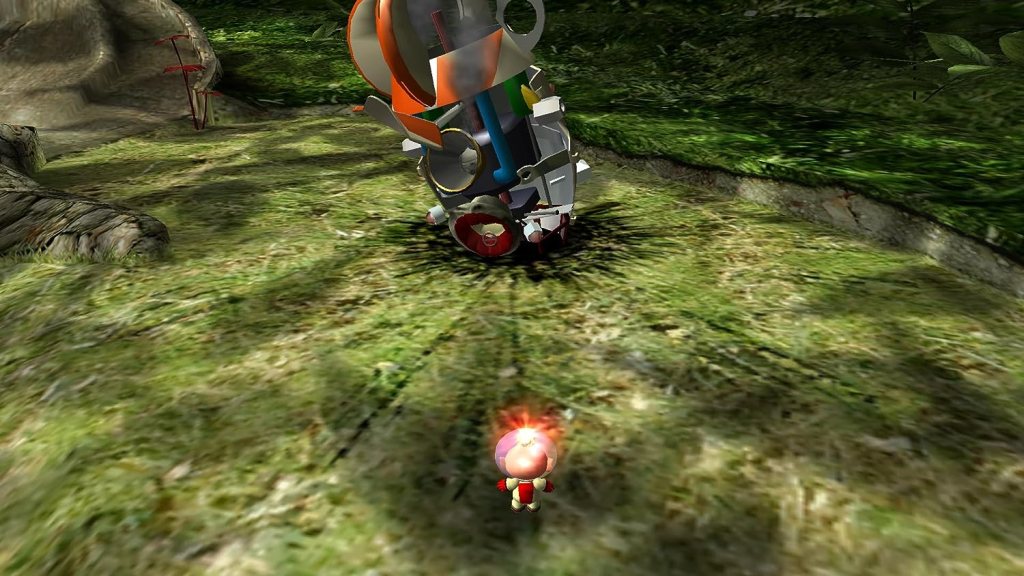
Growing up I loved Pikmin. I never beat the game until I was older, but I loved playing it nonetheless. Real-time strategy (RTS) games can be intimidating as they have steep learning curves and can brutally punish the player for mistakes. But not Pikmin. This is an approachable RTS, so much so that it’s accessible for children. Yet there were plenty of bold design decisions that shaped how Pikmin is played, and I think those risky choices ultimately are what make the game so fantastic.
You play as Captain Olimar, a funky little spaceman who crash landed on an alien planet. He only has 30 days of life support to sustain himself and you need to recover 30 missing spaceship components. Captain Olimar discovers a creature that he dubs Pikmin and he learns how to command and lead them so he can fix his ship and return home. It’s a simple premise, but there’s a few key aspects to take note of.
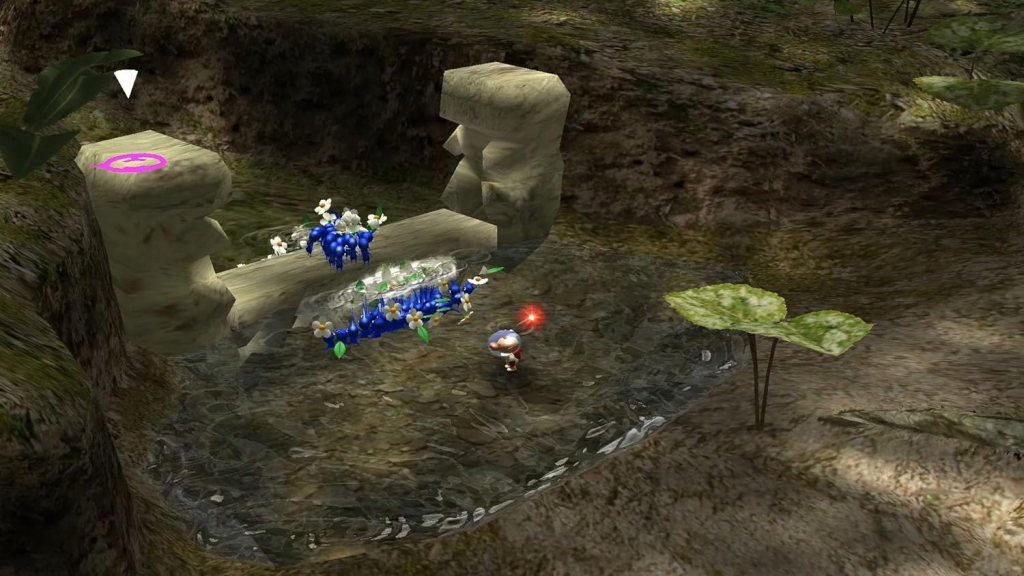
One of the first things that any player will notice about Pikmin is its setting. While Captain Olimar says he has landed on an alien planet, you’ll realize that the planet is only alien to him. The foliage and environmental design of Pikmin is obviously Earth from a microscopic perspective. Grass, stumps, and flowers tower over the player. Empty bottles and cardboard boxes are common obstacles. Most of the threatening fauna seem like evolved versions of common worms, flies, and ladybugs. I love this setting because it is immediately recognizable, but it does feel remarkably alien. Being scaled down makes the world feel monumentally different, and you have to learn how to survive.
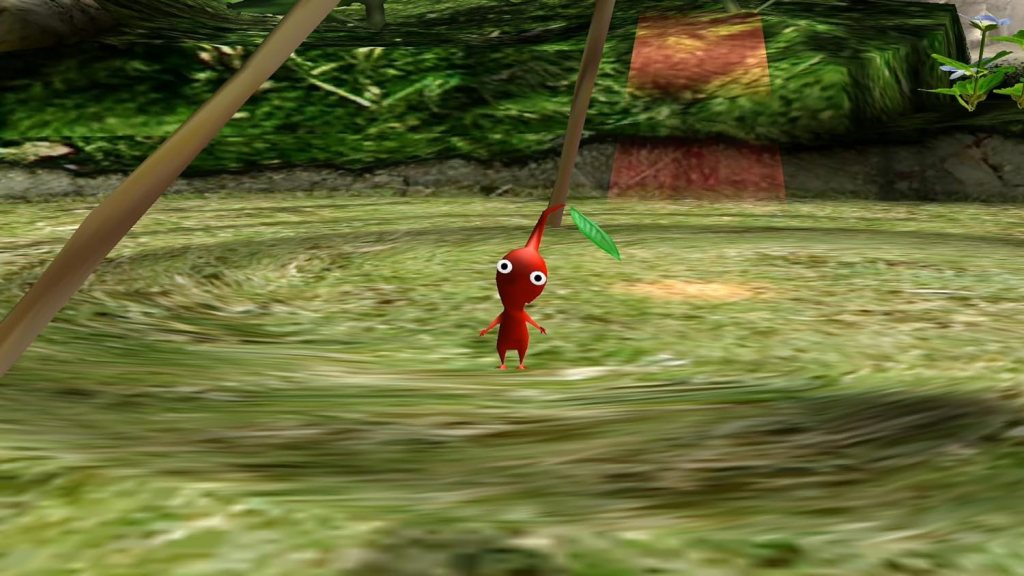
A key component to survival in this alien setting is learning how to utilize Pikmin. The game frames this excellently to compliment the context of learning how to persevere in an unfamiliar environment. There are three types of Pikmin, each with their own properties and niches to understand. The world is rife with hazards such as fire, water, and of course various enemies. I love how Captain Olimar makes observations like how the Pikmin respond to the whistle, or that the blue Pikmin have gills and may be able to swim. While it seems tempting to just bring a bunch of each type of Pikmin everywhere you go for every situation, that can be a risky proposition.
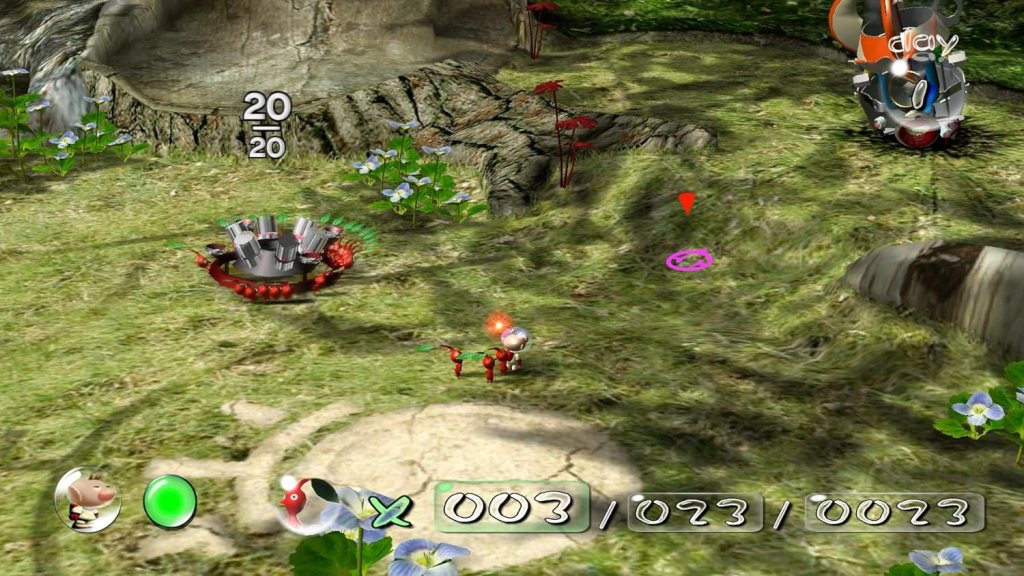
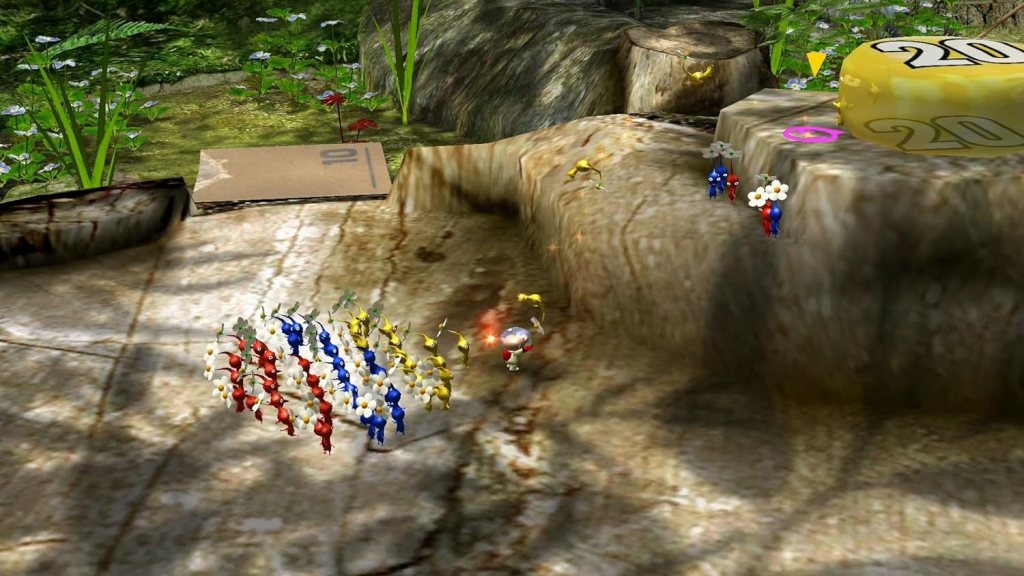
I love how many subtle decisions go into playing Pikmin. You can have 100 Pikmin in your legion at any time, but controlling a big group can be massively unwieldy. It’s easy for them to get caught going through corridors, get picked off by roaming enemies, or accidentally fall into a pit of water. There’s a sort of parental instinct that kicks in when you play Pikmin, they are cute little guys who you planted and raised, there’s no way you want to risk a single death if you can help it. I often only explored with smaller groups of Pikmin so that I could always account for each and every one of them.
While the primary objective of the game is to recover ship parts, there’s a lot of preparatory work to achieve that goal. Walls need to be knocked down, bridges need to be built, you need to build up a force of Pikmin, you need to feed nectar to your Pikmin to empower them, and enemies need to be cleared out of the way. The game is a constant juggling act of small objectives, and it’s easy to feel accomplished with how quickly you progress.
Part of what fuels the rapid decision making of Pikmin is its most risky aspect: the time limit. It’s intimidating at first. 30 days to recover 30 parts. 1 part per day. And each day is only 13 minutes long. Truthfully, it’s a pretty generous limit. It’s often feasible to recover multiple parts every day, or at least make progress towards the next one. Nevertheless, the pressure of a time limit fuels the player to work quickly and attempt to multitask and make risky decisions. You can leave Pikmin to their own devices to take down walls or carry things back to base, but they are extremely vulnerable to predators. Moreover, any Pikmin left alone at the end of the day will be eaten. But if you want to get multiple parts in a day, you have to take that risk.
Time limits can often be off-putting by putting pressure on the player. But the time-crunch serves Pikmin well. You have to make decisions on the fly about what to do with your limited time. Whether it be planting new Pikmin, knocking down walls to serve as shortcuts, or just defeating enemies so they aren’t an issue for a few days, there’s always something to do. The time limit provides real tension and a sense of stake. But it isn’t oppressive as there’s an abundance of time to fully restore Olimar’s ship.
If I had to complain about something about Pikmin, itis the artificial intelligence for the Pikmin themselves. I think it’s ok that they’re kind of dumb, as it contextually makes sense. They have a symbiotic relationship with Captain Olimar. They can use their overwhelming numbers to assist him, and he can use his brain to tell them what to do and help them reproduce. But at times they are just a little too dumb. Enough to be frustrating. It’s a pain to wrangle suicidal Pikmin who got distracted by grass or nectar. Or when throwing them at enemies to engage in combat I often found that the Pikmin would prioritize picking stuff up to carry home rather than attacking. I think it’s fine that they have a one-track mind, but when they actively ignore the player’s direction it can be frustrating.
Ultimately, Pikmin expertly marries its gameplay and narrative. From the somewhat-familiar alien setting, to the learning process of commanding Pikmin, to the parental responsibility that you feel for the titular creatures, to the impending doom that the time limit imparts, the game really does put the player in the shoes of Captain Olimar. And it does all this while remaining fun and accessible for all audiences. Pikmin has always been overlooked compared to other Nintendo juggernauts such as Super Mario and The Legend of Zelda, but in my opinion it’s just as classic.
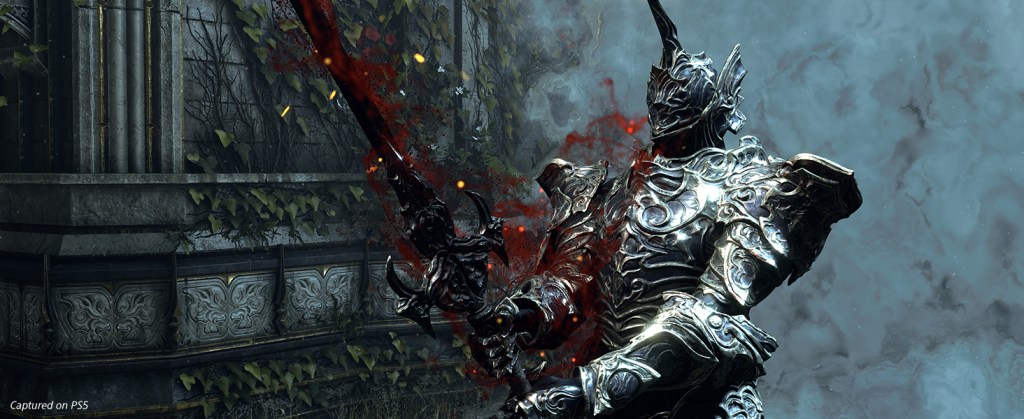
As a fan of FromSoftware’s catalog, Demon’s Souls has long been my white whale. Dark Souls is in contention for my favorite game of all time, yet I never got the opportunity to play its predecessor. Being the progenitor of one of the most successful and influential franchises of games makes Demon’s Souls an incredibly important title. Yet, the original game has only ever been released on the Playstation 3. Which is why I was so excited about the remake of Demon’s Souls, bringing it to the Playstation 5. I really did want to play the original game first before reviewing the remake to compare the differences, but unfortunately, I didn’t get the chance. From what I can tell, this is a faithful recreation of the game, including all the weird, archaic, and unforgiving ideas that were removed from subsequent Soulsborne games. And I love Demon’s Souls for that.
I think Demon’s Souls unfortunately has a bad reputation for being a bit unforgiving with its design. There’s a lot of mechanics and ideas present in Demon’s Souls that never carried over to its successors, and many claim that is for the better. But I feel like playing Demon’s Souls was refreshing. There are many aspects of Demon’s Souls that I wish would make a return in modern releases, especially after playing Dark Souls III and Elden Ring. In short, I felt as if Demon’s Souls was a far more cerebral game, opposed to later titles which rely more on fast-paced action. Demon’s Souls is unforgiving and punishing, leading the player to be cautious and think carefully about their next course of action. To compliment this, combat and bosses are generally far easier to mechanically execute, as long as you come up with a reasonable strategy. What really makes Demon’s Souls shine is how its unforgiving nature contributes to its impeccable atmosphere and worldbuilding.
The world of Demon’s Souls is surprisingly grounded. With many of FromSoftware’s games, I take in the world and its locations, but I’m not quite sure how it all fits together due to the obscured nature of the storytelling. Demon’s Souls only ever lets the player have a fragmented understanding of the world, but I found it enthralling. There are five main locations that the player can visit, and each one is supplemented by some short text passages on their entrance. These brief backgrounds, along with environmental storytelling, were enough to make sense of their respective locales.
Take the Valley of Defilement for example. It’s a narrow valley with poisonous sludge at its base. Its inhabitants have resorted to rickety shacks on the ledges and in the crevices of the walls. Narrow planks that overhang the darkness are the streets of the shoddily built shanty towns. The creatures who live here are all but forgotten, left to suffer in this vile mire. Yet, they make due. They defend their home, using its dark crevices as an advantage to sneak up on invaders. And they do so because the saintly Maiden Astraea lies at the heart of the swamp, and she has resolved to free the valley’s souls of suffering. They worship her, and she protects them. Through almost purely environmental storytelling, Demon’s Souls paints a vivid image of its world and how Valley of Defilement came to be what it is. It’s not just a dirty swamp of vile monsters for the player to slay, it’s a fully realized location that makes sense.
Demon’s Souls is often maligned for being unforgiving, but I don’t think this is an entirely fair perspective. I think the unrelenting challenge and inconveniences are crucial to building tension. The lack of checkpoints is often seen as inconvenient and tedious, but I think that having long gaps between safety is critical in a grim game such as Demon’s Souls. Each level only has a single checkpoint at the start, and many levels open up a shortcut or two as the player progresses. But even the shortcuts never lead directly to the boss. There’s always obstacles and danger blocking your path. I think this is fantastic because it ups the anxiety and tension of exploration and combat. A single misstep means you have to repeat large chunks of the level. This also encourages the player to not only to defeat enemies, but to master besting them in combat so that you can repeatedly bypass them. The added pressure of death works wonderfully with the boss battles in Demon’s Souls.
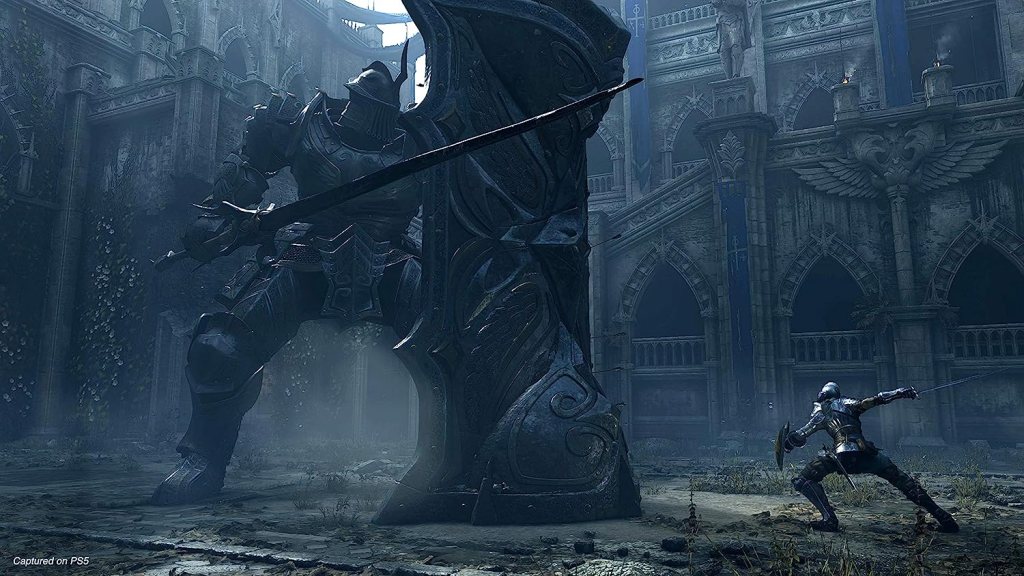
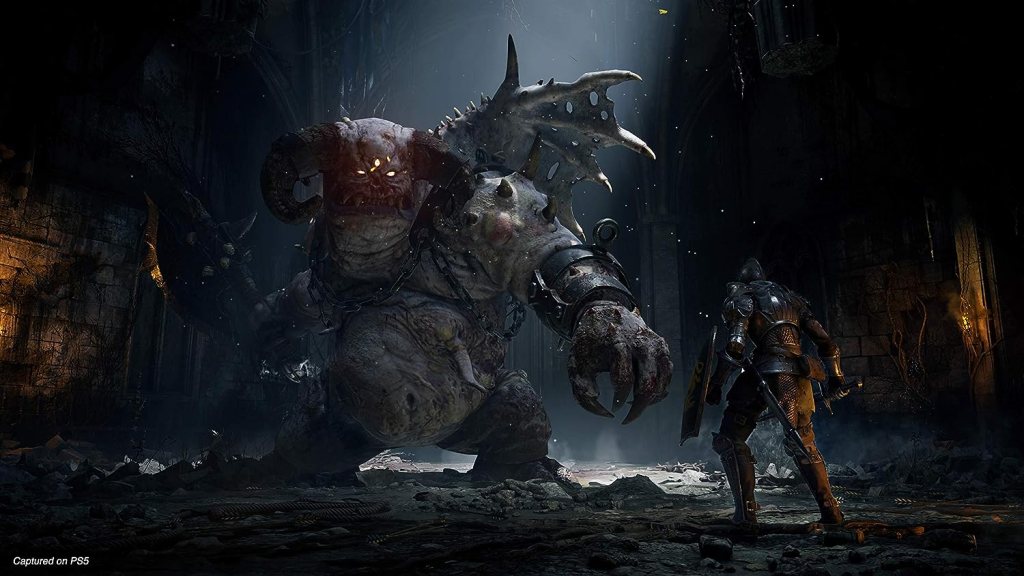
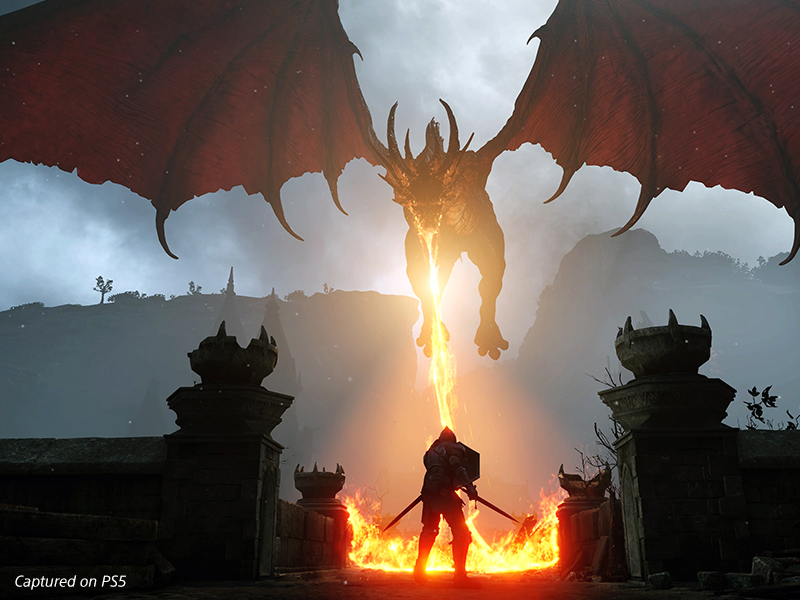
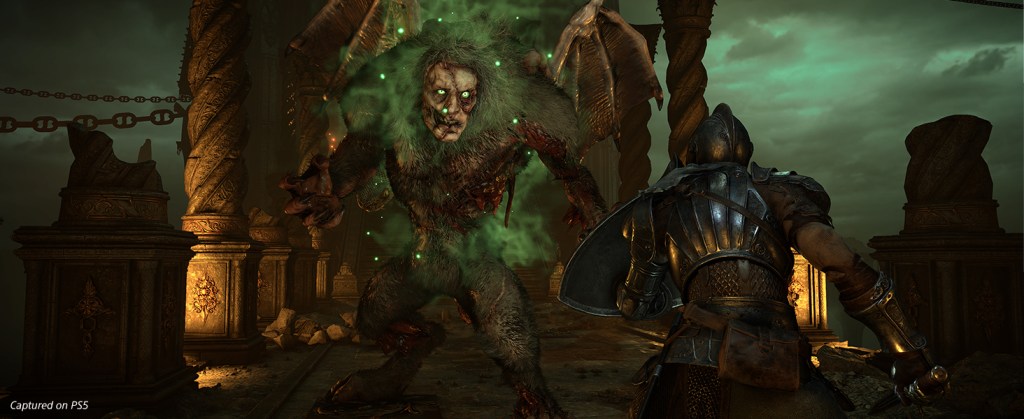
I frequently read that Demon’s Souls has the worst bosses in the series because they are easy and often gimmicky. But I disagree. The bosses are easier to execute then later games because they have fewer attack patterns and generally attack in a slower, more telegraphed manner. But many of the bosses have a trick to them that the player has to figure out. They have unique arenas, weak spots that must be focused, or potent attacks that you have to figure out how to counter. While it’s true that the bosses may be on the easier side, I think each one provides a unique experience that is distinct and memorable. Moreover, easier bosses make sense when the player has to overcome a gauntlet of challenging enemies just to give the boss another shot. It would be enormously frustrating to have to replay the whole level dozens of times because the boss is monstrously difficult.
I think over the years Soulsborne has focused on making bosses more and more difficult. While games like Elden Ring nail the spectacle of boss fights, I do think they often go too far with the bosses moveset. Demon’s Souls bosses are relatively simple in comparison, but I find them to be more memorable because they are all so different. Not just visually different, but mechanically different. While there are some straight up one-on-one duels, there is often more to contend with than just the basic combos that the boss can throw out. The bosses having a “gimmick” is what makes them interesting and memorable.
Not every fight should follow the routine of learning how to dodge every attack the boss has, finding safe times to attack, then getting a hit or two in. Variety is what keeps the game fresh and interesting. While fast-paced duels are often the pinnacle of boss fights, they are even more impactful and memorable if they are kept as an occasional treat. Having some more “gimmicky” fights interspersed throughout the game is a breath of fresh air. And Demon’s Souls bosses are memorable because they behave so differently than many other bosses in the series.
While I do love Demon’s Souls eccentricities, there are some aspects of the game that do feel archaic. The most obvious example is the healing system. In Demon’s Souls, the player collects a variety of consumable moon grasses which restore health. These are collected through exploration, combat, or you can straight up purchase them from certain merchants. While I do think it’s a good idea to limit how much the player can heal, it’s too easy to abuse this system. I often carried dozens of moon grass items, so as long as I didn’t make an egregious mistake I could always heal up to max health with little threat. Conversely, worse players may often run out of moon grass and have to farm enemies to replenish their stock, which is obnoxious. Dark Souls immensely improved on this by only providing a few chugs of their healing flask per checkpoint. That way, players would never have too much or too little.
Demon’s Souls has a unique mechanic which changes the world depending on your actions, called tendency. I think this is actually kind of a nice idea, but its implementation is esoteric. Good actions will make your tendency “white”, while performing bad actions skews it towards “black”. Certain secrets open up depending on your tendency, enemies may get stronger but provide better rewards, and there may even be additional enemies. My issue is how poorly explained this all is. It’s very easy to unknowingly perform an action which makes you move towards black tendency, which ultimately makes the game more difficult. I suppose the learning process can be seen as fun and interesting, but mending your tendency after it plummets is unreliable.
There are a few other archaic systems in Demon’s Souls such as the upgrade system and inventory encumbrance that I don’t want to delve too deep into. But an area that I do think is important to discuss is what FromSoftware is famous for: world and level design. The levels of Demon’s Souls are actually quite condensed, which I think is a positive. It’s tempting to fully explore each area because of this. Mechanically, I also think that the levels are quite good. There’s a variety of scenarios and encounters that the player has to not only use their skills to overcome, but to use their brain as well. There’s a lot of traps and obstacles that encourage caution and thoughtful exploration.
I do think that Demon’s Souls shows its age a bit in some of its levels. There is an abundance of narrow corridors, ledges, and groups of enemies that show the weaknesses of the game. Combat is stunted in cramped spaces like corridors and ledges because your weapon often hits the wall instead of enemies. I get the realism factor here, but enemies don’t seem to follow this rule and inherently have an advantage in these spaces. Furthermore, groups of enemies are famously difficult to deal with in Soulsborne games, and Demon’s Souls has a ton of these groups. The slower pace of combat doesn’t work well when you have to contend with many foes and it’s easy to get stunlocked into death.
As for the world design of Demon’s Souls, I quite enjoy the areas individually but I wish they were not completely disconnected from each other. There are five major areas in the game, each with a handful of levels. But these major areas are not connected with each other, the only way you can access them is through the hub area. I think this is unfortunate in a game that otherwise is impressively immersive. Constantly sitting in load screens and fast traveling around is just not nearly as captivating as having a singular, connected world.
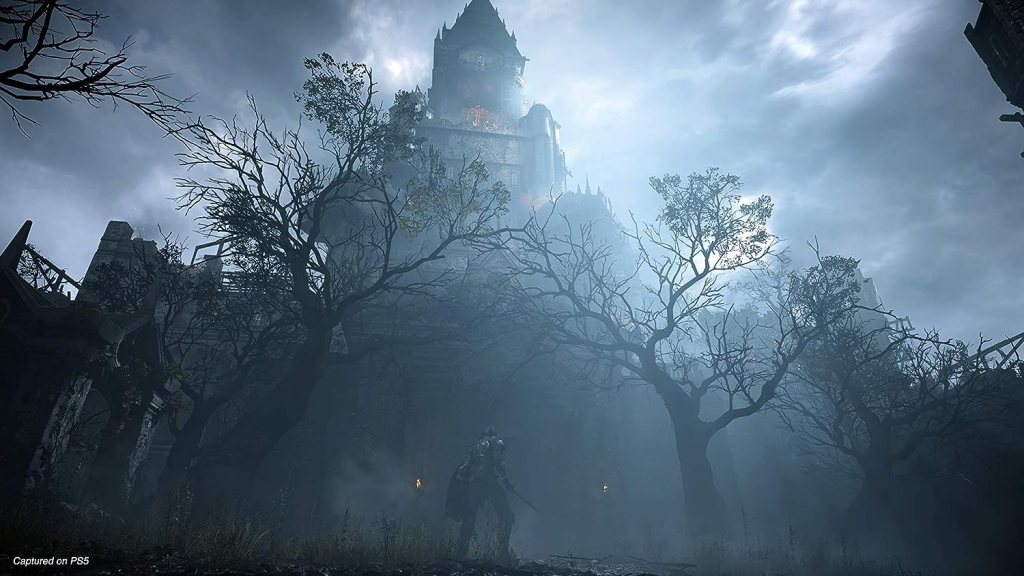
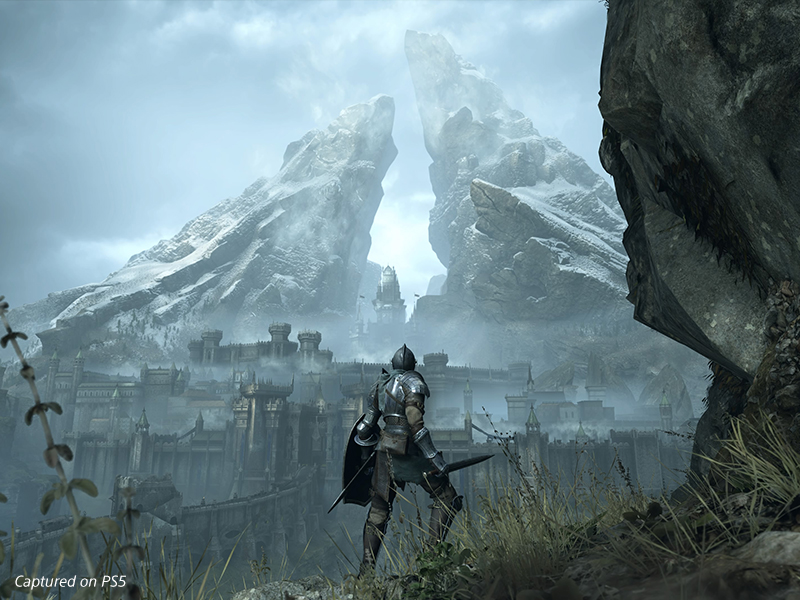
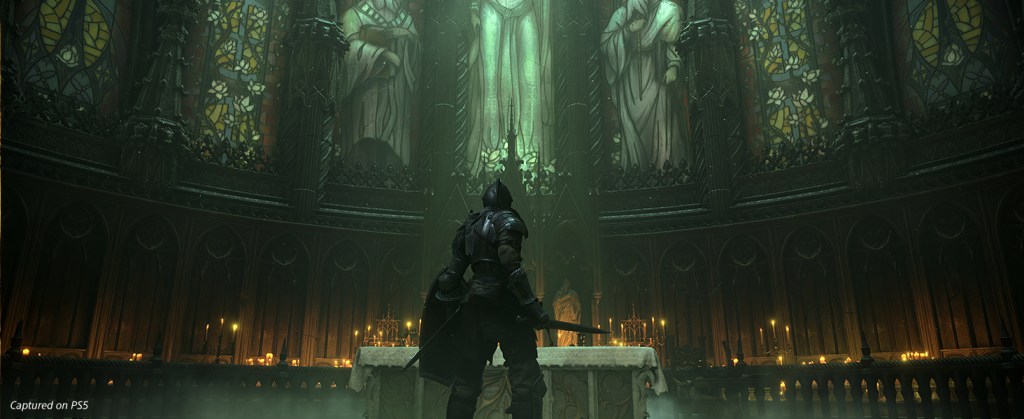
As previously mentioned, I haven’t had the opportunity to play the original game so my perspective on Demon’s Souls as a remake is limited. From my research, it seems as though the gameplay is extremely faithful. Visually, the remake is stunning. However, when compared to the original game’s environments, the remake is showier. The simple Eastern European style simple castles are more ornate. Moreover, the sun beams and impressive lighting do impose a sense of grandeur that wasn’t present in the original game. Gone is the dirty and eerie faint glow of lighting. I don’t think the visual differences are a huge deal as the atmosphere retains its somber mood. I think the bigger change is the music.
After listening to both soundtracks, I think it’s a shame that the spirit of the original was lost in the transition. Particularly in the boss fights. As previously mentioned, the boss fights in Demon’s Souls aren’t always epic one on one duels, many are somber, depressing, or disturbing. The original soundtrack captures these differences quite well. The Fool’s Idol piece is a stark example of how drastically the music was changed. Don’t get me wrong, the music is beautiful. But not like every boss fight needs to be a grand duel, not every song needs to have a dramatic choir with full orchestral backing.
Playing Demon’s Souls put the whole series in perspective for me. It makes me long for a time where Soulsborne games emphasized memorable experiences rather than just difficult ones. Conversely, Demon’s Souls also made me realize how far the series has come. There are many archaic and esoteric aspects to Demon’s Souls, and I am glad that the remake let me experience it all faithfully. It is for these reasons I give Demon’s Souls an 8/10. I encourage everyone to give Demon’s Souls a fair shot. It was a risky title when it was originally released, and not every idea was a hit, but there’s a sense of magic and authenticity that arise from the game’s bold choices.
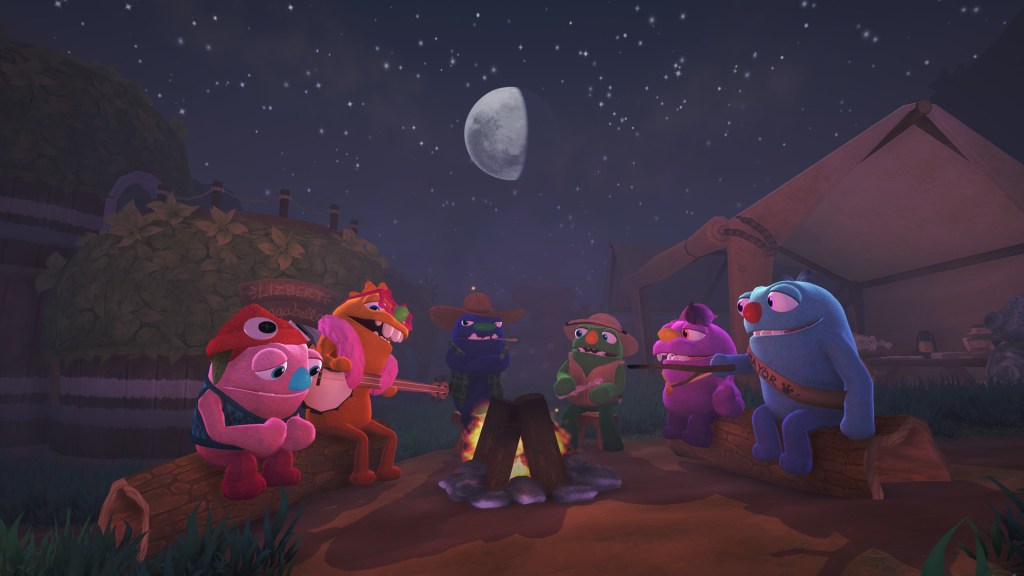
There’s something about Bugsnax that makes it feel nostalgic despite it being released in 2020. It feels like it belongs in the Gamecube/Playstation 2 era of wacky and cartoonish games. Visually, mechanically, and conceptually, Bugsnax feels like one of those weird games that I would play when I was a kid. There’s a certain sense of charm and creativity that is present throughout Bugsnax. Although I don’t consider it a flawless experience in any sense, it’s definitely a game that I enjoyed playing.
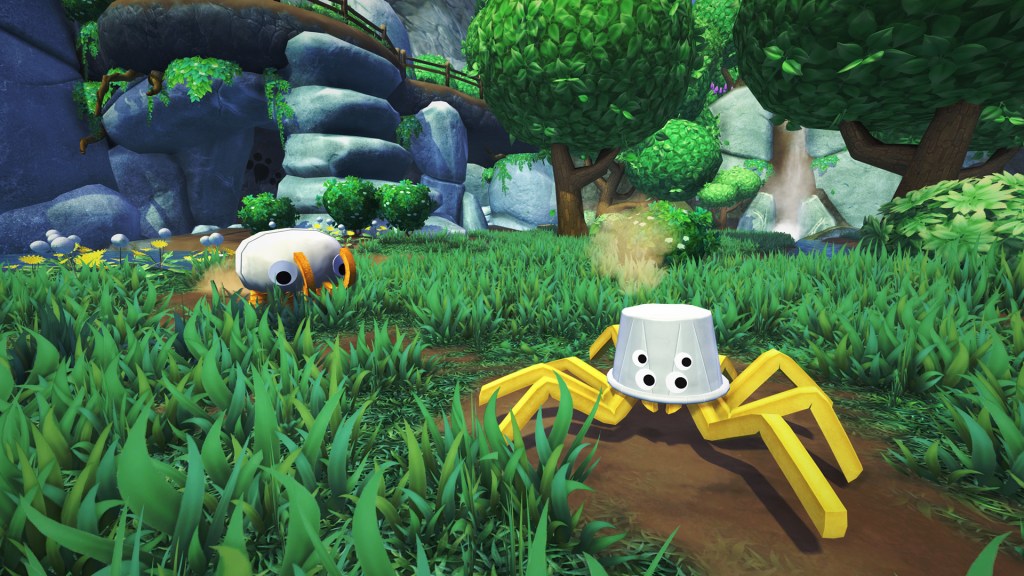
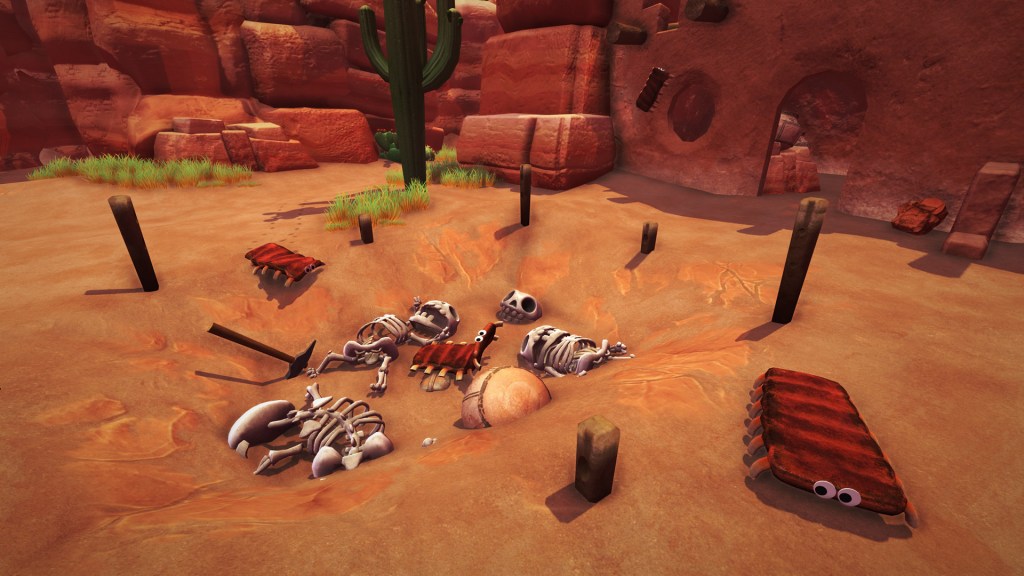
The idea behind Bugsnax is that you are a journalist investigating the disappearance of an adventurer on an unexplored island. A small group has taken up residence on this island because it is home to the titular species of creatures. These Bugsnax are animals that look like food: strawberries, hamburgers, tacos, etc. When you consume them, part of your body takes on traits of the Bugsnax. It is a frightening concept if taken out of the lens of the silly and carefree presentation of the game. When you arrive on the island, you realize that the group who had settled here has split up for some reason, and it is your job to get to the bottom of what happened.
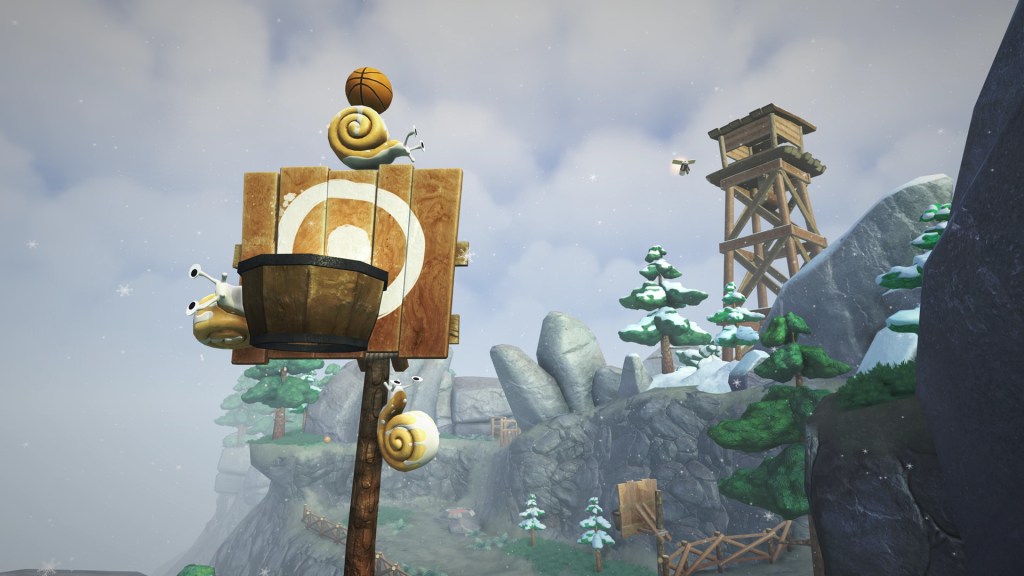
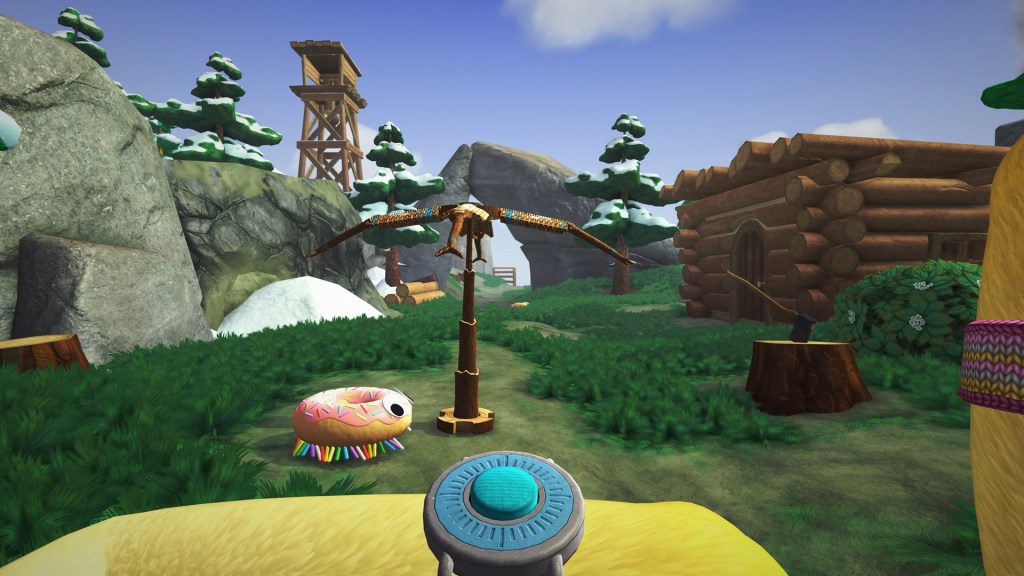
The core gameplay of Bugsnax is catching Bugsnax. As you progress through the game, you unlock tools, traps, and gadgets to wrangle the little critters. It starts out simple enough, such as setting net traps next to bushes while waiting for timid Bugsnax to poke their heads out. As the game progresses, you need to use tools in conjunction with one another as well as the environment and even other Bugsnax. At its core, Bugsnax is an adventure-puzzle game. Trying to figure out how to catch the different creatures was extremely enjoyable. It’s different, it’s unique, and it’s fun to figure out how to capture the trickier Bugsnax and add them to your collection.
While I do appreciate the unique concept and gameplay, I do wish it increased in complexity and depth as the game progressed. While some Bugsnax are trickier than others to capture, it feels like there is a lot of repetition to pad out the game’s cast of creatures. There are a lot of similar Bugsnax that are functionally identical to one another, they are just found in different parts of the map. This can get particularly tedious when trying to tackle many of the game’s sidequests, as they often are as simple as going to catch common Bugsnax around the island. Catching a dozen different variations of the Strabby is not really an engaging puzzle.
As the game progresses, there are some slightly more complex Bugsnax to catch. Some fly, some are frozen and can’t be touched, and others are on fire and will burn your traps. These are interesting the first couple times you encounter them, but once you realize how to handle these hurdles you can use the same strategy for all other similar Bugsnax. There are a few bosses which are unique and I enjoyed figuring out how to handle them, but they are few and far between. Bugsnax would have benefited from having fewer filler and repeat creatures, and more unique Bugsnax that require the user to engage in some problem solving.
Aside from the creature capturing, the appeal of Bugsnax is in the charming cast of characters. There is a central town where residents that you assist will return to. It’s quite cozy to hang out in town and visit with the seemingly silly characters. I was surprised as I kept playing by the depth of the cast.
For what seems like a childish game and concept, Bugsnax has some mature themes and character growth. The townspeople have complex motivations and interpersonal relations. The isolation and pressure of living in a false paradise led to arguments, tension, and distrust. As you progress each character’s story, they are led to resolve their conflicts in mature manners. I was impressed by how real and multi-faceted every character’s personality was.
The weakest aspect of Bugsnax is easily its presentation. Specifically, the visuals. The voice acting was solid, and I loved how the creatures would shout their own names like Pokémon. But visually, the game looks like it belongs in a different era. I like the choice of being cartoonish, but the execution is dated. Honestly, this isn’t a big deal, but it is funny considering that Bugsnax was a launch title for the graphically powerful PS5.
I wasn’t expecting to enjoy Bugsnax as much as I did. I had fun working out how to capture all the creatures. The variety of gadgets and tools makes for some fun puzzles, but I do wish that there were more unique Bugsnax rather than the multitude of different colored species. For a game that seems childish, there are some mature themes and lessons to be learned from the characters. It is for these reasons that I give Bugsnax a 6.5/10. I don’t think it will blow anyone’s mind, but Bugsnax is a fun little adventure nonetheless.
On the surface, Dredge does not appear to be anything special. Mostly, it’s a simple fishing game with some resource management and exploration. But Dredge is more than the sum of its parts. Its systems work together to create an addictive loop that it’s easy to sink hours into. But where Dredge really shines is in its quaint, yet unsettling atmosphere.
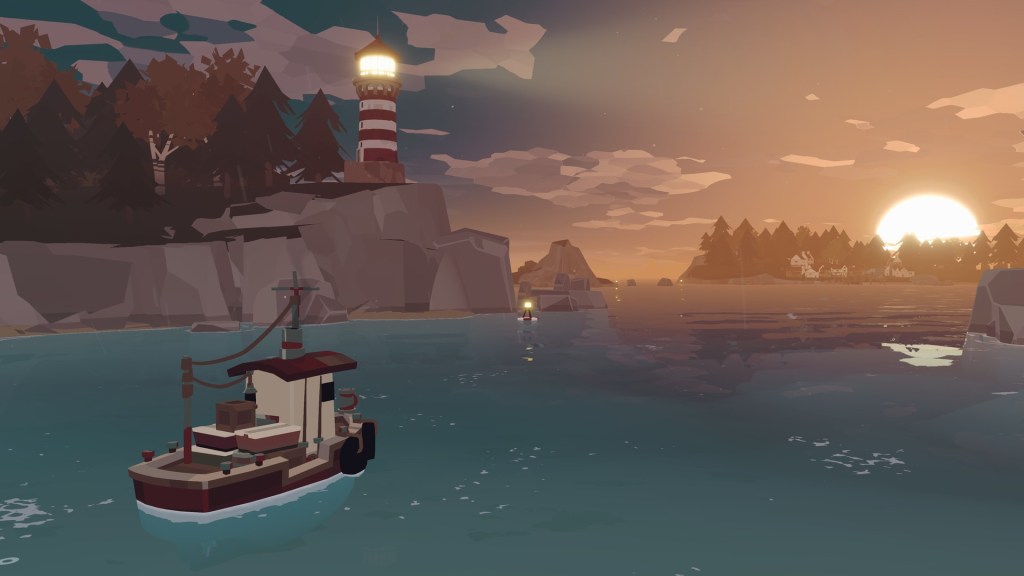
You play as a fisherman who has crashed along the shore of the small town of Greater Marrow. The mayor provides you with a boat, as long as you promise to sell your fish to the town to repay your debt. There’s something quite unsettling about the town, as inhabitants whisper about the previous mayor and fisherman who disappeared. Nevertheless, the town is a safe haven for your travels across the ocean. The lighthouse is an ever-present beacon, guiding the player back to the safety of the harbor no matter where you roam.
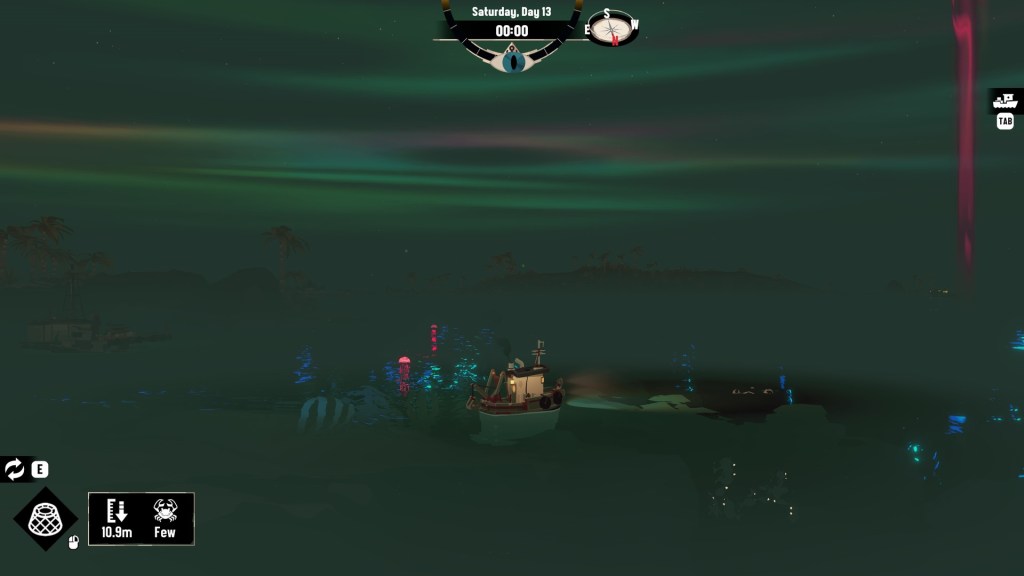
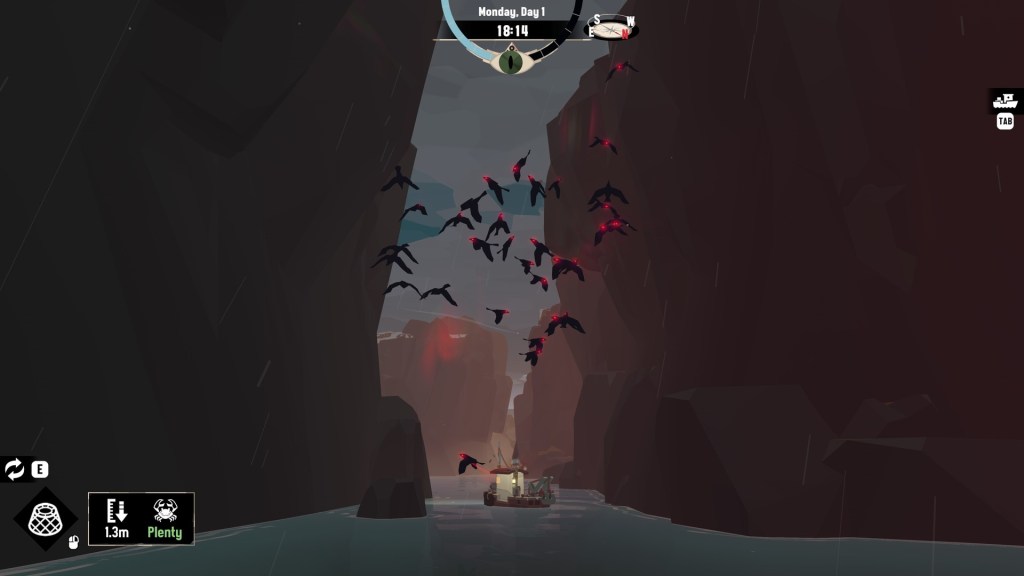
Traveling the seas is fairly relaxing most of the time, but if you aren’t watching the clock, you could find yourself in the pitch-black night. As you spend time away from the safety of a dock at night the panic meter quickly fills. Ghostly apparitions and eldritch abominations stalk your small ship, causing you to frantically navigate to a port. Yet in this panic it is easy to become hopelessly lost and crash upon the rocks. There’s an effect that I quite like when the panic meter fills in which terrain is often invisible until you get very close to it. This is excellent as it punishes the player for panicking and not cautiously steering, and it is thematically appropriate as a terrified captain is prone to making errors and splintering their vessel on the rocks.
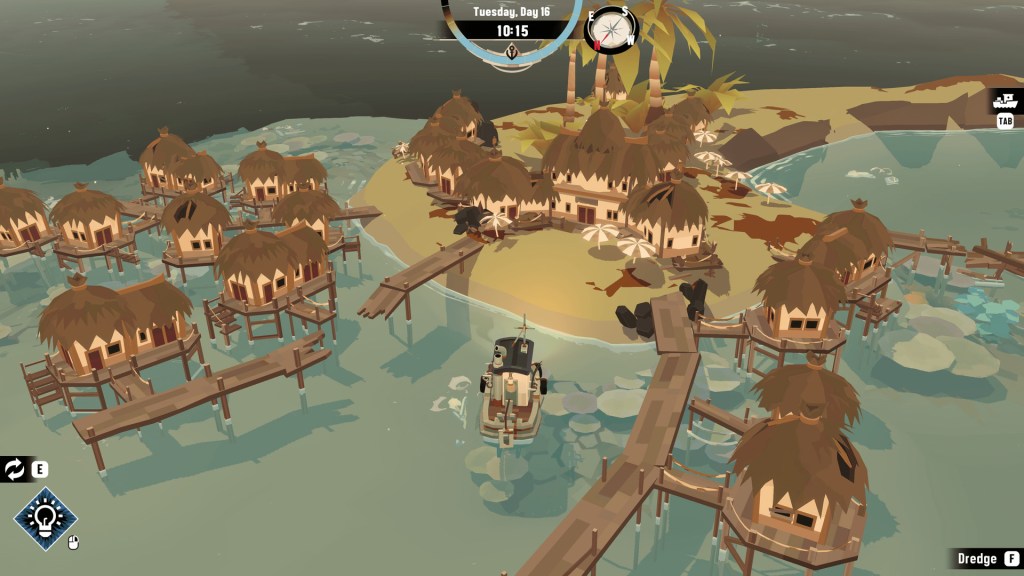
The juxtaposition of safe ports and disquieting darkness is something that I adore. There’s something charming about how a little bit of light and comfort can become such a powerful motivator when surrounded by uncertainty. Dredge is dotted by little towns and floating platforms that serve as shelter. The imposing aesthetic also fuels the contrast between the night and day of Dredge.
The art of Dredge is highly stylized, relying on low-poly silhouettes and shadows. This low-poly approach is utilized wonderfully to create cozy towns and calming waters. Yet, in an almost impressionist fashion, Dredge plays with light and shadows to create more ominous scenes and characters. The standard fish that you become familiar with often can be seen as “aberrations”, deformed and disturbing versions of themselves that suggest that there is something wrong with these waters.
While it’s obvious that Dredge nails the atmosphere and vibes of a spooky fishing game, I think its rudimentary gameplay systems also complement each other quite well to make for a game that’s hard to put down. There are four main components to gameplay: fishing, inventory management, upgrading, and exploration. All of these are relatively simple in isolation, but the quick cycling between them kept gameplay fresh.
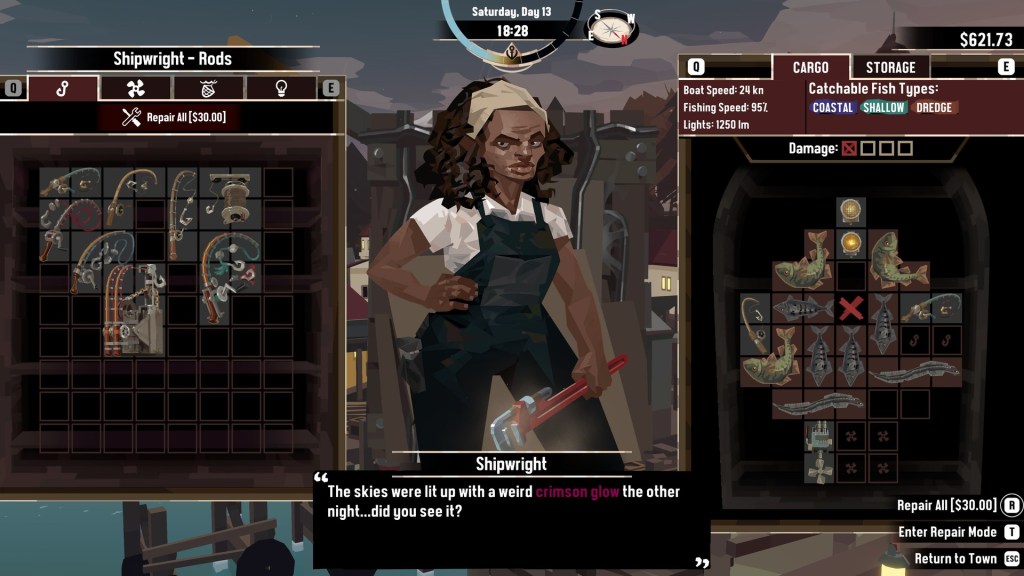
For a fishing game, the actual act of fishing is simple. It’s a minigame in which you time a button press to reel in the fish faster. There are some variations in what the timing wheel looks like and how it functions, but the basic idea is always the same. The only other mastery involved with fishing is identifying the silhouettes of the species of fish to know which one you’re reeling in. Inventory management is similarly straightforward. You have limited capacity on your boat and need to decide what equipment to bring. Moreover, you have to arrange any of your catches or plunder to maximize the relatively limited capacity of your cargo hold. It’s not necessarily difficult, but the awkward geometry of the fish and cargo hold does engage your brain to fit the pieces together. The other component to inventory management is just deciding what is even worth a spot in your hold, as it fills up quickly.
Through maximizing your inventory space and fishing efforts, there are numerous avenues to improve your boat. You can use your yields to upgrade your rods, engines, trawl nets, crab pots, lights, and cargo space. There are so many ways to improve that it always feels like you’re on the cusp of the next one. The upgrades feed into the other avenues of gameplay as it allows you to catch different varieties of fish, have a larger inventory, and explore new areas. While none of the gameplay aspects are complex or deep, they embrace the spirit of brevity to ensure that Dredge never gets stale. They feed into each other for a rapid feedback cycle that it’s easy to get sucked into.
My one desire for Dredge would be to lean more on the night-time terrors. The game rarely encourages the player to make the intimidating trek out into the treacherous night sea. The atmosphere at night is thick and eerie, but aside from a couple of night-only fish there’s rarely a reason to take the risk. Moreover, I wish that being out at night was slightly more threatening. While it’s initially anxiety-inducing, I quickly realized that it was only a little more treacherous than standard sailing. The Lovecraftian atmosphere and spooky vibes are only captivating if the world is actually dangerous. Once the illusion is broken, the game isn’t nearly as suspenseful.
In a year full of smash-hit indie games, I’m glad I chose to play Dredge this spooky season. Its ambience is impeccable. The warm and cozy feeling of taking port under the safety of the lighthouse after frantically evading terrifying monstrosities is magical. While the gameplay doesn’t do anything spectacular or novel, it all fits together quite nicely and knows not to overstay its welcome. It is for these reasons that I give Dredge an 8/10. Dredge has mastered the art of being relaxing while being disquieting, and I love that.

 stephensopinions