You are trapped in a dark cabin in the woods, playing a game of cards that determines your fate. Inscryption blends a multitude of genres to deliver a game that you never know where it will lead next. Tension permeates the experience as you attempt to unravel the dark secrets hidden within. Inscryption is a truly unique experiment, and it all revolves around a simple card game.
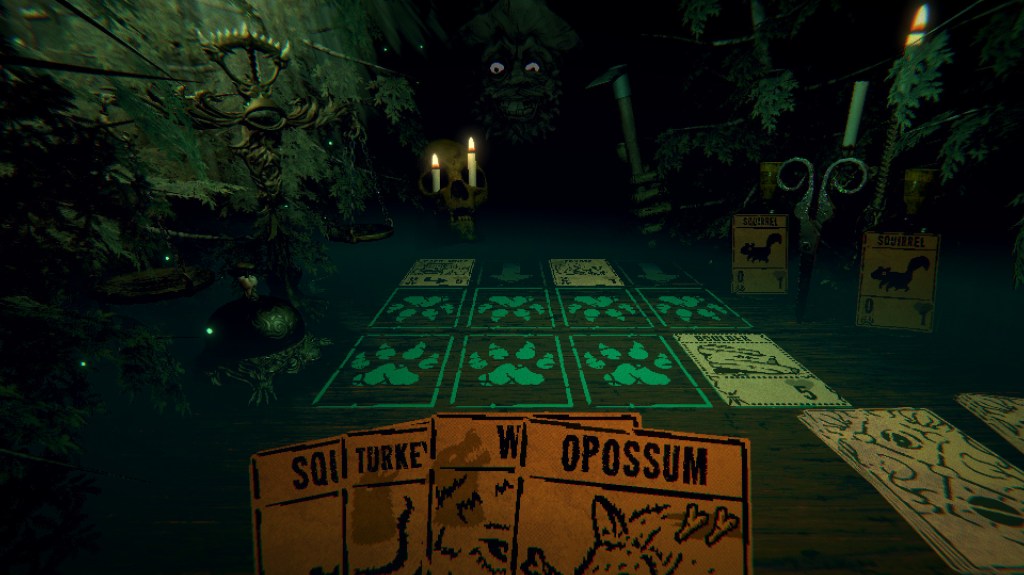
In every act of the Inscryption, you will be playing some variation of the titular card game. The card game itself starts remarkably simple. Whoever deals five damage more than their opponent first, wins the game. Cards have the basic stats like attack and defense, as well as special abilities. It’s all straightforward and easily understood by anyone vaguely familiar with trading-card-games. While I appreciate that the game starts simple and gradually gets more complex, I also think that it is almost too easy to find the winning strategies that almost guarantee success.
You sit across from a mysterious and deranged figure, who sets up tabletop adventure in which you traverse encounter to encounter playing cards. As you defeat his scenarios, you are also given the opportunity to improve your deck. Gaining new cards, adding stats to existing cards, combining cards of the same type, or sacrificing a card to give its ability to another card are some options that you may encounter.

Once I understood the basics of the game, I found it a bit repetitive. It’s pretty easy to leverage events to power-up a single card or two that let you win each round almost immediately. The central card game is just too simple. I never felt like I was building a coherent deck that relied on a synergistic strategy. Instead, I almost always found myself making use of totems to boost the ubiquitous Squirrel card, as it was needed as the foundation to summoning any other creature. After that, I just needed to stall until I drew one of my boosted cards to wreak havoc.
The game was designed this way on purpose, you unlock powerful boosts, items, and cards after playing a few rounds. It becomes difficult to lose without a blundering horribly. The game was intentionally made easy so the player can progress the story. But when the central mechanic is playing cards, and I master the card game after only completing 25% of the game, the following 75% can get a bit dull. The game does mix up the decks periodically throughout the course of the experience, which is a welcome change to keep things fresh.
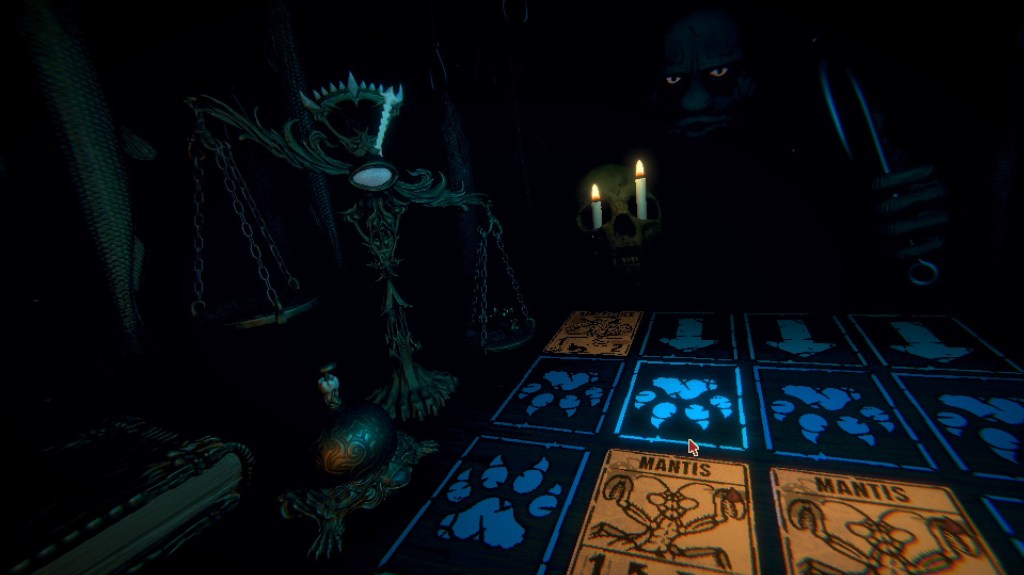
While I found the card game itself to be a little too simple, there is more to Inscryption than playing cards. You can explore the claustrophobic and dingy cabin, interacting with objects in hope that they will help you escape. This was the strongest aspect of Inscryption. The atmosphere and anxiety of playing cards when you are trapped. Every draw, every move, every decision brings you closer to being a victim. Your only hope is to use the cabin’s secrets to your advantage.
The card game pairs well with the atmosphere. It’s designed to be tense, to be played on a knife’s edge. The metallic tinker on the scale as you take damage is chilling feedback that you are a single mistake away from having your candle blown out. The nature of sacrificing cards to summon more powerful ones means you are always careful about what cards you are playing, as momentum plays a pivotal role in keeping your side of the board healthy. In the most desperate of situations you can utilize items, many of which have horrifying implications. Even though I knew it was just a game, I always felt a sense of revulsion whenever I used a pair of pliers to rip out a tooth to add a point of damage to the scale.
Inscryption is cloaked in layers upon layers of metafictional storytelling and genre switching. The nature of the game slowly reveals itself as the player progresses. In an effort to remain spoiler free, I will not delve deep into this aspect of Inscryption. I enjoyed going down the rabbit hole of Inscryption and revealing the deep dark conspiracies within.
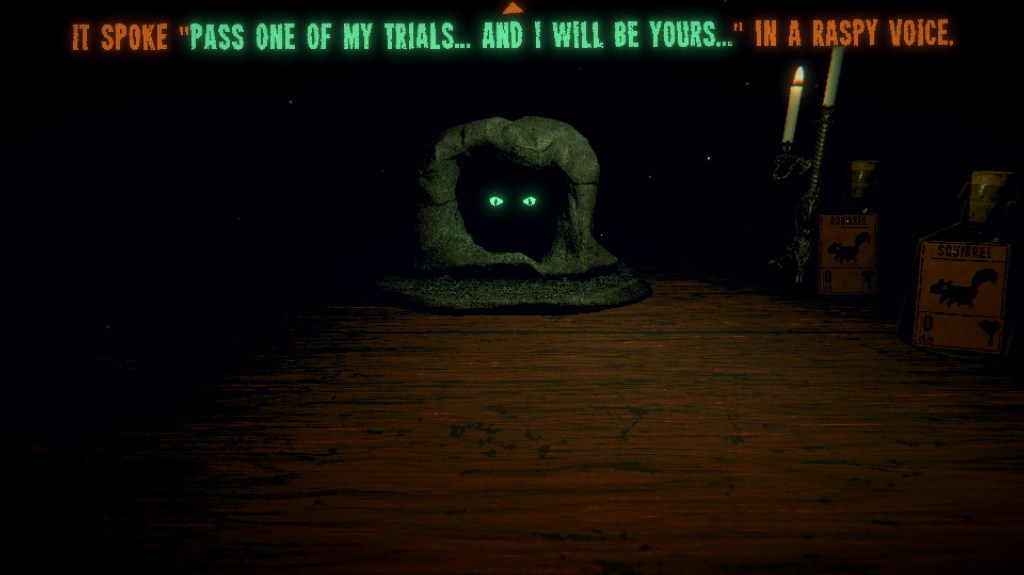
Uniqueness is becoming more and more of a virtue as I play games. The ability for a game to be different. To be weird. To experiment. Inscryption is that kind of game. It may not have the best deck-building or card game mechanics, but the context around that simple card game is what breathes life into Inscryption. It is for these reasons I give Inscryption an 8.5/10. If you are even vaguely interested in Inscryption, don’t read or watch any more about it and play it for yourself.
 stephensopinions